

A Review of the Pharmacological Properties of Insulin Degludec and Their Clinical Relevance
Open accessThe DOI matches its Crossref record; 57 of the 57 references it cites were found in a registry or an index; 66 of the 168 sources its claims cite were checked for support.
Abstract
Data show that insulin degludec has a half-life of >25 h and reaches steady state within 3 days of administration. The pharmacokinetic profile demonstrates an even distribution of exposure across one dosing interval.
Overview
CoChat Summary
## TL;DR
This review summarizes pharmacological studies of insulin degludec (IDeg) and argues that its ultra-long, flat profile and lower day-to-day variability may translate into more flexible dosing and less hypoglycaemia. The paper reports a half-life of >25 h, steady state within 3 days, duration of action beyond 42 h, and four-times lower within-subject variability than insulin glargine.
## Key findings
- IDeg forms multi-hexamers after subcutaneous injection, creating a soluble depot from which insulin is slowly and continuously absorbed; in contrast, insulin glargine forms microprecipitates that must re-dissolve before absorption.
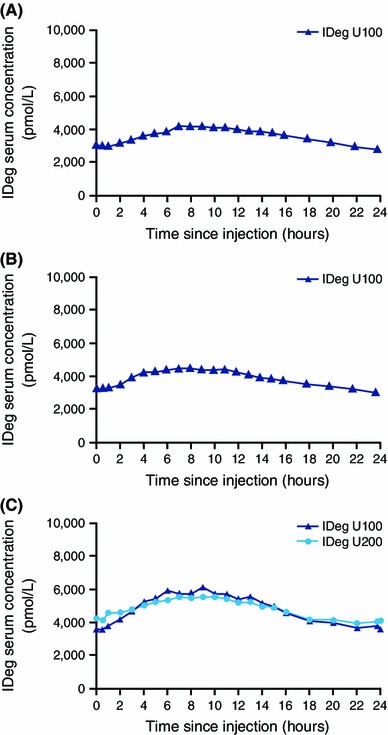
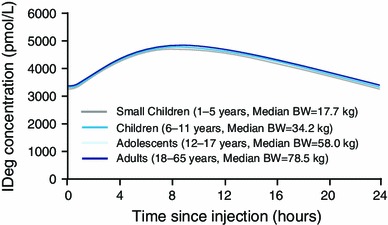
- In pharmacokinetic studies, IDeg reached clinical steady state within 3 days, had a half-life of >25 h, and showed evenly distributed exposure across a 24 h dosing interval.
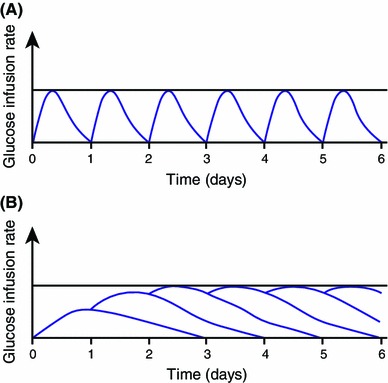
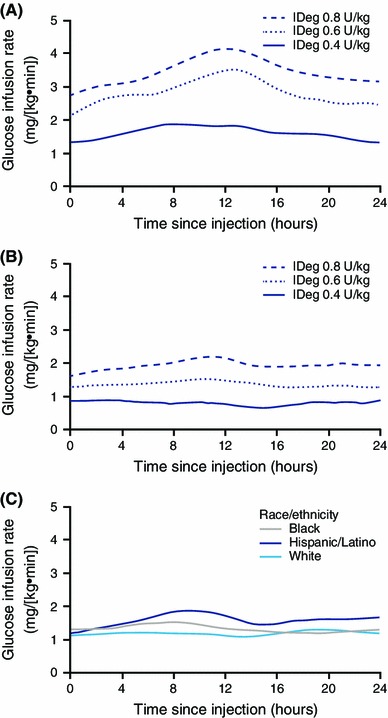
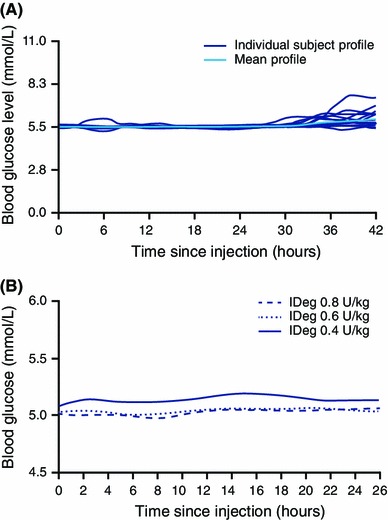
- In pharmacodynamic studies, IDeg had a flat, stable glucose-lowering effect across 24 h and an ultra-long duration of action exceeding 42 h in subjects with type 1 diabetes; in type 2 diabetes, duration of action was beyond 26 h.
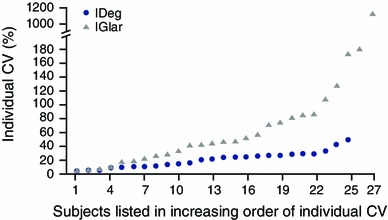
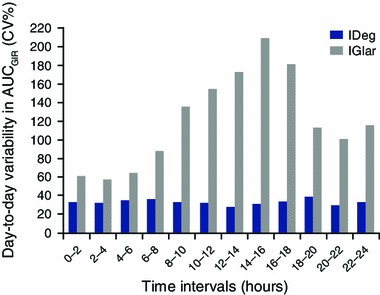
- In a randomized double-blind crossover trial in type 1 diabetes, within-subject variability in glucose-lowering effect was four-times lower with IDeg than with insulin glargine (CV 20% vs 82%; p < 0.0001), and the projected risk of more than double the usual maximum effect was <0.1% for IDeg vs 11% for glargine.
## Methods
- Narrative review of pharmacokinetic and pharmacodynamic studies of IDeg, drawing on multiple clinical trials and phase III data; the paper states the BEGIN clinical trial programme included over 11,000 patients in more than 40 countries.
- Across studies, data collection was standardized: blood sampling for pharmacokinetic endpoints and euglycaemic clamp procedures for pharmacodynamic endpoints, with mostly steady-state designs and limited study centers to reduce variability.
- Main analyses included concentration–time profiles, glucose infusion rate outcomes from clamp studies, linear mixed models on log-transformed pharmacodynamic endpoints, and comparisons/meta-analysis versus insulin glargine.
## Limitations
- The paper states that most studies used steady-state conditions, but some special-population studies used single-dose designs and simulated steady-state profiles instead, which may limit direct comparability across all settings.
- The review notes that IDeg had not yet been approved in the USA at the time, and that cardiovascular safety concerns from FDA review were still being addressed in an ongoing outcomes trial (DEVOTE); this indicates the clinical safety picture was still incomplete.
- Evident from the text: this is a review article summarizing published studies rather than a new primary study, so its conclusions depend on the design and populations of the underlying trials.
Model-written summary. Check it against the paper before relying on it.
Integrity signals
Registry
Cites
Statistics
Figures
![Fig. 2 Mechanism of protraction of insulin degludec (IDeg) and visualisation of IDeg using electron microscopy. a Schematic representation of the formation of IDeg multi-hexamers in the subcutaneous depot from di-hexamers in the pharmaceutical formulation [adapted from Jonassen et al. [16] (Fig. 5, p. 2,112), with kind permission from Springer Science + Business Media). b A transmission electron microscope image showing the effect of phenol on IDeg multi-hexamer linkage—the figure depicts elongated IDeg structures in the absence of phenol; the scale bar represents 200 nm (adapted and reprinted with permission from Steensgaard et al. [18]; Copyright 2014 American Chemical Society)](https://figures.cochat.ai/paper-figures/b25b4ee8a5934bb3bbbc5177ca1e7c78/a-review-of-the-pharmacological-properties-of-insulin-degludec-and-their-figure-2.jpg)
Verification
Claims the paper makes
47 Valid · 2 Not valid · 58 Not checked · 26 Own results and interpretations
The cited sources support only part of this claim — read each source’s verdict below.
In the paper
“Upon diffusion of phenol following injection, the IDeg di-hexamers open at both ends and lead to the formation of multi-hexamers [16].”
§ A Review of the Pharmacological Properties of Insulin Degludec and Their Clinical Relevance > Mechanism of Protraction of Insulin Degludec (IDeg)
What the sources say
- Partly supportedcites [16] Jonassen I Havelund S Hoeg-Jensen T Design of the novel protraction mechanism of insulin degludec, an ultra-long-acting basal insulin Pharm Res. 2012 29 2104 2114 10.1007/s11095-012-0739-z 22485010 PMC3399081 sourceExperimental — accuracy not yet measured
The Discussion says that, after injection, phenol diffuses away and insulin degludec dihexamers reorganise into multihexamer chains. It also proposes that the T6 hexamer opens at both poles, allowing chains to form, but explicitly calls this detailed mechanism a plausible hypothesis rather than an established fact. (LLM, conf=0.86)
plainstates a cause- Asserted: passes — The authors put it forward as true.
- Checkable: passes — It can be checked against evidence.
- Load-bearing: passes — The paper’s conclusions depend on it.
- Based: passes — The paper gives a reason why it holds.
- Partly supported
Every source the paper cites for this claim was checked and supports it.
In the paper
“The protein sequence of IDeg was based on human insulin, modified by acylating DesB30 at the ε-amino group of LysB29 with hexadecandioic acid via a γ-l-glutamic acid linker [16].”
§ A Review of the Pharmacological Properties of Insulin Degludec and Their Clinical Relevance > Mechanism of Protraction of Insulin Degludec (IDeg)
What the sources say
- Supportedcites [16] Jonassen I Havelund S Hoeg-Jensen T Design of the novel protraction mechanism of insulin degludec, an ultra-long-acting basal insulin Pharm Res. 2012 29 2104 2114 10.1007/s11095-012-0739-z 22485010 PMC3399081 source
The Introduction (Fig. 1 caption) states that insulin degludec is desB30 human insulin acylated at the ε-amino group of LysB29 with hexadecandioic acid via a γ-L-glutamic acid linker. This matches the attributed structural description. (LLM, conf=0.95)
plain- Asserted: passes — The authors put it forward as true.
- Checkable: passes — It can be checked against evidence.
- Load-bearing: passes — The paper’s conclusions depend on it.
- Based: passes — The paper gives a reason why it holds.
- Supported
The cited sources support only part of this claim — read each source’s verdict below.
In the paper
“In the pharmaceutical formulation, i.e. in the presence of phenol and zinc, the IDeg hexamers adopt a conformation where only one of the ends is available to interact with the side chain of another IDeg hexamer and thus forms stable di-hexamers.”
§ A Review of the Pharmacological Properties of Insulin Degludec and Their Clinical Relevance > Mechanism of Protraction of Insulin Degludec (IDeg)
What the sources say
- Partly supportedcites [16] Jonassen I Havelund S Hoeg-Jensen T Design of the novel protraction mechanism of insulin degludec, an ultra-long-acting basal insulin Pharm Res. 2012 29 2104 2114 10.1007/s11095-012-0739-z 22485010 PMC3399081 sourceExperimental — accuracy not yet measured
The Discussion says insulin degludec forms stable T3R3 dihexamers in pharmaceutical formulation and that a T3R3 hexamer is open at only one pole. It presents the proposed side-chain interaction between hexamers as a plausible, speculative mechanism, whereas the citing sentence states that interaction as fact. (LLM, conf=0.85)
plainstates a cause- Asserted: passes — The authors put it forward as true.
- Checkable: passes — It can be checked against evidence.
- Load-bearing: passes — The paper’s conclusions depend on it.
- Based: passes — The paper gives a reason why it holds.
- Partly supported
The cited sources support only part of this claim — read each source’s verdict below.
In the paper
“With the gradual diffusion of zinc from the ends of the multi-hexamers, terminal IDeg monomers slowly and steadily dissociate, resulting in a slow and gradual delivery of IDeg from the SC injection site into the circulation [16].”
§ A Review of the Pharmacological Properties of Insulin Degludec and Their Clinical Relevance > Mechanism of Protraction of Insulin Degludec (IDeg)
What the sources say
- Partly supportedcites [16] Jonassen I Havelund S Hoeg-Jensen T Design of the novel protraction mechanism of insulin degludec, an ultra-long-acting basal insulin Pharm Res. 2012 29 2104 2114 10.1007/s11095-012-0739-z 22485010 PMC3399081 sourceExperimental — accuracy not yet measured
The Discussion and Fig. 5 describe zinc diffusion leading to breakdown of multihexamer chains and release of absorbable monomers from their terminal ends. But the paper calls this a proposed mechanism and says further studies are needed to establish its kinetics in vivo; the citing sentence presents it as established. (LLM, conf=0.88)
plainstates a cause- Asserted: passes — The authors put it forward as true.
- Checkable: passes — It can be checked against evidence.
- Load-bearing: passes — The paper’s conclusions depend on it.
- Based: passes — The paper gives a reason why it holds.
- Partly supported
Every source the paper cites for this claim was checked and supports it.
In the paper
“The pharmacodynamic properties of IDeg are preserved in subjects with T2DM with different race/ethnic backgrounds, as shown in Fig. 4c [25].”
§ A Review of the Pharmacological Properties of Insulin Degludec and Their Clinical Relevance > Pharmacodynamic Characteristics of IDeg > Pharmacodynamic Profiles
What the sources say
- Supportedcites [25] Hompesch M Morrow L Watkins E Pharmacokinetic and pharmacodynamic responses of insulin degludec in African American, White, and Hispanic/Latino patients with type 2 diabetes mellitus Clin Ther. 2014 36 507 515 10.1016/j.clinthera.2013.12.014 24508419 source
The Discussion states that IDeg’s glucose-lowering effect was flat and stable across the 24-hour dosing interval irrespective of race/ethnicity, and that its pharmacodynamic properties were preserved across the groups studied. The Conclusion likewise reports similar responses in African American, Hispanic/Latino, and white patients with T2DM. (LLM, conf=0.94)
plain- Asserted: passes — The authors put it forward as true.
- Checkable: passes — It can be checked against evidence.
- Load-bearing: unclear — It is unclear whether the paper’s conclusions depend on it.
- Based: passes — The paper gives a reason why it holds.
- Supported
76 more claims · 26 with their cited sources checked
Create a free account to see all 133 claims and to verify the 21 references still open.
- It may state two separate claims as one. 38
- Probably not a substantial claim. 17
Citations
Cites
Summary of product characteristics
(2013) · Pharmaceutical Medicine · doi:10.1093/med/9780199609147.003.0027 · Cited by 1,905
Lepore, M., Pampanelli, S., Fanelli, C., Porcellati, F., Bartocci, L., Di Vincenzo, A., Cordoni, C., Costa, E., Brunetti, P., & Bolli, G. B. (2000) · Diabetes · doi:10.2337/diabetes.49.12.2142 · Cited by 818
Peyrot, M., Barnett, A. H., Meneghini, L. F., & Schumm‐Draeger, P. ‐. (2012) · Diabetic Medicine · doi:10.1111/j.1464-5491.2012.03605.x · Cited by 655 · cited 2×
“Similar to all insulin analogues, the risk of hypoglycaemia is a major safety concern, and is considered a key obstacle in regulating blood glucose levels by both patients and physicians [10, 57].”
BackgroundHeise, T., Nosek, L., Rønn, B. B., Endahl, L., Heinemann, L., Kapitza, C., & Draeger, E. (2004) · Diabetes · doi:10.2337/diabetes.53.6.1614 · Cited by 614 · cited 1×
“of hypoglycaemia [11, 12].”
Self-citationPsychological Insulin Resistance in Patients With Type 2 Diabetes
Polonsky, W. H., Fisher, L., Guzman, S., Villa-Caballero, L., & Edelman, S. V. (2005) · Diabetes Care · doi:10.2337/diacare.28.10.2543 · Cited by 551 · cited 1×
“However, this can be perceived as restrictive to patient lifestyle and can create a barrier towards the use of basal insulin therapy [9, 10].”
BackgroundDesign of the Novel Protraction Mechanism of Insulin Degludec, an Ultra-long-Acting Basal Insulin
Jonassen, I., Havelund, S., Hoeg-Jensen, T., Steensgaard, D. B., Wahlund, P.-O., & Ribel, U. (2012) · Pharmaceutical Research · doi:10.1007/s11095-012-0739-z · Cited by 448 · cited 6×
“Insulin degludec (IDeg) is a new-generation basal insulin with an ultra-long duration of action developed for once-daily administration [15, 16], which has been designed to address the unmet needs in terms of basal insulin therapy outlined above.”
BackgroundMethodResultInfluentialHeller, S., Buse, J., Fisher, M., Garg, S., Marre, M., Merker, L., Renard, E., Russell-Jones, D., Philotheou, A., Francisco, A. M. O., et al. (2012) · The Lancet · doi:10.1016/s0140-6736(12)60204-9 · Cited by 402
Heise, T., Hermanski, L., Nosek, L., Feldman, A., Rasmussen, S., & Haahr, H. (2012) · Diabetes, Obesity and Metabolism · doi:10.1111/j.1463-1326.2012.01627.x · Cited by 397 · cited 9×
“formed by means of a Biostator (MTB Medizintechnik, Amstetten, Germany) [21, 22] or using a manual clamp, as described previously [20].”
BackgroundMethodInfluentialSelf-citationClinical pharmacokinetics and phamacodynamics: concepts and applications
Rowland, M., & Tozer, T. N. (2011) · Cited by 367
Ratner, R. E., Gough, S. C. L., Mathieu, C., Del Prato, S., Bode, B., Mersebach, H., Endahl, L., & Zinman, B. (2013) · Diabetes, Obesity and Metabolism · doi:10.1111/dom.12032 · Cited by 346 · cited 3×
“This rationale is furthered supported by the reduction in rates of hypoglycaemia, in particular nocturnal hypoglycaemia episodes, being more prominent with IDeg than with IGlar during the maintenance phase—described as the period (from 16 weeks to end of treatment) when stable glycaemic control and insulin dose have b…”
BackgroundInfluential
Research works printed but not linked: 5
- Dhatariya K Yeong J Improved glycaemic controls for patients on twice daily dosing regime of insulin glargine compared to those on a once daily dosing regime Diabetologia. 2010 53 suppl 1 S390
- Kurtzhals P Heise T Strauss HM Multi-hexamer formation is the underlying basis for the ultra-long glucose-lowering effect of insulin degludec Diabetologia. 2011 54 suppl 1 S426
- Haahr H Ikushima I Hirao K Similar pharmacokinetic and pharmacodynamic properties of insulin degludec in Japanese and Caucasian subjects with T1DM [abstract no. PCS-16-6] J Diabetes Investig 2012 3 suppl s1 197 PMC4773674 27042281
- Leiter L Yale JF Chaisson JL Assessment of the impact of fear of hypoglycemic episodes on hypoglycemia management and glucose control management Can J Diabetes. 2005 29 186 192
- Oyer DS Heller S Gough SCL Exercise-related hypoglycaemia occurs at similar frequency with insulin degludec and insulin glargine [abstract] Diabetologia. 2013 56 suppl 1 S84
Cited by
Glycaemic variability in diabetes: clinical and therapeutic implications
Ceriello, A., Monnier, L., & Owens, D. (2019) · The Lancet Diabetes & Endocrinology · doi:10.1016/s2213-8587(18)30136-0 · Cited by 588
Insulin analogues in type 1 diabetes mellitus: Getting better all the time
Mathieu, C., Gillard, P., & Benhalima, K. (2017) · Nature Reviews Endocrinology · doi:10.1038/nrendo.2017.39 · Cited by 248
Wysham, C., Bhargava, A., Chaykin, L., de la Rosa, R., Handelsman, Y., Troelsen, L. N., Kvist, K., & Norwood, P. (2017) · JAMA · doi:10.1001/jama.2017.7117 · Cited by 221
Billings, L. K., Doshi, A., Gouet, D., Oviedo, A., Rodbard, H. W., Tentolouris, N., Grøn, R., Halladin, N., & Jodar, E. (2018) · Diabetes Care · doi:10.2337/dc17-1114 · Cited by 193
“The comparison of different basal insulins may be seen as a limitation as they have different pharmacokinetic properties (25).”
BackgroundPharmacotherapy of type 2 diabetes: An update
Upadhyay, J., Polyzos, S. A., Perakakis, N., Thakkar, B., Paschou, S. A., Katsiki, N., Underwood, P., Park, K.-H., Seufert, J., Kang, E. S., et al. (2018) · Metabolism · doi:10.1016/j.metabol.2017.08.010 · Cited by 187
on behalf of the DEVOTE Study Group, Zinman, B., Marso, S. P., Poulter, N. R., Emerson, S. S., Pieber, T. R., Pratley, R. E., Lange, M., Brown-Frandsen, K., Moses, A., et al. (2018) · Diabetologia · doi:10.1007/s00125-017-4423-z · Cited by 169
“These properties have been demonstrated across different patient populations in several experimental laboratory studies [20, 21].”
BackgroundA review of lipidation in the development of advanced protein and peptide therapeutics
Menacho‐Melgar, R., Decker, J. S., Hennigan, J. N., & Lynch, M. (2018) · Journal of Controlled Release · doi:10.1016/j.jconrel.2018.12.032 · Cited by 171
Derivatization with fatty acids in peptide and protein drug discovery
Kurtzhals, P., Østergaard, S., Nishimura, E., & Kjeldsen, T. (2022) · Nature Reviews Drug Discovery · doi:10.1038/s41573-022-00529-w · Cited by 153
Improving pregnancy outcomes in women with diabetes mellitus: modern management
Ringholm, L., Damm, P., & Mathiesen, E. R. (2019) · Nature Reviews Endocrinology · doi:10.1038/s41574-019-0197-3 · Cited by 143
Heise, T., Nørskov, M., Nosek, L., Kaplan, K., Famulla, S., & Haahr, H. L. (2017) · Diabetes, Obesity and Metabolism · doi:10.1111/dom.12938 · Cited by 118
“ertheless, because of its mechanism of protraction (ie, the formation of microprecipitates) IGlar has the inherent predisposition to pharmacodynamic variability.(2,3) Microscopic precipitation studies have”
BackgroundInfluentialSelf-citationHeise, T., & Mathieu, C. (2017) · Diabetes, Obesity and Metabolism · doi:10.1111/dom.12782 · Cited by 106
“however, the zinc concentration of IDeg U200 has been optimized to increase its bioequivalence to the U100 formulation.(77) An ongoing, randomized, double-blind, multiple-dose, 2-period”
MethodSelf-citationThe competitive athlete with type 1 diabetes
Riddell, M. C., Scott, S. N., Fournier, P. A., Colberg, S. R., Gallen, I. W., Moser, O., Stettler, C., Yardley, J. E., Zaharieva, D. P., Adolfsson, P., et al. (2020) · Diabetologia · doi:10.1007/s00125-020-05183-8 · Cited by 101
Thalange, N., Deeb, L., Iotova, V., Kawamura, T., Klingensmith, G., Philotheou, A., Silverstein, J., Tumini, S., Ocampo Francisco, A., Kinduryte, O., et al. (2015) · Pediatric Diabetes · doi:10.1111/pedi.12263 · Cited by 91
“Pharmacokinetic data have shown that IDeg has a terminal half-life of approximately 25 h, twice that of IGlar, and a duration of action of more than 42 h (18).”
BackgroundPhoto-induced radical thiol–ene chemistry: a versatile toolbox for peptide-based drug design
Ahangarpour, M., Kavianinia, I., Harris, P. W. R., & Brimble, M. A. (2021) · Chemical Society Reviews · doi:10.1039/d0cs00354a · Cited by 93
Rosenstock, J., Juneja, R., Beals, J. M., Moyers, J. S., Ilag, L. L., & McCrimmon, R. J. (2024) · Endocrine Reviews · doi:10.1210/endrev/bnad037 · Cited by 93
“Furthermore, as the half-life of the basal insulin is prolonged, the P/T ratio can be reduced by enabling therapeutic accumulation (9, 85).”
A deep learning approach to adherence detection for type 2 diabetics
Mohebbi, A., Aradóttir, T. B., Johansen, A. R., Bengtsson, H. L., Fraccaro, M., & Mørup, M. (2017) · Annual International Conference of the IEEE Engineering in Medicine and Biology Society (EMBC) · doi:10.1109/embc.2017.8037462 · Cited by 84
“between T1D and T2D patients seen in clinical trials [12], [13].”
BackgroundMethodMarso, S. P., McGuire, D. K., Zinman, B., Poulter, N. R., Emerson, S. S., Pieber, T. R., Pratley, R. E., Haahr, P.-M., Lange, M., Frandsen, K. B., et al. (2016) · American Heart Journal · doi:10.1016/j.ahj.2016.06.004 · Cited by 65
“monomers dissociate slowly from the subcutaneous space and diffuse into the circulation, yielding a duration of action of approximately 40 hours.(11) In several phase 3 clinical trials, IDeg was noninferior to insulin comparators in reducing HbA1c in insulin-naïve T2D, insulin-treated T2D, and type 1 diabetes patients.”
BackgroundRecent Advances in Half-life Extension Strategies for Therapeutic Peptides and Proteins
Tan, H., Su, W., Zhang, W., Wang, P., Sattler, M., & Zou, P. (2019) · Current Pharmaceutical Design · doi:10.2174/1381612825666190206105232 · Cited by 65
Insulin analogs: Glimpse on contemporary facts and future prospective
Sharma, A. K., Taneja, G., Kumar, A. R., Sahu, M., Sharma, G., Kumar, A., Sardana, S., & Deep, A. (2019) · Life Sciences · doi:10.1016/j.lfs.2019.01.011 · Cited by 61
“Some PK/PD investigation reported that IDeg has a half-life of more than 25 h and reaches steady state within 3 days of administration [34].”
BackgroundThe evolution of insulin therapy
Home, P. (2021) · Diabetes Research and Clinical Practice · doi:10.1016/j.diabres.2021.108816 · Cited by 56
Commemorating insulin's centennial: engineering insulin pharmacology towards physiology
Kurtzhals, P., Nishimura, E., Haahr, H. L., Høeg-Jensen, T., Johansson, E., Madsen, P., Sturis, J., & Kjeldsen, T. (2021) · Trends in Pharmacological Sciences · doi:10.1016/j.tips.2021.05.005 · Cited by 56
Self-citationRodbard, H. W., Cariou, B., Pieber, T. R., Endahl, L. A., Zacho, J., & Cooper, J. G. (2016) · Diabetes Obesity and Metabolism · doi:10.1111/dom.12609 · Cited by 49
“Insulin degludec (IDeg) is a new-generation basal insulin with a duration of action that exceeds 42 h [18].”
BackgroundHaahr, H. L., Fita, E. G., & Heise, T. (2016) · Clinical Pharmacokinetics · doi:10.1007/s40262-016-0455-7 · Cited by 49
“The reader is referred to review articles on the pharmacokinetic properties of the separate IDeg and IAsp products [57, 58].”
BackgroundSelf-citationHeise, T., Korsatko, S., Nosek, L., Coester, H. V., Deller, S., Roepstorff, C., Segel, S., Kapur, R., Haahr, H. L., & Hompesch, M. (2015) · Journal of Diabetes · doi:10.1111/1753-0407.12266 · Cited by 48
“This mechanism of prolonged and stable absorption leads to a half-life of ∼25 h, twice that of insulin glargine,(10) a flat and consistent glucose-lowering effect,(11) and an ultralong duration of action of >42 h.(9,12) Various factors can influence the pharmacokinetic and pharmacodynamic properties of insulins and th…”
BackgroundSelf-citationMull, R. W., Harrington, A., Sanchez, L. A., & Tal-Gan, Y. (2018) · Current Topics in Medicinal Chemistry · doi:10.2174/1568026618666180518090705 · Cited by 41
Pan, C., Gross, J. L., Yang, W., Lv, X., Sun, L., Hansen, C. T., Xu, H., & Wagner, R. (2016) · Drugs in R&D · doi:10.1007/s40268-016-0134-z · Cited by 40
“Unfortunately, most current basal insulin analogs do not allow glycemic control over a full 24-h period, and are often limited by their day-to-day variability and thereby a potentially higher risk of hypoglycemia [7].”
BackgroundHeise, T., Kaplan, K., & Haahr, H. L. (2018) · Journal of Diabetes Science and Technology · doi:10.1177/1932296817731422 · Cited by 40
Self-citationGoldman, J., Kapitza, C., Pettus, J., & Heise, T. (2017) · Current Medical Research and Opinion · doi:10.1080/03007995.2017.1335192 · Cited by 38
“The duration of action, defined as the time from administration until blood glucose levels were consistently above 150 mg/dL, was shown to exceed 26 hours (in patients with T2D) and 42 hours in patients with T1D, making it suitable for once-daily dosing [76, 77].”
BackgroundMethodSelf-citationGlycemic variability and mortality in patients hospitalized in general surgery wards
Akirov, A., Shochat, T., Dotan, I., Diker‐Cohen, T., Gorshtein, A., & Shimon, I. (2019) · Surgery · doi:10.1016/j.surg.2019.02.022 · Cited by 41
Conner, K. P., Devanaboyina, S. C., Thomas, V. A., & Rock, D. A. (2020) · Pharmacology & Therapeutics · doi:10.1016/j.pharmthera.2020.107574 · Cited by 41
Insulin degludec/liraglutide (IDegLira) for the treatment of type 2 diabetes
Gough, S. C. L., Jain, R., & Woo, V. C. (2015) · Expert Review of Endocrinology & Metabolism · doi:10.1586/17446651.2016.1113129 · Cited by 40
“[37,38] Within-patient variability of glucose-lowering action can influence the effectiveness of an insulin and can increase hypoglycemia.”
BackgroundOwens, D. R. (2016) · Expert Opinion on Drug Metabolism & Toxicology · doi:10.1080/17425255.2016.1202916 · Cited by 36
“The development of new longer acting insulin analogs has allowed for reduction in the peak-to-trough ratio coupled with a more prolonged and more consistent insulin coverage beyond 24 h, thus enabling glycemic targets to be achieved with reduced risk of hypoglycemia [7].”
BackgroundDegludec: the new ultra-long insulin analogue
Tambascia, M. A., & Eliaschewitz, F. G. (2015) · Diabetology & Metabolic Syndrome · doi:10.1186/s13098-015-0037-0 · Cited by 41
“Thus, hepatic and renal impairment do not significantly interfere with the PK properties of these insulin analogues [23].”
BackgroundTrends in Therapeutic Conjugates: Bench to Clinic
Rudra, A., Li, J., Shakur, R., Bhagchandani, S. H., & Langer, R. (2020) · Bioconjugate Chemistry · doi:10.1021/acs.bioconjchem.9b00828 · Cited by 37
Evans, M., Chubb, B., & Gundgaard, J. (2017) · Diabetes Therapy · doi:10.1007/s13300-017-0236-9 · Cited by 35
“and stable action profile [10, 11], and lower variability over the day than IGlar U100 [12],”
BackgroundA review of the new GLP-1 receptor agonist/basal insulin fixed-ratio combination products
Nuffer, W. A., Guesnier, A., & Trujillo, J. M. (2018) · Therapeutic Advances in Endocrinology and Metabolism · doi:10.1177/2042018817752315 · Cited by 36
Concentrated insulins in current clinical practice
Schloot, N. C., Hood, R. C., Corrigan, S. M., Panek, R. L., & Heise, T. (2018) · Diabetes Research and Clinical Practice · doi:10.1016/j.diabres.2018.12.007 · Cited by 35
Self-citationFactors Influencing Insulin Absorption Around Exercise in Type 1 Diabetes
Pitt, J. P., McCarthy, O. M., Høeg-Jensen, T., Wellman, B., & Bracken, R. M. (2020) · Frontiers in Endocrinology · doi:10.3389/fendo.2020.573275 · Cited by 38
Yamabe, M., Kuroda, M., Hirosawa, Y., Kamino, H., Ohno, H., & Yoneda, M. (2019) · Journal of Diabetes Investigation · doi:10.1111/jdi.12894 · Cited by 29
Metabolism of bioconjugate therapeutics: why, when, and how?
Liu, H., Bolleddula, J., Nichols, A. J., Tang, L., Zhao, Z., & Prakash, C. (2020) · Drug Metabolism Reviews · doi:10.1080/03602532.2020.1716784 · Cited by 32
“…systemic circulation, prolonged duration of action, and lower day-today within-subject variability in their glucose-lowering effect (Hashimoto et al. 1989; Myers et al. 1997; Jones and Patel 2006; Malm-Erjef€alt et al. 2010; Pandyarajan and Weiss 2012; Sanlioglu et al. 2013; Haahr and Heise 2014).”
BackgroundA Comprehensive Review of the Evolution of Insulin Development and Its Delivery Method
Sugumar, V., Ang, K. P., Al-Shanon, A. F., Sethi, G., Yong, P. V. C., Looi, C. Y., & Wong, W. F. (2022) · Pharmaceutics · doi:10.3390/pharmaceutics14071406 · Cited by 37
“Degludec is another novel type of basal insulin analog with ultra-long duration [72].”
BackgroundOptimal Glycaemic Control in Elderly People with Type 2 Diabetes: What Does the Evidence Say?
Mathur, S., Zammitt, N. N., & Frier, B. M. (2014) · Drug Safety · doi:10.1007/s40264-014-0247-7 · Cited by 30
Christiansen, J. S., Niskanen, L., Rasmussen, S., Johansen, T., & Fulcher, G. (2016) · Journal of Diabetes · doi:10.1111/1753-0407.12355 · Cited by 26
“maintained and clearly separated from the flat basal glucose-lowering effects in participants with T1D, indicating that no stacking should be observed with IDegAsp when dosed twice daily.(10)”
BackgroundAso, Y., Suzuki, K., Chiba, Y., Sato, M., Fujita, N., Takada, Y., Murano, S., & Kuroda, H. (2017) · Diabetes Research and Clinical Practice · doi:10.1016/j.diabres.2017.06.007 · Cited by 29
“The smaller day-to-day variability of the glucose lowering effect of IDeg may be associated with its more consistent pharmacokinetic and pharmacodynamic profile (14).”
BackgroundPratley, R. E., Husain, M., Lingvay, I., Pieber, T. R., Mark, T., Saevereid, H. A., Møller, D. V., Zinman, B., & the DEVOTE Study Group (2019) · Cardiovascular Diabetology · doi:10.1186/s12933-019-0960-8 · Cited by 25
Miura, H., Sakaguchi, K., Otowa‐Suematsu, N., Yamada, T., So, A., Komada, H., Okada, Y., Hirota, Y., Tamori, Y., & Ogawa, W. (2020) · Diabetes, Obesity and Metabolism · doi:10.1111/dom.14161 · Cited by 25
“Instead, we restricted data collection to the final week of each 1-month treatment period, which probably minimized the carryover effects of the previously administered formulation, given that the t1/2 of IDeg and IGlarU300 was found to be 25 and 19 hours, respectively.(35,36) Indeed, we found no interaction effects b…”
MethodJeon, H., Lee, A.-J., & Ha, K. (2022) · BioChip Journal · doi:10.1007/s13206-022-00057-0 · Cited by 26
“Insulin determir and insulin degludec are prepared by acylation of insulin with the long-chain fatty acids as myristic acid and hexadecanoic acid, respectively, which extended plasma circulation of insulin through non-covalent albumin binding [93, 94].”
BackgroundHaak, T., Fritsche, A., Füchtenbusch, M., Gehr, B., Gölz, S., Kröger, J., Siegmund, T., Ziegler, R., Droßel, D., Fuchs, S., et al. (2019) · Experimental and Clinical Endocrinology & Diabetes · doi:10.1055/a-0984-5696 · Cited by 29
Bottinelli, C., Cartiser, N., Bévalot, F., Fanton, L., & Guitton, J. (2020) · Critical Reviews in Toxicology · doi:10.1080/10408444.2020.1762540 · Cited by 28
Battelino, T., Bosnyak, Z., Danne, T., Mukherjee, B., Edelman, S., Pilorget, V., Choudhary, P., Renard, E., & Bergenstal, R. (2020) · Diabetes Therapy · doi:10.1007/s13300-020-00781-6 · Cited by 23
Heise, T., Nosek, L., Klein, O., Coester, H. V., Svendsen, A. L., & Haahr, H. L. (2015) · Diabetes Obesity and Metabolism · doi:10.1111/dom.12463 · Cited by 23
“Furthermore, because IDeg behaves similarly in IDegAsp as when administered alone, key properties of IDeg (such as low within-participant variability in glucose-lowering effect across the day and from day-to-day [8]) are expected to be maintained in IDegAsp.”
BackgroundSelf-citationMauricio, D., & HRAMIAK, I. M. (2018) · touchREVIEWS in Endocrinology · doi:10.17925/ee.2018.14supp1.2 · Cited by 27
“Similarly, IDeg has demonstrated activity for up to 42 hours with four times lower dayto-day within-patient variability in glucose reduction compared with Gla-100.(20) A comparison of the steady state PK/PD profiles of Gla300 and IDeg revealed that Gla-300 provided 20% less within-day fluctuation of metabolic activity…”
ResultHolmes, R. S., Crabtree, E. A., & McDonagh, M. S. (2019) · Diabetes Obesity and Metabolism · doi:10.1111/dom.13614 · Cited by 24
“Glargine and degludec are approved for use once daily, and detemir for use once or twice daily.(1,3) We conducted a systematic review to compare the benefits and”
BackgroundSofrà, D. (2017) · Diabetes Therapy · doi:10.1007/s13300-017-0234-y · Cited by 23
“Insulin degludec is a basal insulin with an ultra-long duration of action and a flat pharmacodynamic profile [3, 4], and is associated with a lower risk of hypoglycemia than insulin glargine U100 [5, 6].”
BackgroundKeller, M. F., Vestgaard, M. J., Damm, P., Mathiesen, E. R., & Ringholm, L. (2019) · Diabetes Research and Clinical Practice · doi:10.1016/j.diabres.2019.05.004 · Cited by 25
Injectable systems for long-lasting insulin therapy
Niloy, K. K., & Lowe, T. L. (2023) · Advanced Drug Delivery Reviews · doi:10.1016/j.addr.2023.115121 · Cited by 25
Making a Case for Albumin – a Highly Promising Drug-Delivery System
Merlot, A. M., Kalinowski, D. S., Kovačević, Ž., Jansson, P. J., Lane, D. J. R., Huang, M., Sahni, S., & Richardson, D. R. (2015) · Future Medicinal Chemistry · doi:10.4155/fmc.15.15 · Cited by 24
Harris, S. B., Abrahamson, M. J., Ceriello, A., Charpentier, G., Evans, M., Lehmann, R., Liebl, A., Linjawi, S., Holt, R. I. G., Hosszúfalusi, N., et al. (2020) · Drugs · doi:10.1007/s40265-019-01245-3 · Cited by 22
Cheng, A. Y. Y., Wong, J., Freemantle, N., Acharya, S. H., & Ekinci, E. (2020) · Diabetes Therapy · doi:10.1007/s13300-020-00925-8 · Cited by 20
Model for Simulating Fasting Glucose in Type 2 Diabetes and the Effect of Adherence to Treatment
Aradóttir, T. B., Boiroux, D., Bengtsson, H. L., Kildegaard, J., Orden, B. V., & Jørgensen, J. B. (2017) · IFAC-PapersOnLine · doi:10.1016/j.ifacol.2017.08.2527 · Cited by 21
“From results by Haahr and Heise (2014), three hours after injection the maximum GIR of T2D patients is approximately 50% of the maximum GIR of the T1D patients.”
BackgroundMethodMoser, O., Müller, A., Aberer, F., Aziz, F., Kojzar, H., Sourij, C., Obermayer, A. M., Abbas, F. N., Birnbaumer, P., Lenz, J., et al. (2023) · Diabetes Technology & Therapeutics · doi:10.1089/dia.2022.0422 · Cited by 24
Haak, T., Gölz, S., Fritsche, A., Füchtenbusch, M., Siegmund, T., Schnellbächer, E., Klein, H. H., Uebel, T., & Droßel, D. (2019) · Der Diabetologe · doi:10.1007/s11428-019-0458-8 · Cited by 18
Cengiz, E., Danne, T., Ahmad, T., Ayyavoo, A., Beran, D., Codner, E., Ehtisham, S., Jarosz-Chobot, P., Mungai, L. N. W., Ng, S. M., et al. (2025) · Hormone Research in Paediatrics · doi:10.1159/000543169 · Cited by 17
Pollock, R. F., & Tikkanen, C. K. (2016) · Journal of Medical Economics · doi:10.1080/13696998.2016.1245663 · Cited by 20
Insulin Centennial: Milestones influencing the development of insulin preparations since 1922
Owens, D. R., Monnier, L., Ceriello, A., & Bolli, G. B. (2021) · Diabetes Obesity and Metabolism · doi:10.1111/dom.14587 · Cited by 22
Appropriate Titration of Basal Insulin in Type 2 Diabetes and the Potential Role of the Pharmacist
Patel, D. K., Triplitt, C. L., & Trujillo, J. M. (2019) · Advances in Therapy · doi:10.1007/s12325-019-00907-8 · Cited by 17
Pregnancy outcomes in women with type 1 diabetes using insulin degludec
Ringholm, L., Callesen, N., Damm, P., & Mathiesen, E. R. (2022) · Acta Diabetologica · doi:10.1007/s00592-021-01845-0 · Cited by 17
“Insulin degludec is a newer ultra-long-acting insulin analog on the market with a half-life of 25 h, a duration of action exceeding 42 h [9] and documented efficacy and safety outside of pregnancy with improved glycemic control and lower risk of hypoglycemia compared to insulin glargine [10–12].”
BackgroundBiester, T., Danne, T., Bläsig, S., Remus, K., Aschemeier, B., Kordonouri, O., Bardtrum, L., & Haahr, H. L. (2016) · Pediatric Diabetes · doi:10.1111/pedi.12358 · Cited by 15
Self-citationDong, Z.-Y., Feng, J., & Zhang, J. (2022) · Clinical Therapeutics · doi:10.1016/j.clinthera.2022.09.012 · Cited by 20
Cardiovascular effects of basal insulins
Mannucci, E., Giannini, S., & Dicembrini, I. (2015) · Drug Healthcare and Patient Safety · doi:10.2147/dhps.s43300 · Cited by 15
Landstedt‐Hallin, L., Gundgaard, J., Ericsson, Å., & Ellfors-Zetterlund, S. (2017) · Current Medical Research and Opinion · doi:10.1080/03007995.2016.1277194 · Cited by 17
Glastras, S. J., Cohen, N. D., Dover, T., Kilov, G., MacIsaac, R. J., McGill, M. J., & Fulcher, G. (2020) · Journal of Clinical Medicine · doi:10.3390/jcm9041091 · Cited by 17
“The basal component, insulin degludec, exhibits flat and stable steady-state pharmacokinetic and pharmacodynamic profiles in patients with diabetes [25,26].”
BackgroundKobayashi, D., Kuraoka, E., Hayashi, J., Yasuda, T., Kohmura, Y., Denda, M., Harada, N., Inagaki, N., & Otaka, A. (2022) · ACS Medicinal Chemistry Letters · doi:10.1021/acsmedchemlett.2c00161 · Cited by 15
Long-term safety and efficacy of insulin degludec in the management of type 2 diabetes
Kerlan, V., Thuillier, P., & Alavi, Z. (2015) · Diabetes Metabolic Syndrome and Obesity · doi:10.2147/dmso.s54953 · Cited by 15
“The half-life and duration of action of IDeg are 25 hours and 42 hours, IDeg.7 Studies comparing IDeg with other long-acting insulin analogs have confirmed that IDeg has more stable plasma concentrations.8 A pharmacological study by Heise et al showed the intrapatient variability to be four times lower using IDeg than…”
BackgroundInfluentialHurren, K. M., & O’Neill, J. L. (2016) · Expert Opinion on Drug Metabolism & Toxicology · doi:10.1080/17425255.2016.1245722 · Cited by 14
“Gla-100 and detemir have less day-to-day variability in action compared to NPH, and degludec is associated with less variability compared to Gla-100 [6,8].”
BackgroundØstergaard, L., Frandsen, C. S., Dejgaard, T. F., & Madsbad, S. (2017) · Expert Review of Clinical Pharmacology · doi:10.1080/17512433.2017.1313109 · Cited by 14
“Insulin degludec is a long-acting insulin analog with a half-life of approximately 25 h and a duration of action of about 41 h [22,23].”
BackgroundMoser, O., Tschakert, G., Mueller, A., Groeschl, W., Eckstein, M. L., Koehler, G., Bracken, R. M., Pieber, T. R., & Hofmann, P. (2018) · Frontiers in Endocrinology · doi:10.3389/fendo.2018.00585 · Cited by 16
“We have chosen insulin Degludec since its pharmacodynamic profile is flat and stable, demonstrated by an even distribution of glucose-lowering effects across the 24-h period (24).”
BackgroundOda, H., Mori, A., Ishii, S., Shono, S., Onozawa, E., & Sako, T. (2018) · Journal of Veterinary Medical Science · doi:10.1292/jvms.17-0714 · Cited by 14
“In healthy dogs, subcutaneously injected IDeg might be absorbed slowly and it showed a continuous glucose-lowering effect [5].”
BackgroundTosaka, Y., Kanazawa, A., Ikeda, F., Iida, M., Sato, J., Matsumoto, K., Uchida, T., Tamura, Y., Ogihara, T., Mita, T., et al. (2015) · International Journal of Endocrinology · doi:10.1155/2015/176261 · Cited by 12
“In addition, one review showed that the peak of the glucose-lowering effect of insulin degludec appeared about 12 hours after injection [17].”
BackgroundAddition of 20-kDa PEG to Insulin Lispro Alters Absorption and Decreases Clearance in Animals
Knadler, M. P., Nguyen, T., Campanale, K. M., de Veer, M. J., Beals, J. M., Li, S., Hansen, R. J., Siesky, A. M., Michael, M. D., & Porter, C. J. H. (2016) · Pharmaceutical Research · doi:10.1007/s11095-016-2014-1 · Cited by 12
“Alternatively, in the case of insulin degludec, protein absorption has been delayed by the formation of multi-hexamers in the subcutaneous depot from di-hexamers in the pharmaceutical formulation upon diffusion of phenol from the formulation following injection (6).”
BackgroundInfluentialVilsbøll, T., Vora, J. P., Jarlov, H., Kvist, K., & Blonde, L. (2016) · Clinical Drug Investigation · doi:10.1007/s40261-016-0376-0 · Cited by 12
“Insulin degludec provides a flat and stable steady-state basal insulin profile [23], and effectively reduces fasting plasma glucose (FPG) levels [24], while liraglutide benefits both FPG and postprandial plasma glucose (PPG) levels [25].”
BackgroundSegal, A. R., Vootla, T., & Beaser, R. S. (2016) · Endocrinology and Metabolism Clinics of North America · doi:10.1016/j.ecl.2016.06.009 · Cited by 14
Lalic, N. M., Russel-Szymczyk, M., Culic, M., Tikkanen, C. K., & Chubb, B. (2018) · Diabetes Therapy · doi:10.1007/s13300-018-0426-0 · Cited by 14
“In the T2DMB/B clinical trial [14], high insulin doses were observed in both the degludec and glargine U100 treatment arms.”
BackgroundInfluentialChoi, J., Wahlgren, M., Ek, V., Elofsson, U. M., Fransson, J., Nilsson, L., Terry, A. E., & Söderberg, C. A. G. (2020) · PLoS ONE · doi:10.1371/journal.pone.0242605 · Cited by 9
“Hence, there are several HSA binding proteins [6, 7].”
Predieri, B., Suprani, T., Maltoni, G., Graziani, V., Bruzzi, P., Zucchini, S., & Iughetti, L. (2018) · Frontiers in Endocrinology · doi:10.3389/fendo.2018.00462 · Cited by 13
“Due to its unique mechanism of protracted and constant absorption rate, the mean terminal half-life of IDeg exceeds 25 h with a duration of action exceeding 42 h allowing, at steady-state, a lower within-patient day-to-day variability (15).”
BackgroundTransition of Patients to and from Insulin Degludec: A Clinical Challenge
Hirsch, I. B., & Draznin, B. (2019) · The Journal of Clinical Endocrinology & Metabolism · doi:10.1210/clinem/dgz280 · Cited by 11
Tentolouris, A., Eleftheriadou, I., & Tentolouris, N. (2018) · Annals of Translational Medicine · doi:10.21037/atm.2017.12.28 · Cited by 9
Hompesch, M., Patel, D. K., LaSalle, J. R., & Bolli, G. B. (2019) · Postgraduate Medicine · doi:10.1080/00325481.2019.1568136 · Cited by 10
“T1D and T2D as well as in a range of patient populations (Table 2) [16].”
BackgroundHaak, T., Gölz, S., Fritsche, A., Füchtenbusch, M., Siegmund, T., Schnellbächer, E., Klein, H. H., Uebel, T., & Droßel, D. (2019) · Diabetologie und Stoffwechsel · doi:10.1055/a-0898-7429 · Cited by 11
Safety of Degludec versus Glargine in Type 2 Diabetes.
Marso, S. P., & Buse, J. B. (2017) · PubMed · doi:10.1056/nejmc1712575 · Cited by 3
Russel-Szymczyk, M., Valov, V., Savova, A., & Manova, M. M. (2019) · BMC Endocrine Disorders · doi:10.1186/s12902-019-0460-6 · Cited by 10
Tibaldi, J. M., Mercado, M. E., & Strong, J. L. (2020) · Clinical Diabetes · doi:10.2337/cd20-0014 · Cited by 10
“Their respective mechanisms of protraction and stability—formation of multihexamer degludec chains (23) and slowed release of liraglutide from injection site, as well as reduced elimination rate (24)—enable them to be dosed once daily.”
BackgroundAmod, A., Buse, J. B., McGuire, D. K., Pieber, T. R., Pop‐Busui, R., Pratley, R. E., Zinman, B., Hansen, M. B., Jia, T., Mark, T., et al. (2020) · Diabetes and Vascular Disease Research · doi:10.1177/1479164120970933 · Cited by 10
Johansen, R. F., Søndergaard, E., Linnebjerg, H., Garhyan, P., Lam, E. C. Q., Pørksen, N. K., Jacober, S. J., & Nielsen, S. (2017) · Diabetes Obesity and Metabolism · doi:10.1111/dom.13087 · Cited by 9
Treatment with GLP-1 Receptor Agonists
Madsbad, S., & Holst, J. J. (2018) · Endocrinology · doi:10.1007/978-3-319-27317-4_20-1 · Cited by 10
Thewjitcharoen, Y., Yenseung, N., Malidaeng, A., Butadej, S., Chotwanvirat, P., Krittiyawong, S., Thammawiwat, C., & Himathongkam, T. (2019) · Experimental and Clinical Endocrinology & Diabetes · doi:10.1055/a-0899-5118 · Cited by 8
“In contrast to previous basal insulin, insulin degludec has a unique structure and binds to circulating albumin upon absorption which facilitates its ultra-long and flat action [5].”
MethodResultHundred Years of Insulin Therapy: Purified Early Insulins
Lapolla, A., & Dalfrà, M. G. (2019) · American Journal of Therapeutics · doi:10.1097/mjt.0000000000001081 · Cited by 8
Proteomic Changes to the Updated Discovery of Engineered Insulin and Its Analogs: Pros and Cons
Hanif, N., Wu, H., Xu, P., Li, Y., Bibi, A., Zulfiqar, A., Iqbal, M. Z., Tahir, M., Zhang, X., & Ali, A. (2022) · Current Issues in Molecular Biology · doi:10.3390/cimb44020059 · Cited by 7
“After PK/PD inquiry, it has been announced that IDeg has a lifespan of >25 h and renders to normal condition after three days of regimen [53].”
BackgroundIkushima, I., Kaku, K., Hirao, K., Bardtrum, L., & Haahr, H. L. (2015) · Journal of Diabetes Investigation · doi:10.1111/jdi.12399 · Cited by 9
Self-citationHaahr, H. L., Sasaki, T., Bardtrum, L., & Ikushima, I. (2015) · Journal of Diabetes Investigation · doi:10.1111/jdi.12461 · Cited by 8
“Also, in Caucasian patients with type 1 diabetes mellitus, duration of action was shown to extend beyond the maximum clamp duration of 42 h in all participants, with the exception of three participants where the duration of action ranged from 33 to 39 h.(19) Furthermore, IDeg administered alone provides a flat and sta…”
BackgroundSelf-citation
Metadata
- Authors
- Haahr, H., & Heise, T.
- Affiliations
- Novo Nordisk (Denmark) (DK)
- Profil Institute for Metabolic Research (DE)
- Corresponding author
- Haahr, Hanne
- Venue
- Clinical Pharmacokinetics
- Published
- 2014-09
- Volume
- 53
- Issue
- 9
- Pages
- 787-800
- ISSN
- 0312-5963 (ISSN-L)
- 1179-1926
- PMC
- PMC4156782
- OpenAlex
- W2034327086
- Cited by
- 226
- References
- 57
- Citations by year
- 2026: 8 · 2025: 10 · 2024: 15 · 2023: 14 · 2022: 20 · 2021: 21 · 2020: 23 · 2019: 27 · 2018: 24 · 2017: 26 · 2016: 20 · 2015: 17 · 2014: 1
- FWCI
- 3.39
- Type
- journal article
- Language
- en
- Open access
- hybrid
- doi.org
- Licence
- Locations
- Clinical Pharmacokinetics (publishedVersion, cc-by-nc)
- Europe PMC (PubMed Central) (publishedVersion, cc-by-nc)
- PubMed Central (publishedVersion, cc-by-nc)
- PubMed (publishedVersion)
- Funders
- Novo Nordisk
- Topics
- Health Sciences › Medicine › Endocrinology, Diabetes and Metabolism › Diabetes Management and Research
- Health Sciences › Medicine › Endocrinology, Diabetes and Metabolism › Diabetes Treatment and Management
- Health Sciences › Medicine › Endocrinology, Diabetes and Metabolism › Pancreatic function and diabetes
- Keywords
- insulin degludec, basal insulin, pharmacokinetics, pharmacodynamics, insulin glargine, glucose-lowering effect, euglycaemic clamp, type 1 diabetes, type 2 diabetes, liver dysfunction, renal dysfunction, elderly patients, ethnic differences
- MeSH terms
- Chemistry, Pharmaceutical, Diabetes Mellitus, Type 1, Diabetes Mellitus, Type 2, Humans, Hypoglycemic Agents, Insulin, Long-Acting
About these checks
Registry, retraction, Cites and statistics results are computed, not judged, with one exception: a printed reference that no index lists is read once by a model before it counts as a citation error. Claims are extracted by a model and kept only when their quote appears verbatim in the text; each cited source is then checked, with a model’s help, for whether it says what the claim relies on. Those verdicts can be wrong — read the claim’s quote and the cited source before relying on one.
The claim verdicts this report counts are experimental: their accuracy is not yet measured.
A language model drew the claims from the paper on 2026-10-10, under version 3 of the claim definition (model deepseek-v4.1-flash, prompt extract-v3).
A second model labelled each claim on 2026-10-10 (model jev-1.13-20260917, definition revision gold-guideline-v0.2).
Cited sources are checked with a language model’s help (gpt-6-sol).
Statistics and arithmetic are recomputed, not judged.
Confidence bands are shown only for fields calibrated on our annotated test set. None is calibrated yet, so no band is shown.
What counts as a claim ›How we measure confidence ›How we check this ›
Are you an author, or do you see a problem with this page? Request a review
Data sources
Bibliographic data: Semantic Scholar, OpenAlex, Crossref.
Contains information from the Semantic Scholar Academic Graph Datasets, made available under the ODC Attribution License (ODC-BY 1.0).
Semantic Scholar’s data is described in: Kinney, R., et al. (2023). The Semantic Scholar Open Data Platform. arXiv:2301.10140.
