

Psychedelic Treatments for Psychiatric Disorders: A Systematic Review and Thematic Synthesis of Patient Experiences in Qualitative Studies
Open accessThe DOI matches its Crossref record; 131 of the 133 references it cites were found in a registry or an index.
Abstract
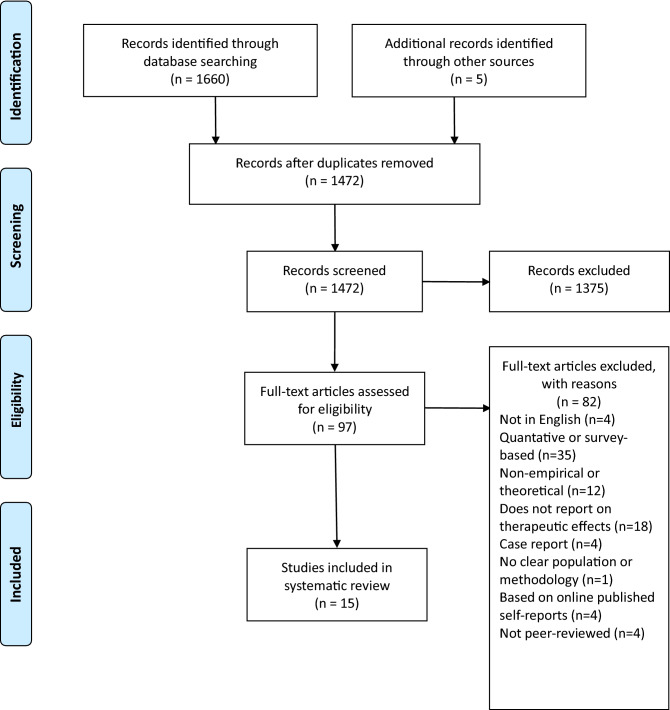
INTRODUCTION: Interest in the use of psychedelic substances for the treatment of mental disorders is increasing. Processes that may affect therapeutic change are not yet fully understood. Qualitative research methods are increasingly used to examine patient accounts; however, currently, no systematic review exists that synthesizes these findings in relation to the use of psychedelics for the treatment of mental disorders. OBJECTIVE: To provide an overview of salient themes in patient experiences of psychedelic treatments for mental disorders, presenting both common and diverging elements in patients' accounts, and elucidating how these affect the treatment process. METHODS: We systematically searched the PubMed, MEDLINE, PsycINFO, and Embase databases for English-language qualitative literature without time limitations. Inclusion criteria were qualitative research design; peer-reviewed studies; based on verbalized patient utterances; and a level of abstraction or analysis of the results. Thematic synthesis was used to analyze and synthesize results across studies. A critical appraisal of study quality and methodological rigor was conducted using the Critical Appraisal Skills Programme (CASP). RESULTS: Fifteen research articles, comprising 178 patient experiences, were included. Studies exhibited a broad heterogeneity in terms of substance, mental disorder, treatment context, and qualitative methodology. Substances included psilocybin, lysergic acid diethylamide (LSD), ibogaine, ayahuasca, ketamine and 3,4-methylenedioxymethamphetamine (MDMA). Disorders included anxiety, depression, eating disorders, post-traumatic stress disorder, and substance use disorders. While the included compounds were heterogeneous in pharmacology and treatment contexts, patients reported largely comparable experiences across disorders, which included phenomenological analogous effects, perspectives on the intervention, therapeutic processes and treatment outcomes. Comparable therapeutic processes included insights, altered self-perception, increased connectedness, transcendental experiences, and an expanded emotional spectrum, which patients reported contributed to clinically and personally relevant responses. CONCLUSIONS: This review demonstrates how qualitative research of psychedelic treatments can contribute to distinguishing specific features of specific substances, and carry otherwise undiscovered implications for the treatment of specific psychiatric disorders.
Overview
The claims and statistics of this paper haven’t been checked yet.
Free: it reads the open-access text and checks the first 5 claims that cite a source we can check. Create a free account to check every claim.
Integrity signals
Registry
Cites
Statistics
Figures
Verification
Claims the paper makes
The claims and statistics of this paper haven’t been checked yet.
Free: it reads the open-access text and checks the first 5 claims that cite a source we can check. Create a free account to check every claim.
Claims other papers make about this one
Each is checked against this paper’s own text: does it say what the citing paper says it does?
The cited source says what the claim attributes to it.
In the citing paper
“Indeed, there appears to be little qualitative research on patient experiences with ketamine for the treatment of any mental disorder (Breeksema et al., 2020a).”
From Psychedelics for the treatment of depression, anxiety, and existential distress in patients with a terminal illness: a systematic review (2022) · cites this paper as Breeksema et al., 2020a
The cited source says what the claim attributes to it.
In the citing paper
“Therapeutic outcomes appear strongly influenced by psychological “set” (mindset, expectations, preparation), environmental “setting,” and structured post-session integration (96, 99, 107, 108), highlighting the central role of context, support, and integration in optimizing benefit.”
From The therapeutic role of self-transcendence in moral injury recovery: theory, mechanisms, and clinical implications (2026) · cites this paper as [107]
The cited source says what the claim attributes to it.
In the citing paper
“These emotions largely cohered with previous observations in other psilocybin studies (36–42).”
Self-check
Percentages, sums and reported differences re-computed from the paper’s own numbers.
The self-check needs the paper’s full text.
Citations
Cites
Using thematic analysis in psychology
Braun, V., & Clarke, V. (2006) · Qualitative Research in Psychology · doi:10.1191/1478088706qp063oa · Cited by 194,414
Preferred Reporting Items for Systematic Reviews and Meta-Analyses: the PRISMA statement
Moher, D., Liberati, A., Tetzlaff, J., Altman, D. G., & for the PRISMA Group (2009) · BMJ · doi:10.1136/bmj.b2535 · Cited by 83,823
Preferred reporting items for systematic reviews and meta-analyses: the PRISMA Statement.
(2009) · PubMed Central · Cited by 44,859
Preferred reporting items for systematic reviews and meta-analyses: The PRISMA statement
Moher, D., Liberati, A., Tetzlaff, J., Altman, D. G., & the PRISMA Group* (2009) · Annals of Internal Medicine · doi:10.7326/0003-4819-151-4-200908180-00135 · Cited by 37,554
(2013) · Cited by 12,072
Methods for the thematic synthesis of qualitative research in systematic reviews
Thomas, J., & Harden, A. (2008) · BMC Medical Research Methodology · doi:10.1186/1471-2288-8-45 · Cited by 9,312
Insel, T., Cuthbert, B., Garvey, M., Heinssen, R., Pine, D. S., Quinn, K., Sanislow, C., & Wang, P. (2010) · American Journal of Psychiatry · doi:10.1176/appi.ajp.2010.09091379 · Cited by 7,067
Qualitative methods for health research
(2009) · Choice Reviews Online · doi:10.5860/choice.47-0901 · Cited by 4,596
Critical appraisal skills programme
Singh, J. (2013) · Journal of Pharmacology and Pharmacotherapeutics · doi:10.4103/0976-500x.107697 · Cited by 2,556
Mediators and Mechanisms of Change in Psychotherapy Research
Kazdin, A. E. (2007) · Annual Review of Clinical Psychology · doi:10.1146/annurev.clinpsy.3.022806.091432 · Cited by 2,504
Research works printed but not linked: 2
- Mithoefer MC Doblin R Mithoefer A Jerome L Ruse J Gibson E A manual for MDMA-assisted psychotherapy in the treatment of posttraumatic stress disorder 2013 Santa Cruz MAPS
- Watts R Day C Krzanowski J Nutt D Carhart-Harris R Patients’ accounts of increased “connectedness” and “acceptance” after psilocybin for treatment-resistant depression J Hum Psychol. 2017 57 5 520 564 · DOI · Paper page
Cited by
Towards an understanding of psychedelic-induced neuroplasticity
Calder, A. E., & Hasler, G. (2023) · Neuropsychopharmacology · doi:10.1038/s41386-022-01389-z · Cited by 313
“These effects are commonly described in terms of learning experiences [154, 158].”
BackgroundTherapeutic alliance and rapport modulate responses to psilocybin assisted therapy for depression
Murphy, R., Kettner, H., Zeifman, R., Giribaldi, B., Kartner, L., Martell, J., Read, T., Murphy-Beiner, A., Baker-Jones, M., Nutt, D., et al. (2022) · Frontiers in Pharmacology · doi:10.3389/fphar.2021.788155 · Cited by 250
Treatment of Posttraumatic Stress Disorder: A State-of-the-art Review
Burback, L., Brémault-Phillips, S., Nijdam, M. J., McFarlane, A., & Vermetten, E. (2024) · Current Neuropharmacology · doi:10.2174/1570159x21666230428091433 · Cited by 208
Self-citationBreeksema, J. J., Kuin, B. W., Kamphuis, J., van den Brink, W., Vermetten, E., & Schoevers, R. A. (2022) · Journal of Psychopharmacology · doi:10.1177/02698811221116926 · Cited by 178
“This is further complicated by the highly variable and context-dependent subjective effects elicited by psychedelics (Breeksema et al., 2020; Carbonaro et al., 2016).”
BackgroundSelf-citationSchimmers, N., Breeksema, J. J., Smith-Apeldoorn, S. Y., Veraart, J., van den Brink, W., & Schoevers, R. A. (2022) · Psychopharmacology · doi:10.1007/s00213-021-06027-y · Cited by 162
Self-citation
Metadata
- Authors
- Breeksema, J. J., Niemeijer, A. R., Krediet, E., Vermetten, E., & Schoevers, R. A.
- Affiliations
- University Medical Center Groningen (NL)
- University of Humanistic Studies (NL)
- Leiden University Medical Center (NL)
- Corresponding author
- Breeksema, Joost J.
- Venue
- CNS Drugs
- Published
- 2020-08-17
- Volume
- 34
- Issue
- 9
- Pages
- 925-946
- ISSN
- 1172-7047 (ISSN-L)
- 1179-1934
- PMC
- PMC7447679
- OpenAlex
- W3049156731
- Cited by
- 224
- References
- 133
- Citations by year
- 2026: 29 · 2025: 33 · 2024: 46 · 2023: 50 · 2022: 43 · 2021: 21 · 2020: 1
- FWCI
- 2.28
- Type
- journal article
- Language
- en
- Open access
- hybrid
- doi.org
- Licence
- cc-by-nc
- creativecommons.org/licenses/by-nc/4.0 (tdm)
- creativecommons.org/licenses/by-nc/4.0 (vor)
- Locations
- CNS Drugs (publishedVersion, cc-by-nc)
- PubMed Central (publishedVersion, cc-by-nc)
- PubMed (publishedVersion)
- University of Humanistic Studies OAI Repository (publishedVersion, other-oa)
- Leiden Repository (Leiden University) (submittedVersion, cc-by-nc)
- Data Archiving and Networked Services (DANS) (submittedVersion, cc-by-nc)
- University of Groningen research database (University of Groningen / Centre for Information Technology) (submittedVersion, cc-by)
- Data Archiving and Networked Services (DANS) (submittedVersion)
- Funders
- Rijksuniversiteit Groningen
- Leids Universitair Medisch Centrum
- Universitair Medisch Centrum Groningen
- Topics
- Social Sciences › Psychology › Clinical Psychology › Psychedelics and Drug Studies
- Social Sciences › Psychology › Clinical Psychology › Psychotherapy Techniques and Applications
- Social Sciences › Health › Religion, Spirituality, and Psychology
- Keywords
- psychedelic therapy, patient experience, mental illness, psilocybin, LSD, ibogaine, ayahuasca, ketamine, MDMA, therapeutic process, insight, transcendental experience, anxiety, depression, eating disorders, post-traumatic stress disorder, substance use disorders
- MeSH terms
- Mental Disorders, Hallucinogens, Humans, Substance-Related Disorders, Patient Outcome Assessment
About these checks
Registry, retraction, Cites and statistics results are computed, not judged, with one exception: a printed reference that no index lists is read once by a model before it counts as a citation error. Claims are extracted by a model and kept only when their quote appears verbatim in the text; each cited source is then checked, with a model’s help, for whether it says what the claim relies on. Those verdicts can be wrong — read the claim’s quote and the cited source before relying on one.
Statistics and arithmetic are recomputed, not judged.
Confidence bands are shown only for fields calibrated on our annotated test set. None is calibrated yet, so no band is shown.
What counts as a claim ›How we measure confidence ›How we check this ›
Are you an author, or do you see a problem with this page? Request a review
How to cite
Cite CoChat for the checks on this page, and the paper for its own findings.
- This page
- CoChat. (2026). Citation check: Psychedelic Treatments for Psychiatric Disorders: A Systematic Review and Thematic Synthesis of Patient Experiences in Qualitative Studies. https://app.cochat.ai/papers/10.1007/s40263-020-00748-y
- The paper
- Breeksema, J. J., Niemeijer, A. R., Krediet, E., Vermetten, E., & Schoevers, R. A. (2020). Psychedelic Treatments for Psychiatric Disorders: A Systematic Review and Thematic Synthesis of Patient Experiences in Qualitative Studies. CNS Drugs. https://doi.org/10.1007/s40263-020-00748-y
Data sources
Bibliographic data: Semantic Scholar, OpenAlex, Crossref.
Contains information from the Semantic Scholar Academic Graph Datasets, made available under the ODC Attribution License (ODC-BY 1.0).
Semantic Scholar’s data is described in: Kinney, R., et al. (2023). The Semantic Scholar Open Data Platform. arXiv:2301.10140.
