

Drug-Drug Interactions Between Glucagon-Like Peptide 1 Receptor Agonists and Oral Medications: A Systematic Review
Open accessThe DOI matches its Crossref record; 45 of the 46 references it cites were found in a registry or an index; 9 of the 52 sources its claims cite were checked for support.
Abstract
BACKGROUND: Glucagon-like peptide 1 receptor agonists (GLP1RAs) are used in the treatment of diabetes and obesity. Their slowing effect of gastric emptying might change oral drug absorption, potentially affecting pharmacokinetics, particularly in the case of medications with a narrow therapeutic index. PURPOSE: The purpose of this systematic review is to summarize data on drug-drug interactions between GLP1RAs and oral drugs. DATA SOURCES: The PubMed and EMBASE databases were searched up to November, 1st 2023. STUDY SELECTION: We selected pharmacokinetic studies of any injectable GLP1RA given with an oral medication, and product prescribing sheets reporting data without access to the original study. DATA EXTRACTION: Two authors independently extracted the data. DATA SYNTHESIS: of drugs with high solubility and permeability (warfarin, contraceptive pills, acetaminophen), drugs with high solubility and low permeability (angiotensin converting enzyme inhibitors), drugs with low solubility and high permeability (statins) and drugs with low solubility and permeability (digoxin). However, the use of GLP1RAs did not exert clinically significant changes in the AUC or differences in clinically relevant endpoints. LIMITATIONS: The major limitations of the studies that are included in this systematic review are the enrollment of healthy subjects and insufficient data in conditions that might affect pharmacokinetics (e.g., kidney dysfunction). CONCLUSIONS: of drugs co-administered with GLP1RAs are consistent with the known delayed gastric output by the latter. Nevertheless, the overall drug exposure was not considered clinically significant. Dose adjustments are probably not required for simultaneous use of GLP1RAs with oral medications. Still, results should be carefully generalized to cases of background kidney dysfunction or when using drugs with narrow therapeutic index. The study is registered in PROSPERO: https://www.crd.york.ac.uk/prospero/display_record.php?ID=CRD42022332339 .
Overview
CoChat Summary
TL;DR
This systematic review found that GLP1 receptor agonists can reduce peak concentrations and delay time to peak of some oral drugs, but they did not produce clinically significant changes in overall exposure (AUC) or clinical endpoints in the studies reviewed. The authors conclude that dose adjustments are generally not needed, though caution is warranted for kidney dysfunction, gastroparesis, and narrow-therapeutic-index drugs.
Key findings
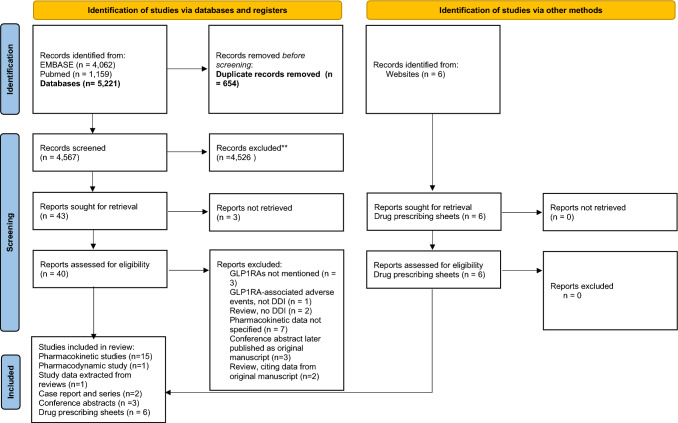
- The review included 22 reports plus 6 prescribing sheets; among the reports were 15 pharmacokinetic studies, 1 pharmacodynamic study, 1 review with unpublished PK data, 3 conference abstracts, 1 case report, and 1 case series.
- Across drug classes, GLP1RAs often caused reduced Cmax and delayed tmax, but no clinically significant changes in AUC or clinically relevant endpoints were found overall.
- For warfarin, most AUC and Cmax confidence intervals stayed within 0.8–1.25; exceptions included 19% and 22% reductions in warfarin Cmax with lixisenatide and dulaglutide, respectively, but these were not considered clinically important.
- For atorvastatin, dulaglutide reduced AUC to 0.786 (90% CI 0.752–0.821), and albiglutide also reduced AUC, but these changes were interpreted as non-clinically significant; in a phase 3 analysis of 966 subjects, statin lipid-lowering effects were comparable to placebo.
Methods
- Systematic review conducted according to PRISMA; PubMed and EMBASE were searched up to November 1, 2023, with reference-list checking and screening of GLP1RA prescribing sheets.
- Included human pharmacokinetic studies of any injectable GLP1RA coadministered with an oral medication; studies of GLP1RA interactions with antihyperglycemic medications were excluded.
- Two authors independently extracted data; outcomes were Cmax, tmax, AUC, and selected pharmacodynamic measures such as INR, lipid levels, gonadotropins, and progesterone; studies were organized using the Biopharmaceutics Classification System (BCS).
Limitations
- The paper states that the major limitations were enrollment of healthy subjects and insufficient data in conditions affecting pharmacokinetics, such as kidney dysfunction.
- The discussion adds that many studies used single-dose GLP1RA administration and many coadministered drugs were also given as single doses, so applicability to chronic use is uncertain.
- Evidence is thin for some clinically important populations and drugs: the text explicitly notes concern about patients with gastroparesis, kidney dysfunction, and narrow therapeutic index drugs; these are limitations evident from the review’s own discussion.
Model-written summary. Check it against the paper before relying on it.
Integrity signals
Registry
Cites
Statistics
Figures
Verification
Claims the paper makes
6 Valid · 2 Not valid · 20 Not checked · 21 Own results and interpretations
The cited sources support only part of this claim — read each source’s verdict below.
In the paper
“The rate or extent of digoxin’s absorption was not affected by coadministration of oral or subcutaneous semaglutide [16].”
§ Drug-Drug Interactions Between Glucagon-Like Peptide 1 Receptor Agonists and Oral Medications: A Systematic Review > Results > BCS Class IV: Low Solubility, Low Permeability
What the sources say
- Partly supportedcites [16] Hausner H, DervingKarsbøl J, Holst AG, Jacobsen JB, Wagner FD, Golor G, et al. Effect of semaglutide on the Pharmacokinetics of Metformin, Warfarin, Atorvastatin and Digoxin in Healthy Subjects. Clin Pharmacokinet. 2017;56(11):1391–401. 28349387 10.1007/s40262-017-0532-6 PMC5648738 sourceExperimental — accuracy not yet measured
The Abstract Methods describe digoxin given before and with subcutaneous semaglutide, not oral semaglutide. The Results (Pharmacokinetics) and Discussion report similar digoxin exposure and peak concentration with subcutaneous semaglutide, supporting that portion of the claim, but this paper does not establish the same result for oral semaglutide. (LLM, conf=0.90)
plain- Asserted: passes — The authors put it forward as true.
- Checkable: passes — It can be checked against evidence.
- Load-bearing: passes — The paper’s conclusions depend on it.
- Based: passes — The paper gives a reason why it holds.
- Partly supported
A result the paper states — it cites no source for it, so there is none to check. The quote shows it is in the paper.
In the paper
“The pharmacodynamic studies demonstrated similar INRAUC and INRmax in subjects on warfarin with or without GLP1RAs.”
§ Drug-Drug Interactions Between Glucagon-Like Peptide 1 Receptor Agonists and Oral Medications: A Systematic Review > Results > BCS Class I: High Solubility, High Permeability
boosted- Asserted: passes — The authors put it forward as true.
- Checkable: passes — It can be checked against evidence.
- Load-bearing: passes — The paper’s conclusions depend on it.
- Based: passes — The paper gives a reason why it holds.
A result the paper states — it cites no source for it, so there is none to check. The quote shows it is in the paper.
In the paper
“Nevertheless, in all studies the digoxin concentrations remained within the therapeutic range.”
§ Drug-Drug Interactions Between Glucagon-Like Peptide 1 Receptor Agonists and Oral Medications: A Systematic Review > Results > BCS Class IV: Low Solubility, Low Permeability
plain- Asserted: passes — The authors put it forward as true.
- Checkable: passes — It can be checked against evidence.
- Load-bearing: passes — The paper’s conclusions depend on it.
- Based: passes — The paper gives a reason why it holds.
A result the paper reports from its own data — it cites no other source for it, so there is none to check. The quote shows it is in the paper.
In the paper
“However, the AUC showed bioequivalence with and without the GLP1 agonists.”
§ Drug-Drug Interactions Between Glucagon-Like Peptide 1 Receptor Agonists and Oral Medications: A Systematic Review > Results > BCS Class I: High Solubility, High Permeability
plain- Asserted: passes — The authors put it forward as true.
- Checkable: passes — It can be checked against evidence.
- Load-bearing: passes — The paper’s conclusions depend on it.
- Based: passes — The paper gives a reason why it holds.
In the paper
“The other prokinetic drugs did not show interaction with GLP1 action.”
§ Drug-Drug Interactions Between Glucagon-Like Peptide 1 Receptor Agonists and Oral Medications: A Systematic Review > Results > BCS Class IV: Low Solubility, Low Permeability
What the sources say
- Not checked — no full text of the sourcecites [28] Meier JJ, Kemmeries G, Holst JJ, Nauck MA. Erythromycin antagonizes the deceleration of gastric emptying by glucagon-like peptide 1 and unmasks its insulinotropic effect in healthy subjects. Diabetes. 2005;54(7):2212–8. 15983224 10.2337/diabetes.54.7.2212 source
plain- Asserted: passes — The authors put it forward as true.
- Checkable: passes — It can be checked against evidence.
- Load-bearing: unclear — It is unclear whether the paper’s conclusions depend on it.
- Based: passes — The paper gives a reason why it holds.
22 more claims
Create a free account to see all 49 claims and every source verdict.
- Probably not a substantial claim. 10
- It may state two separate claims as one. 14
Claims other papers make about this one
Each is checked against this paper’s own text: does it say what the citing paper says it does?
The source backs part of the claim, not all of it — or backs it for a different population, condition or comparison.
In the citing paper
“The second is pharmacokinetic: GLP-1 agonists slow gastric emptying and so alter the absorption rate of oral drugs [47,120], while berberine inhibits enzymes and transporters at the same intestinal interface, so the two perturb one process from different directions [46,47].”
From Berberine-Drug Interactions: Mechanisms, Clinical Relevance and Risk Stratification-A Narrative Review (2026) · cites this paper as [46]
Experimental — accuracy not yet measuredThe source backs part of the claim, not all of it — or backs it for a different population, condition or comparison.
In the citing paper
“These results align with existing literature, which suggests that BCS class II drugs are particularly susceptible to delayed gastric emptying and altered small intestinal transit times.6”
From GLP-1RA-induced delays in gastrointestinal motility: Predicted effects on coadministered drug absorption by PBPK analysis (2025) · cites this paper as [6]
Experimental — accuracy not yet measuredIn the citing paper
“The existing research on how GLP-1RAs affect the absorption of oral medications is limited but indicates potential impacts on maximum concentration (Cmax), total drug exposure defined by AUC, and time to Cmax (Tmax) of coadministered oral drugs.6”
From GLP-1RA-induced delays in gastrointestinal motility: Predicted effects on coadministered drug absorption by PBPK analysis (2025) · cites this paper as [6]
Self-check
Percentages, sums and reported differences re-computed from the paper’s own numbers.
Self-check results appear here once an independent check has confirmed them.
Cited works that were retracted
Works this paper cites that were later retracted, from the retraction notices publishers deposit. Major when the notice came out before this paper was published.
A note, not an issue: for example, a cited work that was retracted only after this paper was published, which its authors could not have known.
In the paper
“Shi Q, Wang Y, Hao Q, Vandvik PO, Guyatt G, Li J, et al. Pharmacotherapy for adults with overweight and obesity: a systematic review and network meta-analysis of randomised controlled trials. The Lancet. 2022;399(10321):259–69.”
Cited work 10.1016/s0140-6736(21)01640-8 · retracted 2024-04-04 · notice 10.1016/s0140-6736(24)00318-0 · this paper published 2024-01-25
Citations
Cites
1 retracted
Shi, Q., Wang, Y., Hao, Q., Vandvik, P. O., Guyatt, G., Li, J., Chen, Z., Xu, S., Shen, Y., Ge, L., et al. (2022) · The Lancet · doi:10.1016/s0140-6736(21)01640-8 · Cited by 279
RetractedThe PRISMA 2020 statement: An updated guideline for reporting systematic reviews
Page, M. J., McKenzie, J. E., Bossuyt, P. M., Boutron, I., Hoffmann, T. C., Mulrow, C. D., Shamseer, L., Tetzlaff, J. M., Akl, E. A., Brennan, S. E., et al. (2021) · BMJ · doi:10.1136/bmj.n71 · Cited by 108,283
Amidon, G. L., Lennernäs, H., Shah, V. P., & Crison, J. R. (1995) · Pharmaceutical Research · doi:10.1023/a:1016212804288 · Cited by 5,430 · cited 1×
“Gastroparesis caused by non-pharmacologic etiologies is indeed known to affect drug absorption [6, 7].”
Background9. Pharmacologic Approaches to Glycemic Treatment: Standards of Medical Care in Diabetes—2022
American Diabetes Association Professional Practice Committee (2022) · Diabetes Care · doi:10.2337/dc22-s009 · Cited by 1,555 · cited 1×
“Beyond glucose control and weight reduction, GLP1RAs were shown to reduce cardiovascular morbidity and mortality and are therefore strongly recommended in early lines of diabetic therapy [3, 4].”
Background6. Glycemic Targets: Standards of Medical Care in Diabetes—2022
American Diabetes Association Professional Practice Committee (2022) · Diabetes Care · doi:10.2337/dc22-s006 · Cited by 1,403
Drucker, D. J., Buse, J. B., Taylor, K., Kendall, D. M., Trautmann, M., Zhuang, D., & Porter, L. (2008) · The Lancet · doi:10.1016/s0140-6736(08)61206-4 · Cited by 1,070
Nauck, M. A., Niedereichholz, U., Ettler, R., Holst, J. J., Ørskov, C., Ritzel, R., & Schmiegel, W. H. (1997) · American Journal of Physiology-Endocrinology and Metabolism · doi:10.1152/ajpendo.1997.273.5.e981 · Cited by 817
Stegeman, B. H., de Bastos, M., Rosendaal, F. R., van Hylckama Vlieg, A., Helmerhorst, F. M., Stijnen, T., & Dekkers, O. M. (2013) · BMJ · doi:10.1136/bmj.f5298 · Cited by 420
Htike, Z. Z., Zaccardi, F., Papamargaritis, D., Webb, D. R., Khunti, K., & Davies, M. J. (2017) · Diabetes, Obesity and Metabolism · doi:10.1111/dom.12849 · Cited by 416
Nauck, M. A., Kemmeries, G., Holst, J. J., & Meier, J. J. (2011) · Diabetes · doi:10.2337/db10-0474 · Cited by 392 · cited 1×
“An open question remains whether chronic use of GLP1RAs will result in tachyphylaxis of the gastric slowing effect, which will mitigate the risk of DDI [51–53].”
BackgroundGastric emptying in diabetes: clinical significance and treatment
Horowitz, M., O’Donovan, D., Jones, K. L., Feinle, C., Rayner, C. K., & Samsom, M. (2002) · Diabetic Medicine · doi:10.1046/j.1464-5491.2002.00658.x · Cited by 308
How Useful Is Paracetamol Absorption as a Marker of Gastric Emptying? A Systematic Literature Study
Willems, M., Quartero, A. O., & Numans, M. E. (2001) · Digestive Diseases and Sciences · doi:10.1023/a:1011935603893 · Cited by 211 · cited 1×
“It has also been used in clinical research as a surrogate measure for gastric emptying [43].”
MethodCilla, D. D., Whitfield, L. R., Gibson, D. M., Sedman, A. J., & Posvar, E. L. (1996) · Clinical Pharmacology & Therapeutics · doi:10.1016/s0009-9236(96)90218-0 · Cited by 204 · cited 1×
“Notably, the efficacy of atorvastatin is poorly correlated with C max [44], probably due to complex pharmacokinetics of drug metabolites with longer half-life compared to the parent compound.”
BackgroundKapitza, C., Nosek, L., Jensen, L., Hartvig, H., Jensen, C. B., & Flint, A. (2015) · The Journal of Clinical Pharmacology · doi:10.1002/jcph.443 · Cited by 175
Alterations of Gastrointestinal Motility in Obesity
Xing, J., & Chen, J. D. Z. (2004) · Obesity Research · doi:10.1038/oby.2004.213 · Cited by 160
Meier, J. J., Kemmeries, G., Holst, J. J., & Nauck, M. A. (2005) · Diabetes · doi:10.2337/diabetes.54.7.2212 · Cited by 146
Diabetic Gastroparesis: Diagnosis and Management
Ma, J., Rayner, C. K., Jones, K. L., & Horowitz, M. (2009) · Drugs · doi:10.2165/00003495-200969080-00003 · Cited by 87
Jalleh, R. J., Jones, K. L., Rayner, C. K., Marathe, C. S., Wu, T., & Horowitz, M. (2022) · Diabetologia · doi:10.1007/s00125-022-05796-1 · Cited by 87
Blase, E., Taylor, K., Gao, H., Wintle, M., & Fineman, M. (2005) · The Journal of Clinical Pharmacology · doi:10.1177/0091270004274432 · Cited by 82
Mosenzon, O., Prato, S. D., Schechter, M., Leiter, L. A., Ceriello, A., DeFronzo, R. A., & Raz, I. (2021) · Cardiovascular Diabetology · doi:10.1186/s12933-021-01281-y · Cited by 76
Coadministration of Liraglutide With Tacrolimus in Kidney Transplant Recipients: A Case Series
Pinelli, N. R., Patel, A., & Salinitri, F. D. (2013) · Diabetes Care · doi:10.2337/dc13-1066 · Cited by 75 · cited 4×
“Fair quality of methodology was considered in studies that enrolled only male subjects (“population” category) [14, 22, 25, 26, 28] or when blood sampling did not coincide with a steady state of an investigated drug [13–17, 19, 24].”
BackgroundInfluentialSmits, M. M., Tonneijck, L., Muskiet, M. H. A., Kramer, M. H. H., Cahen, D. L., & van Raalte, D. H. (2016) · Diabetes, Obesity and Metabolism · doi:10.1111/dom.12593 · Cited by 74 · cited 2×
“An open question remains whether chronic use of GLP1RAs will result in tachyphylaxis of the gastric slowing effect, which will mitigate the risk of DDI [51–53].”
BackgroundPharmacokinetic Drug Interactions with Gastrointestinal Motility Modifying Agents
Greiff, J. M. C., & Rowbotham, D. (1994) · Clinical Pharmacokinetics · doi:10.2165/00003088-199427060-00004 · Cited by 72
Effect of Exenatide on the Steady‐State Pharmacokinetics of Digoxin
Kothare, P. A., Soon, D. K. W., Linnebjerg, H., Park, S., Chan, C., Yeo, A., Lim, M., Mace, K. F., & Wise, S. D. (2005) · The Journal of Clinical Pharmacology · doi:10.1177/0091270005278806 · Cited by 69 · cited 2×
“All other GLP1 agonists resulted in a lower C max and a delayed t max , but the AUC remained unaffected [15, 22, 32, 36].”
BackgroundHausner, H., Derving Karsbøl, J., Holst, A. G., Jacobsen, J. B., Wagner, F.-D., Golor, G., & Anderson, T. W. (2017) · Clinical Pharmacokinetics · doi:10.1007/s40262-017-0532-6 · Cited by 62
Effect of Exenatide on the Pharmacokinetics and Pharmacodynamics of Warfarin in Healthy Asian Men
Soon, D., Kothare, P. A., Linnebjerg, H., Park, S., Yuen, E., Mace, K. F., & Wise, S. D. (2006) · The Journal of Clinical Pharmacology · doi:10.1177/0091270006291622 · Cited by 54
Drug interactions between hormonal contraceptives and psychotropic drugs: a systematic review
Berry-Bibee, E. N., Kim, M.-J., Simmons, K. B., Tepper, N. K., Riley, H. E. M., Pagano, H. P., & Curtis, K. M. (2016) · Contraception · doi:10.1016/j.contraception.2016.07.011 · Cited by 52
Pharmacokinetic Considerations in Gastrointestinal Motor Disorders
Hebbard, G. S., Sun, W. M., Bochner, F., & Horowitz, M. (1995) · Clinical Pharmacokinetics · doi:10.2165/00003088-199528010-00005 · Cited by 51 · cited 1×
“However, previous studies on the extent of drug absorption (area under the curve [AUC]) in patients with other gastrointestinal motility disorders reported conflicting results [8, 9].”
ResultClinical Pharmacology of Incretin Therapies for Type 2 Diabetes Mellitus: Implications for Treatment
Neumiller, J. J. (2011) · Clinical Therapeutics · doi:10.1016/j.clinthera.2011.04.024 · Cited by 47 · cited 1×
“Glucagon-like peptide 1 receptor agonists do not engage in CYP-or transporter-mediated drug-drug interactions (DDI) [5].”
BackgroundJacobsen, L. V., Vouis, J., Hindsberger, C., & Zdravkovic, M. (2011) · The Journal of Clinical Pharmacology · doi:10.1177/0091270010389471 · Cited by 41 · cited 4×
“Pharmacokinetic studies with exenatide [21], lixisenatide [36], liraglutide [17], albiglutide [14], dulaglutide [15] and semaglutide [18] given concomitantly with COCs are presented in Table 3.”
BackgroundInfluentialClinical Pharmacology of Albiglutide, a GLP-1 Receptor Agonist
Young, M. A., Wald, J. A., Matthews, J. E., Scott, R., Hodge, R. J., Zhi, H., & Reinhardt, R. R. (2014) · Postgraduate Medicine · doi:10.3810/pgm.2014.11.2836 · Cited by 41 · cited 3×
“Treatment with dulaglutide showed similar inhibitory effects on C max and t max , but the AUC of atorvastatin was reduced (0.786, 90% CI 0.752–0.821) [15], as with co-administration of albiglutide [29].”
BackgroundInfluentialKapitza, C., Zdravkovic, M., Hindsberger, C., & Flint, A. (2011) · Advances in Therapy · doi:10.1007/s12325-011-0044-y · Cited by 36
Malm-Erjefält, M., Ekblom, M., Vouis, J., Zdravkovic, M., & Lennernäs, H. (2015) · Molecular Pharmaceutics · doi:10.1021/acs.molpharmaceut.5b00278 · Cited by 36 · cited 5×
“Liraglutide was an exception as it also decreased the AUC [24].”
BackgroundInfluentialExenatide effects on statin pharmacokinetics and lipid response
Kothare, P. A., Linnebjerg, H., Skrivanek, Z., Reddy, S., Mace, K., Pena, A., Han, J., Fineman, M., & Mitchell, M. (2007) · Int. Journal of Clinical Pharmacology and Therapeutics · doi:10.5414/cpp45114 · Cited by 36
Kothare, P. A., Seger, M. E., Northrup, J., Mace, K., Mitchell, M. I., & Linnebjerg, H. (2012) · BMC Clinical Pharmacology · doi:10.1186/1472-6904-12-8 · Cited by 35 · cited 2×
“Pharmacokinetic studies with exenatide [21], lixisenatide [36], liraglutide [17], albiglutide [14], dulaglutide [15] and semaglutide [18] given concomitantly with COCs are presented in Table 3.”
BackgroundGlucagon‐like peptide‐1 receptor agonists and the appropriate measurement of gastric emptying
Horowitz, M., Rayner, C. K., Marathe, C. S., Wu, T., & Jones, K. L. (2020) · Diabetes, Obesity and Metabolism · doi:10.1111/dom.14166 · Cited by 32 · cited 1×
“Gastric emptying is frequently evaluated by the simple and inexpensive paracetamol absorption test; yet the use of the paracetamol test has been criticized, particularly since it cannot assess gastric emptying of solid foods [48, 49].”
Backgroundde la Peña, A., Cui, X., Geiser, J., & Loghin, C. (2017) · Clinical Pharmacokinetics · doi:10.1007/s40262-017-0531-7 · Cited by 31
Bush, M., Scott, R., Watanalumlerd, P., Zhi, H., & Lewis, E. (2012) · Postgraduate Medicine · doi:10.3810/pgm.2012.11.2613 · Cited by 30
Development of a Population Pharmacokinetic Model for Atorvastatin Acid and Its Lactone Metabolite
Narwal, R., Akhlaghi, F., Åsberg, A., Hermann, M., & Rosenbaum, S. E. (2010) · Clinical Pharmacokinetics · doi:10.2165/11535980-000000000-00000 · Cited by 24
Linnebjerg, H., Kothare, P., Park, S., Mace, K., & Mitchell, M. (2009) · Int. Journal of Clinical Pharmacology and Therapeutics · doi:10.5414/cpp47651 · Cited by 17
Beti, C., Stratmann, B., Bokman, G., Dreier, J., Hauber, M., Lee-Barkey, Y., Fischer, M., Knabbe, C., & Tschoepe, D. (2019) · Hormone and Metabolic Research · doi:10.1055/a-0818-6374 · Cited by 15
Population pharmacokinetic of paracetamol and atorvastatin with co‐administration of semaglutide
Langeskov, E. K., & Kristensen, K. (2022) · Pharmacology Research & Perspectives · doi:10.1002/prp2.962 · Cited by 12 · cited 4×
“The PK studies with lixisenatide [36], liraglutide [24] and semaglutide [16, 27] demonstrated reduced C max and delayed t max of atorvastatin, but overall minor changes in the AUC were not considered to be of clinical importance (Table 3).”
BackgroundInfluentialFujita, Y., Kitamura, T., Otsuki, M., Tamada, D., Tabuchi, Y., Kozawa, J., Yasuda, T., Okita, K., Imagawa, A., Kaneto, H., et al. (2012) · Diabetes Care · doi:10.2337/dc12-1499 · Cited by 8
Amiodarone-induced Hyperthyroidism during Massive Weight Loss Following Gastric Bypass
Bourron, O., Ciangura, C., Bouillot, J.-L., Massias, L., Poitou, C., & Oppert, J.-M. (2007) · Obesity Surgery · doi:10.1007/s11695-008-9415-0 · Cited by 8
Nagai, Y., Mukai, K., Otsuki, M., Kimura, T., Kozawa, J., Nishizawa, H., Maeda, N., Matsuoka, T., Iwahashi, H., Imagawa, A., et al. (2018) · Internal Medicine · doi:10.2169/internalmedicine.1585-18 · Cited by 7
Research works printed but not linked: 3
- Dahmen R, Steinstraesser A, Poitiers F, Ozoux ML, Pinquier JL. Interaction of subcutaneous lixisenatide 20 lg QD on pharmacokinetic and pharmacodynamic properties of oral ramipril 5 MG QD in. Basic Clin Pharmacol Toxicol. 2011;109:89.
- Liu YH, Ruus P, Steinstraesser A, Teichert L. Effect of the GLP-1 agonist lixisenatide on the pharmacokinetics of warfarin. In: Abstract conference: 70th scientific sessions of the American Diabetes Association. 2010.
- Tham LS, Schneck KB, Geiser JS, Posada M, Dickinson G. Integration of population exposure-response and physiological based pharmacokinetics modeling approaches to evaluate gastric-emptying induced drug interaction risks for dulaglutide. J Pharmacokinet Pharmacodyn. 2018;45:S53–4.
Cited by
Min, J. S., Jo, S. J., Lee, S., Kim, D. Y., Kim, D. H., Lee, C. B., & Bae, S. K. (2025) · Drug Design Development and Therapy · doi:10.2147/dddt.s506957 · Cited by 133
Amiodarone Therapy: Updated Practical Insights
Șorodoc, V., Indrei, L., Dobroghii, C., Asaftei, A., Ceasovschih, A., Constantin, M., Lionte, C., Morărașu, B. C., Diaconu, A.-D., & Șorodoc, L. (2024) · Journal of Clinical Medicine · doi:10.3390/jcm13206094 · Cited by 59
Hooper, L., Liu, S., & Pai, M. P. (2025) · Pharmacotherapy: The Journal of Human Pharmacology and Drug Therapy · doi:10.1002/phar.70007 · Cited by 32
Shankar, A., Sharma, A., Vinas, A., & CHILTON, R. J. (2024) · Cardiovascular Endocrinology & Metabolism · doi:10.1097/xce.0000000000000321 · Cited by 41
Passos, P. R. C., Filho, V. O. C., Noronha, M. M., Hyppólito, E. B., Saldanha, E. F., & Motta, R. V. (2024) · Journal of Gastroenterology and Hepatology · doi:10.1111/jgh.16752 · Cited by 26
Metadata
- Authors
- Calvarysky, B., Dotan, I., Shepshelovich, D., Leader, A., & Cohen, T. D.
- Affiliations
- Hebrew University of Jerusalem (IL)
- Tel Aviv University (IL)
- Venue
- Drug Safety
- Published
- 2024-01-25
- Volume
- 47
- Issue
- 5
- Pages
- 439-451
- ISSN
- 0114-5916 (ISSN-L)
- 1179-1942
- PMC
- PMC11018670
- OpenAlex
- W4391218339
- Semantic Scholar
- 6e5ae3e69330f52feee900b3e7ffbf9c6f31ca04
- Cited by
- 97
- References
- 46
- Citations by year
- 2026: 58 · 2025: 29 · 2024: 9
- FWCI
- 5.60
- Type
- journal article
- Language
- en
- Open access
- hybrid
- doi.org
- Licence
- cc-by-nc
- creativecommons.org/licenses/by-nc/4.0 (tdm)
- creativecommons.org/licenses/by-nc/4.0 (vor)
- Locations
- Drug Safety (publishedVersion, cc-by-nc)
- PubMed Central (publishedVersion, cc-by-nc)
- PubMed (publishedVersion)
- RePEc: Research Papers in Economics (submittedVersion)
- Funders
- Tel Aviv University
- Topics
- Health Sciences › Medicine › Endocrinology, Diabetes and Metabolism › Diabetes Treatment and Management
- Life Sciences › Pharmacology, Toxicology and Pharmaceutics › Pharmacology › Pharmacogenetics and Drug Metabolism
- Health Sciences › Medicine › Pharmacology (medical) › Pharmacology and Obesity Treatment
- Keywords
- GLP-1 receptor agonists, drug-drug interactions, oral drug absorption, gastric emptying, pharmacokinetics, drug solubility and permeability, warfarin, oral contraceptives, paracetamol, ACE inhibitors, statins, digoxin, narrow therapeutic index, diabetes mellitus, obesity
- MeSH terms
- Angiotensin-Converting Enzyme Inhibitors, Digoxin, Drug Interactions, Humans, Warfarin, Glucagon-Like Peptide 1
About these checks
Registry, retraction, Cites and statistics results are computed, not judged, with one exception: a printed reference that no index lists is read once by a model before it counts as a citation error. Claims are extracted by a model and kept only when their quote appears verbatim in the text; each cited source is then checked, with a model’s help, for whether it says what the claim relies on. Those verdicts can be wrong — read the claim’s quote and the cited source before relying on one.
The claim verdicts this report counts are experimental: their accuracy is not yet measured.
A language model drew the claims from the paper on 2026-09-30, under version 3 of the claim definition (model deepseek-v4.1-flash, prompt extract-v3).
A second model labelled each claim on 2026-09-30 (model jev-1.13-20260917, definition revision gold-guideline-v0.2).
Cited sources are checked with a language model’s help (gpt-6-sol).
Statistics and arithmetic are recomputed, not judged.
Confidence bands are shown only for fields calibrated on our annotated test set. None is calibrated yet, so no band is shown.
What counts as a claim ›How we measure confidence ›How we check this ›
Are you an author, or do you see a problem with this page? Request a review
Data sources
Bibliographic data: Semantic Scholar, OpenAlex, Crossref.
Contains information from the Semantic Scholar Academic Graph Datasets, made available under the ODC Attribution License (ODC-BY 1.0).
Semantic Scholar’s data is described in: Kinney, R., et al. (2023). The Semantic Scholar Open Data Platform. arXiv:2301.10140.
