

The New Era of Drug Therapy for Obesity: The Evidence and the Expectations
Open accessThe DOI matches its Crossref record; 106 of the 106 references it cites were found in a registry or an index.
Abstract
There is an urgent need for effective pharmacological therapies to help tackle the growing obesity epidemic and the healthcare crisis it poses. The past 3 years have seen approval of a number of novel anti-obesity drugs. The majority of these influence hypothalamic appetite pathways via dopaminergic or serotoninergic signalling. Some are combination therapies, allowing lower doses to minimize the potential for off-target effects. An alternative approach is to mimic endogenous satiety signals using long-lasting forms of peripheral appetite-suppressing hormones. There is also considerable interest in targeting thermogenesis by brown adipose tissue to increase resting energy expenditure. Obesity pharmacotherapy has seen several false dawns, but improved understanding of the pathways regulating energy balance, and better-designed trials, give many greater confidence that recently approved agents will be both efficacious and safe. Nevertheless, a number of issues from preclinical and clinical development continue to attract debate, and additional large-scale trials are still required to address areas of uncertainty.
Overview
The claims and statistics of this paper haven’t been checked yet.
Free: it reads the open-access text and checks the first 5 claims that cite a source we can check. Create a free account to check every claim.
Integrity signals
Registry
Cites
Statistics
Figures
Verification
Claims the paper makes
The claims and statistics of this paper haven’t been checked yet.
Free: it reads the open-access text and checks the first 5 claims that cite a source we can check. Create a free account to check every claim.
Self-check
Percentages, sums and reported differences re-computed from the paper’s own numbers.
The self-check needs the paper’s full text.
Citations
Cites
Reduction in the incidence of type 2 diabetes with lifestyle intervention or metformin
(2002) · New England Journal of Medicine · doi:10.1056/nejmoa012512 · Cited by 19,011 · cited 1×
“A reduction in body weight of 5–10 % is enough for significant improvements in cardiovascular risk factor profiles [28–32], kidney disease [33] and osteoarthritis [34].”
BackgroundGlobal status report on noncommunicable diseases 2010.
Alwan, A. (2011) · Cited by 8,494
Genetics of Food Intake Self-Regulation in Childhood: Literature Review and Research Opportunities
Faith, M. S., Carnell, S., & Kral, T. V. E. (2013) · Human Heredity · doi:10.1159/000353879 · Cited by 7,601
Identification and Importance of Brown Adipose Tissue in Adult Humans
Cypess, A. M., Lehman, S., Williams, G., Tal, I., Rodman, D., Goldfine, A. B., Kuo, F. C., Palmer, E. L., Tseng, Y.-H., Doria, A., et al. (2009) · New England Journal of Medicine · doi:10.1056/nejmoa0810780 · Cited by 4,399
Predicting Obesity in Young Adulthood from Childhood and Parental Obesity
Whitaker, R. C., Wright, J. A., Pepe, M. S., Seidel, K. D., & Dietz, W. H. (1997) · New England Journal of Medicine · doi:10.1056/nejm199709253371301 · Cited by 4,397
2013 AHA/ACC/TOS Guideline for the Management of Overweight and Obesity in Adults
Jensen, M. D., Ryan, D. H., Apovian, C. M., Ard, J. D., Comuzzie, A. G., Donato, K. A., Hu, F. B., Hubbard, V. S., Jakicic, J. M., Kushner, R. F., et al. (2014) · Journal of the American College of Cardiology · doi:10.1016/j.jacc.2013.11.004 · Cited by 4,058
European Guidelines for Obesity Management in Adults
Yumuk, V., Tsigos, C., Fried, M., Schindler, K., Busetto, L., Micic, D., & Toplak, H. (2015) · Obesity Facts · doi:10.1159/000442721 · Cited by 3,432
Global burden of obesity in 2005 and projections to 2030
Kelly, T., Yang, W., Chen, C.-S., Reynolds, K., & He, J. (2008) · International Journal of Obesity · doi:10.1038/ijo.2008.102 · Cited by 3,319 · cited 1×
“Current projections anticipate that 20 % of adults will be obese by 2030 [4].”
BackgroundFunctional Brown Adipose Tissue in Healthy Adults
Virtanen, K. A., Lidell, M. E., Orava, J., Heglind, M., Westergren, R., Niemi, T., Taittonen, M., Laine, J., Savisto, N.-J., Enerbäck, S., et al. (2009) · New England Journal of Medicine · doi:10.1056/nejmoa0808949 · Cited by 3,058 · cited 1×
“Well known as a source of non-shivering thermogenesis in human infants, it was assumed not to persist into adulthood, until review of positron emission tomography (PET) images from adult cancer patients revealed extensive glucose-avid areas in the neck and thorax, subsequently identified as brown fat [16, 17].”
BackgroundGut hormone PYY3-36 physiologically inhibits food intake
Batterham, R. L., Cowley, M. A., Small, C. J., Herzog, H., Cohen, M. A., Dakin, C. L., Wren, A. M., Brynes, A. E., Low, M. J., Ghatei, M. A., et al. (2002) · Nature · doi:10.1038/nature00887 · Cited by 2,351 · cited 1×
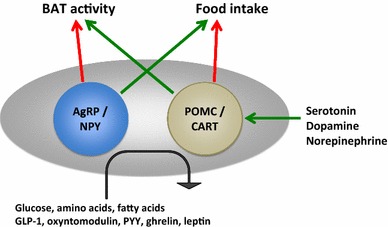
“PYY is a high-affinity agonist of the Y2 receptor, which inhibits the activity of orexigenic AgRP/NPY hypothalamic neurons [87].”
BackgroundSelf-citation
Research works printed but not linked: 1
- National Institute for Health and Care Excellence. Obesity: identification, assessment and management of overweight and obesity in children, young people and adults [Internet]. nice.org.uk. [cited 2015 Mar 8]. Available from: https://www.nice.org.uk/guidance/cg189/resources/guidance-obesity-identification-assessment-and-management-of-overweight-and-obesity-in-children-young-people-and-adults-pdf. 25535639
Cited by
Towards a multidisciplinary approach to understand and manage obesity and related diseases
Bischoff, S. C., Boirie, Y., Cederholm, T., Chourdakis, M., Cuerda, C., Delzenne, N. M., Deutz, N. E., Fouque, D., Genton, L., Gil, C., et al. (2017) · Clinical Nutrition · doi:10.1016/j.clnu.2016.11.007 · Cited by 206
Anti-obesity therapy: from rainbow pills to polyagonists
Müller, T. D., Clemmensen, C., Finan, B., DiMarchi, R. D., & Tschöp, M. H. (2018) · Pharmacological Reviews · doi:10.1124/pr.117.014803 · Cited by 199
“…proopiomelanocortin (POMC) neuronal activity, whereas neurons expressing neuro-peptide Y (NPY)/agouti-related peptide (AgRP) are inhibited (Heisler et al., 2002, 2006; Kuo, 2005, 2006; Garfield and Heisler, 2009; Kuo et al., 2009, 2012; Roepke et al., 2012; Chu et al., 2014; Jones and Bloom, 2015).”
BackgroundEvolution of pharmacological obesity treatments: focus on adverse side‐effect profiles
Krentz, A. J., Fujioka, K., & Hompesch, M. (2016) · Diabetes, Obesity and Metabolism · doi:10.1111/dom.12657 · Cited by 168
“Eventual therapeutic success may depend on better selectivity for the β3 adrenoreceptor which is expressed in brown adipose tissue and to a lesser extent in white adipocytes and other tissues if adverse cardiovascular effects (increased heart rate and/or blood pressure) are to be avoided [140,142,143].”
BackgroundNext generation GLP-1/GIP/glucagon triple agonists normalize body weight in obese mice
Knerr, P. J., Mowery, S. A., Douros, J. D., Premdjee, B., Hjøllund, K. R., He, Y., Kruse Hansen, A. M., Olsen, A. K., Perez-Tilve, D., DiMarchi, R. D., et al. (2022) · Molecular Metabolism · doi:10.1016/j.molmet.2022.101533 · Cited by 152
Dodd, G. T., Xirouchaki, C. E., Eramo, M., Mitchell, C. A., Andrews, Z. B., Henry, B. A., Cowley, M. A., & Tiganis, T. (2019) · Cell Reports · doi:10.1016/j.celrep.2019.08.019 · Cited by 92
Hernáez, Á., Zomeño, M. D., Degano, I. R., Pérez-Fernández, S., Goday, A., Vila, J., Civeira, F., Moure, R., & Marrugat, J. (2018) · Revista Española de Cardiología (English Edition) · doi:10.1016/j.rec.2018.10.010 · Cited by 81
A network-based approach to identify deregulated pathways and drug effects in metabolic syndrome
Misselbeck, K., Parolo, S., Lorenzini, F., Savoca, V., Leonardelli, L., Bora, P., Morine, M. J., Mione, M., Domenici, E., & Priami, C. (2019) · Nature Communications · doi:10.1038/s41467-019-13208-z · Cited by 76
Hernáez, Á., Zomeño, M. D., Degano, I. R., Pérez-Fernández, S., Goday, A., Vila, J., Civeira, F., Moure, R., & Marrugat, J. (2018) · Revista Española de Cardiología · doi:10.1016/j.recesp.2018.07.009 · Cited by 76
Ponnusamy, S., Tran, Q. T., Harvey, I., Smallwood, H. S., Thiyagarajan, T., Banerjee, S., Johnson, D. L., Dalton, J. T., Sullivan, R. D., Miller, D. D., et al. (2017) · The FASEB Journal · doi:10.1096/fj.201600787rr · Cited by 65
Melanocortin‐4 receptor complexity in energy homeostasis,obesity and drug development strategies
Fatima, M. T., Ahmed, I., Fakhro, K. A., & Akil, A. A. (2022) · Diabetes Obesity and Metabolism · doi:10.1111/dom.14618 · Cited by 58
Fucoxanthin in the management of obesity and its related disorders
Miyashita, K., & Hosokawa, M. (2017) · Journal of Functional Foods · doi:10.1016/j.jff.2017.07.009 · Cited by 56
Knerr, P. J., Mowery, S. A., Finan, B., Perez-Tilve, D., Tschöp, M. H., & DiMarchi, R. D. (2020) · Peptides · doi:10.1016/j.peptides.2019.170225 · Cited by 49
Targeting the Inositol Pyrophosphate Biosynthetic Enzymes in Metabolic Diseases
Mukherjee, S., Haubner, J., & Chakraborty, A. (2020) · Molecules · doi:10.3390/molecules25061403 · Cited by 45
Provider attitudes and practice patterns of obesity management with pharmacotherapy
Granara, B., & Laurent, J. (2017) · Journal of the American Association of Nurse Practitioners · doi:10.1002/2327-6924.12481 · Cited by 36
“All agents produce their effects by reducing food intake or nutrient absorption and/or increasing resting or activity-related energy expenditure (Jones & Bloom, 2015).”
BackgroundNatural products in the management of obesity: Fundamental mechanisms and pharmacotherapy
Chan, Y., Ng, S. W., Tan, J. Z. X., Gupta, G., Negi, P., Thangavelu, L. P., Balusamy, S. R., Perumalsamy, H., Yap, W. H., Singh, S. K., et al. (2021) · South African Journal of Botany · doi:10.1016/j.sajb.2021.07.026 · Cited by 35
Rochira, V., Greco, C., Boni, S., Costantino, F., Dalla Valentina, L., Zanni, E., Itani, L., & El Ghoch, M. (2024) · Diseases · doi:10.3390/diseases12090204 · Cited by 34
Yan, K., Zhu, H., Xu, J., Pan, H., Li, N., Wang, L., Yang, H., Liu, M., & Gong, F. (2017) · Frontiers in Pharmacology · doi:10.3389/fphar.2017.00409 · Cited by 34
Choi, L. S., Jo, I. G., Kang, K. S., Im, J. H., Kim, J., Kim, J., Chung, J. W., & Yoo, S. (2020) · International Journal of Obesity · doi:10.1038/s41366-020-00686-1 · Cited by 33
Rao, Y., Liu, H., Gao, L., Yu, H., Ou, T., Tan, J., Huang, S., Wang, H., Li, D., Gu, L., et al. (2015) · Journal of Medicinal Chemistry · doi:10.1021/acs.jmedchem.5b01566 · Cited by 33
Investigational drugs for the treatment of binge eating disorder (BED): an update
Appolinário, J. C., Nardi, A. E., & McElroy, S. L. (2019) · Expert Opinion on Investigational Drugs · doi:10.1080/13543784.2019.1692813 · Cited by 31
The strategy of obesity management: the results of All-Russian observational program “Primavera”
Dedov, I. I., Mel'nichenko, G. A., & Romantsova, T. I. (2016) · Obesity and metabolism · doi:10.14341/omet2016136-44 · Cited by 29
Emerging drugs for the treatment of obesity
Martinussen, C., Bojsen-Møller, K. N., Svane, M. S., Dejgaard, T. F., & Madsbad, S. (2016) · Expert Opinion on Emerging Drugs · doi:10.1080/14728214.2017.1269744 · Cited by 28
Epidemiology of Obesity and Pharmacologic Treatment Options
Shettar, V., Patel, S., & Kidambi, S. (2017) · Nutrition in Clinical Practice · doi:10.1177/0884533617713189 · Cited by 26
“Along those lines, several peptide hormone combinations, including leptin, amylin mimetics, neuropeptide Y (NPY), oxyntomodulin, glucagon, and fibroblast growth factor 21 agonists, are being explored either alone or in combination therapy, particularly with GLP-1 agonists.(213,216,217) While monotherapy with recombina…”
BackgroundOptimization of peptide-based polyagonists for treatment of diabetes and obesity
Knerr, P. J., Finan, B., Gelfanov, V. M., Pérez–Tilve, D., Tschöp, M. H., & DiMarchi, R. D. (2017) · Bioorganic & Medicinal Chemistry · doi:10.1016/j.bmc.2017.10.047 · Cited by 24
Countering the Modern Metabolic Disease Rampage With Ancestral Endocannabinoid System Alignment
Pepper, I., Vinik, A. I., Lattanzio, F. A., McPheat, W. L., & Dobrian, A. D. (2019) · Frontiers in Endocrinology · doi:10.3389/fendo.2019.00311 · Cited by 23
Tékus, É., Mikó, A., Füredi, N., Rostás, I., Tenk, J., Kiss, T., Szitter, I., Balaskó, M., Helyes, Z., Wilhelm, M., et al. (2017) · Journal of Applied Physiology · doi:10.1152/japplphysiol.00884.2016 · Cited by 21
Anti-obesity weight loss medications: Short-term and long-term use
Jeong, D., & Priefer, R. (2022) · Life Sciences · doi:10.1016/j.lfs.2022.120825 · Cited by 21
In search of an ideal drug for safer treatment of obesity: The false promise of pseudoephedrine
Munafò, A., Frara, S., Perico, N., Mauro, R. D., Cortinovis, M., Burgaletto, C., Cantarella, G., Remuzzi, G., Giustina, A., & Bernardini, R. (2021) · Reviews in Endocrine and Metabolic Disorders · doi:10.1007/s11154-021-09658-w · Cited by 20
Zhao, Y., Li, C., Wang, Y., Wang, Z., Wang, J., Zhen, W., Huang, S., Li, T., Fan, H., Ma, Y., et al. (2023) · Journal of Animal Science · doi:10.1093/jas/skad027 · Cited by 19
Molecular Targets in Advanced Therapeutics of Cancers: The Role of Pharmacogenetics
Abubakar, M. B., & Gan, S. H. (2016) · Oncology · doi:10.1159/000446437 · Cited by 17
Sibutramine: efficacy and safety of prescribing in routine clinical practice
Romantsova, T. I. (2015) · Obesity and metabolism · doi:10.14341/omet2015318-24 · Cited by 14
Pharmacotherapy in Treatment of Obesity
Keith, J. N. (2016) · Gastroenterology Clinics of North America · doi:10.1016/j.gtc.2016.07.011 · Cited by 11
Toma, T., Miyakawa, N., Arakaki, Y., Watanabe, T., Nakahara, R., Ali, T. F. S., Biswas, T., Todaka, M., Kondo, T., Fujita, M., et al. (2024) · Diabetologia · doi:10.1007/s00125-024-06260-y · Cited by 10
Haerkens, F., Kikken, C., Kirkels, L. A. M. H., van Amstel, M., Wouters, W., van Doornmalen, E. J. P., Francke, C., & Hughes, S. (2022) · Heliyon · doi:10.1016/j.heliyon.2022.e10108 · Cited by 10
Padhy, I., Banerjee, B., Achary, P. G. R., Gupta, P. P., & Sharma, T. (2024) · Future Journal of Pharmaceutical Sciences · doi:10.1186/s43094-024-00617-1 · Cited by 8
Lee, M. H., Applegate, C. C., Shaffer, A. L., Emamaddin, A., Erdman, J. W., & Nakamura, M. (2022) · PLoS ONE · doi:10.1371/journal.pone.0267876 · Cited by 7
Polymorphism of uncoupling protein genes in football players: Investigation of the functional role
Bondareva, E. A., Андреев, Р. С., Якушкин, А. В., Parfenteva, O. I., Akimov, E. B., & Сонькин, В. Д. (2016) · Human Physiology · doi:10.1134/s0362119716060049 · Cited by 7
Identification of a New Chemotype of Anti-Obesity Compounds by Ensemble Screening
Cho, H.-K., Lee, J., Choi, S. Y., Lim, C., Park, M.-K., An, H., Lee, J. O., Noh, M., Lee, S., & Kim, S. (2020) · ACS Omega · doi:10.1021/acsomega.9b04454 · Cited by 6
O Problema do Sedentarismo. Benefícios da Prática de Atividade Física e Exercício
Raimundo, A., Malta, J., & Bravo, J. (2019) · Portuguese National Funding Agency for Science, Research and Technology (RCAAP Project by FCT) · Cited by 7
NEW INSIGHTS INTO BROWN ADIPOSE TISSUE AS A PHARMACOLOGICAL TARGET IN OBESITY
Andrei, A. M. (2020) · FARMACIA · doi:10.31925/farmacia.2020.1.1 · Cited by 5
Rössner, S., Egger, G. J., Binns, A., & Sagner, M. (2017) · Elsevier eBooks · doi:10.1016/b978-0-12-810401-9.00007-3 · Cited by 4
Tratamento farmacológico da obesidade: passado, presente e futuro.
Geloneze, B. (2019) · HU Revista · doi:10.34019/1982-8047.2018.v44.13989 · Cited by 4
Zhao, X., Zhang, Y., Bai, D., Zhen, W., Guo, C., Wang, Z., Ma, P., Ma, X., Xie, X., Ito, K., et al. (2025) · Animals · doi:10.3390/ani15060823 · Cited by 4
Mamoun, C. (2025) · FARMACIA · doi:10.31925/farmacia.2025.2.10 · Cited by 4
Measuring the Pharmacokinetic Properties of Drugs with a Novel Surgical Rat Model
Christakis, I. A., Scott, R., MINNION, J. S., Cuenco, J., Tan, T., Palazzo, F. F., & Bloom, S. R. (2016) · Journal of Investigative Surgery · doi:10.1080/08941939.2016.1231856 · Cited by 3
Self-citationArzneimittel zur Gewichtsreduktion: Rückblick & Bestandsaufnahme
Engeli, S. (2018) · Adipositas - Ursachen Folgeerkrankungen Therapie · doi:10.1055/s-0038-1654050 · Cited by 2
A Practical Perspective on Confronting the Obesity Epidemic: Public-Health Strategies
Durma, A. C., & Czupryniak, L. (2026) · Nutrients · doi:10.3390/nu18162602 · Cited by 1
Medikamentöse Behandlung der Adipositas
Engeli, S. (2016) · PSYCH up2date · doi:10.1055/s-0041-106154 · Cited by 1
Contemporary pharmacological obesity treatments
Kaszubska, K., Budzyńska, B., & Biała, G. (2016) · Current Issues in Pharmacy and Medical Sciences · doi:10.1515/cipms-2016-0012 · Cited by 1
Ling, L. (2021) · Digital Commons - ACU (Abilene Christian University) · Cited by 1
Moughaizel, M. (2020) · theses.fr (ABES) · doi:10.70675/d21b4f34z8e9az4348za233z7629490bce9e
Lee, M., Applegate, C. C., Shaffer, A. L., Emamaddin, A., Erdman, J. W., & Nakamura, M. (2020) · medRxiv · doi:10.13012/b2idb-4710255_v1
Introduction to Obesity and Anti-obesity Medications
Garcha, S. C., & Kalra, S. (2025) · Springer eBooks · doi:10.1007/978-981-96-1651-0_1
Padhy, I., Banerjee, B., Achary, P. G. R., Gupta, P. P., & Sharma, T. (2024) · Figshare · doi:10.6084/m9.figshare.26694954
Chakrabarti, S. (2020) · Faculty Opinions – Post-Publication Peer Review of the Biomedical Literature · doi:10.3410/f.736928144.793570010
BindingDB (2020) · UC San Diego · doi:10.7270/q2fn18tn
Engineering an oxyntomodulin analogue for weight reduction
Price, S. (2015) · Spiral (Imperial College London) · doi:10.25560/54898
Rössner, S., Egger, G. J., Binns, A., & Sagner, M. (2017) · Elsevier eBooks · doi:10.1016/b978-3-437-23274-9.00007-1
Chewing the Fat: A Metabolic Role for Ldb1 Beyond the Pancreas?
Sims, E. K. (2017) · Endocrinology · doi:10.1210/en.2017-00080
Efeitos de um programa de exercícios calesténicos realizados no domicílio em indivíduos sedentários
Bayer, R. B. (2022) · Portuguese National Funding Agency for Science, Research and Technology (RCAAP Project by FCT)
Lihavuuden lääkehoidon haasteet
Manninen, A. (2026) · Tampere University Institutional Repository (Tampere University)
Foreman, R. E. (2023) · Apollo (University of Cambridge) · doi:10.17863/cam.102080
Misselbeck, K. (2019) · Iris (University of Trento) · doi:10.15168/11572_369023
Development of effective, accessible, and sustainable dietary weight loss program
Lee, M. (2022) · Illinois Digital Environment for Access to Learning and Scholarship (University of Illinois at Urbana-Champaign)
Metadata
- Authors
- Jones, B. J., & Bloom, S. R.
- Affiliations
- Hammersmith Hospital (GB)
- Corresponding author
- Bloom, Stephen R.
- Venue
- Drugs
- Published
- 2015-05-19
- Volume
- 75
- Issue
- 9
- Pages
- 935-945
- ISSN
- 0012-6667 (ISSN-L)
- 1179-1950
- PMC
- PMC4464860
- OpenAlex
- W2118611271
- Cited by
- 58
- References
- 106
- Citations by year
- 2026: 1 · 2025: 2 · 2024: 4 · 2023: 1 · 2022: 4 · 2021: 3 · 2020: 8 · 2019: 8 · 2018: 4 · 2017: 9 · 2016: 12 · 2015: 2
- FWCI
- 6.44
- Type
- journal article
- Language
- en
- Open access
- hybrid
- doi.org
- Licence
- Locations
- Drugs (publishedVersion, cc-by-nc)
- PubMed Central (publishedVersion, cc-by-nc)
- PubMed (publishedVersion)
- Funders
- National Institute for Health and Care Research (FP7-HEALTH-2009-241592, FP7-HEALTH-2009-241592 EuroCHIP, NF-SI-0513-10080, NF-SI-0507-10337, ACF-2010-21-012, NF-SI-0513-10029)
- Imperial College London
- Directorate for Biological Sciences
- Medical Research Council (FP7-HEALTH-2009-241592, MR/K02115X/1, MR/K023667/1, MR/L013088/1)
- Biotechnology and Biological Sciences Research Council (BB/L004259/1, FP7-HEALTH-2009-241592 EuroCHIP, FP7-HEALTH-2009-241592)
- NIHR Imperial Biomedical Research Centre
- FP7 Health (2009-241592 EuroCHIP)
- Topics
- Health Sciences › Medicine › Pharmacology (medical) › Pharmacology and Obesity Treatment
- Life Sciences › Neuroscience › Endocrine and Autonomic Systems › Regulation of Appetite and Obesity
- Health Sciences › Medicine › Surgery › Bariatric Surgery and Outcomes
- Keywords
- anti-obesity drugs, obesity pharmacotherapy, appetite regulation, dopamine signaling, combination therapy, satiety hormones, brown adipose tissue, thermogenesis, resting energy expenditure, energy balance, drug approval, drug safety
- MeSH terms
- Energy Metabolism, Forecasting, Humans, Obesity, Anti-Obesity Agents
About these checks
Registry, retraction, Cites and statistics results are computed, not judged, with one exception: a printed reference that no index lists is read once by a model before it counts as a citation error. Claims are extracted by a model and kept only when their quote appears verbatim in the text; each cited source is then checked, with a model’s help, for whether it says what the claim relies on. Those verdicts can be wrong — read the claim’s quote and the cited source before relying on one.
Statistics and arithmetic are recomputed, not judged.
Confidence bands are shown only for fields calibrated on our annotated test set. None is calibrated yet, so no band is shown.
What counts as a claim ›How we measure confidence ›How we check this ›
Are you an author, or do you see a problem with this page? Request a review
Data sources
Bibliographic data: Semantic Scholar, OpenAlex, Crossref.
Contains information from the Semantic Scholar Academic Graph Datasets, made available under the ODC Attribution License (ODC-BY 1.0).
Semantic Scholar’s data is described in: Kinney, R., et al. (2023). The Semantic Scholar Open Data Platform. arXiv:2301.10140.
