

Patients' preferences for connected insulin pens: a discrete choice experiment among patients with type 1 and type 2 diabetes
Open accessThe DOI matches its Crossref record; 48 of the 48 references it cites were found in a registry or an index.
Abstract
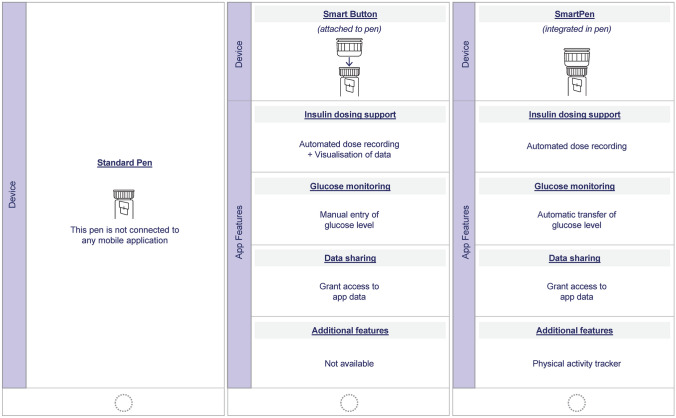
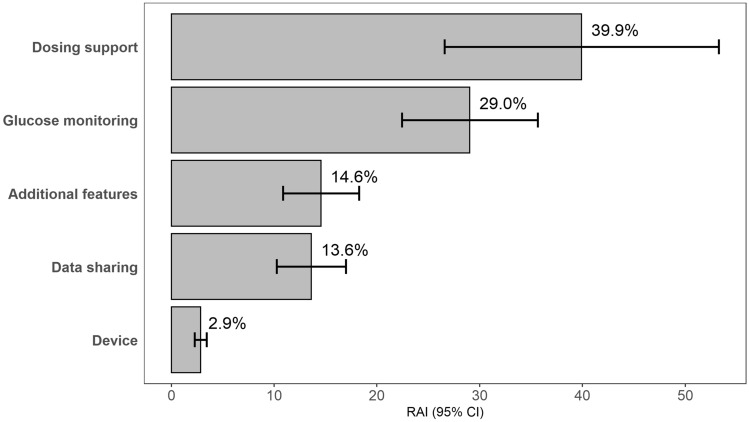
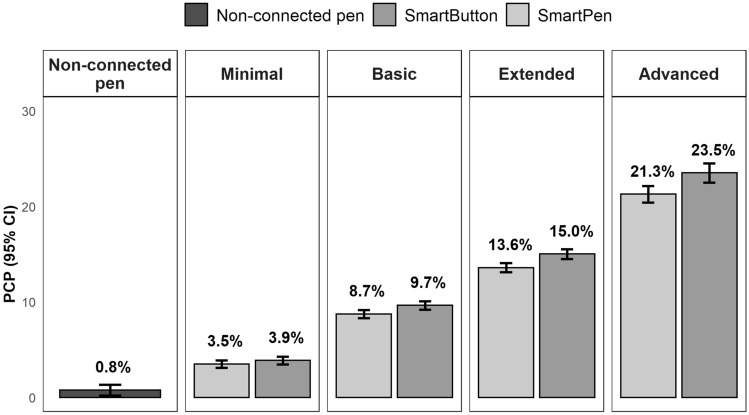
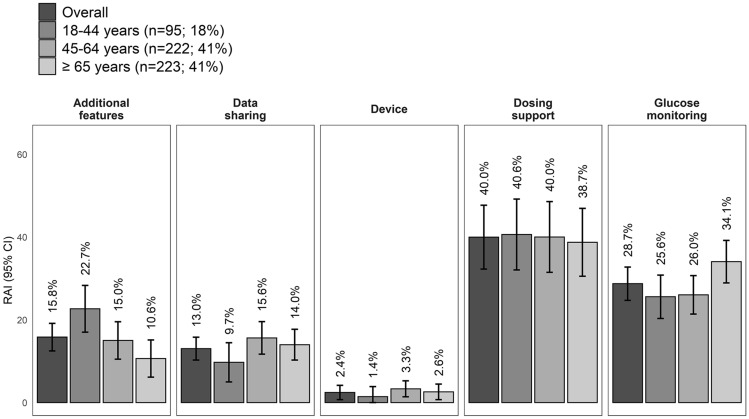
BACKGROUND: This study quantified how people with diabetes value the unique features of connected insulin pens and related mobile apps, and the underlying reasons for preferring connected versus non-connected insulin pens. METHODS: A discrete choice experiment (DCE) was conducted in the USA and UK to elicit preferences of adults (≥ 18 years) with type 1 or 2 diabetes for attributes of insulin pens. Attributes included device type, dosing support, glucose monitoring, additional app features, and data sharing. Relative attribute importance (RAI) scores were calculated to capture the relative importance of an attribute. Predicted choice probabilities were obtained to compare different profiles for connected and non-connected insulin pens. RESULTS: The DCE was completed by 540 participants (58.9% male; 90.7% Caucasian; mean age, 58.3 years; 69.4% type 2 diabetes). Participants most valued the possibility of using a connected insulin pen with dosing support and automated dose logging (RAI = 39.9%), followed by automatic transfer of glucose levels (RAI = 29.0%), additional features of tracking diet and physical activity (RAI = 14.6%), data sharing (RAI = 13.6%), and device type (RAI = 2.9%). All profiles of connected insulin pens were preferred over a non-connected pen (p < 0.001), and pen profiles with advanced features were preferred over those without (p < 0.001). Preferences differed by age but not diabetes type, country of residence, or insulin regimen. CONCLUSION: People with diabetes in the USA and UK prefer connected over non-connected insulin pens due largely to the availability of automated logging of dose and glucose levels.
Overview
The claims and statistics of this paper haven’t been checked yet.
Free: it reads the open-access text and checks the first 5 claims that cite a source we can check. Create a free account to check every claim.
Integrity signals
Registry
Cites
Statistics
Figures
Verification
Claims the paper makes
The claims and statistics of this paper haven’t been checked yet.
Free: it reads the open-access text and checks the first 5 claims that cite a source we can check. Create a free account to check every claim.
Claims other papers make about this one
Each is checked against this paper’s own text: does it say what the citing paper says it does?
In the citing paper
“These pens and pen caps are useful to people with diabetes for realtime insulin dosing and allow clinicians to retrospectively review the insulin delivery times and, in some cases, doses and glucose data to make informed insulin dose adjustments (153).”
From 7. Diabetes Technology: Standards of Care in Diabetes—2025 (2025) · cites this paper as [153]
Self-check
Percentages, sums and reported differences re-computed from the paper’s own numbers.
The self-check needs the paper’s full text.
Citations
Cites
A law of comparative judgment.
Thurstone, L. L. (1927) · Psychological Review · doi:10.1037/h0070288 · Cited by 5,210
Bridges, J. F. P., Hauber, A. B., Marshall, D., Lloyd, A., Prosser, L. A., Regier, D. A., Johnson, F. R., & Mauskopf, J. (2011) · Value in Health · doi:10.1016/j.jval.2010.11.013 · Cited by 2,029 · cited 2×
“Following best practices for preference research [25, 27], the study was conducted in three phases: a targeted literature review to identify attributes to include in the DCE, qualitative interviews to inform and test the final design of the DCE, and a main DCE.”
MethodA latent class model for discrete choice analysis: contrasts with mixed logit
Greene, W. H., & Hensher, D. A. (2003) · Transportation Research Part B: Methodological · doi:10.1016/s0191-2615(02)00046-2 · Cited by 1,893 · cited 1×
“This opt-out behavior was represented by a finite mixture of utility values associated with the non-connected pen, making the RCL a specific case of latent class analysis [38].”
MethodReed Johnson, F., Lancsar, E., Marshall, D., Kilambi, V., Mühlbacher, A., Regier, D. A., Bresnahan, B. W., Kanninen, B., & Bridges, J. F. P. (2013) · Value in Health · doi:10.1016/j.jval.2012.08.2223 · Cited by 1,799
The structure of random utility models
Manski, C. F. (1977) · Theory and Decision · doi:10.1007/bf00133443 · Cited by 1,724
Davies, M. J., D’Alessio, D. A., Fradkin, J., Kernan, W. N., Mathieu, C., Mingrone, G., Rossing, P., Tsapas, A., Wexler, D. J., & Buse, J. B. (2018) · Diabetologia · doi:10.1007/s00125-018-4729-5 · Cited by 1,455 · cited 1×
“Understanding the willingness of people with diabetes to switch from a non-connected to a connected insulin pen and the drivers of such decisions can help tailor the design of diabetes technologies to meet the needs of people using them [17, 18].”
Using conjoint analysis to elicit preferences for health care
Ryan, M. (2000) · BMJ · doi:10.1136/bmj.320.7248.1530 · Cited by 938 · cited 1×
“A DCE was conducted between March 24 and July 4, 2021, to elicit preferences of adults (aged ≥ 18 years) with diabetes for attributes of connected insulin pens [25, 26].”
MethodSample Size Requirements for Discrete-Choice Experiments in Healthcare: a Practical Guide
de Bekker-Grob, E. W., Donkers, B., Jonker, M. F., & Stolk, E. A. (2015) · The Patient - Patient-Centered Outcomes Research · doi:10.1007/s40271-015-0118-z · Cited by 925
Discrete Choice Experiments in Health Economics: Past, Present and Future
Soekhai, V., de Bekker-Grob, E. W., Ellis, A. R., & Vass, C. M. (2019) · PharmacoEconomics · doi:10.1007/s40273-018-0734-2 · Cited by 797 · cited 1×
“For example, a discrete choice experiment (DCE) can be used to elicit the effect that unique features of insulin pens have on the likelihood that people with diabetes would prefer a connected pen over a non-connected pen [19, 20].”
Background6. Glycemic Targets: Standards of Medical Care in Diabetes—2020
American Diabetes Association (2020) · Diabetes Care · doi:10.2337/dc20-s006 · Cited by 744
Research works printed but not linked: 3
- Carson R Louviere J A common nomenclature for stated preference elicitation approaches environmental and resource Economics 2011 49 539 559
- Marschak J Binary choice constraints on random utility indicators 1959 New Haven Cowles Foundation for Research in Economics, Yale University
- McFadden D Conditional logit analysis of qualitative choice behaviour 1973 New York Academic Press
Cited by
7. Diabetes Technology: Standards of Care in Diabetes—2025
American Diabetes Association Professional Practice Committee, ElSayed, N. A., McCoy, R. G., Aleppo, G., Balapattabi, K., Beverly, E. A., Briggs Early, K., Bruemmer, D., Echouffo-Tcheugui, J. B., Ekhlaspour, L., et al. (2025) · Diabetes Care · doi:10.2337/dc25-s007 · Cited by 348
7. Diabetes Technology: Standards of Care in Diabetes—2024
American Diabetes Association Professional Practice Committee, ElSayed, N. A., Aleppo, G., Bannuru, R. R., Bruemmer, D., Collins, B. S., Ekhlaspour, L., Hilliard, M. E., Johnson, E. L., Khunti, K., et al. (2024) · Diabetes Care · doi:10.2337/dc24-s007 · Cited by 281
7. Diabetes Technology: Standards of Care in Diabetes—2026
Bajaj, M. S., McCoy, R. G., Balapattabi, K., Bannuru, R. R., Bellini, N. J., Bennett, A. K., Beverly, E. A., Early, K. B., ChallaSivaKanaka, S., Echouffo-Tcheugui, J. B., et al. (2025) · Diabetes Care · doi:10.2337/dc26-s007 · Cited by 293
The Evolving Landscape of Discrete Choice Experiments in Health Economics: A Systematic Review
Nouwens, S. P. H., Marceta, S. M., Bui, M., van Dijk, D. M. A. H., Groothuis‐Oudshoorn, C. G. M., Veldwijk, J., van Til, J. A., & de Bekker-Grob, E. W. (2025) · PharmacoEconomics · doi:10.1007/s40273-025-01495-y · Cited by 60
Kang, S., Kang, S. M., Choi, J. H., Ko, S., Koo, B. K., Kwon, H.-S., Kim, M. K., Kim, S. Y., Kim, S., Kim, Y., et al. (2025) · Diabetes & Metabolism Journal · doi:10.4093/dmj.2025.0469 · Cited by 85
The Evolution of Diabetes Technology – Options Toward Personalized Care
Zahid, M., Dowlatshahi, S., Kansara, A., & Sadhu, A. (2023) · Endocrine Practice · doi:10.1016/j.eprac.2023.04.007 · Cited by 24
The use of technology in type 2 diabetes and prediabetes: a narrative review
Liarakos, A. L., Lim, J. Z. M., Leelarathna, L., & Wilmot, E. G. (2024) · Diabetologia · doi:10.1007/s00125-024-06203-7 · Cited by 27
Connected Pens or Smart Pens: Technology Needs Context
Heinemann, L., Sieber, J., & Kulzer, B. (2024) · Journal of Diabetes Science and Technology · doi:10.1177/19322968241274796 · Cited by 8
Geng, J., Li, R., Wang, X., Xu, R., Liu, J., Jiang, H., Wang, G., & Hesketh, T. M. (2024) · Patient · doi:10.1007/s40271-024-00697-4 · Cited by 6
Connected Insulin Pens and Pen Caps: Expanding Diabetes Technology Access and Adoption
MacLeod, J. (2025) · Diabetes Spectrum · doi:10.2337/dsi25-0001 · Cited by 5
McGill, J. B., Donihi, A. C., Aktürk, H. K., Freeby, M., Gupta, A., Horton, W. B., Jadoon, M. N., Lathief, S., Miracle-López, S., Tan, C., et al. (2026) · Endocrine Practice · doi:10.1016/j.eprac.2026.06.011 · Cited by 3
Preferences of US adolescents and parents for vaccination against invasive meningococcal disease
Schley, K., Whichello, C. L., Hauber, B., Krucien, N., Cappelleri, J. C., Peyrani, P., Presa, J. V., Coulter, J., & Heidenreich, S. (2024) · Vaccine · doi:10.1016/j.vaccine.2024.126264 · Cited by 2
Self-citationOut of Sight, Out of Mind: A Call to Action for the Treatment of Hypoglycemia
Goldman, J. D., & Isaacs, D. M. (2024) · Clinical Diabetes · doi:10.2337/cd24-0014 · Cited by 3
“%) did not record insulin doses (6).”
History, Classification, and Clinical Utility of Connected Insulin Pens
Kesavadev, J., Saboo, B., Parikh, R. M., Gupta, A. S., Krishnan, G., Bhartia, M., Salis, S. S., & Joshi, S. (2022) · International Journal of Diabetes and Technology · doi:10.4103/ijdt.ijdt_11_23 · Cited by 1
Physician Perceptions of Dose Escalation for Type 2 Diabetes Medications in the United States
Boye, K. S., Jordan, J. B., Malik, R., & Matza, L. S. (2023) · Diabetes Therapy · doi:10.1007/s13300-023-01499-x
Digital Health and Pharmacoadherence
Aungst, T. D., & Mukherjee, S. M. (2024) · Elsevier eBooks · doi:10.1016/b978-0-443-13244-5.00011-0
Tecnología aplicada a la diabetes
Cebada, A. B., Silva, J. B. Q., Escobar-Morreale, H. F., & Chávez, L. N. (2024) · Medicine - Programa de Formación Médica Continuada Acreditado · doi:10.1016/j.med.2024.10.004
Diabetes Technology: Continuous Glucose Monitoring and Insulin Delivery
MacLeod, J., Willis, H. J., Sulik, B., & Chomko, M. (2026) · American Diabetes Association eBooks · doi:10.2337/9781580408493-ch08 · Cited by 1
Insulin pens and the digital ecosystem
JENDLE, J. H., Adolfsson, P., Cardona‐Hernandez, R., Crenier, L., Molfetta, S. D., Ehrmann, D., Giorgino, F., Haluzík, M., Hirsch, I. B., Irace, C., et al. (2026) · Diabetologia · doi:10.1007/s00125-026-06858-4 · Cited by 1
Metadata
- Authors
- Seo, J., Heidenreich, S., Aldalooj, E., Poon, J. L., Spaepen, E., Eby, E. L., & Newson, R. S.
- Affiliations
- Eli Lilly (United States) (US)
- Eli Lilly (Australia) (AU)
- Corresponding author
- Newson, Rachel S.
- ORCID
- Venue
- The Patient - Patient-Centered Outcomes Research
- Published
- 2022-11-28
- Volume
- 16
- Issue
- 2
- Pages
- 127-138
- ISSN
- 1178-1653 (ISSN-L)
- 1178-1661
- PMC
- PMC9911509
- OpenAlex
- W4310172345
- Cited by
- 19
- References
- 47
- Citations by year
- 2026: 3 · 2025: 4 · 2024: 8 · 2023: 3 · 2022: 1
- FWCI
- 2.96
- Type
- journal article
- Language
- en
- Open access
- hybrid
- doi.org
- Licence
- cc-by-nc
- creativecommons.org/licenses/by-nc/4.0 (tdm)
- creativecommons.org/licenses/by-nc/4.0 (vor)
- Locations
- Patient (publishedVersion, cc-by-nc)
- PubMed Central (publishedVersion, cc-by-nc)
- PubMed (publishedVersion)
- RePEc: Research Papers in Economics (submittedVersion)
- Funders
- Eli Lilly and Company (Eli lilly funded Evidera to perform the study)
- Topics
- Health Sciences › Medicine › Endocrinology, Diabetes and Metabolism › Diabetes Management and Research
- Health Sciences › Medicine › Endocrinology, Diabetes and Metabolism › Diabetes Management and Education
- Social Sciences › Economics, Econometrics and Finance › Economics and Econometrics › Economic and Environmental Valuation
- Keywords
- connected insulin pens, type 1 diabetes, type 2 diabetes, patient preferences, mobile health apps, glucose monitoring, data sharing, relative attribute importance, age differences in preference
- MeSH terms
- Adult, Blood Glucose, Diabetes Mellitus, Type 2, Female, Humans, Hypoglycemic Agents, Insulin, Male, Middle Aged, Blood Glucose Self-Monitoring, Patient Preference
About these checks
Registry, retraction, Cites and statistics results are computed, not judged, with one exception: a printed reference that no index lists is read once by a model before it counts as a citation error. Claims are extracted by a model and kept only when their quote appears verbatim in the text; each cited source is then checked, with a model’s help, for whether it says what the claim relies on. Those verdicts can be wrong — read the claim’s quote and the cited source before relying on one.
Statistics and arithmetic are recomputed, not judged.
Confidence bands are shown only for fields calibrated on our annotated test set. None is calibrated yet, so no band is shown.
What counts as a claim ›How we measure confidence ›How we check this ›
Are you an author, or do you see a problem with this page? Request a review
Data sources
Bibliographic data: Semantic Scholar, OpenAlex, Crossref.
Contains information from the Semantic Scholar Academic Graph Datasets, made available under the ODC Attribution License (ODC-BY 1.0).
Semantic Scholar’s data is described in: Kinney, R., et al. (2023). The Semantic Scholar Open Data Platform. arXiv:2301.10140.
