

Incidence of Running-Related Injuries Per 1000 h of running in Different Types of Runners: A Systematic Review and Meta-Analysis
Open accessThe DOI matches its Crossref record; 26 of the 26 references it cites were found in a registry or an index; none of the 16 sources its claims cite is checked for support yet.
Abstract
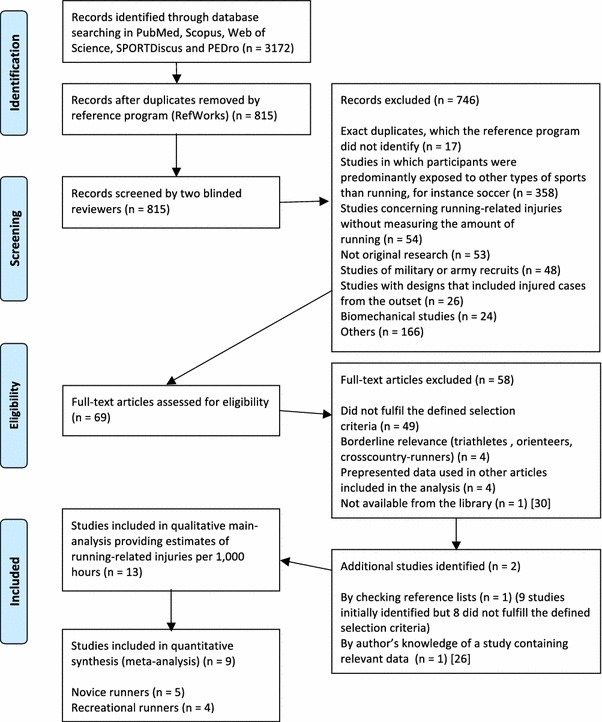
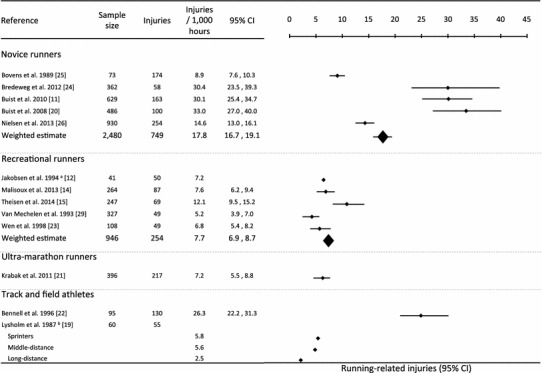
BACKGROUND: No systematic review has identified the incidence of running-related injuries per 1000 h of running in different types of runners. OBJECTIVE: The purpose of the present review was to systematically search the literature for the incidence of running-related injuries per 1000 h of running in different types of runners, and to include the data in meta-analyses. DATA SOURCES: A search of the PubMed, Scopus, SPORTDiscus, PEDro and Web of Science databases was conducted. STUDY SELECTION: Titles, abstracts, and full-text articles were screened by two blinded reviewers to identify prospective cohort studies and randomized controlled trials reporting the incidence of running-related injuries in novice runners, recreational runners, ultra-marathon runners, and track and field athletes. STUDY APPRAISAL AND SYNTHESIS METHODS: Data were extracted from all studies and comprised for further analysis. An adapted scale was applied to assess the risk of bias. RESULTS: After screening 815 abstracts, 13 original articles were included in the main analysis. Running-related injuries per 1000 h of running ranged from a minimum of 2.5 in a study of long-distance track and field athletes to a maximum of 33.0 in a study of novice runners. The meta-analyses revealed a weighted injury incidence of 17.8 (95% confidence interval [CI] 16.7-19.1) in novice runners and 7.7 (95% CI 6.9-8.7) in recreational runners. LIMITATIONS: Heterogeneity in definitions of injury, definition of type of runner, and outcome measures in the included full-text articles challenged comparison across studies. CONCLUSION: Novice runners seem to face a significantly greater risk of injury per 1000 h of running than recreational runners.
Overview
CoChat Summary
TL;DR
This systematic review and meta-analysis found that running-related injury incidence per 1000 h of running was higher in novice runners than recreational runners. Pooled estimates were 17.8 (95% CI 16.7–19.1) for novice runners and 7.7 (95% CI 6.9–8.7) for recreational runners.
Key findings
- Across 13 included articles, running-related injuries per 1000 h of running ranged from 2.5 in long-distance track and field athletes to 33.0 in novice runners.
- Meta-analysis weighted injury incidence was 17.8 (95% CI 16.7–19.1) in novice runners and 7.7 (95% CI 6.9–8.7) in recreational runners; novice runners faced a significantly greater risk.
- One ultra-marathon study reported 7.2 injuries per 1000 h; two track and field studies reported 2.5 to 26.3 per 1000 h, with no weighted estimates calculated for these groups.
- Ten studies pooled for a per-1000-km subanalysis gave a weighted estimate of 1.07 (95% CI 1.01–1.13) running-related injuries per 1000 km.
Methods
- Systematic search of PubMed, Scopus, SPORTDiscus, PEDro, and Web of Science without date restriction; two blinded reviewers screened titles, abstracts, and full texts to include prospective cohort studies and randomized controlled trials in novice runners, recreational runners, ultra-marathon runners, and track and field athletes.
- 13 articles were included (8 prospective cohort studies and 5 randomized controlled trials); data were extracted on study characteristics, injury definitions, and incidence per 1000 h and per 1000 km, and risk of bias was assessed with an adapted Newcastle Ottawa Scale modified for runners.
- Meta-analyses pooled estimates for novice and recreational runners; because one article lacked data to calculate 95% CIs, nine studies were included in the quantitative analyses, and ten studies were pooled for the per-1000-km subanalysis.
Limitations
- Stated: heterogeneity in definitions of injury, definition of type of runner, and outcome measures challenged comparison across studies; exposure time was often self-reported in web-based running diaries, risking recall bias and inaccurate training hours or distance; there was lack of agreement in how exposure time was calculated.
- Stated: not all studies provided raw data or 95% CIs, and corresponding authors were contacted; for Buist et al. [11], separate data for runner groups were unavailable, so the 30.1 per 1000 h estimate was included in the novice category, meaning the true novice incidence might be even higher; only a few studies reported ultra-marathon and track and field incidences, so no weighted estimates were calculated.
- Evident from the text: follow-up periods ranged from 7 days to 81 weeks, and novice-runner estimates were heterogeneous (three studies ranged from 30.1 to 33, higher than the two remaining studies), possibly due to follow-up length and a healthy participant effect; risk-of-bias assessment averaged 6 out of 8 stars (range 3–8), with low stars for ascertainment of exposure (6/13) and assessment of outcome (8/13).
Model-written summary. Check it against the paper before relying on it.
Integrity signals
Registry
Cites
Statistics
Figures
Verification
Claims the paper makes
0 Valid · 1 Not valid · 16 Not checked · 65 Own results and interpretations
A result the paper states — it cites no source for it, so there is none to check. The quote shows it is in the paper.
In the paper
“No systematic review has identified the incidence of running-related injuries per 1000 h of running in different types of runners.”
- Also stated in: § Introduction · plain
“However, no review has been published which systematically searched the literature for studies with information on the incidence of running-related injuries in different types of runners per 1000 h of running.”
§ Incidence of Running-Related Injuries Per 1000 h of running in Different Types of Runners: A Systematic Review and Meta-Analysis > Abstract > Background
plain- Asserted: passes — The authors put it forward as true.
- Checkable: passes — It can be checked against evidence.
- Load-bearing: passes — The paper’s conclusions depend on it.
- Based: passes — The paper gives a reason why it holds.
- Also stated in: § Introduction · plain
A result the paper reports from its own data — it cites no other source for it, so there is none to check. The quote shows it is in the paper.
In the paper
“The meta-analyses revealed a weighted injury incidence of 17.8 (95 % confidence interval [CI] 16.7–19.1) in novice runners and 7.7 (95 % CI 6.9–8.7) in recreational runners.”
§ Incidence of Running-Related Injuries Per 1000 h of running in Different Types of Runners: A Systematic Review and Meta-Analysis > Abstract > Results
plain- Asserted: passes — The authors put it forward as true.
- Checkable: passes — It can be checked against evidence.
- Load-bearing: passes — The paper’s conclusions depend on it.
- Based: passes — The paper gives a reason why it holds.
A result the paper reports from its own data — it cites no other source for it, so there is none to check. The quote shows it is in the paper.
In the paper
“The weighted estimate revealed an injury incidence of 1.07 (95 % CI 1.01–1.13) per 1000 km of running.”
§ Incidence of Running-Related Injuries Per 1000 h of running in Different Types of Runners: A Systematic Review and Meta-Analysis > Results
plain- Asserted: passes — The authors put it forward as true.
- Checkable: passes — It can be checked against evidence.
- Load-bearing: unclear — It is unclear whether the paper’s conclusions depend on it.
- Based: passes — The paper gives a reason why it holds.
None of the sources cited for this claim have been checked yet.
In the paper
“Further, some studies specified the premise that the same runner was included and was contributing exposure time, if running was resumed after an injury occurrence [21, 22].”
§ Incidence of Running-Related Injuries Per 1000 h of running in Different Types of Runners: A Systematic Review and Meta-Analysis > Discussion
plain- Asserted: passes — The authors put it forward as true.
- Checkable: passes — It can be checked against evidence.
- Load-bearing: passes — The paper’s conclusions depend on it.
- Based: passes — The paper gives a reason why it holds.
In the paper
“In the latter, track and field athletes were subdivided into sprinters, middle-distance runners, and long-distance runners, which may be relevant as the reported running-related injury incidence per 1000 h was greater in sprinters and middle-distance runners than in long-distance runners [19].”
§ Incidence of Running-Related Injuries Per 1000 h of running in Different Types of Runners: A Systematic Review and Meta-Analysis > Discussion
What the sources say
- Not checked yetcites [19] Lysholm J Wiklander J Injuries in runners Am J Sports Med. 1987 15 2 168 171 10.1177/036354658701500213 3578639 source
plainstates an association- Asserted: passes — The authors put it forward as true.
- Checkable: passes — It can be checked against evidence.
- Load-bearing: unclear — It is unclear whether the paper’s conclusions depend on it.
- Based: passes — The paper gives a reason why it holds.
22 more claims
Create a free account to see all 82 claims and to verify the 16 references still open.
- Probably not a substantial claim. 40
- It may state two separate claims as one. 37
Claims other papers make about this one
Each is checked against this paper’s own text: does it say what the citing paper says it does?
In the citing paper
“Whereas previous data suggested greater injury rates in novice compared with recreational runners, 51 our findings suggested the opposite, with a greater incidence in recreational (26.1%) than in novice runners (14.9%).”
From The Association Between Running Injuries and Training Parameters: A Systematic Review (2022) · cites this paper as [51]
Self-check
Percentages, sums and reported differences re-computed from the paper’s own numbers.
Each contradiction between two passages listed here was confirmed by an independent check.
Rated minor: it would not touch a result — a value no result rests on, a p-value that stays on the same side of the significance level, or a conflict that is clerical, resolved elsewhere in the paper, or outside its own findings.
In the paper
§ Incidence of Running-Related Injuries Per 1000 h of running in Different Types of Runners: A Systematic Review and Meta-Analysis > Discussion
“the study by Bovens et al. [25], which received no star in item 5 because running exposure was collected in diaries”
§ Incidence of Running-Related Injuries Per 1000 h of running in Different Types of Runners: A Systematic Review and Meta-Analysis > Results
“| Bovens et al. [25] | * | * | * | 0 | * | * | * | * |”
Rated minor: it would not touch a result — a value no result rests on, a p-value that stays on the same side of the significance level, or a conflict that is clerical, resolved elsewhere in the paper, or outside its own findings.
In the paper
“| Jakobsen et al. [12], Denmark | Randomised controlled trial (12 months) | 41 Recreational long-distance runners. Had all taken part in marathon races and intended to take part in at least two marathons during the year of investigation | 19 Men and 2 women aged 24–56.”
§ Incidence of Running-Related Injuries Per 1000 h of running in Different Types of Runners: A Systematic Review and Meta-Analysis > Methods > Data Collection
Reported 41 · recomputed 21
Citations
Cites
van Gent, R. N., Siem, D., van Middelkoop, M., van Os, A. G., Bierma-Zeinstra, S. M. A., & Koes, B. W. (2007) · British Journal of Sports Medicine · doi:10.1136/bjsm.2006.033548 · Cited by 1,420
What are the Main Running-Related Musculoskeletal Injuries?: A Systematic Review
Lopes, A. D., Hespanhol, L. C., Yeung, S. S., & Costa, L. O. P. (2012) · Sports Medicine · doi:10.1007/bf03262301 · Cited by 715
Lysholm, J., & Wiklander, J. (1987) · The American Journal of Sports Medicine · doi:10.1177/036354658701500213 · Cited by 618
Running Injuries: A Review of the Epidemiological Literature
van Mechelen, W. (1992) · Sports Medicine · doi:10.2165/00007256-199214050-00004 · Cited by 521
Bennell, K. L., Malcolm, S. A., Thomas, S. A., Wark, J. D., & Brukner, P. D. (1996) · The American Journal of Sports Medicine · doi:10.1177/036354659602400217 · Cited by 420
What are the Main Risk Factors for Running-Related Injuries?
Saragiotto, B. T., Yamato, T. P., Hespanhol Junior, L. C., Rainbow, M. J., Davis, I. S., & Lopes, A. D. (2014) · Sports Medicine · doi:10.1007/s40279-014-0194-6 · Cited by 278
Buist, I., Bredeweg, S. W., Bessem, B., van Mechelen, W., Lemmink, K. A. P. M., & Diercks, R. L. (2010) · British Journal of Sports Medicine · doi:10.1136/bjsm.2007.044677 · Cited by 258
Prevention of running injuries by warm-up, cool-down, and stretching exercises
van Mechelen, W., Hlobil, H., Kemper, H. C. G., Voorn, W. J., & de Jongh, H. R. (1993) · The American Journal of Sports Medicine · doi:10.1177/036354659302100513 · Cited by 223
Lower extremity alignment and risk of overuse injuries in runners
Wen, D. Y. K., Puffer, J. C., & Schmalzried, T. P. (1997) · Medicine & Science in Sports & Exercise · doi:10.1097/00005768-199710000-00003 · Cited by 187
Buist, I., Bredeweg, S. W., van Mechelen, W., Lemmink, K. A. P. M., Pepping, G.-J., & Diercks, R. L. (2008) · The American Journal of Sports Medicine · doi:10.1177/0363546507307505 · Cited by 167
Cited by
Items 101–200 of 532
Footwear and running-related injuries – Running on faith?
Theisen, D., Malisoux, L., Gette, P., Nührenbörger, C., & Urhausen, A. J. P. (2016) · Sports Orthopaedics and Traumatology · doi:10.1016/j.orthtr.2016.03.047 · Cited by 27
Fitzgerald, D. A., Beckmans, C., Joyce, D., & Mills, K. A. G. (2018) · Journal of science and medicine in sport · doi:10.1016/j.jsams.2018.06.011 · Cited by 28
Nakaoka, G., Barboza, S. D., Verhagen, E., van Mechelen, W., & Hespanhol, L. (2021) · Sports Medicine · doi:10.1007/s40279-021-01483-0 · Cited by 16
How much running is too much? Identifying high-risk running sessions in a 5200-person cohort study
Schuster Brandt Frandsen, J., Hulme, A., Parner, E. T., Møller, M., Lindman, I., Abrahamson, J., Sjørup Simonsen, N., Sandell Jacobsen, J., Ramskov, D., Skejø, S., et al. (2025) · British Journal of Sports Medicine · doi:10.1136/bjsports-2024-109380 · Cited by 25
Self-citationWillems, T. M., Ley, C., Goetghebeur, E. J. T., Theisen, D., & Malisoux, L. (2020) · Journal of Orthopaedic and Sports Physical Therapy · doi:10.2519/jospt.2021.9710 · Cited by 25
Vanwanseele, B., Beéck, T. O. D., Schütte, K., & Davis, J. J. (2020) · Frontiers in Sports and Active Living · doi:10.3389/fspor.2020.575596 · Cited by 26
Effect of the Construction of Carbon Fiber Plate Insert to Midsole on Running Performance
Fu, F., Levadnyi, I., Wang, J., Xie, Z., Fekete, G., Cai, Y., & Gu, Y. (2021) · Materials · doi:10.3390/ma14185156 · Cited by 24
van Iperen, L. P., JONGE, J. D., Gevers, J., & Vos, S. B. (2021) · Psychology of sport and exercise · doi:10.1016/j.psychsport.2021.102082 · Cited by 24
Competitive and Recreational Running Kinematics Examined Using Principal Components Analysis
Quan, W., Zhou, H., Xu, D., Li, S., Baker, J. S., & Gu, Y. (2021) · Healthcare · doi:10.3390/healthcare9101321 · Cited by 24
Factors Influencing Runner's Choices of Footwear
Ramsey, C. A., Lamb, P. F., & Ribeiro, D. C. (2022) · Frontiers in Sports and Active Living · doi:10.3389/fspor.2022.829514 · Cited by 24
Running-induced fatigue and impact loading in runners: A systematic review and meta-analysis
Darch, L., Chalmers, S., Wiltshire, J., Causby, R. S., & Arnold, J. B. (2022) · Journal of Sports Sciences · doi:10.1080/02640414.2022.2089803 · Cited by 25
Tao, H., Joyce, L., Kozak, B., Luiken, J., & Wendt, N. (2019) · International Journal of Sports Physical Therapy · doi:10.26603/ijspt20190731 · Cited by 24
Factors Associated With Half- and Full-Marathon Race-Related Injuries: A 3-Year Review
Mohseni, M., Filmalter, S. E., Taylor, W. C., Vadeboncoeur, T. F., & Thomas, C. S. (2019) · Clinical Journal of Sport Medicine · doi:10.1097/jsm.0000000000000775 · Cited by 24
Nelson, E. O., Kliethermes, S., & Heiderscheit, B. C. (2020) · Journal of Orthopaedic and Sports Physical Therapy · doi:10.2519/jospt.2020.9698 · Cited by 24
Reliability and validity of 2-dimensional video analysis for a running task: A systematic review
Hensley, C. P., Kontos, D., Feldman, C., Wafford, Q. E., Wright, A. A., & Chang, A. H. (2022) · Physical Therapy in Sport · doi:10.1016/j.ptsp.2022.08.001 · Cited by 23
Mann, R. H., Clarsen, B. M., McKay, C. D., Clift, B. C., Williams, C. A., & BARKER, A. R. (2021) · Journal of Sports Sciences · doi:10.1080/02640414.2021.1874160 · Cited by 23
Peak Muscle and Joint Contact Forces of Running with Increased Duty Factors
Bonnaerens, S., Rossom, S. V., Fiers, P., Caekenberghe, I. V., Derie, R., Kaneko, Y., Frederick, E. C., Vanwanseele, B., Aerts, P., Clercq, D. D., et al. (2022) · Medicine & Science in Sports & Exercise · doi:10.1249/mss.0000000000002974 · Cited by 22
Nielsen, R. O., Ramskov, D., Blacket, C., & Malisoux, L. (2023) · Journal of Orthopaedic and Sports Physical Therapy · doi:10.2519/jospt.2023.11959 · Cited by 22
Self-citationJelvegård, S., Timpka, T., Bargoria, V., Gauffin, H., & Jacobsson, J. (2016) · Orthopaedic Journal of Sports Medicine · doi:10.1177/2325967116673972 · Cited by 22
Dingenen, B., Staes, F. F. G. M., Vanelderen, R., Ceyssens, L., Malliaras, P., Barton, C. J., & Deschamps, K. (2020) · Physical Therapy in Sport · doi:10.1016/j.ptsp.2020.04.032 · Cited by 22
Garcia, M. C., Gust, G., & Bazett-Jones, D. M. (2021) · Journal of science and medicine in sport · doi:10.1016/j.jsams.2021.03.006 · Cited by 22
The socio‐economic impact of running‐related injuries: A large prospective cohort study
Visser, T. S., van Middelkoop, M., Fokkema, T., & de Vos, R. (2021) · Scandinavian Journal of Medicine and Science in Sports · doi:10.1111/sms.14016 · Cited by 23
Brake, M. T., Stolwijk, N. M., Staal, J. B., & Hooren, B. V. (2022) · European Journal of Sport Science · doi:10.1080/17461391.2022.2042398 · Cited by 22
THE START-TO-RUN DISTANCE AND RUNNING-RELATED INJURY AMONG OBESE NOVICE RUNNERS: A RANDOMIZED TRIAL
Bertelsen, M. L., Hansen, M., Rasmussen, S., & Nielsen, R. O. (2018) · International Journal of Sports Physical Therapy · doi:10.26603/ijspt20180943 · Cited by 22
Self-citationThe effects of midfoot strike gait retraining on impact loading and joint stiffness
Chan, Z. Y. S., Zhang, J. H., Ferber, R., Shum, G. L. K., & Cheung, R. T. H. (2020) · Physical Therapy in Sport · doi:10.1016/j.ptsp.2020.01.011 · Cited by 22
Zeng, Z., Liu, Y., Li, P., & Wang, L. (2022) · Frontiers in Bioengineering and Biotechnology · doi:10.3389/fbioe.2022.1005496 · Cited by 21
The relationship between the use of running applications and running-related injuries
Kemler, E., Romeijn, K., Vriend, I. I., & Huisstede, B. M. A. (2017) · The Physician and Sportsmedicine · doi:10.1080/00913847.2018.1412812 · Cited by 21
Rosenbloom, C., Morley, F. L., Ahmed, I., & Cox, A. R. (2020) · International Journal of Pharmacy Practice · doi:10.1111/ijpp.12646 · Cited by 21
MRI features of and factors related to ankle injuries in asymptomatic amateur marathon runners
Yao, W., Zhang, Y., Zhang, L., Zhou, J., Zhang, Y., Zheng, X., & Ding, J. (2020) · Skeletal Radiology · doi:10.1007/s00256-020-03530-9 · Cited by 23
Hearn, D. W., Kerr, Z. Y., Wikstrom, E. A., Goss, D. L., Cameron, K. L., Marshall, S. W., & Padua, D. A. (2021) · Orthopaedic Journal of Sports Medicine · doi:10.1177/23259671211039841 · Cited by 20
Anxiety state impact on recovery of runners with lower extremity injuries
Madsen, A., Sharififar, S., Oberhaus, J., Vincent, K. R., & Vincent, H. K. (2022) · PLoS ONE · doi:10.1371/journal.pone.0278444 · Cited by 20
Jafarnezhadgero, A., Fatollahi, A., Sheykholeslami, A., Dionísio, V. C., & Akrami, M. (2021) · BioMedical Engineering OnLine · doi:10.1186/s12938-021-00955-8 · Cited by 20
Besomi, M., Leppe, J., Mauri-Stecca, M. V., Hooper, T. L., & Sizer, P. S. (2019) · Journal of Human Sport and Exercise · doi:10.14198/jhse.2019.143.06 · Cited by 21
Yang, Y., & Zhao, Y. (2024) · Materials & Design · doi:10.1016/j.matdes.2024.112991 · Cited by 19
Reference Values and Determinants of Spatiotemporal and Kinetic Variables in Recreational Runners
Malisoux, L., Napier, C., Gette, P., Delattre, N., & Theisen, D. (2023) · Orthopaedic Journal of Sports Medicine · doi:10.1177/23259671231204629 · Cited by 18
Predicting vertical ground reaction force characteristics during running with machine learning
Bogaert, S., Davis, J. J., & Vanwanseele, B. (2024) · Frontiers in Bioengineering and Biotechnology · doi:10.3389/fbioe.2024.1440033 · Cited by 19
Strength Training Habits in Amateur Endurance Runners in Spain: Influence of Athletic Level
García‐Pinillos, F., Lago‐Fuentes, C., Jaén‐Carrillo, D., Bujalance-Moreno, P., Román, P. Á. L., Roche-Seruendo, L. E., & Ramírez‐Campillo, R. (2020) · International Journal of Environmental Research and Public Health · doi:10.3390/ijerph17218184 · Cited by 18
Fatal Events Related to Running Competitions in the Mountains
Roi, G. S. (2021) · Wilderness and Environmental Medicine · doi:10.1016/j.wem.2020.12.001 · Cited by 18
Möhler, F., Kettner, C., & Stein, T. (2022) · PLoS ONE · doi:10.1371/journal.pone.0265550 · Cited by 18
Ramskov, D., Nielsen, R. O., Sørensen, H., Parner, E. T., Lind, M., & Rasmussen, S. (2016) · BMC Musculoskeletal Disorders · doi:10.1186/s12891-016-1020-0 · Cited by 18
Self-citationLacey, A., Whyte, E. F., O’Keeffe, S., O’Connor, S., Burke, A., & Moran, K. (2023) · PLoS ONE · doi:10.1371/journal.pone.0292369 · Cited by 17
Shah, M., Shah, A., Patel, K., Kshirsagar, A., Sanghvi, S., & Sojitra, V. (2025) · Machine learning for computational science and engineering · doi:10.1007/s44379-025-00017-z · Cited by 17
Running status and history: A self-report study
Wiegand, K., Mercer, J. A., Navalta, J. W., Pharr, J. R., Tandy, R. D., & Silvernail, J. F. (2019) · Physical Therapy in Sport · doi:10.1016/j.ptsp.2019.06.003 · Cited by 17
Quantitative and Qualitative Running Gait Analysis through an Innovative Video-Based Approach
Simoni, L., Scarton, A. M., Macchi, C., Gori, F., Pasquini, G., & Pogliaghi, S. (2021) · Sensors · doi:10.3390/s21092977 · Cited by 17
Injury Incidence and Pattern in Elite Young Male and Female Trail Runners
Sanchez-Garcia, L. F., Penichet-Tomás, A., Pueo, B., & Jiménez-Olmedo, J. M. (2022) · Applied Sciences · doi:10.3390/app12031155 · Cited by 17
Johnston, A. N. B., Wadham, J., Brown, J., Aitken, M., Ranse, J., Hutton, A. E., Richards, B., & Crilly, J. L. (2019) · Prehospital and Disaster Medicine · doi:10.1017/s1049023x18001206 · Cited by 17
Linton, L., & Valentin, S. (2020) · Physical Therapy in Sport · doi:10.1016/j.ptsp.2020.08.004 · Cited by 11
Quan, W., Ren, F., Xu, D., Fekete, G., Baker, J. S., & Gu, Y. (2021) · Frontiers in Bioengineering and Biotechnology · doi:10.3389/fbioe.2021.746761 · Cited by 17
Maschke, B., Palmsten, A., Nelson, E. O., Obermeier, M. C., Reams, M., Heiderscheit, B. C., Russell, H. C., & Chmielewski, T. L. (2021) · Physical Therapy in Sport · doi:10.1016/j.ptsp.2021.12.005 · Cited by 16
Colapietro, M., Fraser, J. J., Resch, J. E., & Hertel, J. N. (2019) · Physical Therapy in Sport · doi:10.1016/j.ptsp.2019.11.010 · Cited by 16
González‐Gross, M., Quesada, C., Rueda, J., Sillero‐Quintana, M., Issaly, N., Díaz, Á. E., Gesteiro, E., Escobar-Toledo, D., de Torres-Peralta, R. S., Roller, M., et al. (2021) · International Journal of Environmental Research and Public Health · doi:10.3390/ijerph18115538 · Cited by 16
Mayne, R., Bleakley, C., & Matthews, M. (2021) · BMC Sports Science Medicine and Rehabilitation · doi:10.1186/s13102-021-00347-4 · Cited by 16
Effect of aerobic training volume on VO2max and time trial of runners
Barbosa, R. R., Perrier-Melo, R. J., Gomes, J. L. D. B., Guimarães, F. J. D. S. P., & Costa, M. D. C. (2024) · Journal of Human Sport and Exercise · doi:10.55860/90apnb26 · Cited by 15
Davinelli, S., Intrieri, M., Alì, S., Righetti, S., Mondazzi, L., Scapagnini, G., & Corbi, G. (2021) · European Journal of Sport Science · doi:10.1080/17461391.2021.1998643 · Cited by 15
Romaratezabala, E., Castillo, D., González, J. R., Rodríguez‐Negro, J., Aritzeta, I., & Yanci, J. (2020) · International Journal of Environmental Research and Public Health · doi:10.3390/ijerph17165649 · Cited by 16
Injury Risk Factors Associated with Weight Training
Grier, T., Brooks, R. D., Solomon, Z., & Jones, B. H. (2022) · Journal of Strength & Conditioning Research · doi:10.1519/jsc.0000000000003791 · Cited by 14
Mitchell, C., McDonnell, S., Oganezova, K., Mockler, D., & Fleming, N. (2023) · Sports Biomechanics · doi:10.1080/14763141.2023.2236058 · Cited by 14
Koh, H. L. A., Lin, W.-H., & Kong, P. W. (2020) · PubMed · Cited by 14
Brund, R. B. K., Waagepetersen, R. P., Nielsen, R. O., Rasmussen, J., Nielsen, M. S., Andersen, C. H., & de Zee, M. (2021) · Sensors · doi:10.3390/s21217418 · Cited by 14
Self-citationEdler, C., Droste, J.-N., Anemüller, R., Pietsch, A., Gebhardt, M., & Riepenhof, H. (2021) · The Physician and Sportsmedicine · doi:10.1080/00913847.2021.2009744 · Cited by 14
Fokkema, T., Varkevisser, N., de Vos, R., Bierma‐Zeinstra, S., & van Middelkoop, M. (2022) · Clinical Journal of Sport Medicine · doi:10.1097/jsm.0000000000001076 · Cited by 14
Neto, M. G., Metsavaht, L. F., Arcanjo, F. L., Guimarães, J. D. S., Conceição, C. S., Guadagnin, E. C., Carvalho, V. O., & Leporace, G. (2023) · Current Emergency and Hospital Medicine Reports · doi:10.1007/s40138-023-00263-6 · Cited by 14
Incidence and Risk Factors of Low Back Pain in Marathon Runners
Wu, B., Chen, C.-C., Wang, J., & Wang, X. (2021) · Pain Research and Management · doi:10.1155/2021/6660304 · Cited by 14
Luz, B. C., dos Santos, A. F., & Serrão, F. V. (2020) · Gait & Posture · doi:10.1016/j.gaitpost.2020.11.027 · Cited by 13
Brund, R. B. K., Rasmussen, S., Kersting, U. G., Arendt‐Nielsen, L., & Palsson, T. S. (2018) · Scandinavian Journal of Pain · doi:10.1515/sjpain-2018-0084 · Cited by 13
Self-citationWolthon, A., Nielsen, R. O., Willy, R. W., Taylor‐Haas, J. A., & Paquette, M. R. (2020) · Footwear Science · doi:10.1080/19424280.2020.1734869 · Cited by 13
Self-citationHarrison, K. D., Sima, A. P., Zernicke, R. F., Darter, B. J., Shall, M. S., Williams, D. S. B., & Finucane, S. (2021) · Journal of Applied Biomechanics · doi:10.1123/jab.2020-0140 · Cited by 13
Holmes, H. H., Monaghan, P. G., Strunk, K. K., Paquette, M. R., & Roper, J. A. (2021) · Frontiers in Sports and Active Living · doi:10.3389/fspor.2021.637516 · Cited by 13
Habitual Running Style Matters: Duty Factor, and Not Stride Frequency, Relates to Loading Magnitude
der Meulen, L. V., Bonnaerens, S., Caekenberghe, I. V., Clerq, D. D., Segers, V., & Fiers, P. (2024) · Journal of Human Kinetics · doi:10.5114/jhk/191528 · Cited by 12
Incidence and biomechanical risk factors for running-related injuries: A prospective cohort study
Moreira, P. F., Veras, P. M., de Oliveira, T. M. D., de Souza, M. A., Catharino, L. L., Borel, W. P., Barbosa, A. C., Fonseca, D. S., & Felício, D. C. (2024) · Journal of Clinical Orthopaedics and Trauma · doi:10.1016/j.jcot.2024.102562 · Cited by 12
Virtual Cycling For Promoting a Healthy Lifestyle
Supriyanto, C., & Liu, B. (2021) · International Journal Of Science Technology & Management · doi:10.46729/ijstm.v2i1.114 · Cited by 12
Most Common Injuries in Crossfit Training: A Systematic Review
Channah, J. B., Mehrab, M., & Maria, C. N. (2022) · International Journal of Sports and Exercise Medicine · doi:10.23937/2469-5718/1510228 · Cited by 12
(2017) · PubMed
Training and technique choices predict self-reported running injuries: An international study
Warne, J. P., Gruber, A. H., Cheung, R. T. H., & Bonacci, J. (2020) · Physical Therapy in Sport · doi:10.1016/j.ptsp.2020.12.017 · Cited by 12
den Berghe, P. V., Breine, B., Haeck, E., & Clercq, D. D. (2021) · Journal of sport and health science/Journal of Sport and Health Science · doi:10.1016/j.jshs.2021.03.009 · Cited by 12
Júnior, J. R. D. S., Gaudette, L. W., Johnson, C. D., Matheus, J. P. C., Lemos, T. V., Davis, I. S., & Tenforde, A. S. (2024) · Sports Medicine - Open · doi:10.1186/s40798-023-00671-8 · Cited by 11
Gao, S., Song, Y., Sun, D., Zheng, Z., Chen, H., Zhang, Q., Xu, Y., & Gu, Y. (2024) · Acta of Bioengineering and Biomechanics · doi:10.37190/abb-02461-2024-03 · Cited by 11
Hollman, H., Ezzat, A. M., Esculier, J.-F., Gustafson, P., & Scott, A. (2019) · Physical Therapy in Sport · doi:10.1016/j.ptsp.2019.04.003 · Cited by 11
Fokkema, T., de Vos, R., Visser, E., Krastman, P., IJzerman, J., Koes, B. W., Verhaar, J. A. N., Bierma‐Zeinstra, S., & van Middelkoop, M. (2020) · BMJ Open Sport & Exercise Medicine · doi:10.1136/bmjsem-2020-000780 · Cited by 11
Mokwena, P. L., Schwellnus, M. P., van Rensburg, A. J., Ramagole, D., Boer, P., & Jordaan, E. (2021) · Clinical Journal of Sport Medicine · doi:10.1097/jsm.0000000000000949 · Cited by 11
Okamura, K., Hasegawa, M., Ikeda, T., Fukuda, K., Egawa, K., & Kanai, S. (2022) · Gait & Posture · doi:10.1016/j.gaitpost.2022.01.006 · Cited by 11
Linton, L., Barr, M., & Valentin, S. (2022) · Journal of Sport Rehabilitation · doi:10.1123/jsr.2021-0364 · Cited by 11
Lang, C., Schleichardt, A., Warschun, F., Walter, N., Fleckenstein, D., Berkel, F., & Ueberschär, O. (2023) · Sports · doi:10.3390/sports11100204 · Cited by 11
Hoglund, L. T., Silbernagel, K. G., & Taweel, N. R. (2015) · PubMed Central · Cited by 11
How Do Novice Runners With Different Body Mass Indexes Begin a Self-chosen Running Regime?
Bertelsen, M. L., Hansen, M., Rasmussen, S., & Nielsen, R. O. (2018) · Journal of Orthopaedic and Sports Physical Therapy · doi:10.2519/jospt.2018.8169 · Cited by 11
Self-citationMobile Technology in Running Science and Medicine: Are We Ready?
Johnston, W., & Heiderscheit, B. C. (2019) · Journal of Orthopaedic and Sports Physical Therapy · doi:10.2519/jospt.2019.0604 · Cited by 11
Duchetto, F. D., Dussault-Picard, C., Gagnon, M., Dixon, P. C., & Cherni, Y. (2024) · Sports Medicine - Open · doi:10.1186/s40798-024-00774-w · Cited by 10
Incidence, Prevalence, and Risk Factors of Running-Related Injuries
Lópes, A. D. (2019) · Elsevier eBooks · doi:10.1016/b978-0-323-67949-7.00001-x · Cited by 10
Analisis Opini Pelari Rekreasional Terkait Faktor Penyebab Cedera Pada Olahraga Lari
Wardati, K. Z., & Kusuma, D. A. (2020) · Jurnal Prestasi Olahraga · Cited by 11
Machine-learned-based prediction of lower extremity overuse injuries using pressure plates
Nuyts, L., Brabandere, A. D., Rossom, S. V., Davis, J. J., & Vanwanseele, B. (2022) · Frontiers in Bioengineering and Biotechnology · doi:10.3389/fbioe.2022.987118 · Cited by 10
Injury characteristics of young elite inline speed skaters: A one season retrospective study
Quintana‐Cepedal, M., Rodríguez, M. Á., Nuño-Iglesias, N., Soto, M. D. V., Crespo, I., & Olmedillas, H. (2023) · The Physician and Sportsmedicine · doi:10.1080/00913847.2023.2205454 · Cited by 10
Hooren, B. V., Willems, P. J. B., Plasqui, G., & Meijer, K. (2024) · Scandinavian Journal of Medicine and Science in Sports · doi:10.1111/sms.14565 · Cited by 10
Philippe, A. G., Goncalves, A., Korchi, K., & Deshayes, M. (2024) · Frontiers in Public Health · doi:10.3389/fpubh.2024.1307382 · Cited by 10
Curi, G. O. B. D. C., da Costa, F. D., Medeiros, V. D. S., Barbosa, V. D., Santos, T. R. T., & Dionísio, V. C. (2024) · The Knee · doi:10.1016/j.knee.2024.07.017 · Cited by 10
Changes in running kinematics and kinetics after a 12-week running program for beginners
Maas, E., & Vanwanseele, B. (2019) · Sports Biomechanics · doi:10.1080/14763141.2019.1651896 · Cited by 10
Camelio, K., Gruber, A. H., Powell, D. W., & Paquette, M. R. (2020) · Journal of Athletic Training · doi:10.4085/1062-6050-0491.19 · Cited by 10
Contemporary Review: The Foot and Ankle in Long-Distance Running
Jastifer, J. R. (2022) · Foot & Ankle Orthopaedics · doi:10.1177/24730114221125455 · Cited by 10
Clinical Aspects of Running Gait Analysis
Gallow, A., & Heiderscheit, B. C. (2016) · Springer eBooks · doi:10.1007/978-3-319-32982-6_15 · Cited by 10
JONGE, J. D., van Iperen, L. P., Gevers, J., & Vos, S. B. (2018) · BMJ Open Sport & Exercise Medicine · doi:10.1136/bmjsem-2018-000427 · Cited by 12
Naderi, A., Yasemi, A., & Mousavi, S. H. (2025) · Research in Sports Medicine · doi:10.1080/15438627.2025.2558950 · Cited by 9
Metadata
- Authors
- Videbæk, S., Bueno, A. M., Nielsen, R. O., & Rasmussen, S.
- Affiliations
- Aarhus University (DK)
- Venue
- Sports Medicine
- Published
- 2015-05-08
- Volume
- 45
- Issue
- 7
- Pages
- 1017-1026
- ISSN
- 0112-1642 (ISSN-L)
- 1179-2035
- PMC
- PMC4473093
- OpenAlex
- W279444749
- Cited by
- 531
- References
- 25
- Citations by year
- 2026: 54 · 2025: 52 · 2024: 46 · 2023: 46 · 2022: 62 · 2021: 63 · 2020: 67 · 2019: 50 · 2018: 41 · 2017: 25 · 2016: 19 · 2015: 6
- FWCI
- 4.60
- Type
- journal article
- Language
- en
- Open access
- hybrid
- doi.org
- Locations
- Sports Medicine (publishedVersion, cc-by)
- Europe PMC (PubMed Central) (publishedVersion, cc-by)
- PubMed (publishedVersion)
- PubMed Central (publishedVersion, cc-by)
- VBN Forskningsportal (Aalborg Universitet) (publishedVersion, other-oa)
- Topics
- Health Sciences › Medicine › Orthopedics and Sports Medicine › Sports injuries and prevention
- Physical Sciences › Engineering › Biomedical Engineering › Lower Extremity Biomechanics and Pathologies
- Health Sciences › Medicine › Public Health, Environmental and Occupational Health › Injury Epidemiology and Prevention
- Keywords
- running injuries, injury incidence, novice runners, recreational runners, track and field athletes, running distance, injury risk
- MeSH terms
- Humans, Recreation, Running, Athletes
About these checks
Registry, retraction, Cites and statistics results are computed, not judged, with one exception: a printed reference that no index lists is read once by a model before it counts as a citation error. Claims are extracted by a model and kept only when their quote appears verbatim in the text; each cited source is then checked, with a model’s help, for whether it says what the claim relies on. Those verdicts can be wrong — read the claim’s quote and the cited source before relying on one.
A language model drew the claims from the paper on 2026-11-19, under version 3 of the claim definition (model deepseek-v4.1-flash, prompt extract-v3).
A second model labelled each claim on 2026-11-19 (model jev-1.13-20260917, definition revision gold-guideline-v0.2).
Statistics and arithmetic are recomputed, not judged.
Confidence bands are shown only for fields calibrated on our annotated test set. None is calibrated yet, so no band is shown.
What counts as a claim ›How we measure confidence ›How we check this ›
Are you an author, or do you see a problem with this page? Request a review
Data sources
Bibliographic data: Semantic Scholar, OpenAlex, Crossref.
Contains information from the Semantic Scholar Academic Graph Datasets, made available under the ODC Attribution License (ODC-BY 1.0).
Semantic Scholar’s data is described in: Kinney, R., et al. (2023). The Semantic Scholar Open Data Platform. arXiv:2301.10140.
