

Incidence of Running-Related Injuries Per 1000 h of running in Different Types of Runners: A Systematic Review and Meta-Analysis
Open accessThe DOI matches its Crossref record; 26 of the 26 references it cites were found in a registry or an index; none of the 16 sources its claims cite is checked for support yet.
Abstract
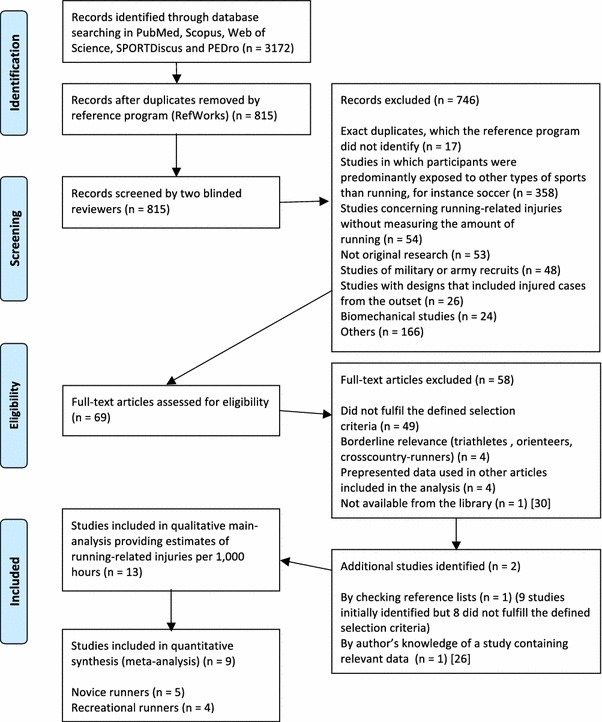
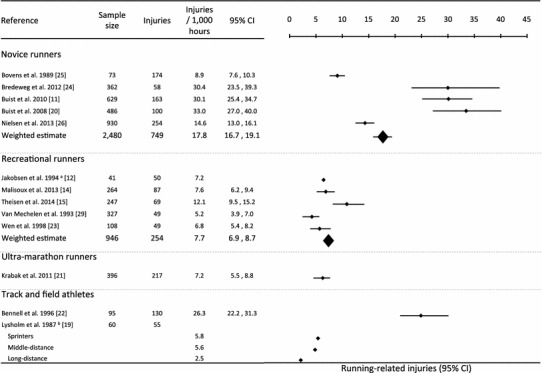
BACKGROUND: No systematic review has identified the incidence of running-related injuries per 1000 h of running in different types of runners. OBJECTIVE: The purpose of the present review was to systematically search the literature for the incidence of running-related injuries per 1000 h of running in different types of runners, and to include the data in meta-analyses. DATA SOURCES: A search of the PubMed, Scopus, SPORTDiscus, PEDro and Web of Science databases was conducted. STUDY SELECTION: Titles, abstracts, and full-text articles were screened by two blinded reviewers to identify prospective cohort studies and randomized controlled trials reporting the incidence of running-related injuries in novice runners, recreational runners, ultra-marathon runners, and track and field athletes. STUDY APPRAISAL AND SYNTHESIS METHODS: Data were extracted from all studies and comprised for further analysis. An adapted scale was applied to assess the risk of bias. RESULTS: After screening 815 abstracts, 13 original articles were included in the main analysis. Running-related injuries per 1000 h of running ranged from a minimum of 2.5 in a study of long-distance track and field athletes to a maximum of 33.0 in a study of novice runners. The meta-analyses revealed a weighted injury incidence of 17.8 (95% confidence interval [CI] 16.7-19.1) in novice runners and 7.7 (95% CI 6.9-8.7) in recreational runners. LIMITATIONS: Heterogeneity in definitions of injury, definition of type of runner, and outcome measures in the included full-text articles challenged comparison across studies. CONCLUSION: Novice runners seem to face a significantly greater risk of injury per 1000 h of running than recreational runners.
Overview
CoChat Summary
TL;DR
This systematic review and meta-analysis found that running-related injury incidence per 1000 h of running was higher in novice runners than recreational runners. Pooled estimates were 17.8 (95% CI 16.7–19.1) for novice runners and 7.7 (95% CI 6.9–8.7) for recreational runners.
Key findings
- Across 13 included articles, running-related injuries per 1000 h of running ranged from 2.5 in long-distance track and field athletes to 33.0 in novice runners.
- Meta-analysis weighted injury incidence was 17.8 (95% CI 16.7–19.1) in novice runners and 7.7 (95% CI 6.9–8.7) in recreational runners; novice runners faced a significantly greater risk.
- One ultra-marathon study reported 7.2 injuries per 1000 h; two track and field studies reported 2.5 to 26.3 per 1000 h, with no weighted estimates calculated for these groups.
- Ten studies pooled for a per-1000-km subanalysis gave a weighted estimate of 1.07 (95% CI 1.01–1.13) running-related injuries per 1000 km.
Methods
- Systematic search of PubMed, Scopus, SPORTDiscus, PEDro, and Web of Science without date restriction; two blinded reviewers screened titles, abstracts, and full texts to include prospective cohort studies and randomized controlled trials in novice runners, recreational runners, ultra-marathon runners, and track and field athletes.
- 13 articles were included (8 prospective cohort studies and 5 randomized controlled trials); data were extracted on study characteristics, injury definitions, and incidence per 1000 h and per 1000 km, and risk of bias was assessed with an adapted Newcastle Ottawa Scale modified for runners.
- Meta-analyses pooled estimates for novice and recreational runners; because one article lacked data to calculate 95% CIs, nine studies were included in the quantitative analyses, and ten studies were pooled for the per-1000-km subanalysis.
Limitations
- Stated: heterogeneity in definitions of injury, definition of type of runner, and outcome measures challenged comparison across studies; exposure time was often self-reported in web-based running diaries, risking recall bias and inaccurate training hours or distance; there was lack of agreement in how exposure time was calculated.
- Stated: not all studies provided raw data or 95% CIs, and corresponding authors were contacted; for Buist et al. [11], separate data for runner groups were unavailable, so the 30.1 per 1000 h estimate was included in the novice category, meaning the true novice incidence might be even higher; only a few studies reported ultra-marathon and track and field incidences, so no weighted estimates were calculated.
- Evident from the text: follow-up periods ranged from 7 days to 81 weeks, and novice-runner estimates were heterogeneous (three studies ranged from 30.1 to 33, higher than the two remaining studies), possibly due to follow-up length and a healthy participant effect; risk-of-bias assessment averaged 6 out of 8 stars (range 3–8), with low stars for ascertainment of exposure (6/13) and assessment of outcome (8/13).
Model-written summary. Check it against the paper before relying on it.
Integrity signals
Registry
Cites
Statistics
Figures
Verification
Claims the paper makes
0 Valid · 1 Not valid · 16 Not checked · 65 Own results and interpretations
A result the paper states — it cites no source for it, so there is none to check. The quote shows it is in the paper.
In the paper
“No systematic review has identified the incidence of running-related injuries per 1000 h of running in different types of runners.”
- Also stated in: § Introduction · plain
“However, no review has been published which systematically searched the literature for studies with information on the incidence of running-related injuries in different types of runners per 1000 h of running.”
§ Incidence of Running-Related Injuries Per 1000 h of running in Different Types of Runners: A Systematic Review and Meta-Analysis > Abstract > Background
plain- Asserted: passes — The authors put it forward as true.
- Checkable: passes — It can be checked against evidence.
- Load-bearing: passes — The paper’s conclusions depend on it.
- Based: passes — The paper gives a reason why it holds.
- Also stated in: § Introduction · plain
A result the paper reports from its own data — it cites no other source for it, so there is none to check. The quote shows it is in the paper.
In the paper
“The meta-analyses revealed a weighted injury incidence of 17.8 (95 % confidence interval [CI] 16.7–19.1) in novice runners and 7.7 (95 % CI 6.9–8.7) in recreational runners.”
§ Incidence of Running-Related Injuries Per 1000 h of running in Different Types of Runners: A Systematic Review and Meta-Analysis > Abstract > Results
plain- Asserted: passes — The authors put it forward as true.
- Checkable: passes — It can be checked against evidence.
- Load-bearing: passes — The paper’s conclusions depend on it.
- Based: passes — The paper gives a reason why it holds.
A result the paper reports from its own data — it cites no other source for it, so there is none to check. The quote shows it is in the paper.
In the paper
“The weighted estimate revealed an injury incidence of 1.07 (95 % CI 1.01–1.13) per 1000 km of running.”
§ Incidence of Running-Related Injuries Per 1000 h of running in Different Types of Runners: A Systematic Review and Meta-Analysis > Results
plain- Asserted: passes — The authors put it forward as true.
- Checkable: passes — It can be checked against evidence.
- Load-bearing: unclear — It is unclear whether the paper’s conclusions depend on it.
- Based: passes — The paper gives a reason why it holds.
None of the sources cited for this claim have been checked yet.
In the paper
“Further, some studies specified the premise that the same runner was included and was contributing exposure time, if running was resumed after an injury occurrence [21, 22].”
§ Incidence of Running-Related Injuries Per 1000 h of running in Different Types of Runners: A Systematic Review and Meta-Analysis > Discussion
plain- Asserted: passes — The authors put it forward as true.
- Checkable: passes — It can be checked against evidence.
- Load-bearing: passes — The paper’s conclusions depend on it.
- Based: passes — The paper gives a reason why it holds.
In the paper
“In the latter, track and field athletes were subdivided into sprinters, middle-distance runners, and long-distance runners, which may be relevant as the reported running-related injury incidence per 1000 h was greater in sprinters and middle-distance runners than in long-distance runners [19].”
§ Incidence of Running-Related Injuries Per 1000 h of running in Different Types of Runners: A Systematic Review and Meta-Analysis > Discussion
What the sources say
- Not checked yetcites [19] Lysholm J Wiklander J Injuries in runners Am J Sports Med. 1987 15 2 168 171 10.1177/036354658701500213 3578639 source
plainstates an association- Asserted: passes — The authors put it forward as true.
- Checkable: passes — It can be checked against evidence.
- Load-bearing: unclear — It is unclear whether the paper’s conclusions depend on it.
- Based: passes — The paper gives a reason why it holds.
22 more claims
Create a free account to see all 82 claims and to verify the 16 references still open.
- Probably not a substantial claim. 40
- It may state two separate claims as one. 37
Claims other papers make about this one
Each is checked against this paper’s own text: does it say what the citing paper says it does?
In the citing paper
“Whereas previous data suggested greater injury rates in novice compared with recreational runners, 51 our findings suggested the opposite, with a greater incidence in recreational (26.1%) than in novice runners (14.9%).”
From The Association Between Running Injuries and Training Parameters: A Systematic Review (2022) · cites this paper as [51]
Self-check
Percentages, sums and reported differences re-computed from the paper’s own numbers.
Each contradiction between two passages listed here was confirmed by an independent check.
Rated minor: it would not touch a result — a value no result rests on, a p-value that stays on the same side of the significance level, or a conflict that is clerical, resolved elsewhere in the paper, or outside its own findings.
In the paper
§ Incidence of Running-Related Injuries Per 1000 h of running in Different Types of Runners: A Systematic Review and Meta-Analysis > Discussion
“the study by Bovens et al. [25], which received no star in item 5 because running exposure was collected in diaries”
§ Incidence of Running-Related Injuries Per 1000 h of running in Different Types of Runners: A Systematic Review and Meta-Analysis > Results
“| Bovens et al. [25] | * | * | * | 0 | * | * | * | * |”
Rated minor: it would not touch a result — a value no result rests on, a p-value that stays on the same side of the significance level, or a conflict that is clerical, resolved elsewhere in the paper, or outside its own findings.
In the paper
“| Jakobsen et al. [12], Denmark | Randomised controlled trial (12 months) | 41 Recreational long-distance runners. Had all taken part in marathon races and intended to take part in at least two marathons during the year of investigation | 19 Men and 2 women aged 24–56.”
§ Incidence of Running-Related Injuries Per 1000 h of running in Different Types of Runners: A Systematic Review and Meta-Analysis > Methods > Data Collection
Reported 41 · recomputed 21
Citations
Cites
van Gent, R. N., Siem, D., van Middelkoop, M., van Os, A. G., Bierma-Zeinstra, S. M. A., & Koes, B. W. (2007) · British Journal of Sports Medicine · doi:10.1136/bjsm.2006.033548 · Cited by 1,420
What are the Main Running-Related Musculoskeletal Injuries?: A Systematic Review
Lopes, A. D., Hespanhol, L. C., Yeung, S. S., & Costa, L. O. P. (2012) · Sports Medicine · doi:10.1007/bf03262301 · Cited by 715
Lysholm, J., & Wiklander, J. (1987) · The American Journal of Sports Medicine · doi:10.1177/036354658701500213 · Cited by 618
Running Injuries: A Review of the Epidemiological Literature
van Mechelen, W. (1992) · Sports Medicine · doi:10.2165/00007256-199214050-00004 · Cited by 521
Bennell, K. L., Malcolm, S. A., Thomas, S. A., Wark, J. D., & Brukner, P. D. (1996) · The American Journal of Sports Medicine · doi:10.1177/036354659602400217 · Cited by 420
What are the Main Risk Factors for Running-Related Injuries?
Saragiotto, B. T., Yamato, T. P., Hespanhol Junior, L. C., Rainbow, M. J., Davis, I. S., & Lopes, A. D. (2014) · Sports Medicine · doi:10.1007/s40279-014-0194-6 · Cited by 278
Buist, I., Bredeweg, S. W., Bessem, B., van Mechelen, W., Lemmink, K. A. P. M., & Diercks, R. L. (2010) · British Journal of Sports Medicine · doi:10.1136/bjsm.2007.044677 · Cited by 258
Prevention of running injuries by warm-up, cool-down, and stretching exercises
van Mechelen, W., Hlobil, H., Kemper, H. C. G., Voorn, W. J., & de Jongh, H. R. (1993) · The American Journal of Sports Medicine · doi:10.1177/036354659302100513 · Cited by 223
Lower extremity alignment and risk of overuse injuries in runners
Wen, D. Y. K., Puffer, J. C., & Schmalzried, T. P. (1997) · Medicine & Science in Sports & Exercise · doi:10.1097/00005768-199710000-00003 · Cited by 187
Buist, I., Bredeweg, S. W., van Mechelen, W., Lemmink, K. A. P. M., Pepping, G.-J., & Diercks, R. L. (2008) · The American Journal of Sports Medicine · doi:10.1177/0363546507307505 · Cited by 167
Cited by
Epidemiology of injuries in professional football: a systematic review and meta-analysis
López-Valenciano, A., Ruiz-Pérez, I., Garcia-Gómez, A., Vera-Garcia, F. J., De Ste Croix, M., Myer, G. D., & Ayala, F. (2020) · British Journal of Sports Medicine · doi:10.1136/bjsports-2018-099577 · Cited by 437
Physiology and Pathophysiology in Ultra-Marathon Running
Knechtle, B., & Nikolaidis, P. T. (2018) · Frontiers in Physiology · doi:10.3389/fphys.2018.00634 · Cited by 325
A systematic review of running-related musculoskeletal injuries in runners
Kakouris, N., Yener, N., & Fong, D. T. P. (2021) · Journal of Sport and Health Science · doi:10.1016/j.jshs.2021.04.001 · Cited by 317
A framework for the etiology of running‐related injuries
Bertelsen, M. L., Hulme, A., Petersen, J., Brund, R. K., Sørensen, H., Finch, C. F., Parner, E. T., & Nielsen, R. O. (2017) · Scandinavian Journal of Medicine & Science in Sports · doi:10.1111/sms.12883 · Cited by 276
Self-citationBiomechanical Risk Factors Associated with Running-Related Injuries: A Systematic Review
Ceyssens, L., Vanelderen, R., Barton, C., Malliaras, P., & Dingenen, B. (2019) · Sports Medicine · doi:10.1007/s40279-019-01110-z · Cited by 261
Haugen, T. A., Sandbakk, Ø. B., Seiler, S., & Tønnessen, E. (2022) · Sports Medicine - Open · doi:10.1186/s40798-022-00438-7 · Cited by 186
Risk factors for overuse injuries in short- and long-distance running: A systematic review
van Poppel, D., van der Worp, M. P., Slabbekoorn, A., van den Heuvel, S. P., van Middelkoop, M., Koes, B. W., Verhagen, A. P., & Scholten-Peeters, G. G. M. (2020) · Journal of sport and health science/Journal of Sport and Health Science · doi:10.1016/j.jshs.2020.06.006 · Cited by 181
Factors Affecting Training and Physical Performance in Recreational Endurance Runners
Boullosa, D. A., Esteve-Lanao, J., Casado, A., Peyré‐Tartaruga, L. A., da Rosa, R. G., & Coso, J. D. (2020) · Sports · doi:10.3390/sports8030035 · Cited by 186
Janssen, M., Scheerder, J., Thibaut, E., Brombacher, A., & Vos, S. (2017) · PLOS ONE · doi:10.1371/journal.pone.0181167 · Cited by 110
(2019) · Europe PMC (PubMed Central) · Cited by 166
Risk and Protective Factors for Middle- and Long-Distance Running-Related Injury
Hulme, A., Nielsen, R. O., Timpka, T., Verhagen, E., & Finch, C. (2017) · Sports Medicine · doi:10.1007/s40279-016-0636-4 · Cited by 120
Self-citationWillwacher, S., Kurz, M., Robbin, J., Thelen, M., Hamill, J., Kelly, L., & Mai, P. (2022) · Sports Medicine · doi:10.1007/s40279-022-01666-3 · Cited by 159
Perfil de lesões em praticantes de CrossFit: revisão sistemática
Dominski, F. H., Siqueira, T. C., Serafim, T. T., & Andrade, A. (2018) · Fisioterapia e Pesquisa · doi:10.1590/1809-2950/17014825022018 · Cited by 162
Injury Profile in Women’s Football: A Systematic Review and Meta-Analysis
López‐Valenciano, A., González, J. R., García, J. A., Aparicio-Sarmiento, A., de Baranda, P. S., Croix, M. D. S., & Ayala, F. (2021) · Sports Medicine · doi:10.1007/s40279-020-01401-w · Cited by 153
CrossFit®: Injury prevalence and main risk factors
da Costa, T. S., Louzada, C. T. N., Miyashita, G. K., da Silva, P. H. J., Sungaila, H. Y. F., Lara, P. H. S., Pochini, A. D. C., Ejnisman, B., Cohen, M., & Arliani, G. G. (2019) · Clinics · doi:10.6061/clinics/2019/e1402 · Cited by 151
Physiological and Biomechanical Mechanisms of Distance Specific Human Running Performance
Thompson, M. A. (2017) · Integrative and Comparative Biology · doi:10.1093/icb/icx069 · Cited by 139
Malisoux, L., Chambon, N., Delattre, N., Gueguen, N., Urhausen, A., & Theisen, D. (2016) · British Journal of Sports Medicine · doi:10.1136/bjsports-2015-095031 · Cited by 86
Understanding Different Types of Recreational Runners and How They Use Running-Related Technology
Janssen, M., Walravens, R., Thibaut, E., Scheerder, J., Brombacher, A., & Vos, S. B. (2020) · International Journal of Environmental Research and Public Health · doi:10.3390/ijerph17072276 · Cited by 127
Hespanhol, L., van Mechelen, W., Postuma, E., & Verhagen, E. A. L. M. (2015) · Scandinavian Journal of Medicine and Science in Sports · doi:10.1111/sms.12541 · Cited by 124
Haugen, T. A., Sandbakk, Ø. B., Enoksen, E., Seiler, S., & Tønnessen, E. (2021) · Sports Medicine · doi:10.1007/s40279-021-01481-2 · Cited by 125
Kiernan, D., Hawkins, D. A., Manoukian, M. A. C., McKallip, M., Oelsner, L., Caskey, C. F., & Coolbaugh, C. L. (2018) · Journal of Biomechanics · doi:10.1016/j.jbiomech.2018.04.001 · Cited by 116
Seiberl, W., Jensen, E., Merker, J., Leitel, M., & Schwirtz, A. (2018) · European Journal of Sport Science · doi:10.1080/17461391.2018.1477993 · Cited by 110
Taddei, U. T., Matias, A. B., Duarte, M., & Sacco, I. C. N. (2020) · The American Journal of Sports Medicine · doi:10.1177/0363546520969205 · Cited by 72
Hespanhol, L., van Mechelen, W., & Verhagen, E. A. L. M. (2016) · Sports Medicine · doi:10.1007/s40279-016-0551-8 · Cited by 107
Effects of Foot Strike Techniques on Running Biomechanics: A Systematic Review and Meta-analysis
Xu, Y., Yuan, P., Wang, R., Wang, D., Liu, J., & Zhou, H. D. (2020) · Sports Health A Multidisciplinary Approach · doi:10.1177/1941738120934715 · Cited by 101
Mousavi, S. H., Hijmans, J. M., Rajabi, R., Diercks, R. L., Zwerver, J., & van der Worp, H. (2019) · Gait & Posture · doi:10.1016/j.gaitpost.2019.01.011 · Cited by 102
Linton, L., & Valentin, S. (2018) · Journal of science and medicine in sport · doi:10.1016/j.jsams.2018.05.021 · Cited by 100
Foot Pronation Contributes to Altered Lower Extremity Loading After Long Distance Running
Mei, Q., Gu, Y., Xiang, L., Baker, J. S., & Fernandez, J. (2019) · Frontiers in Physiology · doi:10.3389/fphys.2019.00573 · Cited by 94
Malisoux, L., Chambon, N., Urhausen, A. J. P., & Theisen, D. (2016) · The American Journal of Sports Medicine · doi:10.1177/0363546516654690 · Cited by 96
Damsted, C., Glad, S., Nielsen, R. O., Sørensen, H., & Malisoux, L. (2018) · International Journal of Sports Physical Therapy · doi:10.26603/ijspt20180931 · Cited by 83
Self-citationVannatta, C. N., Heinert, B. L., & Kernozek, T. W. (2020) · Clinical Biomechanics · doi:10.1016/j.clinbiomech.2020.104991 · Cited by 85
Medial Tibial Stress Syndrome in Novice and Recreational Runners: A Systematic Review
Menéndez, C., Batalla, L., Prieto, A. G., Rodríguez, M. Á., Crespo, I., & Olmedillas, H. (2020) · International Journal of Environmental Research and Public Health · doi:10.3390/ijerph17207457 · Cited by 79
Running related gluteus medius function in health and injury: A systematic review with meta-analysis
Semciw, A. I., Neate, R., & Pizzari, T. (2016) · Journal of Electromyography and Kinesiology · doi:10.1016/j.jelekin.2016.06.005 · Cited by 78
The Association Between Running Injuries and Training Parameters: A Systematic Review
Fredette, A., Roy, J.-S., Perreault, K., Dupuis, F., Napier, C., & Esculier, J.-F. (2022) · Journal of Athletic Training · doi:10.4085/1062-6050-0195.21 · Cited by 74
Shoe feature recommendations for different running levels: A Delphi study
Honert, E. C., Mohr, M., Lam, W., & Nigg, S. (2020) · PLoS ONE · doi:10.1371/journal.pone.0236047 · Cited by 72
Hoitz, F., Mohr, M., Asmussen, M. J., Lam, W., Nigg, S., & Nigg, B. M. (2020) · Footwear Science · doi:10.1080/19424280.2020.1773936 · Cited by 75
Baltich, J., Emery, C. A., Whittaker, J. L., & Nigg, B. M. (2017) · Scandinavian Journal of Medicine & Science in Sports · doi:10.1111/sms.12743 · Cited by 45
Malisoux, L., Delattre, N., Urhausen, A. J. P., & Theisen, D. (2019) · The American Journal of Sports Medicine · doi:10.1177/0363546519892578 · Cited by 69
Analysis of Running-Related Injuries: The Vienna Study
Benca, E., Listabarth, S., Flock, F. K. J., Pablik, E., Fischer, C., Walzer, S. M., Dorotka, R., Windhager, R., & Ziai, P. (2020) · Journal of Clinical Medicine · doi:10.3390/jcm9020438 · Cited by 66
Acute and Chronic Effects of Endurance Running on Inflammatory Markers: A Systematic Review
Barros, E., Nascimento, D. D. C., Prestes, J., Nóbrega, O. D. T., Córdova, C., Sousa, F., & Boullosa, D. A. (2017) · Frontiers in Physiology · doi:10.3389/fphys.2017.00779 · Cited by 65
Trail running injury risk factors: a living systematic review
Viljoen, C. T., van Rensburg, D. C. (. J., van Mechelen, W., Verhagen, E. A. L. M., Silva, B., Scheer, V., Besomi, M., Gajardo-Burgos, R. E., Matos, S., Schoeman, M., et al. (2022) · British Journal of Sports Medicine · doi:10.1136/bjsports-2021-104858 · Cited by 61
Leppänen, M., Viiala, J., Kaikkonen, P., Tokola, K., Vasankari, T. J., Nigg, B. M., Krosshaug, T., Werthner, P., Parkkari, J. P., & Pasanen, K. (2024) · British Journal of Sports Medicine · doi:10.1136/bjsports-2023-107926 · Cited by 62
Injury and Illness Rates During Ultratrail Running
Vernillo, G., Savoldelli, A., Torre, A. L., Skafidas, S., Bortolan, L., & Schena, F. F. (2016) · International Journal of Sports Medicine · doi:10.1055/s-0035-1569347 · Cited by 61
Transverse tendon stiffness is reduced in people with Achilles tendinopathy: A cross-sectional study
Finnamore, E., Waugh, C., Solomons, L., Ryan, M., West, C. R., & Scott, A. (2019) · PLoS ONE · doi:10.1371/journal.pone.0211863 · Cited by 60
Toresdahl, B. G., McElheny, K., Metzl, J., Ammerman, B., Chang, B., & Kinderknecht, J. (2020) · Sports Health: A Multidisciplinary Approach · doi:10.1177/1941738119877180 · Cited by 58
Ruiz‐Pérez, I., López‐Valenciano, A., Jiménez-Loaisa, A., Elvira, J. L. L., Croix, M. D. S., & Ayala, F. (2019) · PeerJ · doi:10.7717/peerj.7989 · Cited by 60
Doyle, E., Doyle, T. L. A., Bonacci, J., & FULLER, J. T. (2022) · Journal of Orthopaedic and Sports Physical Therapy · doi:10.2519/jospt.2022.10585 · Cited by 57
Dingenen, B., Staes, F. F. G. M., Santermans, L., Steurs, L., Eerdekens, M., Geentjens, J., Peers, K. H. E., Thysen, M., & Deschamps, K. (2017) · Physical Therapy in Sport · doi:10.1016/j.ptsp.2017.02.001 · Cited by 57
Hooren, B. V., Plasqui, G., & Meijer, K. (2024) · The American Journal of Sports Medicine · doi:10.1177/03635465231222464 · Cited by 55
Do the benefits of participation in sport and exercise outweigh the negatives? An academic review
Mills, K. A. G., Dudley, D. A., & Collins, N. J. (2019) · Best Practice & Research Clinical Rheumatology · doi:10.1016/j.berh.2019.01.015 · Cited by 55
Multifactorial Determinants of Running Injury Locations in 550 Injured Recreational Runners
Hollander, K., Johnson, C. D., Outerleys, J. B., & Davis, I. S. (2020) · Medicine & Science in Sports & Exercise · doi:10.1249/mss.0000000000002455 · Cited by 51
Experience does not influence injury-related joint kinematics and kinetics in distance runners
Agresta, C. E., Peacock, J., Housner, J. A., Zernicke, R. F., & Zendler, J. D. (2017) · Gait & Posture · doi:10.1016/j.gaitpost.2017.12.020 · Cited by 50
Prospective monitoring of health problems among recreational runners preparing for a half marathon
Hollander, K., Baumann, A., Zech, A., & Verhagen, E. A. L. M. (2018) · BMJ Open Sport & Exercise Medicine · doi:10.1136/bmjsem-2017-000308 · Cited by 51
Mo, S., & Chow, D. H. K. (2018) · Journal of Sports Sciences · doi:10.1080/02640414.2018.1539294 · Cited by 50
Can the “Appropriate” Footwear Prevent Injury in Leisure-Time Running? Evidence Versus Beliefs
Malisoux, L., & Theisen, D. (2020) · Journal of Athletic Training · doi:10.4085/1062-6050-523-19 · Cited by 51
Hulme, A., Salmon, P. M., Nielsen, R. O., Read, G. J. M., & Finch, C. F. (2017) · Applied Ergonomics · doi:10.1016/j.apergo.2017.07.005 · Cited by 42
Self-citationAssociation between the Foot Posture Index and running related injuries: A case-control study
Pérez-Morcillo, A., Gómez-Bernal, A., Gil-Guillén, V. F., Alfaro-Santafé, J., Alfaro-Santafé, J.-V., Quesada, J. A., López‐Pineda, A., Orozco‐Beltrán, D., & Carratalá‐Munuera, C. (2018) · Clinical Biomechanics · doi:10.1016/j.clinbiomech.2018.12.019 · Cited by 48
Vos, S. B., Janssen, M., Goudsmit, J., Lauwerijssen, C., & Brombacher, A. (2016) · Procedia Engineering · doi:10.1016/j.proeng.2016.06.311 · Cited by 47
Injury incidence and risk factors: a cohort study of 706 8-km or 16-km recreational runners
Dallinga, J., Van Rijn, R., Stubbe, J., & Deutekom, M. (2019) · BMJ Open Sport & Exercise Medicine · doi:10.1136/bmjsem-2018-000489 · Cited by 30
Menheere, D., Janssen, M., Funk, M., van der Spek, E. D., Lallemand, C., & Vos, S. B. (2020) · International Journal of Environmental Research and Public Health · doi:10.3390/ijerph17176046 · Cited by 46
Running shoes for preventing lower limb running injuries in adults
Relph, N., Greaves, H., Armstrong, R., Prior, T. D., Spencer, S., Griffiths, I. B., Dey, P., & Langley, B. (2022) · Cochrane Database of Systematic Reviews · doi:10.1002/14651858.cd013368.pub2 · Cited by 46
Desai, P., Jungmalm, J., Börjesson, M., Karlsson, J., & Grau, S. (2020) · Journal of Orthopaedic and Sports Physical Therapy · doi:10.2519/jospt.2021.9673 · Cited by 44
Paquette, M. R., Milner, C. E., & Melcher, D. A. (2016) · Scandinavian Journal of Medicine and Science in Sports · doi:10.1111/sms.12647 · Cited by 41
Medial shoe-ground pressure and specific running injuries: A 1-year prospective cohort study
Brund, R. B. K., Rasmussen, S., Nielsen, R. O., Kersting, U. G., Læssøe, U., & Voigt, M. (2017) · Journal of science and medicine in sport · doi:10.1016/j.jsams.2017.04.001 · Cited by 41
Self-citationAn, W. W., Rainbow, M. J., & Cheung, R. T. H. (2015) · BioMed Research International · doi:10.1155/2015/240153 · Cited by 40
Hespanhol, L., Huisstede, B. M. A., Smits, D., Kluitenberg, B., van der Worp, H., van Middelkoop, M., Hartgens, F., & Verhagen, E. A. L. M. (2015) · Journal of science and medicine in sport · doi:10.1016/j.jsams.2015.12.004 · Cited by 40
Fortington, L. V., van der Worp, H., van den Akker‐Scheek, I., & Finch, C. F. (2016) · Sports Medicine · doi:10.1007/s40279-016-0637-3 · Cited by 39
Dingenen, B., Malliaras, P., Janssen, T., Ceyssens, L., Vanelderen, R., & Barton, C. J. (2019) · Physical Therapy in Sport · doi:10.1016/j.ptsp.2019.05.008 · Cited by 38
The “impacts cause injury” hypothesis: Running in circles or making new strides?
Gruber, A. H. (2023) · Journal of Biomechanics · doi:10.1016/j.jbiomech.2023.111694 · Cited by 38
Nielsen, R. Ø., Bertelsen, M. L., Ramskov, D., Damsted, C., Brund, R. K., Parner, E. T., Sørensen, H., Rasmussen, S., & Kjærgaard, S. (2019) · BMJ Open · doi:10.1136/bmjopen-2019-032627 · Cited by 25
Self-citationRelationship between duty factor and external forces in slow recreational runners
Bonnaerens, S., Fiers, P., Galle, S., Derie, R., Aerts, P., Frederick, E. C., Kaneko, Y., Derave, W., Clercq, D. D., & Segers, V. (2021) · BMJ Open Sport & Exercise Medicine · doi:10.1136/bmjsem-2020-000996 · Cited by 37
SeRUN® study: Development of running profiles using a mixed methods analysis
Besomi, M., Leppe, J., Silvestre, M. C. D., & Setchell, J. (2018) · PLoS ONE · doi:10.1371/journal.pone.0200389 · Cited by 38
Validity of Self-Reported Running Distance
Dideriksen, M., Soegaard, C., & Nielsen, R. O. (2016) · Journal of Strength and Conditioning Research · doi:10.1519/jsc.0000000000001244 · Cited by 30
Self-citationJONGE, J. D., Balk, Y. A., & Taris, T. W. (2020) · International Journal of Environmental Research and Public Health · doi:10.3390/ijerph17031044 · Cited by 37
Viljoen, C. T., van Rensburg, D. C. J., van Rensburg, A. J., Booysen, E., Chauke, S., Coetzee, P. G. H., Hurlimann, A., Jooste, M., Nibe, Y., Schulenburg, C., et al. (2020) · Physical Therapy in Sport · doi:10.1016/j.ptsp.2020.11.029 · Cited by 36
Smarkusz-Zarzecka, J., Ostrowska, L., Leszczyńska, J., Orywal, K., Cwalina, U., & Pogodziński, D. (2020) · Nutrients · doi:10.3390/nu12123758 · Cited by 36
Do Novice Runners Show Greater Changes in Biomechanical Parameters?
Quan, W., Ren, F., Sun, D., Fekete, G., & He, Y. (2021) · Applied Bionics and Biomechanics · doi:10.1155/2021/8894636 · Cited by 36
Common Running Overuse Injuries and Prevention
Kozinc, Ž., & Šarabon, N. (2017) · Montenegrin Journal of Sports Science and Medicine · doi:10.26773/mjssm.2017.09.009 · Cited by 38
The relationship between foot arch flexibility and medial-lateral ground reaction force distribution
Zifchock, R. A., Parker, R., Wan, W., Neary, M. T., Song, J., & Hillstrom, H. J. (2019) · Gait & Posture · doi:10.1016/j.gaitpost.2019.01.012 · Cited by 35
Agresta, C. E., Goulet, G. C., Peacock, J., Housner, J. A., Zernicke, R. F., & Zendler, J. D. (2019) · Gait & Posture · doi:10.1016/j.gaitpost.2019.02.034 · Cited by 36
Liu, Q., Mo, S., Cheung, V. C. K., Cheung, B. M. F., Wang, S., Chan, P. P. K., Malhotra, A., Cheung, R. T. H., & Chan, R. H. M. (2020) · Journal of Biomechanics · doi:10.1016/j.jbiomech.2020.110072 · Cited by 35
Šuc, A., Šarko, P., Pleša, J., & Kozinc, Ž. (2022) · Sports · doi:10.3390/sports10070098 · Cited by 36
Alexander, J. L. N., Culvenor, A. G., Johnston, R. T. R., Ezzat, A. M., & Barton, C. J. (2022) · British Journal of Sports Medicine · doi:10.1136/bjsports-2022-105553 · Cited by 36
Effect of ACTN3 R577X Genotype on Injury Epidemiology in Elite Endurance Runners
Gutiérrez‐Hellín, J., Baltazar‐Martins, G., Aguilar‐Navarro, M., Ruíz‐Moreno, C., Oliván, J., & Coso, J. D. (2021) · Genes · doi:10.3390/genes12010076 · Cited by 34
‘I JUST WANT TO RUN’: how recreational runners perceive and deal with injuries
Verhagen, E. A. L. M., Warsen, M., & Bolling, C. S. (2021) · BMJ Open Sport & Exercise Medicine · doi:10.1136/bmjsem-2021-001117 · Cited by 33
Hulme, A., Salmon, P. M., Nielsen, R. O., Read, G. J. M., & Finch, C. F. (2017) · Theoretical Issues in Ergonomics Science · doi:10.1080/1463922x.2016.1274455 · Cited by 33
Self-citationFokkema, T., Burggraaff, R., Hartgens, F., Kluitenberg, B., Verhagen, E. A. L. M., BACKX, F. J. G., van der Worp, H., Bierma‐Zeinstra, S., Koes, B. W., & van Middelkoop, M. (2018) · Journal of science and medicine in sport · doi:10.1016/j.jsams.2018.09.001 · Cited by 32
Ramskov, D., Rasmussen, S., Sørensen, H., Parner, E. T., Lind, M., & Nielsen, R. O. (2018) · BMJ Open Sport & Exercise Medicine · doi:10.1136/bmjsem-2017-000333 · Cited by 24
Self-citationDamsted, C., Parner, E. T., Sørensen, H., Malisoux, L., Hulme, A., & Nielsen, R. Ø. (2019) · Journal of Orthopaedic & Sports Physical Therapy · doi:10.2519/jospt.2019.8541 · Cited by 21
Self-citationFerreira, V. M. L. M., de Oliveira, R. R., Nazareno, T. S., de Freitas, L. V., & Mendonça, L. D. M. (2020) · Physical Therapy in Sport · doi:10.1016/j.ptsp.2020.06.006 · Cited by 29
Muskuloskeletal injuries in mountain running races: A 5 seasons study
González‐Lázaro, J., Arribas-Cubero, H. F., & Marroyo, J. A. R. (2020) · Injury · doi:10.1016/j.injury.2020.10.045 · Cited by 29
Meigh, N. J., Keogh, J., Schram, B. L., Hing, W. A., & Rathbone, E. N. (2022) · BMC Geriatrics · doi:10.1186/s12877-022-02958-z · Cited by 29
Lópes, A. D., Mascarinas, A., & Hespanhol, L. (2023) · Brazilian Journal of Physical Therapy · doi:10.1016/j.bjpt.2023.100538 · Cited by 29
Paquette, M. R., & Melcher, D. A. (2016) · Journal of Applied Biomechanics · doi:10.1123/jab.2016-0170 · Cited by 29
Running-related injuries in Portuguese trail runners: a retrospective cohort study
Matos, S., Silva, B., Clemente, F. M., & Pereira, J. (2021) · The Journal of Sports Medicine and Physical Fitness · doi:10.23736/s0022-4707.20.11304-5 · Cited by 29
Is it just a score? Understanding Training Load Management Practices Beyond Sports Tracking
Karahanoğlu, A., Coşkun, A., Postma, D. B. W., Scheltinga, B. L., Gouveia, R. H. D. F., Reidsma, D., & Reenalda, J. (2024) · CHI Conference on Human Factors in Computing Systems · doi:10.1145/3613904.3642051 · Cited by 28
Suda, E. Y., Watari, R., Matias, A. B., & Sacco, I. D. C. N. (2020) · Frontiers in Bioengineering and Biotechnology · doi:10.3389/fbioe.2020.00576 · Cited by 28
Naderi, A., Alizadeh, N., Calmeiro, L., & Degens, H. (2024) · Sports Health A Multidisciplinary Approach · doi:10.1177/19417381231223475 · Cited by 27
Smits, D.-W., Backx, F., Van Der Worp, H., Van Middelkoop, M., Hartgens, F., Verhagen, E., Kluitenberg, B., & Huisstede, B. (2019) · Research in Sports Medicine · doi:10.1080/15438627.2018.1492399 · Cited by 21
Rahlf, A. L., Hoenig, T., Stürznickel, J., Cremans, K., Fohrmann, D., Sanchez-Alvarado, A., Rolvien, T., & Hollander, K. (2022) · BMC Sports Science Medicine and Rehabilitation · doi:10.1186/s13102-022-00426-0 · Cited by 27
Metadata
- Authors
- Videbæk, S., Bueno, A. M., Nielsen, R. O., & Rasmussen, S.
- Affiliations
- Aarhus University (DK)
- Venue
- Sports Medicine
- Published
- 2015-05-08
- Volume
- 45
- Issue
- 7
- Pages
- 1017-1026
- ISSN
- 0112-1642 (ISSN-L)
- 1179-2035
- PMC
- PMC4473093
- OpenAlex
- W279444749
- Cited by
- 531
- References
- 25
- Citations by year
- 2026: 54 · 2025: 52 · 2024: 46 · 2023: 46 · 2022: 62 · 2021: 63 · 2020: 67 · 2019: 50 · 2018: 41 · 2017: 25 · 2016: 19 · 2015: 6
- FWCI
- 4.60
- Type
- journal article
- Language
- en
- Open access
- hybrid
- doi.org
- Locations
- Sports Medicine (publishedVersion, cc-by)
- Europe PMC (PubMed Central) (publishedVersion, cc-by)
- PubMed (publishedVersion)
- PubMed Central (publishedVersion, cc-by)
- VBN Forskningsportal (Aalborg Universitet) (publishedVersion, other-oa)
- Topics
- Health Sciences › Medicine › Orthopedics and Sports Medicine › Sports injuries and prevention
- Physical Sciences › Engineering › Biomedical Engineering › Lower Extremity Biomechanics and Pathologies
- Health Sciences › Medicine › Public Health, Environmental and Occupational Health › Injury Epidemiology and Prevention
- Keywords
- running injuries, injury incidence, novice runners, recreational runners, track and field athletes, running distance, injury risk
- MeSH terms
- Humans, Recreation, Running, Athletes
About these checks
Registry, retraction, Cites and statistics results are computed, not judged, with one exception: a printed reference that no index lists is read once by a model before it counts as a citation error. Claims are extracted by a model and kept only when their quote appears verbatim in the text; each cited source is then checked, with a model’s help, for whether it says what the claim relies on. Those verdicts can be wrong — read the claim’s quote and the cited source before relying on one.
A language model drew the claims from the paper on 2026-11-19, under version 3 of the claim definition (model deepseek-v4.1-flash, prompt extract-v3).
A second model labelled each claim on 2026-11-19 (model jev-1.13-20260917, definition revision gold-guideline-v0.2).
Statistics and arithmetic are recomputed, not judged.
Confidence bands are shown only for fields calibrated on our annotated test set. None is calibrated yet, so no band is shown.
What counts as a claim ›How we measure confidence ›How we check this ›
Are you an author, or do you see a problem with this page? Request a review
Data sources
Bibliographic data: Semantic Scholar, OpenAlex, Crossref.
Contains information from the Semantic Scholar Academic Graph Datasets, made available under the ODC Attribution License (ODC-BY 1.0).
Semantic Scholar’s data is described in: Kinney, R., et al. (2023). The Semantic Scholar Open Data Platform. arXiv:2301.10140.
