

Incidence of Running-Related Injuries Per 1000 h of running in Different Types of Runners: A Systematic Review and Meta-Analysis
Open accessThe DOI matches its Crossref record; 26 of the 26 references it cites were found in a registry or an index; none of the 16 sources its claims cite is checked for support yet.
Abstract
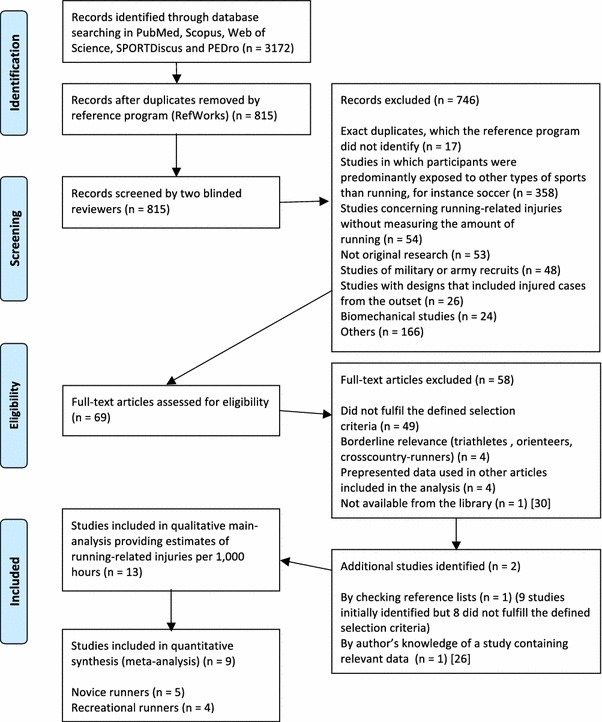
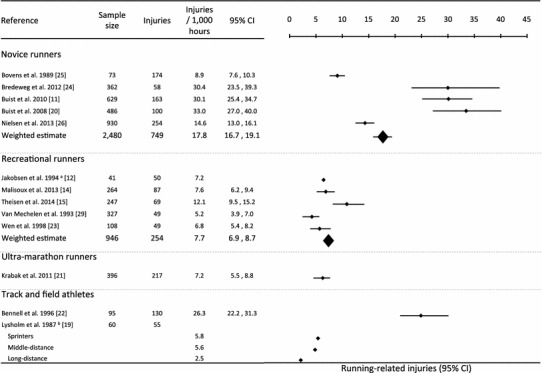
BACKGROUND: No systematic review has identified the incidence of running-related injuries per 1000 h of running in different types of runners. OBJECTIVE: The purpose of the present review was to systematically search the literature for the incidence of running-related injuries per 1000 h of running in different types of runners, and to include the data in meta-analyses. DATA SOURCES: A search of the PubMed, Scopus, SPORTDiscus, PEDro and Web of Science databases was conducted. STUDY SELECTION: Titles, abstracts, and full-text articles were screened by two blinded reviewers to identify prospective cohort studies and randomized controlled trials reporting the incidence of running-related injuries in novice runners, recreational runners, ultra-marathon runners, and track and field athletes. STUDY APPRAISAL AND SYNTHESIS METHODS: Data were extracted from all studies and comprised for further analysis. An adapted scale was applied to assess the risk of bias. RESULTS: After screening 815 abstracts, 13 original articles were included in the main analysis. Running-related injuries per 1000 h of running ranged from a minimum of 2.5 in a study of long-distance track and field athletes to a maximum of 33.0 in a study of novice runners. The meta-analyses revealed a weighted injury incidence of 17.8 (95% confidence interval [CI] 16.7-19.1) in novice runners and 7.7 (95% CI 6.9-8.7) in recreational runners. LIMITATIONS: Heterogeneity in definitions of injury, definition of type of runner, and outcome measures in the included full-text articles challenged comparison across studies. CONCLUSION: Novice runners seem to face a significantly greater risk of injury per 1000 h of running than recreational runners.
Overview
CoChat Summary
TL;DR
This systematic review and meta-analysis found that running-related injury incidence per 1000 h of running was higher in novice runners than recreational runners. Pooled estimates were 17.8 (95% CI 16.7–19.1) for novice runners and 7.7 (95% CI 6.9–8.7) for recreational runners.
Key findings
- Across 13 included articles, running-related injuries per 1000 h of running ranged from 2.5 in long-distance track and field athletes to 33.0 in novice runners.
- Meta-analysis weighted injury incidence was 17.8 (95% CI 16.7–19.1) in novice runners and 7.7 (95% CI 6.9–8.7) in recreational runners; novice runners faced a significantly greater risk.
- One ultra-marathon study reported 7.2 injuries per 1000 h; two track and field studies reported 2.5 to 26.3 per 1000 h, with no weighted estimates calculated for these groups.
- Ten studies pooled for a per-1000-km subanalysis gave a weighted estimate of 1.07 (95% CI 1.01–1.13) running-related injuries per 1000 km.
Methods
- Systematic search of PubMed, Scopus, SPORTDiscus, PEDro, and Web of Science without date restriction; two blinded reviewers screened titles, abstracts, and full texts to include prospective cohort studies and randomized controlled trials in novice runners, recreational runners, ultra-marathon runners, and track and field athletes.
- 13 articles were included (8 prospective cohort studies and 5 randomized controlled trials); data were extracted on study characteristics, injury definitions, and incidence per 1000 h and per 1000 km, and risk of bias was assessed with an adapted Newcastle Ottawa Scale modified for runners.
- Meta-analyses pooled estimates for novice and recreational runners; because one article lacked data to calculate 95% CIs, nine studies were included in the quantitative analyses, and ten studies were pooled for the per-1000-km subanalysis.
Limitations
- Stated: heterogeneity in definitions of injury, definition of type of runner, and outcome measures challenged comparison across studies; exposure time was often self-reported in web-based running diaries, risking recall bias and inaccurate training hours or distance; there was lack of agreement in how exposure time was calculated.
- Stated: not all studies provided raw data or 95% CIs, and corresponding authors were contacted; for Buist et al. [11], separate data for runner groups were unavailable, so the 30.1 per 1000 h estimate was included in the novice category, meaning the true novice incidence might be even higher; only a few studies reported ultra-marathon and track and field incidences, so no weighted estimates were calculated.
- Evident from the text: follow-up periods ranged from 7 days to 81 weeks, and novice-runner estimates were heterogeneous (three studies ranged from 30.1 to 33, higher than the two remaining studies), possibly due to follow-up length and a healthy participant effect; risk-of-bias assessment averaged 6 out of 8 stars (range 3–8), with low stars for ascertainment of exposure (6/13) and assessment of outcome (8/13).
Model-written summary. Check it against the paper before relying on it.
Integrity signals
Registry
Cites
Statistics
Figures
Verification
Claims the paper makes
0 Valid · 1 Not valid · 16 Not checked · 65 Own results and interpretations
A result the paper states — it cites no source for it, so there is none to check. The quote shows it is in the paper.
In the paper
“No systematic review has identified the incidence of running-related injuries per 1000 h of running in different types of runners.”
- Also stated in: § Introduction · plain
“However, no review has been published which systematically searched the literature for studies with information on the incidence of running-related injuries in different types of runners per 1000 h of running.”
§ Incidence of Running-Related Injuries Per 1000 h of running in Different Types of Runners: A Systematic Review and Meta-Analysis > Abstract > Background
plain- Asserted: passes — The authors put it forward as true.
- Checkable: passes — It can be checked against evidence.
- Load-bearing: passes — The paper’s conclusions depend on it.
- Based: passes — The paper gives a reason why it holds.
- Also stated in: § Introduction · plain
A result the paper reports from its own data — it cites no other source for it, so there is none to check. The quote shows it is in the paper.
In the paper
“The meta-analyses revealed a weighted injury incidence of 17.8 (95 % confidence interval [CI] 16.7–19.1) in novice runners and 7.7 (95 % CI 6.9–8.7) in recreational runners.”
§ Incidence of Running-Related Injuries Per 1000 h of running in Different Types of Runners: A Systematic Review and Meta-Analysis > Abstract > Results
plain- Asserted: passes — The authors put it forward as true.
- Checkable: passes — It can be checked against evidence.
- Load-bearing: passes — The paper’s conclusions depend on it.
- Based: passes — The paper gives a reason why it holds.
A result the paper reports from its own data — it cites no other source for it, so there is none to check. The quote shows it is in the paper.
In the paper
“The weighted estimate revealed an injury incidence of 1.07 (95 % CI 1.01–1.13) per 1000 km of running.”
§ Incidence of Running-Related Injuries Per 1000 h of running in Different Types of Runners: A Systematic Review and Meta-Analysis > Results
plain- Asserted: passes — The authors put it forward as true.
- Checkable: passes — It can be checked against evidence.
- Load-bearing: unclear — It is unclear whether the paper’s conclusions depend on it.
- Based: passes — The paper gives a reason why it holds.
None of the sources cited for this claim have been checked yet.
In the paper
“Further, some studies specified the premise that the same runner was included and was contributing exposure time, if running was resumed after an injury occurrence [21, 22].”
§ Incidence of Running-Related Injuries Per 1000 h of running in Different Types of Runners: A Systematic Review and Meta-Analysis > Discussion
plain- Asserted: passes — The authors put it forward as true.
- Checkable: passes — It can be checked against evidence.
- Load-bearing: passes — The paper’s conclusions depend on it.
- Based: passes — The paper gives a reason why it holds.
In the paper
“In the latter, track and field athletes were subdivided into sprinters, middle-distance runners, and long-distance runners, which may be relevant as the reported running-related injury incidence per 1000 h was greater in sprinters and middle-distance runners than in long-distance runners [19].”
§ Incidence of Running-Related Injuries Per 1000 h of running in Different Types of Runners: A Systematic Review and Meta-Analysis > Discussion
What the sources say
- Not checked yetcites [19] Lysholm J Wiklander J Injuries in runners Am J Sports Med. 1987 15 2 168 171 10.1177/036354658701500213 3578639 source
plainstates an association- Asserted: passes — The authors put it forward as true.
- Checkable: passes — It can be checked against evidence.
- Load-bearing: unclear — It is unclear whether the paper’s conclusions depend on it.
- Based: passes — The paper gives a reason why it holds.
22 more claims
Create a free account to see all 82 claims and to verify the 16 references still open.
- Probably not a substantial claim. 40
- It may state two separate claims as one. 37
Claims other papers make about this one
Each is checked against this paper’s own text: does it say what the citing paper says it does?
In the citing paper
“Whereas previous data suggested greater injury rates in novice compared with recreational runners, 51 our findings suggested the opposite, with a greater incidence in recreational (26.1%) than in novice runners (14.9%).”
From The Association Between Running Injuries and Training Parameters: A Systematic Review (2022) · cites this paper as [51]
Self-check
Percentages, sums and reported differences re-computed from the paper’s own numbers.
Each contradiction between two passages listed here was confirmed by an independent check.
Rated minor: it would not touch a result — a value no result rests on, a p-value that stays on the same side of the significance level, or a conflict that is clerical, resolved elsewhere in the paper, or outside its own findings.
In the paper
§ Incidence of Running-Related Injuries Per 1000 h of running in Different Types of Runners: A Systematic Review and Meta-Analysis > Discussion
“the study by Bovens et al. [25], which received no star in item 5 because running exposure was collected in diaries”
§ Incidence of Running-Related Injuries Per 1000 h of running in Different Types of Runners: A Systematic Review and Meta-Analysis > Results
“| Bovens et al. [25] | * | * | * | 0 | * | * | * | * |”
Rated minor: it would not touch a result — a value no result rests on, a p-value that stays on the same side of the significance level, or a conflict that is clerical, resolved elsewhere in the paper, or outside its own findings.
In the paper
“| Jakobsen et al. [12], Denmark | Randomised controlled trial (12 months) | 41 Recreational long-distance runners. Had all taken part in marathon races and intended to take part in at least two marathons during the year of investigation | 19 Men and 2 women aged 24–56.”
§ Incidence of Running-Related Injuries Per 1000 h of running in Different Types of Runners: A Systematic Review and Meta-Analysis > Methods > Data Collection
Reported 41 · recomputed 21
Citations
Cites
van Gent, R. N., Siem, D., van Middelkoop, M., van Os, A. G., Bierma-Zeinstra, S. M. A., & Koes, B. W. (2007) · British Journal of Sports Medicine · doi:10.1136/bjsm.2006.033548 · Cited by 1,420
What are the Main Running-Related Musculoskeletal Injuries?: A Systematic Review
Lopes, A. D., Hespanhol, L. C., Yeung, S. S., & Costa, L. O. P. (2012) · Sports Medicine · doi:10.1007/bf03262301 · Cited by 715
Lysholm, J., & Wiklander, J. (1987) · The American Journal of Sports Medicine · doi:10.1177/036354658701500213 · Cited by 618
Running Injuries: A Review of the Epidemiological Literature
van Mechelen, W. (1992) · Sports Medicine · doi:10.2165/00007256-199214050-00004 · Cited by 521
Bennell, K. L., Malcolm, S. A., Thomas, S. A., Wark, J. D., & Brukner, P. D. (1996) · The American Journal of Sports Medicine · doi:10.1177/036354659602400217 · Cited by 420
What are the Main Risk Factors for Running-Related Injuries?
Saragiotto, B. T., Yamato, T. P., Hespanhol Junior, L. C., Rainbow, M. J., Davis, I. S., & Lopes, A. D. (2014) · Sports Medicine · doi:10.1007/s40279-014-0194-6 · Cited by 278
Buist, I., Bredeweg, S. W., Bessem, B., van Mechelen, W., Lemmink, K. A. P. M., & Diercks, R. L. (2010) · British Journal of Sports Medicine · doi:10.1136/bjsm.2007.044677 · Cited by 258
Prevention of running injuries by warm-up, cool-down, and stretching exercises
van Mechelen, W., Hlobil, H., Kemper, H. C. G., Voorn, W. J., & de Jongh, H. R. (1993) · The American Journal of Sports Medicine · doi:10.1177/036354659302100513 · Cited by 223
Lower extremity alignment and risk of overuse injuries in runners
Wen, D. Y. K., Puffer, J. C., & Schmalzried, T. P. (1997) · Medicine & Science in Sports & Exercise · doi:10.1097/00005768-199710000-00003 · Cited by 187
Buist, I., Bredeweg, S. W., van Mechelen, W., Lemmink, K. A. P. M., Pepping, G.-J., & Diercks, R. L. (2008) · The American Journal of Sports Medicine · doi:10.1177/0363546507307505 · Cited by 167
Cited by
Items 401–500 of 532
Waldman, S. D. (2022) · Elsevier eBooks · doi:10.1016/b978-0-323-82826-0.00168-1
Strongman, Crossfit ve Powerlifting gibi sporların insan fizyolojisi üzerindeki etkileri
Doğukan, S. (2022) · Zenodo (CERN European Organization for Nuclear Research) · doi:10.5281/zenodo.6818456
Barriola, I. E., Arocena, R. P., Urcelay, M., Sarriegi, N., Martin, J. I., & Esnal, H. (2022) · Archivos de medicina del deporte: revista de la Federación Española de Medicina del Deporte y de la Confederación Iberoamericana de Medicina del Deporte · doi:10.18176/archmeddeporte.00084
Development of a trail running injury screening instrument (TRISI)
Viljoen, C. T. (2022) · doi:10.5463/thesis.78
Running Marathons in High School: A 5-Year Review of Injury in a Structured Training Program
Kennedy, M. A., Fortington, L. V., Penney, M., Hart, N. H., d’Hemecourt, P. A., & Sugimoto, D. (2023) · International Journal of Environmental Research and Public Health · doi:10.3390/ijerph20054426
Murasawa, C., Kobayashi, Y., & KOSEKI, M. (2022) · Journal of the Society of Biomechanisms · doi:10.3951/sobim.46.3_176
Lázaro, J. G. (2022) · Buleria (Universidad de León) · doi:10.18002/10612/15750
Zając, B., Olszewski, M., Mika, A., & Maciejczyk, M. (2023) · Journal of Clinical Medicine · doi:10.3390/jcm12072715
Ask me how I am, not only how much it hurts: Narratives of injured recreational runners
Festersen, M. K., Mose, C. B., Kloosterman, A. M., Sivesgaard, H., Ramskov, D., & Schmidt, J. T. (2023) · Physiotherapy Practice and Research · doi:10.3233/ppr-220726
ทิพยุทธ, ห., & สงวนรังศิริกุล, ส. (2019) · Chula Digiverse · doi:10.58837/chula.the.2019.640
Junttila, H., Vaaramo, M., Nerg, I., Huikari, S., Kari, J. T., Leinonen, A., Nurkkala, M., Korpelainen, R., & Korhonen, M. (2023) · Research Square · doi:10.21203/rs.3.rs-3373605/v1
Roche-Seruendo, L. E., Cartón-Llorente, A., Molina‐Molina, A., Rubio-Peirotén, A., Mayo-Nieto, C., & Núñez-Trull, A. (2023) · Revista Española de Podología · doi:10.20986/revesppod.2023.1679/2023
Aportes para la práctica del running
Moreno, P. J. F., Pérez, A. G., Valdivia, J. E. D. R., Ramírez, C. A. F., Figueroa, J. A. G., Carranza, I. G. R., Maldonado, A., López, J. A. H., Ochoa-Martínez, P. Y., Stamatis, A., et al. (2024) · Universidad de Colima eBooks · doi:10.53897/li.2024.0018.ucol
Petty, L., & Lawrence, M. M. (2025) · International journal of exercise science · doi:10.70252/pypq3045
Ribeiro, T. B. (2025) · Contribuciones a las Ciencias Sociales · doi:10.55905/revconv.18n.1-259
Neuromechanical adaptation of a perturbation protocol during treadmill running
Khajooei, M., Quarmby, A., Mayer, F., & Engel, T. (2025) · Journal of Electromyography and Kinesiology · doi:10.1016/j.jelekin.2025.102989
Rabello, R., Desai, G. A., Sforza, C., & Gruber, A. H. (2025) · Sports Biomechanics · doi:10.1080/14763141.2025.2480094
Rodrigues, B. M. (2025) · Digital Library of Theses and Dissertations (Universidade de São Paulo) · doi:10.11606/d.39.2025.tde-05062025-095728
Pedersen Mathias, K., Rasmussen, F. V., Lindman, I., Abrahamson, J., & Nielsen, R. O. (2025) · Translational Sports Medicine · doi:10.1155/tsm2/6630254
Self-citationCOLOMB, J.-B., Jaoude, L. A., Raad, E., & CANT, J. V. (2025) · The Journal of Sports Medicine and Physical Fitness · doi:10.23736/s0022-4707.25.16729-7
Predicting running-related injuries based on runner characteristicsPreprint
Kloppenborg, A., Thomasen, M. M. D., Nielsen, R. O., Hulmán, Á., & Skejø, S. D. (2025) · doi:10.51224/srxiv.620
Self-citationChang, L., Sun, Y., Xue, X., Xu, W., Wu, S. S. X., Adams, R. D., Witchalls, J. B., Pranata, A., Li, Y., & Han, J. (2025) · Scientific Reports · doi:10.1038/s41598-025-17704-9
Age and running experience influence shock attenuation during human running
Desai, G. A., Rosenberg, M. S., & Gruber, A. H. (2025) · Journal of science and medicine in sport · doi:10.1016/j.jsams.2025.10.010
Practical Considerations for Participating in Wilderness Activities During Pregnancy
Schlein, S. M., Reno, E. M., Coffey, C. H., Casper, L. M., Claypool, M. S., Klein, D. A., Wiitala, E. L., & Keyes, L. E. (2025) · Wilderness and Environmental Medicine · doi:10.1177/10806032251398833
Mayne, R., Bleakley, C. M., & Matthews, M. (2021) · Figshare · doi:10.6084/m9.figshare.16696312
Meigh, N. J., Keogh, J., Schram, B., Hing, W., & Rathbone, E. N. (2022) · Figshare · doi:10.6084/m9.figshare.19641875
Rahlf, A. L., Hoenig, T., Stürznickel, J., Cremans, K., Fohrmann, D., Sanchez-Alvarado, A., Rolvien, T., & Hollander, K. (2022) · Figshare · doi:10.6084/m9.figshare.19663677
RABELLO DA SILVA, R. (2024) · Archivio Istituzionale della Ricerca (Universita Degli Studi Di Milano) · doi:10.13130/rabello-da-silva-rodrigo_phd2024-05-28
Meigh, N. J., Keogh, J., Schram, B., Hing, W., & Rathbone, E. N. (2022) · Figshare · doi:10.6084/m9.figshare.19641893
Meigh, N. J., Keogh, J., Schram, B., Hing, W. A., & Rathbone, E. N. (2022) · Figshare · doi:10.6084/m9.figshare.19641881
Musculoskeletal loading during graded running
Baggaley, M. (2022) · doi:10.11575/prism/40245
COMBINING INDIVIDUAL KINETIC AND KINEMATIC PROFILES: A NOVEL APPROACH TO INJURY PREVENTION
Hearn, D. W. (2021) · Carolina Digital Repository (University of North Carolina at Chapel Hill) · doi:10.17615/qx9v-cf61
Meigh, N. J., Keogh, J., Schram, B., Hing, W., & Rathbone, E. N. (2022) · Figshare · doi:10.6084/m9.figshare.19641884
Jamkrajang, P. (2022) · Journal of Sports Science and Technology · doi:10.14456/jsst.2022.3
Effect of footwear drop on running biomechanics and finite element analysis in recreational runners
Quan, W. (2024) · REAL-PhD (Hungarian Academy of Sciences) · doi:10.18136/pe.2023.862
Κουρτελή, Μ. (2016) · University of Thessaly Institutional Repository (University of Thessaly) · doi:10.26253/heal.uth.6699
Correia, H. A. D. (2017) · Portuguese National Funding Agency for Science, Research and Technology (RCAAP Project by FCT) · doi:10.34626/217q-qf20
Meigh, N. J., Keogh, J., Schram, B., Hing, W. A., & Rathbone, E. N. (2022) · Figshare · doi:10.6084/m9.figshare.19641887
Meigh, N. J., Keogh, J., Schram, B., Hing, W. A., & Rathbone, E. N. (2022) · Figshare · doi:10.6084/m9.figshare.19641890
Pelegrinelli, A. R. M. (2017) · LA Referencia (Red Federada de Repositorios Institucionales de Publicaciones Científicas)
Control y valoración del entrenamiento de carrera a pie mediante el uso wearables
Morillo Mateos, S. (2022) · Deposito de Investigacion Universidad de Sevilla (University of Seville)
Effects of shoe midsole cushioning on low back impact shock attenuation in recreational runners
Fok, D. J. (2023) · UWSpace (University of Waterloo)
Kemppainen, L. (2023) · Jyväskylä University Digital Archive (University of Jyväskylä)
Musculoskeletale belasting en adaptatie bij beginnende lopers
Maas, E. (2018) · Lirias
Olkapään vammat korkean intensiteetin toiminnallisessa harjoittelussa, kirjallisuuskatsaus
Pouttu, R. (2021) · UEF eRepo (University of Eastern Finland)
Haidar, M. D. (2024) · ePrints - UNY (Yogyakarta State University)
O som e a sua relação com as forças de reação ao solo e com o equilíbrio na corrida
Carmona, P. (2019) · Portuguese National Funding Agency for Science, Research and Technology (RCAAP Project by FCT)
Walker, K. (2024) · ORCA Online Research @Cardiff (Cardiff University)
EXAMINING ENERGY INDICES IN RECREATIONAL RUNNERS: AIMING TO BETTER ADVISE PERIODIZATION
Davel, K. A. (2023) · IUScholarWorks (Indiana University)
The impact of the step attack pattern in the development of injuries in runners
Lubrano-Lavadera, E. (2022) · HAL AMU
Coats, S. A. (2022) · WakeSpace Scholarship (Wake Forest University)
Kristmundsdóttir, S. Ö. (2024) · Skemman
Situacijske meritve biomehanskih spremenljivk vzdržljivostnega teka – vidik lateralnih asimetrij
Verbošt, G. (2024) · Repository of the University of Ljubljana (University of Ljubljana)
Treinamento de força na prevenção de lesões em corredores de rua
Lopes, G. (2017) · UFPR Digital Collection (Federal University of Paraná)
Barayazarra Irazola, D., & Marcén, N. C. E. (2015) · Zaguan (Universidad de Zaragoza)
Arbeloa Eslava, I., & López, M. O. L. (2018) · Zaguan (University of Zaragoza Repository)
The effect of supplementary Elliptical training protocols on running performance in trained runners
Malan, A. (2024) · Open University of Cape Town (University of Cape Town)
Hover, P., Ooms, L., van Eldert, P., Scheerder, J., Helsen, K., & Alexandris, K. (2020) · Lirias
Molina‐Molina, A. (2023) · Institutional Repository of the University of Granada (University of Granada)
Investigating the Relationship Between Leg Strength and Running Kinematics in Healthy Novice Runners
Sciberras, C. (2024) · Jyväskylä University Digital Archive (University of Jyväskylä)
Jaworski, M. (2020) · Qucosa - Monarch (Chemnitz University of Technology)
Changes in Running Gait Complexity During a Cross-Country Season in Collegiate Runners
Vollmar, J. E. (2018) · IUScholarWorks (Indiana University)
RECOVERY EVALUATION FOLLOWING OVERUSE RUNNING INJURIES.
Nichols, D. (2018) · WakeSpace Scholarship (Wake Forest University)
Neuro-motor control mechanisms of human running in response to unexpected disturbances
Khajooei, M. (2025) · publish.UP (University of Potsdam) · doi:10.25932/publishup-68665
Modification de la technique de course: aspects sur la prévention des blessures et la performance
Abran, G. (2025) · ORBi (University of Liège)
Brusokas, A. (2025) · DiVA (Digitala Vetenskapliga Arkivet)
Anackiewicz, P. (2025) · HAL
Marcos Blanco, A. (2025) · Institutional Repository of the University of Granada (University of Granada)
Zholinsky, A. V., Kadykova, A. I., Gladyshev, N. S., Kopylov, E. D., Mamchur, A. A., Terekhov, M. V., Ivashechkin, A. A., Ivanov, M. V., Kashtanova, D. A., Yudin, V. S., et al. (2025) · N N Priorov Journal of Traumatology and Orthopedics · doi:10.17816/vto693687
Tärkeimmät biomekaaniset riskitekijät juoksuun liittyvissä rasitusvammoissa kuntojuoksijoilla
Reponen, M. (2025) · Theseus (Ammattikorkeakoulujen)
Implementation of the Additive Ratio Assessment (ARAS) Method in Running Shoe Selection
Muharram, A. T., Warsuta, B., Huzaifa, M., Ravelyon, P., Ramadhan, R. R. A., & Raya, H. (2025) · International Conference on Cyber and IT Service Management (CITSM) · doi:10.1109/citsm67730.2025.11291258
Abran, G., Gramage, K., Delvaux, F. H., Croisier, J. ‐., & Schwartz, C. (2025) · Sports Biomechanics · doi:10.1080/14763141.2025.2607738
Chagas, T. P. N. (2024) · LA Referencia (Red Federada de Repositorios Institucionales de Publicaciones Científicas)
Głaz, D., Deska, Ł., Zysiak, S., Głaz, M., Kamińska, N., Zaguła, J., Sołtys, W., Kosmecki, C., Stronczyński, M., & Wicha, K. (2025) · International Journal of Innovative Technologies in Social Science · doi:10.31435/ijitss.4(48).2025.4409
Influence of shoe stack height on patellofemoral kinetics and joint work during running
Reyes, K., & Hannigan, J. J. (2026) · Footwear Science · doi:10.1080/19424280.2026.2615253
Kurniawan, A. W., Danendra, A., Sahal, A., Haqim, A. H., Afif, A., Fanny, A. T., Taufiqi, M. A., Sofi, M. S., Farhan, M., & Naufaldi, M. R. A. (2025) · Jurnal Pedagogik Olahraga · doi:10.24114/jpor.v11i2.68249
A correlational analysis of reported injury incidence between barefoot and shod runners
Woodard, C. E. (2026) · The Journal of Sports Medicine and Physical Fitness · doi:10.23736/s0022-4707.25.16750-9
Returning Female Athletes to Running Following a Tibial Bone Stress Injury
George, E. R. M. (2023) · Tuwhera (Auckland University of Technology)
Analysis of Athletic Injuries and Their Knowledge About the Causes of Injuries and Their Prevention
Janušauskaitė, A. (2022) · Lithuanian University of Health Sciences
Oral disease prevention awareness among runners
Hoduń, A., Jakubik, A., Gawor, A., Szymańska, E., Szczeklik, K., Przeklasa-Bierowiec, A., & Pytko-Polończyk, J. (2018) · Jagiellonian University Repository (Jagiellonian University)
Dufek, J. S., & Bates, B. T. (2026) · Shrine Journal of Research and Sciences · doi:10.65070/sjrs.2026.827
Advancements in Running Biomechanics: Bridging Research and Practical Applications
(2026) · Frontiers research topics · doi:10.3389/978-2-8325-7715-8
Analyse quantifiée de la foulée en rapport avec les pathologies du sport
Benjamin, D. (2022) · theses.fr (ABES) · doi:10.70675/ea2ab69cz3235z40ffzbb92z7936c5523449
Interactions entre le sommeil et l’activité physique : évaluation et interventions auprès d’athlètes
Goldberg, M. (2025) · theses.fr (ABES) · doi:10.70675/d547bdd6z90cez4270z92f2zb0cfc16dd8e1
Arellano, A. L., & Luna-Lozano, P. S. (2026) · Ingeniería Investigación y Tecnología · doi:10.22201/fi.25940732e.2026.27.2.010
Fan, T., Wu, X., Zhang, Z., & Sun, Y. W. (2026) · BMC Musculoskeletal Disorders · doi:10.1186/s12891-026-10004-x
Machine learning-based classification of running-related injury status: a cross-sectional study
Xiao, Y., Li, J., & Dong, H. (2026) · BMC Sports Science Medicine and Rehabilitation · doi:10.1186/s13102-026-02026-8
Connecting Strides: aprendizaje colaborativo internacional para la educación en ciencia del running
Cartón-Llorente, A., Molina‐Molina, A., Roche-Seruendo, L. E., Cardiel-Sánchez, S., Jaén‐Carrillo, D., Mugele, H., Deleu, P., Deschamps, K., & Buret, A. (2026) · Universidad San Jorge eBooks · doi:10.54391/20.500.14888/2151
Cubas, M. B., & Limonchi, M. V. (2026) · Universidad San Jorge eBooks · doi:10.54391/20.500.14888/2149
Binnekamp, M., Scheltinga, B. L., Wouda, F. J., & Reenalda, J. (2026) · Sports Biomechanics · doi:10.1080/14763141.2026.2657897
Gomez, C. A. M., Reyna, M. C. E., Corrales, M. M., Corral, P. G. M., Hernández-Cortés, P. L., & García, L. E. C. (2026) · Journal of Human Sport and Exercise · doi:10.55860/h1sg2m46
Distance runners’ stories of sport injury and disordered eating
Davis, F., Wadey, R., Everard, C., Winter, S., & Day, M. (2026) · Psychology of sport and exercise · doi:10.1016/j.psychsport.2026.103197
Wu, Z.-X., & Chen, C. (2026) · Lecture notes in computer science · doi:10.1007/978-3-032-29175-2_9
Metadata
- Authors
- Videbæk, S., Bueno, A. M., Nielsen, R. O., & Rasmussen, S.
- Affiliations
- Aarhus University (DK)
- Venue
- Sports Medicine
- Published
- 2015-05-08
- Volume
- 45
- Issue
- 7
- Pages
- 1017-1026
- ISSN
- 0112-1642 (ISSN-L)
- 1179-2035
- PMC
- PMC4473093
- OpenAlex
- W279444749
- Cited by
- 531
- References
- 25
- Citations by year
- 2026: 54 · 2025: 52 · 2024: 46 · 2023: 46 · 2022: 62 · 2021: 63 · 2020: 67 · 2019: 50 · 2018: 41 · 2017: 25 · 2016: 19 · 2015: 6
- FWCI
- 4.60
- Type
- journal article
- Language
- en
- Open access
- hybrid
- doi.org
- Locations
- Sports Medicine (publishedVersion, cc-by)
- Europe PMC (PubMed Central) (publishedVersion, cc-by)
- PubMed (publishedVersion)
- PubMed Central (publishedVersion, cc-by)
- VBN Forskningsportal (Aalborg Universitet) (publishedVersion, other-oa)
- Topics
- Health Sciences › Medicine › Orthopedics and Sports Medicine › Sports injuries and prevention
- Physical Sciences › Engineering › Biomedical Engineering › Lower Extremity Biomechanics and Pathologies
- Health Sciences › Medicine › Public Health, Environmental and Occupational Health › Injury Epidemiology and Prevention
- Keywords
- running injuries, injury incidence, novice runners, recreational runners, track and field athletes, running distance, injury risk
- MeSH terms
- Humans, Recreation, Running, Athletes
About these checks
Registry, retraction, Cites and statistics results are computed, not judged, with one exception: a printed reference that no index lists is read once by a model before it counts as a citation error. Claims are extracted by a model and kept only when their quote appears verbatim in the text; each cited source is then checked, with a model’s help, for whether it says what the claim relies on. Those verdicts can be wrong — read the claim’s quote and the cited source before relying on one.
A language model drew the claims from the paper on 2026-11-19, under version 3 of the claim definition (model deepseek-v4.1-flash, prompt extract-v3).
A second model labelled each claim on 2026-11-19 (model jev-1.13-20260917, definition revision gold-guideline-v0.2).
Statistics and arithmetic are recomputed, not judged.
Confidence bands are shown only for fields calibrated on our annotated test set. None is calibrated yet, so no band is shown.
What counts as a claim ›How we measure confidence ›How we check this ›
Are you an author, or do you see a problem with this page? Request a review
Data sources
Bibliographic data: Semantic Scholar, OpenAlex, Crossref.
Contains information from the Semantic Scholar Academic Graph Datasets, made available under the ODC Attribution License (ODC-BY 1.0).
Semantic Scholar’s data is described in: Kinney, R., et al. (2023). The Semantic Scholar Open Data Platform. arXiv:2301.10140.
