

Incidence of Running-Related Injuries Per 1000 h of running in Different Types of Runners: A Systematic Review and Meta-Analysis
Open accessThe DOI matches its Crossref record; 26 of the 26 references it cites were found in a registry or an index; none of the 16 sources its claims cite is checked for support yet.
Abstract
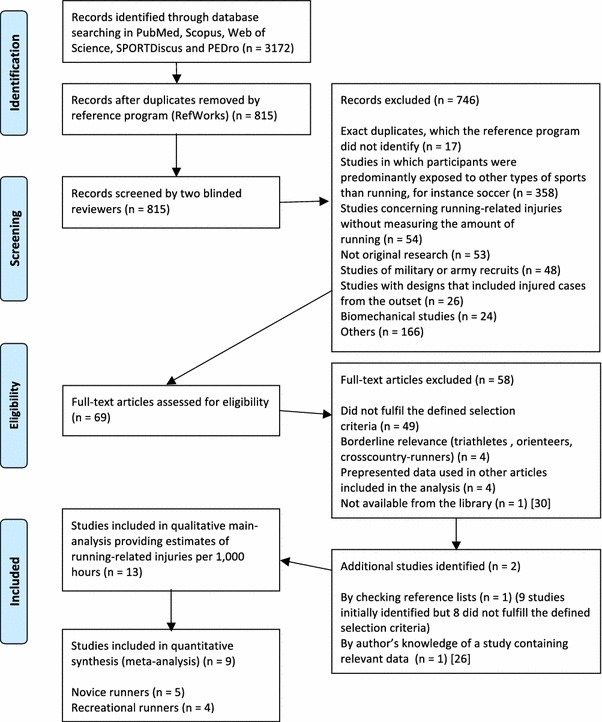
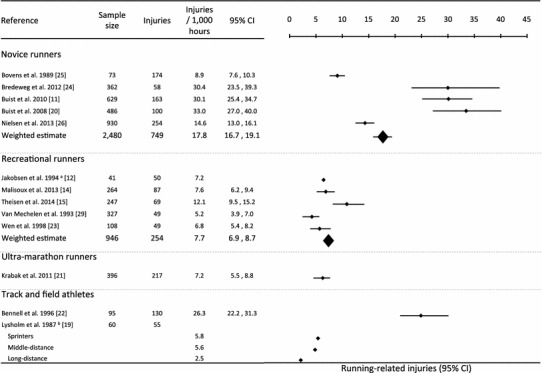
BACKGROUND: No systematic review has identified the incidence of running-related injuries per 1000 h of running in different types of runners. OBJECTIVE: The purpose of the present review was to systematically search the literature for the incidence of running-related injuries per 1000 h of running in different types of runners, and to include the data in meta-analyses. DATA SOURCES: A search of the PubMed, Scopus, SPORTDiscus, PEDro and Web of Science databases was conducted. STUDY SELECTION: Titles, abstracts, and full-text articles were screened by two blinded reviewers to identify prospective cohort studies and randomized controlled trials reporting the incidence of running-related injuries in novice runners, recreational runners, ultra-marathon runners, and track and field athletes. STUDY APPRAISAL AND SYNTHESIS METHODS: Data were extracted from all studies and comprised for further analysis. An adapted scale was applied to assess the risk of bias. RESULTS: After screening 815 abstracts, 13 original articles were included in the main analysis. Running-related injuries per 1000 h of running ranged from a minimum of 2.5 in a study of long-distance track and field athletes to a maximum of 33.0 in a study of novice runners. The meta-analyses revealed a weighted injury incidence of 17.8 (95% confidence interval [CI] 16.7-19.1) in novice runners and 7.7 (95% CI 6.9-8.7) in recreational runners. LIMITATIONS: Heterogeneity in definitions of injury, definition of type of runner, and outcome measures in the included full-text articles challenged comparison across studies. CONCLUSION: Novice runners seem to face a significantly greater risk of injury per 1000 h of running than recreational runners.
Overview
CoChat Summary
TL;DR
This systematic review and meta-analysis found that running-related injury incidence per 1000 h of running was higher in novice runners than recreational runners. Pooled estimates were 17.8 (95% CI 16.7–19.1) for novice runners and 7.7 (95% CI 6.9–8.7) for recreational runners.
Key findings
- Across 13 included articles, running-related injuries per 1000 h of running ranged from 2.5 in long-distance track and field athletes to 33.0 in novice runners.
- Meta-analysis weighted injury incidence was 17.8 (95% CI 16.7–19.1) in novice runners and 7.7 (95% CI 6.9–8.7) in recreational runners; novice runners faced a significantly greater risk.
- One ultra-marathon study reported 7.2 injuries per 1000 h; two track and field studies reported 2.5 to 26.3 per 1000 h, with no weighted estimates calculated for these groups.
- Ten studies pooled for a per-1000-km subanalysis gave a weighted estimate of 1.07 (95% CI 1.01–1.13) running-related injuries per 1000 km.
Methods
- Systematic search of PubMed, Scopus, SPORTDiscus, PEDro, and Web of Science without date restriction; two blinded reviewers screened titles, abstracts, and full texts to include prospective cohort studies and randomized controlled trials in novice runners, recreational runners, ultra-marathon runners, and track and field athletes.
- 13 articles were included (8 prospective cohort studies and 5 randomized controlled trials); data were extracted on study characteristics, injury definitions, and incidence per 1000 h and per 1000 km, and risk of bias was assessed with an adapted Newcastle Ottawa Scale modified for runners.
- Meta-analyses pooled estimates for novice and recreational runners; because one article lacked data to calculate 95% CIs, nine studies were included in the quantitative analyses, and ten studies were pooled for the per-1000-km subanalysis.
Limitations
- Stated: heterogeneity in definitions of injury, definition of type of runner, and outcome measures challenged comparison across studies; exposure time was often self-reported in web-based running diaries, risking recall bias and inaccurate training hours or distance; there was lack of agreement in how exposure time was calculated.
- Stated: not all studies provided raw data or 95% CIs, and corresponding authors were contacted; for Buist et al. [11], separate data for runner groups were unavailable, so the 30.1 per 1000 h estimate was included in the novice category, meaning the true novice incidence might be even higher; only a few studies reported ultra-marathon and track and field incidences, so no weighted estimates were calculated.
- Evident from the text: follow-up periods ranged from 7 days to 81 weeks, and novice-runner estimates were heterogeneous (three studies ranged from 30.1 to 33, higher than the two remaining studies), possibly due to follow-up length and a healthy participant effect; risk-of-bias assessment averaged 6 out of 8 stars (range 3–8), with low stars for ascertainment of exposure (6/13) and assessment of outcome (8/13).
Model-written summary. Check it against the paper before relying on it.
Integrity signals
Registry
Cites
Statistics
Figures
Verification
Claims the paper makes
0 Valid · 1 Not valid · 16 Not checked · 65 Own results and interpretations
A result the paper states — it cites no source for it, so there is none to check. The quote shows it is in the paper.
In the paper
“No systematic review has identified the incidence of running-related injuries per 1000 h of running in different types of runners.”
- Also stated in: § Introduction · plain
“However, no review has been published which systematically searched the literature for studies with information on the incidence of running-related injuries in different types of runners per 1000 h of running.”
§ Incidence of Running-Related Injuries Per 1000 h of running in Different Types of Runners: A Systematic Review and Meta-Analysis > Abstract > Background
plain- Asserted: passes — The authors put it forward as true.
- Checkable: passes — It can be checked against evidence.
- Load-bearing: passes — The paper’s conclusions depend on it.
- Based: passes — The paper gives a reason why it holds.
- Also stated in: § Introduction · plain
A result the paper reports from its own data — it cites no other source for it, so there is none to check. The quote shows it is in the paper.
In the paper
“The meta-analyses revealed a weighted injury incidence of 17.8 (95 % confidence interval [CI] 16.7–19.1) in novice runners and 7.7 (95 % CI 6.9–8.7) in recreational runners.”
§ Incidence of Running-Related Injuries Per 1000 h of running in Different Types of Runners: A Systematic Review and Meta-Analysis > Abstract > Results
plain- Asserted: passes — The authors put it forward as true.
- Checkable: passes — It can be checked against evidence.
- Load-bearing: passes — The paper’s conclusions depend on it.
- Based: passes — The paper gives a reason why it holds.
A result the paper reports from its own data — it cites no other source for it, so there is none to check. The quote shows it is in the paper.
In the paper
“The weighted estimate revealed an injury incidence of 1.07 (95 % CI 1.01–1.13) per 1000 km of running.”
§ Incidence of Running-Related Injuries Per 1000 h of running in Different Types of Runners: A Systematic Review and Meta-Analysis > Results
plain- Asserted: passes — The authors put it forward as true.
- Checkable: passes — It can be checked against evidence.
- Load-bearing: unclear — It is unclear whether the paper’s conclusions depend on it.
- Based: passes — The paper gives a reason why it holds.
None of the sources cited for this claim have been checked yet.
In the paper
“Further, some studies specified the premise that the same runner was included and was contributing exposure time, if running was resumed after an injury occurrence [21, 22].”
§ Incidence of Running-Related Injuries Per 1000 h of running in Different Types of Runners: A Systematic Review and Meta-Analysis > Discussion
plain- Asserted: passes — The authors put it forward as true.
- Checkable: passes — It can be checked against evidence.
- Load-bearing: passes — The paper’s conclusions depend on it.
- Based: passes — The paper gives a reason why it holds.
In the paper
“In the latter, track and field athletes were subdivided into sprinters, middle-distance runners, and long-distance runners, which may be relevant as the reported running-related injury incidence per 1000 h was greater in sprinters and middle-distance runners than in long-distance runners [19].”
§ Incidence of Running-Related Injuries Per 1000 h of running in Different Types of Runners: A Systematic Review and Meta-Analysis > Discussion
What the sources say
- Not checked yetcites [19] Lysholm J Wiklander J Injuries in runners Am J Sports Med. 1987 15 2 168 171 10.1177/036354658701500213 3578639 source
plainstates an association- Asserted: passes — The authors put it forward as true.
- Checkable: passes — It can be checked against evidence.
- Load-bearing: unclear — It is unclear whether the paper’s conclusions depend on it.
- Based: passes — The paper gives a reason why it holds.
22 more claims
Create a free account to see all 82 claims and to verify the 16 references still open.
- Probably not a substantial claim. 40
- It may state two separate claims as one. 37
Claims other papers make about this one
Each is checked against this paper’s own text: does it say what the citing paper says it does?
In the citing paper
“Whereas previous data suggested greater injury rates in novice compared with recreational runners, 51 our findings suggested the opposite, with a greater incidence in recreational (26.1%) than in novice runners (14.9%).”
From The Association Between Running Injuries and Training Parameters: A Systematic Review (2022) · cites this paper as [51]
Self-check
Percentages, sums and reported differences re-computed from the paper’s own numbers.
Each contradiction between two passages listed here was confirmed by an independent check.
Rated minor: it would not touch a result — a value no result rests on, a p-value that stays on the same side of the significance level, or a conflict that is clerical, resolved elsewhere in the paper, or outside its own findings.
In the paper
§ Incidence of Running-Related Injuries Per 1000 h of running in Different Types of Runners: A Systematic Review and Meta-Analysis > Discussion
“the study by Bovens et al. [25], which received no star in item 5 because running exposure was collected in diaries”
§ Incidence of Running-Related Injuries Per 1000 h of running in Different Types of Runners: A Systematic Review and Meta-Analysis > Results
“| Bovens et al. [25] | * | * | * | 0 | * | * | * | * |”
Rated minor: it would not touch a result — a value no result rests on, a p-value that stays on the same side of the significance level, or a conflict that is clerical, resolved elsewhere in the paper, or outside its own findings.
In the paper
“| Jakobsen et al. [12], Denmark | Randomised controlled trial (12 months) | 41 Recreational long-distance runners. Had all taken part in marathon races and intended to take part in at least two marathons during the year of investigation | 19 Men and 2 women aged 24–56.”
§ Incidence of Running-Related Injuries Per 1000 h of running in Different Types of Runners: A Systematic Review and Meta-Analysis > Methods > Data Collection
Reported 41 · recomputed 21
Citations
Cites
van Gent, R. N., Siem, D., van Middelkoop, M., van Os, A. G., Bierma-Zeinstra, S. M. A., & Koes, B. W. (2007) · British Journal of Sports Medicine · doi:10.1136/bjsm.2006.033548 · Cited by 1,420
What are the Main Running-Related Musculoskeletal Injuries?: A Systematic Review
Lopes, A. D., Hespanhol, L. C., Yeung, S. S., & Costa, L. O. P. (2012) · Sports Medicine · doi:10.1007/bf03262301 · Cited by 715
Lysholm, J., & Wiklander, J. (1987) · The American Journal of Sports Medicine · doi:10.1177/036354658701500213 · Cited by 618
Running Injuries: A Review of the Epidemiological Literature
van Mechelen, W. (1992) · Sports Medicine · doi:10.2165/00007256-199214050-00004 · Cited by 521
Bennell, K. L., Malcolm, S. A., Thomas, S. A., Wark, J. D., & Brukner, P. D. (1996) · The American Journal of Sports Medicine · doi:10.1177/036354659602400217 · Cited by 420
What are the Main Risk Factors for Running-Related Injuries?
Saragiotto, B. T., Yamato, T. P., Hespanhol Junior, L. C., Rainbow, M. J., Davis, I. S., & Lopes, A. D. (2014) · Sports Medicine · doi:10.1007/s40279-014-0194-6 · Cited by 278
Buist, I., Bredeweg, S. W., Bessem, B., van Mechelen, W., Lemmink, K. A. P. M., & Diercks, R. L. (2010) · British Journal of Sports Medicine · doi:10.1136/bjsm.2007.044677 · Cited by 258
Prevention of running injuries by warm-up, cool-down, and stretching exercises
van Mechelen, W., Hlobil, H., Kemper, H. C. G., Voorn, W. J., & de Jongh, H. R. (1993) · The American Journal of Sports Medicine · doi:10.1177/036354659302100513 · Cited by 223
Lower extremity alignment and risk of overuse injuries in runners
Wen, D. Y. K., Puffer, J. C., & Schmalzried, T. P. (1997) · Medicine & Science in Sports & Exercise · doi:10.1097/00005768-199710000-00003 · Cited by 187
Buist, I., Bredeweg, S. W., van Mechelen, W., Lemmink, K. A. P. M., Pepping, G.-J., & Diercks, R. L. (2008) · The American Journal of Sports Medicine · doi:10.1177/0363546507307505 · Cited by 167
Cited by
Items 301–400 of 532
Prévention et prise en charge de la blessure liée à la course à pied
Godin, A., Grémeaux, V., Servant, G., Besson, C., Fourchet, F., & Mourot, L. (2022) · JMIG · doi:10.53738/revmed.2022.18.798.1874 · Cited by 2
Estrategias de prevención de lesiones en corredores de diferentes niveles y distancias
Sampietro, M., Asinari, J., Gays, C., & Thomas, A. E. (2023) · Argentinian Journal of Respiratory & Physical Therapy · doi:10.58172/ajrpt.v5i1.253 · Cited by 2
Azevedo, A. P. D. S., Mezêncio, B., Nóbrega, C., Cardoso-Filho, C. A., de Matos‐Neto, E. M., de Araújo, J. A., Cambri, L. T., Amadio, A. C., Seelaender, M. C. L., & Serrão, J. C. (2024) · Human Movement Science · doi:10.1016/j.humov.2024.103305 · Cited by 2
The effect of running experience and speed on local dynamic stability in running
Cerrito, A., Wittwer, L., & Schmitt, K. (2025) · Frontiers in Sports and Active Living · doi:10.3389/fspor.2025.1387934 · Cited by 2
Injury surveillance in The FA Walking Football Cup 2024
Price, A. G., Sprouse, B., Chandran, A. S., Hough, J., Hennis, P. J., Ahmed, A. N., Hibberd, T., & Varley, I. (2025) · Science and Medicine in Football · doi:10.1080/24733938.2025.2524172 · Cited by 2
Exercise and Osteoarthritis: The Effect of Running with Aging in the Masters-Level Athlete
Zlotnicki, J. P., Mares, A. V., & Musahl, V. (2016) · Springer eBooks · doi:10.1007/978-3-319-32982-6_14 · Cited by 2
Approche des pathologies en triathlon
Sanfilippo, D., Delvaux, F. H., Croisier, J. ‐., Forthomme, B., & Kaux, J. (2019) · Journal de Traumatologie du Sport · doi:10.1016/j.jts.2019.07.008 · Cited by 2
Load Transference with Running Speed in Natural Rear-foot Strike Male Runners
Li, R., Liu, H. R., Chen, X., Baďurová, J., Fan, H., & Yang, L. (2020) · Leather and Footwear Journal · doi:10.24264/lfj.20.2.7 · Cited by 2
Muscular Activation Patterns During Exercise on the Treadmill, Stepper, and Elliptical Trainer
Eken, M. M., Withers, A., Flanagan, K., Burger, J., Bosch, A. N., & Lamberts, R. P. (2020) · The Journal of Strength and Conditioning Research · doi:10.1519/jsc.0000000000003743 · Cited by 2
Wilkinson, J., & Mayhew, L. (2021) · British Journal of Sports Medicine · doi:10.1136/bjsm-2021-basemabs.2 · Cited by 2
A Primer on Wearable Technology for Injury Risk Management in Distance Running
den Berghe, P. V. (2024) · Springer eBooks · doi:10.1007/978-3-031-45113-3_4 · Cited by 2
Baltich, J. (2016) · Libraries and Cultural Resources (University of Calgary) · doi:10.11575/prism/28115 · Cited by 2
Coetzee, D. R. (2020) · Open University of Cape Town (University of Cape Town) · Cited by 2
The Comparison of Treadmill and Overground Running with the Use of Inertial Measurement Units (IMUs)
Moon, G. R. (2021) · The Research Repository @ WVU (West Virginia University) · doi:10.33915/etd.10205 · Cited by 2
Dimmick, H. L. (2024) · doi:10.11575/prism/42766 · Cited by 2
Kestävyysjuoksun lajianalyysi ja valmennuksen ohjelmointi : voimaharjoittelun näkökulma
Pirkola, L. (2020) · Jyväskylä University Digital Archive (University of Jyväskylä) · Cited by 2
Áhrif vöðvaþreytu á hlaupahring, hreyfiferla og kraftvægi um hné hjá áhugahlaupurum
Auðunsson, L. (2021) · Skemman · Cited by 2
Áhrif þreytu á vöðvavirkni hjá karlhlaupurum
Gunnarsson, O. (2019) · Skemman · Cited by 2
Lee, D. K., Maltz, N., Becker, J., & Cotter, J. A. (2021) · International journal of exercise science · doi:10.70252/pdyr6658 · Cited by 1
The influence of great toe valgus on pronation and frontal plane knee motion during running
Stoneham, R., Barry, G., Lee, S., & Wilkinson, M. (2020) · Northumbria Research Link (Northumbria University) · Cited by 1
Tomović, M., Toliopoulos, A., Κουτλιάνος, Ν., Dalkiranis, A., Bubanj, S., Deligiannis, A. P., & Kouidi, E. J. (2022) · International Journal of Environmental Research and Public Health · doi:10.3390/ijerph191912289 · Cited by 1
Júnior, J. R. D. S., Bradach, M. M., Gaudette, L. W., & Tenforde, A. S. (2023) · Applied Sciences · doi:10.3390/app13063441 · Cited by 1
Lantelme, S. (2023) · Kinésithérapie la Revue · doi:10.1016/j.kine.2023.11.001 · Cited by 1
George, W. T., Debopadhaya, S., Stephen, S. J., Botti, B. A., Burr, D. B., & Vashishth, D. (2024) · Bone · doi:10.1016/j.bone.2024.117279 · Cited by 1
Doyle, E., Doyle, T. L. A., Bonacci, J., WILLS, J. A., Campbell, R. A., & FULLER, J. T. (2025) · Scandinavian Journal of Medicine and Science in Sports · doi:10.1111/sms.70002 · Cited by 1
The role of hip abductor strengthening and the effects on running gait. A systematic review
Hall, G. D., Barry, G., & Hayes, P. R. (2025) · Advanced Exercise and Health Science · doi:10.1016/j.aehs.2025.02.004 · Cited by 1
Advanced Machine Learning Techniques for Explainable Detection of Knee Injuries in Runners
Fuentes-Jiménez, D., García-de-Villa, S., Casillas-Pérez, D., Floría, P., & Melgarejo-Meseguer, F.-M. (2025) · IEEE International Symposium on Medical Measurements and Applications (MeMeA) · doi:10.1109/memea65319.2025.11068035 · Cited by 1
Kiernan, D., Hawkins, D. A., & Christiansen, B. (2025) · Journal of Biomechanics · doi:10.1016/j.jbiomech.2025.112955 · Cited by 1
Curi, G. O. B. D. C., da Costa, F. D., Medeiros, V. D. S., Barbosa, V. D., Santos, T. R. T., & Dionísio, V. C. (2025) · Journal of Bodywork and Movement Therapies · doi:10.1016/j.jbmt.2025.07.011 · Cited by 1
Acute Effects of Marathon and Ultramarathon Running on Body Composition in Trained Male Athletes
Düz, S., Ilbak, İ., Kinaci, A. E., Šagát, P., & Bartík, P. (2025) · Medicina · doi:10.3390/medicina61122123 · Cited by 1
Abran, G., Schwartz, C., Dardenne, N., Delvaux, F. H., & Croisier, J. (2026) · The American Journal of Sports Medicine · doi:10.1177/03635465251392242 · Cited by 1
der Meulen, L. V., Swinnen, W., Clercq, D. D., & Segers, V. (2026) · Journal of Sports Sciences · doi:10.1080/02640414.2025.2610788 · Cited by 1
Assessment of Xsens Motion Trackers’ Accuracy to Measure Induced Vibrations During Endurance Running
Martina, C., Appiani, A., & Scaccabarozzi, D. (2026) · Journal of Functional Morphology and Kinesiology · doi:10.3390/jfmk11010082 · Cited by 1
Zhang, Z., Fan, T., Wu, J., & Sun, Y. (2026) · Scandinavian Journal of Medicine and Science in Sports · doi:10.1111/sms.70229 · Cited by 1
Jarske, H., Leppänen, M., Avela, J., Vasankari, T. J., Krosshaug, T., Pasanen, K., & Parkkari, J. P. (2026) · Gait & Posture · doi:10.1016/j.gaitpost.2026.110174 · Cited by 1
Basile, G. C., Alito, A., Alessandro de, S. I. R. E., Cova, A., Filardi, V., Ferioli, D., Maccarone, M. C., Capodaglio, P., & Fontana, J. M. (2026) · Journal of Back and Musculoskeletal Rehabilitation · doi:10.1177/10538127261446412 · Cited by 1
Return to Running (RTR) nach Rekonstruktionen des vorderen Kreuzbandes – ein narrativer Review
Diemer, F., Schoch, W., Sutor, V., & Zebisch, J. (2026) · Sportverletzung · Sportschaden · doi:10.1055/a-2808-1311 · Cited by 1
Nair, A., van Rensburg, A. J., Viljoen, C. T., Ramkilawon, G., Ramagole, D., Maleka, T. E., & van Rensburg, D. C. J. (2026) · The Physician and Sportsmedicine · doi:10.1080/00913847.2026.2680966 · Cited by 1
Running-related injuries and risks among runners in township running clubs in Soweto, Johannesburg
Masilana, V., & Kunene, S. H. (2026) · South African Journal of Sports Medicine · doi:10.17159/2078-516x/2026/v38i1a20618 · Cited by 1
Análise estatística de lesões osteomusculares em corredores amadores de Imperatriz-MA
Machado, V. M. D. S., Martins, A. B. O. D. S., da Motta, J. P. C., Santos, E. D. L. D., Martins, A. C. S., de Mello, L. C. C., Ferreira, M. C., Pires, M. V. A., Carvalho, R. F., & Fernandes, J. C. F. (2026) · Revista Eletrônica Acervo Saúde · doi:10.25248/reas.e24144.2026 · Cited by 1
Chittenden, E., Bell, A., Forbes, G., Tooth, P., Porter, R., Vliet, R. V. D., Shouman, K., & Williams, S. (2026) · Frontiers in Sports and Active Living · doi:10.3389/fspor.2026.1937574 · Cited by 2
Otter, T. A. (2017) · Cited by 1
Olivier, B., Naidoo, V., Tau, M., Quinn, S.-L., & Stewart, A. (2017) · The JBI Database of Systematic Reviews and Implementation Reports · doi:10.11124/jbisrir-2016-002961 · Cited by 1
Der Einfluss eines Ultramarathons auf den Bewegungsapparat
Knechtle, B., & Nikolaidis, P. Τ. (2018) · Praxis · doi:10.1024/1661-8157/a002927 · Cited by 1
Stressfraktur des Kreuzbeins bei einem Freizeitlangstreckenläufer
Heitmann, M., & Teßmann, U.-J. (2019) · Der Unfallchirurg · doi:10.1007/s00113-019-00742-0 · Cited by 1
Self-Report and Contemporaneously Recorded Running Agreement in Recreational Athletes
Leech, R. D., Grunseit, A. C., & Edwards, K. (2020) · The Journal of Strength and Conditioning Research · doi:10.1519/jsc.0000000000003759 · Cited by 1
Change in Force-based Metrics during Outdoor 2- and 4-Mile Runs
Renner, K., & Queen, R. M. (2021) · Medicine & Science in Sports & Exercise · doi:10.1249/mss.0000000000002653 · Cited by 1
Losciale, J. M., Wayman, K., Mansfield, C. J., Rethman, K., & Briggs, M. S. (2021) · Physiotherapy Theory and Practice · doi:10.1080/09593985.2021.1946876 · Cited by 1
Temporal changes of pelvic and knee kinematics during running
Jamkrajang, P., Saelee, A., Suwanmana, S., Wiltshire, H., Irwin, G., & Limroongreungrat, W. (2022) · Journal of Physical Education and Sport · doi:10.7752/jpes.2022.03096 · Cited by 1
IMPACTO DA PRÁTICA REGULAR DE EXERCÍCIO AERÓBICO NA QUALIDADE DO SONO
Dias, A. J., Pereira, I. C. S., de Melo, F. K., Mariano, I. G. A., Drummond, L. R., & Salgado, J. V. V. (2022) · Revista Extensão em Ação · doi:10.32356/exta.v23.n1.60889 · Cited by 1
Two-Year Injury Incidence and Movement Characteristics Among Division-I Cross-Country Athletes
Wiegand, K., Tandy, R. D., & Silvernail, J. F. (2023) · International journal of exercise science · doi:10.70252/pwtl5476 · Cited by 1
Mann, R. H. (2023) · British Journal of Sports Medicine · doi:10.1136/bjsports-2022-106608 · Cited by 1
Ali, M. A., & Sugiarto, S. B. M. (2023) · Journal of Hunan University Natural Sciences · doi:10.55463/issn.1674-2974.50.4.15 · Cited by 1
Well-trained Endurance Runners’ Foot Contact Patterns: Barefoot vs. Shod Condition
Ouréns, M. M., Muñoz‐Pérez, I., Tuimil, J. L., Saleta-Cobos, M., & Varela-Sanz, A. (2023) · International Journal of Sports Medicine · doi:10.1055/a-2156-2553 · Cited by 1
Effect of Repetitive Loading from 5 km of Running on Plantar Pressure in Healthy Young Participants
Momoka, T., Takabayashi, T., Hajime, K., Kikumoto, T., & Kubo, M. (2025) · Journal of the American Podiatric Medical Association · doi:10.7547/23-113 · Cited by 1
Running Step Rate Can Be Increased With Both Metronome and Music Auditory Cueing
Lally, E., Ericksen, H. M., Azen, R., Huddleston, W. E., & Earl-Boehm, J. E. (2025) · Journal of Sport Rehabilitation · doi:10.1123/jsr.2024-0392 · Cited by 1
Li, X., Shao, E., Fang, Y., Wang, D., Zheng, Z., Chen, H., Liu, Q., Fekete, G., Sun, D. B., & Gu, Y. (2025) · Frontiers in Sports and Active Living · doi:10.3389/fspor.2025.1536629 · Cited by 1
Using Music to Modify Step-Rate and Running Biomechanics in Healthy Runners
Lally, E. (2023) · UWM Digital Commons (University of Wisconsin–Milwaukee) · Cited by 1
Hulme, A. (2017) · FedUni ResearchOnline (Federation University Australia) · Cited by 1
Efectos de las medias compresivas graduales sobre el organismo tras su uso prolongado
Resta, M. C. (2017) · LA Referencia (Red Federada de Repositorios Institucionales de Publicaciones Científicas) · Cited by 1
Smith, T. D. (2017) · Open University of Cape Town (University of Cape Town) · Cited by 1
Seruendo, R., & Enrique, L. (2018) · Institutional Repository of the University of Granada (University of Granada) · Cited by 1
Doi, H., Matsui, H., Nishioka, D., Ito, Y., & Saura, R. (2024) · Research Square · doi:10.21203/rs.3.rs-3850139/v1 · Cited by 1
Möhler, F. (2022) · Repository KITopen (Karlsruhe Institute of Technology) · doi:10.5445/ir/1000145572 · Cited by 1
Event impact management plan. Guidance for creating (health) impact with running events
Hover, P., Ooms, L., van Eldert, P., Scheerder, J., Helsen, K., & Alexandris, K. (2020) · Lirias · Cited by 1
Explainable Machine-Learning based Detection of Knee Injuries in RunnersPreprint
Fuentes-Jiménez, D., García-de-Villa, S., Casillas-Pérez, D., Floría, P., & Melgarejo-Meseguer, F.-M. (2026) · arXiv (Cornell University) · doi:10.48550/arxiv.2602.11668 · Cited by 2
Použitie kompresného oblečenia u bežcov: áno, nie?
Struhár, I. (2016) · Studia sportiva · doi:10.5817/sts2016-2-8
Master, M. (2017)
Variability in recreational runners – a stride time analysis perspective
Norris, M. (2017) · University of Limerick Institutional Repository (University of Limerick) · doi:10.34961/5844
Évaluation du taux de blessures chez les pratiquants de CrossFit en France
Petit, J., Gille, M., & Grémeaux, V. (2018) · Journal de Traumatologie du Sport · doi:10.1016/j.jts.2017.12.017 · Cited by 1
Blouin, C., Supiot, A., Pradon, D., & Perrier, A. (2018) · Revue du Podologue · doi:10.1016/j.revpod.2018.05.006
Assessing footwear in the presence of running-related injuries
Ramsey, C. A. (2018) · Otago University Research Archive (University of Otago)
Ripoll, E. M. (2018) · RiuNet (Universitat Politècnica de València) · doi:10.4995/thesis/10251/113078
RISK OF ACUTE KIDNEY INJURY AND HYPONATREMIA IN LONG-DISTANCE RUNNERS
Adnan, W. A. H. W. M., & Abdullah, R. (2018) · Journal of Health and Translational Medicine
Linner, T., Murphy, C. A., & O'Keefe, J. (2019) · UND Scholarly Commons (University of North Dakota)
Brund, R. B. K. (2018) · VBN Forskningsportal (Aalborg Universitet) · doi:10.5278/vbn.phd.med.00114
Oliveira-Rosado, J. (2020) · Portuguese National Funding Agency for Science, Research and Technology (RCAAP Project by FCT) · doi:10.34626/cej6-p619
Feasibility og usability af kadenceøgning hos motionsløbere med forreste knæsmerter
Jensen, P. S. (2020) · NVA (Nasjonalt vitenarkiv)
Terviseriskid ultravastupidavusaladega tegelejatel = Health risks of ultra endurance sports
Linnus, S. (2018) · DSpace repository (University of Tartu)
Taddei, U. T. (2020) · Digital Library of Theses and Dissertations (Universidade de São Paulo) · doi:10.11606/t.5.2020.tde-31102020-122935
Iacob, G. S. (2020) · Bulletin of the Transilvania University of Braşov Series IX Sciences of Human Kinetics · doi:10.31926/but.shk.2020.13.62.2.25
Effects of a Gluteal Activation Program on Muscle Fatigue and Performance During a 5K Run
Lane, C. A. (2019) · SHAREOK (University of Oklahoma; Oklahoma State University; Central Oklahoma University)
LOW BACK PAIN IN RUNNING: FROM PREVALENCE TO DIFFERENTIAL DIAGNOSIS
Maselli, F. (2020) · CINECA IRIS Institutial Research Information System (University of Genoa) · doi:10.15167/maselli-filippo_phd2020-05-26
Wilson, C. S. (2020) · Montana State University ScholarWorks (Montana State University)
Does Wearing Multiple Pairs of Shoes Influence Injury Rates?
Mihy, J. A. (2020) · Digital Scholarship - UNLV (University of Nevada Reno) · doi:10.34917/22110076
Butcher-Mokha, M., Leon, A., & Buluchevskaya, Y. (2021) · Research in Health and Medicine
Strautnikaitė, G., & Bertašiūtė, V. (2020) · Lithuanian University of Health Sciences
"Preventative Aspects of Muscle Displacement in the Running Athlete"
Sergio, D. (2021) · Biomedical Journal of Scientific & Technical Research · doi:10.26717/bjstr.2021.35.005759
Neubauer, B. R., Drevlow, Z., & Gerlach, A. (2019) · UND Scholarly Commons (University of North Dakota)
Matias, A. B. (2021) · Digital Library of Theses and Dissertations (Universidade de São Paulo) · doi:10.11606/t.5.2021.tde-09032022-143823
Athletics: Long-Distance Running
Fermín, T. M., & Papakostas, E. (2022) · Springer eBooks · doi:10.1007/978-3-662-64532-1_3
Zinner, M., & Breslow, R. G. (2021) · Springer eBooks · doi:10.1007/978-3-030-74625-4_22
Metadata
- Authors
- Videbæk, S., Bueno, A. M., Nielsen, R. O., & Rasmussen, S.
- Affiliations
- Aarhus University (DK)
- Venue
- Sports Medicine
- Published
- 2015-05-08
- Volume
- 45
- Issue
- 7
- Pages
- 1017-1026
- ISSN
- 0112-1642 (ISSN-L)
- 1179-2035
- PMC
- PMC4473093
- OpenAlex
- W279444749
- Cited by
- 531
- References
- 25
- Citations by year
- 2026: 54 · 2025: 52 · 2024: 46 · 2023: 46 · 2022: 62 · 2021: 63 · 2020: 67 · 2019: 50 · 2018: 41 · 2017: 25 · 2016: 19 · 2015: 6
- FWCI
- 4.60
- Type
- journal article
- Language
- en
- Open access
- hybrid
- doi.org
- Locations
- Sports Medicine (publishedVersion, cc-by)
- Europe PMC (PubMed Central) (publishedVersion, cc-by)
- PubMed (publishedVersion)
- PubMed Central (publishedVersion, cc-by)
- VBN Forskningsportal (Aalborg Universitet) (publishedVersion, other-oa)
- Topics
- Health Sciences › Medicine › Orthopedics and Sports Medicine › Sports injuries and prevention
- Physical Sciences › Engineering › Biomedical Engineering › Lower Extremity Biomechanics and Pathologies
- Health Sciences › Medicine › Public Health, Environmental and Occupational Health › Injury Epidemiology and Prevention
- Keywords
- running injuries, injury incidence, novice runners, recreational runners, track and field athletes, running distance, injury risk
- MeSH terms
- Humans, Recreation, Running, Athletes
About these checks
Registry, retraction, Cites and statistics results are computed, not judged, with one exception: a printed reference that no index lists is read once by a model before it counts as a citation error. Claims are extracted by a model and kept only when their quote appears verbatim in the text; each cited source is then checked, with a model’s help, for whether it says what the claim relies on. Those verdicts can be wrong — read the claim’s quote and the cited source before relying on one.
A language model drew the claims from the paper on 2026-11-19, under version 3 of the claim definition (model deepseek-v4.1-flash, prompt extract-v3).
A second model labelled each claim on 2026-11-19 (model jev-1.13-20260917, definition revision gold-guideline-v0.2).
Statistics and arithmetic are recomputed, not judged.
Confidence bands are shown only for fields calibrated on our annotated test set. None is calibrated yet, so no band is shown.
What counts as a claim ›How we measure confidence ›How we check this ›
Are you an author, or do you see a problem with this page? Request a review
Data sources
Bibliographic data: Semantic Scholar, OpenAlex, Crossref.
Contains information from the Semantic Scholar Academic Graph Datasets, made available under the ODC Attribution License (ODC-BY 1.0).
Semantic Scholar’s data is described in: Kinney, R., et al. (2023). The Semantic Scholar Open Data Platform. arXiv:2301.10140.
