

The DOI matches its Crossref record; 60 of the 60 references it cites were found in a registry or an index.
Drinking Strategies: Planned Drinking Versus Drinking to Thirst
Open accessAbstract
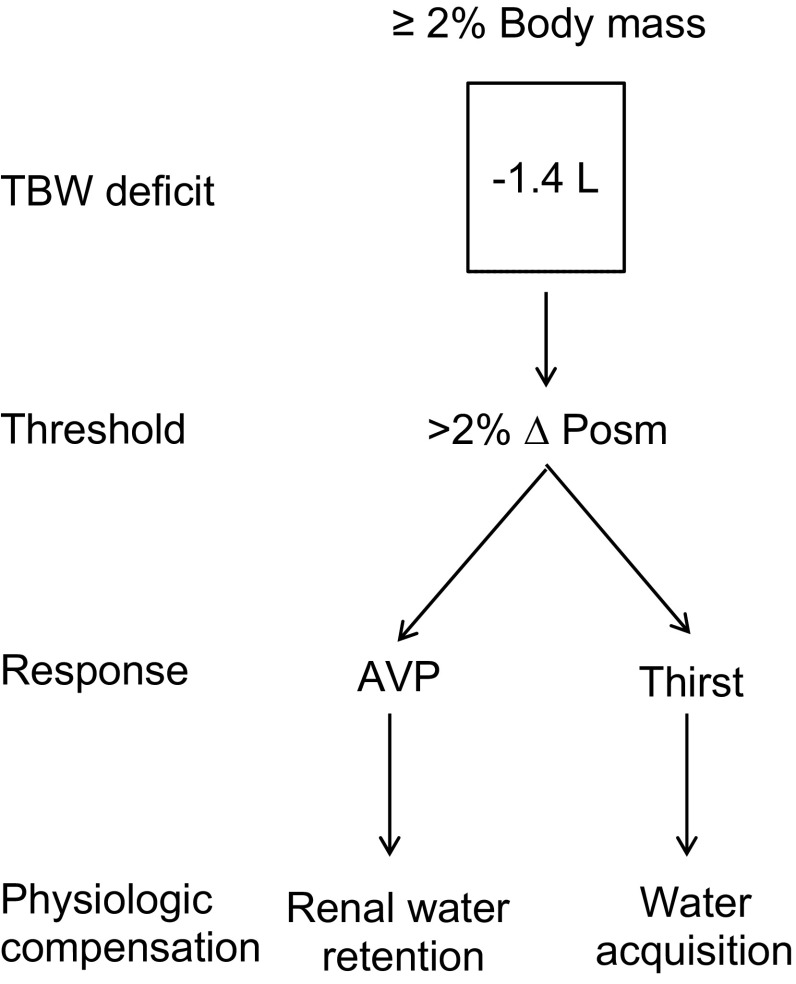
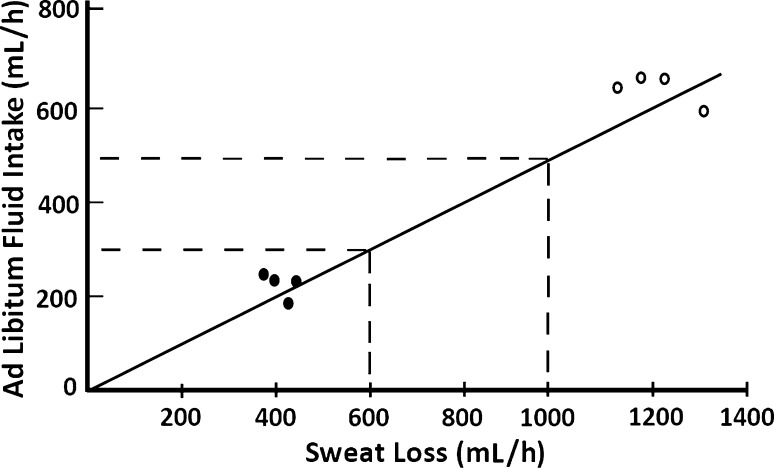
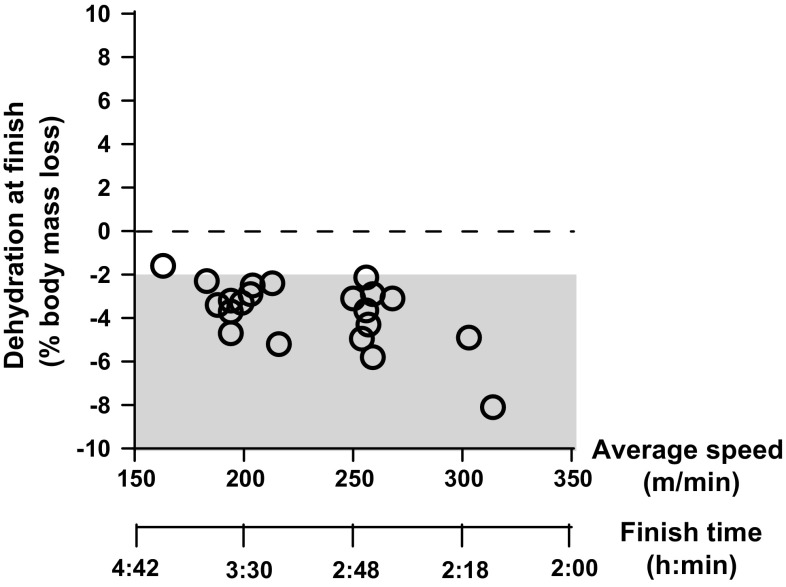
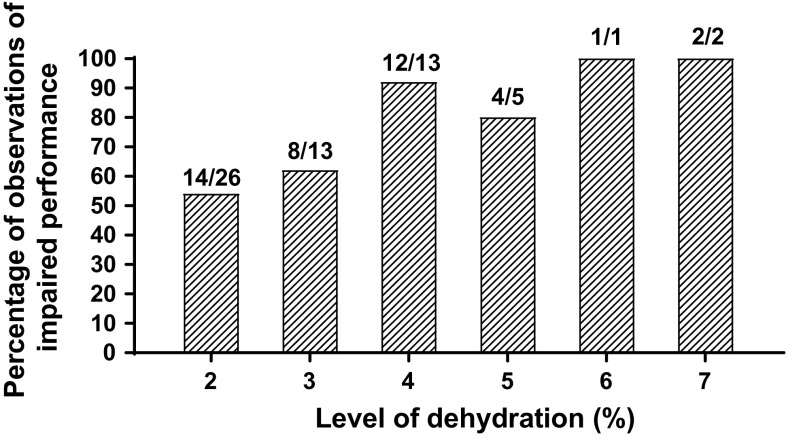
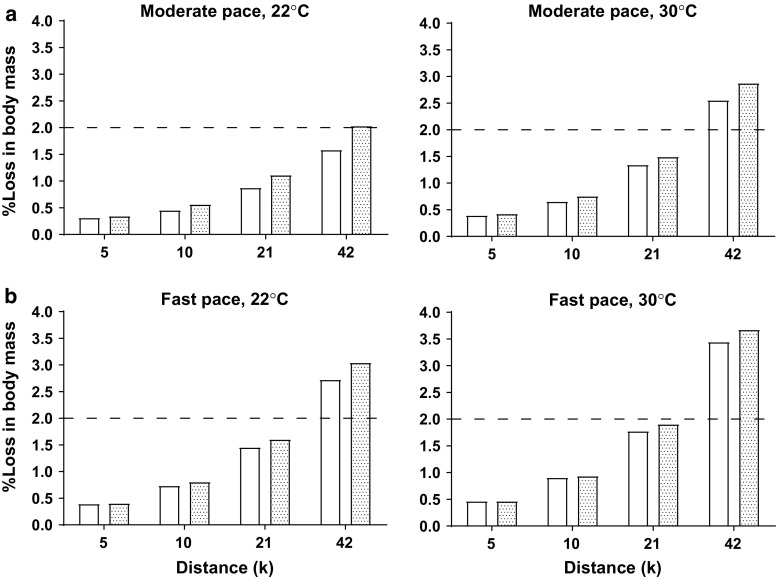
In humans, thirst tends to be alleviated before complete rehydration is achieved. When sweating rates are high and ad libitum fluid consumption is not sufficient to replace sweat losses, a cumulative loss in body water results. Body mass losses of 2% or greater take time to accumulate. Dehydration of ≥ 2% body mass is associated with impaired thermoregulatory function, elevated cardiovascular strain and, in many conditions (e.g., warmer, longer, more intense), impaired aerobic exercise performance. Circumstances where planned drinking is optimal include longer duration activities of > 90 min, particularly in the heat; higher-intensity exercise with high sweat rates; exercise where performance is a concern; and when carbohydrate intake of 1 g/min is desired. Individuals with high sweat rates and/or those concerned with exercise performance should determine sweat rates under conditions (exercise intensity, pace) and environments similar to that anticipated when competing and tailor drinking to prevent body mass losses > 2%. Circumstances where drinking to thirst may be sufficient include short duration exercise of < 1 h to 90 min; exercise in cooler conditions; and lower-intensity exercise. It is recommended to never drink so much that weight is gained.
Overview
The claims and statistics of this paper haven’t been checked yet.
Run the check — free, no account needed. It reads the open-access text and checks the sources it cites.
Integrity signals
Registry
Cites
Statistics
Figures
Verification
Claims the paper makes
The claims and statistics of this paper haven’t been checked yet.
Run the check — free, no account needed. It reads the open-access text and checks the sources it cites.
Claims other papers make about this one
Each is checked against this paper’s own text: does it say what the citing paper says it does?
In the citing paper
“Drinking-to-thirst is an acknowledged means of maintaining hydration during short-duration exercise (<90 min), when environmental conditions are cool, and/or when exercise intensity is low (e.g., < 60% V̇O2max) [121].”
From International Society of Sports Nutrition Position Stand: nutritional considerations for single-stage ultra-marathon training and racing (2019) · cites this paper as [121]
Self-check
Percentages, sums and reported differences re-computed from the paper’s own numbers.
The self-check needs the paper’s full text.
Citations
Cites
ACSM Position Stand: Exercise and Fluid Replacement
Convertino, V. A., Armstrong, L. E., Coyle, E. F., Mack, G. W., Sawka, M. N., Senay, L. C., & Sherman, W. M. (1996) · Medicine & Science in Sports & Exercise · doi:10.1097/00005768-199610000-00045 · Cited by 1,977
Williams Textbook of Endocrinology
Stoffer, S. S. (1999) · JAMA · doi:10.1001/jama.281.9.851 · Cited by 1,245
Dietary Reference Intakes for Water, Potassium, Sodium, Chloride, and Sulfate
Institute of Medicine (2005) · National Academies Press eBooks · doi:10.17226/10925 · Cited by 1,054
Influence of graded dehydration on hyperthermia and cardiovascular drift during exercise
Montain, S. J., & Coyle, E. F. (1992) · Journal of Applied Physiology · doi:10.1152/jappl.1992.73.4.1340 · Cited by 769
Central mechanisms of osmosensation and systemic osmoregulation
Bourque, C. W. (2008) · Nature reviews. Neuroscience · doi:10.1038/nrn2400 · Cited by 703
Human Circulation: Regulation During Physical Stress
Rowell, L. B. (1986) · Medical Entomology and Zoology · Cited by 672
Human Circulation: Regulation During Physical Stress
Iatridis, P. G. (1987) · JAMA · doi:10.1001/jama.1987.03400220116052 · Cited by 533
Mechanisms of aerobic performance impairment with heat stress and dehydration
Cheuvront, S. N., Kenefick, R. W., Montain, S. J., & Sawka, M. N. (2010) · Journal of Applied Physiology · doi:10.1152/japplphysiol.00367.2010 · Cited by 477
Self-citationDehydration: Physiology, Assessment, and Performance Effects
Cheuvront, S. N., & Kenefick, R. W. (2014) · Comprehensive Physiology · doi:10.1002/cphy.c130017 · Cited by 461
Self-citationThermoregulatory and blood responses during exercise at graded hypohydration levels
Sawka, M. N., Young, A. J., Francesconi, R. P., Muza, S. R., & PANDOLF, K. B. (1985) · Journal of Applied Physiology · doi:10.1152/jappl.1985.59.5.1394 · Cited by 402
Fluid Balance and Endurance Exercise Performance
Cheuvront, S. N., Carter, R., & Sawka, M. N. (2003) · Current Sports Medicine Reports · doi:10.1249/00149619-200308000-00006 · Cited by 380
GREENLEAF, J. E. (1992) · Medicine & Science in Sports & Exercise · doi:10.1249/00005768-199206000-00007 · Cited by 376
Physiology of Man in the Desert
Adolph, E. F. (1969) · Medical Entomology and Zoology · Cited by 372
Physiological consequences of hypohydration: exercise performance and thermoregulation.
Sawka, M. N. (1992) · PubMed · Cited by 372
Influence of age on thirst and fluid intake
Kenney, W. L., & Chiu, P. (2001) · Medicine & Science in Sports & Exercise · doi:10.1097/00005768-200109000-00016 · Cited by 353
Effect of hyperosmolality on control of blood flow and sweating
FORTNEY, S. M., Wenger, C. B., Bove, J. R., & NADEL, E. R. (1984) · Journal of Applied Physiology · doi:10.1152/jappl.1984.57.6.1688 · Cited by 278
Hydration for recreational sport and physical activity
Kenefick, R. W., & Cheuvront, S. N. (2012) · Nutrition Reviews · doi:10.1111/j.1753-4887.2012.00523.x · Cited by 274
Self-citationThe effects of fluid restriction on hydration status and subjective feelings in man
Shirreffs, S. M., Merson, S. J., Fraser, S. M., & Archer, D. T. (2004) · British Journal of Nutrition · doi:10.1079/bjn20041149 · Cited by 252
Hypohydration and human performance: Impact of environment and physiological mechanisms
Sawka, M. N., Cheuvront, S. N., & Kenefick, R. W. (2015) · Sports Medicine · doi:10.1007/s40279-015-0395-7 · Cited by 236
Self-citationThirst following water deprivation in humans
Rolls, B. J., Wood, R. J., Rolls, E. T., Lind, H., Lind, W., & Ledingham, J. G. (1980) · American Journal of Physiology-Regulatory, Integrative and Comparative Physiology · doi:10.1152/ajpregu.1980.239.5.r476 · Cited by 228
6 Influence of Body Water and Blood Volume on Thermoregulation and Exercise Performance in the Heat
SAWNA, M. N., & Coyle, E. F. (1999) · Exercise and Sport Sciences Reviews · doi:10.1249/00003677-199900270-00008 · Cited by 226
Stroke volume during exercise: interaction of environment and hydration
González‐Alonso, J., Mora‐Rodríguez, R., & Coyle, E. F. (2000) · American Journal of Physiology-Heart and Circulatory Physiology · doi:10.1152/ajpheart.2000.278.2.h321 · Cited by 220
Influence of Hydration on Physiological Function and Performance During Trail Running in the Heat
Casa, D. J., Stearns, R. L., Lopez, R. M., Ganio, M. S., McDermott, B. P., Yeargin, S. W., Yamamoto, L. M., Mazerolle, S. M., Roti, M. W., Armstrong, L. E., et al. (2010) · Journal of Athletic Training · doi:10.4085/1062-6050-45.2.147 · Cited by 216
Circulatory response to submaximal and maximal exercise after thermal dehydration
Saltin, B. (1964) · Journal of Applied Physiology · doi:10.1152/jappl.1964.19.6.1125 · Cited by 206
Hew-Butler, T., Rosner, M. H., Fowkes-Godek, S., Dugas, J. P., Hoffman, M. D., Lewis, D. P., Maughan, R. J., Miller, K. C., Montain, S. J., Rehrer, N. J., et al. (2015) · Clinical Journal of Sport Medicine · doi:10.1097/jsm.0000000000000221 · Cited by 205
Does Dehydration Impair Exercise Performance?
Sawka, M. N., & Noakes, T. D. (2007) · Medicine & Science in Sports & Exercise · doi:10.1249/mss.0b013e318124a664 · Cited by 189
Control of thermoregulatory sweating is altered by hydration level and exercise intensity
Montain, S. J., Latzka, W. A., & Sawka, M. N. (1995) · Journal of Applied Physiology · doi:10.1152/jappl.1995.79.5.1434 · Cited by 186
Daily Body Mass Variability and Stability in Active Men Undergoing Exercise-Heat Stress
Cheuvront, S. N., Carter, R., Montain, S. J., & Sawka, M. N. (2004) · International Journal of Sport Nutrition and Exercise Metabolism · doi:10.1123/ijsnem.14.5.532 · Cited by 157
GREENLEAF, J. E., & Sargent, F. (1965) · Journal of Applied Physiology · doi:10.1152/jappl.1965.20.4.719 · Cited by 155
Physiologic basis for understanding quantitative dehydration assessment
Cheuvront, S. N., Kenefick, R. W., Charkoudian, N., & Sawka, M. N. (2013) · The American Journal of Clinical Nutrition · doi:10.3945/ajcn.112.044172 · Cited by 154
Self-citationInhibition of plasma vasopressin after drinking in dehydrated humans
Geelen, G., KEIL, L. C., Kravik, S. E., Wade, C. E., Thrasher, T. N., Barnes, P. R., Pyka, G., Nesvig, C., & GREENLEAF, J. E. (1984) · American Journal of Physiology-Regulatory, Integrative and Comparative Physiology · doi:10.1152/ajpregu.1984.247.6.r968 · Cited by 143
Sawka, M. N. (2007) · Medicine & Science in Sports & Exercise · doi:10.1249/01.mss.0000272779.34140.3b · Cited by 123
Hew‐Butler, T., Verbalis, J. G., & Noakes, T. D. (2006) · Clinical Journal of Sport Medicine · doi:10.1097/00042752-200607000-00001 · Cited by 115
Exercise-associated hyponatremia and hydration status in 161-km ultramarathoners
HOFFMAN, M. D., HEW-BUTLER, T., & STUEMPFLE, K. J. (2013) · Medicine & Science in Sports & Exercise · doi:10.1249/mss.0b013e31827985a8 · Cited by 111
Denton, D. A., Shade, R. E., Zamarripa, F., Egan, G. F., Blair-West, J. R., McKinley, M. J., & Fox, P. T. (1999) · Proceedings of the National Academy of Sciences · doi:10.1073/pnas.96.5.2532 · Cited by 104
Body Fluid Balance During Heat Stress in Humans
Mack, G. W., & Nadel, E. R. (1996) · Comprehensive Physiology · doi:10.1002/cphy.cp040110 · Cited by 103
Dugas, J. P., Oosthuizen, U., Tucker, R., & Noakes, T. D. (2008) · European Journal of Applied Physiology · doi:10.1007/s00421-008-0876-6 · Cited by 100
OBSERVATIONS ON WATER METABOLISM IN THE DESERT
Adolph, E. F., & Dill, D. B. (1938) · American Journal of Physiology-Legacy Content · doi:10.1152/ajplegacy.1938.123.2.369 · Cited by 100
Drinking and water balance during exercise and heat acclimation
GREENLEAF, J. E., Brock, P. J. M., KEIL, L. C., & Morse, J. T. (1983) · Journal of Applied Physiology · doi:10.1152/jappl.1983.54.2.414 · Cited by 89
Drinking behaviors of elite male runners during marathon competition
Beis, L. Y., Wright-Whyte, M., Fudge, B., Noakes, T., & Pitsiladis, Y. P. (2012) · Clinical Journal of Sport Medicine · doi:10.1097/jsm.0b013e31824a55d7 · Cited by 85
Hydration Strategies, Weight Change and Performance in a 161 km Ultramarathon
Hoffman, M. D., & Stuempfle, K. J. (2014) · Research in Sports Medicine · doi:10.1080/15438627.2014.915838 · Cited by 82
Osmoregulatory modulation of thermal sweating in humans: reflex effects of drinking
Takamata, A., Mack, G. W., Gillen, C. M., Jozsi, A. C., & NADEL, E. R. (1995) · American Journal of Physiology-Regulatory, Integrative and Comparative Physiology · doi:10.1152/ajpregu.1995.268.2.r414 · Cited by 81
Dion, T., Savoie, F. A., Asselin, A., Gariepy, C., & Goulet, E. D. B. (2013) · European Journal of Applied Physiology · doi:10.1007/s00421-013-2730-8 · Cited by 79
Effect of fluid intake volume on 2-h running performances in a 25??C environment
DARIES, H. N., Noakes, T. D., & Dennis, S. C. (2000) · Medicine & Science in Sports & Exercise · doi:10.1097/00005768-200010000-00019 · Cited by 78
Body fluid balance : exercise and sport
BUSKIRK, E. R., & Puhl, S. M. (1996) · Cited by 76
BEAN, W. B., & Eichna, L. W. (1943) · Cited by 74
The Posterior Pituitary and Water Metabolism
Samson, W. K. (2011) · Oxford University Press eBooks · doi:10.1093/oso/9780199744121.003.0009 · Cited by 65
Acute suppression of plasma vasopressin and thirst after drinking in hypernatremic humans
Thompson, C. J., Burd, J. M., & Baylis, P. H. (1987) · American Journal of Physiology-Regulatory, Integrative and Comparative Physiology · doi:10.1152/ajpregu.1987.252.6.r1138 · Cited by 64
Fluid Replacement and Performance During the Marathon
Cheuvront, S. N., Montain, S. J., & Sawka, M. N. (2007) · Sports Medicine · doi:10.2165/00007256-200737040-00020 · Cited by 61
Drinking to Thirst Versus Drinking Ad Libitum During Road Cycling
Armstrong, L. E., Johnson, E. C., Kunces, L. J., Ganio, M. S., Judelson, D. A., Kupchak, B. R., Vingren, J. L., Muñoz, C. X., Huggins, R. A., Hydren, J. R., et al. (2014) · Journal of Athletic Training · doi:10.4085/1062-6050-49.3.85 · Cited by 59
Knechtle, B., Senn, O., Imoberdorf, R., Joleska, I., Wirth, A., Knechtle, P., & Rosemann, T. J. (2010) · PubMed · doi:10.5167/uzh-33190 · Cited by 51
Takamata, A., Nagashima, K., Nosé, H., & Morimoto, T. (1998) · American Journal of Physiology-Regulatory, Integrative and Comparative Physiology · doi:10.1152/ajpregu.1998.275.1.r286 · Cited by 44
MECHANISMS FOR DISSIPATING HEAT IN MAN AND DOG
Dill, D. B., Bock, A. V., & Edwards, H. T. (1933) · American Journal of Physiology-Legacy Content · doi:10.1152/ajplegacy.1933.104.1.36 · Cited by 38
Ad‐libitum drinking and performance during a 40‐km cycling time trial in the heat
Berkulo, M. A. R., Bol, S., Levels, K., Lamberts, R. P., Daanen, H. A. M., & Noakes, T. D. (2015) · European Journal of Sport Science · doi:10.1080/17461391.2015.1009495 · Cited by 37
Prescribed Drinking Leads to Better Cycling Performance than Ad Libitum Drinking
Bardis, C. N., Kavouras, S. A., Adams, J. D., Geladas, N. D., Panagiotakos, D. B., & Sidossis, L. S. (2017) · Medicine & Science in Sports & Exercise · doi:10.1249/mss.0000000000001202 · Cited by 37
Vokes, T. (1987) · Annual Review of Nutrition · doi:10.1146/annurev.nu.07.070187.002123 · Cited by 30
Hoffman, M. D., Cotter, J. D., Goulet, E. D. B., & Laursen, P. B. (2016) · Wilderness and Environmental Medicine · doi:10.1016/j.wem.2016.03.003 · Cited by 26
Ormerod, J. K., Elliott, T. A., Scheett, T. P., VanHeest, J. L., Armstrong, L. E., & Maresh, C. M. (2003) · International Journal of Sport Nutrition and Exercise Metabolism · doi:10.1123/ijsnem.13.1.15 · Cited by 22
Hoffman, M. D., Cotter, J. D., Goulet, E. D. B., & Laursen, P. B. (2016) · Wilderness and Environmental Medicine · doi:10.1016/j.wem.2016.04.004 · Cited by 9
(2019) · The Journal of Physical Fitness and Sports Medicine · doi:10.7600/jpfsm.8.333 · Cited by 3
Research works printed but not linked: 1
- Nadel ER, Fortney SM, Wenger CB. Circulatory adjustments during heat stress. In: Paoletti R, editor. Exercise bioenergetics and gas exchange. North-Holland Biomedical Press, Amsterdam; 1980.
Cited by
Sorted by citations
Périard, J. D., Eijsvogels, T. M. H., & Daanen, H. A. M. (2021) · Physiological Reviews · doi:10.1152/physrev.00038.2020 · Cited by 774
Tiller, N. B., Roberts, J. D., Beasley, L., Chapman, S., Pinto, J. M., Smith, L., Wiffin, M., Russell, M., Sparks, S. A., Duckworth, L., et al. (2019) · Journal of the International Society of Sports Nutrition · doi:10.1186/s12970-019-0312-9 · Cited by 164
Practical Hydration Solutions for Sports
Belval, L. N., Hosokawa, Y., Casa, D. J., Adams, W. M., Armstrong, L. E., Baker, L. B., Burke, L., Cheuvront, S., Chiampas, G., González-Alonso, J., et al. (2019) · Nutrients · doi:10.3390/nu11071550 · Cited by 132
IOC consensus statement on recommendations and regulations for sport events in the heat
Racinais, S., Hosokawa, Y., Akama, T., Bermon, S., Bigard, X. A., Casa, D. J., Grundstein, A., Jay, O., Massey, A., Migliorini, S., et al. (2022) · British Journal of Sports Medicine · doi:10.1136/bjsports-2022-105942 · Cited by 147
Swifter, higher, stronger: What’s on the menu?
Burke, L. M., & Hawley, J. A. (2018) · Science · doi:10.1126/science.aau2093 · Cited by 135
Metadata
- Authors
- Kenefick, R. W.
- Affiliations
- United States Army (US)
- Corresponding author
- Kenefick, Robert W.
- Venue
- Sports Medicine
- Published
- 2018-01-24
- Volume
- 48
- Issue
- S1
- Pages
- 31-37
- ISSN
- 0112-1642 (ISSN-L)
- 1179-2035
- PMC
- PMC5790864
- OpenAlex
- W2785137812
- Cited by
- 142
- References
- 60
- Citations by year
- 2026: 9 · 2025: 10 · 2024: 19 · 2023: 11 · 2022: 14 · 2021: 28 · 2020: 19 · 2019: 20 · 2018: 12
- FWCI
- 2.59
- Type
- journal article
- Language
- en
- Open access
- hybrid
- doi.org
- Licence
- Locations
- Sports Medicine (publishedVersion, cc-by)
- PubMed Central (publishedVersion, cc-by)
- PubMed (publishedVersion)
- Funders
- U.S. Department of Defense
- Gran Sasso Science Institute
- Topics
- Health Sciences › Medicine › Physiology (medical) › Thermoregulation and physiological responses
- Health Sciences › Medicine › Orthopedics and Sports Medicine › Sports Performance and Training
- Health Sciences › Medicine › Physiology (medical) › Cardiovascular and exercise physiology
- Keywords
- dehydration, sweat rate, weight loss, exercise thermoregulation, exercise performance, carbohydrate intake, heat exposure
- MeSH terms
- Dehydration, Drinking, Humans, Sweating, Thirst, Water, Water-Electrolyte Balance, Exercise, Athletes
About these checks
Registry, retraction, Cites and statistics results are computed, not judged, with one exception: a printed reference that no index lists is read once by a model before it counts as a citation error. Claims are extracted by a model and kept only when their quote appears verbatim in the text; each cited source is then checked, with a model’s help, for whether it says what the claim relies on. Those verdicts can be wrong — read the claim’s quote and the cited source before relying on one.
Statistics and arithmetic are recomputed, not judged.
Confidence bands are shown only for fields calibrated on our annotated test set. None is calibrated yet, so no band is shown.
What counts as a claim ›How we measure confidence ›How we check this ›
Are you an author, or do you see a problem with this page? Request a review
