

Dietary Nitrate Supplementation and Exercise Performance: An Umbrella Review of 20 Published Systematic Reviews with Meta-analyses
Open accessThe DOI matches its Crossref record; 64 of the 65 references it cites were found in a registry or an index.
Abstract
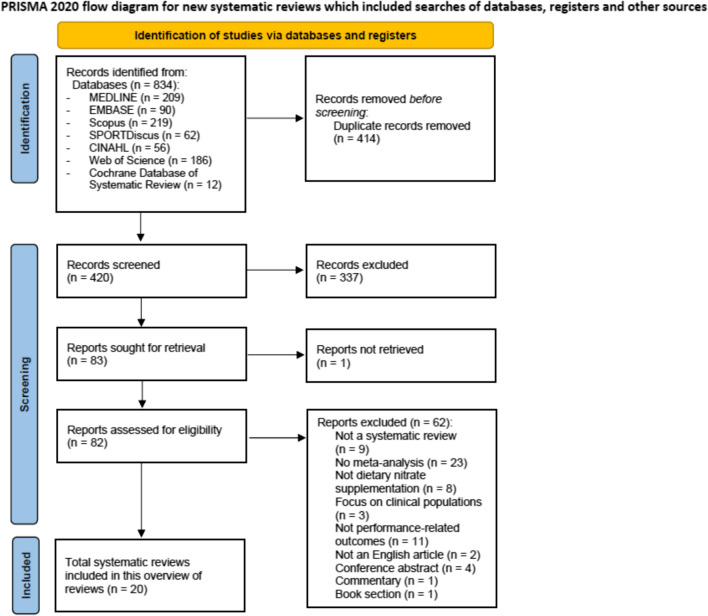
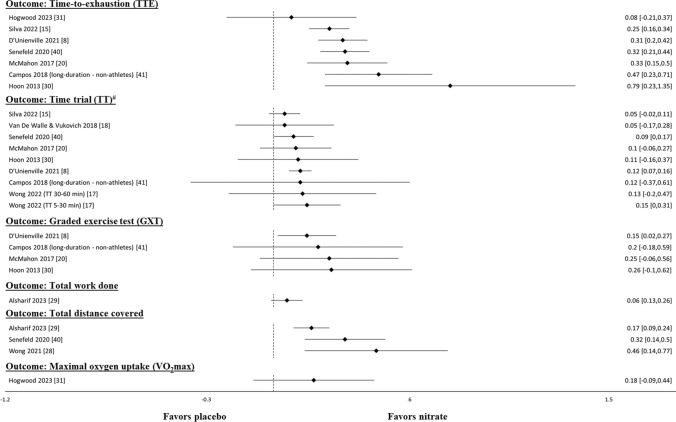
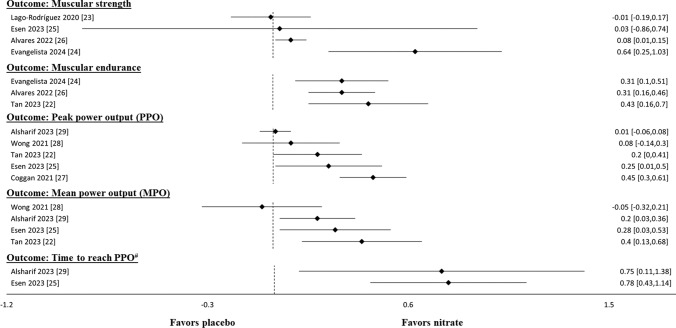
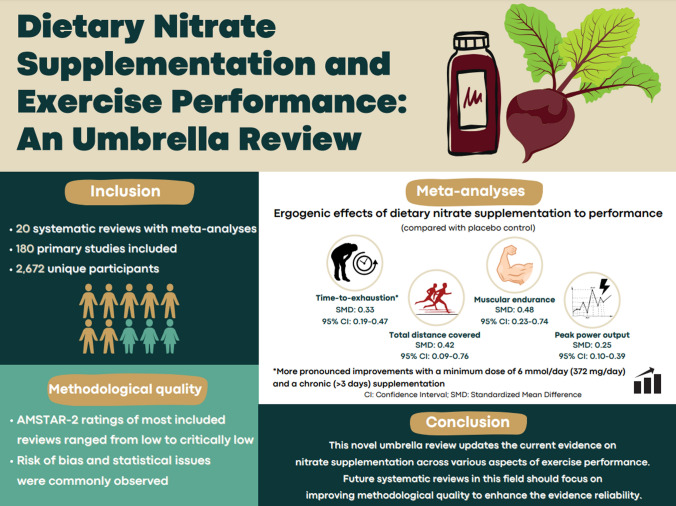
Background: Dietary nitrate (NO 3 − ) supplementation is purported to benefit exercise performance. However, previous studies have evaluated this nutritional strategy with various performance outcomes, exercise tasks, and dosing regimens, often yielding inconsistent results that limit the generalizability of the findings. Objective: We aimed to synthesize the available evidence regarding the effect of NO 3 − supplementation on 11 domains of exercise performance. Methods: An umbrella review was reported in accordance with the Preferred Reporting Items for Overviews of Reviews guideline. Seven databases (MEDLINE, EMBASE, Cochrane Database, CINAHL, Scopus, SPORTDiscus, and Web of Science) were searched from inception until July 2024. Systematic reviews with meta-analyses comparing NO 3 − supplementation and placebo-controlled conditions were included. Literature search, data extraction, and methodological quality assessment (A Measurement Tool to Assess Systematic Reviews Assessing the Methodological quality of SysTemAtic Review [AMSTAR-2]) were conducted independently by two reviewers. Results: Twenty systematic reviews with meta-analyses, representing 180 primary studies and 2672 unique participants, met the inclusion criteria. Our meta-analyses revealed mixed effects of NO 3 − supplementation. It improved time-to-exhaustion tasks [standardized mean difference (SMD): 0.33; 95% confidence interval (CI) 0.19–0.47] with subgroup analyses indicating more pronounced improvements when a minimum dose of 6 mmoL/day (372 mg/day) and chronic (> 3 days) supplementation protocol was implemented. Additionally, ergogenic effects of NO 3 − supplementation were observed for total distance covered (SMD: 0.42; 95% CI 0.09–0.76), muscular endurance (SMD: 0.48; 95% CI 0.23–0.74), peak power output (PPO; SMD: 0.25; 95% CI 0.10 to 0.39), and time to PPO (SMD: − 0.76; 95% CI − 1.18, − 0.33). However, no significant improvements were found for other performance outcomes (all p > 0.05). The AMSTAR-2 ratings of most included reviews ranged from low to critically low. Conclusions: This novel umbrella review with a large-scale meta-analysis provides an updated synthesis of evidence on the effects of NO 3 − supplementation across various aspects of exercise performance. Our review also highlights significant methodological quality issues that future systematic reviews in this field should address to enhance the reliability of evidence. Clinical Trial Registration: This study was registered in the International Prospective Register of Systematic Review (PROSPERO) database (registration number: CRD42024577461).
Overview
The claims and statistics of this paper haven’t been checked yet.
Free: it reads the open-access text and checks the first 5 claims that cite a source we can check. Create a free account to check every claim.
Integrity signals
Registry
Cites
Statistics
Figures
Verification
Claims the paper makes
The claims and statistics of this paper haven’t been checked yet.
Free: it reads the open-access text and checks the first 5 claims that cite a source we can check. Create a free account to check every claim.
Claims other papers make about this one
Each is checked against this paper’s own text: does it say what the citing paper says it does?
The source backs part of the claim, not all of it — or backs it for a different population, condition or comparison.
In the citing paper
“Evidence from systematic reviews and meta-analyses indicates modest but consistent ergogenic effects of dietary nitrate.”
From Dietary Nitrate-Rich Vegetables as Natural Modulators of Health: Mechanisms and Benefits in Ageing Populations (2026) · cites this paper as [200]
Experimental — accuracy not yet measuredThe source backs part of the claim, not all of it — or backs it for a different population, condition or comparison.
In the citing paper
“Supplementation has been associated with improvements in time to exhaustion, muscular endurance, peak power output, and exercise efficiency, particularly at doses of at least 6 mmol/day (approximately 372 mg) and with repeated intake [193,200].”
From Dietary Nitrate-Rich Vegetables as Natural Modulators of Health: Mechanisms and Benefits in Ageing Populations (2026) · cites this paper as [200]
Experimental — accuracy not yet measured
Self-check
Percentages, sums and reported differences re-computed from the paper’s own numbers.
The self-check needs the paper’s full text.
Citations
Cites
Measuring inconsistency in meta-analyses
Higgins, J. P. T., Thompson, S. G., Deeks, J. J., & Altman, D. G. (2003) · BMJ · doi:10.1136/bmj.327.7414.557 · Cited by 63,139 · cited 1×
“I-square values of 25%, 50%, and 75% were considered indicative of low, moderate, and high heterogeneity, respectively [39].”
Shea, B. J., Reeves, B. C., Wells, G., Thuku, M., Hamel, C., Moran, J., Moher, D., Tugwell, P., Welch, V., Kristjansson, E., et al. (2017) · BMJ · doi:10.1136/bmj.j4008 · Cited by 10,636 · cited 2×
“Two independent reviewers (EP and JI) assessed the methodological quality of the included reviews in duplicate using AMSTAR-2 (A MeaSurement Tool to Assess systematic Reviews) [33].”
Systematic review finds overlapping reviews were not mentioned in every other overview
Pieper, D., Antoine, S.-L., Mathes, T., Neugebauer, E. A. M., & Eikermann, M. (2014) · Journal of Clinical Epidemiology · doi:10.1016/j.jclinepi.2013.11.007 · Cited by 1,318 · cited 2×
“The overlap in component primary studies included in all eligible reviews was assessed using the Corrected Covered Area (CCA) formula [34]: CCA = ( N − r )/( rc − r ), where N is the sum of the total primary studies included in all the reviews, r is the number of unique primary studies, and c is…”
Food sources of nitrates and nitrites: The physiologic context for potential health benefits
Hord, N. G., Tang, Y., & Bryan, N. S. (2009) · The American Journal of Clinical Nutrition · doi:10.3945/ajcn.2008.27131 · Cited by 1,069 · cited 1×
“The latter pathway is fueled by dietary consumption of nitrate (NO 3− )-rich foods, such as green leafy or root vegetables, which account for ~ 80% of the body’s NO 3− supply [4, 5].”
IOC Consensus Statement: Dietary Supplements and the High-performance Athlete
Maughan, R. J., Burke, L. M., Dvorak, J., Larson-Meyer, D. E., Peeling, P., Phillips, S. M., Rawson, E. S., Walsh, N. P., Garthe, I., Geyer, H., et al. (2018) · British Journal of Sports Medicine · doi:10.1136/bjsports-2018-099027 · Cited by 1,004 · cited 2×
“In the field of sports nutrition, systematic reviews and meta-analyses synthesize the available primary studies to reflect the quantity and quality of research available based on the inclusion or exclusion criteria needed to answer specific questions [10].”
Gates, M., Gates, A., Pieper, D., Fernandes, R. M., Tricco, A. C., Moher, D., Brennan, S. E., Li, T., Pollock, M., Lunny, C., et al. (2022) · BMJ · doi:10.1136/bmj-2022-070849 · Cited by 856 · cited 4×
“Our umbrella review of systematic reviews with meta-analyses followed the Preferred Reporting Items for Overviews of Reviews (PRIOR) statement [32].”
InfluentialReliability of Power in Physical Performance Tests
Hopkins, W. G., Schabort, E. J., & Hawley, J. A. (2001) · Sports Medicine · doi:10.2165/00007256-200131030-00005 · Cited by 825
Endogenous nitric oxide synthesis: Biological functions and pathophysiology
Bredt, D. S. (1999) · Free Radical Research · doi:10.1080/10715769900301161 · Cited by 796 · cited 2×
“…body has two complementary pathways to generate NO: the NO synthase-dependent pathway (i.e., the biosynthesis of NO from the conversion of L-arginine to L-citrulline in the presence of oxygen) and the nitrate-nitrite-NO pathway, which requires a series of intricate inter-organ reactions [2, 3].”
Effects of dietary nitrate on oxygen cost during exercise
Larsen, F. J., Weitzberg, E., Lundberg, J. O., & Ekblom, B. (2007) · Acta Physiologica · doi:10.1111/j.1748-1716.2007.01713.x · Cited by 637 · cited 1×
“…and muscle contractile efficiency during exercise [6, 7], NO 3− consumption in the form of high-nitrate-containing foods or juice, such as beetroot, spinach, kale, and carrots, has been extensively studied for its potential benefits on exercise performance over the past two decades [8, 9].”
Bailey, S. J., Fulford, J., Vanhatalo, A., Winyard, P. G., Blackwell, J. R., DiMenna, F. J., Wilkerson, D. P., Benjamin, N., & Jones, A. M. (2010) · Journal of Applied Physiology · doi:10.1152/japplphysiol.00046.2010 · Cited by 607 · cited 2×
“These improvements are likely mediated by the reduced ATP cost of force production and spared muscle phosphocreatine stores during submaximal contraction, as well as enhanced muscle blood flow, oxygen delivery, mitochondrial respiration, and calcium handling, as previously highlighted [ 6, 52, 53].”
Cited by
Yu, T., & Ding, C. (2025) · Frontiers in Nutrition · doi:10.3389/fnut.2025.1675654 · Cited by 19
Meng, F., Liu, Y., Qiu, B., & Li, J. (2025) · Life · doi:10.3390/life15091425 · Cited by 9
“Consistently, a recent umbrella review also reported that nitrate supplementation had no significant ergogenic effect on muscle strength [74].”
Rowland, A., Edwards, S., Prieto-Bellver, G., Menz, B. D., Rowland, A., Cornelisse, E., Karapetis, C. S., Wallen, M. P., & Hopkins, A. M. (2026) · Journal of the International Society of Sports Nutrition · doi:10.1080/15502783.2026.2630487 · Cited by 7
“The end product, nitric oxide, is a potent signalling molecule that mediates vasodilation, enhances muscle blood flow, improves oxygen delivery and increases mitochondrial efficiency [50].”
Salem, A., Ammar, A., Kerkeni, M., Boujelbane, M. A., Uyar, A. M., Köbel, L. M., Selvaraj, S. A., Zare, R., Heinrich, K. M., Jahrami, H., et al. (2025) · Biology of Sport · doi:10.5114/biolsport.2025.151658 · Cited by 6
Navarro, P. E., Díaz, C. G., Pérez, R. G., Gil‐Izquierdo, Á., García, C. J., Giménez-Monzó, D., Perales, A., & Sanz, J. M. M. (2025) · Nutrients · doi:10.3390/nu17162706 · Cited by 6
“…of nitric oxide (NO), whose synthesis occurs through the entero-salivary pathway: nitrates (NO 3 − ), after ingestion, are reduced to nitrites (NO 2 − ) by the action of oral bacteria, and subsequently to NO under hypoxic or acidosis conditions characteristic of physical exercise [3,9–11, 32, 33].”
Liang, J., Huang, T., Li, J., Yang, Z., Ni, J., & Wang, Y. (2026) · RSC Advances · doi:10.1039/d6ra00317f · Cited by 6
Raimundo, R. D., Laurindo, L. F., Gimenez, F. V. M., Benjamim, C. J. R., Gonzaga, L. A., Barbosa, M. P. C. R., Martins, M. D. M., Ito, E. H., Barroca, A. L., Brito, G. D. J., et al. (2025) · Healthcare · doi:10.3390/healthcare13192496 · Cited by 5
“As a key signaling molecule, NO promotes vasodilation, regulates blood flow, and enables parasympathetic reactivation—mechanisms particularly relevant to post-exercise cardiovascular recovery [3,4].”
Poon, E. T., Wong, P.-S., Kong, A. P. S., & Ali, A. (2025) · EClinicalMedicine · doi:10.1016/j.eclinm.2025.103606 · Cited by 5
Self-citationKurhaluk, N., Kołodziejska, R., Buyun, L., Kamiński, P., & Tkaczenko, H. (2026) · International Journal of Molecular Sciences · doi:10.3390/ijms27083461 · Cited by 3
“Supplementation has been associated with improvements in time to exhaustion, muscular endurance, peak power output, and exercise efficiency, particularly at doses of at least 6 mmol/day (approximately 372 mg) and with repeated intake [193,200].”
Ramos, O. J. F., Filho, C. A. D. S., Majeed, S., & Álvares, T. S. (2026) · Nutrients · doi:10.3390/nu18050860 · Cited by 3
“…also highlight a lack of long-term randomized trials focusing specifically on postmenopausal women and clinically relevant muscle quality outcomes [15,16] NO plays a critical role in skeletal muscle performance by modulating Ca 2+ release and sensitivity, thereby enhancing muscle contractile…”
Poon, E. T., Iu, J. C.-K., Franklin, B. A., Phillips, S. M., Lubans, D. R., Schoenfeld, B. J., Smith, J. J., Kennedy, S. G., Wong, P.-S., & Batrakoulis, A. (2026) · Obesity Reviews · doi:10.1111/obr.70171 · Cited by 3
Self-citationWong, T. H., Ooi, D. S. Q., & Burns, S. F. (2025) · Beverages · doi:10.3390/beverages11040097 · Cited by 2
“Most recently, an umbrella review of 20 systematic reviews on nitrate supplementation and exercise performance included five reviews that examined the power output during high-intensity exercise [21].”
Self-citationDávila, E. O. P., Neder‐Suárez, D., Legleu, C. E. C., Hernández‐Torres, R. P., Carreño, R. E. A., & Benítez-Hernández, Z. P. (2026) · Nutrition and Health · doi:10.1177/02601060261416845 · Cited by 2
“Nitrate (NO3-) is the primary bioactive compound reported in the studies, and researchers have investigated its ergo-genic potential in sports (Poon et al., 2025).”
The 4Ps framework of nutritional strategies for optimal performance
Gleeson, M. (2026) · Performance Nutrition · doi:10.1186/s44410-026-00022-0 · Cited by 2
“…(NaNO 3 ) or concentrated vegetable sources of nitrate (usually beetroot juice shots) containing about 6–8 mmoles (370– 500 mg) or 7 mg/kg BM of nitrate 2–3 h prior to exercise has been shown to improve performance in prolonged continuous or intermittent high-intensity activity [32, 34, 36].”
da Silva, L. S. L., Gonçalves, L. D. S., Júnior, M. F. T., Sousa, Y. B. A., Rebelo, M. A., Guimarães, C. S., Tanus-Santos, J. E., Júnior, C. R. B., & Benjamim, C. J. R. (2026) · Antioxidants · doi:10.3390/antiox15030321 · Cited by 2
“Furthermore, these outcomes are widely explained by the bioenergetics contributions to NO 3 − to exercise capacity, where it is more related to exercise actions that last between 2 and 10 minutes of duration [50,51].”
Mrakic‐Sposta, S., Vezzoli, A., Parenza, M., Magno, M., D'Angelo, G., Nannipieri, F., Battaglia, S., Solfanelli, L., Tacconi, E., Dellanoce, C., et al. (2026) · Nutrients · doi:10.3390/nu18081215 · Cited by 2
“Each 30 g serving provides 0.77 g nitrates from Truebeet™ ( Beta vulgaris ) (Bio-gen Extracts Pvt. Ltd., Bangalore, India), improving blood flow, oxygen delivery, mitochondrial efficiency, and exercise performance [19,38–41].”
InfluentialArnaoutis, G., Vallas, G., Toubekis, A. G., & Nomikos, T. (2026) · International Journal of Sport Nutrition and Exercise Metabolism · doi:10.1123/ijsnem.2026-0014 · Cited by 2
Qin, G., & Kim, S. (2026) · Frontiers in Nutrition · doi:10.3389/fnut.2026.1858216 · Cited by 2
“The limited evidence available indicates that hormonal cycling may influence plasma nitrite and nitric oxide bioavailability throughout the menstrual cycle, which could have a moderating effect on the response to the beetroot juice supplement in females (23).”
Stout, J. R., Housh, T. J., & Bergstrom, H. C. (2026) · Journal of the International Society of Sports Nutrition · doi:10.1080/15502783.2026.2711031 · Cited by 2
“Nitrate or bicarbonate may be useful for specific roles, phases, or athletes, but nitrate evidence is strongest for recreational team-sport players in Yo-Yo IR1 and selected short-recovery sprint protocols, not for every team-sport context [39,41,43,44].”
InfluentialRamírez-Munera, M., Arcusa, R., López-Román, F. J., Ávila-Gandía, V., Pérez-Piñero, S., Muñoz-Carrillo, J. C., Luque-Rubia, A. J., & Marhuenda, J. (2025) · Nutrients · doi:10.3390/nu17142381 · Cited by 2
“Although several studies have examined their effects separately [31,33,35,41,52,53], to our knowledge, no study has investigated their co-supplementation.”
Poon, E. T., Li, H., Wong, P.-S., Sum, W. M.-K., Little, J. P., & Sabag, A. (2026) · Obesity Reviews · doi:10.1111/obr.70144 · Cited by 3
“To address the potential overlapping and methodological in-consistencies between individual reviews, we conducted additional meta-analyses using eligible primary studies (i.e., randomized controlled trials [RCTs]) included in all reviews, as employed in prior research [30, 31].”
Self-citationFat-Free Mass Accretion: Limits, Targets, and Best Practices
Trexler, E. T., Jagim, A. R., Torres, M., Potter, N. D., Ketterly, J., Kerkow-Provo, Z., & Lane, M. T. (2026) · Strength and conditioning journal · doi:10.1519/ssc.0000000000000986 · Cited by 1
Self-citationWong, T. H., Lau, I. G. L., & Burns, S. F. (2025) · International Journal of Food Science & Technology · doi:10.1093/ijfood/vvaf136
Self-citationPeoples, B. M., McIntosh, M. C., Harrison, K. D., Smith, B. R., Santamaría-Guzmán, K., Campos-Vargas, S. E., Cifuentes, D. C., Mueller, B. J., Kavazis, A. N., Beck, D. T., et al. (2025) · GeroScience · doi:10.1007/s11357-025-02048-z
“Meanwhile, dietary NO 3 -, abundant in vegetables such as beetroot and leafy greens, is proposed to improve endothelial function, enhance muscle contractility, and metabolic efficiency via nitric oxide pathways [16, 17].”
Мельник, О. В., Sorokina, N. O., Lischishyn, H. V., & Петрук, І. В. (2025) · Public Health Journal · doi:10.32782/pub.health.2025.2.16
Ammar, A., Salem, A., Kerkeni, M., Mera, T. A., Baťalík, L., Toral-Noristz, M., Jahrami, H., Tounsi, S., Żmijewski, P., Ghazzawi, H., et al. (2026) · International Journal of Food Sciences and Nutrition · doi:10.1080/09637486.2026.2625827
“…physiological signatures, whereby BJ enhances vascular, metabolic efficiency, and autonomic regulation (Jurado-Castro et al. 2022; Poon et al. 2025; Celik et al. 2026), while CR preferentially supports phosphagen-driven anaerobic work and energy buffering (Kreider et al. 2017; de…”
He, Y., Ge, X., Tang, C., Wang, Y., Huang, H., Leng, B., & Zhang, C. (2026) · Biology of Sport · doi:10.5114/biolsport.2026.162401
Morais, D. M., Nehme, R., Mendonça, M. E. D. F., de Branco, F. M. S., & de Oliveira, E. P. (2026) · Nutrition & Metabolism · doi:10.1186/s12986-026-01146-9
“The effects of NO₃ ⁻ supplementation, primarily through beetroot juice, have been widely investigated, especially for its potential to lower blood pressure [27] and improve exercise performance, primarily in aerobic exercises such as cycling and running [28, 29].”
Webb, A. J., Clift, H., Hill, C., Mousa, N., Jayaraj, N. A., Quraishi, J., Mills, C. E., & O’Gallagher, K. (2026) · British Journal of Clinical Pharmacology · doi:10.1002/bcp.70640
“35 Note that the elevated nitrate reduction with decreased salivary pH may only be a transient/ acute effect: The BP-lowering effect wore off in the sixth hour-post ingestion/of chewing, and chronic modulation of salivary pH may have the opposite effect, for example, with changes in the oral…”
Kulak, B., Błaszczyk, J., Brzeziński, M., Godyń-Müller, K., Grześkowiak, M., Kasprzak, M., Majchrzak, Z., Pelant, H., Pierzyńska, K., & Zeigner, M. (2026) · Journal of Education Health and Sport · doi:10.12775/jehs.2026.93.72651
Dietary and nutritional supplementation strategies for table tennis athletes: a mini-review
Wang, Z., Shen, L., & Gao, S. (2026) · Frontiers in Nutrition · doi:10.3389/fnut.2026.1849900
Nguyen, V. H., Shannon, O. M., Burton, E., Stirling, E., Farzam, S., Benjamim, C. J. R., Burley, C. V., Stephan, B. C. M., & Siervo, M. (2026) · International Journal of Food Sciences and Nutrition · doi:10.1080/09637486.2026.2694532
“…pressure (Webb et al. 2008; Kapil et al. 2015), enhancement of exercise performance (e.g. through improved oxygen efficiency (Shepherd et al. 2015; Poon et al. 2025)) and broader cardiometabolic benefits including endothelial protection and attenuation of atherosclerotic vascular disease…”
Impact of Supplements on Health, Sport Performance and Well-being of Climbers: A Narrative Review
Zezawska, K., Pal, A., Cegiełka, P., Cienkowski, K., Adamczyk, A., Sicińska, M. M., Ślot, M., Głowacka, I., Katra, M., & Szczęsny, M. (2026) · Journal of Education Health and Sport · doi:10.12775/jehs.2026.94.72996
Cherappurath, N., Navaf, M., YILDIZ, M., Ceylan, H. İ., Thoompenthodi, M. A., Elayaraja, M., Muntean, R. I., Ștefănică, V., Sunooj, K. V., & Pelasseri, M. (2026) · Nutrients · doi:10.3390/nu18152551
Bhimani, M. M., Bommarito, J. C., Miners, N. I., Khangura, P. K., Stapleton, R. K., Sharma, A., Thiessen, J. S., Cyr, N. O., McCarthy, D. G., Dong, J., et al. (2026) · Experimental Physiology · doi:10.1113/ep093800
Ткаченко, Г. М., Rymuszka, A., Kołodziejska, R., & Kurhaluk, N. (2026) · International Journal of Molecular Sciences · doi:10.3390/ijms27198629
Šatalić, Z., & Duraković, M. M. (2026) · Elsevier eBooks · doi:10.1016/b978-0-443-40344-6.00286-6
Modi, S. J., Patil, S., Zutshi, D., Patil, V., Ganu, G., Bhaskar, A., Gujrati, G., Muthuraj, P., Mehta, A., Vora, A., et al. (2026) · medRxiv · doi:10.64898/2026.09.30.26363751
Bruno, J., Montoro-Bombú, R., Thapa, R. K., & Sarmento, H. (2026) · Sports Medicine · doi:10.1007/s40279-026-02538-w
Mohammadi, A., Tek, T., Jalali, P., Asadi, B., Franjko, I., Sporiš, G., Gutenberger, K., & Nobarı, H. (2026) · Journal of Human Sport and Exercise · doi:10.55860/2etc7v20
“Although hypoxia and acidosis favour nitric-oxide generation (Poon et al., 2025; Tan et al., 2023), cuff pressure limits the ability of vasodilation to increase bulk flow during exercise.”
InfluentialZhao, Z., Lai, Z., Zhao, S., Li, W., Wang, M., Guan, F., Liang, X., Zhang, J., & Wang, L. (2026) · Nutrients · doi:10.3390/nu18203315
“…varies substantially across exercise modalities: meta-analytic evidence supports benefits for endurance and high-intensity intermittent protocols [1,4,10], whereas findings for single-sprint and resistance-based tasks are less consistent and may depend on dose, task format, and training status…”
InfluentialNaclerio, F., Karsten, B., & Larumbe-Zabala, E. (2026) · Greenwich Academic Literature Archive (University of Greenwich)
Spor Bilimlerinde Çok Disiplinli Yaklaşımlar: Performans, Karar Verme ve Güvenlik
Kurhan, C. O., KURT, Y., Bozkurt, O., Kurhan, C. O., TAŞÇI, M., KURT, Y., Sari, O., CEYHAN, A., UÇAR, H., Aydemir, R., et al. (2026) · Bidge Yayınları eBooks · doi:10.70269/ad4vrfonzwtq
Fisiologi Sistem Energi dan Metabolisme pada Latihan Fisik
Argarini, R., Herawati, L., Rejeki, P. S., & Sari, G. M. (2026) · Airlangga University Press eBooks · doi:10.20473/aup.1715
Óxido nítrico e desempenho fisio: uma revisão da literatura sobre suplementos e fontes alimentares
da Silva, A. G. T., da Silva, R. M., Lima, T. D. S., Freitas, F. M. N. D. O., & dos Reis, D. S. (2026) · Periódicos Brasil Pesquisa Científica · doi:10.36557/2674-9432.2026v5n8p657-671
Mazzo, M. F., Barbosa, I. P., Silva, C. A., Macêdo, M. P., Arrais, J. L., Chaves, M. C., Fioravante, M. B., & Sanches, F. L. F. Z. (2026) · Journal of Physical Education and Sport · doi:10.7752/jpes.2026.09159
Guo, W., Li, T., Hu, Z., An, N., & Wu, H. (2026) · Nitric Oxide · doi:10.1016/j.niox.2026.10.008
da Silva, A. K. S., & NASCIMENTO, F. G. D. (2026) · Revista Tópicos · doi:10.70773/revistatopicos/793468178
Bescós, R., Lundberg, J. O., Stein, L. Y., Benjamim, C. J. R., Weitzberg, E., & Casas‐Agustench, P. (2026) · Critical Reviews in Food Science and Nutrition · doi:10.1080/10408398.2026.2749335
Metadata
- Authors
- Poon, E. T.-C., Iu, J. C.-K., Sum, W. M.-K., Wong, P.-S., Lo, K. K.-H., Ali, A., Burns, S. F., & Trexler, E. T.
- Affiliations
- Chinese University of Hong Kong (HK)
- Hong Kong Polytechnic University (HK)
- Massey University (NZ)
- Nanyang Technological University (SG)
- Duke University (US)
- Corresponding author
- Poon, Eric Tsz-Chun
- ORCID
- Venue
- Sports Medicine
- Published
- 2025-03-14
- Volume
- 55
- Issue
- 5
- Pages
- 1213-1231
- ISSN
- 0112-1642 (ISSN-L)
- 1179-2035
- PMC
- PMC12106159
- OpenAlex
- W4408473421
- Semantic Scholar
- 414ad644fd48d8877f885d644548a525e3fdf210
- Cited by
- 28
- References
- 65
- Citations by year
- 2026: 20 · 2025: 8
- FWCI
- 3.27
- Type
- journal article
- Language
- en
- Open access
- hybrid
- doi.org
- Licence
- cc-by
- creativecommons.org/licenses/by/4.0 (tdm)
- creativecommons.org/licenses/by/4.0 (vor)
- Locations
- Sports Medicine (publishedVersion, cc-by)
- PubMed Central (publishedVersion, cc-by)
- PubMed (publishedVersion)
- PolyU Institutional Research Archive (Hong Kong Polytechnic University) (submittedVersion, cc-by)
- NIE Digital Repository (National Institute of Education, Nanyang Technological University) (submittedVersion)
- Funders
- Chinese University of Hong Kong
- Topics
- Health Sciences › Medicine › Physiology (medical) › Exercise and Physiological Responses
- Health Sciences › Medicine › Physiology (medical) › Cardiovascular and exercise physiology
- Health Sciences › Nursing › Nutrition and Dietetics › Muscle metabolism and nutrition
- Keywords
- nitrate supplementation, exercise performance, time to exhaustion, ergogenic aids, peak power, muscular endurance, total distance covered, dose-response relationship, chronic supplementation, methodological quality of systematic reviews, umbrella review of meta-analyses, AMSTAR 2, cycling performance, running performance
- MeSH terms
- Systematic Reviews as Topic, Humans, Nitrates, Meta-Analysis as Topic, Exercise, Dietary Supplements, Athletic Performance
About these checks
Registry, retraction, Cites and statistics results are computed, not judged, with one exception: a printed reference that no index lists is read once by a model before it counts as a citation error. Claims are extracted by a model and kept only when their quote appears verbatim in the text; each cited source is then checked, with a model’s help, for whether it says what the claim relies on. Those verdicts can be wrong — read the claim’s quote and the cited source before relying on one.
Statistics and arithmetic are recomputed, not judged.
Confidence bands are shown only for fields calibrated on our annotated test set. None is calibrated yet, so no band is shown.
What counts as a claim ›How we measure confidence ›How we check this ›
Are you an author, or do you see a problem with this page? Request a review
Data sources
Bibliographic data: Semantic Scholar, OpenAlex, Crossref.
Contains information from the Semantic Scholar Academic Graph Datasets, made available under the ODC Attribution License (ODC-BY 1.0).
Semantic Scholar’s data is described in: Kinney, R., et al. (2023). The Semantic Scholar Open Data Platform. arXiv:2301.10140.
