

Dietary Nitrate Supplementation and Exercise Performance: An Umbrella Review of 20 Published Systematic Reviews with Meta-analyses
Open accessThe DOI matches its Crossref record; 64 of the 65 references it cites were found in a registry or an index.
Abstract
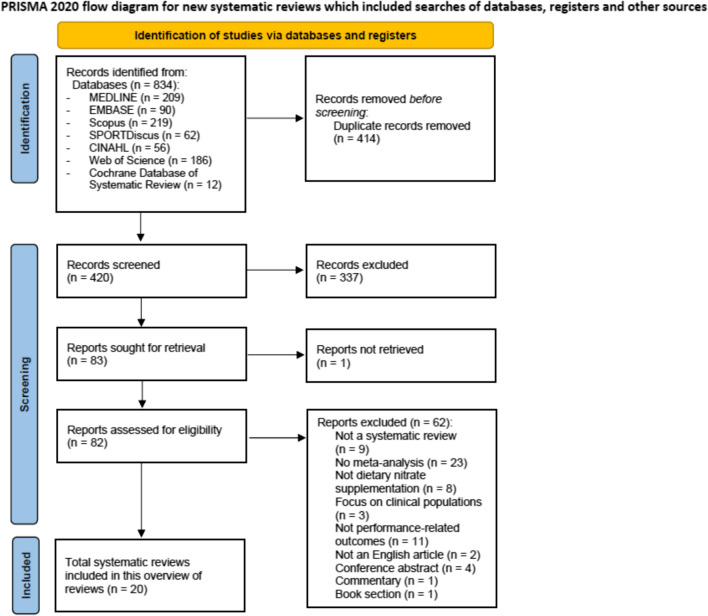
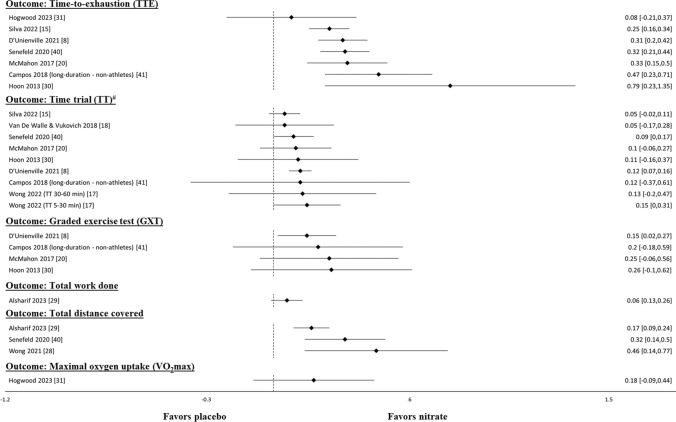
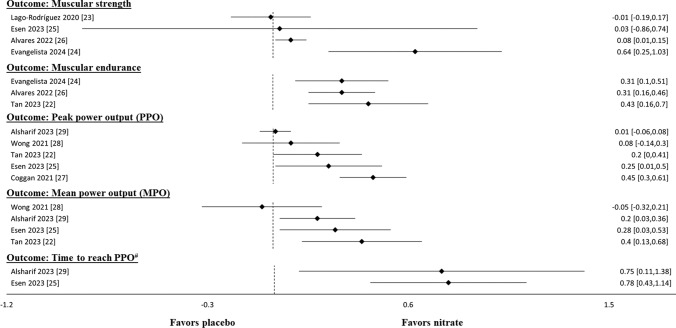
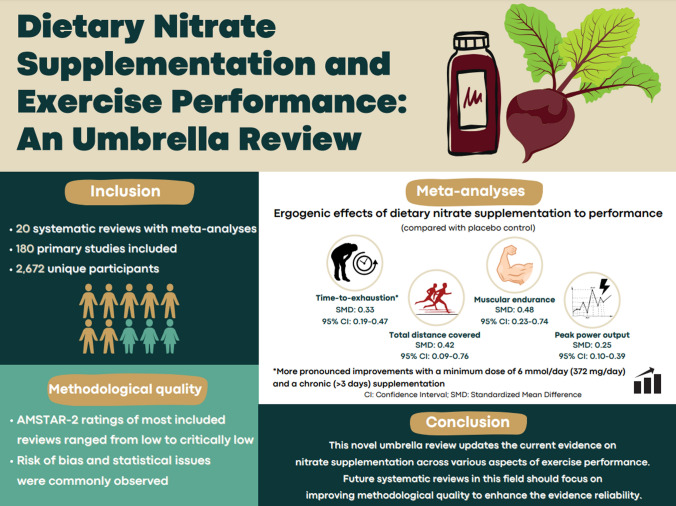
Background: Dietary nitrate (NO 3 − ) supplementation is purported to benefit exercise performance. However, previous studies have evaluated this nutritional strategy with various performance outcomes, exercise tasks, and dosing regimens, often yielding inconsistent results that limit the generalizability of the findings. Objective: We aimed to synthesize the available evidence regarding the effect of NO 3 − supplementation on 11 domains of exercise performance. Methods: An umbrella review was reported in accordance with the Preferred Reporting Items for Overviews of Reviews guideline. Seven databases (MEDLINE, EMBASE, Cochrane Database, CINAHL, Scopus, SPORTDiscus, and Web of Science) were searched from inception until July 2024. Systematic reviews with meta-analyses comparing NO 3 − supplementation and placebo-controlled conditions were included. Literature search, data extraction, and methodological quality assessment (A Measurement Tool to Assess Systematic Reviews Assessing the Methodological quality of SysTemAtic Review [AMSTAR-2]) were conducted independently by two reviewers. Results: Twenty systematic reviews with meta-analyses, representing 180 primary studies and 2672 unique participants, met the inclusion criteria. Our meta-analyses revealed mixed effects of NO 3 − supplementation. It improved time-to-exhaustion tasks [standardized mean difference (SMD): 0.33; 95% confidence interval (CI) 0.19–0.47] with subgroup analyses indicating more pronounced improvements when a minimum dose of 6 mmoL/day (372 mg/day) and chronic (> 3 days) supplementation protocol was implemented. Additionally, ergogenic effects of NO 3 − supplementation were observed for total distance covered (SMD: 0.42; 95% CI 0.09–0.76), muscular endurance (SMD: 0.48; 95% CI 0.23–0.74), peak power output (PPO; SMD: 0.25; 95% CI 0.10 to 0.39), and time to PPO (SMD: − 0.76; 95% CI − 1.18, − 0.33). However, no significant improvements were found for other performance outcomes (all p > 0.05). The AMSTAR-2 ratings of most included reviews ranged from low to critically low. Conclusions: This novel umbrella review with a large-scale meta-analysis provides an updated synthesis of evidence on the effects of NO 3 − supplementation across various aspects of exercise performance. Our review also highlights significant methodological quality issues that future systematic reviews in this field should address to enhance the reliability of evidence. Clinical Trial Registration: This study was registered in the International Prospective Register of Systematic Review (PROSPERO) database (registration number: CRD42024577461).
Overview
The claims and statistics of this paper haven’t been checked yet.
Free: it reads the open-access text and checks the first 5 claims that cite a source we can check. Create a free account to check every claim.
Integrity signals
Registry
Cites
Statistics
Figures
Verification
Claims the paper makes
The claims and statistics of this paper haven’t been checked yet.
Free: it reads the open-access text and checks the first 5 claims that cite a source we can check. Create a free account to check every claim.
Claims other papers make about this one
Each is checked against this paper’s own text: does it say what the citing paper says it does?
The source backs part of the claim, not all of it — or backs it for a different population, condition or comparison.
In the citing paper
“Evidence from systematic reviews and meta-analyses indicates modest but consistent ergogenic effects of dietary nitrate.”
From Dietary Nitrate-Rich Vegetables as Natural Modulators of Health: Mechanisms and Benefits in Ageing Populations (2026) · cites this paper as [200]
Experimental — accuracy not yet measuredThe source backs part of the claim, not all of it — or backs it for a different population, condition or comparison.
In the citing paper
“Supplementation has been associated with improvements in time to exhaustion, muscular endurance, peak power output, and exercise efficiency, particularly at doses of at least 6 mmol/day (approximately 372 mg) and with repeated intake [193,200].”
From Dietary Nitrate-Rich Vegetables as Natural Modulators of Health: Mechanisms and Benefits in Ageing Populations (2026) · cites this paper as [200]
Experimental — accuracy not yet measured
Self-check
Percentages, sums and reported differences re-computed from the paper’s own numbers.
The self-check needs the paper’s full text.
Citations
Cites
Measuring inconsistency in meta-analyses
Higgins, J. P. T., Thompson, S. G., Deeks, J. J., & Altman, D. G. (2003) · BMJ · doi:10.1136/bmj.327.7414.557 · Cited by 63,139 · cited 1×
“I-square values of 25%, 50%, and 75% were considered indicative of low, moderate, and high heterogeneity, respectively [39].”
Shea, B. J., Reeves, B. C., Wells, G., Thuku, M., Hamel, C., Moran, J., Moher, D., Tugwell, P., Welch, V., Kristjansson, E., et al. (2017) · BMJ · doi:10.1136/bmj.j4008 · Cited by 10,636 · cited 2×
“Two independent reviewers (EP and JI) assessed the methodological quality of the included reviews in duplicate using AMSTAR-2 (A MeaSurement Tool to Assess systematic Reviews) [33].”
Systematic review finds overlapping reviews were not mentioned in every other overview
Pieper, D., Antoine, S.-L., Mathes, T., Neugebauer, E. A. M., & Eikermann, M. (2014) · Journal of Clinical Epidemiology · doi:10.1016/j.jclinepi.2013.11.007 · Cited by 1,318 · cited 2×
“The overlap in component primary studies included in all eligible reviews was assessed using the Corrected Covered Area (CCA) formula [34]: CCA = ( N − r )/( rc − r ), where N is the sum of the total primary studies included in all the reviews, r is the number of unique primary studies, and c is…”
Food sources of nitrates and nitrites: The physiologic context for potential health benefits
Hord, N. G., Tang, Y., & Bryan, N. S. (2009) · The American Journal of Clinical Nutrition · doi:10.3945/ajcn.2008.27131 · Cited by 1,069 · cited 1×
“The latter pathway is fueled by dietary consumption of nitrate (NO 3− )-rich foods, such as green leafy or root vegetables, which account for ~ 80% of the body’s NO 3− supply [4, 5].”
IOC Consensus Statement: Dietary Supplements and the High-performance Athlete
Maughan, R. J., Burke, L. M., Dvorak, J., Larson-Meyer, D. E., Peeling, P., Phillips, S. M., Rawson, E. S., Walsh, N. P., Garthe, I., Geyer, H., et al. (2018) · British Journal of Sports Medicine · doi:10.1136/bjsports-2018-099027 · Cited by 1,004 · cited 2×
“In the field of sports nutrition, systematic reviews and meta-analyses synthesize the available primary studies to reflect the quantity and quality of research available based on the inclusion or exclusion criteria needed to answer specific questions [10].”
Gates, M., Gates, A., Pieper, D., Fernandes, R. M., Tricco, A. C., Moher, D., Brennan, S. E., Li, T., Pollock, M., Lunny, C., et al. (2022) · BMJ · doi:10.1136/bmj-2022-070849 · Cited by 856 · cited 4×
“Our umbrella review of systematic reviews with meta-analyses followed the Preferred Reporting Items for Overviews of Reviews (PRIOR) statement [32].”
InfluentialReliability of Power in Physical Performance Tests
Hopkins, W. G., Schabort, E. J., & Hawley, J. A. (2001) · Sports Medicine · doi:10.2165/00007256-200131030-00005 · Cited by 825
Endogenous nitric oxide synthesis: Biological functions and pathophysiology
Bredt, D. S. (1999) · Free Radical Research · doi:10.1080/10715769900301161 · Cited by 796 · cited 2×
“…body has two complementary pathways to generate NO: the NO synthase-dependent pathway (i.e., the biosynthesis of NO from the conversion of L-arginine to L-citrulline in the presence of oxygen) and the nitrate-nitrite-NO pathway, which requires a series of intricate inter-organ reactions [2, 3].”
Effects of dietary nitrate on oxygen cost during exercise
Larsen, F. J., Weitzberg, E., Lundberg, J. O., & Ekblom, B. (2007) · Acta Physiologica · doi:10.1111/j.1748-1716.2007.01713.x · Cited by 637 · cited 1×
“…and muscle contractile efficiency during exercise [6, 7], NO 3− consumption in the form of high-nitrate-containing foods or juice, such as beetroot, spinach, kale, and carrots, has been extensively studied for its potential benefits on exercise performance over the past two decades [8, 9].”
Bailey, S. J., Fulford, J., Vanhatalo, A., Winyard, P. G., Blackwell, J. R., DiMenna, F. J., Wilkerson, D. P., Benjamin, N., & Jones, A. M. (2010) · Journal of Applied Physiology · doi:10.1152/japplphysiol.00046.2010 · Cited by 607 · cited 2×
“These improvements are likely mediated by the reduced ATP cost of force production and spared muscle phosphocreatine stores during submaximal contraction, as well as enhanced muscle blood flow, oxygen delivery, mitochondrial respiration, and calcium handling, as previously highlighted [ 6, 52, 53].”
Cited by
Yu, T., & Ding, C. (2025) · Frontiers in Nutrition · doi:10.3389/fnut.2025.1675654 · Cited by 19
Meng, F., Liu, Y., Qiu, B., & Li, J. (2025) · Life · doi:10.3390/life15091425 · Cited by 9
“Consistently, a recent umbrella review also reported that nitrate supplementation had no significant ergogenic effect on muscle strength [74].”
Rowland, A., Edwards, S., Prieto-Bellver, G., Menz, B. D., Rowland, A., Cornelisse, E., Karapetis, C. S., Wallen, M. P., & Hopkins, A. M. (2026) · Journal of the International Society of Sports Nutrition · doi:10.1080/15502783.2026.2630487 · Cited by 7
“The end product, nitric oxide, is a potent signalling molecule that mediates vasodilation, enhances muscle blood flow, improves oxygen delivery and increases mitochondrial efficiency [50].”
Salem, A., Ammar, A., Kerkeni, M., Boujelbane, M. A., Uyar, A. M., Köbel, L. M., Selvaraj, S. A., Zare, R., Heinrich, K. M., Jahrami, H., et al. (2025) · Biology of Sport · doi:10.5114/biolsport.2025.151658 · Cited by 6
Navarro, P. E., Díaz, C. G., Pérez, R. G., Gil‐Izquierdo, Á., García, C. J., Giménez-Monzó, D., Perales, A., & Sanz, J. M. M. (2025) · Nutrients · doi:10.3390/nu17162706 · Cited by 6
“…of nitric oxide (NO), whose synthesis occurs through the entero-salivary pathway: nitrates (NO 3 − ), after ingestion, are reduced to nitrites (NO 2 − ) by the action of oral bacteria, and subsequently to NO under hypoxic or acidosis conditions characteristic of physical exercise [3,9–11, 32, 33].”
Metadata
- Authors
- Poon, E. T.-C., Iu, J. C.-K., Sum, W. M.-K., Wong, P.-S., Lo, K. K.-H., Ali, A., Burns, S. F., & Trexler, E. T.
- Affiliations
- Chinese University of Hong Kong (HK)
- Hong Kong Polytechnic University (HK)
- Massey University (NZ)
- Nanyang Technological University (SG)
- Duke University (US)
- Corresponding author
- Poon, Eric Tsz-Chun
- ORCID
- Venue
- Sports Medicine
- Published
- 2025-03-14
- Volume
- 55
- Issue
- 5
- Pages
- 1213-1231
- ISSN
- 0112-1642 (ISSN-L)
- 1179-2035
- PMC
- PMC12106159
- OpenAlex
- W4408473421
- Cited by
- 28
- References
- 65
- Citations by year
- 2026: 20 · 2025: 8
- FWCI
- 3.27
- Type
- journal article
- Language
- en
- Open access
- hybrid
- doi.org
- Licence
- cc-by
- creativecommons.org/licenses/by/4.0 (tdm)
- creativecommons.org/licenses/by/4.0 (vor)
- Locations
- Sports Medicine (publishedVersion, cc-by)
- PubMed Central (publishedVersion, cc-by)
- PubMed (publishedVersion)
- PolyU Institutional Research Archive (Hong Kong Polytechnic University) (submittedVersion, cc-by)
- NIE Digital Repository (National Institute of Education, Nanyang Technological University) (submittedVersion)
- Funders
- Chinese University of Hong Kong
- Topics
- Health Sciences › Medicine › Physiology (medical) › Exercise and Physiological Responses
- Health Sciences › Medicine › Physiology (medical) › Cardiovascular and exercise physiology
- Health Sciences › Nursing › Nutrition and Dietetics › Muscle metabolism and nutrition
- Keywords
- nitrate supplementation, exercise performance, time to exhaustion, ergogenic aids, peak power, muscular endurance, total distance covered, dose-response relationship, chronic supplementation, methodological quality of systematic reviews, umbrella review of meta-analyses, AMSTAR 2, cycling performance, running performance
- MeSH terms
- Systematic Reviews as Topic, Humans, Nitrates, Meta-Analysis as Topic, Exercise, Dietary Supplements, Athletic Performance
About these checks
Registry, retraction, Cites and statistics results are computed, not judged, with one exception: a printed reference that no index lists is read once by a model before it counts as a citation error. Claims are extracted by a model and kept only when their quote appears verbatim in the text; each cited source is then checked, with a model’s help, for whether it says what the claim relies on. Those verdicts can be wrong — read the claim’s quote and the cited source before relying on one.
Statistics and arithmetic are recomputed, not judged.
Confidence bands are shown only for fields calibrated on our annotated test set. None is calibrated yet, so no band is shown.
What counts as a claim ›How we measure confidence ›How we check this ›
Are you an author, or do you see a problem with this page? Request a review
Data sources
Bibliographic data: Semantic Scholar, OpenAlex, Crossref.
Contains information from the Semantic Scholar Academic Graph Datasets, made available under the ODC Attribution License (ODC-BY 1.0).
Semantic Scholar’s data is described in: Kinney, R., et al. (2023). The Semantic Scholar Open Data Platform. arXiv:2301.10140.
