

Dietary Nitrate Supplementation and Exercise Performance: An Umbrella Review of 20 Published Systematic Reviews with Meta-analyses
Open accessThe DOI matches its Crossref record; 64 of the 65 references it cites were found in a registry or an index.
Abstract
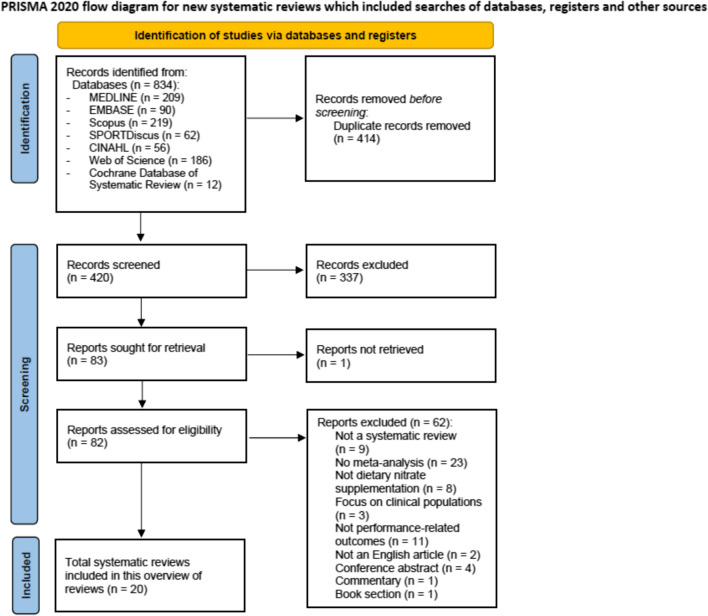
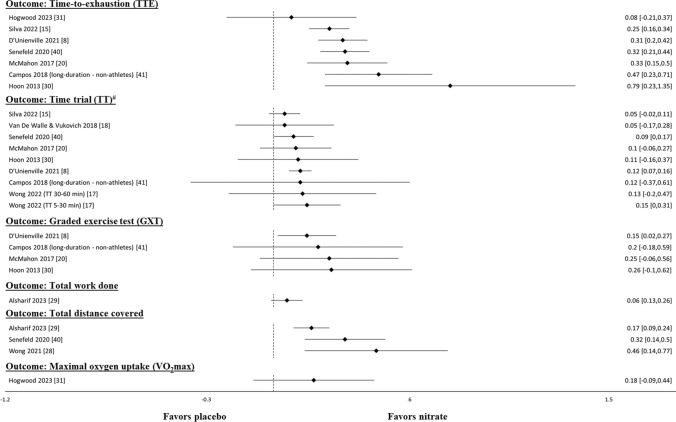
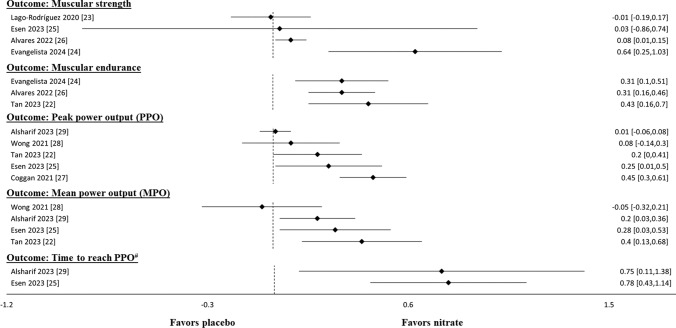
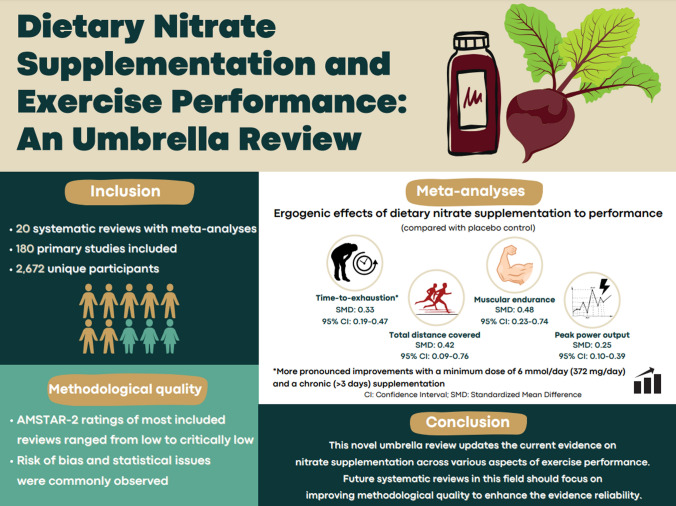
Background: Dietary nitrate (NO 3 − ) supplementation is purported to benefit exercise performance. However, previous studies have evaluated this nutritional strategy with various performance outcomes, exercise tasks, and dosing regimens, often yielding inconsistent results that limit the generalizability of the findings. Objective: We aimed to synthesize the available evidence regarding the effect of NO 3 − supplementation on 11 domains of exercise performance. Methods: An umbrella review was reported in accordance with the Preferred Reporting Items for Overviews of Reviews guideline. Seven databases (MEDLINE, EMBASE, Cochrane Database, CINAHL, Scopus, SPORTDiscus, and Web of Science) were searched from inception until July 2024. Systematic reviews with meta-analyses comparing NO 3 − supplementation and placebo-controlled conditions were included. Literature search, data extraction, and methodological quality assessment (A Measurement Tool to Assess Systematic Reviews Assessing the Methodological quality of SysTemAtic Review [AMSTAR-2]) were conducted independently by two reviewers. Results: Twenty systematic reviews with meta-analyses, representing 180 primary studies and 2672 unique participants, met the inclusion criteria. Our meta-analyses revealed mixed effects of NO 3 − supplementation. It improved time-to-exhaustion tasks [standardized mean difference (SMD): 0.33; 95% confidence interval (CI) 0.19–0.47] with subgroup analyses indicating more pronounced improvements when a minimum dose of 6 mmoL/day (372 mg/day) and chronic (> 3 days) supplementation protocol was implemented. Additionally, ergogenic effects of NO 3 − supplementation were observed for total distance covered (SMD: 0.42; 95% CI 0.09–0.76), muscular endurance (SMD: 0.48; 95% CI 0.23–0.74), peak power output (PPO; SMD: 0.25; 95% CI 0.10 to 0.39), and time to PPO (SMD: − 0.76; 95% CI − 1.18, − 0.33). However, no significant improvements were found for other performance outcomes (all p > 0.05). The AMSTAR-2 ratings of most included reviews ranged from low to critically low. Conclusions: This novel umbrella review with a large-scale meta-analysis provides an updated synthesis of evidence on the effects of NO 3 − supplementation across various aspects of exercise performance. Our review also highlights significant methodological quality issues that future systematic reviews in this field should address to enhance the reliability of evidence. Clinical Trial Registration: This study was registered in the International Prospective Register of Systematic Review (PROSPERO) database (registration number: CRD42024577461).
Overview
The claims and statistics of this paper haven’t been checked yet.
Free: it reads the open-access text and checks the first 5 claims that cite a source we can check. Create a free account to check every claim.
Integrity signals
Registry
Cites
Statistics
Figures
Verification
Claims the paper makes
The claims and statistics of this paper haven’t been checked yet.
Free: it reads the open-access text and checks the first 5 claims that cite a source we can check. Create a free account to check every claim.
Claims other papers make about this one
Each is checked against this paper’s own text: does it say what the citing paper says it does?
The source backs part of the claim, not all of it — or backs it for a different population, condition or comparison.
In the citing paper
“Evidence from systematic reviews and meta-analyses indicates modest but consistent ergogenic effects of dietary nitrate.”
From Dietary Nitrate-Rich Vegetables as Natural Modulators of Health: Mechanisms and Benefits in Ageing Populations (2026) · cites this paper as [200]
Experimental — accuracy not yet measuredThe source backs part of the claim, not all of it — or backs it for a different population, condition or comparison.
In the citing paper
“Supplementation has been associated with improvements in time to exhaustion, muscular endurance, peak power output, and exercise efficiency, particularly at doses of at least 6 mmol/day (approximately 372 mg) and with repeated intake [193,200].”
From Dietary Nitrate-Rich Vegetables as Natural Modulators of Health: Mechanisms and Benefits in Ageing Populations (2026) · cites this paper as [200]
Experimental — accuracy not yet measured
Self-check
Percentages, sums and reported differences re-computed from the paper’s own numbers.
The self-check needs the paper’s full text.
Citations
Cites
Measuring inconsistency in meta-analyses
Higgins, J. P. T., Thompson, S. G., Deeks, J. J., & Altman, D. G. (2003) · BMJ · doi:10.1136/bmj.327.7414.557 · Cited by 63,139 · cited 1×
“I-square values of 25%, 50%, and 75% were considered indicative of low, moderate, and high heterogeneity, respectively [39].”
Shea, B. J., Reeves, B. C., Wells, G., Thuku, M., Hamel, C., Moran, J., Moher, D., Tugwell, P., Welch, V., Kristjansson, E., et al. (2017) · BMJ · doi:10.1136/bmj.j4008 · Cited by 10,636 · cited 2×
“Two independent reviewers (EP and JI) assessed the methodological quality of the included reviews in duplicate using AMSTAR-2 (A MeaSurement Tool to Assess systematic Reviews) [33].”
Systematic review finds overlapping reviews were not mentioned in every other overview
Pieper, D., Antoine, S.-L., Mathes, T., Neugebauer, E. A. M., & Eikermann, M. (2014) · Journal of Clinical Epidemiology · doi:10.1016/j.jclinepi.2013.11.007 · Cited by 1,318 · cited 2×
“The overlap in component primary studies included in all eligible reviews was assessed using the Corrected Covered Area (CCA) formula [34]: CCA = ( N − r )/( rc − r ), where N is the sum of the total primary studies included in all the reviews, r is the number of unique primary studies, and c is…”
Food sources of nitrates and nitrites: The physiologic context for potential health benefits
Hord, N. G., Tang, Y., & Bryan, N. S. (2009) · The American Journal of Clinical Nutrition · doi:10.3945/ajcn.2008.27131 · Cited by 1,069 · cited 1×
“The latter pathway is fueled by dietary consumption of nitrate (NO 3− )-rich foods, such as green leafy or root vegetables, which account for ~ 80% of the body’s NO 3− supply [4, 5].”
IOC Consensus Statement: Dietary Supplements and the High-performance Athlete
Maughan, R. J., Burke, L. M., Dvorak, J., Larson-Meyer, D. E., Peeling, P., Phillips, S. M., Rawson, E. S., Walsh, N. P., Garthe, I., Geyer, H., et al. (2018) · British Journal of Sports Medicine · doi:10.1136/bjsports-2018-099027 · Cited by 1,004 · cited 2×
“In the field of sports nutrition, systematic reviews and meta-analyses synthesize the available primary studies to reflect the quantity and quality of research available based on the inclusion or exclusion criteria needed to answer specific questions [10].”
Gates, M., Gates, A., Pieper, D., Fernandes, R. M., Tricco, A. C., Moher, D., Brennan, S. E., Li, T., Pollock, M., Lunny, C., et al. (2022) · BMJ · doi:10.1136/bmj-2022-070849 · Cited by 856 · cited 4×
“Our umbrella review of systematic reviews with meta-analyses followed the Preferred Reporting Items for Overviews of Reviews (PRIOR) statement [32].”
InfluentialReliability of Power in Physical Performance Tests
Hopkins, W. G., Schabort, E. J., & Hawley, J. A. (2001) · Sports Medicine · doi:10.2165/00007256-200131030-00005 · Cited by 825
Endogenous nitric oxide synthesis: Biological functions and pathophysiology
Bredt, D. S. (1999) · Free Radical Research · doi:10.1080/10715769900301161 · Cited by 796 · cited 2×
“…body has two complementary pathways to generate NO: the NO synthase-dependent pathway (i.e., the biosynthesis of NO from the conversion of L-arginine to L-citrulline in the presence of oxygen) and the nitrate-nitrite-NO pathway, which requires a series of intricate inter-organ reactions [2, 3].”
Effects of dietary nitrate on oxygen cost during exercise
Larsen, F. J., Weitzberg, E., Lundberg, J. O., & Ekblom, B. (2007) · Acta Physiologica · doi:10.1111/j.1748-1716.2007.01713.x · Cited by 637 · cited 1×
“…and muscle contractile efficiency during exercise [6, 7], NO 3− consumption in the form of high-nitrate-containing foods or juice, such as beetroot, spinach, kale, and carrots, has been extensively studied for its potential benefits on exercise performance over the past two decades [8, 9].”
Bailey, S. J., Fulford, J., Vanhatalo, A., Winyard, P. G., Blackwell, J. R., DiMenna, F. J., Wilkerson, D. P., Benjamin, N., & Jones, A. M. (2010) · Journal of Applied Physiology · doi:10.1152/japplphysiol.00046.2010 · Cited by 607 · cited 2×
“These improvements are likely mediated by the reduced ATP cost of force production and spared muscle phosphocreatine stores during submaximal contraction, as well as enhanced muscle blood flow, oxygen delivery, mitochondrial respiration, and calcium handling, as previously highlighted [ 6, 52, 53].”
Beetroot juice and exercise: pharmacodynamic and dose-response relationships
Wylie, L. J., Kelly, J., Bailey, S. J., Blackwell, J. R., Skiba, P. F., Winyard, P. G., Jeukendrup, A. E., Vanhatalo, A., & Jones, A. M. (2013) · Journal of Applied Physiology · doi:10.1152/japplphysiol.00372.2013 · Cited by 500 · cited 2×
“The potential mechanisms underlying such ergogenic effects have been discussed and outlined in detail elsewhere [2, 47].”
Dietary Nitrate Supplementation and Exercise Performance
Jones, A. M. (2014) · Sports Medicine · doi:10.1007/s40279-014-0149-y · Cited by 442
Dietary nitrate increases tetanic [Ca2+]i and contractile force in mouse fast‐twitch muscle
Hernández, A., Schiffer, T. A., Ivarsson, N., Cheng, A. J., Bruton, J. D., Lundberg, J. O., Weitzberg, E., & Westerblad, H. (2012) · The Journal of Physiology · doi:10.1113/jphysiol.2012.232777 · Cited by 319 · cited 2×
“These benefits may be mediated by NO 3− -derived NO that enhances the rate of phosphocreatine resynthesis and the capacity of the anaerobic glycolytic pathway [7].”
McMahon, N. F., Leveritt, M. D., & Pavey, T. G. (2017) · Sports Medicine · doi:10.1007/s40279-016-0617-7 · Cited by 221 · cited 4×
“…tolerance tasks, exercise tests that assessed the time taken to complete a fixed distance or work (i.e., TT tests) showed more equivocal results among the included reviews [8, 15, 17, 18, 20, 30, 41, 42], and our meta-analysis of all included primary studies did not reveal significant improvements.”
InfluentialAerobic Fitness Affects the Exercise Performance Responses to Nitrate Supplementation
PORCELLI, S., RAMAGLIA, M., BELLISTRI, G., PAVEI, G., PUGLIESE, L., MONTORSI, M., RASICA, L., & MARZORATI, M. (2015) · Medicine & Science in Sports & Exercise · doi:10.1249/mss.0000000000000577 · Cited by 187 · cited 1×
“…likely involve a “ceiling effect,” where highly fit individuals may have already optimized their physiological systems for performance and have less room for improvement in terms of oxygen delivery, mitochondrial function, and NO bioavailability, compared with their less-fit counterparts [56].”
Tamme, T., Reinik, M., Roasto, M., Juhkam, K., Tenno, T., & Kiis, A. (2006) · Food Additives and Contaminants · doi:10.1080/02652030500482363 · Cited by 168 · cited 1×
“The latter pathway is fueled by dietary consumption of nitrate (NO 3− )-rich foods, such as green leafy or root vegetables, which account for ~ 80% of the body’s NO 3− supply [4, 5].”
Thompson, C., Wylie, L. J., Fulford, J., Kelly, J., Black, M. I., McDonagh, S. T. J., Jeukendrup, A. E., Vanhatalo, A., & Jones, A. M. (2015) · European Journal of Applied Physiology · doi:10.1007/s00421-015-3166-0 · Cited by 156 · cited 1×
“However, the performance impacts of NO 3− underlying this statement were primarily based on a limited number of original studies available at the time of publication (2018) [11–14].”
Jones, A. M., Vanhatalo, A., Seals, D. R., Rossman, M. J., Piknova, B., & Jonvik, K. L. (2021) · Medicine & Science in Sports & Exercise · doi:10.1249/mss.0000000000002470 · Cited by 156 · cited 4×
“…body has two complementary pathways to generate NO: the NO synthase-dependent pathway (i.e., the biosynthesis of NO from the conversion of L-arginine to L-citrulline in the presence of oxygen) and the nitrate-nitrite-NO pathway, which requires a series of intricate inter-organ reactions [2, 3].”
InfluentialHoon, M. W., Johnson, N. A., Chapman, P. G., & Burke, L. M. (2013) · International Journal of Sport Nutrition and Exercise Metabolism · doi:10.1123/ijsnem.23.5.522 · Cited by 154 · cited 7×
“…points from individual studies without accounting for the likely dependence between those points [8, 17, 19–23, 25, 28, 42], while two applied a fixed-effect meta-analytic model [18, 30], which is unrealistic given that it is unlikely NO 3− supplementation has a single true effect across samples.”
InfluentialCoggan, A. R., Leibowitz, J. L., Spearie, C. A., Kadkhodayan, A., Thomas, D. P., Ramamurthy, S., Mahmood, K., Park, S., Waller, S., Farmer, M., et al. (2015) · Circulation Heart Failure · doi:10.1161/circheartfailure.115.002141 · Cited by 136
Skeletal muscle nNOSμ protein content is increased by exercise training in humans
McConell, G. K., Bradley, S. J., Stephens, T. J., Canny, B. J., Kingwell, B. A., & Lee-Young, R. S. (2007) · American Journal of Physiology-Regulatory, Integrative and Comparative Physiology · doi:10.1152/ajpregu.00796.2006 · Cited by 136 · cited 1×
“It is also suggested that well-trained individuals tend to have higher baseline levels of NO 3− than untrained individuals as training can enhance the production of NO via the NO synthase pathway [57].”
Influence of beetroot juice supplementation on intermittent exercise performance
Wylie, L. J., Bailey, S. J., Kelly, J., Blackwell, J. R., Vanhatalo, A., & Jones, A. M. (2016) · European Journal of Applied Physiology · doi:10.1007/s00421-015-3296-4 · Cited by 133
Dietary nitrate supplementation improves sprint and high-intensity intermittent running performance
Thompson, C., Vanhatalo, A., Jell, H., Fulford, J., Carter, J., Nyman, L., Bailey, S. J., & Jones, A. M. (2016) · Nitric Oxide · doi:10.1016/j.niox.2016.10.006 · Cited by 130 · cited 1×
“However, the performance impacts of NO 3− underlying this statement were primarily based on a limited number of original studies available at the time of publication (2018) [11–14].”
Energy turnover for Ca2+ cycling in skeletal muscle
Barclay, C. J., WOLEDGE, R. C., & Curtin, N. A. (2007) · Journal of Muscle Research and Cell Motility · doi:10.1007/s10974-007-9116-7 · Cited by 129 · cited 1×
“These improvements are likely mediated by the reduced ATP cost of force production and spared muscle phosphocreatine stores during submaximal contraction, as well as enhanced muscle blood flow, oxygen delivery, mitochondrial respiration, and calcium handling, as previously highlighted [ 6, 52, 53].”
Bailey, S. J., Varnham, R. L., DiMenna, F. J., Breese, B. C., Wylie, L. J., & Jones, A. M. (2015) · Journal of Applied Physiology · doi:10.1152/japplphysiol.01141.2014 · Cited by 127
Ergogenic effect of nitrate supplementation: a systematic review and meta-analysis
SENEFELD, J. W., WIGGINS, C. C., REGIMBAL, R. J., DOMINELLI, P. B., BAKER, S. E., & JOYNER, M. J. (2020) · Medicine & Science in Sports & Exercise · doi:10.1249/mss.0000000000002363 · Cited by 125 · cited 6×
“Aside from the exercise type, duration and dosing factors, several individual reviews [8, 30, 41, 42] indicated that the ergogenic benefits of NO 3− supplementation appear to be more pronounced in non-athletes and recreationally active individuals, as compared with highly trained athletes.”
InfluentialFulford, J., Winyard, P. G., Vanhatalo, A., Bailey, S. J., Blackwell, J. R., & Jones, A. M. (2013) · Pflügers Archiv - European Journal of Physiology · doi:10.1007/s00424-013-1220-5 · Cited by 118 · cited 1×
“These improvements are likely mediated by the reduced ATP cost of force production and spared muscle phosphocreatine stores during submaximal contraction, as well as enhanced muscle blood flow, oxygen delivery, mitochondrial respiration, and calcium handling, as previously highlighted [ 6, 52, 53].”
Similar Sensitivity of Time to Exhaustion and Time-Trial Time to Changes in Endurance
AMANN, M., HOPKINS, W. G., & MARCORA, S. M. (2008) · Medicine & Science in Sports & Exercise · doi:10.1249/mss.0b013e31815e728f · Cited by 115 · cited 2×
“This distinction is important, as open-ended exercise tasks involving exercising until exhaustion have been suggested to have a greater variability, partly owing to psychological factors such as boredom and motivation [48, 49].”
Dietary Nitrate Enhances the Contractile Properties of Human Skeletal Muscle
Coggan, A. R., & Peterson, L. R. (2018) · Exercise and Sport Sciences Reviews · doi:10.1249/jes.0000000000000167 · Cited by 86
Poon, E. T., Li, H., Gibala, M. J., Wong, S. H., & Ho, R. S. T. (2024) · Scandinavian Journal of Medicine and Science in Sports · doi:10.1111/sms.14652 · Cited by 85
Self-citationShaltout, H. A., Eggebeen, J., Marsh, A. P., Brubaker, P. H., Laurienti, P. J., Burdette, J. H., Basu, S., Morgan, A., Dos Santos, P. C., Norris, J. L., et al. (2017) · Nitric Oxide · doi:10.1016/j.niox.2017.05.005 · Cited by 82
Nuñez de González, M. T., Osburn, W. N., Hardin, M. D., Longnecker, M., Garg, H. K., Bryan, N. S., & Keeton, J. T. (2015) · Journal of Food Science · doi:10.1111/1750-3841.12858 · Cited by 80 · cited 1×
“The same is true for studies that utilize whole-food sources of NO 3 − , as the naturally occurring NO 3 − content of both conventional and organic vegetables can also vary considerably based on regional differences, soil quality, growing conditions, and storage conditions [64].”
Wickham, K. A., & Spriet, L. L. (2019) · Applied Physiology, Nutrition, and Metabolism · doi:10.1139/apnm-2019-0063 · Cited by 71 · cited 1×
“It has been suggested that differences in sex hormone composition and the associated disparity in muscle mass between men and may impact the storage, utilization, and retention of NO 3− within the body following [59].”
Silva, K. V. C., Costa, B. D., Gomes, A. C., Saunders, B., & Mota, J. F. (2022) · Advances in Nutrition · doi:10.1093/advances/nmac054 · Cited by 64 · cited 7×
“…individual reviews, which suggested that chronic (i.e., multiple-day) supplementation of NO 3− confers greater benefits in improving performance compared with acute supplementation [17, 29, 30, 41], and a minimum of 5 mmoL/day (310 mg/day) would be recommended for performance benefits [15, 18, 41].”
InfluentialCampos, H. O., Drummond, L. R., Rodrigues, Q. T., Machado, F. S. M., Pires, W., Wanner, S. P., & Coimbra, C. C. (2018) · British Journal of Nutrition · doi:10.1017/s0007114518000132 · Cited by 59 · cited 5×
“There were also six reviews utilized RoB/quality assessments tools (i.e., either the PEDro tool [20, 22, 23, 25] or “customized” tools [27, 42]) that do not fully assess bias arising from the selection of reported outcomes, while 12 reviews did not perform analyses to investigate the possible…”
InfluentialVan De Walle, G. P., & Vukovich, M. D. (2018) · Journal of Strength and Conditioning Research · doi:10.1519/jsc.0000000000002046 · Cited by 56 · cited 5×
“…points from individual studies without accounting for the likely dependence between those points [8, 17, 19–23, 25, 28, 42], while two applied a fixed-effect meta-analytic model [18, 30], which is unrealistic given that it is unlikely NO 3− supplementation has a single true effect across samples.”
InfluentialWhat Is in Your Beet Juice? Nitrate and Nitrite Content of Beet Juice Products Marketed to Athletes
Gallardo, E. J., & Coggan, A. R. (2019) · International Journal of Sport Nutrition and Exercise Metabolism · doi:10.1123/ijsnem.2018-0223 · Cited by 56 · cited 1×
“This information is critically important, as commercially available beetroot juice products display considerable within-product and between-product variation in measured NO 3− content, with large differences between labeled values and measured values often observed [63].”
d’Unienville, N. M. A., Blake, H. T., Coates, A. M., Hill, A. M., Nelson, M. J., & Buckley, J. D. (2021) · Journal of the International Society of Sports Nutrition · doi:10.1186/s12970-021-00472-y · Cited by 56 · cited 5×
“…tolerance tasks, exercise tests that assessed the time taken to complete a fixed distance or work (i.e., TT tests) showed more equivocal results among the included reviews [8, 15, 17, 18, 20, 30, 41, 42], and our meta-analysis of all included primary studies did not reveal significant improvements.”
InfluentialGao, C., Gupta, S., Adli, T., Hou, W., Coolsaet, R., Hayes, A., Kim, K., Pandey, A., Gordon, J., Chahil, G., et al. (2021) · Journal of the International Society of Sports Nutrition · doi:10.1186/s12970-021-00450-4 · Cited by 53 · cited 6×
“…while another meta-analysis [29] that included seven studies reported no significant ergogenic effect of NO 3− supplementation on TWD. Gao et al. [21] included 73 studies and indicated that NO 3− supplementation benefits performance-related outcomes, including TTE and total distance traveled,…”
InfluentialWoessner, M., VanBruggen, M. D., Pieper, C. F., Sloane, R., Kraus, W. E., Gow, A. J., & Allen, J. D. (2018) · Circulation Research · doi:10.1161/circresaha.118.313131 · Cited by 51
Coggan, A. R., Baranauskas, M. N., Hinrichs, R. J., Liu, Z., & Carter, S. J. (2021) · Journal of the International Society of Sports Nutrition · doi:10.1186/s12970-021-00463-z · Cited by 44 · cited 5×
“There were also six reviews utilized RoB/quality assessments tools (i.e., either the PEDro tool [20, 22, 23, 25] or “customized” tools [27, 42]) that do not fully assess bias arising from the selection of reported outcomes, while 12 reviews did not perform analyses to investigate the possible…”
InfluentialShannon, O. M., Allen, J. D., Bescos, R., Burke, L., Clifford, T., Easton, C., Gonzalez, J. T., Jones, A. M., Jonvik, K. L., Larsen, F. J., et al. (2022) · Sports Medicine · doi:10.1007/s40279-022-01701-3 · Cited by 44 · cited 2×
“Despite ongoing advancements in this field, the expert consensus identified several key limitations in the current literature, including small sample sizes and a narrow focus on specific exercise tasks or experimental conditions [16].”
Habitual Dietary Nitrate Intake in Highly Trained Athletes
Jonvik, K. L., Nyakayiru, J., van Dijk, J.-W., Wardenaar, F. C., van Loon, L. J. C., & Verdijk, L. B. (2017) · International Journal of Sport Nutrition and Exercise Metabolism · doi:10.1123/ijsnem.2016-0239 · Cited by 43 · cited 1×
“Another suggestion is that highly trained or elite athletes have a greater habitual NO 3− intake through their diet because of higher overall energy intakes, but this suggestion has been challenged [58] as the overall doses are lower than those typically obtained by supplemental NO 3− doses.”
Papadopoulos, S., Δίπλα, Κ., Triantafyllou, Α., Nikolaidis, M. G., Kyparos, A., Touplikioti, P., Vrabas, I. S., & Zafeiridis, A. (2018) · Journal of the American College of Nutrition · doi:10.1080/07315724.2017.1401497 · Cited by 42 · cited 1×
“However, this heterogeneity became non-significant ( I 2 = 13%; p = 0.29) when a primary study [46] that utilized a specific handgrip endurance test at 30% of 1 repetition maximum was removed.”
InfluentialAlsharif, N. S., Clifford, T., Alhebshi, A., Rowland, S. N., & Bailey, S. J. (2023) · Antioxidants · doi:10.3390/antiox12061194 · Cited by 40 · cited 5×
“…11 studies, reported that NO 3− supplementation did not enhance exercise training with respect to ̇ V O 2 max, while another meta-analysis [29] that included seven studies reported no significant ergogenic effect of NO 3− supplementation on TWD. Gao et al. [21] included 73 studies and…”
InfluentialSiervo, M., Oggioni, C., Jakovljevic, D. G., Trenell, M., Mathers, J. C., Houghton, D., Celis-Morales, C., Ashor, A. W., Ruddock, A., Ranchordas, M., et al. (2016) · Nutrition Research · doi:10.1016/j.nutres.2016.11.004 · Cited by 37 · cited 1×
“Additionally, there is a lack of studies focusing on youth and older populations, who have distinct physiological characteristics, such as variations in muscle mass, hormonal pro-files, and cardiovascular function, which can influence their adaptation to NO 3− supplementation [60, 61].”
Wong, T. H., Sim, A., & Burns, S. F. (2021) · Nutrients · doi:10.3390/nu13113674 · Cited by 35 · cited 6×
“Furthermore, it has been suggested that NO 3− supplementation may have a stronger effect on initial force production of type II muscle fibers [28].”
InfluentialSelf-citationEsen, Ö., Dobbin, N., & Callaghan, M. J. (2022) · Journal of the American Nutrition Association · doi:10.1080/07315724.2022.2037475 · Cited by 32 · cited 9×
“There were also six reviews utilized RoB/quality assessments tools (i.e., either the PEDro tool [20, 22, 23, 25] or “customized” tools [27, 42]) that do not fully assess bias arising from the selection of reported outcomes, while 12 reviews did not perform analyses to investigate the possible…”
InfluentialSHOULD TIME TRIAL PERFORMANCE BE PREDICTED FROM THREE SERIAL TIME-TO-EXHAUSTION TESTS?
Jeukendrup, A. E., & Currell, K. (2005) · Medicine & Science in Sports & Exercise · doi:10.1249/01.mss.0000175095.56646.4b · Cited by 30 · cited 2×
“This distinction is important, as open-ended exercise tasks involving exercising until exhaustion have been suggested to have a greater variability, partly owing to psychological factors such as boredom and motivation [48, 49].”
Kang, J., Ratamess, N. A., Faigenbaum, A. D., Bush, J. A., Finnerty, C., DiFiore, M., Garcia, A., & Beller, N. A. (2023) · The Journal of Strength and Conditioning Research · doi:10.1519/jsc.0000000000004497 · Cited by 29 · cited 1×
“It might also be possible that these differences are so small that they are often undetectable in research settings because of typical biological or equipment variability [51].”
Álvares, T. S., de Oliveira, G. V., Volino‐Souza, M., Conte‐Júnior, C. A., & Murias, J. M. (2021) · Critical Reviews in Food Science and Nutrition · doi:10.1080/10408398.2021.1884040 · Cited by 28 · cited 3×
“Two reviews [24, 26] reported significant ergogenic effects, while another two reviews [23, 25] reported no superiority of NO 3− supplementation over placebo conditions for measures of muscular strength.”
Hennis, P. J., Mitchell, K., Gilbert-Kawai, E. T., Bountziouka, V., Wade, A. M., Feelisch, M., Grocott, M. P. W., & Martín, D. (2016) · Nitric Oxide · doi:10.1016/j.niox.2016.08.007 · Cited by 27 · cited 1×
“Additionally, there is a lack of studies focusing on youth and older populations, who have distinct physiological characteristics, such as variations in muscle mass, hormonal pro-files, and cardiovascular function, which can influence their adaptation to NO 3− supplementation [60, 61].”
Peel, J., McNarry, M. A., Heffernan, S. M., Nevola, V. R., Kilduff, L. P., & Waldron, M. (2021) · Sports Medicine · doi:10.1007/s40279-021-01500-2 · Cited by 25 · cited 3×
“Notably, most included reviews [15, 17, 18, 20, 21, 24, 25, 28–30, 40 –42 ] ( n”
RETOS. Nuevas Tendencias en Educación Física, Deporte y Recreación
Rial, B. M. (2014) · Cited by 22
Norouzzadeh, M., Rashedi, M. H., Payandeh, N., Harijani, A. M., & Shahinfar, H. (2024) · Journal of Functional Foods · doi:10.1016/j.jff.2024.106082 · Cited by 22 · cited 1×
“To address the potentially high overlap rates between individual reviews, we conducted additional meta-analyses using eligible primary studies (i.e., randomized controlled trials) included in all reviews, as employed in relevant prior research [37].”
Lago-Rodríguez, Á., Domínguez, R., Ramos-Álvarez, J. J., Tobal, F. M., Jiménez, P. J., Tan, R., & Bailey, S. J. (2020) · Nutrients · doi:10.3390/nu12103022 · Cited by 21 · cited 7×
“There were also six reviews utilized RoB/quality assessments tools (i.e., either the PEDro tool [20, 22, 23, 25] or “customized” tools [27, 42]) that do not fully assess bias arising from the selection of reported outcomes, while 12 reviews did not perform analyses to investigate the possible…”
InfluentialTan, R., Pennell, A., Karl, S. T., Cass, J. K., Go, K., Clifford, T., Bailey, S. J., & Perkins Storm, C. (2023) · Nutrients · doi:10.3390/nu15112493 · Cited by 19 · cited 5×
“There were also six reviews utilized RoB/quality assessments tools (i.e., either the PEDro tool [20, 22, 23, 25] or “customized” tools [27, 42]) that do not fully assess bias arising from the selection of reported outcomes, while 12 reviews did not perform analyses to investigate the possible…”
InfluentialJiaqi, Z., Dai, Z.-H., Wong, S. H., Chen, Z., & Poon, E. T. (2024) · Journal of the International Society of Sports Nutrition · doi:10.1080/15502783.2024.2334680 · Cited by 19 · cited 1×
“Finally, authors of future NO 3− studies should be sure to include detailed information about the source of NO 3− utilized and, if possible, the results of independent testing to verify the NO 3− content of the product [62].”
Self-citationEvangelista, J. F., Meirelles, C., Aguiar, G. S., Alves, R., & Matsuura, C. (2023) · Journal of the American Nutrition Association · doi:10.1080/27697061.2023.2211318 · Cited by 14 · cited 5×
“In the 11 reviews that reported on the sex ratio of the included participants, only 7–37% of the pooled sample participants were women, while two reviews solely involved male participants [22, 24].”
InfluentialHogwood, A. C., Anderson, K. C., Ortiz de Zevallos, J., Paterson, C., Weltman, A., & Allen, J. D. (2023) · Sports Medicine - Open · doi:10.1186/s40798-023-00632-1 · Cited by 14 · cited 5×
“One meta-analysis [31], including 11 studies, reported that NO 3− supplementation did not enhance exercise training with respect to ̇ V O 2 max, while another meta-analysis [29] that included seven studies reported no significant ergogenic effect of NO 3− supplementation on TWD. Gao et al. [21]…”
InfluentialWong, T. H., Sim, A., & Burns, S. F. (2022) · Journal of Exercise Science & Fitness · doi:10.1016/j.jesf.2022.06.004 · Cited by 11 · cited 6×
“Eleven reviews reported on the sex composition of the included participants [17, 19, 20, 23, 25–28, 30, 31, 41], and all of these reviews found a predominance of male over female participants.”
InfluentialSelf-citationInfographic. Wake up and smell the coffee: caffeine supplementation and exercise performance
Grgić, J., Grgic, I., Pickering, C., Schoenfeld, B. J., Bishop, D. J., Virgile, A., & Pedišić, Ž. (2019) · British Journal of Sports Medicine · doi:10.1136/bjsports-2019-101097 · Cited by 9 · cited 1×
“Aggregated results were summarized using medians and ranges, as performed previously [35, 36].”
Association between caffeine intake and fat free mass index: a retrospective cohort study
Tian, Y.-L., Liu, X., Yang, M., Wu, Y., Yin, F.-Q., Zhang, Z., & Zhang, C. (2024) · Journal of the International Society of Sports Nutrition · doi:10.1080/15502783.2024.2445607 · Cited by 9
da Silva, W. T., Machado, P. G., Mesquita, V. S. P. A., Andrade, E. F., Lima, R. R., & Pereira, L. J. (2022) · Science & Sports · doi:10.1016/j.scispo.2022.02.004 · Cited by 5 · cited 4×
“Eleven reviews reported on the sex composition of the included participants [17, 19, 20, 23, 25–28, 30, 31, 41], and all of these reviews found a predominance of male over female participants.”
Influential
Cited by
Yu, T., & Ding, C. (2025) · Frontiers in Nutrition · doi:10.3389/fnut.2025.1675654 · Cited by 19
Meng, F., Liu, Y., Qiu, B., & Li, J. (2025) · Life · doi:10.3390/life15091425 · Cited by 9
“Consistently, a recent umbrella review also reported that nitrate supplementation had no significant ergogenic effect on muscle strength [74].”
Rowland, A., Edwards, S., Prieto-Bellver, G., Menz, B. D., Rowland, A., Cornelisse, E., Karapetis, C. S., Wallen, M. P., & Hopkins, A. M. (2026) · Journal of the International Society of Sports Nutrition · doi:10.1080/15502783.2026.2630487 · Cited by 7
“The end product, nitric oxide, is a potent signalling molecule that mediates vasodilation, enhances muscle blood flow, improves oxygen delivery and increases mitochondrial efficiency [50].”
Salem, A., Ammar, A., Kerkeni, M., Boujelbane, M. A., Uyar, A. M., Köbel, L. M., Selvaraj, S. A., Zare, R., Heinrich, K. M., Jahrami, H., et al. (2025) · Biology of Sport · doi:10.5114/biolsport.2025.151658 · Cited by 6
Navarro, P. E., Díaz, C. G., Pérez, R. G., Gil‐Izquierdo, Á., García, C. J., Giménez-Monzó, D., Perales, A., & Sanz, J. M. M. (2025) · Nutrients · doi:10.3390/nu17162706 · Cited by 6
“…of nitric oxide (NO), whose synthesis occurs through the entero-salivary pathway: nitrates (NO 3 − ), after ingestion, are reduced to nitrites (NO 2 − ) by the action of oral bacteria, and subsequently to NO under hypoxic or acidosis conditions characteristic of physical exercise [3,9–11, 32, 33].”
Metadata
- Authors
- Poon, E. T.-C., Iu, J. C.-K., Sum, W. M.-K., Wong, P.-S., Lo, K. K.-H., Ali, A., Burns, S. F., & Trexler, E. T.
- Affiliations
- Chinese University of Hong Kong (HK)
- Hong Kong Polytechnic University (HK)
- Massey University (NZ)
- Nanyang Technological University (SG)
- Duke University (US)
- Corresponding author
- Poon, Eric Tsz-Chun
- ORCID
- Venue
- Sports Medicine
- Published
- 2025-03-14
- Volume
- 55
- Issue
- 5
- Pages
- 1213-1231
- ISSN
- 0112-1642 (ISSN-L)
- 1179-2035
- PMC
- PMC12106159
- OpenAlex
- W4408473421
- Cited by
- 28
- References
- 65
- Citations by year
- 2026: 20 · 2025: 8
- FWCI
- 3.27
- Type
- journal article
- Language
- en
- Open access
- hybrid
- doi.org
- Licence
- cc-by
- creativecommons.org/licenses/by/4.0 (tdm)
- creativecommons.org/licenses/by/4.0 (vor)
- Locations
- Sports Medicine (publishedVersion, cc-by)
- PubMed Central (publishedVersion, cc-by)
- PubMed (publishedVersion)
- PolyU Institutional Research Archive (Hong Kong Polytechnic University) (submittedVersion, cc-by)
- NIE Digital Repository (National Institute of Education, Nanyang Technological University) (submittedVersion)
- Funders
- Chinese University of Hong Kong
- Topics
- Health Sciences › Medicine › Physiology (medical) › Exercise and Physiological Responses
- Health Sciences › Medicine › Physiology (medical) › Cardiovascular and exercise physiology
- Health Sciences › Nursing › Nutrition and Dietetics › Muscle metabolism and nutrition
- Keywords
- nitrate supplementation, exercise performance, time to exhaustion, ergogenic aids, peak power, muscular endurance, total distance covered, dose-response relationship, chronic supplementation, methodological quality of systematic reviews, umbrella review of meta-analyses, AMSTAR 2, cycling performance, running performance
- MeSH terms
- Systematic Reviews as Topic, Humans, Nitrates, Meta-Analysis as Topic, Exercise, Dietary Supplements, Athletic Performance
About these checks
Registry, retraction, Cites and statistics results are computed, not judged, with one exception: a printed reference that no index lists is read once by a model before it counts as a citation error. Claims are extracted by a model and kept only when their quote appears verbatim in the text; each cited source is then checked, with a model’s help, for whether it says what the claim relies on. Those verdicts can be wrong — read the claim’s quote and the cited source before relying on one.
Statistics and arithmetic are recomputed, not judged.
Confidence bands are shown only for fields calibrated on our annotated test set. None is calibrated yet, so no band is shown.
What counts as a claim ›How we measure confidence ›How we check this ›
Are you an author, or do you see a problem with this page? Request a review
Data sources
Bibliographic data: Semantic Scholar, OpenAlex, Crossref.
Contains information from the Semantic Scholar Academic Graph Datasets, made available under the ODC Attribution License (ODC-BY 1.0).
Semantic Scholar’s data is described in: Kinney, R., et al. (2023). The Semantic Scholar Open Data Platform. arXiv:2301.10140.
