

Caffeine and Sports Performance: The Conflict between Caffeine Intake to Enhance Performance and Avoiding Caffeine to Ensure Sleep Quality
Open accessThe DOI matches its Crossref record; 197 of the 197 references it cites were found in a registry or an index.
Abstract
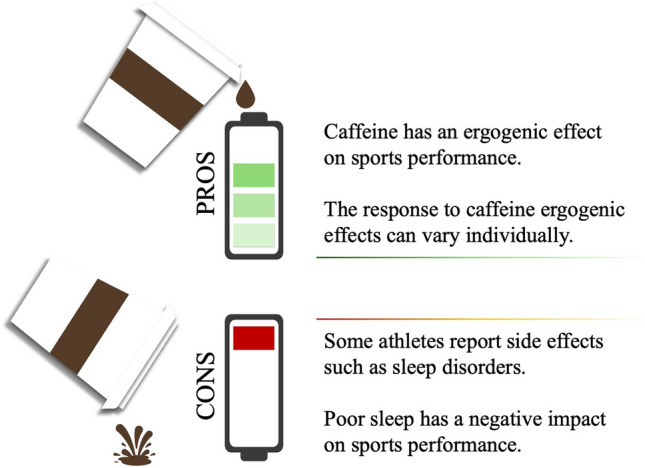
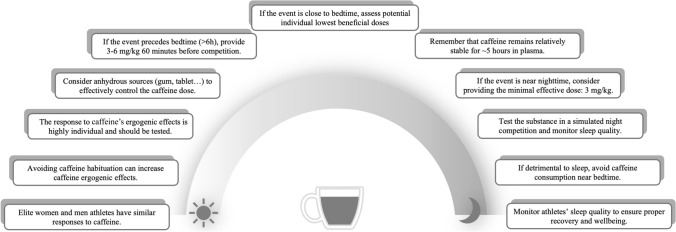
The ergogenic effects of caffeine have been reported in scientific literature over a wide spectrum of sporting activities. The current recommendation for caffeine supplementation is ingesting ~ 3–6 mg/kg about 1 h before the onset of exercise. However, some studies reporting caffeine-induced ergogenic effects during exercise have also reported increased activation and reduced sleep quality in the hours after caffeine ingestion. While most of the research on caffeine supplementation for sporting activities recommends the consumption of this stimulant to enhance performance, research focusing on athletes’ sleep quality advises against this decision, especially before competition in the evening or later. Considering that some athletes often compete in the evening or later, the general recommendation of caffeine supplementation may be modified for these athletes as acute caffeine intake in these conditions may produce undesirable side effects such as insomnia and, potentially, reduced performance in subsequent days. In this review, we examine literature on this topic to help athletes and sports practitioners solve the dilemma between the convenience of using caffeine to enhance sports performance or avoiding caffeine to ensure sleep quality. This review identifies potential solutions for this decision, keeping the focus on athletes’ well-being. Overall, the performance response to caffeine and the effect of this substance on sleep quality can vary interindividually and depend on the conditions of the exercise session (time of onset, duration, etc.). For this reason, nutritional practitioners should assess their athletes individually to resolve the conflict between caffeine ingestion and ensuring sleep quality on an individual basis, using simulated competitions with dual measurement of performance during exercise and unwanted effects in the following hours. In addition, the dose, timing, and source of caffeine supplementation can be individually adjusted to obtain performance benefits while reducing side effects for athletes ingesting caffeine before evening sporting events.
Overview
The claims and statistics of this paper haven’t been checked yet.
Free: it reads the open-access text and checks the first 5 claims that cite a source we can check. Create a free account to check every claim.
Integrity signals
Registry
Cites
Statistics
Figures
Verification
Claims the paper makes
The claims and statistics of this paper haven’t been checked yet.
Free: it reads the open-access text and checks the first 5 claims that cite a source we can check. Create a free account to check every claim.
Claims other papers make about this one
Each is checked against this paper’s own text: does it say what the citing paper says it does?
The source backs part of the claim, not all of it — or backs it for a different population, condition or comparison.
In the citing paper
“This finding suggests that the 3 mg/kg dose commonly recommended in sports nutrition guidelines may already approach a plateau for fat-oxidation benefits [78].”
From Pre-Exercise Caffeine as a Modulator of Exercise-Induced Acute Cardiometabolic Responses: A Narrative Review (2026) · cites this paper as [78]
Experimental — accuracy not yet measuredThe cited source says what the claim attributes to it.
In the citing paper
“Previous studies [4,5,78] suggest that 3–6 mg·kg−1 is the most commonly used dose range for improving aerobic, high-intensity, and sport-specific performance, yet doses of approximately 2–3 mg·kg−1 may already produce observable ergogenic effects.”
From Pre-Exercise Caffeine as a Modulator of Exercise-Induced Acute Cardiometabolic Responses: A Narrative Review (2026) · cites this paper as [78]
The cited source says what the claim attributes to it.
In the citing paper
“Previous studies [4,5,78] suggest that 3–6 mg·kg−1 is the most commonly used dose range for improving aerobic, high-intensity, and sport-specific performance, yet doses of approximately 2–3 mg·kg−1 may already produce observable ergogenic effects.”
From Pre-Exercise Caffeine as a Modulator of Exercise-Induced Acute Cardiometabolic Responses: A Narrative Review (2026) · cites this paper as [78]
Experimental — accuracy not yet measured
Self-check
Percentages, sums and reported differences re-computed from the paper’s own numbers.
The self-check needs the paper’s full text.
Citations
Cites
Diekelmann, S., & Born, J. (2010) · Nature Reviews Neuroscience · doi:10.1038/nrn2762 · Cited by 3,760 · cited 2×
“It is well established that sleep is fundamental to human health [49–57].”
Fredholm, B. B., Bättig, K., Holmén, J., Nehlig, A., & Zvartau, E. E. (1999) · Pharmacological Reviews · doi:10.1016/s0031-6997(24)01396-6 · Cited by 2,624 · cited 2×
“Caf-feine’s physical performance benefits have been widely investigated and appear to be mostly driven via caffeine’s (1,3,7-trimethylxanthine) blockade of adenosine receptors [7–10] that leads to the inhibition of the negative neuro-modulation effects of adenosine.”
Adenosine: A Mediator of the Sleep-Inducing Effects of Prolonged Wakefulness
Porkka-Heiskanen, T., Strecker, R. E., Thakkar, M., Bjørkum, A. A., Greene, R. W., & McCarley, R. W. (1997) · Science · doi:10.1126/science.276.5316.1265 · Cited by 1,252
The sleep-deprived human brain
Krause, A. J., Simon, E. B., Mander, B. A., Greer, S. M., Saletin, J. M., Goldstein-Piekarski, A. N., & Walker, M. P. (2017) · Nature Reviews Neuroscience · doi:10.1038/nrn.2017.55 · Cited by 1,200
Zeitzer, J. M., Dijk, D., Kronauer, R. E., Brown, E. N., & Czeisler, C. A. (2000) · The Journal of Physiology · doi:10.1111/j.1469-7793.2000.00695.x · Cited by 1,175 · cited 1×
“Increasingly, by competing at night, athletes are exposed to bright light [168] that impacts the human circadian rhythm and the concentration of melatonin in plasma [169].”
Overnight therapy? The role of sleep in emotional brain processing
Walker, M. P., & van der Helm, E. (2009) · Psychological Bulletin · doi:10.1037/a0016570 · Cited by 1,087 · cited 1×
“Sleep has several functions, playing an important role in emotional regulation, homeostatic restoration, immune control, memory processing, mood regulation, thermoregulation, and tissue repair [49, 51–53, 55, 140].”
The Role of Sleep in Cognition and Emotion
Walker, M. P. (2009) · Annals of the New York Academy of Sciences · doi:10.1111/j.1749-6632.2009.04416.x · Cited by 993
Adenosine–dopamine receptor–receptor interactions as an integrative mechanism in the basal ganglia
Ferré, S., Fuxe, K., B. Fredholm, B., Morelli, M., & Popoli, P. (1997) · Trends in Neurosciences · doi:10.1016/s0166-2236(97)01096-5 · Cited by 824 · cited 1×
“…exerts some “fatiguing” effects during exercise through the inhibition of the release of excitatory neurotransmitters, the blockage of its receptors after caffeine intake produces just the contrary effect—a higher release of excitatory neurotransmitters such as dopamine and noradrenaline [69].”
Caffeine and Exercise: Metabolism, Endurance and Performance
Graham, T. E. (2001) · Sports Medicine · doi:10.2165/00007256-200131110-00002 · Cited by 819
Effects of caffeine on human behavior
Smith, A. (2002) · Food and Chemical Toxicology · doi:10.1016/s0278-6915(02)00096-0 · Cited by 741 · cited 3×
“The half-life of caffeine appears to vary widely in humans, with studies reporting intervals from 4 to 6 h [2], 2.5 to 10 h [40], and 2 to 12 h [179].”
Influential
Research works printed but not linked: 1
- Leg D, Cycling E. Effects of caffeine ingestion on utilization of muscle glycogen and lipid. Hum Perform. 1980;1:86–90.
Cited by
Wang, Y., Su, W., Zhang, S., Zhao, L. R., Lv, Y., Gu, B., & Yu, L. (2025) · Nutrients · doi:10.3390/nu17213475 · Cited by 16
“Early studies demonstrated that caffeine enhances aerobic endurance primarily by promoting fat oxidation and conserving muscle glycogen stores [8,9].”
Kocak, A., Georgousopoulou, E. N., Knight-Agarwal, C. R., Matthews, R. W., & Minehan, M. (2025) · Sports · doi:10.3390/sports13090317 · Cited by 7
“Existing athlete-focused reviews have been largely narrative, noting trends toward sleep impairment but lacking the statistical synthesis necessary to determine consistent patterns across studies [19].”
Negaresh, R., Al-Riyami, S. A. A., Ghahfarrokhi, M. M., Coso, J. D., Karimi, Z., Yaghoobi, M., & Bagheri, R. (2026) · Sports Medicine · doi:10.1007/s40279-026-02441-4 · Cited by 6
“Recent reviews, such as those by de Souza et al. (2022) [48] and Silva et al. (2025) [49], provide valuable insights by pooling data and offering broader analyses of caffeine’s side effects in athletes.”
Cao, M., Liu, W., & Du, J. (2026) · Food Science and Biotechnology · doi:10.1007/s10068-026-02181-1 · Cited by 4
“Caffeine is commonly supplemented by athletes before or during competitive events, owing to its increasing mobilization of intracellular calcium, enhancing in free fatty acid oxidation, and serving as an adenosine receptor antagonist in the central nervous system (Silva et al., 2025).”
Geng, H., Zhou, Z., Meng, L., Zhuang, M., & Zhao, Y. (2026) · Metabolites · doi:10.3390/metabo16070478 · Cited by 2
“Previous studies [4,5,78] suggest that 3–6 mg · kg − 1 is the most commonly used dose range for improving aerobic, high-intensity, and sport-specific performance, yet doses of approximately 2–3 mg · kg − 1 may already produce observable ergogenic effects.”
Dou, Y., Feng, Z., Xu, H., Ma, H., Jiang, Y., Lyu, X., Han, B., Liu, S., Liu, C., & Ren, D. (2026) · Nutrients · doi:10.3390/nu18091339 · Cited by 2
“…and early take-off impulse (Impulse0–200) indicate that its primary benefit was concentrated in the early phase of movement initiation (CMJ: p = 0.0034; Impulse0–200: p = 0.0007), which is consistent with the central stimulatory effects of caffeine as a classic adenosine receptor antagonist [37].”
InfluentialSeddik, M., Dhahbi, W., Bessifi, M., Moussa-Chamari, I., Ceylan, H. İ., Ceylan, N. B., Muntean, R. I., Čular, D., & Souissi, N. (2026) · Life · doi:10.3390/life16060922 · Cited by 2
“Individual-ized caffeine strategies incorporating cycle monitoring remain investigational and require replication in hormonally verified, adequately powered samples before prescriptive application [12,14].”
InfluentialBaek, J. Y., Lee, J. Y., Han, S. O., & Hyeon, J. E. (2026) · Biotechnology and Bioprocess Engineering · doi:10.1007/s12257-026-00280-8 · Cited by 1
“In addition, RPE during exercise is reduced by about 5–10% despite equal or greater workloads, suggesting that caffeine not only produces small-to-moderate enhancements in objec - tive exercise performance but also attenuates subjective feelings of effort [31 , 32].”
From GPT-4 to Expert-Endorsed Athlete Guidance: A Delphi Consensus on Sleep and Jet Lag
Vitale, J. A., McCall, A., Athlete Travel & Sleep Interest Group (ATSIG), Alonso, J.-M., Bender, A. M., Biggins, M., Charest, J., Dohi, M., Filip-Stachnik, A., Fullagar, H. H. K., et al. (2026) · Sports Medicine · doi:10.1007/s40279-026-02484-7 · Cited by 1
“Round 2 emphasized timing—avoiding intake eight hours before night-time sleep or late-night events—to balance performance benefits against sleep disruption [28, 29].”
Todorović, N. (2025) · Sports Medicine · doi:10.1007/s40279-025-02362-8 · Cited by 1
do Nascimento, M. T., Araujo, M. S., de Sena, L. A., Medeiros, R. A., Segatelli, M. G., & Tarley, C. R. T. (2025) · Journal of Pharmaceutical and Biomedical Analysis Open · doi:10.1016/j.jpbao.2025.100096
Silva, H., Coso, J. D., & Pickering, C. (2025) · Sports Medicine · doi:10.1007/s40279-025-02358-4
Self-citationCan pre-workout supplements benefit your workouts?
Roberts, J., Lillis, J. B., & Naclerio, F. (2026) · The Conversation · doi:10.64628/ab.udjccgfre
Musa, S. J., Ghazali, A. R., Fauzi, N. F. M., Mohamad, M. I., Rahman, A. H. A., & Safii, N. S. (2026) · Jurnal Gizi dan Pangan · doi:10.25182/jgp.2026.21.1.11-20
Ionescu, C., Rarinca, V., Visternicu, M., Ciobica, A. S., Burlui, V., Gheban, D., & Tomiţa, D. I. (2026) · Balneo and PRM Research Journal · doi:10.12680/balneo.2026.1010
Dampak Kafein Pada Performa Atlet Elit Wanita
Widiawati, P., Sugiarto, D., Paramita, F., Ramadhan, M. P., Audina, Y. T., Erdilanita, U., Sudarmada, I. N., & Nasiruddin, N. J. M. (2026) · Sporta Saintika · doi:10.24036/sporta.v11i1.533
At the Other End of the Spectrum: Bigorexia as an Emerging Cardiovascular Phenotype in Adolescents
AbdelMassih, A. F., Hosheh, A., Arun, D., Ghafary, L. M., Khalife, M., Ravikumar, M., & Ziadeh, P. (2026) · Clinical Journal of Sport Medicine · doi:10.1097/jsm.0000000000001500
Żmuda, A. R., Kudłacik, A., Łukasik, J., Franków, M., Jarosz, K. A., Schmidt, A. K., Całusińska-Skowron, M., Jeziorowska, K., Bałdys, K., & Kaczmarek, O. (2026) · International Journal of Innovative Technologies in Social Science · doi:10.31435/ijitss.3(51).2026.6511
Hajian, M., Rajabi, S., Razavianzadeh, N., & Ziaolhagh, S. J. (2026) · Jundishapur Journal of Natural Pharmaceutical Products · doi:10.5812/jjnpp-170890
Zhang, J., Li, Y., Wei, B., Li, X., Xiao, Z., Wu, X., Ye, X., & Zhang, S. (2026) · Frontiers in Physiology · doi:10.3389/fphys.2026.1960237
Abdulhassan, B. M. (2026) · RESEARCH IN PHYSICAL EDUCATION SPORT AND HEALTH · doi:10.2478/rpesh-2026-0009
“Athlete-focused guidance further emphasizes that dose and timing decisions should be individualized and balanced against potential effects on subsequent sleep (Silva et al., 2025).”
Zhang, Q., 徐宏汉, Mo, J., Wang, F., Gao, X., Zhou, C., Zeng, Z., Dong, X., Huang, D., Shi, H., et al. (2026) · Nutrients · doi:10.3390/nu18203441
“The retained random-effects analyses estimate averages across potentially different effects; they do not establish an effect shared across populations or guarantee that the average represents any exercise setting [7,24].”
He, B., Zhou, C., Zeng, Z., Dong, X., Huang, D., Shi, H., Li, H., Gao, K., Xie, Y., Zhou, A., et al. (2026) · Nutrients · doi:10.3390/nu18203434
“It is frequently taken before training or competition because of its perceived ability to improve alertness and physical performance [2].”
Rhon, D. I., Greenlee, T. A., Plisky, P. J., Kiesel, K. B., Milan, R. A., & Teyhen, D. S. (2026) · Translational Journal of the American College of Sports Medicine · doi:10.1249/tjx.0000000000000392
Lafeková, M., Štefániková, G. K., & Skala, F. (2026) · Sports · doi:10.3390/sports14110476
Liang, Z., Wang, S., Wang, J., Chen, J., & Song, S. (2026) · Frontiers in Physiology · doi:10.3389/fphys.2026.1932524
Metadata
- Authors
- Silva, H., Del Coso, J., & Pickering, C.
- Corresponding author
- Silva, Hugo
- Venue
- Sports Medicine
- Published
- 2025-06-27
- Volume
- 55
- Issue
- 7
- Pages
- 1579-1592
- ISSN
- 0112-1642 (ISSN-L)
- 1179-2035
- PMC
- PMC12296924
- OpenAlex
- W4411718163
- Semantic Scholar
- a9e64d4e966913e4938368dbd5d9998aa11963e2
- Cited by
- 21
- References
- 197
- Citations by year
- 2026: 16 · 2025: 5
- FWCI
- 2.83
- Type
- journal article
- Language
- en
- Open access
- hybrid
- doi.org
- Licence
- cc-by
- creativecommons.org/licenses/by/4.0 (tdm)
- creativecommons.org/licenses/by/4.0 (vor)
- Locations
- Sports Medicine (publishedVersion, cc-by)
- PubMed Central (publishedVersion, cc-by)
- PubMed (publishedVersion)
- Funders
- Instituto Universitário da Maia
- Topics
- Health Sciences › Medicine › Pharmacology (medical) › Coffee research and impacts
- Health Sciences › Medicine › Orthopedics and Sports Medicine › Sports Performance and Training
- Social Sciences › Psychology › Experimental and Cognitive Psychology › Sleep and Work-Related Fatigue
- Keywords
- caffeine, ergogenic aids, athletic performance, sleep quality, insomnia, caffeine side effects
- MeSH terms
- Sleep Quality, Central Nervous System Stimulants, Caffeine, Humans, Sleep, Dietary Supplements, Athletic Performance, Performance-Enhancing Substances
About these checks
Registry, retraction, Cites and statistics results are computed, not judged, with one exception: a printed reference that no index lists is read once by a model before it counts as a citation error. Claims are extracted by a model and kept only when their quote appears verbatim in the text; each cited source is then checked, with a model’s help, for whether it says what the claim relies on. Those verdicts can be wrong — read the claim’s quote and the cited source before relying on one.
Statistics and arithmetic are recomputed, not judged.
Confidence bands are shown only for fields calibrated on our annotated test set. None is calibrated yet, so no band is shown.
What counts as a claim ›How we measure confidence ›How we check this ›
Are you an author, or do you see a problem with this page? Request a review
Data sources
Bibliographic data: Semantic Scholar, OpenAlex, Crossref.
Contains information from the Semantic Scholar Academic Graph Datasets, made available under the ODC Attribution License (ODC-BY 1.0).
Semantic Scholar’s data is described in: Kinney, R., et al. (2023). The Semantic Scholar Open Data Platform. arXiv:2301.10140.
