

Relationship between frailty, nutrition, body composition, quality of life, and gender in institutionalized older people
Open accessThe DOI matches its Crossref record; 32 of the 32 references it cites were found in a registry or an index.
Abstract
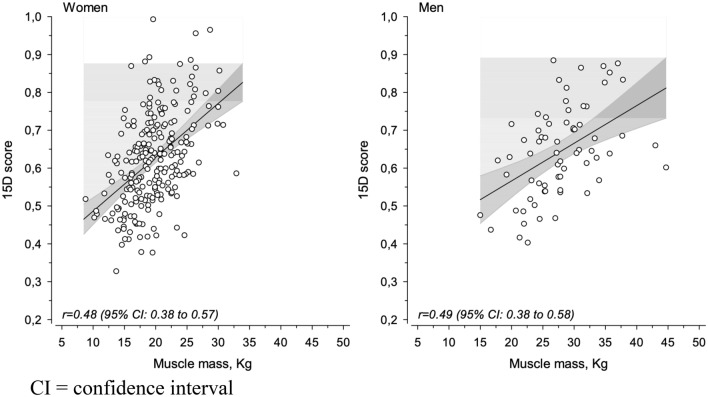
Our aim was to explore the relationship between frailty, nutrition, body composition, and how gender modifies this relationship among long-term care facility residents. We further investigated how body composition correlates with health-related quality of life (HRQoL) in both genders. In all, 549 residents (> 65 years of age) were recruited from 17 long-term care facilities for this cross-sectional study. Demographic information, diagnoses, use of medications, and nutritional supplements were retrieved from medical records. Participants’ frailty status, cognition, nutritional status, HRQoL, and body composition were determined. Energy, protein, and fat intakes were retrieved from 1- to 2-day food diaries. The final sample consisted of 300 residents (77% women, mean age 83 years). The majority of participants, 62% of women and 63% of men, were identified as frail. Frail participants in both genders showed lower body mass index (p = 0.0013), muscle mass (MM) (p < 0.001), poorer nutritional status (p = 0.0012), cognition (p = 0.0021), and lower HRQoL (p < 0.001) than did prefrail participants. Women had higher fat mass, whereas men exhibited higher MM. The HRQoL correlated with the MM in both women, r = 0.48 [95% CI 0.38, 0.57] and men r = 0.49 [95% CI 0.38, 0.58]. Interventions aimed at strengthening and retaining MM of long-term residents may also support their HRQoL.
Overview
The claims and statistics of this paper haven’t been checked yet.
Free: it reads the open-access text and checks the first 5 claims that cite a source we can check. Create a free account to check every claim.
Integrity signals
Registry
Cites
Statistics
Figures
Verification
Claims the paper makes
The claims and statistics of this paper haven’t been checked yet.
Free: it reads the open-access text and checks the first 5 claims that cite a source we can check. Create a free account to check every claim.
Claims other papers make about this one
Each is checked against this paper’s own text: does it say what the citing paper says it does?
The source backs part of the claim, not all of it — or backs it for a different population, condition or comparison.
In the citing paper
“Frailty and advanced dementia are prevalent among the majority of nursing home residents, underscoring the precise indications for PA [487].”
From Global consensus on optimal exercise recommendations for enhancing healthy longevity in older adults (ICFSR) (2025) · cites this paper as [487]
Experimental — accuracy not yet measuredIn the citing paper
“Frailty and advanced dementia are prevalent among the majority of nursing home residents, underscoring the precise indications for PA [487].”
From Global consensus on optimal exercise recommendations for enhancing healthy longevity in older adults (ICFSR) (2025) · cites this paper as [487]
Self-check
Percentages, sums and reported differences re-computed from the paper’s own numbers.
The self-check needs the paper’s full text.
Citations
Cites
Folstein, M. F., Folstein, S. E., & McHugh, P. R. (1975) · Journal of Psychiatric Research · doi:10.1016/0022-3956(75)90026-6 · Cited by 88,282
Frailty in Older Adults: Evidence for a Phenotype
Fried, L. P., Tangen, C. M., Walston, J., Newman, A. B., Hirsch, C., Gottdiener, J., Seeman, T., Tracy, R., Kop, W. J., Burke, G., et al. (2001) · The Journals of Gerontology Series A: Biological Sciences and Medical Sciences · doi:10.1093/gerona/56.3.m146 · Cited by 24,907 · cited 5×
“Indeed, malnutrition, frailty, and sarcopenia share a common pathophysiology and are manifested by weight loss, which is a typical characteristic in all these situations [1, 2, 6, 9].”
BackgroundMethodInfluentialHirono, N., Mori, E., Ikejiri, Y., Imamura, T., Shimomura, T., Hashimoto, M., Yamashita, H., & Ikeda, M. (1997) · Brain and nerve · Cited by 21,039
Kok, J. S., Berg, I. J., & Scherder, E. J. A. (2013) · Dementia and Geriatric Cognitive Disorders Extra · doi:10.1159/000353441 · Cited by 20,589
Older Adults' Reasons for Using Technology while Aging in Place
Peek, S. T. M., Luijkx, K. G., Rijnaard, M. D., Nieboer, M. E., van der Voort, C. S., Aarts, S., van Hoof, J., Vrijhoef, H. J. M., & Wouters, E. J. M. (2016) · Gerontology · doi:10.1159/000430949 · Cited by 19,690
Sensitivity and False Alarm Rate of a Fall Sensor in Long-Term Fall Detection in the Elderly
Kangas, M., Korpelainen, R., Vikman, I., Nyberg, L., & Jämsä, T. (2015) · Gerontology · doi:10.1159/000362720 · Cited by 18,909
Guralnik, J. M., Simonsick, E. M., Ferrucci, L., Glynn, R. J., Berkman, L. F., Blazer, D. G., Scherr, P. A., & Wallace, R. B. (1994) · Journal of Gerontology · doi:10.1093/geronj/49.2.m85 · Cited by 9,792 · cited 2×
“(4) Slowness – based on the gate speed using a 4-m walk time from the Short Physical Performance Battery test (SPPB) [19] – was defined as < 0.”
MethodInfluentialA global clinical measure of fitness and frailty in elderly people
Rockwood, K. (2005) · Canadian Medical Association Journal · doi:10.1503/cmaj.050051 · Cited by 8,968 · cited 1×
“’s Clinical Frailty Scale, which evaluates specific domains, including comorbidity, function, and cognition to generate a frailty score, is also often used to identify frailty [24].”
MethodJanssen, I., Heymsfield, S. B., & Ross, R. (2002) · Journal of the American Geriatrics Society · doi:10.1046/j.1532-5415.2002.50216.x · Cited by 3,139 · cited 1×
“Men are well known for having about one-third more MM than women, and their muscle loss with aging occurs at a slower pace than in women [27].”
BackgroundVellas, B., Guigoz, Y., Garry, P. J., Nourhashemi, F., Bennahum, D., Lauque, S., & Albarede, J.-L. (1999) · Nutrition · doi:10.1016/s0899-9007(98)00171-3 · Cited by 2,161 · cited 3×
“Nutritional status was assessed, using the Mini Nutritional Assessment (MNA) long version [6].”
BackgroundMethodA simple frailty questionnaire (FRAIL) predicts outcomes in middle aged African Americans
Morley, J. E., Malmstrom, T. K., & Miller, D. K. (2012) · The Journal of nutrition, health and aging · doi:10.1007/s12603-012-0084-2 · Cited by 1,987 · cited 1×
“Other validated, well-known frailty tools include, for example, simple FRAIL questionnaire that also has five questions similar to Fried’s frailty tool, but it is even more simple [2, 22] and PRISMA 7 which includes seven questions [23].”
MethodThe 15D instrument of health-related quality of life: properties and applications
Sintonen, H. (2001) · Annals of Medicine · doi:10.3109/07853890109002086 · Cited by 1,217 · cited 3×
“The inclusion criteria for the present study were as follows: age ≥ 65 years, living permanently in institutional care, sufficient information available on demographic factors, frailty status determined according to Fried’s phenotype criteria, records of a 1–2-day food diary, information on 15-D HRQoL [18], and body c…”
MethodInfluentialPhysical Frailty: ICFSR International Clinical Practice Guidelines for Identification and Management
Dent, E., Morley, J. E., Cruz-Jentoft, A. J., Woodhouse, L., Rodríguez-Mañas, L., Fried, L. P., Woo, J., Aprahamian, I., Sanford, A., Lundy, J., et al. (2019) · The Journal of nutrition, health and aging · doi:10.1007/s12603-019-1273-z · Cited by 1,049 · cited 2×
“Frailty is a multifactorial geriatric syndrome characterized by decreased reserve and is a leading contributor to functional decline and early mortality in older adults [3].”
BackgroundPrevalence of Frailty in Nursing Homes: A Systematic Review and Meta-Analysis
Kojima, G. (2015) · Journal of the American Medical Directors Association · doi:10.1016/j.jamda.2015.06.025 · Cited by 517 · cited 4×
“A systematic review and meta-analysis by Kojima [14] of nine studies with a total of 1373 residents revealed that the prevalence of frailty, including prefrailty, ranged from 19% to 75.6%.”
BackgroundInfluentialCereda, E., Pedrolli, C., Klersy, C., Bonardi, C., Quarleri, L., Cappello, S., Turri, A., Rondanelli, M., & Caccialanza, R. (2016) · Clinical Nutrition · doi:10.1016/j.clnu.2016.03.008 · Cited by 499
Osteoporosis and Sarcopenia Increase Frailty Syndrome in the Elderly
Greco, E. A., Pietschmann, P., & Migliaccio, S. (2019) · Frontiers in Endocrinology · doi:10.3389/fendo.2019.00255 · Cited by 335
Protein Consumption and the Elderly: What Is the Optimal Level of Intake?
Baum, J., Kim, I.-Y., & Wolfe, R. (2016) · Nutrients · doi:10.3390/nu8060359 · Cited by 312
Verlaan, S., Ligthart-Melis, G. C., Wijers, S. L. J., Cederholm, T., Maier, A. B., & de van der Schueren, M. A. E. (2017) · Journal of the American Medical Directors Association · doi:10.1016/j.jamda.2016.12.074 · Cited by 246 · cited 2×
“Institutionalized older people are often frail, sarcopenic, and malnourished [1, 13, 14, 16].”
BackgroundBeeri, M. S., Leugrans, S. E., Delbono, O., Bennett, D. A., & Buchman, A. S. (2021) · Journal of the American Geriatrics Society · doi:10.1111/jgs.17206 · Cited by 237
Dietary Patterns, Skeletal Muscle Health, and Sarcopenia in Older Adults
Granic, A., Sayer, A. A., & Robinson, S. M. (2019) · Nutrients · doi:10.3390/nu11040745 · Cited by 211
Van Ancum, J. M., Pijnappels, M., Jonkman, N. H., Scheerman, K., Verlaan, S., Meskers, C. G. M., & Maier, A. B. (2018) · BMC Geriatrics · doi:10.1186/s12877-018-0812-5 · Cited by 99
Frailty and Health-Related Quality of Life Among Residents of Long-Term Care Facilities
Kanwar, A., Singh, M., Lennon, R. J., Ghanta, K., McNallan, S. M., & Roger, V. L. (2013) · Journal of Aging and Health · doi:10.1177/0898264313493003 · Cited by 92
The clinical usefulness of muscle mass and strength measures in older people: a systematic review
Lunt, E., Ong, T. I. W., Gordon, A. L., Greenhaff, P. L., & Gladman, J. R. F. (2020) · Age and Ageing · doi:10.1093/ageing/afaa123 · Cited by 90 · cited 1×
“Similarly, lower skeletal MM at admission independently predicted falls and mortality 3 months postdischarge in hospitalized older patients [30].”
BackgroundNutritional Status, Energy, Protein, and Micronutrient Intake of Older Service House Residents
Vikstedt, T., Suominen, M. H., Joki, A., Muurinen, S., Soini, H., & Pitkälä, K. H. (2011) · Journal of the American Medical Directors Association · doi:10.1016/j.jamda.2010.12.098 · Cited by 85
Self-citationBuckinx, F., Reginster, J.-Y., Pétermans, J., Croisier, J., Beaudart, C., Brunois, T., & Bruyère, O. (2016) · Aging Clinical and Experimental Research · doi:10.1007/s40520-016-0616-4 · Cited by 78
Iolascon, G., Gimigliano, R., Bianco, M., de Sire, A., Moretti, A., Giusti, A., Malavolta, N., Migliaccio, S., Migliore, A., Napoli, N., et al. (2017) · The Journal of nutrition, health and aging · doi:10.1007/s12603-016-0823-x · Cited by 78
Body mass index (BMI), body composition and mortality of nursing home elderly residents
Kimyagarov, S., Klid, R., Levenkrohn, S., Fleissig, Y., Kopel, B., Arad, M., & Adunsky, A. (2009) · Archives of Gerontology and Geriatrics · doi:10.1016/j.archger.2009.10.013 · Cited by 60 · cited 4×
“Frailty was inversely associated with BMI, MM, nutritional status, and cognition.”
BackgroundInfluentialReijnierse, E. M., Verlaan, S., Pham, V. K., Lim, W. K., Meskers, C. G. M., & Maier, A. B. (2019) · The Journals of Gerontology: Series A · doi:10.1093/gerona/gly281 · Cited by 41 · cited 1×
“However, in a systematic review the clinical significance of MM was still unknown, due to the small number of longitudinal studies on MM as a predictor of different outcomes [31].”
BackgroundAnalyses of gender differences in profiles of nursing home residents with Alzheimer's disease
Buchanan, R. J., Wang, S., Ju, H., & Graber, D. R. (2004) · Gender Medicine · doi:10.1016/s1550-8579(04)80010-x · Cited by 34 · cited 1×
“In a previous study, male residents with Alzheimer’s disease (AD) were more likely to receive intervention programs for mood, behavior, and cognitive loss than female residents with AD [26].”
BackgroundPrevalence of Frailty in Nursing Home Residents According to Various Diagnostic Tools.
Buckinx, F., Reginster, J.-Y., Gillain, S., Pétermans, J., Brunois, T., & Bruyère, O. (2017) · PubMed · doi:10.14283/jfa.2017.20 · Cited by 31 · cited 1×
“5%), depending on the tool used to identify frailty [21].”
MethodThe impact of biological frailty syndrome on quality of life of nursing home residents
Parra, M. D. S., Garrido, M., Chacón, R. M. F., Saiz, M. J. S., & Valentín, M. J. D. (2017) · Applied Nursing Research · doi:10.1016/j.apnr.2017.02.025 · Cited by 13
Daly, R. M., & Nowson, C. A. (2018) · American Journal of Clinical Nutrition · doi:10.1093/ajcn/nqy289 · Cited by 4 · cited 1×
“Malnutrition, particularly inadequate energy and protein intake, is a key element associated with loss of MM and physical functioning in older people [4, 5].”
Background
Research works printed but not linked: 1
- Fried LP Tangen CM Walston J Writing Group for the European Working Group on Sarcopenia in Older People 2 (EWGSOP2) the Extended Group for EWGSOP2 Sarcopenia: revised European consensus on definition and diagnosis Age Ageing 2019 1 16 31
Cited by
Aging, longevity, and healthy aging: the public health approach
Gianfredi, V., Nucci, D., Pennisi, F., Maggi, S., Veronese, N., & Soysal, P. (2025) · Aging Clinical and Experimental Research · doi:10.1007/s40520-025-03021-8 · Cited by 318
“Proper nutrition is essential for maintaining the physical and mental health of older adults [72].”
Izquierdo, M., de Souto Barreto, P., Arai, H., Bischoff-Ferrari, H. A., Cadore, E. L., Cesari, M., Chen, L.-K., Coen, P. M., Courneya, K. S., Duque, G., et al. (2025) · The Journal of nutrition, health and aging · doi:10.1016/j.jnha.2024.100401 · Cited by 273
Self-citationNutritional Status and Sarcopenia in Nursing Home Residents: A Cross-Sectional Study
Hua, N., Zhang, Y., Tan, X., Liu, L., Mo, Y., Yao, X., Wang, X., Wiley, J., & Wang, X. (2022) · International Journal of Environmental Research and Public Health · doi:10.3390/ijerph192417013 · Cited by 38
“However, a recent study of institutionalized older people revealed that female residents had lower energy and nutrient intakes and were more likely to be malnourished than male [42].”
BackgroundŞahin, Ü. K., Tozluoglu, E. Y., Durdu, H., Korkmaz, N., BAHAR, N. T., & Yavuz, E. (2022) · Aging Clinical and Experimental Research · doi:10.1007/s40520-022-02164-2 · Cited by 15
“Older adults with higher BMI were determined to be significantly more frail in the current study.”
BackgroundInfluentialZorawna, M., Mäntylä, P., Pitkälä, K. H., Suominen, M. H., Kautiainen, H., Saarela, R. K. T., & Hiltunen, K. (2023) · Journal of Oral Rehabilitation · doi:10.1111/joor.13431 · Cited by 10
Self-citation
Metadata
- Authors
- Jyväkorpi, S. K., Lindström, M., Suominen, M. H., Kautiainen, H., Salminen, K., Niskanen, R. T., Pitkälä, K. H., & Roitto, H.-M.
- Affiliations
- University of Helsinki (FI)
- City of Helsinki (FI)
- Corresponding author
- Jyväkorpi, S. K.
- ORCID
- Venue
- Aging Clinical and Experimental Research
- Published
- 2022-02-11
- Volume
- 34
- Issue
- 6
- Pages
- 1357-1363
- ISSN
- 1594-0667 (ISSN-L)
- 1720-8319
- PMC
- PMC9151503
- OpenAlex
- W4211260517
- Cited by
- 18
- References
- 32
- Citations by year
- 2026: 3 · 2025: 5 · 2024: 6 · 2023: 1 · 2022: 3
- FWCI
- 2.32
- Type
- journal article
- Language
- en
- Open access
- hybrid
- doi.org
- Licence
- cc-by
- creativecommons.org/licenses/by/4.0 (tdm)
- creativecommons.org/licenses/by/4.0 (vor)
- Locations
- Aging Clinical and Experimental Research (publishedVersion, cc-by)
- PubMed Central (publishedVersion, cc-by)
- PubMed (publishedVersion)
- Työväentutkimus Vuosikirja (submittedVersion)
- Funders
- Päivikki ja Sakari Sohlbergin Säätiö
- VTR-funding of the Helsinki University Hospital
- University of Helsinki including Helsinki University Central Hospital
- Topics
- Health Sciences › Medicine › Physiology (medical) › Nutrition and Health in Aging
- Health Sciences › Medicine › Geriatrics and Gerontology › Frailty in Older Adults
- Health Sciences › Medicine › Geriatrics and Gerontology › Geriatric Care and Nursing Homes
- Keywords
- frailty, nutritional status, body composition, health-related quality of life, gender differences, long-term care residents, older adults, muscle mass, body mass index, fat mass, cognition, pre-frailty, energy and protein intake
- MeSH terms
- Frailty, Aged, Aged, 80 and over, Body Composition, Cross-Sectional Studies, Female, Humans, Male, Nutritional Status, Quality of Life, Geriatric Assessment, Frail Elderly
About these checks
Registry, retraction, Cites and statistics results are computed, not judged, with one exception: a printed reference that no index lists is read once by a model before it counts as a citation error. Claims are extracted by a model and kept only when their quote appears verbatim in the text; each cited source is then checked, with a model’s help, for whether it says what the claim relies on. Those verdicts can be wrong — read the claim’s quote and the cited source before relying on one.
Statistics and arithmetic are recomputed, not judged.
Confidence bands are shown only for fields calibrated on our annotated test set. None is calibrated yet, so no band is shown.
What counts as a claim ›How we measure confidence ›How we check this ›
Are you an author, or do you see a problem with this page? Request a review
Data sources
Bibliographic data: Semantic Scholar, OpenAlex, Crossref.
Contains information from the Semantic Scholar Academic Graph Datasets, made available under the ODC Attribution License (ODC-BY 1.0).
Semantic Scholar’s data is described in: Kinney, R., et al. (2023). The Semantic Scholar Open Data Platform. arXiv:2301.10140.
