

Making a Lecture Stick: the Effect of Spaced Instruction on Knowledge Retention in Medical Education
Open accessThe DOI matches its Crossref record; 48 of the 48 references it cites were found in a registry or an index.
Abstract
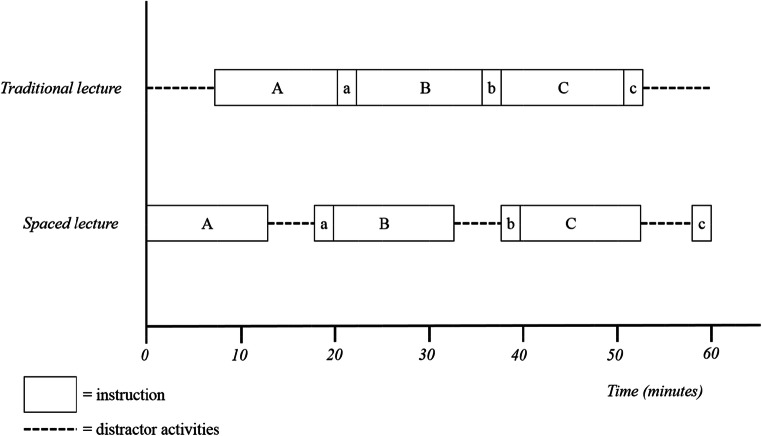
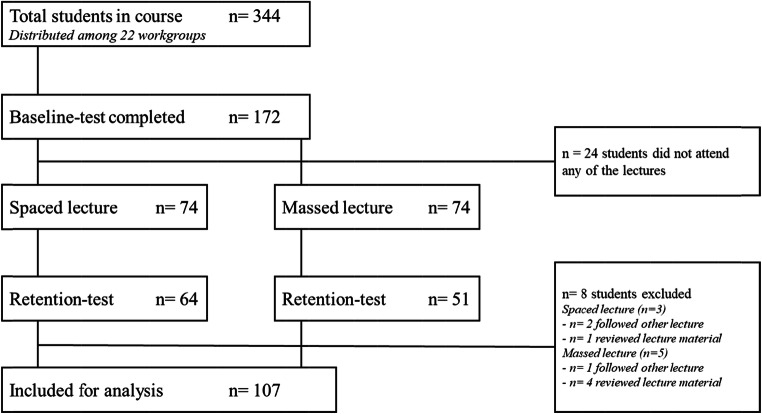
Introduction: Poor knowledge retention is a persistent problem among medical students. This challenging issue may be addressed by optimizing frequently used instructional designs, such as lectures. Guided by neuroscientific literature, we designed a spaced learning lecture in which the educator repeats the to-be-learned information using short temporal intervals. We investigated if this modified instructional design could enhance students’ retention. Materials and Methods: Second-year medical students (n= 148) were randomly allocated to either the spaced lecture or the traditional lecture. The spaced lecture consisted of three 15-min instructional periods, separated by 5-min intervals. A short summary of the preceding information was provided after each interval. The traditional lecture encompassed the same information including the summary in the massed format, thus without the intervals. All students performed a baseline knowledge test 2 weeks prior to the lectures and students’ knowledge retention was assessed 8 days after the lectures. Results: The average score on the retention test (α= 0.74) was not significantly different between the spaced lecture group (33.8% ± 13.6%) and the traditional lecture group (31.8% ± 12.9%) after controlling for students’ baseline-test performance (F(1,104) = 0.566,p= 0.458). Students’ narrative comments showed that the spaced lecture format was well-received and subjectively benefitted their attention-span and cognitive engagement. Discussion and Conclusion: We were unable to show increased knowledge retention after the spaced lecture compared with the traditional lecture. Based on these findings, we provide recommendations for further research. Ultimately, we aim for optimized spaced learning designs to facilitate learning in the medical curriculum and to help educate health professionals with a solid knowledge base.
Overview
The claims and statistics of this paper haven’t been checked yet.
Free: it reads the open-access text and checks the first 5 claims that cite a source we can check. Create a free account to check every claim.
Integrity signals
Registry
Cites
Statistics
Figures
Verification
Claims the paper makes
The claims and statistics of this paper haven’t been checked yet.
Free: it reads the open-access text and checks the first 5 claims that cite a source we can check. Create a free account to check every claim.
Self-check
Percentages, sums and reported differences re-computed from the paper’s own numbers.
The self-check needs the paper’s full text.
Citations
Cites
Active learning increases student performance in science, engineering, and mathematics
Freeman, S., Eddy, S. L., McDonough, M., Smith, M. K., Okoroafor, N., Jordt, H., & Wenderoth, M. P. (2014) · Proceedings of the National Academy of Sciences · doi:10.1073/pnas.1319030111 · Cited by 9,787 · cited 1×
“For instance, lectures are still widely used as a teaching modality, whereas it has been shown that traditional lecturing is less effective for retaining knowledge compared with active learning modalities [6, 7].”
BackgroundDistributed practice in verbal recall tasks: A review and quantitative synthesis.
Cepeda, N. J., Pashler, H., Vul, E., Wixted, J. T., & Rohrer, D. (2006) · Psychological Bulletin · doi:10.1037/0033-2909.132.3.354 · Cited by 1,888 · cited 3×
“, the spacing effect, is based on evidence derived from a century of psychological research (for a meta-analysis, see Cepeda et al, 2006 [8] or Carpenter et al, 2012 [9]).”
BackgroundResultThe critical role of retrieval practice in long-term retention
Roediger, H. L., & Butler, A. C. (2011) · Trends in Cognitive Sciences · doi:10.1016/j.tics.2010.09.003 · Cited by 1,796
The Critical Importance of Retrieval for Learning
Karpicke, J. D., & Roediger, H. L. (2008) · Science · doi:10.1126/science.1152408 · Cited by 1,791
The Molecular and Systems Biology of Memory
Kandel, E. R., Dudai, Y., & Mayford, M. R. (2014) · Cell · doi:10.1016/j.cell.2014.03.001 · Cited by 1,134
Replication and Analysis of Ebbinghaus’ Forgetting Curve
Murre, J. M. J., & Dros, J. (2015) · PLOS ONE · doi:10.1371/journal.pone.0120644 · Cited by 777 · cited 2×
“The 8-day period was selected since the Ebbinghaus forgetting curve indicates that forgetting declines exponentially and most of the forgetting occurs in the first week after initial learning [38, 39].”
MethodTeaching Surgical Skills: What Kind of Practice Makes Perfect?: A Randomized, Controlled Trial
Moulton, C.-A. E., Dubrowski, A., MacRae, H., Graham, B., Grober, E., & Reznick, R. (2006) · Annals of Surgery · doi:10.1097/01.sla.0000234808.85789.6a · Cited by 653
Spacing Effects in Learning: A Temporal Ridgeline of Optimal Retention
Cepeda, N. J., Vul, E., Rohrer, D., Wixted, J. T., & Pashler, H. (2008) · Psychological Science · doi:10.1111/j.1467-9280.2008.02209.x · Cited by 631
Protein phosphatase 1 is a molecular constraint on learning and memory
Genoux, D., Haditsch, U., Knobloch, M., Michalon, A., Storm, D., & Mansuy, I. M. (2002) · Nature · doi:10.1038/nature00928 · Cited by 472
Carpenter, S. K., Cepeda, N. J., Rohrer, D., Kang, S. H. K., & Pashler, H. (2012) · Educational Psychology Review · doi:10.1007/s10648-012-9205-z · Cited by 469
Cited by
Systematic review of distributed practice and retrieval practice in health professions education
Trumble, E., Lodge, J. M., Mandrusiak, A., & Forbes, R. (2023) · Advances in Health Sciences Education · doi:10.1007/s10459-023-10274-3 · Cited by 80
Khalafi, A., Fallah, Z., & Sharif-Nia, H. (2024) · BMC Medical Education · doi:10.1186/s12909-024-05290-9 · Cited by 20
“Also, Timmer et al. (2020) investigated the effect of spaced instruction on knowledge retention in medical education in the Netherlands.”
BackgroundMethodChen, Y., Zhang, R., Zhou, Z., Hong, M., Huang, Z. Y., Wen, H., & Peng, L. (2025) · Frontiers in Medicine · doi:10.3389/fmed.2025.1505588 · Cited by 13
Problem-based learning and digital platforms in medical education
Greenspan, A. A., Goldberg, G. S., & Hamilton, K. L. (2025) · Frontiers in Education · doi:10.3389/feduc.2025.1631337 · Cited by 12
Choe, A. I., Woodard, S. A., Thompson, B. M., Walter, V., Fotos, J. S., & Kasales, C. J. (2022) · Journal of the American College of Radiology · doi:10.1016/j.jacr.2022.03.010 · Cited by 12
Fraundorf, S. H., Caddick, Z. A., Nokes‐Malach, T. J., & Rottman, B. M. (2023) · Cognitive Research Principles and Implications · doi:10.1186/s41235-023-00508-8 · Cited by 11
Durable Learning Strategies in Nursing Education: State-of-the-Evidence Review
Mechtel, M., Kitt-Lewis, E. A., Reaves, C., Sinacori, B., O’Brien, T., Logan, P., Rimbey, P., Streiff, K., & Phillips, K. M. (2024) · Journal of Nursing Education · doi:10.3928/01484834-20231112-05 · Cited by 9
Barrabi, C., & Derricott, H. (2025) · AJP Advances in Physiology Education · doi:10.1152/advan.00086.2025 · Cited by 6
Virtual spaced-learning method, during COVID-19 for Pharm D students
Sharifdini, M., Evazalipour, M., & Hesari, Z. (2023) · BMC Medical Education · doi:10.1186/s12909-023-04595-5 · Cited by 6
O’Hare, L., Stark, P., Gittner, A., McGuinness, C., Thurston, A., & Biggart, A. (2023) · Frontiers in Education · doi:10.3389/feduc.2023.1199617 · Cited by 4
Methods to Improve Knowledge Retention in Medical Students
Mok, C. H. (2020) · Medical Science Educator · doi:10.1007/s40670-020-01057-1 · Cited by 3
Yu, C., Li, F., Zhang, N., Hu, H., Huang, H., Wang, J., Tao, Y., & Wu, Y. (2026) · JMIR Medical Education · doi:10.2196/87959 · Cited by 2
The Student Voice: Perceptions of Durable Learning
Reaves, C., Kitt-Lewis, E. A., Mechtel, M., & Logan, P. (2024) · Nurse Educator · doi:10.1097/nne.0000000000001653 · Cited by 1
Silva Sánchez, M., Lainez Quinde, G. A., & Zambrano Vélez, W. A. (2026) · Education Sciences · doi:10.3390/educsci16060962
“The use of various terminological tags to describe spaced learning in the search engine is justified by the literature, as multiple authors—such as Bego et al. (2024); Namaziandost et al. (2020); and Timmer et al. (2020)—have conceptualized this technique using different terms.”
Impact of duration and number of subjects on students’ performance in junior clerkshipPreprint
Aaraj, S., Kausar, A., & Farooqui, F. (2023) · Research Square · doi:10.21203/rs.3.rs-2871508/v1
Effect of Duration and Number of Subjects on Students' Performance in Junior Clerkship
Aaraj, S., Kausar, A., & Farooqui, F. (2024) · Journal of Islamic International Medical College · doi:10.57234/jiimc.september24.1925
NEUROCIÊNCIA EDUCACIONAL APLICADA A CURSOS DA SAÚDE: revisão de escopo e proposta de framework
Silva, A. S. P., & Valotta, L. A. (2025) · Revista Exitus · doi:10.24065/re.v15i1.2652
Sari, N. W., Samsuri, T., & Khairiyah, U. (2023) · Multi Discere Journal · doi:10.36312/mj.v2i2.2720
Additional file 1 of Virtual spaced-learning method, during COVID-19 for Pharm D students
Sharifdini, M., Evazalipour, M., & Hesari, Z. (2023) · Figshare · doi:10.6084/m9.figshare.24030931
Damayanti, D., Dwiningsih, K., & Arivi, M. A. (2025) · JTK (Jurnal Tadris Kimiya) · doi:10.15575/jtk.v10i2.50089
Cheng, X., Liao, W., Cui, H., Pan, Y., & Hu, Y. (2026) · Learning and Instruction · doi:10.1016/j.learninstruc.2026.102320
Özsaban, A., Bayram, A., Kılıç, Ç. T., Calp, M. H., & Öztürk, H. (2026) · BMC Medical Education · doi:10.1186/s12909-026-08716-8
Wang, M., Li, C., Rodriguez-Morales, A. J., & Bairwa, M. (2026) · Frontiers research topics · doi:10.3389/978-2-8325-7980-0
Case-based CDIO learning and decision-making performance in undergraduate health sciences education
Lai, T. T. T. (2026) · Educación Médica · doi:10.1016/j.edumed.2026.101229
Guerra, J. (2026) · International Journal of Mathematical Education in Science and Technology · doi:10.1080/0020739x.2026.2719550
Metadata
- Authors
- Timmer, M. C. J., Steendijk, P., Arend, S. M., & Versteeg, M.
- Affiliations
- Leiden University Medical Center (NL)
- Corresponding author
- Versteeg, Marjolein
- Venue
- Medical Science Educator
- Published
- 2020-06-09
- Volume
- 30
- Issue
- 3
- Pages
- 1211-1219
- ISSN
- 2156-8650 (ISSN-L)
- PMC
- PMC8368805
- OpenAlex
- W3035240271
- Cited by
- 20
- References
- 48
- Citations by year
- 2026: 5 · 2025: 3 · 2024: 3 · 2023: 7 · 2022: 1 · 2020: 1
- FWCI
- 1.68
- Type
- journal article
- Language
- en
- Open access
- hybrid
- doi.org
- Licence
- cc-by
- creativecommons.org/licenses/by/4.0 (tdm)
- creativecommons.org/licenses/by/4.0 (vor)
- Locations
- Medical Science Educator (publishedVersion, cc-by)
- PubMed Central (publishedVersion, cc-by)
- PubMed (publishedVersion)
- Leiden Repository (Leiden University) (submittedVersion, cc-by)
- Data Archiving and Networked Services (DANS) (submittedVersion, cc-by)
- Funders
- Leiden University Medical Center
- Topics
- Social Sciences › Education › Innovations in Medical Education
- Life Sciences › Neuroscience › Cognitive Neuroscience › Memory Processes and Influences
- Social Sciences › Psychology › Experimental and Cognitive Psychology › Visual and Cognitive Learning Processes
- Keywords
- spaced learning, knowledge retention, medical students, lecture design, instructional design, cognitive engagement, attention span, medical education
About these checks
Registry, retraction, Cites and statistics results are computed, not judged, with one exception: a printed reference that no index lists is read once by a model before it counts as a citation error. Claims are extracted by a model and kept only when their quote appears verbatim in the text; each cited source is then checked, with a model’s help, for whether it says what the claim relies on. Those verdicts can be wrong — read the claim’s quote and the cited source before relying on one.
Statistics and arithmetic are recomputed, not judged.
Confidence bands are shown only for fields calibrated on our annotated test set. None is calibrated yet, so no band is shown.
What counts as a claim ›How we measure confidence ›How we check this ›
Are you an author, or do you see a problem with this page? Request a review
Data sources
Bibliographic data: Semantic Scholar, OpenAlex, Crossref.
Contains information from the Semantic Scholar Academic Graph Datasets, made available under the ODC Attribution License (ODC-BY 1.0).
Semantic Scholar’s data is described in: Kinney, R., et al. (2023). The Semantic Scholar Open Data Platform. arXiv:2301.10140.
