

Making a Lecture Stick: the Effect of Spaced Instruction on Knowledge Retention in Medical Education
Open accessThe DOI matches its Crossref record; 48 of the 48 references it cites were found in a registry or an index.
Abstract
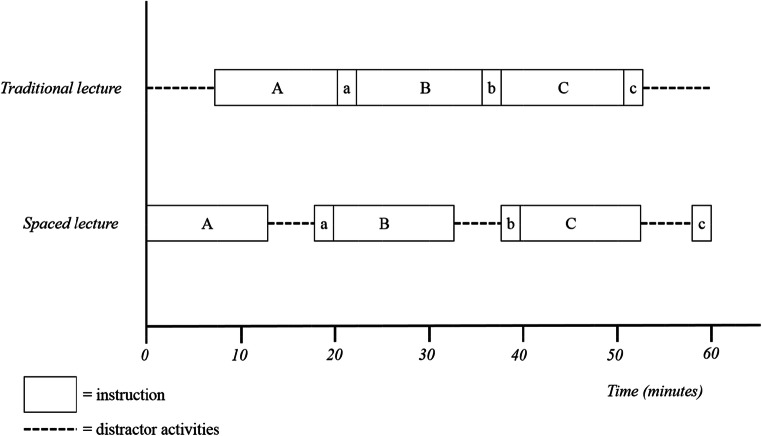
Introduction: Poor knowledge retention is a persistent problem among medical students. This challenging issue may be addressed by optimizing frequently used instructional designs, such as lectures. Guided by neuroscientific literature, we designed a spaced learning lecture in which the educator repeats the to-be-learned information using short temporal intervals. We investigated if this modified instructional design could enhance students’ retention. Materials and Methods: Second-year medical students (n= 148) were randomly allocated to either the spaced lecture or the traditional lecture. The spaced lecture consisted of three 15-min instructional periods, separated by 5-min intervals. A short summary of the preceding information was provided after each interval. The traditional lecture encompassed the same information including the summary in the massed format, thus without the intervals. All students performed a baseline knowledge test 2 weeks prior to the lectures and students’ knowledge retention was assessed 8 days after the lectures. Results: The average score on the retention test (α= 0.74) was not significantly different between the spaced lecture group (33.8% ± 13.6%) and the traditional lecture group (31.8% ± 12.9%) after controlling for students’ baseline-test performance (F(1,104) = 0.566,p= 0.458). Students’ narrative comments showed that the spaced lecture format was well-received and subjectively benefitted their attention-span and cognitive engagement. Discussion and Conclusion: We were unable to show increased knowledge retention after the spaced lecture compared with the traditional lecture. Based on these findings, we provide recommendations for further research. Ultimately, we aim for optimized spaced learning designs to facilitate learning in the medical curriculum and to help educate health professionals with a solid knowledge base.
Overview
The claims and statistics of this paper haven’t been checked yet.
Free: it reads the open-access text and checks the first 5 claims that cite a source we can check. Create a free account to check every claim.
Integrity signals
Registry
Cites
Statistics
Figures
Verification
Claims the paper makes
The claims and statistics of this paper haven’t been checked yet.
Free: it reads the open-access text and checks the first 5 claims that cite a source we can check. Create a free account to check every claim.
Self-check
Percentages, sums and reported differences re-computed from the paper’s own numbers.
The self-check needs the paper’s full text.
Citations
Cites
Active learning increases student performance in science, engineering, and mathematics
Freeman, S., Eddy, S. L., McDonough, M., Smith, M. K., Okoroafor, N., Jordt, H., & Wenderoth, M. P. (2014) · Proceedings of the National Academy of Sciences · doi:10.1073/pnas.1319030111 · Cited by 9,787 · cited 1×
“For instance, lectures are still widely used as a teaching modality, whereas it has been shown that traditional lecturing is less effective for retaining knowledge compared with active learning modalities [6, 7].”
BackgroundDistributed practice in verbal recall tasks: A review and quantitative synthesis.
Cepeda, N. J., Pashler, H., Vul, E., Wixted, J. T., & Rohrer, D. (2006) · Psychological Bulletin · doi:10.1037/0033-2909.132.3.354 · Cited by 1,888 · cited 3×
“, the spacing effect, is based on evidence derived from a century of psychological research (for a meta-analysis, see Cepeda et al, 2006 [8] or Carpenter et al, 2012 [9]).”
BackgroundResultThe critical role of retrieval practice in long-term retention
Roediger, H. L., & Butler, A. C. (2011) · Trends in Cognitive Sciences · doi:10.1016/j.tics.2010.09.003 · Cited by 1,796
The Critical Importance of Retrieval for Learning
Karpicke, J. D., & Roediger, H. L. (2008) · Science · doi:10.1126/science.1152408 · Cited by 1,791
The Molecular and Systems Biology of Memory
Kandel, E. R., Dudai, Y., & Mayford, M. R. (2014) · Cell · doi:10.1016/j.cell.2014.03.001 · Cited by 1,134
Replication and Analysis of Ebbinghaus’ Forgetting Curve
Murre, J. M. J., & Dros, J. (2015) · PLOS ONE · doi:10.1371/journal.pone.0120644 · Cited by 777 · cited 2×
“The 8-day period was selected since the Ebbinghaus forgetting curve indicates that forgetting declines exponentially and most of the forgetting occurs in the first week after initial learning [38, 39].”
MethodTeaching Surgical Skills: What Kind of Practice Makes Perfect?: A Randomized, Controlled Trial
Moulton, C.-A. E., Dubrowski, A., MacRae, H., Graham, B., Grober, E., & Reznick, R. (2006) · Annals of Surgery · doi:10.1097/01.sla.0000234808.85789.6a · Cited by 653
Spacing Effects in Learning: A Temporal Ridgeline of Optimal Retention
Cepeda, N. J., Vul, E., Rohrer, D., Wixted, J. T., & Pashler, H. (2008) · Psychological Science · doi:10.1111/j.1467-9280.2008.02209.x · Cited by 631
Protein phosphatase 1 is a molecular constraint on learning and memory
Genoux, D., Haditsch, U., Knobloch, M., Michalon, A., Storm, D., & Mansuy, I. M. (2002) · Nature · doi:10.1038/nature00928 · Cited by 472
Carpenter, S. K., Cepeda, N. J., Rohrer, D., Kang, S. H. K., & Pashler, H. (2012) · Educational Psychology Review · doi:10.1007/s10648-012-9205-z · Cited by 469
King, A. (1992) · American Educational Research Journal · doi:10.2307/1163370 · Cited by 365
The shuffling of mathematics problems improves learning
Rohrer, D., & Taylor, K. (2007) · Instructional Science · doi:10.1007/s11251-007-9015-8 · Cited by 357 · cited 1×
“The beneficial effects of spaced learning on retention have been shown for a variety of learning tasks concerning factual knowledge [10], conceptual knowledge [11, 12], and procedural knowledge [13].”
BackgroundThe right time to learn: Mechanisms and optimization of spaced learning
Smolen, P., Zhang, Y., & Byrne, J. H. (2016) · Nature Reviews Neuroscience · doi:10.1038/nrn.2015.18 · Cited by 326 · cited 3×
“Despite some empirical evidence including our own study, researchers acknowledge that optimal spacing protocols for humans remain unknown and we may need to gain more fundamental knowledge of the mechanisms of memory formation in order to develop these protocols [23].”
BackgroundMethodOptimizing distributed practice
Cepeda, N. J., Coburn, N., Rohrer, D., Wixted, J. T., Mozer, M. C., & Pashler, H. (2009) · Experimental Psychology · doi:10.1027/1618-3169.56.4.236 · Cited by 296 · cited 1×
“This is in line with evidence indicating that short intervening gaps potentially promote advantages on shorter retention periods [8, 10, 41].”
ResultKerfoot, B. P., DeWolf, W. C., Masser, B. A., Church, P. A., & Federman, D. D. (2007) · Medical Education · doi:10.1111/j.1365-2929.2006.02644.x · Cited by 278
Everyday attention and lecture retention: the effects of time, fidgeting, and mind wandering
Farley, J., Risko, E. F., & Kingstone, A. (2013) · Frontiers in Psychology · doi:10.3389/fpsyg.2013.00619 · Cited by 241
Menzel, R., Manz, G., Menzel, R., & Greggers, U. (2001) · Learning & Memory · doi:10.1101/lm.40001 · Cited by 201
Daydreaming and its correlates in an educational environment
Lindquist, S. I., & McLean, J. P. (2011) · Learning and Individual Differences · doi:10.1016/j.lindif.2010.12.006 · Cited by 182
The Phosphatase SHP2 Regulates the Spacing Effect for Long-Term Memory Induction
Pagani, M. R., Oishi, K., Gelb, B. D., & Zhong, Y. (2009) · Cell · doi:10.1016/j.cell.2009.08.033 · Cited by 157
Very long‐term retention of basic science knowledge in doctors after graduation
Custers, E. J. F. M., & ten Cate, O. T. J. (2011) · Medical Education · doi:10.1111/j.1365-2923.2010.03889.x · Cited by 152
Mauelshagen, J., Sherff, C. M., & Carew, T. J. (1998) · Learning & Memory · doi:10.1101/lm.5.3.246 · Cited by 129 · cited 1×
“Research has shown that consolidation of memory on the molecular level, referred to as long-term potentiation (LTP), is elicited particularly by spaced trials and to a lesser extent by massed trials [28, 29].”
BackgroundAvoiding Surgical Skill Decay: A Systematic Review on the Spacing of Training Sessions
Cecílio‐Fernandes, D., Cnossen, F., Jaarsma, D. A. D. C., & Tio, R. A. (2017) · Journal of surgical education · doi:10.1016/j.jsurg.2017.08.002 · Cited by 126
Spaced Learning Enhances Subsequent Recognition Memory by Reducing Neural Repetition Suppression
Xue, G., Mei, L., Chen, C., Lu, Z.-L., Poldrack, R., & Dong, Q. (2011) · Journal of Cognitive Neuroscience · doi:10.1162/jocn.2010.21532 · Cited by 114
Teaching in small portions dispersed over time enhances long-term knowledge retention
Raman, M., Mclaughlin, K., Violato, C., Rostom, A., Allard, J., & Coderre, S. (2010) · Medical Teacher · doi:10.3109/01421590903197019 · Cited by 112 · cited 1×
“, 1 h/week, significantly enhanced knowledge retention after 1 month [22].”
BackgroundFields, R. D. (2005) · Scientific American · doi:10.1038/scientificamerican0205-74 · Cited by 109
Pfiesteria shumwayae kills fish by micropredation not exotoxin secretion
Vogelbein, W. K., Lovko, V. J., Shields, J. D., Reece, K. S., Mason, P. L., Haas, L. W., & Walker, C. C. (2002) · Nature · doi:10.1038/nature01008 · Cited by 105
Making long-term memories in minutes: a spaced learning pattern from memory research in education
Kelley, P., & Whatson, T. (2013) · Frontiers in Human Neuroscience · doi:10.3389/fnhum.2013.00589 · Cited by 103
Mahler, S. A., Wolcott, C., Swoboda, T. K., Wang, H., & Arnold, T. (2011) · Medical Education · doi:10.1111/j.1365-2923.2010.03891.x · Cited by 100
Distributed practice and procedural memory consolidation in musicians’ skill learning
Simmons, A. L. (2012) · Journal of Research in Music Education · doi:10.1177/0022429411424798 · Cited by 71 · cited 1×
“The beneficial effects of spaced learning on retention have been shown for a variety of learning tasks concerning factual knowledge [10], conceptual knowledge [11, 12], and procedural knowledge [13].”
BackgroundA role for ERKII in synaptic pattern selectivity on the time‐scale of minutes
Ajay, S. M., & Bhalla, U. S. (2004) · European Journal of Neuroscience · doi:10.1111/j.1460-9568.2004.03725.x · Cited by 64
Spacing Simultaneously Promotes Multiple Forms of Learning in Children's Science Curriculum
Gluckman, M., Vlach, H. A., & Sandhofer, C. M. (2014) · Applied Cognitive Psychology · doi:10.1002/acp.2997 · Cited by 57
Pediatric resuscitation training—Instruction all at once or spaced over time?
Patocka, C., Khan, F., Dubrovsky, A. S., Brody, D., Bank, I., & Bhanji, F. (2014) · Resuscitation · doi:10.1016/j.resuscitation.2014.12.003 · Cited by 54
Molecular Determinants of the Spacing Effect
Naqib, F., Sossin, W. S., & Farah, C. A. (2012) · Neural Plasticity · doi:10.1155/2012/581291 · Cited by 49
Recall of lecture information: a question of what, when and where
GILES, R. M., Johnson, M. R., KNIGHT, K. E., ZAMMETT, S., & Weinman, J. A. (1982) · Medical Education · doi:10.1111/j.1365-2923.1982.tb01262.x · Cited by 41
Cao, G., & Harris, K. M. (2014) · Journal of Neurophysiology · doi:10.1152/jn.00297.2014 · Cited by 41
PKC Differentially Translocates during Spaced and Massed Training in Aplysia
Farah, C. A., Weatherill, D., Dunn, T. W., & Sossin, W. S. (2009) · The Journal of Neuroscience · doi:10.1523/jneurosci.1533-09.2009 · Cited by 38
How much basic science content do second-year medical students remember from their first year?
Schneid, S. D., Pashler, H., & Armour, C. (2019) · Medical Teacher · doi:10.1080/0142159x.2018.1426845 · Cited by 34
Mobile spaced education for surgery rotation improves National Board of Medical Examiners scores
Smeds, M. R., Thrush, C. R., Mizell, J. S., Berry, K. S., & Bentley, F. R. (2015) · Journal of Surgical Research · doi:10.1016/j.jss.2015.10.010 · Cited by 30
Unprepared Retesting of First Year Knowledge: How Much Do Second Year Medical Students Remember?
Weggemans, M. M., Custers, E., & ten Cate, O. (2017) · Medical Science Educator · doi:10.1007/s40670-017-0431-3 · Cited by 30
Improving the impact of didactic resident training with online spaced education
Gyorki, D. E., Shaw, T. J., Nicholson, J., Baker, C., Pitcher, M. E., Skandarajah, A. R., Segelov, E., & Mann, G. B. (2013) · ANZ Journal of Surgery · doi:10.1111/ans.12166 · Cited by 27
Spaced learning and innovative teaching: school time, pedagogy of attention and learning awareness
Garzia, M., Mangione, G. R., Longo, L., & Pettenati, M. C. (2016) · Research on Education and Media · doi:10.1515/rem-2016-0004 · Cited by 27
Spaced education activates students in a theoretical radiological science course: a pilot study
Nkenke, E., Vairaktaris, E., Bauersachs, A., Eitner, S., Budach, A., Knipfer, C., & Stelzle, F. (2012) · BMC Medical Education · doi:10.1186/1472-6920-12-32 · Cited by 26
Boettcher, M., Boettcher, J., Mietzsch, S., Krebs, T. F., Bergholz, R., & Reinshagen, K. (2017) · Surgical Endoscopy · doi:10.1007/s00464-017-5650-6 · Cited by 26
Toetsen in het hoger onderwijs
Berkel, H. J. M. V., Bax, A., & Brinke, D. J.-T. (2017) · Bohn Stafleu van Loghum eBooks · doi:10.1007/978-90-368-1679-3 · Cited by 17
Long-term retention of information across the undergraduate medical school curriculum.
Simanton, E. G., & Hansen, L. A. (2012) · PubMed · Cited by 15
Effectiveness of Test-Enhanced Learning (TEL) in lectures for undergraduate medical students
Ayyub, A., & Mahboob, U. (2017) · Pakistan Journal of Medical Sciences · doi:10.12669/pjms.336.13358 · Cited by 13
The pre‐clinical curriculum: an information processing problem
RAZZELL, P., & Weinman, J. A. (1977) · Medical Education · doi:10.1111/j.1365-2923.1977.tb00605.x · Cited by 4
Toetsen: toetssteen of dobbelsteen
Berkel, H. J. M. V., & Bax, A. (2013) · Bohn Stafleu van Loghum eBooks · doi:10.1007/978-90-368-0239-0_2 · Cited by 2
Cited by
Systematic review of distributed practice and retrieval practice in health professions education
Trumble, E., Lodge, J. M., Mandrusiak, A., & Forbes, R. (2023) · Advances in Health Sciences Education · doi:10.1007/s10459-023-10274-3 · Cited by 80
Khalafi, A., Fallah, Z., & Sharif-Nia, H. (2024) · BMC Medical Education · doi:10.1186/s12909-024-05290-9 · Cited by 20
“Also, Timmer et al. (2020) investigated the effect of spaced instruction on knowledge retention in medical education in the Netherlands.”
BackgroundMethodChen, Y., Zhang, R., Zhou, Z., Hong, M., Huang, Z. Y., Wen, H., & Peng, L. (2025) · Frontiers in Medicine · doi:10.3389/fmed.2025.1505588 · Cited by 13
Problem-based learning and digital platforms in medical education
Greenspan, A. A., Goldberg, G. S., & Hamilton, K. L. (2025) · Frontiers in Education · doi:10.3389/feduc.2025.1631337 · Cited by 12
Choe, A. I., Woodard, S. A., Thompson, B. M., Walter, V., Fotos, J. S., & Kasales, C. J. (2022) · Journal of the American College of Radiology · doi:10.1016/j.jacr.2022.03.010 · Cited by 12
Metadata
- Authors
- Timmer, M. C. J., Steendijk, P., Arend, S. M., & Versteeg, M.
- Affiliations
- Leiden University Medical Center (NL)
- Corresponding author
- Versteeg, Marjolein
- Venue
- Medical Science Educator
- Published
- 2020-06-09
- Volume
- 30
- Issue
- 3
- Pages
- 1211-1219
- ISSN
- 2156-8650 (ISSN-L)
- PMC
- PMC8368805
- OpenAlex
- W3035240271
- Cited by
- 20
- References
- 48
- Citations by year
- 2026: 5 · 2025: 3 · 2024: 3 · 2023: 7 · 2022: 1 · 2020: 1
- FWCI
- 1.68
- Type
- journal article
- Language
- en
- Open access
- hybrid
- doi.org
- Licence
- cc-by
- creativecommons.org/licenses/by/4.0 (tdm)
- creativecommons.org/licenses/by/4.0 (vor)
- Locations
- Medical Science Educator (publishedVersion, cc-by)
- PubMed Central (publishedVersion, cc-by)
- PubMed (publishedVersion)
- Leiden Repository (Leiden University) (submittedVersion, cc-by)
- Data Archiving and Networked Services (DANS) (submittedVersion, cc-by)
- Funders
- Leiden University Medical Center
- Topics
- Social Sciences › Education › Innovations in Medical Education
- Life Sciences › Neuroscience › Cognitive Neuroscience › Memory Processes and Influences
- Social Sciences › Psychology › Experimental and Cognitive Psychology › Visual and Cognitive Learning Processes
- Keywords
- spaced learning, knowledge retention, medical students, lecture design, instructional design, cognitive engagement, attention span, medical education
About these checks
Registry, retraction, Cites and statistics results are computed, not judged, with one exception: a printed reference that no index lists is read once by a model before it counts as a citation error. Claims are extracted by a model and kept only when their quote appears verbatim in the text; each cited source is then checked, with a model’s help, for whether it says what the claim relies on. Those verdicts can be wrong — read the claim’s quote and the cited source before relying on one.
Statistics and arithmetic are recomputed, not judged.
Confidence bands are shown only for fields calibrated on our annotated test set. None is calibrated yet, so no band is shown.
What counts as a claim ›How we measure confidence ›How we check this ›
Are you an author, or do you see a problem with this page? Request a review
Data sources
Bibliographic data: Semantic Scholar, OpenAlex, Crossref.
Contains information from the Semantic Scholar Academic Graph Datasets, made available under the ODC Attribution License (ODC-BY 1.0).
Semantic Scholar’s data is described in: Kinney, R., et al. (2023). The Semantic Scholar Open Data Platform. arXiv:2301.10140.
