

The impact of educational gamification on cognition, emotions, and motivation: a randomized controlled trial
Open accessThe DOI matches its Crossref record; 189 of the 191 references it cites were found in a registry or an index, and 1 are not checked yet; none of the 100 sources its claims cite is checked for support yet.
Abstract
This study examines the impact of gamification on education using a novel gamified digital learning platform and a randomized controlled trial (RCT) protocol. Following established research guidelines (CONSORT, Cochrane Collaboration, EVAT©), we assessed the individual and combined effects of points, badges, and challenges against a control group without gamification. The RCT evaluated participant characteristics (sociodemographics, game habits, player traits) and outcomes in cognition (learning, engagement, webcam-based eye-tracking for visual attention, cognitive load), emotions (affective states, webcam-based facial emotion recognition), and motivation (intrinsic motivation). Results showed significantly higher learning for participants using all game elements versus the control group, while badges alone increased cognitive load compared to the other gamification groups. These findings suggest that gamification is more effective when thoughtfully integrating game elements rather than applying elements in isolation, aligning goal-setting with feedback, and combining intrinsic and extrinsic motivational cues. The absence of significant results in other variables may reflect the novelty effect, emphasizing the importance of aligning gamification with pedagogical goals, considering individual and contextual factors, and designing systems that address usability and long-term impact. Educational implications and design recommendations are provided.
Checked 2026-11-23 · 1 reference not checked yet
Overview
CoChat Summary
TL;DR
This randomized controlled trial tested isolated and combined gamification elements (points, badges, challenges) against a non-gamified control in an undergraduate nursing course. Combining all three elements improved learning performance versus control, while badges alone increased cognitive load; most other cognitive, emotional, and motivational outcomes showed no significant group differences.
Key findings
- A one-way MANOVA showed a significant effect of learning environment on the eight response variables: Roy’s Largest Root = 0.318; F(8, 73) = 2.902, p = 0.007; partial η² = 0.241.
- Learning performance was significantly higher in IGAll than CG (95% CI −3.83, −0.38; p = 0.009); IGAll mean = 3.28 (SD = 2.024) vs CG mean = 1.18 (SD = 1.741). H1a was supported, but H1b and H1c were rejected.
- Cognitive load differed by group: IGBadges had higher load than IGChallenges (95% CI 0.236, 9.044; p = 0.034) and IGAll (95% CI 0.482, 8.903; p = 0.021), with a near-significant difference vs IGPoints (95% CI −0.026, 8.638; p = 0.052). IGBadges mean = 21.2019 (SD = 4.86110) vs IGAll = 16.5094 (SD = 3.87113).
- No significant group differences were found for engagement, visual attention, valence, arousal, interest/enjoyment, or proportion of neutral emotion; hypotheses H2–H7 were not supported.
Methods
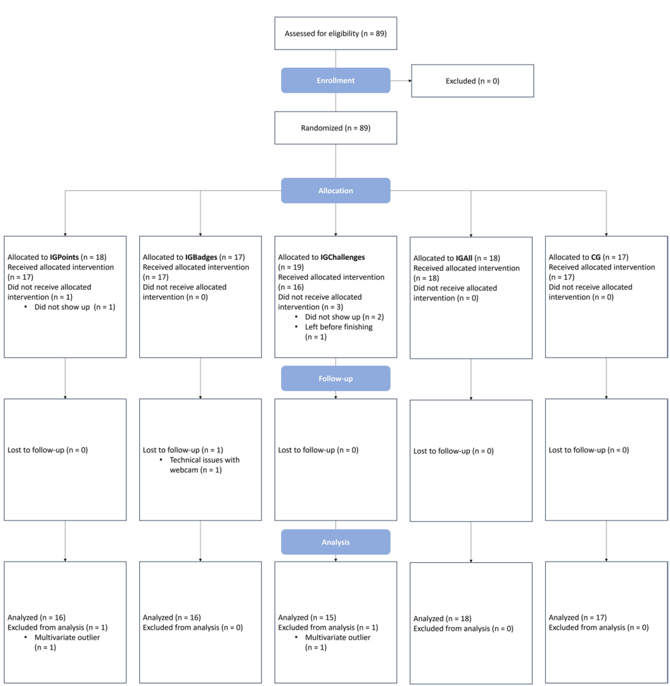
- Between-subjects RCT with five groups: IGPoints (n = 16), IGBadges (n = 16), IGChallenges (n = 15), IGAll (n = 18), and CG (n = 17). Participants were 82 undergraduate nursing students (72 women, 10 men; ages 17–30, M = 18.67, SD = 1.89) recruited from an Anatomy and Physiology course in Lisbon, Portugal; 89 were recruited and 82 analyzed after exclusions.
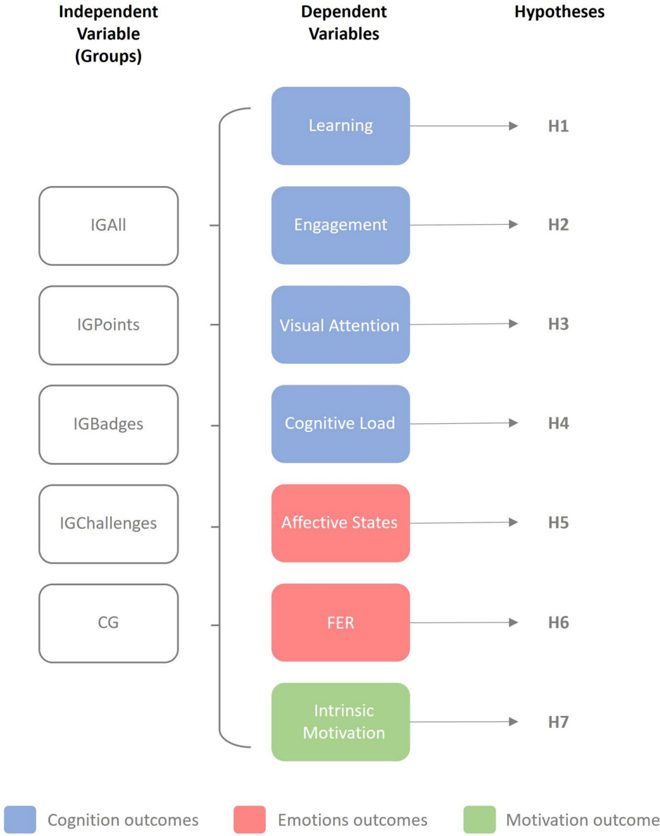
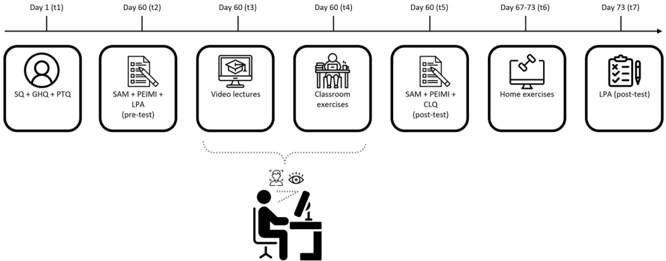
- The digital course was nested in a gamified platform with four gamified versions and one control version. Measures included learning performance (10 multiple-choice pre/post exam), engagement (80 home exercises), visual attention (WebGazer webcam eye-tracking gaze points), cognitive load (18-item CLQ, 11-point Likert), affective states (SAM valence/arousal), facial emotion recognition (Morphcast proportion of neutral emotion), and intrinsic motivation (PEIMI Interest/Enjoyment scale).
- Analysis used one-way MANOVA with learning environment as the independent variable and eight response variables, followed by univariate ANOVAs and post-hoc Tukey tests. An a priori power analysis using G*Power specified N = 80 with medium effect size f²(V) = 0.09, power = 0.80, alpha = 0.05.
Limitations
- The paper states the sample was mainly women aged 17–20, nursing students, born in Portugal, who played less than 10 hours weekly or not at all, with challenge and goal orientation as predominant traits; it was a convenience sample selected due to available professors and calendar constraints.
- The paper states the intervention measured only short-term effects due to limited course duration; the novelty effect may have influenced results; the CLQ was translated and back-translated because no validated Portuguese version existed; webcam eye-tracking is less precise than infrared eye-tracking; webcam FER may introduce bias, inaccuracy, and miscategorization; and sample size limited statistical power for moderator and mediator analyses.
- The text also makes evident that most outcomes showed no significant effects, that badges lacked clear achievement criteria, and that the combined gamification group’s learning gain may reflect cumulative or novelty-related effects rather than a single measured mediator.
Model-written summary. Check it against the paper before relying on it.
Integrity signals
Registry
Cites
Statistics
Figures


Verification
Claims the paper makes
0 Valid · 1 Not valid · 65 Not checked · 66 Own results and interpretations
A result the paper reports from its own data — it cites no other source for it, so there is none to check. The quote shows it is in the paper.
In the paper
“Results showed significantly higher learning for participants using all game elements versus the control group, while badges alone increased cognitive load compared to the other gamification groups.”
§ The impact of educational gamification on cognition, emotions, and motivation: a randomized controlled trial > Abstract
plainstates a cause- Asserted: passes — The authors put it forward as true.
- Checkable: passes — It can be checked against evidence.
- Load-bearing: passes — The paper’s conclusions depend on it.
- Based: passes — The paper gives a reason why it holds.
A result the paper reports from its own data — it cites no other source for it, so there is none to check. The quote shows it is in the paper.
In the paper
“while badges alone increased cognitive load compared to the other gamification groups.”
§ The impact of educational gamification on cognition, emotions, and motivation: a randomized controlled trial > Abstract
plainstates a cause- Asserted: passes — The authors put it forward as true.
- Checkable: passes — It can be checked against evidence.
- Load-bearing: passes — The paper’s conclusions depend on it.
- Based: passes — The paper gives a reason why it holds.
A result the paper reports from its own data — it cites no other source for it, so there is none to check. The quote shows it is in the paper.
In the paper
“One-way MANOVA analysis revealed an effect of the learning environment on the response variables [Roy's Largest Root = 0.318; F(8, 73) = 2.902, p = 0.007; partial η 2 = 0.241)].”
§ The impact of educational gamification on cognition, emotions, and motivation: a randomized controlled trial > Results
plainstates an association- Asserted: passes — The authors put it forward as true.
- Checkable: passes — It can be checked against evidence.
- Load-bearing: passes — The paper’s conclusions depend on it.
- Based: passes — The paper gives a reason why it holds.
- Rests on an assumption not shown here.
A result the paper reports from its own data — it cites no other source for it, so there is none to check. The quote shows it is in the paper.
In the paper
“comparison of Cognitive Load's means between IGBadges and IGPoints tend to significance (I.C. 95%) -0.026, 8.638; p = 0.052)”
§ The impact of educational gamification on cognition, emotions, and motivation: a randomized controlled trial > Results
hedged- Asserted: passes — The authors put it forward as true.
- Checkable: passes — It can be checked against evidence.
- Load-bearing: unclear — It is unclear whether the paper’s conclusions depend on it.
- Based: passes — The paper gives a reason why it holds.
- Rests on an assumption not shown here.
A result the paper reports from its own data — it cites no other source for it, so there is none to check. The quote shows it is in the paper.
In the paper
“When points, badges, and challenges were combined, there was a significant positive impact on learning performance.”
§ The impact of educational gamification on cognition, emotions, and motivation: a randomized controlled trial > Gamification and education
plainstates a cause- Asserted: passes — The authors put it forward as true.
- Checkable: passes — It can be checked against evidence.
- Load-bearing: passes — The paper’s conclusions depend on it.
- Based: passes — The paper gives a reason why it holds.
37 more claims
Create a free account to see all 132 claims and to verify the 89 references still open.
- It may state two separate claims as one. 66
- Probably not a substantial claim. 49
- The quote only partly states this claim. 2
Statistics that don’t add up
Each reported p-value recomputed from its test statistic and degrees of freedom, each partial η² from its F, and each ratio, mean difference or B printed with a p checked against its own confidence interval.
Rated minor: it would not touch a result — a value no result rests on, a p-value that stays on the same side of the significance level, or a conflict that is clerical, resolved elsewhere in the paper, or outside its own findings.
In the paper
“F(4, 77) = 0.637, p = 0.612”
§ The impact of educational gamification on cognition, emotions, and motivation: a randomized controlled trial > Results
Reported p = .612 · recomputed p = .638
Statistics recomputed
Every reported test result, recomputed from its test statistic and degrees of freedom. A result shows as not adding up only once an independent check has confirmed it.
- Doesn’t add upF(4, 77) = 0.637reported p = .612 · recomputed p = .638
“F(4, 77) = 0.637, p = .612”
- ConsistentF(4, 77) = 0.137reported p = .968 · recomputed p = .968
“F(4, 77) = 0.137, p = .968”
- ConsistentF(4, 77) = 0.203reported p = .936 · recomputed p = .936
“F(4, 77) = 0.203, p = .936”
- ConsistentF(4, 77) = 0.339reported p = .851 · recomputed p = .851
“F(4, 77) = 0.339, p = .851”
- ConsistentF(4, 77) = 0.303reported p = .875 · recomputed p = .875
“F(4, 77) = 0.303, p = .875”
9 more recomputed tests
Create a free account to see every test the Stats check recomputed.
Self-check
Percentages, sums and reported differences re-computed from the paper’s own numbers.
Each contradiction between two passages listed here was confirmed by an independent check.
Rated major: it would touch a result — a value a result rests on, reported and recomputed p-values on opposite sides of the significance level, two passages that conflict with no sign which is right, or a cited work retracted before this paper was published.
In the paper
§ The impact of educational gamification on cognition, emotions, and motivation: a randomized controlled trial > Discussion
“Our results support hypothesis H1a (refer to Table 6 for Learning Performance data and Post-hoc Tukey's Tests), indicating that integrating all game elements enhances learning performance compared to other IG and CG groups.”
§ The impact of educational gamification on cognition, emotions, and motivation: a randomized controlled trial > Results
“The other comparisons are non-significant.”
Citations
Cites
Tabachnick, B. G., & Fidell, L. S. (1983) · Cited by 80,058
Faul, F., Erdfelder, E., Lang, A.-G., & Buchner, A. (2007) · Behavior Research Methods · doi:10.3758/bf03193146 · Cited by 65,971 · cited 7×
“One-way MANOVA analysis revealed an effect of the learning environment on the response variables [Roy’s Largest Root = 0.318; F(8, 73) = 2.902, p = 0.007; partial η 2 = 0.241)].”
InfluentialRyan, R. M., & Deci, E. L. (2000) · American Psychologist · doi:10.1037//0003-066x.55.1.68 · Cited by 54,599
Guidelines for the process of cross-cultural adaptation of self-report measures
Beaton, D. E., Bombardier, C., Guillemin, F., & Ferraz, M. B. (2000) · Spine · doi:10.1097/00007632-200012150-00014 · Cited by 14,542
CONSORT 2010 Statement: updated guidelines for reporting parallel group randomised trials
Schulz, K. F., Altman, D. G., Moher, D., & for the CONSORT Group (2010) · BMJ · doi:10.1136/bmj.c332 · Cited by 9,329
From game design elements to gamefulness: defining "gamification"
Deterding, S., Dixon, D., Khaled, R., & Nacke, L. (2011) · Proceedings of the 15th International Academic MindTrek Conference: Envisioning Future Media Environments · doi:10.1145/2181037.2181040 · Cited by 8,402 · cited 1×
“Gamification involves integrating game elements into non-game contexts and is distinct from traditional gameplay (Deterding et al., 2011, 2013).”
Ryan, R. M., & Deci, E. L. (2020) · Contemporary Educational Psychology · doi:10.1016/j.cedpsych.2020.101860 · Cited by 6,037
Csíkszentmihályi, M. (1975) · Cited by 5,690
Does Gamification Work? -- A Literature Review of Empirical Studies on Gamification
Hamari, J., Koivisto, J., & Sarsa, H. (2014) · 2014 47th Hawaii International Conference on System Sciences · doi:10.1109/hicss.2014.377 · Cited by 5,201 · cited 1×
“Gamification itself can act as a novelty effect, which may be short-lived rather than enduring (Hamari et al., 2014).”
Heuristic evaluation of user interfaces
Nielsen, J., & Molich, R. (1990) · Proceedings of the SIGCHI conference on Human factors in computing systems Empowering people - CHI '90 · doi:10.1145/97243.97281 · Cited by 3,533
Research works printed but not linked: 4
- Berglund, A., & Jedel, I. (2023). Higher education students' perceptions of the game element points in a gamified learning management system. The 7th International GamiFIN Conference, Lap- land, Finland. https:// ceur-ws. org/ Vol-3405/ paper 12. pdf
- Borys, M., & Plechawska-Wójcik, M. (2017). Eye-tracking metrics in perception and visual attention research. European Journal of Medical Technologies, 3(16), 11-23.
- Marôco, J. (2023). Análise Estatística com o SPSS Statistics (8th ed.). ReportNumber.
- Papoutsaki, A., Sangkloy, P., Laskey, J., Daskalova, N., Huang, J., & Hays, J. (2016). Webgazer: Scal- able webcam eye tracking using user interactions. In Proceedings of the Twenty-Fifth International Joint Conference on Artificial Intelligence (IJCAI), pp. 3839-3845. https:// doi. org/ 10. 5555/ 30610 53. 30611 56 · doi:10.5555/3061053.3061156
Cited by
Systemic Gamification Theory (SGT): A Holistic Model for Inclusive Gamified Digital Learning
Coelho, F., & Abreu, A. M. (2025) · Multimodal Technologies and Interaction · doi:10.3390/mti9070070 · Cited by 20
Self-citationThe Psychology of EdTech Nudging: Persuasion, Cognitive Load, and Intrinsic Motivation
Balaskas, S., Yfantidou, I., Nikolopoulos, T., & Komis, K. (2025) · European Journal of Investigation in Health Psychology and Education · doi:10.3390/ejihpe15090179 · Cited by 20
Coelho, F., Rando, B., Bernardes, R. A., Pontífice-Sousa, P., Gonçalves, D. J. V., & Abreu, A. M. (2025) · Entertainment Computing · doi:10.1016/j.entcom.2025.101065 · Cited by 18
Self-citationRahimipour, M., Haghjoo, R., Mosalanejad, L., & Karimian, Z. (2025) · BMC Medical Education · doi:10.1186/s12909-025-07922-0 · Cited by 10
Jumanto, & Wicaksono, A. G. (2026) · Attractive Innovative Education Journal · doi:10.51278/aj.v8i2.2356 · Cited by 10
Metadata
- Authors
- Coelho, F., Rando, B., Aparício, D., Pontífice-Sousa, P., Gonçalves, D., & Abreu, A. M.
- Affiliations
- Universidade Católica Portuguesa (PT)
- University of Lisbon (PT)
- Instituto de Engenharia de Sistemas e Computadores Investigação e Desenvolvimento (PT)
- Corresponding author
- Coelho, Franz
- ORCID
- Venue
- Journal of Computers in Education
- Published
- 2025-07-15
- Volume
- 13
- Issue
- 2
- Pages
- 537-584
- ISSN
- 2197-9995 (ISSN-L)
- 2197-9987
- OpenAlex
- W4412414972
- Cited by
- 102
- References
- 191
- Citations by year
- 2026: 80 · 2025: 21
- FWCI
- 60.13
- Type
- journal article
- Language
- en
- Open access
- hybrid
- doi.org
- Licence
- cc-by
- creativecommons.org/licenses/by/4.0 (tdm)
- creativecommons.org/licenses/by/4.0 (vor)
- Locations
- Journal of Computers in Education (publishedVersion, cc-by)
- Portuguese National Funding Agency for Science, Research and Technology (RCAAP Project by FCT) (submittedVersion, other-oa)
- Funders
- Fundação para a Ciência e a Tecnologia (UID/04279 - Centro de investigação Interdisciplinar em Saúde (CIIS), 2022.10688.BD)
- Universidade Católica Portuguesa
- Topics
- Social Sciences › Psychology › Developmental and Educational Psychology › Educational Games and Gamification
- Physical Sciences › Computer Science › Computer Science Applications › Online Learning and Analytics
- Social Sciences › Sociology and Political Science › Digital Games and Media
- Keywords
- educational gamification, points, badges, challenges, intrinsic motivation, extrinsic motivation, cognitive load, visual attention, facial emotion recognition, affective states, learning outcomes, digital learning platforms, novelty effect
About these checks
Registry, retraction, Cites and statistics results are computed, not judged, with one exception: a printed reference that no index lists is read once by a model before it counts as a citation error. Claims are extracted by a model and kept only when their quote appears verbatim in the text; each cited source is then checked, with a model’s help, for whether it says what the claim relies on. Those verdicts can be wrong — read the claim’s quote and the cited source before relying on one.
A language model drew the claims from the paper on 2026-11-23, under version 3 of the claim definition (model deepseek-v4.1-flash, prompt extract-v3).
A second model labelled each claim on 2026-11-23 (model jev-1.13-20260917, definition revision gold-guideline-v0.2).
Statistics and arithmetic are recomputed, not judged.
Confidence bands are shown only for fields calibrated on our annotated test set. None is calibrated yet, so no band is shown.
What counts as a claim ›How we measure confidence ›How we check this ›
Are you an author, or do you see a problem with this page? Request a review
Data sources
Bibliographic data: Semantic Scholar, OpenAlex, Crossref.
Contains information from the Semantic Scholar Academic Graph Datasets, made available under the ODC Attribution License (ODC-BY 1.0).
Semantic Scholar’s data is described in: Kinney, R., et al. (2023). The Semantic Scholar Open Data Platform. arXiv:2301.10140.
