

Conspiracy theories on Twitter: emerging motifs and temporal dynamics during the COVID-19 pandemic
Open accessThe DOI matches its Crossref record; 65 of the 66 references it cites were found in a registry or an index.
Abstract
The COVID-19 pandemic resulted in an upsurge in the spread of diverse conspiracy theories (CTs) with real-life impact. However, the dynamics of user engagement remain under-researched. In the present study, we leverage Twitter data across 11 months in 2020 from the timelines of 109 CT posters and a comparison group (non-CT group) of equal size. Within this approach, we used word embeddings to distinguish non-CT content from CT-related content as well as analysed which element of CT content emerged in the pandemic. Subsequently, we applied time series analyses on the aggregate and individual level to investigate whether there is a difference between CT posters and non-CT posters in non-CT tweets as well as the temporal dynamics of CT tweets. In this regard, we provide a description of the aggregate and individual series, conducted a STL decomposition in trends, seasons, and errors, as well as an autocorrelation analysis, and applied generalised additive mixed models to analyse nonlinear trends and their differences across users. The narrative motifs, characterised by word embeddings, address pandemic-specific motifs alongside broader motifs and can be related to several psychological needs (epistemic, existential, or social). Overall, the comparison of the CT group and non-CT group showed a substantially higher level of overall COVID-19-related tweets in the non-CT group and higher level of random fluctuations. Focussing on conspiracy tweets, we found a slight positive trend but, more importantly, an increase in users in 2020. Moreover, the aggregate series of CT content revealed two breaks in 2020 and a significant albeit weak positive trend since June. On the individual level, the series showed strong differences in temporal dynamics and a high degree of randomness and day-specific sensitivity. The results stress the importance of Twitter as a means of communication during the pandemic and illustrate that these beliefs travel very fast and are quickly endorsed.
Overview
The claims and statistics of this paper haven’t been checked yet.
Free: it reads the open-access text and checks the first 5 claims that cite a source we can check. Create a free account to check every claim.
Integrity signals
Registry
Cites
Statistics
Figures
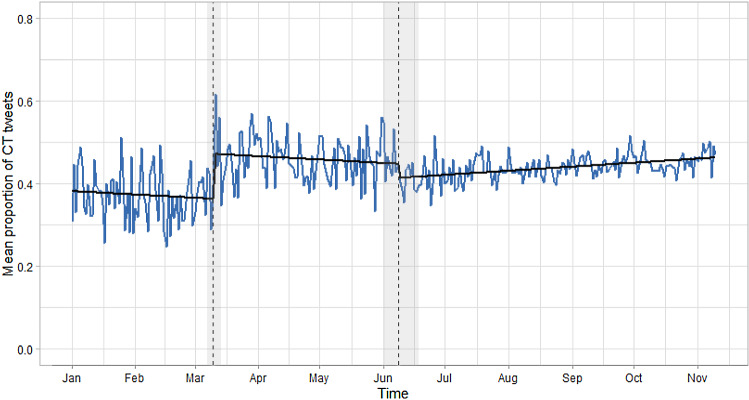
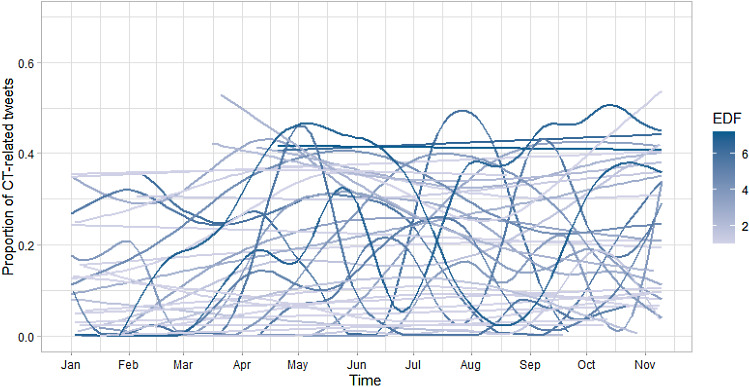
Verification
Claims the paper makes
The claims and statistics of this paper haven’t been checked yet.
Free: it reads the open-access text and checks the first 5 claims that cite a source we can check. Create a free account to check every claim.
Claims other papers make about this one
Each is checked against this paper’s own text: does it say what the citing paper says it does?
The cited source says what the claim attributes to it.
In the citing paper
“it has also overwhelmingly caused, intensified and created other ECD events, such as supply chain disconnection, misinformation, conspiracy [9], and geopolitical crises [10].”
From AI and data science for smart emergency, crisis and disaster resilience. (2023) · cites this paper as [9]
Self-check
Percentages, sums and reported differences re-computed from the paper’s own numbers.
The self-check needs the paper’s full text.
Citations
Cites
The Measurement of Observer Agreement for Categorical Data
Landis, J. R., & Koch, G. G. (1977) · Biometrics · doi:10.2307/2529310 · Cited by 81,148 · cited 1×
“76%[51].”
Glove: Global Vectors for Word Representation
Pennington, J., Socher, R., & Manning, C. (2014) · Proceedings of the 2014 Conference on Empirical Methods in Natural Language Processing (EMNLP) · doi:10.3115/v1/d14-1162 · Cited by 34,071 · cited 10×
“Pennington and colleagues [56] showed, in experiments regarding the word analogy task, that a 100-dimensional GloVe model outperforms HPCA vectors or vLBL.”
BackgroundMethodResultInfluentialEfficient Estimation of Word Representations in Vector Space
Mikolov, T., Chen, K., Corrado, G., & Dean, J. (2013) · arXiv · doi:10.48550/arxiv.1301.3781 · Cited by 26,568
Generalized Additive Models: An Introduction with R
Wood, S. N. (2017) · doi:10.1201/9781315370279 · Cited by 13,852
Understanding Conspiracy Theories
Douglas, K. M., Uscinski, J. E., Sutton, R. M., Cichocka, A., Nefes, T., Ang, C. S., & Deravi, F. (2019) · Political Psychology · doi:10.1111/pops.12568 · Cited by 1,511 · cited 1×
“Topics have been likewise diverse, ranging from overall theoretical discussions [22, 23], anti-science CTs, often discussed with the example of anti-climate change CTs [24–26] or anti-vaccination CTs [27–29], and the role of demographic predictors [20, 30], political predictors, such as political…”
BackgroundFrom Micro to Meso: Critical Steps in Conceptualizing and Conducting Multilevel Research
Klein, K. J., & Kozlowski, S. W. J. (2000) · Organizational Research Methods · doi:10.1177/109442810033001 · Cited by 1,471 · cited 1×
“In this regard, scholars have repeatedly stressed not to trivially generalise results from one level to the other, both, with regard to social systems in general [14], and culture or social media, in particular [15].”
BackgroundThe Psychology of Conspiracy Theories
Douglas, K. M., Sutton, R. M., & Cichocka, A. (2017) · Current Directions in Psychological Science · doi:10.1177/0963721417718261 · Cited by 1,316 · cited 3×
“Douglas et al. [1] stress that although CTs aim to fulfil these needs, they fail to do so.”
BackgroundInfluentialA postmodern Pandora's box: anti-vaccination misinformation on the internet
Kata, A. (2010) · Vaccine · doi:10.1016/j.vaccine.2009.12.022 · Cited by 1,208 · cited 1×
“Moreover, conspiracy content has been found on many online platforms [37].”
BackgroundGoertzel, T. (1994) · Political Psychology · doi:10.2307/3791630 · Cited by 1,094 · cited 1×
“…discussions [22, 23], anti-science CTs, often discussed with the example of anti-climate change CTs [24–26] or anti-vaccination CTs [27–29], and the role of demographic predictors [20, 30], political predictors, such as political orientation [31, 32], or psychological predictors [33–36].”
BackgroundAguinis, H., Gottfredson, R. K., & Culpepper, S. A. (2013) · Journal of Management · doi:10.1177/0149206313478188 · Cited by 1,090 · cited 1×
“The differences in the level, slope, and nonlinear trends were tested following recommendations from the overall literature on multi-level models [66] and growth curve analyses [67].”
Method
Research works printed but not linked: 7
- Hale, T., Petherick, A., Phillips, T., Webster, S.: Variation in gov- ernment responses to COVID-19. Blavatnik Sch. Gov. Work. Pap. 31, 2020-2111 (2020)
- Oliver, J.E., Wood, T.J.: Conspiracy theories and the paranoid style(s) of mass opinion. Am. J. Polit. Sci. 58, 952-966 (2014) · DOI · Paper page
- Brennen, J.S., Simon, F., Howard, P.N., Nielsen, R.K.: Types, sources, and claims of COVID-19 misinformation. Reuters Inst. 7, 1-3 (2020)
- Chollet, F., Allaire, J.J.: Deep Learning with R. Manning Publica- tions (2017)
- Kusner, M., Sun, Y., Kolkin, N., Weinberger, K.: From word embed- dings to document distances. In: Presented at the International Conference on Machine Learning (2015)
- Wickham, H.: The tidyverse. R Package Ver. 1, 1 (2017)
- Dominici, F., McDermott, A., Zeger, S.L., Samet, J.M.: On the use of generalized additive models in time-series studies of air pollution and health. Am. J. Epidemiol. 156, 193-203 (2002). https://doi.org/ 10.1093/aje/ · doi:10.1093/aje/ · Paper page
Cited by
AI and data science for smart emergency, crisis and disaster resilience.
Cao, L. (2023) · International journal of data science and analytics · doi:10.1007/s41060-023-00393-w · Cited by 122
“COVID-19 have been not only a global health emergency, crisis and disaster [7, 8], it has also overwhelmingly caused, intensified and created other ECD events, such as supply chain disconnection, misinformation, conspiracy [9], and geopolitical crises [10].”
BackgroundContent Moderation As a Political Issue: The Twitter Discourse Around Trump's Ban
Alizadeh, M., Gilardi, F., Hoes, E., Klüser, K. J., Kubli, M., & Marchal, N. (2022) · Journal of Quantitative Description Digital Media · doi:10.51685/jqd.2022.023 · Cited by 71
“First, following Batzdorfer et al. (2022), we excluded all tweets that were not written in English, removed stop words, convert all tokens to lowercase, and replaced mentions and links with proper tokens.”
BackgroundSelf-citationCao, L., & Liu, Q. (2022) · doi:10.1101/2022.08.22.22279022 · Cited by 49
Cao, L., & Liu, Q. (2024) · ACM Computing Surveys · doi:10.1145/3686150 · Cited by 61
Desinformación anticientífica sobre la COVID-19 difundida en Twitter en Hispanoamérica
García-Marín, D., & Merino-Ortego, M. (2022) · Cuadernos info · doi:10.7764/cdi.52.42795 · Cited by 50
Online information disorder: fake news, bots and trolls
Giachanou, A., Zhang, X., Barrón‐Cedeño, A., Koltsova, O. Y., & Rosso, P. (2022) · International Journal of Data Science and Analytics · doi:10.1007/s41060-022-00325-0 · Cited by 30
Multifaceted online coordinated behavior in the 2020 US presidential election
Tardelli, S., Nizzoli, L., Avvenuti, M., Cresci, S., & Tesconi, M. (2024) · EPJ Data Science · doi:10.1140/epjds/s13688-024-00467-0 · Cited by 37
“Furthermore, our characterization approach is applicable beyond political debates to other information operations datasets, including those about conspiracy theories [79, 80] and infodemics [81, 82].”
MethodDynamics and characteristics of misinformation related to earthquake predictions on Twitter
Dallo, I., Elroy, O., Fallou, L., Komendantova, N., & Yosipof, A. (2023) · Scientific Reports · doi:10.1038/s41598-023-40399-9 · Cited by 28
“Several research papers have used NLP approaches, including BERT, to investigate tweets related to COVID-19 misinformation and conspiracy theories 20,53,54 .”
BackgroundMethodAlizadeh, M., Hoes, E., & Gilardi, F. (2023) · Scientific Reports · doi:10.1038/s41598-023-40716-2 · Cited by 25
“These findings have policy implications for content moderation efforts 31 especially that of curbing the spread of misinformation 32 , coordinated information operations 26 , conspiracy theories 33 , and bot activities 4 .”
Self-citationCyber-echoes of climate crisis: Unraveling anthropogenic climate change narratives on social media
Elroy, O., Komendantova, N., & Yosipof, A. (2024) · Current Research in Environmental Sustainability · doi:10.1016/j.crsust.2024.100256 · Cited by 20
“Misinformation and conspiracy theories offer people explanations and a sense of control over a situation of uncertainty (Batzdorfer et al., 2022).”
BackgroundMining the Discussion of Monkeypox Misinformation on Twitter Using RoBERTa
Elroy, O., Erokhin, D. V., Komendantova, N., & Yosipof, A. (2023) · IFIP advances in information and communication technology · doi:10.1007/978-3-031-34111-3_36 · Cited by 15
Analysis of COVID-19 5G Conspiracy Theory Tweets Using SentenceBERT Embedding
Elroy, O., & Yosipof, A. (2022) · Lecture notes in computer science · doi:10.1007/978-3-031-15931-2_16 · Cited by 16
Detecting coordinated and bot-like behavior in Twitter: the Jürgen Conings case
Clerck, B. D., Toledano, J. C. F., Utterbeeck, F. V., & Rocha, L. E. C. (2024) · EPJ Data Science · doi:10.1140/epjds/s13688-024-00477-y · Cited by 13
“The results align with the findings of a previous study [68], indicating that people sharing conspiracy theory content had greater impulsive behavior in their posting.”
ResultThe anatomy of conspiracy theorists: Unveiling traits using a comprehensive Twitter dataset
Gambini, M., Tardelli, S., & Tesconi, M. (2024) · Computer Communications · doi:10.1016/j.comcom.2024.01.027 · Cited by 23
“Following this initial processing step, we perform the experiments on both our dataset and the dataset from [28].”
BackgroundMethodInfluentialElroy, O., & Yosipof, A. (2023) · Lecture notes in computer science · doi:10.1007/978-3-031-44207-0_22 · Cited by 10
A Tool Kit for Relation Induction in Text Analysis
Stoltz, D. S., Taylor, M. A., & Dudley, J. S. K. (2024) · Sociological Methods & Research · doi:10.1177/00491241241233242 · Cited by 14
“…conceptual engagement with it, Carbone and Mijs (2022) measured how much 3,660 most popular songs across 23 European countries discuss inequality, Batzdorfer et al. (2021) identi fi ed the narrative motifs used by conspiracy theorists on Twitter (see also Akram, 2020), Voyer, Kline, and Danton…”
Batzdorfer, V., Zenk-Möltgen, W., Young, L. A., Κατσανίδου, Α., Breuer, J., & Bishop, L. (2024) · Research Ethics · doi:10.1177/17470161241257575 · Cited by 7
“…Yang et al., 2021) and news avoidance (de Bruin et al., 2021), polarization (Hart et al., 2020; Reiter-Haas et al., 2023), conspiracy theories (Batzdorfer et al., 2022; Hornsey et al., 2021), the psychological implications of telework (Schmitt et al., 2021) and self-isolation (Heffner et al.,…”
Self-citationBoguslavsky, D. V., Sharov, K. S., & Sharova, N. P. (2022) · Journal of Global Health · doi:10.7189/jogh.12.03013 · Cited by 5
Comparing methods for creating a national random sample of twitter users
Alizadeh, M., Zare, D., Samei, Z., Alizadeh, M., Kubli, M., Aliahmadi, M., Ebrahimi, S., & Gilardi, F. (2024) · Social Network Analysis and Mining · doi:10.1007/s13278-024-01327-5 · Cited by 6
Self-citationKnow an Emotion by the Company It Keeps: Word Embeddings from Reddit/Coronavirus
García‐Rudolph, A., Sánchez-Pinsach, D., Frey, D., Opisso, E., Cisek, K. K., & Kelleher, J. D. (2023) · Applied Sciences · doi:10.3390/app13116713 · Cited by 3
“Batzdorfer et al. [52] used word embeddings to distinguish non-conspiracy theory content from conspiracy theory-related content and analyzed which element of conspiracy theory content emerged during the pandemic.”
BackgroundThakur, N., Cui, S., Patel, K. A., Azizi, N., Knieling, V., Han, C., Poon, A., & Shah, R. (2023) · Computation · doi:10.3390/computation11110234 · Cited by 3
Duzen, Z., Riveni, M., & Aktaş, M. S. (2024) · Research Square · doi:10.21203/rs.3.rs-4243635/v1 · Cited by 3
Alizadeh, M., Hoes, E., & Gilardi, F. (2022) · doi:10.31219/osf.io/har52 · Cited by 2
Self-citationThe Discussions of Monkeypox Misinformation on Social Media
Elroy, O., & Yosipof, A. (2025) · Data · doi:10.3390/data10090137 · Cited by 1
Samaras, G. (2026) · Visual Studies · doi:10.1080/1472586x.2026.2638805 · Cited by 1
Of Stances, Themes, and Anomalies in COVID-19 Mask-Wearing Tweets
Low, J. F., Fung, B. C. M., & Iqbal, F. (2023) · IEEE Access · doi:10.1109/access.2023.3298557 · Cited by 2
“, [34], and how information from social media influ-”
BackgroundEvaluación de quejas de consumidores durante COVID-19 analizando Twitter a gran escala
Gutiérrez-Leefmans, M., García-Miramón, F., & Murck, M. (2023) · Cuadernos info · doi:10.7764/cdi.55.56763 · Cited by 2
Russian Information Operations May Have Caused Hate CrimesPreprint
Alizadeh, M., Chen, A., & Shapiro, J. N. (2023) · OSF Preprints (OSF Preprints) · doi:10.31219/osf.io/a2wbc
Self-citationInformation Disorders in the Current Media Environment
Buturoiu, R., Corbu, N., & Boţan, M. (2023) · Springer studies in media and political communication · doi:10.1007/978-3-031-41954-6_7 · Cited by 2
Detection of Conspiracy Theories from Tweets Using NLI-Based Zero Shot Text Classification Models
Jakubowska, W., Kociołek, M., & Kurowski, D. (2023) · Lecture notes in networks and systems · doi:10.1007/978-3-031-41630-9_19
A Short Survey on Fake News Detection in Pandemic Situation Towards Future Directions
Rathinapriya, V., & Kalaivani, J. (2023) · Lecture notes in electrical engineering · doi:10.1007/978-981-99-6690-5_34
The Importance of Readability in the Discussions of Monkeypox Misinformation on TwitterPreprint
Elroy, O., & Yosipof, A. (2023) · SSRN Electronic Journal · doi:10.2139/ssrn.4636666
Cao, L. (2023) · Data analytics · doi:10.1007/978-981-99-9915-6_10
Modeling Publication Collection and Processing
Cao, L. (2023) · Data analytics · doi:10.1007/978-981-99-9915-6_8
An adaptive clustering framework for personality prediction using enhanced seed optimization
Hartono, H., Zuhanda, M. K., Syah, R. B. Y., Fauzi, F. I., Wahyuni, N. S., Istiana, I., & Yulina, E. (2025) · Decision Analytics Journal · doi:10.1016/j.dajour.2025.100630
Mikuličiūtė, V., Zokas, J., Mendelytė, E., & Radzevičienė, A. (2025) · Journal of Cognitive Psychology · doi:10.1080/20445911.2025.2599238
Additional file 1 of Detecting coordinated and bot-like behavior in Twitter: the Jürgen Conings case
Clerck, B. D., Fernandez Toledano, J. C., Utterbeeck, F. V., & Rocha, L. E. C. (2024) · Figshare · doi:10.6084/m9.figshare.26730097
Editorial: The phenomenon of misinformation in different domains and by various disciplines
Biella, M., & Batzdorfer, V. (2026) · Frontiers in Psychology · doi:10.3389/fpsyg.2025.1763023
Self-citationLeave the world(view) behind, but keep the words: The effect of conspiracism on writing
Miani, A., Adornetti, I., Altavilla, D., Deriu, V., Chiera, A., & Ferretti, F. (2026) · PLoS ONE · doi:10.1371/journal.pone.0346496 · Cited by 1
“A similar pattern was observed also on social media, where conspiracy posts on Reddit are longer [55] and tweets by conspiracy promoters are more frequent [61].”
Metadata
- Authors
- Batzdorfer, V., Steinmetz, H., Biella, M., & Alizadeh, M.
- Affiliations
- GESIS - Leibniz Institute for the Social Sciences (DE)
- Universität Trier (DE)
- University of Tübingen (DE)
- Harvard University (US)
- Corresponding author
- Batzdorfer, Veronika
- Venue
- International Journal of Data Science and Analytics
- Published
- 2021-12-24
- Volume
- 13
- Issue
- 4
- Pages
- 315-333
- ISSN
- 2364-415X (ISSN-L)
- 2364-4168
- PMC
- PMC8703214
- OpenAlex
- W4205125937
- Cited by
- 38
- References
- 63
- Citations by year
- 2026: 3 · 2025: 3 · 2024: 10 · 2023: 16 · 2022: 6
- FWCI
- 11.09
- Type
- journal article
- Language
- en
- Open access
- hybrid
- doi.org
- Licence
- cc-by
- creativecommons.org/licenses/by/4.0 (tdm)
- creativecommons.org/licenses/by/4.0 (vor)
- Locations
- International Journal of Data Science and Analytics (publishedVersion, cc-by)
- PubMed Central (publishedVersion, cc-by)
- PubMed (publishedVersion)
- BOA (University of Milano-Bicocca) (submittedVersion, cc-by)
- Social Science Open Access Repository (GESIS – Leibniz Institute for the Social Sciences) (submittedVersion, cc-by)
- Funders
- GESIS – Leibniz-Institut für Sozialwissenschaften e.V.
- Topics
- Social Sciences › Sociology and Political Science › Misinformation and Its Impacts
- Social Sciences › Communication › Communication and COVID-19 Impact
- Social Sciences › Communication › Public Relations and Crisis Communication
- Keywords
- conspiracy theories, COVID-19 pandemic, Twitter, temporal dynamics, user engagement, narrative motifs, psychological needs, epistemic needs, social media misinformation, STL decomposition, autocorrelation
About these checks
Registry, retraction, Cites and statistics results are computed, not judged, with one exception: a printed reference that no index lists is read once by a model before it counts as a citation error. Claims are extracted by a model and kept only when their quote appears verbatim in the text; each cited source is then checked, with a model’s help, for whether it says what the claim relies on. Those verdicts can be wrong — read the claim’s quote and the cited source before relying on one.
Statistics and arithmetic are recomputed, not judged.
Confidence bands are shown only for fields calibrated on our annotated test set. None is calibrated yet, so no band is shown.
What counts as a claim ›How we measure confidence ›How we check this ›
Are you an author, or do you see a problem with this page? Request a review
Data sources
Bibliographic data: Semantic Scholar, OpenAlex, Crossref.
Contains information from the Semantic Scholar Academic Graph Datasets, made available under the ODC Attribution License (ODC-BY 1.0).
Semantic Scholar’s data is described in: Kinney, R., et al. (2023). The Semantic Scholar Open Data Platform. arXiv:2301.10140.
