

Conspiracy theories on Twitter: emerging motifs and temporal dynamics during the COVID-19 pandemic
Open accessThe DOI matches its Crossref record; 65 of the 66 references it cites were found in a registry or an index.
Abstract
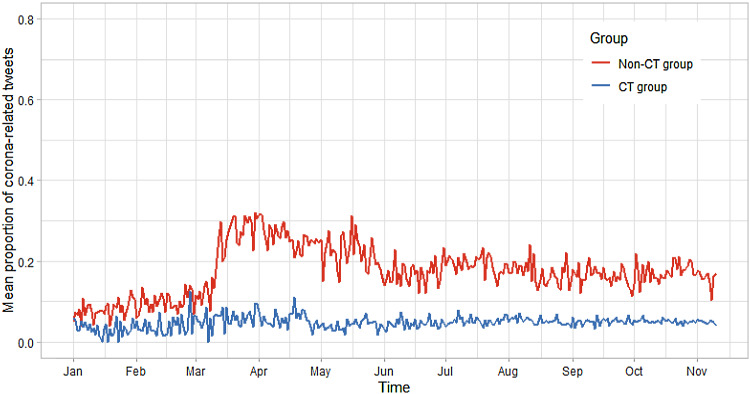
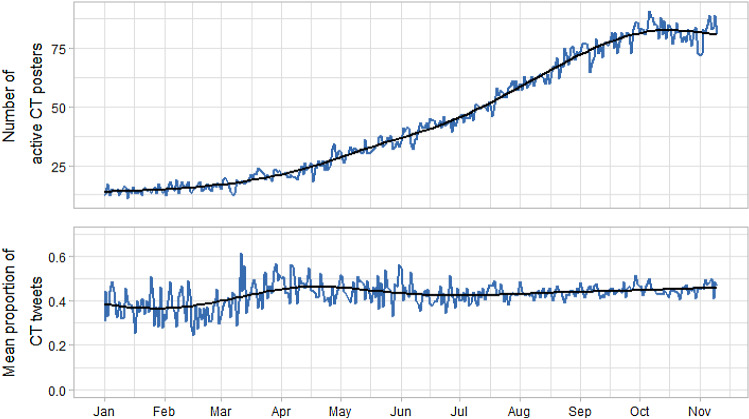
The COVID-19 pandemic resulted in an upsurge in the spread of diverse conspiracy theories (CTs) with real-life impact. However, the dynamics of user engagement remain under-researched. In the present study, we leverage Twitter data across 11 months in 2020 from the timelines of 109 CT posters and a comparison group (non-CT group) of equal size. Within this approach, we used word embeddings to distinguish non-CT content from CT-related content as well as analysed which element of CT content emerged in the pandemic. Subsequently, we applied time series analyses on the aggregate and individual level to investigate whether there is a difference between CT posters and non-CT posters in non-CT tweets as well as the temporal dynamics of CT tweets. In this regard, we provide a description of the aggregate and individual series, conducted a STL decomposition in trends, seasons, and errors, as well as an autocorrelation analysis, and applied generalised additive mixed models to analyse nonlinear trends and their differences across users. The narrative motifs, characterised by word embeddings, address pandemic-specific motifs alongside broader motifs and can be related to several psychological needs (epistemic, existential, or social). Overall, the comparison of the CT group and non-CT group showed a substantially higher level of overall COVID-19-related tweets in the non-CT group and higher level of random fluctuations. Focussing on conspiracy tweets, we found a slight positive trend but, more importantly, an increase in users in 2020. Moreover, the aggregate series of CT content revealed two breaks in 2020 and a significant albeit weak positive trend since June. On the individual level, the series showed strong differences in temporal dynamics and a high degree of randomness and day-specific sensitivity. The results stress the importance of Twitter as a means of communication during the pandemic and illustrate that these beliefs travel very fast and are quickly endorsed.
Overview
The claims and statistics of this paper haven’t been checked yet.
Free: it reads the open-access text and checks the first 5 claims that cite a source we can check. Create a free account to check every claim.
Integrity signals
Registry
Cites
Statistics
Figures
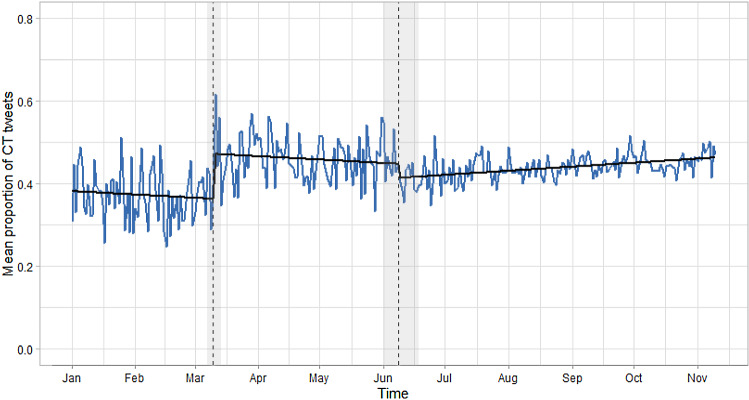
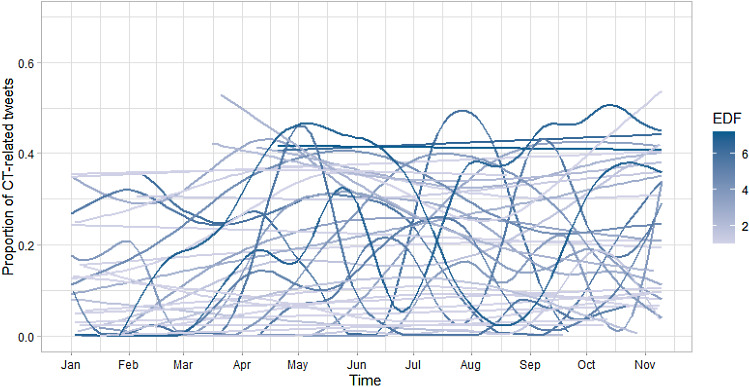
Verification
Claims the paper makes
The claims and statistics of this paper haven’t been checked yet.
Free: it reads the open-access text and checks the first 5 claims that cite a source we can check. Create a free account to check every claim.
Claims other papers make about this one
Each is checked against this paper’s own text: does it say what the citing paper says it does?
The cited source says what the claim attributes to it.
In the citing paper
“it has also overwhelmingly caused, intensified and created other ECD events, such as supply chain disconnection, misinformation, conspiracy [9], and geopolitical crises [10].”
From AI and data science for smart emergency, crisis and disaster resilience. (2023) · cites this paper as [9]
Self-check
Percentages, sums and reported differences re-computed from the paper’s own numbers.
The self-check needs the paper’s full text.
Citations
Cites
The Measurement of Observer Agreement for Categorical Data
Landis, J. R., & Koch, G. G. (1977) · Biometrics · doi:10.2307/2529310 · Cited by 81,148 · cited 1×
“76%[51].”
Glove: Global Vectors for Word Representation
Pennington, J., Socher, R., & Manning, C. (2014) · Proceedings of the 2014 Conference on Empirical Methods in Natural Language Processing (EMNLP) · doi:10.3115/v1/d14-1162 · Cited by 34,071 · cited 10×
“Pennington and colleagues [56] showed, in experiments regarding the word analogy task, that a 100-dimensional GloVe model outperforms HPCA vectors or vLBL.”
BackgroundMethodResultInfluentialEfficient Estimation of Word Representations in Vector Space
Mikolov, T., Chen, K., Corrado, G., & Dean, J. (2013) · arXiv · doi:10.48550/arxiv.1301.3781 · Cited by 26,568
Generalized Additive Models: An Introduction with R
Wood, S. N. (2017) · doi:10.1201/9781315370279 · Cited by 13,852
Understanding Conspiracy Theories
Douglas, K. M., Uscinski, J. E., Sutton, R. M., Cichocka, A., Nefes, T., Ang, C. S., & Deravi, F. (2019) · Political Psychology · doi:10.1111/pops.12568 · Cited by 1,511 · cited 1×
“Topics have been likewise diverse, ranging from overall theoretical discussions [22, 23], anti-science CTs, often discussed with the example of anti-climate change CTs [24–26] or anti-vaccination CTs [27–29], and the role of demographic predictors [20, 30], political predictors, such as political…”
BackgroundFrom Micro to Meso: Critical Steps in Conceptualizing and Conducting Multilevel Research
Klein, K. J., & Kozlowski, S. W. J. (2000) · Organizational Research Methods · doi:10.1177/109442810033001 · Cited by 1,471 · cited 1×
“In this regard, scholars have repeatedly stressed not to trivially generalise results from one level to the other, both, with regard to social systems in general [14], and culture or social media, in particular [15].”
BackgroundThe Psychology of Conspiracy Theories
Douglas, K. M., Sutton, R. M., & Cichocka, A. (2017) · Current Directions in Psychological Science · doi:10.1177/0963721417718261 · Cited by 1,316 · cited 3×
“Douglas et al. [1] stress that although CTs aim to fulfil these needs, they fail to do so.”
BackgroundInfluentialA postmodern Pandora's box: anti-vaccination misinformation on the internet
Kata, A. (2010) · Vaccine · doi:10.1016/j.vaccine.2009.12.022 · Cited by 1,208 · cited 1×
“Moreover, conspiracy content has been found on many online platforms [37].”
BackgroundGoertzel, T. (1994) · Political Psychology · doi:10.2307/3791630 · Cited by 1,094 · cited 1×
“…discussions [22, 23], anti-science CTs, often discussed with the example of anti-climate change CTs [24–26] or anti-vaccination CTs [27–29], and the role of demographic predictors [20, 30], political predictors, such as political orientation [31, 32], or psychological predictors [33–36].”
BackgroundAguinis, H., Gottfredson, R. K., & Culpepper, S. A. (2013) · Journal of Management · doi:10.1177/0149206313478188 · Cited by 1,090 · cited 1×
“The differences in the level, slope, and nonlinear trends were tested following recommendations from the overall literature on multi-level models [66] and growth curve analyses [67].”
MethodConspiracy Theories and the Paranoid Style(s) of Mass Opinion
Oliver, J. E., & Wood, T. J. (2014) · American Journal of Political Science · doi:10.1111/ajps.12084 · Cited by 877
The psychological roots of anti-vaccination attitudes: A 24-nation investigation.
Hornsey, M. J., Harris, E. A., & Fielding, K. S. (2018) · Health Psychology · doi:10.1037/hea0000586 · Cited by 788
Growth Modeling Using Random Coefficient Models: Model Building, Testing, and Illustrations
Bliese, P. D., & Ployhart, R. E. (2002) · Organizational Research Methods · doi:10.1177/109442802237116 · Cited by 786 · cited 1×
“The differences in the level, slope, and nonlinear trends were tested following recommendations from the overall literature on multi-level models [66] and growth curve analyses [67].”
MethodOn the use of generalized additive models in time-series studies of air pollution and health
Dominici, F. (2002) · American Journal of Epidemiology · doi:10.1093/aje/kwf062 · Cited by 728
Analytic thinking reduces belief in conspiracy theories
Swami, V., Voracek, M., Stieger, S., Tran, U. S., & Furnham, A. (2014) · Cognition · doi:10.1016/j.cognition.2014.08.006 · Cited by 726 · cited 1×
“…discussions [22, 23], anti-science CTs, often discussed with the example of anti-climate change CTs [24–26] or anti-vaccination CTs [27–29], and the role of demographic predictors [20, 30], political predictors, such as political orientation [31, 32], or psychological predictors [33–36].”
BackgroundCoronavirus conspiracy beliefs, mistrust, and compliance with government guidelines in England
Freeman, D., Waite, F., Rosebrock, L., Petit, A., Causier, C., East, A., Jenner, L., Teale, A.-L., Carr, L., Mulhall, S., et al. (2022) · Psychological Medicine · doi:10.1017/s0033291720001890 · Cited by 714
Jolley, D., & Douglas, K. M. (2014) · British Journal of Psychology · doi:10.1111/bjop.12018 · Cited by 685
Dead and Alive: Beliefs in Contradictory Conspiracy Theories
Wood, M. J., Douglas, K. M., & Sutton, R. M. (2012) · Social Psychological and Personality Science · doi:10.1177/1948550611434786 · Cited by 660
Social media for large studies of behavior
Ruths, D., & Pfeffer, J. (2014) · Science · doi:10.1126/science.346.6213.1063 · Cited by 648 · cited 2×
“Likewise, we recommend a careful interpretation of our study for CT processes beyond posting on Twitter, as these users may represent a sample that is not representative of the general population [75, 76].”
BackgroundMethodLewandowsky, S., Oberauer, K., & Gignac, G. E. (2013) · Psychological Science · doi:10.1177/0956797612457686 · Cited by 638
Automated Text Analysis for Consumer Research
Humphreys, A., & Wang, R. J.-H. (2018) · Journal of Consumer Research · doi:10.1093/jcr/ucx104 · Cited by 636 · cited 1×
“Relating to epistemic needs, pragmatic markers indicate the individual attention, assessment of causes and commitment to stances [71] (e.g. “uncover” is associated with “growing_totalitarian”, c (cid:2) 0.40 or “batresearch_program”, c 0.40).”
BackgroundInfluentialDetecting Automation of Twitter Accounts: Are You a Human, Bot, or Cyborg?
Chu, Z., Gianvecchio, S., Wang, H., & Jajodia, S. (2012) · IEEE Transactions on Dependable and Secure Computing · doi:10.1109/tdsc.2012.75 · Cited by 634
Political Extremism Predicts Belief in Conspiracy Theories
van Prooijen, J.-W., Krouwel, A. P. M., & Pollet, T. V. (2015) · Social Psychological and Personality Science · doi:10.1177/1948550614567356 · Cited by 626 · cited 1×
“Topics have been likewise diverse, ranging from overall theoretical discussions [22, 23], anti-science CTs, often discussed with the example of anti-climate change CTs [24–26] or anti-vaccination CTs [27–29], and the role of demographic predictors [20, 30], political predictors, such as political orientation [31, 32],…”
BackgroundSwami, V., Coles, R., Stieger, S., Pietschnig, J., Furnham, A., Rehim, S., & Voracek, M. (2011) · British Journal of Psychology · doi:10.1111/j.2044-8295.2010.02004.x · Cited by 624
Compensatory Control: Achieving Order Through the Mind, Our Institutions, and the Heavens
Kay, A. C., Whitson, J. A., Gaucher, D., & Galinsky, A. D. (2009) · Current Directions in Psychological Science · doi:10.1111/j.1467-8721.2009.01649.x · Cited by 598
Modelling Palaeoecological Time Series Using Generalised Additive Models
Simpson, G. L. (2018) · Frontiers in Ecology and Evolution · doi:10.3389/fevo.2018.00149 · Cited by 560 · cited 2×
“Second, we formally tested for linear and nonlinear trends, season effects, and potential group differences by means of generalised additive models [GAMs, 12, 64, 65].”
MethodHamaker, E. L., Asparouhov, T., Brose, A., Schmiedek, F., & Muthén, B. (2018) · Multivariate Behavioral Research · doi:10.1080/00273171.2018.1446819 · Cited by 549 · cited 1×
“This is the case for the occurrence of linear or nonlinear trends, autocorrelation [43], systematic fluctuations (periodicity and seasonality, see [44]), and structural breaks in mean level, trend, or variance [45] that show the behaviour of the system in response to sudden and emerging external or internal events.”
BackgroundPrevention is better than cure: addressing anti-vaccine conspiracy theories
Jolley, D., & Douglas, K. M. (2017) · Journal of Applied Social Psychology · doi:10.1111/jasp.12453 · Cited by 446 · cited 1×
“…theoretical discussions [22, 23], anti-science CTs, often discussed with the example of anti-climate change CTs [24–26] or anti-vaccination CTs [27–29], and the role of demographic predictors [20, 30], political predictors, such as political orientation [31, 32], or psychological predictors…”
BackgroundConspiracy Theories: Evolved Functions and Psychological Mechanisms
van Prooijen, J.-W., & van Vugt, M. (2018) · Perspectives on Psychological Science · doi:10.1177/1745691618774270 · Cited by 414 · cited 7×
“mind [18], or an extremist political attitude, van Prooijen and van Vugt [2] emphasise the evolutionary roots of CTs”
BackgroundMethodInfluentialBertin, P., Nera, K., & Delouvée, S. (2020) · Frontiers in Psychology · doi:10.3389/fpsyg.2020.565128 · Cited by 381 · cited 1×
“These public health interventions pro-foundly impacted sensemaking (e.g. distrust of authorities) and behavioural responses (e.g. decreased willingness for vaccination or increase in deviant behaviour) [6–8].”
BackgroundShahsavari, S., Holur, P., Wang, T., Tangherlini, T. R., & Roychowdhury, V. (2020) · Journal of Computational Social Science · doi:10.1007/s42001-020-00086-5 · Cited by 354
Hornsey, M. J., & Fielding, K. S. (2017) · American Psychologist · doi:10.1037/a0040437 · Cited by 345
Starbird, K. (2017) · Proceedings of the International AAAI Conference on Web and Social Media · doi:10.1609/icwsm.v11i1.14878 · Cited by 307 · cited 1×
“Research found that CTs identified in social media posts differed from rumours in their temporal pattern, that is, CTs peaked multiple times in a period, whereas rumours showed single peaks and recession patterns [40].”
Backgroundrtweet: Collecting and analyzing Twitter data
Kearney, M. (2019) · Journal of Open Source Software · doi:10.21105/joss.01829 · Cited by 306 · cited 1×
“Further, we used the R-package rtweet 0.7.0 for harvesting the Twitter data [69]; tweetbotornot 0.1.0 for bot classification [52]; text2vec 0.6 for the GloVe word embedding [57]; CMDist 3.0 for concept mover’s distance [62], tidyverse 1.3.0 for general data wrangling [70].”
MethodInfluentialCrocker, J., Luhtanen, R., Broadnax, S., & Blaine, B. E. (1999) · Personality and Social Psychology Bulletin · doi:10.1177/01461672992511003 · Cited by 283
Conspiracy Theories and Conspiracy Theorizing
Clarke, S. (2002) · Philosophy of the Social Sciences · doi:10.1177/004931032002001 · Cited by 275 · cited 1×
“Topics have been likewise diverse, ranging from overall theoretical discussions [22, 23], anti-science CTs, often discussed with the example of anti-climate change CTs [24–26] or anti-vaccination CTs [27–29], and the role of demographic predictors [20, 30], political predictors, such as political…”
BackgroundDouglas, K. M., & Sutton, R. M. (2011) · British Journal of Social Psychology · doi:10.1111/j.2044-8309.2010.02018.x · Cited by 261
Time series analysis for psychological research: examining and forecasting change
Jebb, A. T., Tay, L., Wang, W., & Huang, Q. (2015) · Frontiers in Psychology · doi:10.3389/fpsyg.2015.00727 · Cited by 249 · cited 1×
“Among these, time series analysis has been applied considerably seldom [42].”
BackgroundGaining insights from social media language: Methodologies and challenges.
Kern, M. L., Park, G., Eichstaedt, J. C., Schwartz, H. A., Sap, M., Smith, L. K., & Ungar, L. H. (2016) · Psychological Methods · doi:10.1037/met0000091 · Cited by 221 · cited 1×
“In this regard, scholars have repeatedly stressed not to trivially generalise results from one level to the other, both, with regard to social systems in general [14], and culture or social media, in particular [15].”
BackgroundTime Series Analysis for the Social Sciences
Box-Steffensmeier, J. M., Freeman, J. R., Hitt, M. P., & Pevehouse, J. C. W. (2014) · Cambridge University Press eBooks · doi:10.1017/cbo9781139025287 · Cited by 217 · cited 2×
“Next, we calculated the autocorrelation function and partial autocorrelation function due to two substantive reasons—that is, to judge the level of inertia (positive autocorrelation) versus bouncing (negative autocorrelation) of the behaviour as well as to evaluate whether the estimated time series models require enla…”
BackgroundMethodŠrol, J., Ballová Mikušková, E., & Čavojová, V. (2021) · Applied Cognitive Psychology · doi:10.1002/acp.3798 · Cited by 217
Media Use, Social Structure, and Belief in 9/11 Conspiracy Theories
Stempel, C., Hargrove, T., & Stempel, G. H. (2007) · Journalism & Mass Communication Quarterly · doi:10.1177/107769900708400210 · Cited by 213
Gladkova, A., Drozd, A., & Matsuoka, S. (2016) · Proceedings of the NAACL Student Research Workshop · doi:10.18653/v1/n16-2002 · Cited by 202
On pins and needles: How vaccines are portrayed on Pinterest
Guidry, J. P. D., Carlyle, K., Messner, M., & Jin, Y. (2015) · Vaccine · doi:10.1016/j.vaccine.2015.08.064 · Cited by 201 · cited 1×
“…theoretical discussions [22, 23], anti-science CTs, often discussed with the example of anti-climate change CTs [24–26] or anti-vaccination CTs [27–29], and the role of demographic predictors [20, 30], political predictors, such as political orientation [31, 32], or psychological predictors…”
BackgroundClimate change: Why the conspiracy theories are dangerous
Douglas, K. M., & Sutton, R. M. (2015) · Bulletin of the Atomic Scientists · doi:10.1177/0096340215571908 · Cited by 196 · cited 1×
“…diverse, ranging from overall theoretical discussions [22, 23], anti-science CTs, often discussed with the example of anti-climate change CTs [24–26] or anti-vaccination CTs [27–29], and the role of demographic predictors [20, 30], political predictors, such as political orientation [31,…”
BackgroundThe False positive problem of automatic bot detection in social science research
Rauchfleisch, A., & Kaiser, J. (2020) · PLOS ONE · doi:10.1371/journal.pone.0241045 · Cited by 184 · cited 1×
“calculated the intercoder-reliability [54] for the CT accounts (κ 0.”
BackgroundPolitical polarization drives online conversations about COVID ‐19 in the United States
Jiang, J., Chen, E., Yan, S., Lerman, K., & Ferrara, E. (2020) · Human Behavior and Emerging Technologies · doi:10.1002/hbe2.202 · Cited by 171 · cited 1×
“We collected a list of thematic keywords, potentially indicative for conspiracy theories, based on research articles [47, 48], and third-party sources [49].”
MethodAssociations between schizotypy and belief in conspiracist ideation
Barron, D., Morgan, K., Towell, T., Altemeyer, B., & Swami, V. (2014) · Personality and Individual Differences · doi:10.1016/j.paid.2014.06.040 · Cited by 164 · cited 1×
“…discussions [22, 23], anti-science CTs, often discussed with the example of anti-climate change CTs [24–26] or anti-vaccination CTs [27–29], and the role of demographic predictors [20, 30], political predictors, such as political orientation [31, 32], or psychological predictors [33–36].”
BackgroundOnline Social Endorsement and Covid-19 Vaccine Hesitancy in the United Kingdom
Chadwick, A., Kaiser, J., Vaccari, C., Freeman, D., Lambe, S., Loe, B. S., Vanderslott, S., Lewandowsky, S., Conroy, M., Ross, A. R. N., et al. (2021) · Social Media + Society · doi:10.1177/20563051211008817 · Cited by 151
Chan, M.-P. S., Winneg, K., Hawkins, L., Farhadloo, M., Jamieson, K. H., & Albarracín, D. (2018) · Social Science & Medicine · doi:10.1016/j.socscimed.2018.07.007 · Cited by 128 · cited 1×
“Such social media communicationmay affect public risk perceptions during other crisis events, like the Zika virus in the USA in 2016 [39].”
Klein, C., Clutton, P., & Dunn, A. G. (2019) · PLOS ONE · doi:10.1371/journal.pone.0225098 · Cited by 111 · cited 1×
“Likewise, as understanding the minimal sufficient determinants for radicalisation processes, frameworks span pathological manifestations, cognitive or trait explanations, yet few approaches adopt an actionable definition [17].”
BackgroundConspiracy Talk on Social Media: Collective Sensemaking during a Public Health Crisis
Kou, Y., Gui, X., Chen, Y., & Pine, K. (2017) · Proceedings of the ACM on Human-Computer Interaction · doi:10.1145/3134696 · Cited by 103 · cited 1×
“A plethora of definitions regarding conspiracy theories exist that are at times contradictory and reflect a phenomenon that is hard to actionably delineate [16].”
BackgroundShahsavari, S., Holur, P., Wang, T., et al. (2020) · Research Square · doi:10.21203/rs.3.rs-52079/v1 · Cited by 92
Semiparametric Regression with R
Harezlak, J., Ruppert, D., & WAND, M. P. (2018) · Use R! · doi:10.1007/978-1-4939-8853-2 · Cited by 85 · cited 1×
“The number of basis functions were investigated by using the gam.check function in the mgcv package [68], which indicated that higher numbers were unnecessary.”
MethodValidating multiple structural change models–a case study
Zeileis, A., & Kleiber, C. (2005) · Journal of Applied Econometrics · doi:10.1002/jae.856 · Cited by 79
Concept Mover’s Distance: measuring concept engagement via word embeddings in texts
Stoltz, D. S., & Taylor, M. A. (2019) · Journal of Computational Social Science · doi:10.1007/s42001-019-00048-6 · Cited by 75 · cited 5×
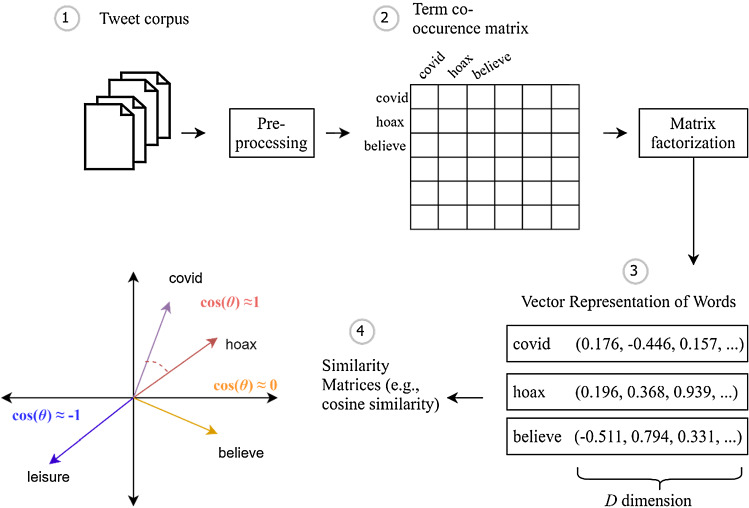
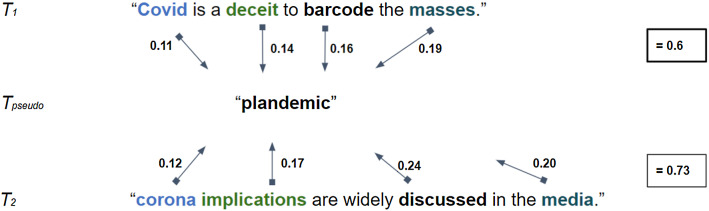
“Calculating the semantic similarity is achieved with the concept mover’s distance (CMD) algorithm [62].”
BackgroundMethodInfluential'The Government Spies Using Our Webcams': The Language of Conspiracy Theories in Online Discussions
Samory, M., & Mitra, T. (2018) · Proceedings of the ACM on Human-Computer Interaction · doi:10.1145/3274421 · Cited by 74
Antecedents and consequences of COVID-19 conspiracy beliefs: a systematic reviewPreprint
van Mulukom, V., Pummerer, L., Alper, S., Bai, H., Čavojová, V., Farias, J. E. M., Kay, C. S., Lazarević, L. B., Lobato, E. J. C., Marinthe, G., et al. (2020) · doi:10.31234/osf.io/u8yah · Cited by 71
Conspiracies Online: User Discussions in a Conspiracy Community Following Dramatic Events
Samory, M., & Mitra, T. (2018) · Proceedings of the International AAAI Conference on Web and Social Media · doi:10.1609/icwsm.v12i1.15039 · Cited by 66 · cited 2×
“natural disasters) or terror events cause a high level of uncertainty and, thus, foster the emergence of conspiracy ideation [3, 4].”
BackgroundTracking and Analyzing Individual Distress Following Terrorist Attacks Using Social Media Streams
Lin, Y., Margolin, D., & Wen, X. (2017) · Risk Analysis · doi:10.1111/risa.12829 · Cited by 53 · cited 1×
“natural disasters) or terror events cause a high level of uncertainty and, thus, foster the emergence of conspiracy ideation [3, 4].”
BackgroundRandomized single-subject experiments and statistical tests.
Edgington, E. S. (1987) · Journal of Counseling Psychology · doi:10.1037/0022-0167.34.4.437 · Cited by 47 · cited 1×
“In the most extreme example, single case designs have emerged but remained limited in their popularity [46].”
BackgroundShahsavari, S., Holur, P., Tangherlini, T. R., & Roychowdhury, V. (2020) · arXiv (Cornell University) · doi:10.48550/arxiv.2004.13783 · Cited by 47 · cited 1×
“We collected a list of thematic keywords, potentially indicative for conspiracy theories, based on research articles [47, 48], and third-party sources [49].”
MethodHow Smart Is my Dummy? Time Series Tests for the Influence of Politics
Caporale, T., & GRIER, K. B. (2005) · Political Analysis · doi:10.1093/pan/mpi004 · Cited by 31 · cited 1×
“This is the case for the occurrence of linear or nonlinear trends, autocorrelation [43], systematic fluctuations (periodicity and seasonality, see [44]), and structural breaks in mean level, trend, or variance [45] that show the behaviour of the system in response to sudden and emerging external or internal events.”
BackgroundAlternative Narratives of Crisis Events: Communities and Social Botnets Engaged on Social Media
Nied, A. C., Stewart, L., Spiro, E., & Starbird, K. (2017) · Companion of the 2017 ACM Conference on Computer Supported Cooperative Work and Social Computing · doi:10.1145/3022198.3026307 · Cited by 29 · cited 1×
“[41], indicating that respective groups on Twitter comprise individuals with diverse ideologies and beliefs.”
BackgroundPersonality Correlates and Cyclicity in Positive and Negative Affect
Almagor, M., & Ehrlich, S. (1990) · Psychological Reports · doi:10.2466/pr0.1990.66.3c.1159 · Cited by 22 · cited 1×
“This is the case for the occurrence of linear or nonlinear trends , autocorrelation [43], systematic fluctu-ations (periodicity and seasonality, see [44]), and structural breaks in mean level, trend, or variance [45] that show the behaviour of the system in response to sudden and emerging external…”
BackgroundResources to Examine the Quality of Word Embedding Models Trained on n-Gram Data
Elekes, Á., Englhardt, A., Schäler, M., & Böhm, K. (2018) · Conference on Computational Natural Language Learning · doi:10.18653/v1/k18-1041 · Cited by 5 · cited 1×
“This is a direct evaluation of the GloVe model performance—based on the hit-miss ratio of predicting a set of query terms and semantically related target words [58].”
Method
Research works printed but not linked: 7
- Hale, T., Petherick, A., Phillips, T., Webster, S.: Variation in gov- ernment responses to COVID-19. Blavatnik Sch. Gov. Work. Pap. 31, 2020-2111 (2020)
- Oliver, J.E., Wood, T.J.: Conspiracy theories and the paranoid style(s) of mass opinion. Am. J. Polit. Sci. 58, 952-966 (2014) · DOI · Paper page
- Brennen, J.S., Simon, F., Howard, P.N., Nielsen, R.K.: Types, sources, and claims of COVID-19 misinformation. Reuters Inst. 7, 1-3 (2020)
- Chollet, F., Allaire, J.J.: Deep Learning with R. Manning Publica- tions (2017)
- Kusner, M., Sun, Y., Kolkin, N., Weinberger, K.: From word embed- dings to document distances. In: Presented at the International Conference on Machine Learning (2015)
- Wickham, H.: The tidyverse. R Package Ver. 1, 1 (2017)
- Dominici, F., McDermott, A., Zeger, S.L., Samet, J.M.: On the use of generalized additive models in time-series studies of air pollution and health. Am. J. Epidemiol. 156, 193-203 (2002). https://doi.org/ 10.1093/aje/ · doi:10.1093/aje/ · Paper page
Cited by
AI and data science for smart emergency, crisis and disaster resilience.
Cao, L. (2023) · International journal of data science and analytics · doi:10.1007/s41060-023-00393-w · Cited by 122
“COVID-19 have been not only a global health emergency, crisis and disaster [7, 8], it has also overwhelmingly caused, intensified and created other ECD events, such as supply chain disconnection, misinformation, conspiracy [9], and geopolitical crises [10].”
BackgroundContent Moderation As a Political Issue: The Twitter Discourse Around Trump's Ban
Alizadeh, M., Gilardi, F., Hoes, E., Klüser, K. J., Kubli, M., & Marchal, N. (2022) · Journal of Quantitative Description Digital Media · doi:10.51685/jqd.2022.023 · Cited by 71
“First, following Batzdorfer et al. (2022), we excluded all tweets that were not written in English, removed stop words, convert all tokens to lowercase, and replaced mentions and links with proper tokens.”
BackgroundSelf-citationCao, L., & Liu, Q. (2022) · doi:10.1101/2022.08.22.22279022 · Cited by 49
Cao, L., & Liu, Q. (2024) · ACM Computing Surveys · doi:10.1145/3686150 · Cited by 61
Desinformación anticientífica sobre la COVID-19 difundida en Twitter en Hispanoamérica
García-Marín, D., & Merino-Ortego, M. (2022) · Cuadernos info · doi:10.7764/cdi.52.42795 · Cited by 50
Metadata
- Authors
- Batzdorfer, V., Steinmetz, H., Biella, M., & Alizadeh, M.
- Affiliations
- GESIS - Leibniz Institute for the Social Sciences (DE)
- Universität Trier (DE)
- University of Tübingen (DE)
- Harvard University (US)
- Corresponding author
- Batzdorfer, Veronika
- Venue
- International Journal of Data Science and Analytics
- Published
- 2021-12-24
- Volume
- 13
- Issue
- 4
- Pages
- 315-333
- ISSN
- 2364-415X (ISSN-L)
- 2364-4168
- PMC
- PMC8703214
- OpenAlex
- W4205125937
- Cited by
- 38
- References
- 63
- Citations by year
- 2026: 3 · 2025: 3 · 2024: 10 · 2023: 16 · 2022: 6
- FWCI
- 11.09
- Type
- journal article
- Language
- en
- Open access
- hybrid
- doi.org
- Licence
- cc-by
- creativecommons.org/licenses/by/4.0 (tdm)
- creativecommons.org/licenses/by/4.0 (vor)
- Locations
- International Journal of Data Science and Analytics (publishedVersion, cc-by)
- PubMed Central (publishedVersion, cc-by)
- PubMed (publishedVersion)
- BOA (University of Milano-Bicocca) (submittedVersion, cc-by)
- Social Science Open Access Repository (GESIS – Leibniz Institute for the Social Sciences) (submittedVersion, cc-by)
- Funders
- GESIS – Leibniz-Institut für Sozialwissenschaften e.V.
- Topics
- Social Sciences › Sociology and Political Science › Misinformation and Its Impacts
- Social Sciences › Communication › Communication and COVID-19 Impact
- Social Sciences › Communication › Public Relations and Crisis Communication
- Keywords
- conspiracy theories, COVID-19 pandemic, Twitter, temporal dynamics, user engagement, narrative motifs, psychological needs, epistemic needs, social media misinformation, STL decomposition, autocorrelation
About these checks
Registry, retraction, Cites and statistics results are computed, not judged, with one exception: a printed reference that no index lists is read once by a model before it counts as a citation error. Claims are extracted by a model and kept only when their quote appears verbatim in the text; each cited source is then checked, with a model’s help, for whether it says what the claim relies on. Those verdicts can be wrong — read the claim’s quote and the cited source before relying on one.
Statistics and arithmetic are recomputed, not judged.
Confidence bands are shown only for fields calibrated on our annotated test set. None is calibrated yet, so no band is shown.
What counts as a claim ›How we measure confidence ›How we check this ›
Are you an author, or do you see a problem with this page? Request a review
Data sources
Bibliographic data: Semantic Scholar, OpenAlex, Crossref.
Contains information from the Semantic Scholar Academic Graph Datasets, made available under the ODC Attribution License (ODC-BY 1.0).
Semantic Scholar’s data is described in: Kinney, R., et al. (2023). The Semantic Scholar Open Data Platform. arXiv:2301.10140.
