

Solvable models of quantum black holes: a review on Jackiw–Teitelboim gravity
Open accessThe DOI matches its Crossref record; 282 of the 290 references it cites were found in a registry or an index; 78 of the 207 sources its claims cite were checked for support.
Abstract
We review recent developments in Jackiw-Teitelboim gravity, a simple solvable model of quantum gravity in two dimensions. It has proven fruitful for analyzing the relation between black holes and chaos, the role of wormholes in black hole physics and holography, and the way in which information that falls into a black hole can be recovered.
Overview
CoChat Summary
TL;DR
This review presents Jackiw–Teitelboim (JT) gravity as a solvable two-dimensional model of quantum black holes, with classical dynamics reducing to a boundary Schwarzian theory and quantum amplitudes computable exactly. It surveys how JT gravity connects to random matrix ensembles, spacetime wormholes, chaos, and the entropy of Hawking radiation.
Key findings
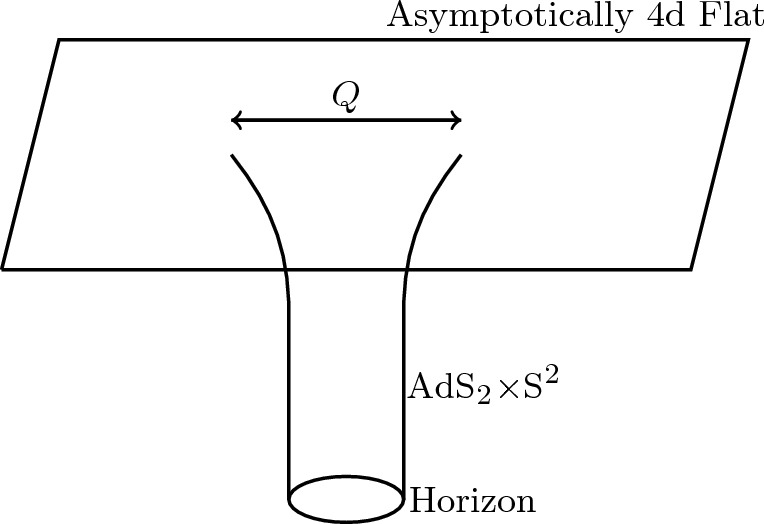
- JT gravity arises as a universal near-horizon description of near-extremal black holes and as the s-wave sector of higher-dimensional gravity with spherical symmetry; its classical solutions reduce to a boundary Schwarzian action.
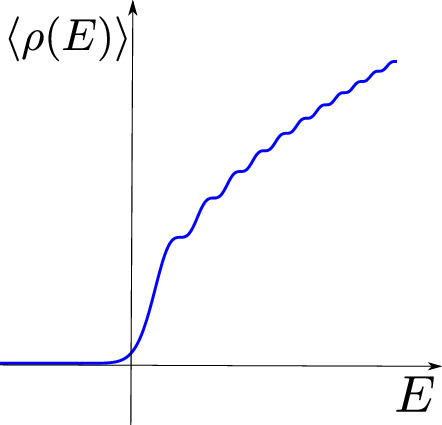
- The quantum disk partition function is one-loop exact, and the resulting density of states is continuous; for large energy the spectrum matches the classical Bekenstein–Hawking entropy, while quantum effects become large at small energies.
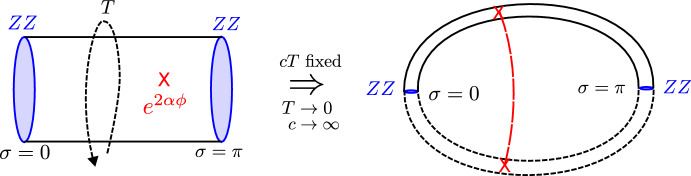
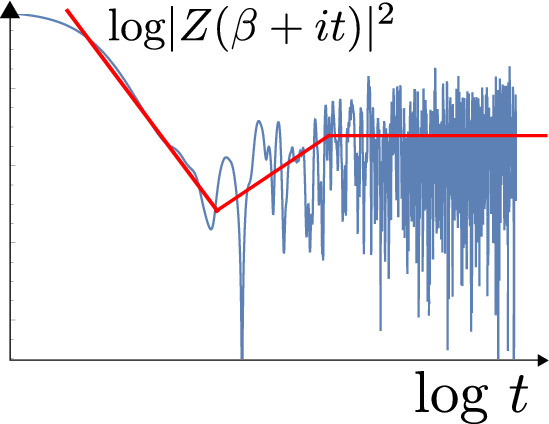
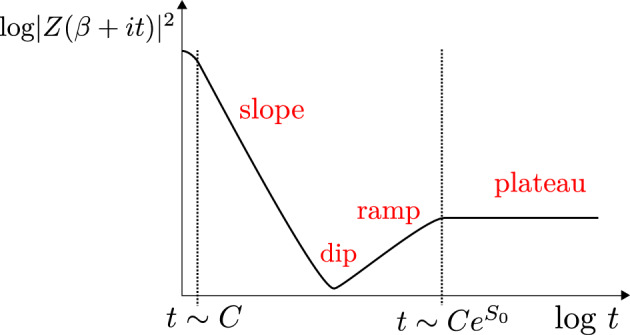
- JT gravity is equivalent, order by order in the topological expansion, to a double-scaled matrix integral; wormhole contributions produce the slope, ramp, and plateau of the spectral form factor, with the ramp explained by the double trumpet and the plateau by the contact term.
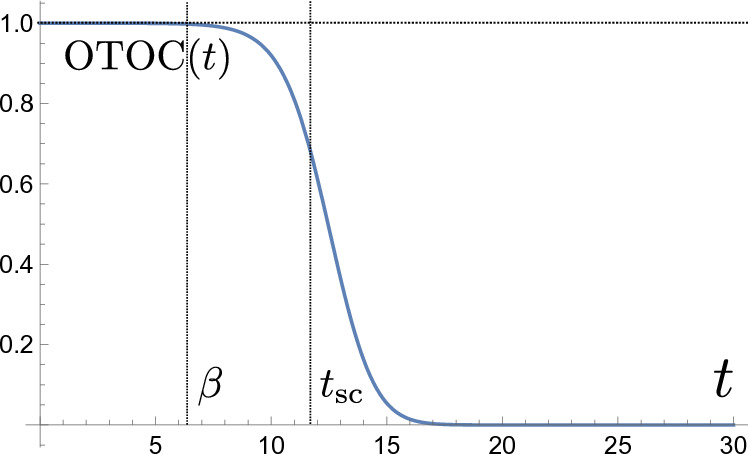
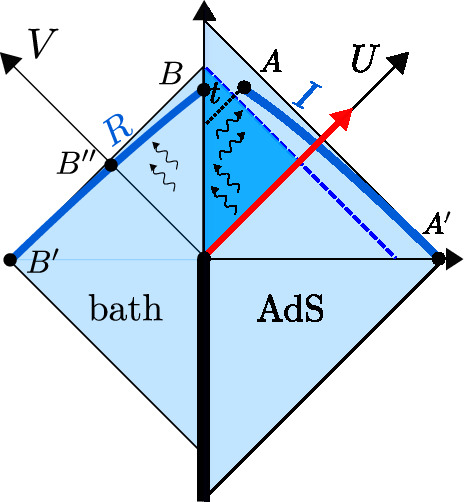
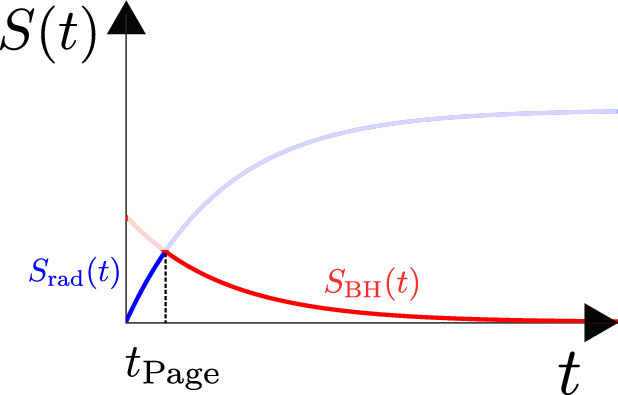
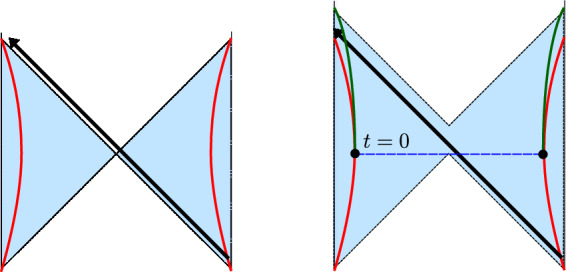
- Applications include replica wormholes and the island formula for Hawking radiation entropy, OTOCs showing maximal chaos with scrambling time logarithmic in \(C\), and black hole interior volume growth that saturates when non-perturbative random matrix effects become important.
Methods
- This is a review article synthesizing developments in JT gravity, organized into classical JT gravity, quantum JT gravity, spacetime wormholes and random matrices, and applications/future directions.
- It uses Euclidean gravitational path integrals, the Schwarzian reduction, BF/gauge-theoretic formulations, Liouville theory limits, matrix model topological recursion, and comparisons with random matrix ensembles.
- No empirical sample or dataset is analyzed; the work is theoretical and literature-based, with computations and derivations drawn from the cited JT gravity literature.
Limitations
- The paper states several open problems: the gravitational origin of erratic late-time oscillations and discreteness is not fully understood; the factorization puzzle and ensemble-averaging interpretation remain unresolved; the non-perturbative completion of the JT matrix model is ill-defined in the forbidden region; finite-cutoff results disagree; full dS matter correlators and supersymmetric OTOCs are unknown.
- The review itself notes that its applications section is not entirely self-contained and refers to the literature for details, and that it does not do justice to the information-loss topic.
- As a review, it does not present new primary data or a single new empirical test; its conclusions are syntheses of prior theoretical results.
Model-written summary. Check it against the paper before relying on it.
Integrity signals
Registry
Cites
Statistics
Figures
Verification
Claims the paper makes
58 Valid · 11 Not valid · 84 Not checked · 343 Own results and interpretations
At least one cited source doesn’t support this claim or points to a different paper, and none confirmed it — see the verdicts below.
In the paper
“This means that the matrix model dual to JT gravity is non-perturbatively ill-defined.”
§ Solvable models of quantum black holes: a review on Jackiw–Teitelboim gravity > Spacetime wormholes and random matrices > Non-perturbative effects in topological expansion
What the sources say
- Disputedcites Saad et al. (2019) matched to “JT gravity as a matrix integral” (2019) sourceExperimental — accuracy not yet measured
The Introduction (p. 7) explicitly says the model can be defined nonperturbatively on an appropriate contour, although it lacks the reality properties of a conventional matrix integral. Section 5.5 (p. 51) explains that viable nonperturbative completions exist but are not unique. That is contrary to calling the model nonperturbatively ill-defined without qualification. (LLM, conf=0.91)
Checked by a reasoning model — may be wrong.
plain- Asserted: passes — The authors put it forward as true.
- Checkable: passes — It can be checked against evidence.
- Load-bearing: passes — The paper’s conclusions depend on it.
- Based: passes — The paper gives a reason why it holds.
- Disputed
The cited sources support only part of this claim — read each source’s verdict below.
In the paper
“Eynard and Orantin (2007) started from Mirzakhani’s recursion relation (4.20) and applied to it the Laplace transform (4.41) to derive a recursion relation for . After a lengthy calculation, they obtained precisely the recursion (4.38) with the spectral curve used in JT gravity. This result completes the derivation that JT gravity is equivalent, order by order in the topological expansion, to a double-scaled matrix integral.”
- Also stated in: § JT and random matrices · boosted
“This result completes the derivation that JT gravity is equivalent, order by order in the topological expansion, to a double-scaled matrix integral.”
- Also stated in: § Non-perturbative effects in topological expansion · boosted
“By the above matching of recursion relations, the SSS duality is proven order-by-order in the topological expansion in powers of .”
§ Solvable models of quantum black holes: a review on Jackiw–Teitelboim gravity > Spacetime wormholes and random matrices > JT and random matrices
What the sources say
- Partly supportedcites Eynard and Orantin (2007) matched to “Weil-Petersson volume of moduli spaces, Mirzakhani's recursion and matrix models” (2007) sourceExperimental — accuracy not yet measured
Corollary 2.1 (p. 3) identifies the Laplace-transformed Weil–Petersson volume recursion with a spectral curve for the Kontsevich matrix integral and gives a genus expansion. The Conclusion says the transformed Mirzakhani recursion solves that integral’s loop equations. Our copy does not identify the theory as JT gravity or establish equivalence to a double-scaled matrix integral; that broader equivalence is the citing authors’ conclusion. (LLM, conf=0.86)
boostedstates an association- Asserted: passes — The authors put it forward as true.
- Checkable: passes — It can be checked against evidence.
- Load-bearing: passes — The paper’s conclusions depend on it.
- Based: passes — The paper gives a reason why it holds.
- Also stated in: § JT and random matrices · boosted
The cited sources support only part of this claim — read each source’s verdict below.
In the paper
“An important recent result is that these models are not independent, but JT gravity can be embedded in Liouville gravity. This was first noticed for the spectrum in Saad et al. (2019), and subsequently developed in detail in Mertens and Turiaci (2021), Mertens (2021), Turiaci et al. (2021), Fan and Mertens (2022a), Suzuki and Takayanagi (2021), Hirano and Kuroki (2022), Artemev (2022).”
- Also stated in: § Liouville gravity and minimal string · plain
“An important recent result is that these models are not independent, but JT gravity can be embedded in Liouville gravity.”
§ Solvable models of quantum black holes: a review on Jackiw–Teitelboim gravity > Applications and future directions > Liouville gravity and minimal string
What the sources say
- Supportedcites Saad et al. (2019) matched to “JT gravity as a matrix integral” (2019) source
Section 4 (p. 37) shows that the large-p limit of the (2,p) minimal string yields the JT gravity spectral curve. The citing sentence attributes the spectral observation—not a fully developed embedding—to Saad et al., which matches the paper's qualified conclusion that JT gravity is 'in some sense' this limit. (LLM, conf=0.90)
- Supportedcites Mertens and Turiaci (2021) matched to “Liouville quantum gravity — holography, JT and matrices” (2021) source
The Introduction and summary (page not specified) defines the minimal string’s continuum description as Liouville gravity and says JT gravity can be viewed as its parametric limit. The Conclusions (page not specified) describe the paper’s analysis of Liouville-gravity amplitudes in that JT limit. This supports the claimed embedding without attributing the initial observation to this paper. (LLM, conf=0.92)
- Not matchedcites Mertens (2021)
More than one paper fits this citation.
plainstates a cause- Asserted: passes — The authors put it forward as true.
- Checkable: passes — It can be checked against evidence.
- Load-bearing: unclear — It is unclear whether the paper’s conclusions depend on it.
- Based: passes — The paper gives a reason why it holds.
- Also stated in: § Liouville gravity and minimal string · plain
The sources with a verdict support this claim; the rest weren’t checked yet, have no full text we could read, or their verdicts aren’t rated yet.
In the paper
“To start, it is instructive to consider what is the most general theory of dilaton gravity in two dimensions with a two-derivative action (Banks and O’Loughlin 1991; Louis-Martinez et al. 1994; Ikeda 1994; Grumiller et al. 2002). Working in Euclidean signature, any such theory can be written as2.1where is the two-dimensional metric and is the dilaton field.”
§ Solvable models of quantum black holes: a review on Jackiw–Teitelboim gravity > Classical Jackiw–Teitelboim gravity > Dilaton gravity models
What the sources say
- Not checked — no full text of the sourcecites Banks and O’Loughlin 1991 matched to “Two-dimensional quantum gravity in Minkowski space” (1991) source
- Supportedcites Louis-Martinez et al. 1994 matched to “Exact Dirac quantization of all 2D dilaton gravity theories” (1994) source
The Introduction (p. 2) states that the most general two-dimensional action depending on a metric and scalar field, with at most second derivatives, can be written in the form it gives. This supports the attributed claim about the general two-derivative dilaton-gravity action; the paper does not need to use the citing document’s equation number. (LLM, conf=0.91)
- Supportedcites Ikeda 1994 matched to “Two-Dimensional Gravity and Nonlinear Gauge Theory” (1994) source
Section 4.1 (p. 22) explicitly presents the general action for a two-dimensional metric coupled to a scalar field without higher-derivative terms. It also describes a field redefinition of that action, supporting the cited characterization of two-derivative dilaton gravity. (LLM, conf=0.91)
plain- Asserted: passes — The authors put it forward as true.
- Checkable: passes — It can be checked against evidence.
- Load-bearing: unclear — It is unclear whether the paper’s conclusions depend on it.
- Based: passes — The paper gives a reason why it holds.
The cited sources support only part of this claim — read each source’s verdict below.
In the paper
“We might be tempted to refer to the extremal Bekenstein–Hawking area as extremal degeneracy of black hole microstates, although we will see this is an incorrect interpretation both in JT gravity (Stanford and Witten 2017) and for the higher-dimensional black hole.”
§ Solvable models of quantum black holes: a review on Jackiw–Teitelboim gravity > Classical Jackiw–Teitelboim gravity > Dilaton gravity models
What the sources say
- Partly supportedcites Stanford and Witten 2017 matched to “Fermionic localization of the schwarzian theory” (2017) sourceExperimental — accuracy not yet measured
In “A note on the density of states” (page unavailable), the paper cautions that the Schwarzian density is smooth and cannot by itself be interpreted as energy levels with definite multiplicities. That supports caution about inferring microstate degeneracy in dilaton gravity, but the passage does not discuss the extremal Bekenstein–Hawking area or establish what that area represents. (LLM, conf=0.78)
- Partly supportedcites Ghosh et al. (2020) matched to “A universal Schwarzian sector in two-dimensional conformal field theories” (2020) sourceExperimental — accuracy not yet measured
Section 4.1 identifies the extremal-limit area term as the classical BTZ entropy, while §2.3.2 gives a Schwarzian density of states that falls to zero at the energy threshold. This supports caution against treating that area term as a count of exactly extremal states. The paper studies near-extremal BTZ black holes, however, and notes that its treatment becomes uncontrolled at exponentially low temperatures; it does not establish the claim for higher-dimensional black holes. (LLM, conf=0.83)
- Partly supportedcites Iliesiu and Turiaci (2021) matched to “The statistical mechanics of near-extremal black holes” (2021) sourceExperimental — accuracy not yet measured
The Discussion says that, for the four-dimensional near-extremal black holes studied, the continuum of states suggests their extremal degeneracy is not given by the naive area-based entropy. The claim is broader and more definite than that conclusion: the paper cautions that non-perturbative contributions matter for a quantitative statement, and it describes a supersymmetric case in which area-based extremal degeneracy is consistent with the density of states. (LLM, conf=0.87)
hedged- Asserted: passes — The authors put it forward as true.
- Checkable: passes — It can be checked against evidence.
- Load-bearing: unclear — It is unclear whether the paper’s conclusions depend on it.
- Based: passes — The paper gives a reason why it holds.
- Partly supported
251 more claims · 39 with their cited sources checked
Create a free account to see all 496 claims and to verify the 76 references still open.
- It may state two separate claims as one. 166
- The quote only partly states this claim. 4
- Probably not a substantial claim. 85
Claims other papers make about this one
Each is checked against this paper’s own text: does it say what the citing paper says it does?
The source backs part of the claim, not all of it — or backs it for a different population, condition or comparison.
In the citing paper
“a local Weyl transformation can be used to reintroduce a dilaton kinetic term parametrized by γ [361]”
From Unveiling horizons in quantum critical collapse (2026) · cites this paper as [361]
Experimental — accuracy not yet measured
Self-check
Percentages, sums and reported differences re-computed from the paper’s own numbers.
Each contradiction between two passages listed here was confirmed by an independent check.
Rated minor: it would not touch a result — a value no result rests on, a p-value that stays on the same side of the significance level, or a conflict that is clerical, resolved elsewhere in the paper, or outside its own findings.
In the paper
§ Solvable models of quantum black holes: a review on Jackiw–Teitelboim gravity > Spacetime wormholes and random matrices > Non-perturbative effects in topological expansion
“Its Fourier transform yields a linear downward piece, starting at the time , and perfectly canceling the slope linear growth.”
§ Solvable models of quantum black holes: a review on Jackiw–Teitelboim gravity > Spacetime wormholes and random matrices > Non-perturbative effects in topological expansion
“The spectral form factor decays with a power-law expression as studied extensively for the more complicated boundary two-point functions in Sect. 3. This is the so-called slope.”
Citations
Cites
Particle creation by black holes
Hawking, S. W. (1975) · Communications In Mathematical Physics · doi:10.1007/bf02345020 · Cited by 13,106
Large Mass Hierarchy from a Small Extra Dimension
Randall, L., & Sundrum, R. (1999) · Physical Review Letters · doi:10.1103/physrevlett.83.3370 · Cited by 9,227
The Large N Limit of Superconformal Field Theories and Supergravity
Maldacena, J. M. (1997) · arXiv · doi:10.48550/arxiv.hep-th/9711200 · Cited by 6,821
The Large-N Limit of Superconformal Field Theories and Supergravity
Maldacena, J. (1999) · International Journal of Theoretical Physics · doi:10.1023/a:1026654312961 · Cited by 6,704
A planar diagram theory for strong interactions
Hooft, G. '. (1974) · Nuclear Physics B · doi:10.1016/0550-3213(74)90154-0 · Cited by 4,476
Holographic Derivation of Entanglement Entropy from AdS/CFT
Ryu, S., & Takayanagi, T. (2006) · arXiv · doi:10.48550/arxiv.hep-th/0603001 · Cited by 4,321
Ryu, S., & Takayanagi, T. (2006) · Physical Review Letters · doi:10.1103/physrevlett.96.181602 · Cited by 4,302
Action integrals and partition functions in quantum gravity
Gibbons, G. W., & Hawking, S. W. (1977) · Physical Review D · doi:10.1103/physrevd.15.2752 · Cited by 3,449
Chaos and quantum thermalization
Srednicki, M. (1994) · Physical Review E · doi:10.1103/physreve.50.888 · Cited by 3,175
Quantum geometry of bosonic strings
Polyakov, A. M. (1981) · Physics Letters B · doi:10.1016/0370-2693(81)90743-7 · Cited by 3,144
Research works printed but not linked: 2
- Kitaev A (2014) 2015 Breakthrough prize fundamental physics symposium. https://www.youtube.com/watch?v=OQ9qN8j7EZI
- Mehta ML Random matrices 2004 3 Amsterdam Elsevier Academic Press
Cited by
Items 101–183 of 183
Antonini, S., Iliesiu, L. V., Rath, P., & Tran, P. D. (2025) · Physical Review Letters · doi:10.1103/ft96-b212 · Cited by 7
“The action of this theory is given by [1] The first term is a topological term with χ g,n = 2 − 2 g − n the Euler characteristic of the spacetime M with genus g and n boundaries ∂M .”
On the gauge invariance of the higher-derivative Yang–Mills–Chern–Simons action
Ghasemkhani, M., Soleimani, G., & Bufalo, R. (2024) · The European Physical Journal C · doi:10.1140/epjc/s10052-024-12821-7 · Cited by 2
“One can also a e-mail: m_ghasemkhani@sbu.ac.ir (corresponding author) b e-mail: g.soleimani.m76@gmail.com c e-mail: rodrigo.bufalo@ufla.br note the interest in two-dimensional gravitational solvable models of black holes [7].”
Quantum mechanics from general relativity and the quantum Friedmann equation
Matone, M., & Dimakis, N. (2025) · The European Physical Journal C · doi:10.1140/epjc/s10052-025-14930-3 · Cited by 8
“Remarkably, the Schwarzian derivative also appears in related contexts such as the Jackiw–Teitelboim gravity [101–103] and the Sachdev–Ye–Kitaev model [104–109].”
Gravitational dynamics of near-extreme Kerr (Anti-)de Sitter black holes
Mariani, F., & Toldo, C. (2026) · Journal of High Energy Physics · doi:10.1007/jhep02(2026)052 · Cited by 16
“Models of dilaton gravity in 2D, also known as Jackiw-Teitelboim (JT) gravity [3, 4] (see [5] for a review) capture this by means of a non-trivial profile for the scalar field, breaking the AdS 2 conformal symmetry, and displaying at the same time thermodynamic characteristics of black holes, and…”
KdV conformal symmetry breaking in nearly AdS2
Cárdenas, M. (2024) · Journal of High Energy Physics · doi:10.1007/jhep10(2024)052 · Cited by 7
“We have recovered the known result for k = 1 [47, 48], where the entropy has a linear behavior on the temperature and also introduce an interesting generalization with a power law dependence.”
BackgroundTwo-dimensional (bi-)scalar gravities from four-dimensional Horndeski
Nejati, M. S., & Vahidinia, M. H. (2024) · Classical and Quantum Gravity · doi:10.1088/1361-6382/ad85be · Cited by 5
“Jackiw– Teitelboim (JT) gravity [7, 8] as an important dilaton theory, has taught us a lot in different contexts (see, e.g. [9] for a recent review).”
Castro, A. (2023) · Journal of High Energy Physics · doi:10.1007/jhep08(2023)036 · Cited by 5
“Recent developments in JT gravity [3, 4], a model of euclidean 2-dimensional quantum gravity on constant negatively curved spacetimes (the hyperbolic plane, which is the euclidean version of AdS2), have proved potential for shedding light on this topic due to its simplicity and rich physical content [5].”
BackgroundHolographic central charge for sine dilaton gravity
Mahapatra, P., Rathi, H., & Roychowdhury, D. (2025) · Physics Letters B · doi:10.1016/j.physletb.2025.139813 · Cited by 3
“On the other hand, its bulk dual, namely the JT gravity, has been proved to be an excellent toy model of quantum gravity in two dimensions [27].”
The spectrum of a quantum Lifshitz black hole in two dimensions
Harksen, M., & Sybesma, W. (2025) · Journal of High Energy Physics · doi:10.1007/jhep02(2025)214 · Cited by 2
Quantum corrections to η/s from JT gravity
Cremonini, S., Li, L., Liu, X.-L., & Nian, J. (2026) · Journal of High Energy Physics · doi:10.1007/jhep06(2026)193 · Cited by 9
“The papers [15, 16, 20, 56–58] calculated the density of black hole states and the matrix elements of conformal primaries in comprehensive studies of the Schwarzian theory and its coupling to conformal matter.”
InfluentialDiscrete JT gravity as an Ising model
Erdmenger, J., Karl, J., Thurn, Y., Vojta, M., & Xian, Z.-Y. (2025) · Journal of High Energy Physics · doi:10.1007/jhep05(2025)165 · Cited by 10
“It provides a solvable toy model for quantum gravity [32].”
BackgroundTime-dependent wormhole solutions in conformal Weyl gravity
Heydari-Fard, M., Bordbar, M. R., & Mohammadi, G. (2023) · Physical review. D/Physical review. D. · doi:10.1103/physrevd.108.104068 · Cited by 4
Das, S., & Dinda, A. (2025) · Journal of High Energy Physics · doi:10.1007/jhep11(2025)084 · Cited by 4
Notes on solution phase space and BTZ black hole
Guo, W. (2024) · The European Physical Journal C · doi:10.1140/epjc/s10052-024-13565-0 · Cited by 1
“But the Einstein tensor vanishes kinematically for any two-dimensional metric, and if we want to make the theory have dynamic effects, we must add some other fields, e.g. scalar field (called dilaton), which corresponds to JT gravity or other models [42–47].”
Measurement and teleportation in the cSYK/JT correspondence
Brinster, R., Förste, S., Kruse, Y., & Natu, S. (2025) · Journal of High Energy Physics · doi:10.1007/jhep04(2025)201 · Cited by 1
Generalized conformal quantum mechanics as an ideal observer in two-dimensional gravity
Banerjee, A., Kibe, T., Molina, M., & Mukhopadhyay, A. (2025) · Physical review. D/Physical review. D. · doi:10.1103/physrevd.111.066011 · Cited by 2
“Jackiw-Teitelboim (JT) gravity [1, 2] is one of the simplest gravitational theories which has black hole solutions and admits holographic interpretation [3–9].”
BackgroundMethodInfluentialJackiw-Teitelboim gravity as a noncritical string
Dowd, E., & Giribet, G. E. (2024) · Physical review. D/Physical review. D. · doi:10.1103/physrevd.110.086015 · Cited by 1
“…gravity coupled to a dilaton field, JT gravity serves as a simplified yet powerful tool for studying fundamental concepts in quantum gravity, black hole physics, condensed matter, quantum information, and holography ; see [4]-[20] and references therein and thereof ; for a recent review, see [21].”
BackgroundReplica phase transition with quantum gravity corrections
Nian, J., & Zhong, Y. (2026) · Physical review. D/Physical review. D. · doi:10.1103/s5vj-rk9g · Cited by 2
Chaos and moduli space volumes in unorientable JT gravity
Tall, J., Weber, T., Urbina, J. D., & Richter, K. (2025) · Journal of High Energy Physics · doi:10.1007/jhep07(2025)046 · Cited by 6
“A very nice review of JT gravity can be found in [8].”
Sezgin, E. (2023) · Springer eBooks · doi:10.1007/978-981-19-3079-9_46-1 · Cited by 17
Breathing mode sphere reductions to two dimensions*
Liu, J. T. (2025) · Journal of Physics A Mathematical and Theoretical · doi:10.1088/1751-8121/adfbc8 · Cited by 1
Accidental symmetry near extreme spinning black holes
Banerjee, A., Porfyriadis, A. P., & Remmen, G. N. (2025) · Journal of High Energy Physics · doi:10.1007/jhep04(2025)149 · Cited by 2
Teleparallel Jackiw–Teitelboim gravity
Böhmer, C. G., Ferraro, R., & Fiorini, F. (2024) · International Journal of Modern Physics D · doi:10.1142/s0218271824300015 · Cited by 1
Holographic deformations of matrix models
Bovon, A., Samtleben, H., & Tsimpis, D. (2025) · Journal of High Energy Physics · doi:10.1007/jhep07(2025)051 · Cited by 1
“Moreover, dilaton-gravity models such as JT gravity and its supersymmetric generalizations – see, e.g. [52] for a review – provide solvable models of (super)gravity that capture the dynamics near the horizon of near-extremal black holes.”
Acceleration from a phase of entropic balance
Chakrabarti, S. (2025) · The European Physical Journal C · doi:10.1140/epjc/s10052-025-14335-2 · Cited by 1
Quantum-corrected evaporation and absorption cross-section of near-extremal rotating black holes
Luo, S., & Zayas, L. A. P. (2026) · Journal of High Energy Physics · doi:10.1007/jhep05(2026)194 · Cited by 4
“One can also explain this phenomenon from the correlator point of view, for which [47] provides a complete comparison between the quantum and the semiclassical expressions.”
Solvable models of heat transport in quantum mechanics
Loganayagam, R., Narayan, P., & Swathi, T. S. (2025) · Journal of High Energy Physics · doi:10.1007/jhep12(2025)071 · Cited by 1
Holographic shear correlators at low temperatures, and quantum η/s
Kanargias, A., KIRITSIS, E. B., Murthy, S., Papadoulaki, O., & Porfyriadis, A. P. (2026) · Journal of High Energy Physics · doi:10.1007/jhep07(2026)149 · Cited by 7
“More generally, the theory is exactly solvable, and the correlators can be calculated by a variety of methods (see the review [11]).”
InfluentialToward reality of Jackiw-Teitelboim gravity in a three-component fermion chain
Huang, F.-J., Chen, Q.-H., Fu, Y., Chen, Q., Zhao, Y.-F., & Guo, W. H. (2025) · Physical review. D/Physical review. D. · doi:10.1103/8j5m-7t3p · Cited by 1
Comments on firewalls in JT gravity with matter
Cui, C.-X., & Rozali, M. (2025) · Journal of High Energy Physics · doi:10.1007/jhep03(2025)104 · Cited by 3
Gravity from AKSZ-Manin theories in two, three, and four dimensions
Borsten, L., Kanakaris, D., & Kim, H. (2025) · Journal of High Energy Physics · doi:10.1007/jhep06(2025)075 · Cited by 8
“Correspondingly, here we have unconstrained 𝔰𝔬 ( 2 , 𝑑 − 1 ) -valued 1 - and 2 - forms, while in [21] there are 𝔰𝔬 ( 2 , 𝑑 − 1 ) -valued 1 - and 2 -forms and an ℝ 𝑑 + 1 -valued 0 -form, where the 2 -form and 0 -form are constrained to effect the embedding AdS 𝑑 + 1 ↩ → ℝ 𝑑 + 1 and to ensure the connection is torsion fr…”
InfluentialBeyond AdS$_2$/dCFT$_1$: Insertions in Two Wilson LoopsPreprint
Correa, D. H., Faraggi, A., Mück, W., et al. (2023) · arXiv (Cornell University) · doi:10.48550/arxiv.2303.17635
“Given the current interest and insights obtained from gravity in AdS 2 in the form of the Jackiw-Teitelboim model (see reviews [58, 59]), it is relevant to precisely clarify which parts of the techniques displayed here can be applied.”
MethodHawking radiation in Jackiw–Teitelboim gravity
Dar, W. A., Ganai, P. A., & Kajuri, N. (2025) · The European Physical Journal C · doi:10.1140/epjc/s10052-025-14198-7
“We refer the reader to [21] for a recent review.”
Temperatures of AdS2 black holes and holography revisited
Kim, W., & Nam, M. (2024) · Modern Physics Letters A · doi:10.1142/s0217732324501219 · Cited by 1
A revision to the QES prescriptionPreprint
Azizi, A., & Khodahami, A. A. (2026) · SSRN Electronic Journal · doi:10.2139/ssrn.7049061
The fate of nucleated black holes in de Sitter quantum gravity
Shi, X., Turiaci, G. J., & Wu, C.-H. (2026) · Journal of High Energy Physics · doi:10.1007/jhep08(2026)191 · Cited by 5
Self-citationCollier, S., Eberhardt, L., & Zhang, M. (2023) · SciPost Physics · doi:10.21468/scipost.report.7507
Observations of compact stars and fermion-boson stars with a quartic self-interaction
Valdez-Alvarado, S., Cruz-Osorio, A., Dávila, J. M., Ureña-López, L. A., & Becerril, R. (2025) · Classical and Quantum Gravity · doi:10.1088/1361-6382/adc361 · Cited by 3
Tensor Models and Group Field Theories: Combinatorics, Large N and Renormalization
Carrozza, S. (2024) · Elsevier eBooks · doi:10.1016/b978-0-323-95703-8.00112-9 · Cited by 14
Report on scipost_202303_00042v1
Ted Jacobson, A., & Visser, M. R. (2023) · SciPost Physics · doi:10.21468/scipost.report.6997
Quantum fluctuations and Newton-Cartan geometry for non-relativistic de Sitter space
Harksen, M., Hidalgo, D., & Sybesma, W. (2026) · Journal of High Energy Physics · doi:10.1007/jhep09(2026)097
“Inspired by the computation of the one-loop contribution to the boundary description of the relativistic Schwarzian, see [31] for a comprehensive review, we compute the one-loop contribution to the non-relativistic Schwarzian theory and find that it correctly reflects the number of generators of…”
Approaching a dynamical extreme black hole horizon
Porfyriadis, A. P., Rosen, C. A., & Tsaraktsidis, G. (2026) · Journal of High Energy Physics · doi:10.1007/jhep06(2026)068 · Cited by 3
“…physics literature, extreme black holes are currently subject to intense investigation due to the realization that there are large quantum mechanical fluctuations in their AdS 2 throat region, which are governed by solvable effective two-dimensional models of gravity (see e.g. the review [3]).”
One-loop effect in the charged 2D black hole near extremality
Toni, L. (2026) · Journal of High Energy Physics · doi:10.1007/jhep09(2026)057 · Cited by 1
“This symmetry supports large diffeomorphism and large gauge transformation modes, which turn out to be exact zero modes [29] and play a crucial role in producing the logarithmic correction of the entropy [30, 31].”
Revisiting the second order formalism of JT gravity
Lin, G., & Usatyuk, M. (2026) · Journal of High Energy Physics · doi:10.1007/jhep03(2026)253 · Cited by 9
Aggarwal, A., Castro, A., Detournay, S., et al. (2023) · SciPost Physics · doi:10.21468/scipost.report.7302
Entanglement revivals and scrambling for evaporating black holes
Batista, L. B. N., Bragagnolo, N., Holmes, R., & Kumar, S. P. (2026) · Physical review. D/Physical review. D. · doi:10.1103/z1j3-zq5g
“The 2d dilaton is proportional to the area of the two-sphere in the higher dimensional setting [19], and its value at the horizon determines the Bekenstein-Hawking (BH) entropy of the black hole.”
Discrete bulk spectrum in Jackiw-Teitelboim theory
Dongsu Bak, A., Kim, C., & Yi, S.-H. (2025) · Physical review. D/Physical review. D. · doi:10.1103/98z9-qdhq · Cited by 3
A new perspective on dilaton gravity at finite cutoff
Griguolo, L., Papalini, J., Russo, L., & Seminara, D. (2026) · Journal of High Energy Physics · doi:10.1007/jhep08(2026)197 · Cited by 7
q-Askey deformations of double-scaled SYK
Aguilar-Gutierrez, S. E., Kukolj, T., & Seitz, J. (2026) · Journal of High Energy Physics · doi:10.1007/jhep09(2026)196 · Cited by 9
Entanglement generation between field modes mediated by a fluctuating conducting wall
Anonymous, Fazio, T., Passante, R., et al. (2026) · Physical review. D/Physical review. D. · doi:10.1103/h81j-hddn
“This is also conceptually similar to recent proposals of fuzzy event horizons of a black hole in quantum gravity models [23–25].”
Asymptotics of Weil-Petersson volumes and two-dimensional quantum gravities
Griguolo, L., Papalini, J., Russo, L., & Seminara, D. (2024) · SciPost Physics · doi:10.21468/scipostphys.17.6.156 · Cited by 8
“Path-integrating over the dilaton sets R = − 2 requiring the space-time to be hyperbolic and constrains the dynamics of the theory to live on its one-dimensional boundary (see [ 25 ] for a nice review).”
Fiducial observers and the thermal atmosphere in the black hole quantum throat
Mertens, T. G., Tappeiner, T., & Torres, B. D. S. L. (2026) · Journal of High Energy Physics · doi:10.1007/jhep04(2026)145 · Cited by 10
Self-citationLambiase, G., Övgün, A., & Pantig, R. C. (2024) · SSRN Electronic Journal · doi:10.2139/ssrn.4881684
Unimodular time in JT gravity: a holographic clock
Etkin, A., & Rassouli, F.-S. (2026) · Journal of High Energy Physics · doi:10.1007/jhep08(2026)193 · Cited by 2
“The first term in this boundary action in Poincaré coordinates gives the well-known Schwarzian [23–25, 30, 84–87] Then, by considering the asymptotic solution for A u at the boundary: we find that the on-shell action becomes: As expected, the first term reproduces the Schwarzian action, while the…”
Aggarwal, A., Castro, A., Detournay, S., et al. (2023) · SciPost Physics · doi:10.21468/scipost.report.7468
Haneder, F., Urbina, J. D., Moreno, C., Weber, T., & Richter, K. (2025) · Physical review. D/Physical review. D. · doi:10.1103/rsrq-l6z8 · Cited by 8
Collier, S., Eberhardt, L., & Zhang, M. (2023) · SciPost Physics · doi:10.21468/scipost.report.7508
Beyond AdS2/dCFT1: insertions in two Wilson loops
Correa, D. H., Faraggi, A., Mück, W., Zayas, L. A. P., & Silva, G. A. (2023) · Journal of High Energy Physics · doi:10.1007/jhep10(2023)127 · Cited by 1
“Given the current interest and insights obtained from gravity in AdS 2 in the form of the Jackiw-Teitelboim model (see reviews [58, 59]), it is relevant to precisely clarify which parts of the techniques displayed here can be applied.”
MethodAlcala, A., & Plyushchay, M. S. (2026) · Physical review. D/Physical review. D. · doi:10.1103/ks12-b2v5 · Cited by 4
Novikov, O. O., & Shavrin, A. A. (2026) · International Journal of Theoretical Physics · doi:10.1007/s10773-026-06380-8
Sezgin, E. (2024) · Springer eBooks · doi:10.1007/978-981-99-7681-2_46 · Cited by 2
Cosmic acceleration from nothing
Good, M. R. R., & Linder, E. V. (2025) · The European Physical Journal C · doi:10.1140/epjc/s10052-025-14887-3 · Cited by 1
“Among other uses in physics, the Schwarzian appears in conformal field theory (CFT) and AdS 2 gravity, governing boundary dynamics in Jackiw–Teitelboim (JT) gravity (see e.g. [3,4]).”
Ted Jacobson, A., & Visser, M. R. (2023) · SciPost Physics · doi:10.21468/scipost.report.6941
s o ( 2 , 2 ) extension of Jackiw-Teitelboim gravity via the Virasoro-Kac-Moody semidirect product
Chirco, G., Vacchiano, L., & Vitale, P. (2025) · Physical review. D/Physical review. D. · doi:10.1103/kpkz-rszk · Cited by 5
Report on scipost_202403_00003v1
Detournay, S., Smoes, T., & Wutte, R. (2024) · SciPost Physics · doi:10.21468/scipost.report.8854
Gravitational-wave-inspired scrambling delay in Sachdev-Ye-Kitaev wormhole teleportation
Anonymous, & Mishra, S. K. (2026) · APS Open Science · doi:10.1103/dcsl-w84w
Higher-loop wormhole length in sine-dilaton gravity from DSSYK Krylov complexity
Alfinito, E., & Beccaria, M. (2026) · Journal of High Energy Physics · doi:10.1007/jhep08(2026)120 · Cited by 3
“At large N and fixed p , the effective low-energy description of the SYK model is Schwarzian quantum mechanics, i.e. the boundary action of JT gravity on nearly AdS 2 [3, 6–12].”
Evolving Page curves for black holes coupled to cooling baths
Dar, W. A., Kajuri, N., & Panigrahi, R. (2026) · Physical review. D/Physical review. D. · doi:10.1103/28wh-w9db
Kink collisions in a two-dimensional gravity model
He, Z., & Zhong, Y. (2026) · Physics Letters B · doi:10.1016/j.physletb.2026.140815 · Cited by 1
“Two-dimensional gravity provides a simplified framework for studying di ffi cult issues in gravitational theory, such as the quantization of gravity [76, 77], gravitational collapse [78], and black hole evaporation [79, 80, 81, 82, 83]; see [84, 85, 86] for reviews.”
Exact Schwarzian metric factor and holographic Wilson-loop screening
Tierz, M. (2026) · Journal of High Energy Physics · doi:10.1007/jhep09(2026)215 · Cited by 1
“…repackages averaged boundary-anchored geodesic data as an effective line element; gauge-invariant formulations of bulk observables and matter Wilson lines in JT gravity [17, 22, 43] and the ensemble treatment of the near-extremal spectrum [16, 23] provide the natural framework for going beyond it.”
New aspects of the gauge-gravity relation
Shuvaev, A. G. (2025) · Physical review. D/Physical review. D. · doi:10.1103/physrevd.111.066023
Ramp and plateau in bulk correlators within the disk topology in Jackiw-Teitelboim gravity
Germani, C., & Komendyak, M. (2026) · Physical review. D/Physical review. D. · doi:10.1103/37dn-cdf1
Report on scipost_202403_00003v1
Detournay, S., Smoes, T., & Wutte, R. (2024) · SciPost Physics · doi:10.21468/scipost.report.8835
Bittencourt, T. F., & Sobreiro, R. F. (2025) · Chinese Journal of Physics · doi:10.1016/j.cjph.2025.09.018 · Cited by 1
“Moreover, inclusion of matter may be relevant for black hole analysis [5,24,26].”
InfluentialLu, J. X., Ou, M., & Yang, Z. (2025) · Springer Series in Astrophysics and Cosmology · doi:10.1007/978-981-96-6170-1_19
Structure and Properties of Sugra
Ceresole, A., & Dall'Agata, G. (2026) · Cambridge University Press eBooks · doi:10.1017/9781009575874.015
Living on the edge: a non-perturbative resolution to the negativity of bulk entropies
Antonini, S., Iliesiu, L. V., Rath, P., & Tran, P. D. (2026) · Journal of High Energy Physics · doi:10.1007/jhep03(2026)035 · Cited by 7
Fredholm determinants from Schrödinger-type equations, and deformation of Tracy–Widom distribution
Kimura, T., & Navand, X. (2026) · Letters in Mathematical Physics · doi:10.1007/s11005-025-02034-8 · Cited by 2
“Namely, it enables one to notice signs of an underlying discrete spectrum, which is highly relevant in the quantum gravity side of the duality.”
InfluentialHawking radiation from a semi-classical Schwarzschild black hole
Shafiee, M., & Sheykhi, A. (2026) · The European Physical Journal C · doi:10.1140/epjc/s10052-026-16370-z · Cited by 2
g t t g r r = − 1 black hole thermodynamics in general quasitopological gravity
Anonymous (2026) · Physical review. D/Physical review. D. · doi:10.1103/gbdk-xm4c · Cited by 10
“See e.g. [92] for a review.”
Lecture notes on strings in AdS$_3$ from the worldsheet and the AdS$_3$/CFT$_2$ duality
Kovensky, N. (2026) · SciPost Physics Lecture Notes · doi:10.21468/scipostphyslectnotes.132 · Cited by 8
On the explicit asymptotic symmetry breaking of $$sl(3,\mathbb {R})$$ Jackiw–Teitelboim gravity
Özer, H. T., & Filiz, A. (2025) · The European Physical Journal C · doi:10.1140/epjc/s10052-025-14301-y · Cited by 6
Schouten, K., & Isachenkov, M. (2026) · Annales Henri Poincaré · doi:10.1007/s00023-026-01764-2 · Cited by 10
Metadata
- Authors
- Mertens, T. G., & Turiaci, G. J.
- Affiliations
- Ghent University (BE)
- University of Washington (US)
- Corresponding author
- Mertens, Thomas G.
- Venue
- Living Reviews in Relativity
- Published
- 2023-07-31
- Volume
- 26
- Issue
- 1
- Pages
- 4-4
- ISSN
- 1433-8351 (ISSN-L)
- PMC
- PMC10390458
- OpenAlex
- W4385429136
- Semantic Scholar
- cdd9cd0c34b569bf23e7edcc07477a76678529bd
- Cited by
- 181
- References
- 290
- Citations by year
- 2026: 39 · 2025: 68 · 2024: 46 · 2023: 29
- FWCI
- 36.47
- Type
- journal article
- Language
- en
- Open access
- diamond
- doi.org
- Licence
- cc-by
- creativecommons.org/licenses/by/4.0 (tdm)
- creativecommons.org/licenses/by/4.0 (vor)
- Locations
- Living Reviews in Relativity (publishedVersion, cc-by)
- PubMed (publishedVersion)
- arXiv (Cornell University) (submittedVersion)
- Ghent University Academic Bibliography (Ghent University) (submittedVersion, other-oa)
- PubMed Central (submittedVersion, cc-by)
- DOAJ (DOAJ: Directory of Open Access Journals) (submittedVersion, cc-by-sa)
- arXiv (Cornell University)
- Funders
- European Research Council (BHHQG-101040024)
- FWO Vlaanderen
- National Science Foundation (PHY-2207584)
- Institute for Advanced Study (Sivian Fund)
- Topics
- Physical Sciences › Physics and Astronomy › Nuclear and High Energy Physics › Black Holes and Theoretical Physics
- Physical Sciences › Physics and Astronomy › Nuclear and High Energy Physics › Noncommutative and Quantum Gravity Theories
- Physical Sciences › Physics and Astronomy › Astronomy and Astrophysics › Cosmology and Gravitation Theories
- Keywords
- Jackiw-Teitelboim gravity, two-dimensional quantum gravity, solvable models, black holes, chaos, wormholes, holography, spherical symmetry
About these checks
Registry, retraction, Cites and statistics results are computed, not judged, with one exception: a printed reference that no index lists is read once by a model before it counts as a citation error. Claims are extracted by a model and kept only when their quote appears verbatim in the text; each cited source is then checked, with a model’s help, for whether it says what the claim relies on. Those verdicts can be wrong — read the claim’s quote and the cited source before relying on one.
The claim verdicts this report counts are experimental: their accuracy is not yet measured.
A language model drew the claims from the paper on 2026-10-10, under version 3 of the claim definition (model deepseek-v4.1-flash, prompt extract-v3).
A second model labelled each claim on 2026-10-10 (model jev-1.13-20260917, definition revision gold-guideline-v0.2).
Cited sources are checked with a language model’s help (gpt-6-sol).
Statistics and arithmetic are recomputed, not judged.
Confidence bands are shown only for fields calibrated on our annotated test set. None is calibrated yet, so no band is shown.
What counts as a claim ›How we measure confidence ›How we check this ›
Are you an author, or do you see a problem with this page? Request a review
Data sources
Bibliographic data: Semantic Scholar, OpenAlex, Crossref.
Contains information from the Semantic Scholar Academic Graph Datasets, made available under the ODC Attribution License (ODC-BY 1.0).
Semantic Scholar’s data is described in: Kinney, R., et al. (2023). The Semantic Scholar Open Data Platform. arXiv:2301.10140.
