

Creating a Digital Health Smartphone App and Digital Phenotyping Platform for Mental Health and Diverse Healthcare Needs: an Interdisciplinary and Collaborative Approach
Open accessThe DOI matches its Crossref record; 46 of the 46 references it cites were found in a registry or an index.
Abstract
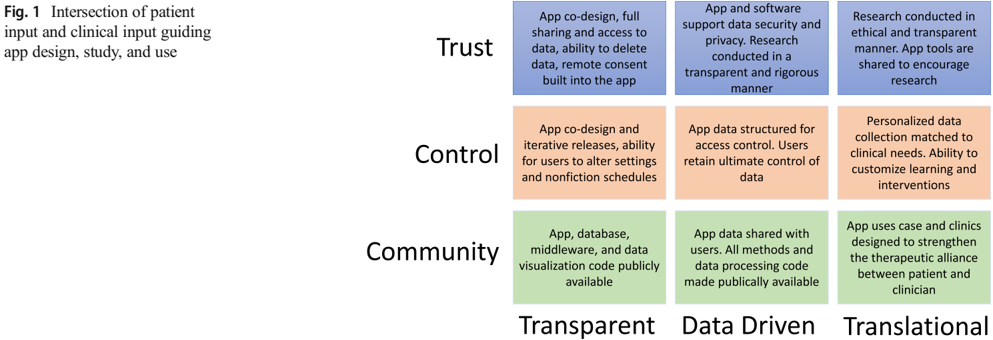
As the potential of smartphone apps and sensors for healthcare and clinical research continues to expand, there is a concomitant need for open, accessible, and scalable digital tools. While many current app platforms offer useful solutions for either clinicians or patients, fewer seek to serve both and support the therapeutic relationship between them. Thus, we aimed to create a novel smartphone platform at the intersection of patient demands for trust, control, and community and clinician demands for transparent, data driven, and translational tools. The resulting LAMP platform has evolved through numerous iterations and with much feedback from patients, designers, sociologists, advocates, clinicians, researchers, app developers, and philanthropists. As an open and free tool, the LAMP platform continues to evolve as reflected in its current diverse use cases across research and clinical care in psychiatry, neurology, anesthesia, and psychology. In this paper, we explore the motivation, features, current progress, and next steps to pair the platform for use in a new digital psychiatry clinic, to advance digital interventions for youth mental health, and to bridge gaps in available mental health care for underserved patient groups. The code for the LAMP platform is freely shared with this paper to encourage others to adapt and improve on our team’s efforts.
Overview
The claims and statistics of this paper haven’t been checked yet.
Free: it reads the open-access text and checks the first 5 claims that cite a source we can check. Create a free account to check every claim.
Integrity signals
Registry
Cites
Statistics
Figures

Verification
Claims the paper makes
The claims and statistics of this paper haven’t been checked yet.
Free: it reads the open-access text and checks the first 5 claims that cite a source we can check. Create a free account to check every claim.
Claims other papers make about this one
Each is checked against this paper’s own text: does it say what the citing paper says it does?
The source backs part of the claim, not all of it — or backs it for a different population, condition or comparison.
In the citing paper
“There is currently somewhere between 10,000 and 20,000 mental health apps [23,24], but it is estimated that only about 3% to 4% are actually evidence based.”
From Mobile Apps for Mental Health Issues: Meta-Review of Meta-Analyses (2020) · cites this paper as [23]
Experimental — accuracy not yet measuredThe source backs part of the claim, not all of it — or backs it for a different population, condition or comparison.
In the citing paper
“Cocreated with patients and clinicians, mindLAMP is designed not to drive care decisions or protocolize treatment but, rather, to serve as a flexible tool to be deployed in a personalized manner to customize care for each person.”
From Technology enabled clinical care (TECC): Protocol for a prospective longitudinal cohort study of smartphone-augmented mental health treatment (2021) · cites this paper as [24]
Experimental — accuracy not yet measuredThe check wasn’t confident either way, so it gives no verdict — never disputed.
In the citing paper
“Given that most people access social media via mobile devices, digital phenotyping and social media are closely related (Torous et al., 2019).”
From Social Media and Mental Health: Benefits, Risks, and Opportunities for Research and Practice (2020) · cites this paper as Torous et al., 2019
Experimental — accuracy not yet measuredIn the citing paper
“There is currently somewhere between 10,000 and 20,000 mental health apps [23,24], but it is estimated that only about 3% to 4% are actually evidence based.”
From Mobile Apps for Mental Health Issues: Meta-Review of Meta-Analyses (2020) · cites this paper as [23]
Self-check
Percentages, sums and reported differences re-computed from the paper’s own numbers.
The self-check needs the paper’s full text.
Citations
Cites
Kessler, R. C., Berglund, P., Demler, O., Jin, R., Merikangas, K. R., & Walters, E. E. (2005) · Archives of General Psychiatry · doi:10.1001/archpsyc.62.6.593 · Cited by 20,391 · cited 1×
“With the onset of nearly three quarters of mental disorders occurring before age 24 (Kessler et al. 2005), there may be unique opportunities to leverage this increasing use of digital technology for detecting risk factors for mental illness, facilitating referral, and delivering targeted digital…”
BackgroundThe Journal of the American Academy of Psychiatry and the Law.
(2021) · PubMed · doi:10.29158/jaapl.210028-20 · Cited by 3,823
The Lancet Commission on global mental health and sustainable development
Patel, V., Saxena, S., Lund, C., Thornicroft, G., Baingana, F., Bolton, P., Chisholm, D., Collins, P. Y., Cooper, J. L., Eaton, J., et al. (2018) · The Lancet · doi:10.1016/s0140-6736(18)31612-x · Cited by 3,692
(2003) · Manual for Research Ethics Committees · doi:10.1017/cbo9780511550089.028 · Cited by 3,413
Cognition and Depression: Current Status and Future Directions
Gotlib, I. H., & Joormann, J. (2010) · Annual Review of Clinical Psychology · doi:10.1146/annurev.clinpsy.121208.131305 · Cited by 2,420 · cited 1×
“For illnesses like schizophrenia, where impaired cognition is a primary source of disability (Tandon et al. 2010), and others like depression, where cognitive deficits are often present but overlooked (Gotlib and Joormann 2010), the potential of monitoring cognition via digital device is appealing.”
BackgroundFirth, J., Torous, J., Nicholas, J., Carney, R., Pratap, A., Rosenbaum, S., & Sarris, J. (2017) · World Psychiatry · doi:10.1002/wps.20472 · Cited by 1,097
Self-citationPersonal Sensing: Understanding Mental Health Using Ubiquitous Sensors and Machine Learning
Mohr, D. C., Zhang, M., & Schueller, S. M. (2017) · Annual Review of Clinical Psychology · doi:10.1146/annurev-clinpsy-032816-044949 · Cited by 802 · cited 1×
“…(e.g., GPS, call/text logs), sometimes collectively referred to as digital phenotyping (Torous et al. 2016), can help track patient progress over time, identify triggers for relapse, and help quantify functional outcomes like sleep, physical activity, and social engagement (Mohr et al. 2017).”
BackgroundTorous, J., Nicholas, J., Larsen, M. E., Firth, J., & Christensen, H. (2018) · Evidence Based Mental Health · doi:10.1136/eb-2018-102891 · Cited by 790 · cited 2×
“Using guided survey research (Torous et al. 2018), focus groups, structured inter-views, and clinical experience with apps in the mental health care settings, we sought early and continuous input from patients on the platform.”
BackgroundSelf-citationTorous, J., Kiang, M. V., Lorme, J., & Onnela, J.-P. (2016) · JMIR Mental Health · doi:10.2196/mental.5165 · Cited by 758 · cited 1×
“…capture of environmental context with smartphone sensors (e.g., GPS, call/text logs), sometimes collectively referred to as digital phenotyping (Torous et al. 2016), can help track patient progress over time, identify triggers for relapse, and help quantify functional outcomes like sleep,…”
BackgroundSelf-citationFirth, J., Torous, J., Nicholas, J., Carney, R., Rosenbaum, S., & Sarris, J. (2017) · Journal of Affective Disorders · doi:10.1016/j.jad.2017.04.046 · Cited by 675 · cited 1×
“Numerous review papers continue to raise caution about consumer apps offering interventions for depression (Firth et al. 2017a), bipolar disorder (Nicholas et al. 2015), anxiety disorders (Firth et al. 2017b), and more.”
BackgroundSelf-citationFleming, T., Bavin, L., Lucassen, M., Stasiak, K., Hopkins, S., & Merry, S. (2018) · Journal of Medical Internet Research · doi:10.2196/jmir.9275 · Cited by 670
Naslund, J. A., Aschbrenner, K. A., Araya, R., Marsch, L. A., Unützer, J., Patel, V., & Bartels, S. J. (2017) · The Lancet Psychiatry · doi:10.1016/s2215-0366(17)30096-2 · Cited by 638 · cited 1×
“There is considerable evidence supporting the feasibility, acceptability, and initial clinical effectiveness of digital mental health interventions across diverse low-and middle-income countries (Naslund et al. 2017).”
BackgroundSelf-citationm-Health adoption by healthcare professionals: a systematic review
Gagnon, M.-P., Ngangue, P., Payne-Gagnon, J., & Desmartis, M. (2016) · Journal of the American Medical Informatics Association · doi:10.1093/jamia/ocv052 · Cited by 622
The Learning Healthcare System: Workshop Summary
Olsen, L., Aisner, D. L., & McGinnis, J. M. (2013) · Cited by 582
Mobile Apps for Bipolar Disorder: A Systematic Review of Features and Content Quality
Nicholas, J., Larsen, M. E., Proudfoot, J., & Christensen, H. (2015) · Journal of Medical Internet Research · doi:10.2196/jmir.4581 · Cited by 438
The WPA-Lancet psychiatry commission on the future of psychiatry
Bhugra, D., Tasman, A., Pathare, S., Priebe, S., Smith, S., Torous, J., Arbuckle, M. R., Langford, A., Alarcón, R. D., Chiu, H. F. K., et al. (2017) · The Lancet Psychiatry · doi:10.1016/s2215-0366(17)30333-4 · Cited by 392 · cited 1×
“…pace of innovation has pushed the digital mental health field ahead of national regulations for medical devices (McNiel and Binder 2018), medical-legal standards (Hilty et al. 2018a, b; Hsin and Torous 2018), privacy laws (Glenn and Monteith 2014), and even clinical evidence (Bhugra et al. 2017).”
BackgroundSelf-citationSchizophrenia, “Just the Facts” 5. Treatment and prevention Past, present, and future
Tandon, R., Nasrallah, H. A., & Keshavan, M. S. (2010) · Schizophrenia Research · doi:10.1016/j.schres.2010.05.025 · Cited by 385 · cited 1×
“For illnesses like schizophrenia, where impaired cognition is a primary source of disability (Tandon et al. 2010), and others like depression, where cognitive deficits are often present but overlooked (Gotlib and Joormann 2010), the potential of monitoring cognition via digital device is appealing.”
BackgroundSelf-citationTorous, J., & Roberts, L. W. (2017) · JAMA Psychiatry · doi:10.1001/jamapsychiatry.2017.0262 · Cited by 362 · cited 2×
“The sheer volume and ease of availability of the over 10,000 patient facing apps does not equate to quality (Torous and Roberts 2017).”
BackgroundSelf-citationMental health: there’s an app for that
Anthes, E. (2016) · Nature · doi:10.1038/532020a · Cited by 333 · cited 1×
“A fitting and often referenced metaphor for this space is the ‘ wild west ’ (Anthes 2016), which captures the tension between expansion and innovation versus standards and reproducible evidence.”
BackgroundAncker, J. S., Witteman, H. O., Hafeez, B., Provencher, T., Van de Graaf, M., & Wei, E. (2015) · Journal of Medical Internet Research · doi:10.2196/jmir.4209 · Cited by 273 · cited 1×
“This need is consistent with prior qualitative and survey research regarding patient perspectives on mental health apps (de Alva et al. 2015; Ancker et al. 2015).”
ResultUsability of Commercially Available Mobile Applications for Diverse Patients
Sarkar, U., Gourley, G. I., Lyles, C. R., Tieu, L., Clarity, C., Newmark, L., Singh, K., & Bates, D. W. (2016) · Journal of General Internal Medicine · doi:10.1007/s11606-016-3771-6 · Cited by 257 · cited 1×
“Yet, actual uptake of mental health apps by patients (Fleming et al. 2018; Noel et al. 2018) and clinicians (Schueller et al. 2016) remains low.”
BackgroundTorous, J., Wisniewski, H., Liu, G., & Keshavan, M. (2018) · JMIR Mental Health · doi:10.2196/11715 · Cited by 201 · cited 2×
“Using guided survey research (Torous et al. 2018), focus groups, structured inter-views, and clinical experience with apps in the mental health care settings, we sought early and continuous input from patients on the platform.”
BackgroundSelf-citationRohani, D. A., Faurholt-Jepsen, M., Kessing, L. V., & Bardram, J. E. (2017) · doi:10.2196/preprints.9691 · Cited by 195 · cited 1×
“…by more than 10,000 mental health-related apps directly available for download today (Torous and Roberts 2017), exponential rise in academically published papers (Firth et al. 2016), or millions of dollars invested (Safavi et al. 2019), the field is clearly rapidly advancing (Hilty et al. 2017).”
BackgroundAsselbergs, J., Ruwaard, J., Ejdys, M., Schrader, N., Sijbrandij, M., & Riper, H. (2016) · Journal of Medical Internet Research · doi:10.2196/jmir.5505 · Cited by 192 · cited 2×
“many mobile app studies correlating sensors to metrics like mood have failed to replicate (Asselbergs et al. 2016; Rohani et al. 2018), we are cautious to make any claims about this”
BackgroundPrivacy in the Digital World: Medical and Health Data Outside of HIPAA Protections
Glenn, T., & Monteith, S. (2014) · Current Psychiatry Reports · doi:10.1007/s11920-014-0494-4 · Cited by 145 · cited 3×
“Violations of trust, such as the recent experiences from the highly visible Cambridge Analytica to the less visible world of data brokers selling patient data (Glenn and Monteith 2014), are thus important to acknowledge and design against.”
BackgroundTen Simple Rules for the Open Development of Scientific Software
Prlić, A., & Procter, J. B. (2012) · PLoS Computational Biology · doi:10.1371/journal.pcbi.1002802 · Cited by 141 · cited 1×
“By creating an application program interface (API), it is easy for others to copy, adapt, connect, and modify our code to augment our version or create their own (Prli ć and Procter 2012).”
Adoption of e-health technology by physicians: a scoping review
de Grood, C., Raissi, A., Kwon, Y., & Santana, M. (2016) · Journal of Multidisciplinary Healthcare · doi:10.2147/jmdh.s103881 · Cited by 139
Moore, R. C., Swendsen, J., & Depp, C. A. (2017) · International Journal of Methods in Psychiatric Research · doi:10.1002/mpr.1562 · Cited by 137 · cited 1×
“Numerous studies in mental health with participants using smartphones have collected active and passive data, but research has paid less attention to metadata and even less on cognition (Moore et al. 2017).”
BackgroundHilty, D. M., Maheu, M. M., Drude, K. P., & Hertlein, K. M. (2018) · Academic Psychiatry · doi:10.1007/s40596-018-0992-5 · Cited by 119 · cited 1×
“…pace of innovation has pushed the digital mental health field ahead of national regulations for medical devices (McNiel and Binder 2018), medical-legal standards (Hilty et al. 2018a, b; Hsin and Torous 2018), privacy laws (Glenn and Monteith 2014), and even clinical evidence (Bhugra et al. 2017).”
BackgroundExploring mental health providers' interest in using web and mobile-based tools in their practices
Schueller, S. M., Washburn, J. J., & Price, M. (2016) · Internet Interventions · doi:10.1016/j.invent.2016.06.004 · Cited by 98 · cited 1×
“For illnesses like schizophrenia, where impaired cognition is a primary source of disability (Tandon et al. 2010), and others like depression, where cognitive deficits are often present but overlooked (Gotlib and Joormann 2010), the potential of monitoring cognition via digital device is appealing.”
BackgroundDas Gupta, M., Engelman, R., Levy, J., Luchsinger, G., Merrick, T., & Je, R. (2014) · Cited by 97
Hilty, D. M., Sunderji, N., Suo, S., Chan, S., & McCarron, R. M. (2018) · International Review of Psychiatry · doi:10.1080/09540261.2019.1571483 · Cited by 85 · cited 1×
“…pace of innovation has pushed the digital mental health field ahead of national regulations for medical devices (McNiel and Binder 2018), medical-legal standards (Hilty et al. 2018a, b; Hsin and Torous 2018), privacy laws (Glenn and Monteith 2014), and even clinical evidence (Bhugra et al. 2017).”
BackgroundHilty, D. M., Chan, S., Hwang, T., Wong, A., & Bauer, A. M. (2017) · mHealth · doi:10.21037/mhealth.2017.06.02 · Cited by 84 · cited 1×
“…by more than 10,000 mental health-related apps directly available for download today (Torous and Roberts 2017), exponential rise in academically published papers (Firth et al. 2016), or millions of dollars invested (Safavi et al. 2019), the field is clearly rapidly advancing (Hilty et al. 2017).”
BackgroundTop-Funded Digital Health Companies And Their Impact On High-Burden, High-Cost Conditions
Safavi, K., Mathews, S. C., Bates, D. W., Dorsey, E. R., & Cohen, A. B. (2019) · Health Affairs · doi:10.1377/hlthaff.2018.05081 · Cited by 75
Di Matteo, D., Fine, A., Fotinos, K., Rose, J., & Katzman, M. (2018) · JMIR Mental Health · doi:10.2196/mental.9539 · Cited by 68 · cited 1×
“They wanted to ensure that their data remained under their control and would only be accessed by them, their healthcare team, or the clinical study team, which is consistent with prior research (Di Matteo et al. 2018).”
ResultEcological momentary assessment and beyond: The rising interest in e-mental health research
Firth, J., Torous, J., & Yung, A. R. (2016) · Journal of Psychiatric Research · doi:10.1016/j.jpsychires.2016.05.002 · Cited by 67 · cited 1×
“…by more than 10,000 mental health-related apps directly available for download today (Torous and Roberts 2017), exponential rise in academically published papers (Firth et al. 2016), or millions of dollars invested (Safavi et al. 2019), the field is clearly rapidly advancing (Hilty et al. 2017).”
BackgroundSelf-citationClinical technology specialists
Ben-Zeev, D., Drake, R., & Marsch, L. (2015) · BMJ · doi:10.1136/bmj.h945 · Cited by 66 · cited 1×
“While the concept of a digital navigator is relatively new (Ben-Zeev et al. 2015), the digital clinic for mental health is even more nascent.”
BackgroundDomaney, N. M., Torous, J. B., & Greenberg, W. E. (2018) · Academic Psychiatry · doi:10.1007/s40596-018-0939-x · Cited by 65 · cited 1×
“Clinician engagement is also a challenge, especially at a time where burnout is increasingly associated with excessive technology use related to electronic medical records (Domaney et al. 2018).”
BackgroundSelf-citationDichotomies in the Development and Implementation of Digital Mental Health Tools
Torous, J., & Haim, A. (2018) · Psychiatric Services · doi:10.1176/appi.ps.201800193 · Cited by 42 · cited 1×
“While bringing order, trust, and clinical evidence into this space will happen, no single solution or correct approach exists (Torous and Haim 2018).”
BackgroundSelf-citationCurrent Regulation of Mobile Mental Health Applications.
Armontrout, J. A., Torous, J. B., Cohen, M., McNiel, D. E., & Binder, R. L. (2018) · PubMed · doi:10.29158/jaapl.003748-18 · Cited by 38 · cited 1×
“This may be because the pace of innovation has pushed the digital mental health field ahead of national regulations for medical devices (McNiel and Binder 2018), medical-legal standards (Hilty et al. 2018a, b; Hsin and Torous 2018), privacy laws (Glenn and Monteith 2014), and even clinical evidence…”
BackgroundSelf-citationTorous, J., & Roux, S. (2017) · JMIR Mental Health · doi:10.2196/mental.7911 · Cited by 36 · cited 1×
“While data visualization of digital health data remains a nascent area, good visual representations can spark a clinically relevant conversation and allow new insights (Torous and Roux 2017).”
BackgroundSelf-citationHilty, D. M., Turvey, C., & Hwang, T. (2018) · Current Psychiatry Reports · doi:10.1007/s11920-018-0878-y · Cited by 36 · cited 1×
“…pace of innovation has pushed the digital mental health field ahead of national regulations for medical devices (McNiel and Binder 2018), medical-legal standards (Hilty et al. 2018a, b; Hsin and Torous 2018), privacy laws (Glenn and Monteith 2014), and even clinical evidence (Bhugra et al. 2017).”
BackgroundIt feels different from real life: Users' Opinions of Mobile Applications for Mental Health
de Alva, F. E. M., Wadley, G., & Lederman, R. (2015) · Proceedings of the Annual Meeting of the Australian Special Interest Group for Computer Human Interaction · doi:10.1145/2838739.2838806 · Cited by 30 · cited 2×
“This need is consistent with prior qualitative and survey research regarding patient perspectives on mental health apps (de Alva et al. 2015; Ancker et al. 2015).”
BackgroundResultNoel, V. A., Acquilano, S. C., Carpenter-Song, E. A., & Drake, R. E. (2018) · JMIR Mental Health · doi:10.2196/12255 · Cited by 28
Self-citationMueller, N. E., Panch, T., Macias, C., Cohen, B. M., Ongur, D., & Baker, J. T. (2018) · JMIR Mental Health · doi:10.2196/10092 · Cited by 26
Creating boundaries to empower digital health technology
Hsin, H., & Torous, J. B. (2018) · BJPsych Open · doi:10.1192/bjo.2018.37 · Cited by 12 · cited 1×
“…pace of innovation has pushed the digital mental health field ahead of national regulations for medical devices (McNiel and Binder 2018), medical-legal standards (Hilty et al. 2018a, b; Hsin and Torous 2018), privacy laws (Glenn and Monteith 2014), and even clinical evidence (Bhugra et al. 2017).”
BackgroundSelf-citation
Research works printed but not linked: 1
- Ben-Zeev, D., Drake, R., & Marsch, L. (2015). Clinical technology spe- cialists. BMJ: British Medical Journal (Online), 350.
Cited by
Torous, J., Jän Myrick, K., Rauseo-Ricupero, N., & Firth, J. (2020) · JMIR Mental Health · doi:10.2196/18848 · Cited by 946
“Our team is fortunate in that we have created our own app tool (freely available and open source) [22] that we often utilize in research and care, but we realize that different apps are often needed for different situations.”
BackgroundSelf-citationSocial Media and Mental Health: Benefits, Risks, and Opportunities for Research and Practice
Naslund, J. A., Bondre, A., Torous, J., & Aschbrenner, K. A. (2020) · Journal of Technology in Behavioral Science · doi:10.1007/s41347-020-00134-x · Cited by 746
“Given that most people access social media via mobile devices, digital phenotyping and social media are closely related (Torous et al. 2019).”
BackgroundMethodInfluentialSelf-citationDesigning and scaling up integrated youth mental health care
McGorry, P. D., Mei, C., Chanen, A., Hodges, C., Alvarez‐Jimenez, M., & Killackey, E. (2022) · World Psychiatry · doi:10.1002/wps.20938 · Cited by 546
“The mindLAMP app can be adapted for implementation in all resource settings 126 and is currently being used by researchers and clinicians in over 20 sites globally.”
Digital interventions for the treatment of depression: a meta-analytic review
Moshe, I., Terhorst, Y., Philippi, P., Domhardt, M., Cuijpers, P., Cristea, I., Pulkki-Råback, L., Baumeister, H., & Sander, L. B. (2021) · Psychological Bulletin · doi:10.1037/bul0000334 · Cited by 390
Lee, E. E., Torous, J., De Choudhury, M., Depp, C. A., Graham, S. A., Kim, H.-C., Paulus, M. P., Krystal, J. H., & Jeste, D. V. (2021) · Biological Psychiatry: Cognitive Neuroscience and Neuroimaging · doi:10.1016/j.bpsc.2021.02.001 · Cited by 429
“…treatment response, and behaviors, thoughts, and emotions (62,63). a r Platforms designed to enable multimodal data collection, like mindLAMP (64), AWARE (65), and CrossCheck (66) aid in continuous remote monitoring and identification of subjective and objective indicators of psychotic…”
BackgroundSelf-citation
Metadata
- Authors
- Torous, J., Wisniewski, H., Bird, B., Carpenter, E., David, G., Elejalde, E., Fulford, D., Guimond, S., Hays, R., Henson, P., Hoffman, L., Lim, C., Menon, M., Noel, V., Pearson, J., Peterson, R., Susheela, A., Troy, H., Vaidyam, A., Weizenbaum, E., Naslund, J. A., & Keshavan, M.
- Affiliations
- Beth Israel Deaconess Medical Center (US)
- Dartmouth College (US)
- Bentley University (US)
- University of Ottawa (CA)
- Boston University (US)
- Harvard University (US)
- Corresponding author
- Torous, John
- ORCID
- Venue
- Journal of Technology in Behavioral Science
- Published
- 2019-04-27
- Volume
- 4
- Issue
- 2
- Pages
- 73-85
- ISSN
- 2366-5963 (ISSN-L)
- OpenAlex
- W2941525596
- Cited by
- 202
- References
- 46
- Citations by year
- 2026: 19 · 2025: 39 · 2024: 24 · 2023: 31 · 2022: 36 · 2021: 28 · 2020: 22 · 2019: 3
- FWCI
- 25.20
- Type
- journal article
- Language
- en
- Open access
- hybrid
- doi.org
- Licence
- cc-by
- creativecommons.org/licenses/by/4.0 (tdm)
- creativecommons.org/licenses/by/4.0 (vor)
- Locations
- Journal of Technology in Behavioral Science (publishedVersion, cc-by)
- Funders
- National Institute of Mental Health (1K23MH116130-0)
- Topics
- Social Sciences › Psychology › Applied Psychology › Digital Mental Health Interventions
- Health Sciences › Health Professions › General Health Professions › Mobile Health and mHealth Applications
- Social Sciences › Psychology › Experimental and Cognitive Psychology › Mental Health Research Topics
- Keywords
- mobile application, digital phenotyping, digital psychiatry, youth mental health, access to mental health care, underserved populations, clinician-patient relationship, open source software, interdisciplinary collaboration, digital interventions
About these checks
Registry, retraction, Cites and statistics results are computed, not judged, with one exception: a printed reference that no index lists is read once by a model before it counts as a citation error. Claims are extracted by a model and kept only when their quote appears verbatim in the text; each cited source is then checked, with a model’s help, for whether it says what the claim relies on. Those verdicts can be wrong — read the claim’s quote and the cited source before relying on one.
Statistics and arithmetic are recomputed, not judged.
Confidence bands are shown only for fields calibrated on our annotated test set. None is calibrated yet, so no band is shown.
What counts as a claim ›How we measure confidence ›How we check this ›
Are you an author, or do you see a problem with this page? Request a review
Data sources
Bibliographic data: Semantic Scholar, OpenAlex, Crossref.
Contains information from the Semantic Scholar Academic Graph Datasets, made available under the ODC Attribution License (ODC-BY 1.0).
Semantic Scholar’s data is described in: Kinney, R., et al. (2023). The Semantic Scholar Open Data Platform. arXiv:2301.10140.
