

Social influence and unfollowing accelerate the emergence of echo chambers
Open accessThe DOI matches its Crossref record; 78 of the 80 references it cites were found in a registry or an index, and 2 are not checked yet.
Abstract
While social media make it easy to connect with and access information from anyone, they also facilitate basic influence and unfriending mechanisms that may lead to segregated and polarized clusters known as “echo chambers.” Here we study the conditions in which such echo chambers emerge by introducing a simple model of information sharing in online social networks with the two ingredients of influence and unfriending. Users can change both their opinions and social connections based on the information to which they are exposed through sharing. The model dynamics show that even with minimal amounts of influence and unfriending, the social network rapidly devolves into segregated, homogeneous communities. These predictions are consistent with empirical data from Twitter. Although our findings suggest that echo chambers are somewhat inevitable given the mechanisms at play in online social media, they also provide insights into possible mitigation strategies.
Overview
The claims and statistics of this paper haven’t been checked yet.
Free: it reads the open-access text and checks the first 5 claims that cite a source we can check. Create a free account to check every claim.
Integrity signals
Registry
Cites
Statistics
Figures
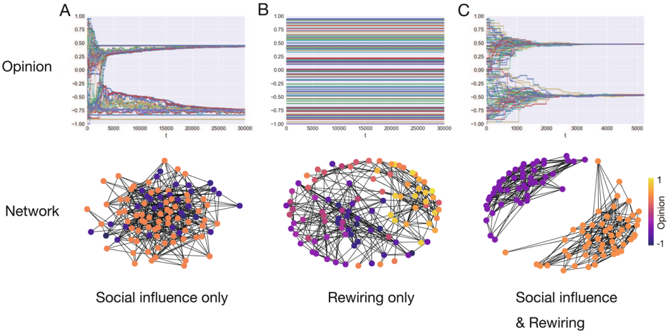
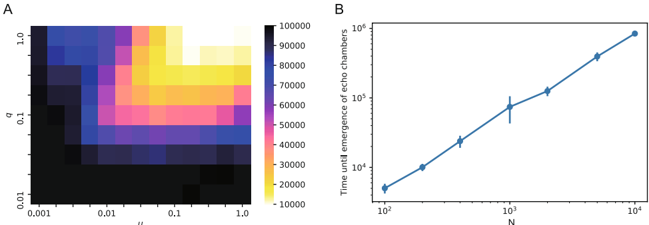

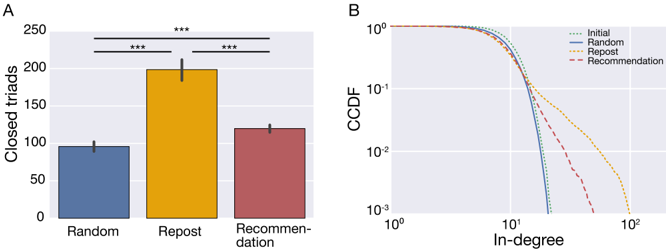
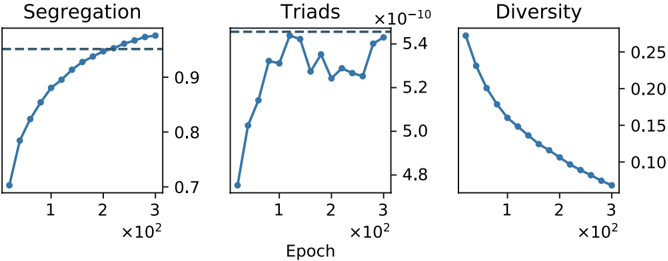
Verification
Claims the paper makes
The claims and statistics of this paper haven’t been checked yet.
Free: it reads the open-access text and checks the first 5 claims that cite a source we can check. Create a free account to check every claim.
Claims other papers make about this one
Each is checked against this paper’s own text: does it say what the citing paper says it does?
The cited source says what the claim attributes to it.
In the citing paper
“They are generally sheltered from other opinions since they cut ties to other agents not part of their group, and have been selected out [140].”
From Epistemic Communities under Active Inference (2022) · cites this paper as [140]
Self-check
Percentages, sums and reported differences re-computed from the paper’s own numbers.
The self-check needs the paper’s full text.
Citations
Cites
1 retracted
Limited individual attention and online virality of low-quality information
Qiu, X., F. M. Oliveira, D., Sahami Shirazi, A., Flammini, A., & Menczer, F. (2017) · Nature Human Behaviour · doi:10.1038/s41562-017-0132 · Cited by 180 · cited 3×
“25 based on empirical results from Twitter [71].”
BackgroundInfluentialSelf-citationRetractedAdvances in neural information processing systems 7
Cios, K., & Shields, M. (1997) · Neurocomputing · doi:10.1016/s0925-2312(97)90018-7 · Cited by 22,059
Birds of a Feather: Homophily in Social Networks
McPherson, M., Smith-Lovin, L., & Cook, J. M. (2001) · Annual Review of Sociology · doi:10.1146/annurev.soc.27.1.415 · Cited by 18,567
The spread of true and false news online
Vosoughi, S., Roy, D., & Aral, S. (2018) · Science · doi:10.1126/science.aap9559 · Cited by 8,847
Confirmation Bias: A Ubiquitous Phenomenon in Many Guises
Nickerson, R. S. (1998) · Review of General Psychology · doi:10.1037/1089-2680.2.2.175 · Cited by 7,267
Dynamic models of segregation†
Schelling, T. C. (1971) · The Journal of Mathematical Sociology · doi:10.1080/0022250x.1971.9989794 · Cited by 4,915
Lazer, D. M. J., Baum, M. A., Benkler, Y., Berinsky, A. J., Greenhill, K. M., Menczer, F., Metzger, M. J., Nyhan, B., Pennycook, G., Rothschild, D., et al. (2018) · Science · doi:10.1126/science.aao2998 · Cited by 4,160
Self-citationStatistical physics of social dynamics
Castellano, C., Fortunato, S., & Loreto, V. (2009) · Reviews of Modern Physics · doi:10.1103/revmodphys.81.591 · Cited by 4,119
Exposure to ideologically diverse news and opinion on Facebook
Bakshy, E., Messing, S., & Adamic, L. A. (2015) · Science · doi:10.1126/science.aaa1160 · Cited by 3,245
Measuring user influence in twitter: The million follower fallacy
Cha, M., Haddadi, H., Benevenuto, F., & Gummadi, K. (2010) · Proceedings of the International AAAI Conference on Web and Social Media · doi:10.1609/icwsm.v4i1.14033 · Cited by 3,022 · cited 2×
“This value is within the range observed in the literature [11, 17].”
Research works printed but not linked: 10
- Bonabeau, E. (2009). Decisions 2.0: The Power of Collective Intelligence. MIT Sloan Management Review, 50(2), 45.
- Surowiecki, J. (2005). The Wisdom Of Crowds. New York: Anchor Books.
- Benkler, Y. (2006). The Wealth of Networks: How Social Production Transforms Markets and Free- dom. New Haven: Yale University Press.
- Conover, M., Ratkiewicz, J., Francisco, M., Gonçalves, B., Menczer, F., Flammini, A. (2011). in International AAAI Conference on Web and Social Media (AAAI, Palo Alto, CA, USA, 2011), ICWSM '11, pp. 89-96. https:// www. aaai. org/ ocs/ index. php/ ICWSM/ ICWSM 11/ paper/ view/ 2847
- J. Bright, arXiv: 1609. 05003 v2 (2017)
- Friedkin, N. E. (2006). A structural theory of social influence (Vol. 13). Cambridge: Cambridge University Press.
- C.R. Sunstein, Republic.com, reprint edn. (Princeton University Press, Princeton, NJ, USA, 2002)
- K. Garimella, G. De Francisci Morales, A. Gionis, M. Mathioudakis, in Proceedings of the 2018 World Wide Web Conference (2018), pp. 913-922
- Alvarez-Hamelin, J. I., Dall'Asta, L., Barrat, A., & Vespignani, A. (2006). Advances in Neural Informa- tion Processing Systems, 41-50.
- P. Windrum, G. Fagiolo, A. Moneta, Journal of Artificial Societies and Social Simulation 10(2), 8 (2007). http:// jasss. soc. surrey. ac. uk/ 10/2/ 8. html
Cited by
Items 101–200 of 289
Generative Artificial Intelligence and the 4C Learning Skills for the 21st Century
Türker, P. M., & Öztürk, M. (2024) · Advances in educational technologies and instructional design book series · doi:10.4018/979-8-3693-7220-3.ch011 · Cited by 10
Urban structure reinforces attitudes towards tsunami evacuation
Makinoshima, F., Oishi, Y., & Imamura, F. (2023) · Scientific Reports · doi:10.1038/s41598-023-33562-9 · Cited by 7
Theory of Opinion Distribution in Human Relations Where Trust and Distrust Mixed
Ishii, A., & Kawahata, Y. (2020) · Smart innovation, systems and technologies · doi:10.1007/978-981-15-5925-9_40 · Cited by 18
A Fake News Dissemination Model Based on Updating Reliability and Doubt among Individuals
Yoshikawa, K., Awa, T., Kusano, R., Satō, H., Ichino, M., & Yoshiura, H. (2020) · International Conference on Awareness Science and Technology (iCAST) · doi:10.1109/icast51195.2020.9319485 · Cited by 7
Siem, B., Kretzmeyer, B., & Stürmer, S. (2021) · Journal of Pacific Rim Psychology · doi:10.1177/18344909211052587 · Cited by 7
“…they might also more likely decide to leave social networks as soon as they evolve into echo chambers instead of taking action against this development (e.g., through reporting the network)—a form of withdrawal behavior that might ultimately strengthen echo chambers (Sasahara et al., 2021).”
BackgroundRetrospective analysis of controversial topics on COVID-19 in Japan
Miyazaki, K., Uchiba, T., Toriumi, F., Tanaka, K., & Sakaki, T. (2021) · IEEE/ACM International Conference on Advances in Social Networks Analysis and Mining (ASONAM) · doi:10.1145/3487351.3490963 · Cited by 8
“Moreover, the controversy tends to accelerate if left unmitigated [7]; hence, it is desirable to accurately identify controversial features and mitigate them before the problem becomes severe [8].”
BackgroundInformation avoidance, selective exposure, and fake(?) news: A green market experimentPreprint
Momsen, K., & Ohndorf, M. (2019) · RePEc: Research Papers in Economics · Cited by 11
Echo chamber formation sharpened by priority users
Ferraz de Arruda, H., Andrade Oliveira, K., & Moreno, Y. (2024) · iScience · doi:10.1016/j.isci.2024.111098 · Cited by 6
Designing and validating an AI-supported tool for enhancing critical inquiry in EFL education
Lai, W. Y. W., Kim, P., & Lee, J. S. (2025) · Research Methods in Applied Linguistics · doi:10.1016/j.rmal.2025.100266 · Cited by 6
Polarized opinion states in static networks driven by limited information horizons
Pérez-Martínez, H., Mingueza, F. B., Soriano‐Paños, D., Gómez‐Gardeñes, J., & Floría, L. M. (2023) · Chaos Solitons & Fractals · doi:10.1016/j.chaos.2023.113917 · Cited by 10
AI Ethics and Policies: Why European Journalism Needs More of Both
Romeo, G., & Griglié, E. (2022) · Digital ethics lab yearbook · doi:10.1007/978-3-031-09846-8_14 · Cited by 9
Cognitive mechanisms in the era of information: “echo-bubbles” and “echo-chambers”
Bazhanov, V. A. (2022) · Philosophy Journal · doi:10.21146/2072-0726-2022-15-4-152-164 · Cited by 12
Enhancing User Acceptance of an AI Agent’s Recommendation in Information-Sharing Environments
Kehat, R., Hirschprung, R. S., & Alkoby, S. (2024) · Applied Sciences · doi:10.3390/app14177874 · Cited by 7
Emergence of echo chambers in social media communication involving multiple topics
Nagura, T., & Akiyama, E. (2025) · Information Communication & Society · doi:10.1080/1369118x.2025.2456561 · Cited by 6
“Sasahara et al. (2021) introduced an MAS model considering the unique characteristics of social media communication.”
García-Rodríguez, A., Govezensky, T., Gershenson, C., Naumis, G. G., & Barrio, R. A. (2021) · Advances in Complex Systems · doi:10.1142/s021952592150017x · Cited by 6
A New Method to Investigate the Presence of the Echo Chamber Effect on Consumer Behavior
Mahmoudi, A., & Jemielniak, D. (2025) · Journal of Consumer Behaviour · doi:10.1002/cb.2493 · Cited by 5
An overview of opinion polarization: models, drivers, and strategic solutions
Liu, S., Wu, Z., & Martínez, L. (2025) · Information Processing & Management · doi:10.1016/j.ipm.2025.104433 · Cited by 10
Polarizing Opinion Dynamics with Confirmation Bias
Chen, T., Wang, X., & Tsourakakis, C. E. (2022) · Lecture notes in computer science · doi:10.1007/978-3-031-19097-1_9 · Cited by 8
Mechanistic interplay between information spreading and opinion polarization
Oliveira, K. A., de Arruda, H. F., & Moreno, Y. (2025) · PNAS Nexus · doi:10.1093/pnasnexus/pgaf402 · Cited by 6
“This extension lets us track information cascades while studying how posting, recommendation, and rewiring interact with opinion dynamics.”
Making the Digital Tangible Through Analog Games: Design Retrospective of Digital Literacy Games
DeJong, S. (2023) · Lecture notes in computer science · doi:10.1007/978-3-031-35930-9_5 · Cited by 5
Online news ecosystem dynamics: supply, demand, diffusion, and the role of disinformation
Gravino, P., Prevedello, G., & Brugnoli, E. (2024) · Applied Network Science · doi:10.1007/s41109-024-00643-1 · Cited by 9
“A significant portion of research has examined the impact of disinformation on human behaviour (Bastick 2021), political elections (Morgan 2018), sustainability (Treen et al. 2020), and health (Sasahara et al. 2021).”
BackgroundThe Metaphorical Modeling of COVID-19 Pandemic Crisis in Infosphere Online News Articles
Husain, M. A. A. (2020) · Journal of Education College Wasit University · doi:10.31185/eduj.vol1.iss40.1570 · Cited by 5
Enthusiastic Fandom: Analyzing Tweets of Professional Baseball Fans
Mizuno, M., Sano, Y., & Sasahara, K. (2021) · Quarterly Journal of Marketing · doi:10.7222/marketing.2021.015 · Cited by 5
Self-citationA Noise Based Medical Elites Silence Model and Public Health Opinion Distortion in Social Networks
Wei, J., Qin, C., Ji, H., Guo, L., Chen, J., & Xu, Y. (2022) · Frontiers in Public Health · doi:10.3389/fpubh.2021.791893 · Cited by 6
“Sasahara et al. (18) focus on the unfriending effect on opinion exchange and find that very small changes of influence and unfriending can cause online communities to become segregated.”
BackgroundSocial Influence in Signed Networks
He, X., Lu, J., Du, H., & Jin, X. (2023) · IEEE Transactions on Computational Social Systems · doi:10.1109/tcss.2022.3220944 · Cited by 6
“To explore the specific characteristics of the collective dynamics of social influence, a series of mathematical and statistical models have been explored [22], [23], [24], [25], [26], [27], [28], [29].”
BackgroundEcho Chambers within the Russo-Ukrainian War: The Role of Bipartisan Users
Zhang, P., Haq, E.-U., Zhu, Y., Hui, P., & Tyson, G. (2023) · IEEE/ACM International Conference on Advances in Social Networks Analysis and Mining (ASONAM) · doi:10.1145/3625007.3627475 · Cited by 5
“C Y ] 16 N ov 2023 echo chambers, e.g. homophily [21] and social influence [22].”
BackgroundSun, L. M., Chen, Y., & Xu, Y. (2025) · Current Issues in Tourism · doi:10.1080/13683500.2025.2552362 · Cited by 4
Zulham, Z. (2025) · Socious Journal · doi:10.62872/dhbvke44 · Cited by 4
“These mechanisms operate simultaneously and reinforce one another, producing increasingly stable patterns of information isolation over time (Sasahara et al., 2019).”
InfluentialPatterns, Models, and Challenges in Online Social Media: A Survey
Marco, N. D., Bonetti, A., Martino, E. D., Loru, E., Nudo, J., Pandolfo, M. E., Pecile, G., Sangiorgio, E., Scalco, I., Zollo, S., et al. (2026) · ACM Transactions on the Web · doi:10.1145/3796548 · Cited by 6
Bagnoli, F., Cavalcabo’, G. D. B., Casu, B., & Guazzini, A. (2021) · Future Internet · doi:10.3390/fi13110296 · Cited by 4
“In the following, we shall report the results of experiments concerning parameters that determine a change in the behavior of the system [2,9,31].”
BackgroundA normative approach to radicalization in social networks
Bouttier, V., Leclercq, S., Jardri, R., & Denève, S. (2024) · Journal of Computational Social Science · doi:10.1007/s42001-024-00267-6 · Cited by 4
“Additionally, the present model considers fixed and positive connections, while individuals tend to communicate only with people having similar convictions [37], may distrust others [38], and may even actively distrust people with opposite convictions [39] .”
Wang, Y., & Lin, X. (2024) · Chinese Journal of Communication · doi:10.1080/17544750.2024.2377602 · Cited by 4
“…tend to consume information that is consistent with their viewpoints, exacerbating echo chambers and filter bubbles that confine individuals within a homogenized realm of information (Garrett, 2009) and further reinforcing polarization and rigid opinions on social media (Sasahara et al., 2021).”
Sayama, H. (2023) · Lecture notes in computer science · doi:10.1007/978-3-031-30445-3_38 · Cited by 4
Lomonaco, F., Taibi, D., Trianni, V., Buršić, S., Donabauer, G., & Ognibene, D. (2023) · Communications in computer and information science · doi:10.1007/978-3-031-29800-4_26 · Cited by 10
An Analysis of the Dynamics of Ties on Twitter
Kheiri, K., Khan, M. F. A., Derr, T., & Karimi, H. R. (2023) · IEEE International Conference on Big Data (BigData) · doi:10.1109/bigdata59044.2023.10386839 · Cited by 8
“Secondly, it can profoundly impact network structure, potentially disrupting information flow or exacerbating polarization [18].”
BackgroundNetwork structure shapes consensus dynamics through individual decisions
Priniski, J. H., Linford, B., Hirschmann, A., Venumuddala, S. K., Morstatter, F., Rodriguez, N., Brantingham, P. J., & Lu, H. (2026) · Proceedings of the National Academy of Sciences · doi:10.1073/pnas.2520483123 · Cited by 3
Determinants of chatbot continuance intention in airlines: theory and evidence
Mehra, A., Paul, J., Rajput, S., Soni, G., & Ata, S. (2026) · Journal of Research in Interactive Marketing · doi:10.1108/jrim-07-2025-0386 · Cited by 4
Stepaniuk, K., Lăzăroiu, G., Misiewicz, C., & Crespo-Pereira, V. (2024) · Engineering Management in Production and Services · doi:10.2478/emj-2024-0031 · Cited by 6
Domain-based user embedding for competing events on social media
Xu, W., & Sasahara, K. (2025) · Journal of Computational Social Science · doi:10.1007/s42001-025-00439-y · Cited by 3
“It is widely known that on controversial topics, social ties are often divided between those in favor of it and those opposed to it, exhibiting an echo chamber structure [54].”
Self-citationA Spectral-Based Model for Describing Social Polarization in Online Communities
Kinoshita, T., & Aida, M. (2022) · IEICE Transactions on Communications · doi:10.1587/transcom.2021mep0001 · Cited by 4
Matthews, A., Otala, J. M., Wali, E., Kurtic, G., Millington, L., Simpson, M. H., Matthews, J. N., & Madraki, G. (2023) · Northeast Journal of Complex Systems · doi:10.22191/nejcs/vol5/iss1/5/ · Cited by 4
A hypernetwork-based urn model for explaining collective dynamics
Lu, J., Du, H., & He, X. (2023) · PLoS ONE · doi:10.1371/journal.pone.0291778 · Cited by 3
“Aiming to explore the detailed characteristics of collective dynamics, a range of computational and statistical models have been explored [19, 20].”
BackgroundChung, M., & Lapinski, M. K. (2023) · Asian Communication Research · doi:10.20879/acr.2023.20.020 · Cited by 4
Recommendation System as a Social Determinant of Health
Goswami, A. (2024) · Digital Society · doi:10.1007/s44206-024-00118-x · Cited by 4
“Sasahara et al. (2021) found that echo chambers are an inevitable consequence of the mechanism of social media and any social network would eventually devolve into segregated, polarized, and homogenous communities despite minimal influence and unfriending by users.”
Network-based computational communication
Huang, M. D., Wang, J.-L., & Zhang, Z.-K. (2025) · Europhysics Letters (EPL) · doi:10.1209/0295-5075/ade337 · Cited by 3
Baugh, R. F. (2020) · Advances in Medical Education and Practice · doi:10.2147/amep.s246658 · Cited by 4
Matsui, K., & Hashimoto, T. (2025) · Evolutionary and Institutional Economics Review · doi:10.1007/s40844-025-00299-1 · Cited by 3
“Sasahara et al. (2021) constructed a basic model focusing on social media users to demonstrate “Echo Chambers,” where even minimal actions, such as information sharing and unfollowing, can rapidly generate isolated clusters of opinions.”
InfluentialBreaking the Loop: Causal Learning to Mitigate Echo Chambers in Social Networks
Yu, D., Li, Q., Huo, H., & Xu, G. (2025) · ACM Transactions on Information Systems · doi:10.1145/3757738 · Cited by 3
“Social networks have become integral platforms for information sharing and public discourse, fundamentally shaping how people interact with information in the digital age [39, 58, 81].”
Huang, M., Wang, J.-L., & Zhang, Z. (2025) · Entropy · doi:10.3390/e27121240 · Cited by 3
“…understanding are concepts such as community, which reveals how homophilic groups form and solidify, often leading to phenomena like echo chambers [4,5]; influence propagation, which models how ideas and behaviors spread through networks; and system dynamics, which captures the temporal evolution…”
D-MODD: A diffusion model of opinion dynamics derived from online data
Achitouv, I., Chavalarias, D., & Fournier-S’niehotta, R. (2026) · Physica A Statistical Mechanics and its Applications · doi:10.1016/j.physa.2026.132052 · Cited by 2
Sentiment Analysis of Social Media Algorithms Influencing Public Opinion and Polarization
Raut, A., Singh, D., Chhura, B., Pathak, J., Patil, R. V., & Atugade, S. (2025) · International Conference on Science Technology Engineering and Mathematics (ICONSTEM) · doi:10.1109/iconstem65670.2025.11374798 · Cited by 2
“Unfortunately, there is a downside to this free flowing information, the fact that not only has it become easy to spread false information [18] through these platforms, but it has also made it faster to do so when used in conjunction with echo chambers [19].”
Hypothesis testing for community structure in temporal networks using e-values
Yanchenko, E., Williams, J., & Martin, R. (2026) · Network Science · doi:10.1017/nws.2026.10036 · Cited by 3
“An example of this case comes from models like that of Sasahara et al. (2021).”
InfluentialFitriyanti, A., & Nur, A. H. B. (2026) · Harmoni · doi:10.32488/harmoni.v25i1.954 · Cited by 4
Modeling Malicious Behaviors and Fake News Dissemination on Social Networks
Yoshikawa, K., Ichino, M., & Yoshiura, H. (2021) · Lecture notes in computer science · doi:10.1007/978-3-030-85447-8_53 · Cited by 2
Designed Denial: Infodemics and Fake News
Hendricks, V. F., & Mehlsen, C. (2022) · Springer eBooks · doi:10.1007/978-3-030-98629-2_3 · Cited by 2
Tracks on the Trail: Popular Music, Race, and the US Presidency
Gorzelany-Mostak, D. C. (2023) · University of Michigan Press eBooks · doi:10.3998/mpub.12654659 · Cited by 2
Feng, Y., Zhang, Y., & Han, W. (2024) · International Journal of Modern Physics C · doi:10.1142/s0129183124501365 · Cited by 2
The Role of Social Networks in the Spread of Fake News
Rodič, B. (2024) · doi:10.18690/um.fov.3.2024.64 · Cited by 2
EchoSense: a framework for analyzing the echo chambers phenomenon: a case study on Qatar events
Kavargyris, D. C., Georgiou, K., & Angelis, L. (2024) · Social Network Analysis and Mining · doi:10.1007/s13278-024-01275-0 · Cited by 2
“Personalized search engines and recommendation strategies are primarily implemented to assist users in finding valuable information.”
Politicians-based Deep Learning Models for Detecting News, Authors and Media Political Ideology
Alzhrani, K. (2022) · International Journal of Advanced Computer Science and Applications · doi:10.14569/ijacsa.2022.0130286 · Cited by 2
“Regardless of the adopted methods to build the news recommendation systems, researchers pointed out that such systems increase pro-attitudinal selective exposure of political news [11], [12], [13].”
MethodThe Duty to Promote Digital Minimalism in Group Agents
Aylsworth, T., & Castro, C. (2024) · Springer eBooks · doi:10.1007/978-3-031-45638-1_7 · Cited by 2
Negative Impact of Online Political Incivility on Willingness to See Political CommentsPreprint
Nishi, K. (2024) · arXiv (Cornell University) · doi:10.48550/arxiv.2403.08372 · Cited by 2
Lindner, I., Heidergott, B., Badri, S., & Praum, M. (2024) · SSRN Electronic Journal · doi:10.2139/ssrn.4851284 · Cited by 3
Menczer, F. (2021) · The Conversation · doi:10.64628/aai.frgm7d35s · Cited by 2
Self-citationMenczer, F. (2021) · The Conversation · doi:10.64628/aai.jhepqwmac · Cited by 8
Self-citationOpinion Dynamics and the Inevitability of a Polarised and Homophilic Society
Prieto-Curiel, R. (2021) · IntechOpen eBooks · doi:10.5772/intechopen.96989 · Cited by 1
Nethnography and Social Network Analysis for Studying Online Social Space
Ziglioli, G., & Alhassan, A. Y. (2021) · Advances in knowledge acquisition, transfer, and management book series/Advances in knowledge acquisition, transfer and management book series · doi:10.4018/978-1-7998-8473-6.ch015 · Cited by 1
Local Edge Dynamics and Opinion Polarization
Bhalla, N., Lechowicz, A., & Musco, C. (2025) · ACM Transactions on Intelligent Systems and Technology · doi:10.1145/3709006 · Cited by 5
“Like our work, several related works study the validity of their synthetic opinion network models compared to real-world data [23, 55, 59].”
InfluentialSayama, H. (2022) · Northeast Journal of Complex Systems · doi:10.22191/nejcs/vol4/iss1/3 · Cited by 1
“While there are many recent studies on social fragmentation [1–9], most of the earlier studies typically considered only two societal outcomes: (1) fragmented society with many disconnected, incompatible social clusters and (2) well-connected society in which cultural/opinion states of individuals…”
BackgroundSpontaneous side-taking drives memory, empathy, and author attribution in conflict narratives
Woodward, C., Hiskes, B., & Breithaupt, F. A. (2024) · Discover Psychology · doi:10.1007/s44202-024-00159-w · Cited by 1
Opiniones políticas compartidas en grupos de WhatsApp: radicalización o diversidad
Santarén, V. R. (2024) · European Public & Social Innovation Review · doi:10.31637/epsir-2024-1536 · Cited by 2
Can Large Language Models Effectively Mitigate Polarization in Social Media Text?
Santos, L. R. J., Marinho, L. B., Campelo, C. E. C., Menczer, F., & Flammini, A. (2025) · ACM Web Science Conference (WebSci) · doi:10.1145/3717867.3717904 · Cited by 8
Self-citationBainbridge, T. F., Ryan, M., Golley, S., Kakoschke, N., & Brindal, E. (2025) · PLoS ONE · doi:10.1371/journal.pone.0323849 · Cited by 1
Liu, S., Guan, X., & Xia, H. (2025) · Journal of Systems Science and Systems Engineering · doi:10.1007/s11518-025-5696-2 · Cited by 1
Alibašić, H. (2024) · Emerald Group Publishing Limited eBooks · doi:10.1108/979-8-88730-661-220251008 · Cited by 1
Generative AI as a Tool for Cultivating Critical Thinking in the EFL Classroom
Mitrulescu, C. M. (2025) · Revista Academiei Forţelor Terestre · doi:10.2478/raft-2025-0055 · Cited by 2
Saito, R., Takano, R., Pertiwi, P. P., Khoiriyah, M., Aotani, A., Miura, H., Muramoto, T., & Murao, O. (2026) · Journal of Disaster Research · doi:10.20965/jdr.2026.p0181 · Cited by 1
Algorithmic recommendations and echo chambers: User awareness in the UAE
Abdelhamid, A. M. M., & Ali, M. S. M. (2026) · Social Sciences & Humanities Open · doi:10.1016/j.ssaho.2026.102930 · Cited by 2
Who Follows Whom? The Role of Geography and Similarity in Online Attention Networks
Quintana, A., Guo, Z., Grinberg, N., & Lazer, D. M. J. (2026) · Cambridge University Press eBooks · doi:10.1017/9781009695923 · Cited by 1
The SIS Competition Model for Conflicting Rumors
Takiguchi, Y., & Nemoto, K. (2026) · Journal of the Physical Society of Japan · doi:10.7566/jpsj.95.064801 · Cited by 1
“Recently, more concrete opinion models motivated by social media have been proposed[15, 16, 17].”
Pham, J., Carmichael, J., Sampson, C., & López, R. M. (2026) · AERA Open · doi:10.1177/23328584261458838 · Cited by 1
Digitalisierung und Demokratie: Ethische Perspektiven
Grimm, P., & Zöllner, O. (2020) · Franz Steiner Verlag eBooks · doi:10.25162/9783515128278 · Cited by 1
Atiqi, M. A., Chang, S., & Deguchi, H. (2022) · Systems Research and Behavioral Science · doi:10.1002/sres.2889 · Cited by 1
The Effect of Increasing Number of Topics to Polarization and Echo Chambers on SNS
Nagura, T., & Akiyama, E. (2023) · Transactions of the Japanese Society for Artificial Intelligence · doi:10.1527/tjsai.38-4_b-n11 · Cited by 1
Gradwohl, N., Strandburg‐Peshkin, A., & Giese, H. (2023) · Scientific Reports · doi:10.1038/s41598-023-38353-w · Cited by 2
“Thus, making incentives for consensus more salient could lead individuals to get in contact with others who disagree 9 —similar to politically interested individuals who seek more diverse information 46 —providing a possible mechanism to avoid echo chambers and network polarization.”
Asanprakit, S., & Kraiwanit, T. (2023) · Corporate Law & Governance Review · doi:10.22495/clgrv5i2sip7 · Cited by 1
“The rapid development of the internet and social media has attracted both consumers and businesses, with a significant number of people utilising platforms like Facebook and Instagram (Limna et al., 2021; Sasahara et al., 2021; Štreimikien ė et al., 2021).”
BackgroundOptimizing Diverse Information Exposure in Social Graphs
Colin, J., & Maniu, S. (2024) · IEEE International Conference on Big Data (BigData) · doi:10.1109/bigdata62323.2024.10825032 · Cited by 2
“Moreover, [20] showed experimentally that the entropy can also quantify polarization in a graph.”
A primer on data-driven modeling \@ifstar{}of complex social systems
Volkening, A. (2025) · Proceedings of symposia in applied mathematics · doi:10.1090/psapm/080/00726 · Cited by 2
Analytical insights from a model of opinion formation based on persuasive argument theory
Pedraza, L., Saintier, N., Pinasco, J. P., Balenzuela, P., & Anteneodo, C. (2025) · Physical review. E · doi:10.1103/j5z4-5ry9 · Cited by 2
Exposure to Opposing Views on Social Media: A Critical Analysis of Studies, Theory, and the Medium
Chaudhary, S., & Schatzki, T. R. (2025) · Journal of Social Philosophy · doi:10.1111/josp.70019 · Cited by 1
Siddiqui, M. A. (2025) · Journal of Arabian Studies · doi:10.1080/21534764.2026.2632041 · Cited by 2
Generating Realistic Interest-Driven Information Cascades
Cinus, F., Bonchi, F., Monti, C., & Panisson, A. (2020) · Proceedings of the International AAAI Conference on Web and Social Media · doi:10.1609/icwsm.v14i1.7283 · Cited by 1
Politics-related Online Communities: Thematic Landscape and (Para)linguistic Features
Platonov, K., & Svetlov, K. V. (2021) · Conference of Open Innovations Association (FRUCT) · doi:10.23919/fruct50888.2021.9347591 · Cited by 1
Hankinson, B. J. (2022) · Queensland University of Technology · doi:10.5204/thesis.eprints.232831 · Cited by 3
Kawahata, Y. (2024) · arXiv (Cornell University) · doi:10.48550/arxiv.2401.01352 · Cited by 1
Kawahata, Y. (2024) · arXiv (Cornell University) · doi:10.48550/arxiv.2401.01902 · Cited by 1
Low, J. F., Fung, B. C. M., Iqbal, F., & Fachkha, C. (2024) · arXiv (Cornell University) · doi:10.48550/arxiv.2402.01905 · Cited by 2
Kawahata, Y. (2024) · RePEc: Research Papers in Economics · doi:10.48550/arxiv.2403.18837 · Cited by 1
Kawahata, Y. (2024) · arXiv (Cornell University) · doi:10.48550/arxiv.2404.08649 · Cited by 1
Dynamical opinion clusters exploration suite: Modeling social media opinion dynamics
de Arruda, H. F., Oliveira, K. A., & Moreno, Y. (2025) · SoftwareX · doi:10.1016/j.softx.2025.102136 · Cited by 1
Metadata
- Authors
- Sasahara, K., Chen, W., Peng, H., Ciampaglia, G. L., Flammini, A., & Menczer, F.
- Affiliations
- Japan Science and Technology Agency (JP)
- Indiana University Bloomington (US)
- University of Michigan (US)
- University of South Florida (US)
- Corresponding author
- Sasahara, Kazutoshi
- Venue
- Journal of Computational Social Science
- Published
- 2020-09-11
- Volume
- 4
- Issue
- 1
- Pages
- 381-402
- ISSN
- 2432-2717 (ISSN-L)
- 2432-2725
- OpenAlex
- W3081047394
- Cited by
- 211
- References
- 73
- Citations by year
- 2026: 19 · 2025: 44 · 2024: 39 · 2023: 37 · 2022: 31 · 2021: 36 · 2020: 4
- FWCI
- 11.42
- Type
- journal article
- Language
- en
- Update notices
- correction (2022-04-19)
- Open access
- hybrid
- doi.org
- Licence
- cc-by
- creativecommons.org/licenses/by/4.0 (tdm)
- creativecommons.org/licenses/by/4.0 (vor)
- Locations
- Journal of Computational Social Science (publishedVersion, cc-by)
- arXiv (Cornell University) (submittedVersion)
- RePEc: Research Papers in Economics (submittedVersion)
- arXiv (Cornell University)
- Funders
- Japan Science and Technology Agency (JPMJPR16D6, JPMJCR17A4)
- Japan Society for the Promotion of Science (JP19H04217, JP17H06383 in #4903)
- Defense Advanced Research Projects Agency (W911NF-17-C-0094)
- Indiana University Network Science Institute
- Topics
- Physical Sciences › Physics and Astronomy › Statistical and Nonlinear Physics › Opinion Dynamics and Social Influence
- Social Sciences › Communication › Social Media and Politics
- Physical Sciences › Physics and Astronomy › Statistical and Nonlinear Physics › Complex Network Analysis Techniques
- Keywords
- echo chambers, social influence, unfriending, social networking sites, opinion polarization, information sharing, social segregation, community formation, Twitter, mitigation measures
About these checks
Registry, retraction, Cites and statistics results are computed, not judged, with one exception: a printed reference that no index lists is read once by a model before it counts as a citation error. Claims are extracted by a model and kept only when their quote appears verbatim in the text; each cited source is then checked, with a model’s help, for whether it says what the claim relies on. Those verdicts can be wrong — read the claim’s quote and the cited source before relying on one.
Statistics and arithmetic are recomputed, not judged.
Confidence bands are shown only for fields calibrated on our annotated test set. None is calibrated yet, so no band is shown.
What counts as a claim ›How we measure confidence ›How we check this ›
Are you an author, or do you see a problem with this page? Request a review
Data sources
Bibliographic data: Semantic Scholar, OpenAlex, Crossref.
Contains information from the Semantic Scholar Academic Graph Datasets, made available under the ODC Attribution License (ODC-BY 1.0).
Semantic Scholar’s data is described in: Kinney, R., et al. (2023). The Semantic Scholar Open Data Platform. arXiv:2301.10140.
