

Social influence and unfollowing accelerate the emergence of echo chambers
Open accessThe DOI matches its Crossref record; 78 of the 80 references it cites were found in a registry or an index, and 2 are not checked yet.
Abstract
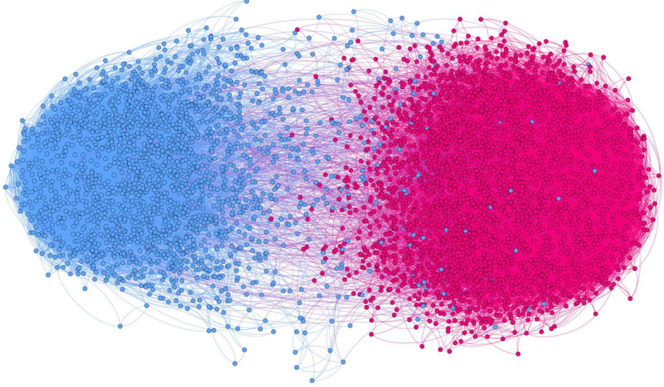
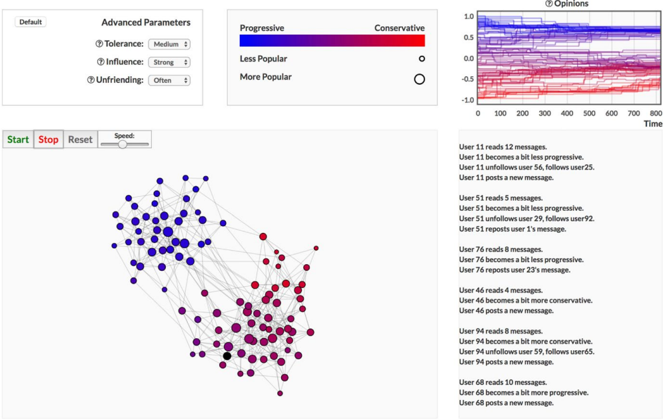
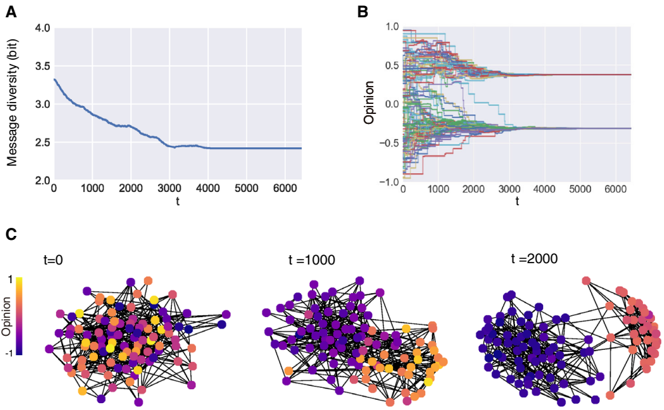
While social media make it easy to connect with and access information from anyone, they also facilitate basic influence and unfriending mechanisms that may lead to segregated and polarized clusters known as “echo chambers.” Here we study the conditions in which such echo chambers emerge by introducing a simple model of information sharing in online social networks with the two ingredients of influence and unfriending. Users can change both their opinions and social connections based on the information to which they are exposed through sharing. The model dynamics show that even with minimal amounts of influence and unfriending, the social network rapidly devolves into segregated, homogeneous communities. These predictions are consistent with empirical data from Twitter. Although our findings suggest that echo chambers are somewhat inevitable given the mechanisms at play in online social media, they also provide insights into possible mitigation strategies.
Overview
The claims and statistics of this paper haven’t been checked yet.
Free: it reads the open-access text and checks the first 5 claims that cite a source we can check. Create a free account to check every claim.
Integrity signals
Registry
Cites
Statistics
Figures

Verification
Claims the paper makes
The claims and statistics of this paper haven’t been checked yet.
Free: it reads the open-access text and checks the first 5 claims that cite a source we can check. Create a free account to check every claim.
Claims other papers make about this one
Each is checked against this paper’s own text: does it say what the citing paper says it does?
The cited source says what the claim attributes to it.
In the citing paper
“They are generally sheltered from other opinions since they cut ties to other agents not part of their group, and have been selected out [140].”
From Epistemic Communities under Active Inference (2022) · cites this paper as [140]
Self-check
Percentages, sums and reported differences re-computed from the paper’s own numbers.
The self-check needs the paper’s full text.
Citations
Cites
1 retracted
Limited individual attention and online virality of low-quality information
Qiu, X., F. M. Oliveira, D., Sahami Shirazi, A., Flammini, A., & Menczer, F. (2017) · Nature Human Behaviour · doi:10.1038/s41562-017-0132 · Cited by 180 · cited 3×
“25 based on empirical results from Twitter [71].”
BackgroundInfluentialSelf-citationRetractedAdvances in neural information processing systems 7
Cios, K., & Shields, M. (1997) · Neurocomputing · doi:10.1016/s0925-2312(97)90018-7 · Cited by 22,059
Birds of a Feather: Homophily in Social Networks
McPherson, M., Smith-Lovin, L., & Cook, J. M. (2001) · Annual Review of Sociology · doi:10.1146/annurev.soc.27.1.415 · Cited by 18,567
The spread of true and false news online
Vosoughi, S., Roy, D., & Aral, S. (2018) · Science · doi:10.1126/science.aap9559 · Cited by 8,847
Confirmation Bias: A Ubiquitous Phenomenon in Many Guises
Nickerson, R. S. (1998) · Review of General Psychology · doi:10.1037/1089-2680.2.2.175 · Cited by 7,267
Dynamic models of segregation†
Schelling, T. C. (1971) · The Journal of Mathematical Sociology · doi:10.1080/0022250x.1971.9989794 · Cited by 4,915
Lazer, D. M. J., Baum, M. A., Benkler, Y., Berinsky, A. J., Greenhill, K. M., Menczer, F., Metzger, M. J., Nyhan, B., Pennycook, G., Rothschild, D., et al. (2018) · Science · doi:10.1126/science.aao2998 · Cited by 4,160
Self-citationStatistical physics of social dynamics
Castellano, C., Fortunato, S., & Loreto, V. (2009) · Reviews of Modern Physics · doi:10.1103/revmodphys.81.591 · Cited by 4,119
Exposure to ideologically diverse news and opinion on Facebook
Bakshy, E., Messing, S., & Adamic, L. A. (2015) · Science · doi:10.1126/science.aaa1160 · Cited by 3,245
Measuring user influence in twitter: The million follower fallacy
Cha, M., Haddadi, H., Benevenuto, F., & Gummadi, K. (2010) · Proceedings of the International AAAI Conference on Web and Social Media · doi:10.1609/icwsm.v4i1.14033 · Cited by 3,022 · cited 2×
“This value is within the range observed in the literature [11, 17].”
Friends and neighbors on the Web
Adamic, L. A., & Adar, E. (2003) · Social Networks · doi:10.1016/s0378-8733(03)00009-1 · Cited by 2,954
Growing Artificial Societies: Social Science from the Bottom Up
Epstein, J. M., & Axtell, R. L. (1996) · doi:10.7551/mitpress/3374.001.0001 · Cited by 2,441
The spreading of misinformation online
Del Vicario, M., Bessi, A., Zollo, F., Petroni, F., Scala, A., Caldarelli, G., Stanley, H. E., & Quattrociocchi, W. (2016) · Proceedings of the National Academy of Sciences · doi:10.1073/pnas.1517441113 · Cited by 2,407
The difference: how the power of diversity creates better groups, firms, schools, and societies
(2007) · Choice Reviews Online · doi:10.5860/choice.45-1534 · Cited by 2,280
Experimental Study of Inequality and Unpredictability in an Artificial Cultural Market
Salganik, M. J., Dodds, P. S., & Watts, D. J. (2006) · Science · doi:10.1126/science.1121066 · Cited by 2,231
Mixing beliefs among interacting agents
Deffuant, G., Neau, D., Amblard, F., & Weisbuch, G. (2000) · Advances in Complex Systems · doi:10.1142/s0219525900000078 · Cited by 2,165
Filter Bubbles, Echo Chambers, and Online News Consumption
Flaxman, S., Goel, S., & Rao, J. M. (2016) · Public Opinion Quarterly · doi:10.1093/poq/nfw006 · Cited by 1,992
Beyond misinformation: Understanding and coping with the “post-truth” era.
Lewandowsky, S., Ecker, U. K. H., & Cook, J. (2017) · Journal of Applied Research in Memory and Cognition · doi:10.1016/j.jarmac.2017.07.008 · Cited by 1,985 · cited 2×
“For example, it does not help to promote content that will be disregarded [59].”
BackgroundComplex Contagions and the Weakness of Long Ties
Centola, D., & Macy, M. (2007) · American Journal of Sociology · doi:10.1086/521848 · Cited by 1,878
FILTER BUBBLE: Wie wir im Internet entmündigt werden
Pariser, E. (2012) · doi:10.3139/9783446431164 · Cited by 1,849
Group formation in large social networks: membership, growth, and evolution
Backstrom, L., Huttenlocher, D., Kleinberg, J., & Lan, X. (2006) · Proceedings of the 12th ACM SIGKDD international conference on Knowledge discovery and data mining · doi:10.1145/1150402.1150412 · Cited by 1,805 · cited 2×
“[4] Lars Backstrom, Dan Huttenlocher, Jon Kleinberg, and Xiangyang Lan.”
BackgroundEveryone's an influencer: quantifying influence on twitter
Bakshy, E., Hofman, J. M., Mason, W. A., & Watts, D. J. (2011) · Proceedings of the fourth ACM international conference on Web search and data mining · doi:10.1145/1935826.1935845 · Cited by 1,689 · cited 2×
“These hub nodes affect the dissemination of the same messages in many cases, but not always [5].”
BackgroundPolarization and Partisan Selective Exposure
Stroud, N. J. (2010) · Journal of Communication · doi:10.1111/j.1460-2466.2010.01497.x · Cited by 1,346
Feeling validated versus being correct: A meta-analysis of selective exposure to information
Hart, W., Albarracín, D., Eagly, A. H., Brechan, I., Lindberg, M. J., & Merrill, L. (2009) · Psychological Bulletin · doi:10.1037/a0015701 · Cited by 1,292
Echo Chamber: Rush Limbaugh and the Conservative Media Establishment
(2009) · Choice Reviews Online · doi:10.5860/choice.47-0104 · Cited by 1,256 · cited 2×
“[48] K.”
Political Polarization on Twitter
Conover, M., Ratkiewicz, J., Francisco, M., Goncalves, B., Flammini, A., & Menczer, F. (2011) · Zenodo · doi:10.5281/zenodo.4589064 · Cited by 1,254
Self-citation#Republic: Divided Democracy in the Age of Social Media
Sunstein, C. R. (2017) · doi:10.1515/9781400884711 · Cited by 1,153
The echo chamber is overstated: the moderating effect of political interest and diverse media
Dubois, E., & Blank, G. (2018) · Information, Communication & Society · doi:10.1080/1369118x.2018.1428656 · Cited by 1,055 · cited 2×
“[28] Elizabeth Dubois and Grant Blank.”
Echo chambers online?: Politically motivated selective exposure among Internet news users
Garrett, R. K. (2009) · Journal of Computer-Mediated Communication · doi:10.1111/j.1083-6101.2009.01440.x · Cited by 1,040
The Web as a Graph: Measurements, Models, and Methods
Kleinberg, J. M., Kumar, R., Raghavan, P., Rajagopalan, S., & Tomkins, A. S. (1999) · Lecture Notes in Computer Science · doi:10.1007/3-540-48686-0_1 · Cited by 1,016 · cited 1×
“This is consistent with the copy model for network growth, which approximates preferential attachment [52].”
ResultIdeological Segregation Online and Offline *
Gentzkow, M., & Shapiro, J. M. (2011) · The Quarterly Journal of Economics · doi:10.1093/qje/qjr044 · Cited by 980
Page, S. (2008) · Princeton University Press eBooks · doi:10.1515/9781400830282 · Cited by 881
Homogeneity in confiding relations
Marsden, P. V. (1988) · Social Networks · doi:10.1016/0378-8733(88)90010-x · Cited by 804
Microscopic evolution of social networks
Leskovec, J., Backstrom, L., Kumar, R., & Tomkins, A. (2008) · Proceedings of the 14th ACM SIGKDD international conference on Knowledge discovery and data mining · doi:10.1145/1401890.1401948 · Cited by 728 · cited 1×
“Friendship recommendation engines suggest new ties based on common interests, beliefs, and friends, often resulting in the closure of open triads [1, 4, 57, 88].”
BackgroundAn Experimental Study of Homophily in the Adoption of Health Behavior
Centola, D. (2011) · Science · doi:10.1126/science.1207055 · Cited by 681
Selective Exposure to Information: A Critical Review
Sears, D. O., & Freedman, J. L. (1967) · Public Opinion Quarterly · doi:10.1086/267513 · Cited by 674
Nonequilibrium phase transition in the coevolution of networks and opinions
Holme, P., & Newman, M. E. J. (2006) · Physical Review E · doi:10.1103/physreve.74.056108 · Cited by 621
Competition among memes in a world with limited attention
Weng, L., Flammini, A., Vespignani, A., & Menczer, F. (2012) · Scientific Reports · doi:10.1038/srep00335 · Cited by 620
Self-citationModels of Social Influence: Towards the Next Frontiers
Flache, A., Mäs, M., Feliciani, T., Chattoe-Brown, E., Deffuant, G., Huet, S., & Lorenz, J. (2017) · Journal of Artificial Societies and Social Simulation · doi:10.18564/jasss.3521 · Cited by 601
Predicting the Political Alignment of Twitter Users
Conover, M. D., Goncalves, B., Ratkiewicz, J., Flammini, A., & Menczer, F. (2011) · 2011 IEEE Third Int'l Conference on Privacy, Security, Risk and Trust and 2011 IEEE Third Int'l Conference on Social Computing · doi:10.1109/passat/socialcom.2011.34 · Cited by 588 · cited 4×
“Our model generates opinions in the [−1,+1] range, while the empirical network has binary labels (‘liberal’ or ‘conservative’) inferred from a training set and propagation through the network [21].”
InfluentialSelf-citationModeling echo chambers and polarization dynamics in social networks
Baumann, F., Lorenz-Spreen, P., Sokolov, I. M., & Starnini, M. (2020) · Physical Review Letters · doi:10.1103/physrevlett.124.048301 · Cited by 427
(Almost) Everything in Moderation: New Evidence on Americans' Online Media Diets
Guess, A. M. (2021) · American Journal of Political Science · doi:10.1111/ajps.12589 · Cited by 342 · cited 1×
“Even if polarized media consumption may not be the norm for most people, it is common among the most politically active, knowledgeable, engaged, and influential individuals [36].”
Global Village or Cyber-Balkans? Modeling and Measuring the Integration of Electronic Communities
Van Alstyne, M., & Brynjolfsson, E. (2005) · Management Science · doi:10.1287/mnsc.1050.0363 · Cited by 335
Political Discourse on Social Media: Echo Chambers, Gatekeepers, and the Price of Bipartisanship
Garimella, K., De Francisci Morales, G., Gionis, A., & Mathioudakis, M. (2018) · Proceedings of the 2018 World Wide Web Conference on World Wide Web - WWW '18 · doi:10.1145/3178876.3186139 · Cited by 335 · cited 2×
“[36] Kiran Garimella, Gianmarco De Francisci Morales, Aristides Gionis, and Michael Mathioudakis.”
BackgroundAnatomy of news consumption on Facebook
Schmidt, A. L., Zollo, F., Del Vicario, M., Bessi, A., Scala, A., Caldarelli, G., Stanley, H. E., & Quattrociocchi, W. (2017) · Proceedings of the National Academy of Sciences · doi:10.1073/pnas.1617052114 · Cited by 305
Consensus formation on adaptive networks
Kozma, B., & Barrat, A. (2008) · Physical Review E · doi:10.1103/physreve.77.016102 · Cited by 271
Geschke, D., Lorenz, J., & Holtz, P. (2019) · British Journal of Social Psychology · doi:10.1111/bjso.12286 · Cited by 271
Happiness Is Assortative in Online Social Networks
Bollen, J., Gonçalves, B., Ruan, G., & Mao, H. (2011) · Artificial Life · doi:10.1162/artl_a_00034 · Cited by 257 · cited 2×
“[11] Johan Bollen, Bruno Gonçalves, Guangchen Ruan, and Huina Mao.”
Partisan asymmetries in online political activity
Conover, M. D., Gonçalves, B., Flammini, A., & Menczer, F. (2012) · EPJ Data Science · doi:10.1140/epjds6 · Cited by 234
Self-citationAn empirical examination of echo chambers in US climate policy networks
Jasny, L., Waggle, J., & Fisher, D. R. (2015) · Nature Climate Change · doi:10.1038/nclimate2666 · Cited by 227
Modeling confirmation bias and polarization
Del Vicario, M., Scala, A., Caldarelli, G., Stanley, H. E., & Quattrociocchi, W. (2017) · Scientific Reports · doi:10.1038/srep40391 · Cited by 222
Bright, J. (2018) · Journal of Computer-Mediated Communication · doi:10.1093/jcmc/zmx002 · Cited by 207 · cited 2×
“[13] Jonathan Bright.”
Measuring online social bubbles
Nikolov, D., Oliveira, D. F. M., Flammini, A., & Menczer, F. (2015) · PeerJ Computer Science · doi:10.7717/peerj-cs.38 · Cited by 205
Self-citationHow algorithmic popularity bias hinders or promotes quality
Ciampaglia, G. L., Nematzadeh, A., Menczer, F., & Flammini, A. (2018) · Scientific Reports · doi:10.1038/s41598-018-34203-2 · Cited by 204
Self-citationThe Dark Side of Information Proliferation
Hills, T. T. (2019) · Perspectives on Psychological Science · doi:10.1177/1745691618803647 · Cited by 183
The role of information diffusion in the evolution of social networks
Weng, L., Ratkiewicz, J., Perra, N., Gonçalves, B., Castillo, C., Bonchi, F., Schifanella, R., Menczer, F., & Flammini, A. (2013) · ACM SIGKDD Conference on Knowledge Discovery and Data Mining (KDD) · doi:10.1145/2487575.2487607 · Cited by 179 · cited 3×
“[88] Lilian Weng, Jacob Ratkiewicz, Nicola Perra, Bruno Gonçalves, Carlos Castillo, Francesco Bonchi, Rossano Schifanella, Filippo Menczer, and Alessandro Flammini.”
BackgroundSelf-citationInformation gerrymandering and undemocratic decisions
Stewart, A. J., Mosleh, M., Diakonova, M., Arechar, A. A., Rand, D. G., & Plotkin, J. B. (2019) · Nature · doi:10.1038/s41586-019-1507-6 · Cited by 176
Graph fission in an evolving voter model
Durrett, R., Gleeson, J. P., Lloyd, A. L., Mucha, P. J., Shi, F., Sivakoff, D., Socolar, J. E. S., & Varghese, C. (2012) · Proceedings of the National Academy of Sciences · doi:10.1073/pnas.1200709109 · Cited by 174 · cited 1×
“Other models have explored the essential tension between social influence and social selection [24, 29, 47, 84, 90].”
BackgroundBecker, J., Porter, E., & Centola, D. (2019) · Proceedings of the National Academy of Sciences · doi:10.1073/pnas.1817195116 · Cited by 157 · cited 1×
“On the other hand, recent experimental results suggest that social information exchange in homogeneous networks increases accuracy and reduces polarization [8], casting doubt on theories that political echo chambers reduce belief accuracy.”
BackgroundCompetition-Induced Criticality in a Model of Meme Popularity
Gleeson, J. P., Ward, J. A., O’Sullivan, K. P., & Lee, W. T. (2014) · Physical Review Letters · doi:10.1103/physrevlett.112.048701 · Cited by 150
Fragile online relationship: a first look at unfollow dynamics in twitter
Kwak, H., Chun, H., & Moon, S. (2011) · Proceedings of the SIGCHI Conference on Human Factors in Computing Systems · doi:10.1145/1978942.1979104 · Cited by 148
Topical interests and the mitigation of search engine bias
Fortunato, S., Flammini, A., Menczer, F., & Vespignani, A. (2006) · Proceedings of the National Academy of Sciences · doi:10.1073/pnas.0605525103 · Cited by 138
Self-citationModelling opinion dynamics in the age of algorithmic personalisation
Perra, N., & Rocha, L. E. C. (2019) · Scientific Reports · doi:10.1038/s41598-019-43830-2 · Cited by 127
Emergence of segregation in evolving social networks
Henry, A. D., Prałat, P., & Zhang, C.-Q. (2011) · Proceedings of the National Academy of Sciences · doi:10.1073/pnas.1014486108 · Cited by 120
Network Structure and Patterns of Information Diversity on Twitter1
Shore, J., Baek, J., & Dellarocas, C. (2018) · MIS Quarterly · doi:10.25300/misq/2018/14558 · Cited by 117
The production of information in the attention economy
Ciampaglia, G. L., Flammini, A., & Menczer, F. (2015) · Scientific Reports · doi:10.1038/srep09452 · Cited by 108
Self-citationQuantifying Biases in Online Information Exposure
Nikolov, D., Lalmas, M., Flammini, A., & Menczer, F. (2019) · Journal of the Association for Information Science and Technology · doi:10.1002/asi.24121 · Cited by 96 · cited 1×
“The first refers to search engines [34], the second to social media feeds [66, 67].”
BackgroundSelf-citationUnfriending on Facebook: Friend Request and Online/Offline Behavior Analysis
Sibona, C., & Walczak, S. (2011) · 2011 44th Hawaii International Conference on System Sciences · doi:10.1109/hicss.2011.467 · Cited by 90 · cited 2×
“And finally, social media empower users to dissolve ties that, although not by design, often tend to be the ones connecting them with those with whom they disagree [78].”
Predictors of short-term decay of cell phone contacts in a large scale communication network
Raeder, T., Ližardo, O., Hachen, D. S., & Chawla, N. V. (2011) · Social Networks · doi:10.1016/j.socnet.2011.07.002 · Cited by 81
Segregation and polarization in urban areas
Morales, A. J., Dong, X., Bar-Yam, Y., & Pentland, A. (2019) · Royal Society Open Science · doi:10.1098/rsos.190573 · Cited by 66 · cited 2×
“Finally, geographic segregation in urban areas may promote polarization in both physical and online spaces by fracturing the social space of mutual exposure [62].”
BackgroundConsensus formation on coevolving networks: groups' formation and structure
Kozma, B., & Barrat, A. (2008) · Journal of Physics A Mathematical and Theoretical · doi:10.1088/1751-8113/41/22/224020 · Cited by 64
Evans, T., & Fu, F. (2018) · Royal Society Open Science · doi:10.1098/rsos.181122 · Cited by 61 · cited 1×
“Pressures toward stronger opinions [31] or more radical opinions [7] are not included in our model, nor are repulsion effects driving opinions farther apart [26, 27].”
BackgroundGray, K., Rand, D. G., Ert, E., Lewis, K., Hershman, S., & Norton, M. I. (2014) · Psychological Science · doi:10.1177/0956797614521816 · Cited by 58
Communication in Online Social Networks Fosters Cultural Isolation
Keijzer, M. A., Mäs, M., & Flache, A. (2018) · Complexity · doi:10.1155/2018/9502872 · Cited by 49 · cited 1×
“Network transitivity, which is also incorporated in our model, has been shown to lead to the formation of groups when combined with reciprocity [41] or with one-to-many communication [51].”
BackgroundOpinion diversity and community formation in adaptive networks
Yu, Y., Xiao, G., Li, G., Tay, W. P., & Teoh, H. F. (2017) · Chaos An Interdisciplinary Journal of Nonlinear Science · doi:10.1063/1.4989668 · Cited by 31 · cited 1×
“Other models have explored the essential tension between social influence and social selection [24, 29, 47, 84, 90].”
BackgroundStruggle in Cyberspace: Fact and Friction on the World Wide Web
KATZ, J. E. (1998) · The ANNALS of the American Academy of Political and Social Science · doi:10.1177/0002716298560001015 · Cited by 22
Serving a Billion Personalized News Feeds
Bäckström, L. (2016) · ACM International Conference on Web Search and Data Mining (WSDM) · doi:10.1145/2835776.2835848 · Cited by 15 · cited 2×
“engagement [3].”
A FRAMEWORK FOR THE CALIBRATION OF SOCIAL SIMULATION MODELS
Ciampaglia, G. L. (2013) · Advances in Complex Systems · doi:10.1142/s0219525913500306 · Cited by 10
Self-citationNetwork model of conviction-driven social segregation
Teza, G., Suweis, S. S., Gherardi, M., Maritan, A., & Lagomarsino, M. C. (2019) · Physical review. E · doi:10.1103/physreve.99.032310 · Cited by 5
Research works printed but not linked: 10
- Bonabeau, E. (2009). Decisions 2.0: The Power of Collective Intelligence. MIT Sloan Management Review, 50(2), 45.
- Surowiecki, J. (2005). The Wisdom Of Crowds. New York: Anchor Books.
- Benkler, Y. (2006). The Wealth of Networks: How Social Production Transforms Markets and Free- dom. New Haven: Yale University Press.
- Conover, M., Ratkiewicz, J., Francisco, M., Gonçalves, B., Menczer, F., Flammini, A. (2011). in International AAAI Conference on Web and Social Media (AAAI, Palo Alto, CA, USA, 2011), ICWSM '11, pp. 89-96. https:// www. aaai. org/ ocs/ index. php/ ICWSM/ ICWSM 11/ paper/ view/ 2847
- J. Bright, arXiv: 1609. 05003 v2 (2017)
- Friedkin, N. E. (2006). A structural theory of social influence (Vol. 13). Cambridge: Cambridge University Press.
- C.R. Sunstein, Republic.com, reprint edn. (Princeton University Press, Princeton, NJ, USA, 2002)
- K. Garimella, G. De Francisci Morales, A. Gionis, M. Mathioudakis, in Proceedings of the 2018 World Wide Web Conference (2018), pp. 913-922
- Alvarez-Hamelin, J. I., Dall'Asta, L., Barrat, A., & Vespignani, A. (2006). Advances in Neural Informa- tion Processing Systems, 41-50.
- P. Windrum, G. Fagiolo, A. Moneta, Journal of Artificial Societies and Social Simulation 10(2), 8 (2007). http:// jasss. soc. surrey. ac. uk/ 10/2/ 8. html
Cited by
The echo chamber effect on social media
Cinelli, M., De Francisci Morales, G., Galeazzi, A., Quattrociocchi, W., & Starnini, M. (2021) · Proceedings of the National Academy of Sciences · doi:10.1073/pnas.2023301118 · Cited by 2,092
Modeling echo chambers and polarization dynamics in social networks
Baumann, F., Lorenz-Spreen, P., Sokolov, I. M., & Starnini, M. (2020) · Physical Review Letters · doi:10.1103/physrevlett.124.048301 · Cited by 427
Darwin, Rusdin, D., Mukminatien, N., Suryati, N., Laksmi, E. D., & Marzuki (2024) · Cogent Education · doi:10.1080/2331186x.2023.2290342 · Cited by 290
“Another portion of the participants (P5) reflects on the risk of AI creating “echo chambers”—a limitation already suggested by Sasahara et al. (2019).”
Link recommendation algorithms and dynamics of polarization in online social networks
Santos, F. P., Lelkes, Y., & Levin, S. A. (2021) · Proceedings of the National Academy of Sciences · doi:10.1073/pnas.2102141118 · Cited by 208
Greijdanus, H., de Matos Fernandes, C. A., Turner-Zwinkels, F., Honari, A., Roos, C. A., Rosenbusch, H., & Postmes, T. (2020) · Current Opinion in Psychology · doi:10.1016/j.copsyc.2020.03.003 · Cited by 204
Metadata
- Authors
- Sasahara, K., Chen, W., Peng, H., Ciampaglia, G. L., Flammini, A., & Menczer, F.
- Affiliations
- Japan Science and Technology Agency (JP)
- Indiana University Bloomington (US)
- University of Michigan (US)
- University of South Florida (US)
- Corresponding author
- Sasahara, Kazutoshi
- Venue
- Journal of Computational Social Science
- Published
- 2020-09-11
- Volume
- 4
- Issue
- 1
- Pages
- 381-402
- ISSN
- 2432-2717 (ISSN-L)
- 2432-2725
- OpenAlex
- W3081047394
- Cited by
- 211
- References
- 73
- Citations by year
- 2026: 19 · 2025: 44 · 2024: 39 · 2023: 37 · 2022: 31 · 2021: 36 · 2020: 4
- FWCI
- 11.42
- Type
- journal article
- Language
- en
- Update notices
- correction (2022-04-19)
- Open access
- hybrid
- doi.org
- Licence
- cc-by
- creativecommons.org/licenses/by/4.0 (tdm)
- creativecommons.org/licenses/by/4.0 (vor)
- Locations
- Journal of Computational Social Science (publishedVersion, cc-by)
- arXiv (Cornell University) (submittedVersion)
- RePEc: Research Papers in Economics (submittedVersion)
- arXiv (Cornell University)
- Funders
- Japan Science and Technology Agency (JPMJPR16D6, JPMJCR17A4)
- Japan Society for the Promotion of Science (JP19H04217, JP17H06383 in #4903)
- Defense Advanced Research Projects Agency (W911NF-17-C-0094)
- Indiana University Network Science Institute
- Topics
- Physical Sciences › Physics and Astronomy › Statistical and Nonlinear Physics › Opinion Dynamics and Social Influence
- Social Sciences › Communication › Social Media and Politics
- Physical Sciences › Physics and Astronomy › Statistical and Nonlinear Physics › Complex Network Analysis Techniques
- Keywords
- echo chambers, social influence, unfriending, social networking sites, opinion polarization, information sharing, social segregation, community formation, Twitter, mitigation measures
About these checks
Registry, retraction, Cites and statistics results are computed, not judged, with one exception: a printed reference that no index lists is read once by a model before it counts as a citation error. Claims are extracted by a model and kept only when their quote appears verbatim in the text; each cited source is then checked, with a model’s help, for whether it says what the claim relies on. Those verdicts can be wrong — read the claim’s quote and the cited source before relying on one.
Statistics and arithmetic are recomputed, not judged.
Confidence bands are shown only for fields calibrated on our annotated test set. None is calibrated yet, so no band is shown.
What counts as a claim ›How we measure confidence ›How we check this ›
Are you an author, or do you see a problem with this page? Request a review
Data sources
Bibliographic data: Semantic Scholar, OpenAlex, Crossref.
Contains information from the Semantic Scholar Academic Graph Datasets, made available under the ODC Attribution License (ODC-BY 1.0).
Semantic Scholar’s data is described in: Kinney, R., et al. (2023). The Semantic Scholar Open Data Platform. arXiv:2301.10140.
