

Social influence and unfollowing accelerate the emergence of echo chambers
Open accessThe DOI matches its Crossref record; 78 of the 80 references it cites were found in a registry or an index, and 2 are not checked yet.
Abstract
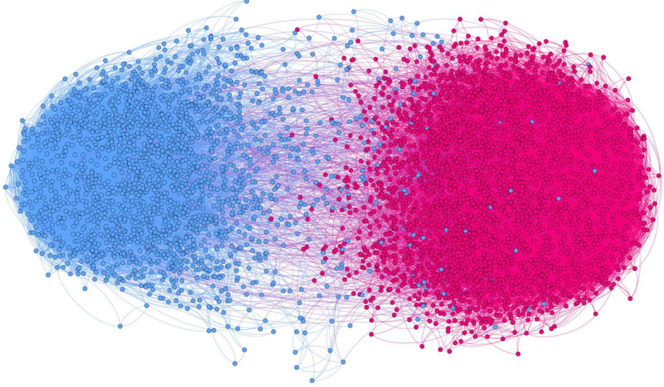
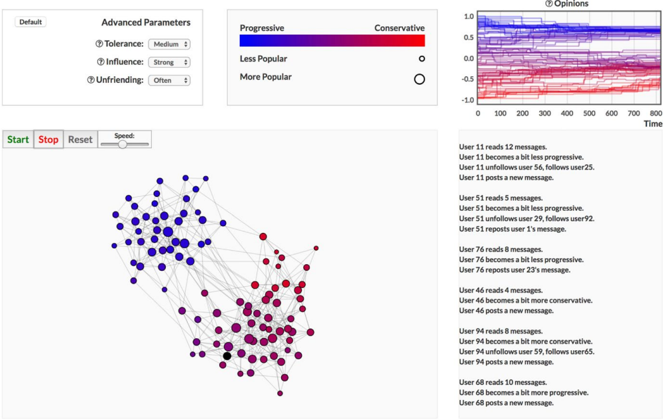
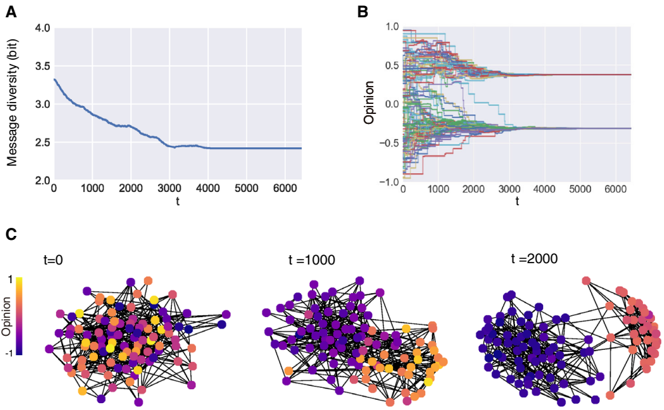
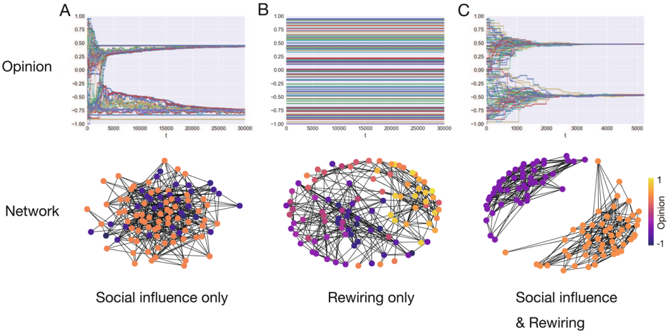
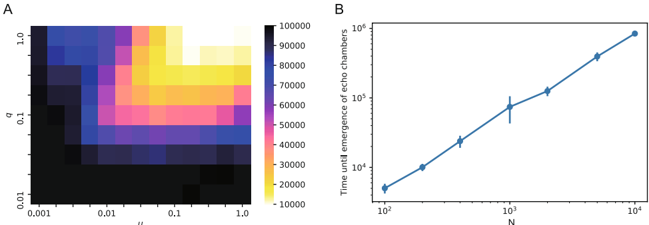
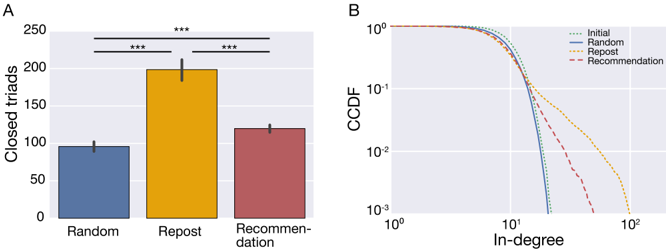
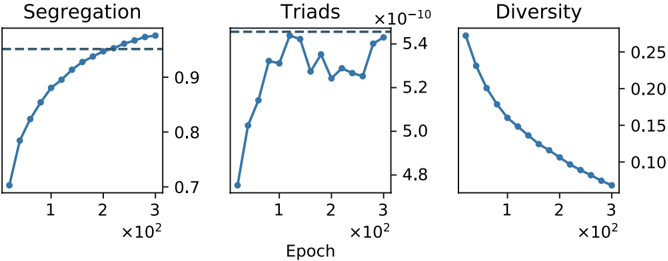
While social media make it easy to connect with and access information from anyone, they also facilitate basic influence and unfriending mechanisms that may lead to segregated and polarized clusters known as “echo chambers.” Here we study the conditions in which such echo chambers emerge by introducing a simple model of information sharing in online social networks with the two ingredients of influence and unfriending. Users can change both their opinions and social connections based on the information to which they are exposed through sharing. The model dynamics show that even with minimal amounts of influence and unfriending, the social network rapidly devolves into segregated, homogeneous communities. These predictions are consistent with empirical data from Twitter. Although our findings suggest that echo chambers are somewhat inevitable given the mechanisms at play in online social media, they also provide insights into possible mitigation strategies.
Overview
The claims and statistics of this paper haven’t been checked yet.
Free: it reads the open-access text and checks the first 5 claims that cite a source we can check. Create a free account to check every claim.
Integrity signals
Registry
Cites
Statistics
Figures

Verification
Claims the paper makes
The claims and statistics of this paper haven’t been checked yet.
Free: it reads the open-access text and checks the first 5 claims that cite a source we can check. Create a free account to check every claim.
Claims other papers make about this one
Each is checked against this paper’s own text: does it say what the citing paper says it does?
The cited source says what the claim attributes to it.
In the citing paper
“They are generally sheltered from other opinions since they cut ties to other agents not part of their group, and have been selected out [140].”
From Epistemic Communities under Active Inference (2022) · cites this paper as [140]
Self-check
Percentages, sums and reported differences re-computed from the paper’s own numbers.
The self-check needs the paper’s full text.
Citations
Cites
1 retracted
Limited individual attention and online virality of low-quality information
Qiu, X., F. M. Oliveira, D., Sahami Shirazi, A., Flammini, A., & Menczer, F. (2017) · Nature Human Behaviour · doi:10.1038/s41562-017-0132 · Cited by 180 · cited 3×
“25 based on empirical results from Twitter [71].”
BackgroundInfluentialSelf-citationRetractedAdvances in neural information processing systems 7
Cios, K., & Shields, M. (1997) · Neurocomputing · doi:10.1016/s0925-2312(97)90018-7 · Cited by 22,059
Birds of a Feather: Homophily in Social Networks
McPherson, M., Smith-Lovin, L., & Cook, J. M. (2001) · Annual Review of Sociology · doi:10.1146/annurev.soc.27.1.415 · Cited by 18,567
The spread of true and false news online
Vosoughi, S., Roy, D., & Aral, S. (2018) · Science · doi:10.1126/science.aap9559 · Cited by 8,847
Confirmation Bias: A Ubiquitous Phenomenon in Many Guises
Nickerson, R. S. (1998) · Review of General Psychology · doi:10.1037/1089-2680.2.2.175 · Cited by 7,267
Dynamic models of segregation†
Schelling, T. C. (1971) · The Journal of Mathematical Sociology · doi:10.1080/0022250x.1971.9989794 · Cited by 4,915
Lazer, D. M. J., Baum, M. A., Benkler, Y., Berinsky, A. J., Greenhill, K. M., Menczer, F., Metzger, M. J., Nyhan, B., Pennycook, G., Rothschild, D., et al. (2018) · Science · doi:10.1126/science.aao2998 · Cited by 4,160
Self-citationStatistical physics of social dynamics
Castellano, C., Fortunato, S., & Loreto, V. (2009) · Reviews of Modern Physics · doi:10.1103/revmodphys.81.591 · Cited by 4,119
Exposure to ideologically diverse news and opinion on Facebook
Bakshy, E., Messing, S., & Adamic, L. A. (2015) · Science · doi:10.1126/science.aaa1160 · Cited by 3,245
Measuring user influence in twitter: The million follower fallacy
Cha, M., Haddadi, H., Benevenuto, F., & Gummadi, K. (2010) · Proceedings of the International AAAI Conference on Web and Social Media · doi:10.1609/icwsm.v4i1.14033 · Cited by 3,022 · cited 2×
“This value is within the range observed in the literature [11, 17].”
Research works printed but not linked: 10
- Bonabeau, E. (2009). Decisions 2.0: The Power of Collective Intelligence. MIT Sloan Management Review, 50(2), 45.
- Surowiecki, J. (2005). The Wisdom Of Crowds. New York: Anchor Books.
- Benkler, Y. (2006). The Wealth of Networks: How Social Production Transforms Markets and Free- dom. New Haven: Yale University Press.
- Conover, M., Ratkiewicz, J., Francisco, M., Gonçalves, B., Menczer, F., Flammini, A. (2011). in International AAAI Conference on Web and Social Media (AAAI, Palo Alto, CA, USA, 2011), ICWSM '11, pp. 89-96. https:// www. aaai. org/ ocs/ index. php/ ICWSM/ ICWSM 11/ paper/ view/ 2847
- J. Bright, arXiv: 1609. 05003 v2 (2017)
- Friedkin, N. E. (2006). A structural theory of social influence (Vol. 13). Cambridge: Cambridge University Press.
- C.R. Sunstein, Republic.com, reprint edn. (Princeton University Press, Princeton, NJ, USA, 2002)
- K. Garimella, G. De Francisci Morales, A. Gionis, M. Mathioudakis, in Proceedings of the 2018 World Wide Web Conference (2018), pp. 913-922
- Alvarez-Hamelin, J. I., Dall'Asta, L., Barrat, A., & Vespignani, A. (2006). Advances in Neural Informa- tion Processing Systems, 41-50.
- P. Windrum, G. Fagiolo, A. Moneta, Journal of Artificial Societies and Social Simulation 10(2), 8 (2007). http:// jasss. soc. surrey. ac. uk/ 10/2/ 8. html
Cited by
The echo chamber effect on social media
Cinelli, M., De Francisci Morales, G., Galeazzi, A., Quattrociocchi, W., & Starnini, M. (2021) · Proceedings of the National Academy of Sciences · doi:10.1073/pnas.2023301118 · Cited by 2,092
Modeling echo chambers and polarization dynamics in social networks
Baumann, F., Lorenz-Spreen, P., Sokolov, I. M., & Starnini, M. (2020) · Physical Review Letters · doi:10.1103/physrevlett.124.048301 · Cited by 427
Darwin, Rusdin, D., Mukminatien, N., Suryati, N., Laksmi, E. D., & Marzuki (2024) · Cogent Education · doi:10.1080/2331186x.2023.2290342 · Cited by 290
“Another portion of the participants (P5) reflects on the risk of AI creating “echo chambers”—a limitation already suggested by Sasahara et al. (2019).”
Link recommendation algorithms and dynamics of polarization in online social networks
Santos, F. P., Lelkes, Y., & Levin, S. A. (2021) · Proceedings of the National Academy of Sciences · doi:10.1073/pnas.2102141118 · Cited by 208
Greijdanus, H., de Matos Fernandes, C. A., Turner-Zwinkels, F., Honari, A., Roos, C. A., Rosenbusch, H., & Postmes, T. (2020) · Current Opinion in Psychology · doi:10.1016/j.copsyc.2020.03.003 · Cited by 204
Digital media and misinformation: An outlook on multidisciplinary strategies against manipulation
Caled, D., & Silva, M. J. (2021) · Journal of Computational Social Science · doi:10.1007/s42001-021-00118-8 · Cited by 227
“Sasahara et al. [48], for example, argument that a possibility would be to expose users to content distant from their preferences, e.g., by discouraging triadic closure when recommending new social ties, using algorithms to optimize the diversity of opinions, and preventing the complete dissolution…”
BackgroundMethodUnderstanding Echo Chambers in E-commerce Recommender Systems
Ge, Y., Zhao, S., Zhou, H., Pei, C., Sun, F., Ou, W., & Zhang, Y. (2020) · Proceedings of the 43rd International ACM SIGIR Conference on Research and Development in Information Retrieval · doi:10.1145/3397271.3401431 · Cited by 125
A Confirmation Bias View on Social Media Induced Polarisation During Covid-19
Modgil, S., Singh, R. K., Gupta, S., & Dennehy, D. (2024) · Information Systems Frontiers · doi:10.1007/s10796-021-10222-9 · Cited by 168
“…such studies have made valuable contributions to knowledge; however, they do not conceptualise how the (i) foundational elements, (ii) role of actors, and (iii) phenomena lead to the emergence of echo chambers through dominance of confirmation bias (Boulianne et al., 2020; Sasahara et al., 2020).”
Rumor Propagation is Amplified by Echo Chambers in Social Media
Choi, D., Chun, S., Oh, H., Han, J., & Kwon, T. “. (2020) · Scientific Reports · doi:10.1038/s41598-019-57272-3 · Cited by 164
Ruffo, G., Semeraro, A., Giachanou, A., & Rosso, P. (2022) · Computer Science Review · doi:10.1016/j.cosrev.2022.100531 · Cited by 148
“[231] define a network of agents, each of them with a limited screen that shows the most recent messages posted (or reposted) by their neighbours.”
BackgroundA scoping review of empirical studies on generative artificial intelligence in language education
Wang, Y., Zhang, T., Yao, L., & Seedhouse, P. (2025) · Innovation in Language Learning and Teaching · doi:10.1080/17501229.2025.2509759 · Cited by 159
Neutral bots probe political bias on social media
Chen, W., Pacheco, D., Yang, K.-C., & Menczer, F. (2021) · Nature Communications · doi:10.1038/s41467-021-25738-6 · Cited by 64
Self-citationIonescu, C. G., & Licu, M. (2023) · Social Sciences · doi:10.3390/socsci12080465 · Cited by 98
““Collective algorithmic imagineries”, or ways of thinking about what algorithms are, what they should be, how they function, and what these imaginations, in turn, make possible, meaning that if users think the algorithm behaves in a particular way according to a specific logic, users tend to adapt their behavior to th…”
BackgroundTowards responsible media recommendation
Elahi, M., Jannach, D., Skjærven, L., Knudsen, E., Sjøvaag, H., Tolonen, K., Holmstad, Ø., Pipkin, I., Throndsen, E., Stenbom, A., et al. (2022) · AI and Ethics · doi:10.1007/s43681-021-00107-7 · Cited by 60
The Effect of People Recommenders on Echo Chambers and Polarization
Cinus, F., Minici, M., Monti, C., & Bonchi, F. (2022) · Proceedings of the International AAAI Conference on Web and Social Media · doi:10.1609/icwsm.v16i1.19275 · Cited by 65
Modelling how social network algorithms can influence opinion polarization
de Arruda, H. F., Cardoso, F. M., de Arruda, G. F., Hernández, A. R., Costa, L. D. F., & Moreno, Y. (2021) · Information Sciences · doi:10.1016/j.ins.2021.12.069 · Cited by 96
Echo Chambers in Online Social Networks: A Systematic Literature Review
Mahmoudi, A., Jemielniak, D., & Ciechanowski, L. (2024) · IEEE Access · doi:10.1109/access.2024.3353054 · Cited by 79
“They stated that ‘‘The joint effect of social influence and rewiring accelerates the joint emergence of both polarization and segregation’’ [43].”
BackgroundInfluentialEpistemic Communities under Active Inference
Albarracin, M., Demekas, D., Ramstead, M. J. D., & Heins, C. (2022) · Entropy · doi:10.3390/e24040476 · Cited by 60
“They 1338 are generally sheltered from other opinions since they cut ties to other agents which are 1339 not part of their group, and have been selected out [140].”
BackgroundFighting False Information from Propagation Process: A Survey
Sun, L., Rao, Y., Wu, L., Zhang, X., Lan, Y., & Nazir, A. (2023) · ACM Computing Surveys · doi:10.1145/3563388 · Cited by 68
“[138] also pointed out that echo chambers are somewhat inevitable in online social platforms, and gave possible strategies to against the echo chambers on social media, such as increase users’ social distance, discourage triadic closure, and discourage users to completely disengage from others with diferent opinions.”
BackgroundOpinion dynamics: Statistical physics and beyond
Starnini, M., Baumann, F., Galla, T., Garcia, D., Íñiguez, G., Karsai, M., Lorenz, J., & Sznajd-Weron, K. (2026) · Reviews of Modern Physics · doi:10.1103/j1zg-ddqv · Cited by 73
A general framework to link theory and empirics in opinion formation models
Kozitsin, I. (2022) · Scientific Reports · doi:10.1038/s41598-022-09468-3 · Cited by 63
The Dual Echo Chamber: Modeling Social Media Polarization for Interventional Recommending
Donkers, T., & Ziegler, J. (2021) · ACM Conference on Recommender Systems (RecSys) · doi:10.1145/3460231.3474261 · Cited by 76
“The decision-making process of whether to integrate a proposed message is usually modeled as a function of proximity in an attitude space [7, 15, 28, 58].”
BackgroundRumors in Retweet: Ideological Asymmetry in the Failure to Correct Misinformation
DeVerna, M., Guess, A. M., Berinsky, A. J., Tucker, J. A., & Jost, J. T. (2022) · Personality and Social Psychology Bulletin · doi:10.1177/01461672221114222 · Cited by 75
“One worry is that because of “echo chambers” belief-inconsistent corrective information may not reach the appropriate target (Barberá et al., 2015; Del Vicario et al., 2016; Sasahara et al., 2021).”
BackgroundAn adaptive bounded-confidence model of opinion dynamics on networks
Kan, U., Feng, M., & Porter, M. A. (2022) · Journal of Complex Networks · doi:10.1093/comnet/cnac055 · Cited by 80
Drivers of social influence in the Twitter migration to Mastodon
Cava, L. L., Aiello, L. M., & Tagarelli, A. (2023) · Scientific Reports · doi:10.1038/s41598-023-48200-7 · Cited by 48
On the impossibility of breaking the echo chamber effect in social media using regulation
Avin, C., Daltrophe, H., & Lotker, Z. (2024) · Scientific Reports · doi:10.1038/s41598-023-50850-6 · Cited by 58
Emergence of Polarization in Coevolving Networks
Liu, J., Huang, S., Aden, N. M., Johnson, N. F., & Song, C. (2023) · Physical Review Letters · doi:10.1103/physrevlett.130.037401 · Cited by 69
Depolarization of echo chambers by random dynamical nudge
Currin, C. B., Vera, S. V., & Khaledi‐Nasab, A. (2022) · Scientific Reports · doi:10.1038/s41598-022-12494-w · Cited by 46
“…suggested, the formation of clusters in social media networks is a consequence of the selective exposure of users actively seeking cognitively congruent social media content 1,2 , high transitivity of social networks 42,66 , and reinforcing mechanisms advanced by the platform’s algorithms 67 .”
BackgroundMethodInfluentialDuped by Bots: Why Some are Better than Others at Detecting Fake Social Media Personas
Kenny, R., Fischhoff, B., Davis, A. L., Carley, K. M., & Canfield, C. (2022) · Human Factors The Journal of the Human Factors and Ergonomics Society · doi:10.1177/00187208211072642 · Cited by 46
Durazzi, F., Müller, M., Salathé, M., & Remondini, D. (2021) · Scientific Reports · doi:10.1038/s41598-021-99301-0 · Cited by 41
“However, the underlying network and community structure is likely to have a significant influence over which information users are exposed to [7, 8, 9].”
BackgroundCan Crowdsourcing Rescue the Social Marketplace of Ideas?
Yasseri, T., & Menczer, F. (2023) · Communications of the ACM · doi:10.1145/3578645 · Cited by 45
Self-citationLin, H., Wang, Y., Lee, J., & Kim, Y. (2023) · Journal of Computer-Mediated Communication · doi:10.1093/jcmc/zmad022 · Cited by 34
Tang, X., Zhang, L., & Yuan, K. (2024) · Journal of Destination Marketing & Management · doi:10.1016/j.jdmm.2024.100859 · Cited by 41
A Transformer-based Framework for Neutralizing and Reversing the Political Polarity of News Articles
Liu, R., Jia, C., & Vosoughi, S. (2021) · Proceedings of the ACM on Human-Computer Interaction · doi:10.1145/3449139 · Cited by 44
“• Social media platforms whose recommendation algorithms try to amplify the information that users are likely to engage with in the future [86].”
BackgroundOtala, J. M., Kurtic, G., Grasso, I., Liu, Y., Matthews, J. N., & Madraki, G. (2021) · International World Wide Web Conference (WWW) · doi:10.1145/3442442.3452305 · Cited by 33
Information Credibility in the Social Web: Contexts, Approaches, and Open IssuesPreprint
Pasi, G., & Viviani, M. (2020) · arXiv (Cornell University) · doi:10.48550/arxiv.2001.09473 · Cited by 35
Kantian Ethics and the Attention Economy: Duty and Distraction
Aylsworth, T., & Castro, C. (2024) · Springer eBooks · doi:10.1007/978-3-031-45638-1 · Cited by 37
Dong, H., Ren, J., Padmanabhan, B., & Nickerson, J. V. (2019) · Information & Management · doi:10.1016/j.im.2021.103588 · Cited by 33
Recommender Systems and Algorithmic Hate
Smith, J. J., Jayne, L., & Burke, R. (2022) · ACM Conference on Recommender Systems (RecSys) · doi:10.1145/3523227.3551480 · Cited by 40
“In one study, researchers modeled how a digital environment that is not polarized in the beginning will become polarized over time, due to the mechanics of social influence in digital spaces [42].”
BackgroundPositive algorithmic bias cannot stop fragmentation in homophilic networks
Blex, C., & Yasseri, T. (2020) · Journal of Mathematical Sociology · doi:10.1080/0022250x.2020.1818078 · Cited by 38
Mean-field theory of social laser
Alodjants, A. P., Bazhenov, A. Y., Khrennikov, A. Y., & Bukhanovsky, A. V. (2022) · Scientific Reports · doi:10.1038/s41598-022-12327-w · Cited by 36
Bigger than sports: Identity politics, Colin Kaepernick, and concession making in #BoycottNike
Eschmann, R., Groshek, J., Li, S., Toraif, N., & Thompson, J. G. (2020) · Computers in Human Behavior · doi:10.1016/j.chb.2020.106583 · Cited by 28
Strategies for reducing polarization in social networks
Wu, Y., Li, L., Yu, Q., Gan, J., & Zhang, Y. (2023) · Chaos Solitons & Fractals · doi:10.1016/j.chaos.2022.113095 · Cited by 33
Promotional language and the adoption of innovative ideas in science
Peng, H., Qiu, H. S., Fosse, H. B., & Uzzi, B. (2024) · Proceedings of the National Academy of Sciences · doi:10.1073/pnas.2320066121 · Cited by 26
Self-citationHatemongers ride on echo chambers to escalate hate speech diffusion
Goel, V., Sahnan, D., Dutta, S., Bandhakavi, A., & Chakraborty, T. (2023) · PNAS Nexus · doi:10.1093/pnasnexus/pgad041 · Cited by 25
Cascades Across Networks Are Sufficient for the Formation of Echo Chambers: An Agent-Based Model
Fränken, J.-P., & Pilditch, T. D. (2021) · Journal of Artificial Societies and Social Simulation · doi:10.18564/jasss.4566 · Cited by 30
Coscia, M., & Rossi, L. (2022) · PLoS ONE · doi:10.1371/journal.pone.0263184 · Cited by 27
“These principles have been successfully included in previous models dealing with users’ polarization [18, 19].”
BackgroundResultAggressive behaviour of anti-vaxxers and their toxic replies in English and Japanese
Miyazaki, K., Uchiba, T., Tanaka, K., & Sasahara, K. (2022) · Humanities and Social Sciences Communications · doi:10.1057/s41599-022-01245-x · Cited by 27
“Especially on vaccine topics, users are often inside ‘echo chambers’ with the belief and they only see what they want to see [10], but in reality, a reply can reach anyone regardless of the follow-follower networks [11](3).”
Self-citationBridging Echo Chambers? Understanding Political Partisanship through Semantic Network Analysis
Erickson, J., Yan, B., & Huang, J. (2023) · Social Media + Society · doi:10.1177/20563051231186368 · Cited by 28
“Furthermore, because social influence contributes to the echo chamber phenomenon, studying partisan communication through a relational perspective provides further insight into how communication in a partisan context occurs (Dubois et al., 2020; Sasahara et al., 2021).”
BackgroundClustering and stubbornness regulate the formation of echo chambers in personalised opinion dynamics
Botte, N., Ryckebusch, J., & Rocha, L. E. C. (2022) · Physica A Statistical Mechanics and its Applications · doi:10.1016/j.physa.2022.127423 · Cited by 30
Kim, B., Wang, Y., Lee, J., & Kim, Y. (2022) · Computers in Human Behavior · doi:10.1016/j.chb.2022.107414 · Cited by 24
Liu, J., Schwarz, A., Risius, M., Hirschheim, R., & Scotter, J. R. V. (2025) · The Journal of Strategic Information Systems · doi:10.1016/j.jsis.2025.101904 · Cited by 31
Bright, J., Marchal, N., Ganesh, B., & Rudinac, S. (2021) · Human Communication Research · doi:10.1093/hcr/hqab020 · Cited by 33
“…the formation of these echo chambers, their social dynamics, and their impact on the beliefs and actions of those who inhabit them have generated a growing stream of research (Baele et al., 2019; Bliuc et al., 2018; Oswald & Bright, 2021; Regehr, 2020; Sasahara et al., 2020; van Eck et al., 2021).”
BackgroundA Geometric Model of Opinion Polarization
Hązła, J., Jin, Y., Mossel, E., & Ramnarayan, G. (2023) · Mathematics of Operations Research · doi:10.1287/moor.2023.1355 · Cited by 26
Transitions between polarization and radicalization in a temporal bilayer echo-chamber model
Gajewski, Ł. G., Sienkiewicz, J., & Hołyst, J. A. (2022) · Physical review. E · doi:10.1103/physreve.105.024125 · Cited by 25
The Manufacture of Partisan Echo Chambers by Follow Train Abuse on Twitter
Torres-Lugo, C., Yang, K.-C., & Menczer, F. (2022) · Proceedings of the International AAAI Conference on Web and Social Media · doi:10.1609/icwsm.v16i1.19354 · Cited by 28
“These are characteristics that we use to label the community as a partisan echo chamber (Sasahara et al. 2020).”
BackgroundInfluentialSelf-citationThe spread of fake news: Disclosure willingness role
Le, M. T. H. (2024) · Heliyon · doi:10.1016/j.heliyon.2024.e34468 · Cited by 21
Pay Attention: a Call to Regulate the Attention Market and Prevent Algorithmic Emotional Governance
Michel, F., & Gandon, F. L. (2024) · Proceedings of the AAAI/ACM Conference on AI Ethics and Society · doi:10.1609/aies.v7i1.31696 · Cited by 25
“This adequacy likely involves many other features that are not transparent since the platforms rarely inform users about how and for which purpose their personalized feed was composed.”
Co-evolutionary Game Dynamics of Competitive Cognitions and Public Opinion Environment
Liu, H., Wang, X., Liu, L., & Li, Z. (2021) · Frontiers in Physics · doi:10.3389/fphy.2021.658130 · Cited by 20
Community Moderation and the New Epistemology of Fact Checking on Social MediaPreprint
Augenstein, I., Bakker, M. A., Chakraborty, T., Corney, D. P. A., Ferrara, E., Gurevych, I., Hale, S. A., Hovy, E. H., Ji, H., Larraz, I., et al. (2025) · TUbilio (Technical University of Darmstadt) · doi:10.48550/arxiv.2505.20067 · Cited by 28
“Research on modeling social opinion dynamics offers network analytics methods to efficiently identify users with opposing perspectives by studying their online activity 42,68 .”
Self-citationDense and influential core promotion of daily viral information spread in political echo chambers
Asatani, K., Yamano, H., Sakaki, T., & Sakata, I. (2021) · Scientific Reports · doi:10.1038/s41598-021-86750-w · Cited by 18
The gender gap in scholarly self-promotion on social media
Peng, H., Teplitskiy, M., Romero, D. M., & Horvát, E.-Á. (2025) · Nature Communications · doi:10.1038/s41467-025-60590-y · Cited by 17
“…would be valuable because algorithms on online platforms may amplify small initial differences in online attention, as produced via differential self-promotion practice, into large disparities in ultimate academic recognition 70,108 and conventional markers of scienti fi c excellence 15,17,20 .”
Self-citationZhang, A. Q., Montague, K. E., & Jhaver, S. (2026) · ACM Transactions on Social Computing · doi:10.1145/3862615 · Cited by 17
How social rewiring preferences bridge polarized communities
Borges, H. M., de Vasconcelos, V. V. L., & Pinheiro, F. L. (2024) · Chaos Solitons & Fractals · doi:10.1016/j.chaos.2024.114594 · Cited by 24
Distributive effervescence: emotional energy and social cohesion in secularizing societies
McCaffree, K. J., & Shults, F. L. (2021) · Theory and Society · doi:10.1007/s11186-021-09470-0 · Cited by 20
Makinoshima, F., Oishi, Y., & Imamura, F. (2022) · International Journal of Disaster Risk Reduction · doi:10.1016/j.ijdrr.2022.102810 · Cited by 17
Modeling algorithmic bias: simplicial complexes and evolving network topologies
Pansanella, V., Rossetti, G., & Milli, L. (2022) · Applied Network Science · doi:10.1007/s41109-022-00495-7 · Cited by 25
De-sounding echo chambers: Simulation-based analysis of polarization dynamics in social networks
Donkers, T., & Ziegler, J. (2023) · Online Social Networks and Media · doi:10.1016/j.osnem.2023.100275 · Cited by 18
Knowledge mapping of information cocoons: A bibliometric study using visual analysis
Yan, C., Pu, K., & Luo, X. (2024) · Journal of Librarianship and Information Science · doi:10.1177/09610006231222628 · Cited by 17
“Social media make it easy to connect with anyone and get information, but they also promote basic influences and unwinding mechanisms, which can lead to isolation and polarized clusters known as “echo chambers” (Sasahara et al., 2021).”
Three roots of online toxicity: disembodiment, accountability, and disinhibition
Pandita, S., Garg, K., Zhang, J., & Mobbs, D. (2024) · Trends in Cognitive Sciences · doi:10.1016/j.tics.2024.06.001 · Cited by 19
Opinion disparity in hypergraphs with community structure
Landry, N., & Restrepo, J. G. (2023) · Physical review. E · doi:10.1103/physreve.108.034311 · Cited by 20
“, the tendency of individuals to associate with similar minded individuals [9–13], bounded confidence interactions [14–16], unfollowing on social media platforms [17], and social reinforcement and feedback mechanisms [18, 19].”
BackgroundExploring cognitive inertia in opinion dynamics using an activity-driven model
Pranesh, S., & Gupta, S. (2024) · Chaos Solitons & Fractals · doi:10.1016/j.chaos.2024.115879 · Cited by 16
Voter model can accurately predict individual opinions in online populations
Vendeville, A. (2025) · Physical review. E · doi:10.1103/physreve.111.064310 · Cited by 17
Fitting in and breaking up: A nonlinear version of coevolving voter models
Kureh, Y. H., & Porter, M. A. (2020) · Physical review. E · doi:10.1103/physreve.101.062303 · Cited by 23
The structure of segregation in co-authorship networks and its impact on scientific production
Jaramillo, A. M., Williams, H. T. P., Perra, N., & de Menezes, R. P. (2023) · EPJ Data Science · doi:10.1140/epjds/s13688-023-00411-8 · Cited by 19
“…more or fewer citations over time, (ii) the analysis of the diversity of the scientific publications inside the communities using opinion distance [13] and their demographic diversity to understand if the segregated and isolated communities are not diverse and echoing research to the point of…”
BackgroundNguyen, T. T., Nguyen, D. C., Nguyen, H. T., Do, H., Ngo, T., Pham, A. B. G., Tran, T. Q., Hoang, L. P., Dang, H., Boyer, L., et al. (2025) · Scientific Reports · doi:10.1038/s41598-025-19175-4 · Cited by 18
“Notably, our finding that prolonged SNS was associated with stronger endorsement of fake news echoes the “echo chamber” effect, whereby repeated exposure to homogenous content reinforces existing convictions, including false ones 43,44 .”
Kozitsin, I., Gubanov, A. V., Sayfulin, E. R., & Goiko, V. L. (2023) · Online Social Networks and Media · doi:10.1016/j.osnem.2023.100248 · Cited by 15
A high-dimensional approach to measuring online polarization
Phillips, S. C., Uyheng, J., & Carley, K. M. (2023) · Journal of Computational Social Science · doi:10.1007/s42001-023-00227-6 · Cited by 19
“Several studies use controlled virtual experiments to investigate the effect of varying parameters, like density and agent influence, on network measures, such as centrality [68] and segregation [70].”
BackgroundMethodEcho Chambers and Segregation in Social Networks: Markov Bridge Models and Estimation
Luo, R., Nettasinghe, B., & Krishnamurthy, V. (2021) · IEEE Transactions on Computational Social Systems · doi:10.1109/tcss.2021.3091168 · Cited by 16
Singh, M., Kaur, R., Matsuo, A., Iyengar, S. R. S., & Sasahara, K. (2021) · Frontiers in Psychology · doi:10.3389/fpsyg.2021.768856 · Cited by 13
Self-citationLubashevskiy, V., Ozaydin, S. Y., & Özaydin, F. (2023) · Entropy · doi:10.3390/e25020365 · Cited by 14
“have shown how unfriending accelerates the emergence of echo chambers [27].”
BackgroundHow heterogeneous social influence acts on human decision-making in online social networks
Ni, X., Xiong, F., Pan, S., Chen, H., Wu, J. X., & Wang, L. (2023) · Chaos Solitons & Fractals · doi:10.1016/j.chaos.2023.113617 · Cited by 13
Susceptibility to Unreliable Information Sources: Swift Adoption with Minimal Exposure
Ye, J., Luceri, L., Jiang, J., & Ferrara, E. (2024) · International World Wide Web Conference (WWW) · doi:10.1145/3589334.3648154 · Cited by 20
“Our objective is to investigate whether exposure to a particular set of sources interplays with users’ decision to adopt sources with either similar or dissimilar levels of credibility.”
BackgroundDepolarization of opinions on social networks through random nudges
Pal, R., Kumar, A., & Santhanam, M. S. (2023) · Physical review. E · doi:10.1103/physreve.108.034307 · Cited by 18
The democratization dilemma: When everyone is an expert, who do we trust?
Mahajan, S. (2025) · Humanities and Social Sciences Communications · doi:10.1057/s41599-025-04734-x · Cited by 11
“Recent studies demonstrate that such algorithmic curation can foster echo chambers that sti fl e innovation and reduce cognitive diversity (Doshi and Hauser 2024; Kusters et al. 2020; Sasahara et al. 2021).”
Identifying Political Polarization in Social Media: A Literature Review
Rum, S. N. M., Mohamed, R., & Asfarian, A. (2023) · Journal of Advanced Research in Applied Sciences and Engineering Technology · doi:10.37934/araset.34.1.8089 · Cited by 14
George, N., Sham, A., Ajith, T., & Bastos, M. (2024) · Social Science Computer Review · doi:10.1177/08944393241269394 · Cited by 16
“This is particularly relevant for social media pro fi le pictures, with the presence of human faces on social media pro fi les being associated with higher user engagement, which in turn is conducive to trustworthiness and likability (Li & Xie, 2020; Sasahara et al., 2020).”
How ‘engagement’ makes you vulnerable to manipulation and misinformation on social media
Menczer, F. (2021) · doi:10.64628/aai.k4psdnjmt · Cited by 10
Self-citationCombating Misinformation/ Disinformation in Online Social Media: A Multidisciplinary View
Barni, M., Fang, Y., Liu, Y., Robinson, L., Sasahara, K., Vincent, S., Wang, X., & Wu, Z. (2022) · APSIPA Transactions on Signal and Information Processing · doi:10.1561/116.00000127 · Cited by 11
Self-citationCharacterizing the Anti-Vaxxers’ Reply Behavior on Social Media
Miyazaki, K., Uchiba, T., Tanaka, K., & Sasahara, K. (2021) · IEEE/WIC/ACM International Conference on Web Intelligence · doi:10.1145/3498851.3498934 · Cited by 12
“This is because social media users usually follow almost only the people they want to follow and see only what they want to see [28], but reply behavior can send messages beyond the follow-follower relationships [11]1.”
BackgroundSelf-citationAdding Types, But Not Tokens, Affects Property Induction
Xie, B., Navarro, D., & Hayes, B. K. (2020) · Cognitive Science · doi:10.1111/cogs.12895 · Cited by 10
Martínez, I. C., Martínez, J. M. R., Zapata, C. M., & Moreno, S. M. (2022) · Revista de Comunicación · doi:10.26441/rc21.1-2022-a6 · Cited by 12
The Dynamics of Online Opinion Formation: Polarization Around the Vaccine Development for COVID-19
Jain, G., Sreenivas, A. B., Gupta, S., & Tiwari, A. A. (2022) · Springer eBooks · doi:10.1007/978-981-16-5268-4_3 · Cited by 10
Retweets Amplify the Echo Chamber Effect
Rao, A., Morstatter, F., & Lerman, K. (2023) · IEEE/ACM International Conference on Advances in Social Networks Analysis and Mining (ASONAM) · doi:10.1145/3625007.3627485 · Cited by 13
“Several studies have, therefore, used retweet links to study echo chambers [3], [5], [7].”
ResultMomsen, K., & Ohndorf, M. (2022) · Public Choice · doi:10.1007/s11127-022-01016-x · Cited by 10
Inside the Echo Chamber: Disentangling network dynamics from polarizationPreprint
Balsamo, D., Gelardi, V., Han, C., Rama, D., Samantray, A., Zucca, C., & Starnini, M. (2019) · arXiv (Cornell University) · doi:10.48550/arxiv.1906.09076 · Cited by 9
Controlling Segregation in Social Network Dynamics as an Edge Formation Game
Luo, R., Nettasinghe, B., & Krishnamurthy, V. (2022) · IEEE Transactions on Network Science and Engineering · doi:10.1109/tnse.2022.3162789 · Cited by 13
Mitigating opinion polarization in social networks using adversarial attacks
Ninomiya, M., Ichinose, G., Chiyomaru, K., & Takemoto, K. (2025) · Scientific Reports · doi:10.1038/s41598-025-93213-z · Cited by 12
Lavorgna, A., & Corda, A. (2024) · International Criminology · doi:10.1007/s43576-024-00134-4 · Cited by 9
“…online is generally associated with an increase in the ideological distance between individuals, leading to major intergroup segregation leading to antagonistic dynamics with non-groups members (e.g., Bakshy et al., 2015; Devlin & Grant, 2017; Sasahara et al., 2021; Schmidt et al., 2017).”
Cognitive dissonance and introversion effects on opinion dynamics and echo chamber formation
Tan, E., Stemler, T., & SMALL, M. P. (2024) · Physica A Statistical Mechanics and its Applications · doi:10.1016/j.physa.2024.130130 · Cited by 7
Metadata
- Authors
- Sasahara, K., Chen, W., Peng, H., Ciampaglia, G. L., Flammini, A., & Menczer, F.
- Affiliations
- Japan Science and Technology Agency (JP)
- Indiana University Bloomington (US)
- University of Michigan (US)
- University of South Florida (US)
- Corresponding author
- Sasahara, Kazutoshi
- Venue
- Journal of Computational Social Science
- Published
- 2020-09-11
- Volume
- 4
- Issue
- 1
- Pages
- 381-402
- ISSN
- 2432-2717 (ISSN-L)
- 2432-2725
- OpenAlex
- W3081047394
- Cited by
- 211
- References
- 73
- Citations by year
- 2026: 19 · 2025: 44 · 2024: 39 · 2023: 37 · 2022: 31 · 2021: 36 · 2020: 4
- FWCI
- 11.42
- Type
- journal article
- Language
- en
- Update notices
- correction (2022-04-19)
- Open access
- hybrid
- doi.org
- Licence
- cc-by
- creativecommons.org/licenses/by/4.0 (tdm)
- creativecommons.org/licenses/by/4.0 (vor)
- Locations
- Journal of Computational Social Science (publishedVersion, cc-by)
- arXiv (Cornell University) (submittedVersion)
- RePEc: Research Papers in Economics (submittedVersion)
- arXiv (Cornell University)
- Funders
- Japan Science and Technology Agency (JPMJPR16D6, JPMJCR17A4)
- Japan Society for the Promotion of Science (JP19H04217, JP17H06383 in #4903)
- Defense Advanced Research Projects Agency (W911NF-17-C-0094)
- Indiana University Network Science Institute
- Topics
- Physical Sciences › Physics and Astronomy › Statistical and Nonlinear Physics › Opinion Dynamics and Social Influence
- Social Sciences › Communication › Social Media and Politics
- Physical Sciences › Physics and Astronomy › Statistical and Nonlinear Physics › Complex Network Analysis Techniques
- Keywords
- echo chambers, social influence, unfriending, social networking sites, opinion polarization, information sharing, social segregation, community formation, Twitter, mitigation measures
About these checks
Registry, retraction, Cites and statistics results are computed, not judged, with one exception: a printed reference that no index lists is read once by a model before it counts as a citation error. Claims are extracted by a model and kept only when their quote appears verbatim in the text; each cited source is then checked, with a model’s help, for whether it says what the claim relies on. Those verdicts can be wrong — read the claim’s quote and the cited source before relying on one.
Statistics and arithmetic are recomputed, not judged.
Confidence bands are shown only for fields calibrated on our annotated test set. None is calibrated yet, so no band is shown.
What counts as a claim ›How we measure confidence ›How we check this ›
Are you an author, or do you see a problem with this page? Request a review
Data sources
Bibliographic data: Semantic Scholar, OpenAlex, Crossref.
Contains information from the Semantic Scholar Academic Graph Datasets, made available under the ODC Attribution License (ODC-BY 1.0).
Semantic Scholar’s data is described in: Kinney, R., et al. (2023). The Semantic Scholar Open Data Platform. arXiv:2301.10140.
