

Social influence and unfollowing accelerate the emergence of echo chambers
Open accessThe DOI matches its Crossref record; 78 of the 80 references it cites were found in a registry or an index, and 2 are not checked yet.
Abstract
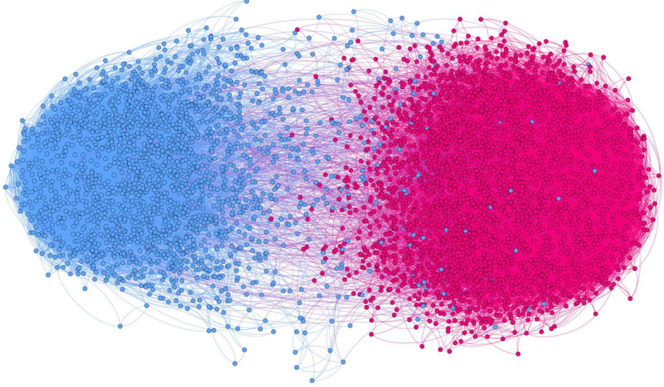
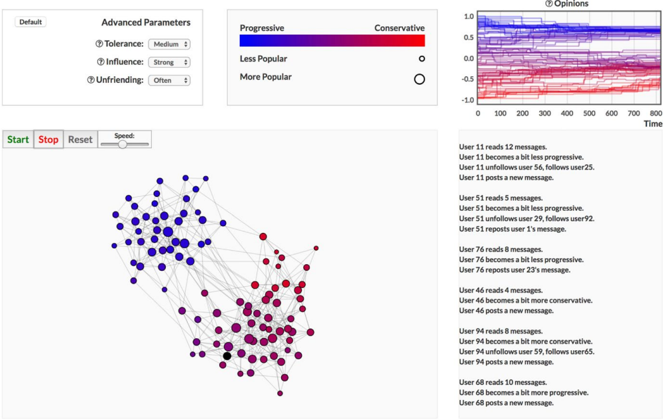
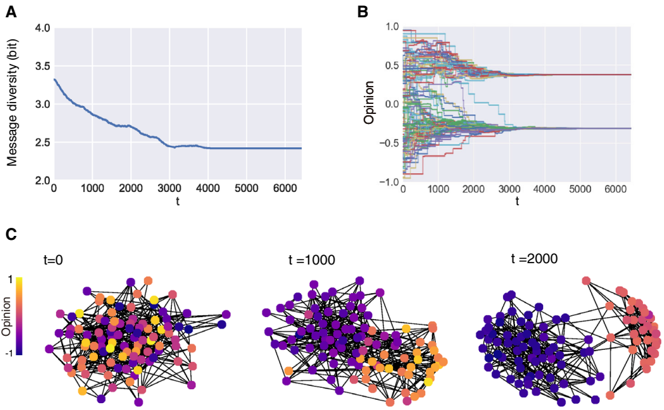
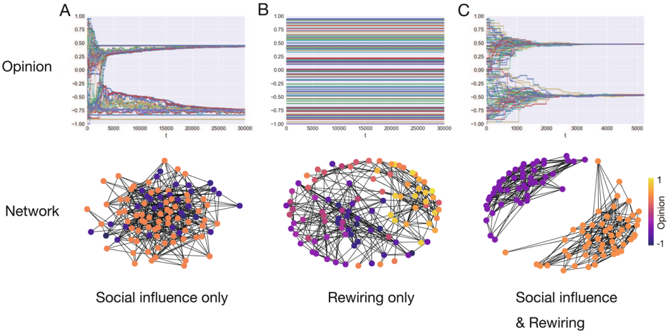
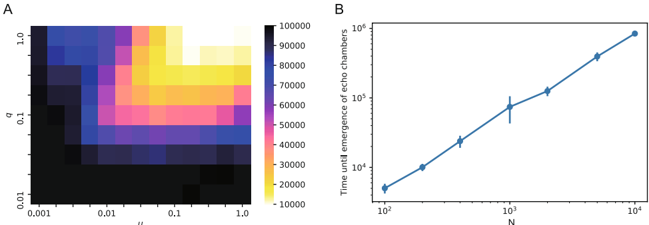
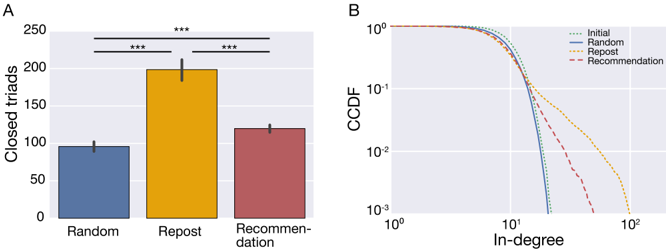
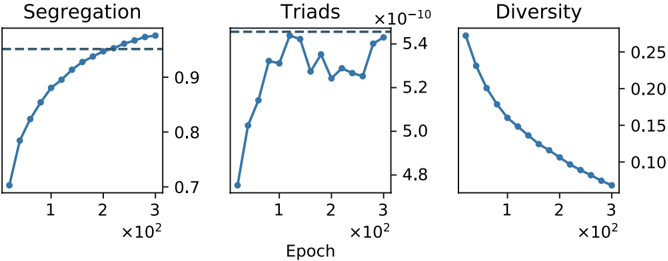
While social media make it easy to connect with and access information from anyone, they also facilitate basic influence and unfriending mechanisms that may lead to segregated and polarized clusters known as “echo chambers.” Here we study the conditions in which such echo chambers emerge by introducing a simple model of information sharing in online social networks with the two ingredients of influence and unfriending. Users can change both their opinions and social connections based on the information to which they are exposed through sharing. The model dynamics show that even with minimal amounts of influence and unfriending, the social network rapidly devolves into segregated, homogeneous communities. These predictions are consistent with empirical data from Twitter. Although our findings suggest that echo chambers are somewhat inevitable given the mechanisms at play in online social media, they also provide insights into possible mitigation strategies.
Overview
The claims and statistics of this paper haven’t been checked yet.
Free: it reads the open-access text and checks the first 5 claims that cite a source we can check. Create a free account to check every claim.
Integrity signals
Registry
Cites
Statistics
Figures

Verification
Claims the paper makes
The claims and statistics of this paper haven’t been checked yet.
Free: it reads the open-access text and checks the first 5 claims that cite a source we can check. Create a free account to check every claim.
Claims other papers make about this one
Each is checked against this paper’s own text: does it say what the citing paper says it does?
The cited source says what the claim attributes to it.
In the citing paper
“They are generally sheltered from other opinions since they cut ties to other agents not part of their group, and have been selected out [140].”
From Epistemic Communities under Active Inference (2022) · cites this paper as [140]
Self-check
Percentages, sums and reported differences re-computed from the paper’s own numbers.
The self-check needs the paper’s full text.
Citations
Cites
1 retracted
Limited individual attention and online virality of low-quality information
Qiu, X., F. M. Oliveira, D., Sahami Shirazi, A., Flammini, A., & Menczer, F. (2017) · Nature Human Behaviour · doi:10.1038/s41562-017-0132 · Cited by 180 · cited 3×
“25 based on empirical results from Twitter [71].”
BackgroundInfluentialSelf-citationRetractedAdvances in neural information processing systems 7
Cios, K., & Shields, M. (1997) · Neurocomputing · doi:10.1016/s0925-2312(97)90018-7 · Cited by 22,059
Birds of a Feather: Homophily in Social Networks
McPherson, M., Smith-Lovin, L., & Cook, J. M. (2001) · Annual Review of Sociology · doi:10.1146/annurev.soc.27.1.415 · Cited by 18,567
The spread of true and false news online
Vosoughi, S., Roy, D., & Aral, S. (2018) · Science · doi:10.1126/science.aap9559 · Cited by 8,847
Confirmation Bias: A Ubiquitous Phenomenon in Many Guises
Nickerson, R. S. (1998) · Review of General Psychology · doi:10.1037/1089-2680.2.2.175 · Cited by 7,267
Dynamic models of segregation†
Schelling, T. C. (1971) · The Journal of Mathematical Sociology · doi:10.1080/0022250x.1971.9989794 · Cited by 4,915
Lazer, D. M. J., Baum, M. A., Benkler, Y., Berinsky, A. J., Greenhill, K. M., Menczer, F., Metzger, M. J., Nyhan, B., Pennycook, G., Rothschild, D., et al. (2018) · Science · doi:10.1126/science.aao2998 · Cited by 4,160
Self-citationStatistical physics of social dynamics
Castellano, C., Fortunato, S., & Loreto, V. (2009) · Reviews of Modern Physics · doi:10.1103/revmodphys.81.591 · Cited by 4,119
Exposure to ideologically diverse news and opinion on Facebook
Bakshy, E., Messing, S., & Adamic, L. A. (2015) · Science · doi:10.1126/science.aaa1160 · Cited by 3,245
Measuring user influence in twitter: The million follower fallacy
Cha, M., Haddadi, H., Benevenuto, F., & Gummadi, K. (2010) · Proceedings of the International AAAI Conference on Web and Social Media · doi:10.1609/icwsm.v4i1.14033 · Cited by 3,022 · cited 2×
“This value is within the range observed in the literature [11, 17].”
Research works printed but not linked: 10
- Bonabeau, E. (2009). Decisions 2.0: The Power of Collective Intelligence. MIT Sloan Management Review, 50(2), 45.
- Surowiecki, J. (2005). The Wisdom Of Crowds. New York: Anchor Books.
- Benkler, Y. (2006). The Wealth of Networks: How Social Production Transforms Markets and Free- dom. New Haven: Yale University Press.
- Conover, M., Ratkiewicz, J., Francisco, M., Gonçalves, B., Menczer, F., Flammini, A. (2011). in International AAAI Conference on Web and Social Media (AAAI, Palo Alto, CA, USA, 2011), ICWSM '11, pp. 89-96. https:// www. aaai. org/ ocs/ index. php/ ICWSM/ ICWSM 11/ paper/ view/ 2847
- J. Bright, arXiv: 1609. 05003 v2 (2017)
- Friedkin, N. E. (2006). A structural theory of social influence (Vol. 13). Cambridge: Cambridge University Press.
- C.R. Sunstein, Republic.com, reprint edn. (Princeton University Press, Princeton, NJ, USA, 2002)
- K. Garimella, G. De Francisci Morales, A. Gionis, M. Mathioudakis, in Proceedings of the 2018 World Wide Web Conference (2018), pp. 913-922
- Alvarez-Hamelin, J. I., Dall'Asta, L., Barrat, A., & Vespignani, A. (2006). Advances in Neural Informa- tion Processing Systems, 41-50.
- P. Windrum, G. Fagiolo, A. Moneta, Journal of Artificial Societies and Social Simulation 10(2), 8 (2007). http:// jasss. soc. surrey. ac. uk/ 10/2/ 8. html
Cited by
Items 201–289 of 289
Nonlinear opinion models and other networked systems
Kureh, Y. H. (2020) · eScholarship (California Digital Library)
Changes to the Amplification of Risk Information within the British Press: 1985-2017
Rooke, M. (2021) · Kent Academic Repository (University of Kent) · doi:10.22024/unikent/01.02.85923
Phase transition and cascading collapse in binary decision-making dynamicsPreprint
Chen, X., Wang, X., Liu, L., Tang, S., & Zheng, Z. (2021) · arXiv (Cornell University) · doi:10.48550/arxiv.2105.11616
Retrospective Analysis of Controversial Subtopics on COVID-19 in JapanPreprint
Miyazaki, K., Uchiba, T., Toriumi, F., Tanaka, K., & Sakaki, T. (2021) · arXiv (Cornell University) · doi:10.48550/arxiv.2106.09354
“Moreover, the polarity tends to accelerate if left unmitigated [7]; hence, it is desirable to accurately identify polarization features and mitigate them before the problem becomes severe [8].”
BackgroundDistributed computation and inference
Ramnarayan, G. (2020) · DSpace@MIT (Massachusetts Institute of Technology)
Social Media and Civic Engagement: Salvation or …?
Kennedy, K. J. (2021) · Springer briefs in education · doi:10.1007/978-981-16-7495-2_3
Digitalisierung und Demokratie: Eine Momentaufnahme
Mechnich, J., & Kallinich, D. (2019) · Journal für politische Bildung · doi:10.46499/1254.1679
Reliability-Disguised Attacks on Social Network to Accelerate Fake News Dissemination
Yoshikawa, K., Awa, T., Kusano, R., Ichino, M., & Yoshiura, H. (2021) · IEEE International Conference on Software Quality, Reliability and Security Companion (QRS-C) · doi:10.1109/qrs-c55045.2021.00127
Using Partitions by Attributes for Social Control
Klochko, A., & Николаевич, Ф. Д. (2022) · International Conference Management of Large-Scale System Development (MLSD) · doi:10.1109/mlsd55143.2022.9934711
Negative Influence of the Internet on Psychological Polarization
Song, X. (2023) · Lecture Notes in Education Psychology and Public Media · doi:10.54254/2753-7048/4/2022718
Massive Case Study of Opinion Distribution in a Relationship with Mixed Trust and DistrustPreprint
Kawahata, Y. (2023) · arXiv (Cornell University) · doi:10.48550/arxiv.2310.19850
Kawahata, Y. (2023) · arXiv (Cornell University) · doi:10.48550/arxiv.2311.01519
Kawahata, Y. (2023) · arXiv (Cornell University) · doi:10.48550/arxiv.2311.02445 · Cited by 1
Kawahata, Y. (2023) · arXiv (Cornell University) · doi:10.48550/arxiv.2311.03137
Kawahata, Y. (2023) · arXiv (Cornell University) · doi:10.48550/arxiv.2311.05488
From Spin States to Social Consensus: Ising Approach to Dimer Configurations in Opinion FormationPreprint
Kawahata, Y. (2023) · arXiv (Cornell University) · doi:10.48550/arxiv.2311.14761
Perspective in Opinion Dynamics on Complex Convex Domains of Time Networks for Addiction, ForgettingPreprint
Kawahata, Y. (2023) · arXiv (Cornell University) · doi:10.48550/arxiv.2311.15318
del Pozo, S. M., Pinto, S., Serafino, M., Cicchini, T., Moss, F., Makse, H. A., & Balenzuela, P. (2023) · Research Square · doi:10.21203/rs.3.rs-3627291/v1
Kawahata, Y. (2023) · arXiv (Cornell University) · doi:10.48550/arxiv.2312.00862
Kawahata, Y. (2024) · arXiv (Cornell University) · doi:10.48550/arxiv.2401.01349 · Cited by 1
Modeling Opinion Toroidal Polarization: Insights from Bounding Confidence Beyond, Distance MattersPreprint
Kawahata, Y. (2024) · arXiv (Cornell University) · doi:10.48550/arxiv.2401.01346
Kawahata, Y. (2024) · arXiv (Cornell University) · doi:10.48550/arxiv.2401.01347
Kawahata, Y. (2024) · arXiv (Cornell University) · doi:10.48550/arxiv.2401.05348
Kawahata, Y. (2024) · RePEc: Research Papers in Economics · doi:10.48550/arxiv.2403.02342
Kawahata, Y. (2024) · arXiv (Cornell University) · doi:10.48550/arxiv.2403.03239
Leclercq, S. (2023) · theses.fr (ABES) · doi:10.70675/cd59d3c2za8e5z4e97z9b95z8d6f0b38f79f
Kawahata, Y. (2024) · arXiv (Cornell University) · doi:10.48550/arxiv.2403.05585
Kawahata, Y. (2024) · arXiv (Cornell University) · doi:10.48550/arxiv.2403.05593
Singh, A. (2023) · Journal of Student Research · doi:10.47611/jsrhs.v12i4.5275
Kawahata, Y. (2024) · arXiv (Cornell University) · doi:10.48550/arxiv.2404.01312
Kawahata, Y. (2024) · arXiv (Cornell University) · doi:10.48550/arxiv.2402.18598 · Cited by 1
Yin, J. D.-C. (2024) · Online Journal of Public Health Informatics · doi:10.2196/55104 · Cited by 3
“Additionally, involving moderators in content management [46,47] aimed at antivaccination hardliners could mitigate their impact on chambering [48].”
BackgroundA new Approach for Community Dynamics and Influence in Social Networks: Case of Wexit Movement
Gassara, O., Tshimula, J. M., & Chikhaoui, B. (2024) · International Conference on Control, Decision and Information Technologies (CoDIT) · doi:10.1109/codit62066.2024.10708177
“In recent years, social media present a precious source of information that serves to address issues in a wide range of domains, since social media includes the sheer volume of data generated by individuals using a spontaneous language [1].”
BackgroundThe Effect of Agenda-Setting on Occurrence of Echo Chamber on Social Media
Nagura, T., & Akiyama, E. (2024) · Transactions of the Japanese Society for Artificial Intelligence · doi:10.1527/tjsai.39-6-ag24-a
Heidergott, B., Lindner, I., Badri, S., & Praum, M. (2024) · SSRN Electronic Journal · doi:10.2139/ssrn.5012196
Referential type opinion formation with fluctuating affinities on social network
Yano, R. (2024) · Journal of Statistical Mechanics Theory and Experiment · doi:10.1088/1742-5468/ad96aa
Lindner, I., Heidergott, B., Badri, S., & Praum, M. (2025) · SSRN Electronic Journal · doi:10.2139/ssrn.5248291 · Cited by 2
Lindner, I., Heidergott, B., Badri, S., & Praum, M. (2025) · SSRN Electronic Journal · doi:10.2139/ssrn.5249942
Making hidden religiosity visible in Japan: A computational analysis on social mediaPreprint
Tsunematsu, A., Komiya, A., & Takano, R. (2025) · PsyArXiv (OSF Preprints) · doi:10.31234/osf.io/rm59f_v2
Computational Methods in Media Psychology
Fisher, J. T. (2025) · Oxford University Press eBooks · doi:10.1093/oxfordhb/9780197689875.013.0017
Join Social and Temporal Information for Rumor Detection
Du, D., & Ban, Z. (2025) · Lecture notes in computer science · doi:10.1007/978-981-95-0020-8_40
Suissa, J. S., & Goulet‐Scott, B. E. (2023) · The Conversation · doi:10.64628/aai.6wgskthqn
Analysis of Echo Chamber Formation by Friend Recommendation
Iwanaga, M., & Tajima, K. (2025) · ACM Conference on Hypertext and Social Media (HT) · doi:10.1145/3720553.3746667
Human–misinformation interaction
Shin, D. (2025) · Elsevier eBooks · doi:10.1016/b978-0-443-16104-9.00003-8
Interbrain Synchrony Mitigates Extremism Within Echo Chambers
Sobeh, A., Vakrat, T. M., & Shamay‐Tsoory, S. (2025) · Annals of the New York Academy of Sciences · doi:10.1111/nyas.70083
Inagaki, K., & Hara, Y. (2025) · Japanese Journal of JSCE · doi:10.2208/jscejj.24-00191
The Role of Network Rewiring in Influencing Extremism and Pluralistic Ignorance
Topuz, E., & Yücel, G. (2025) · Springer proceedings in complexity · doi:10.1007/978-3-031-91782-0_36
Maximizing Diverse Information Exposure in Content-Based Social Networks
Colin, J., & Maniu, S. (2025) · Lecture notes in computer science · doi:10.1007/978-3-662-72449-1_1
Navigating the Post-Factual Disinformation Minefield: An In-Depth Examination
Alibašić, H. (2024) · Emerald Group Publishing Limited eBooks · doi:10.1108/979-8-88730-661-220251009
The Effect of Fact-Checking Using a Model Considering Facts and Opinions
Kodama, H., Mutoh, A., Shima, K., Moriyama, K., Matsui, T., & Inuzuka, N. (2025) · IEEE Global Conference on Consumer Electronics (GCCE) · doi:10.1109/gcce65946.2025.11275143
Initial Opinion Polarization Analysis Based on Information Cocoons
Yang, J., & Liu, Y. (2025) · International Conference on Computer Vision and Data Mining (ICCVDM) · doi:10.1109/iccvdm66874.2025.11290008
“…have discussed this problem from various aspects such as network propagation mechanism and recommendation system bias [3] [4] , there are still deficiencies in how to conduct polarization modeling analysis while taking into account computational efficiency and network structure preservation [5] .”
Situating Emotions in Radicalization. Online-based Affectivity and Violent Extremism
Valentini, D. (2024) · osnaDocs (Osnabrück University) · doi:10.48693/581
Thesis_Leadership for Sustainable Change_compressed.pdf
Neumann, & Wils, T. (2021) · Figshare · doi:10.6084/m9.figshare.14573025
Jaramillo, A. M., Williams, H. T. P., Perra, N., & Menezes, R. (2024) · Figshare · doi:10.6084/m9.figshare.26624776
Kawahata, Y. (2023) · arXiv (Cornell University) · doi:10.13140/rg.2.2.16442.61129
Additional file 1 of Modeling algorithmic bias: simplicial complexes and evolving network topologies
Pansanella, V., Rossetti, G., & Milli, L. (2022) · Figshare · doi:10.6084/m9.figshare.20499861
Kawahata, Y. (2023) · arXiv (Cornell University) · doi:10.13140/rg.2.2.29025.52326
Persson, B., Wickenberg, M., & Ångman, E. (2024) · University Library of Skövde (University of Skövde)
Modelling Irrational Agent Beliefs In Online Social Networks
CHUKWUMA, F. (2023) · Staffordshire Online Repository (Staffordshire University)
A model for French votersPreprint
Vendeville, A. (2024) · HAL
Automated Information Warfare: For and Against Saturation Attacks
Low, J. F. (2023) · eScholarship@McGill (McGill) · doi:10.82308/4782 · Cited by 1
Echo-Politics: Political Fragmentation, Echo Chambers and Polarization in Online Turkish Society
OZAYDIN, S. Y., & Ozaydin, S. Y. (2023) · Institutional Repositories DataBase (IRDB)
Networks, Polarization, and Voting: Models for Information Aggregation in Social Settings
Jin, Y. (2023) · DSpace@MIT (Massachusetts Institute of Technology)
Modeling and Evaluating the Impact of Extreme Opinions on Opinion Polarization in Social Groups
Liu, Y., Nakajima, K., & Aida, M. (2025) · IEEE Intl Conf on Dependable, Autonomic and Secure Computing, Intl Conf on Pervasive Intelligence and Computing, Intl Conf on Cloud and Big Data Computing, Intl Conf on Cyber Science and Technology Congress (DASC/PiCom/CBDCom/CyberSciTech) · doi:10.1109/dasc68382.2025.00032
“Recommendation systems exacerbate this issue by continuously presenting content aligned with users’ past activities [5], thereby further fragmenting both the information landscape and public opinion [6].”
Mitra, A., Majumdar, R., Das, R., Saha, A., Paul, J., Mondal, S., & Sil, J. (2026) · ACM Transactions on Knowledge Discovery from Data · doi:10.1145/3789258 · Cited by 1
Embracing Indigeneity in Theory, Research and Practice: Real-World Applications of Human Development
Kapadia, S., & Bhangaokar, R. (2026) · Springer eBooks · doi:10.1007/978-981-95-4037-2_16
The Backfire of Influence Operation: How Manipulating Moderate Influencers Affects Online Discourse
Takeda, T., Toriumi, F., & Sugawara, T. (2026) · Studies in computational intelligence · doi:10.1007/978-3-032-16723-1_21
Influence of Agent Social and Network Segregation on Fake News Diffusion
Kitagawa, Y., & Akiyama, E. (2025) · IEEE International Conference on Big Data (BigData) · doi:10.1109/bigdata66926.2025.11402069
Chomel, V. (2022) · theses.fr (ABES) · doi:10.70675/9ee41aa0ze5d3z436ezb779zd17f5ee3e142 · Cited by 1
Partition Diversity in Complex Networks
Mangold, L. (2025) · theses.fr (ABES) · doi:10.70675/65c3485bz7da2z4fd6z91fcz90db3ecec3bb
The Echo Chamber Effect: Exploring Social Media\'s Role in Polarizing Public Opinion.
Thunga, Y. B. (2026) · International Journal for Research in Applied Science and Engineering Technology · doi:10.22214/ijraset.2026.81800
EchoShield: Understanding Structural Hole Spanners to Mitigate Echo Chambers
Rajashekar, M., Govind, P. C. S., Thirumalareddy, S. R., Sankar, N. S., Chakraborty, R., Bertini, F., & Bhattacharya, M. (2026) · ACM Web Science Conference (WebSci) · doi:10.1145/3795513.3807428
Stable sentiment and persistent dynamics in US economic news over 45 years
Rocha, L. E. C. (2026) · PNAS Nexus · doi:10.1093/pnasnexus/pgag318
“In dynamical terms, when memory deepens and short-range corrective feedback weakens, fluctuations can become more self-sustaining and harder to reverse (46, 47).”
Modeling Misinformation as a Commons ProblemPreprint
Malhotra, V. (2026) · arXiv (Cornell University) · doi:10.48550/arxiv.2607.06984
“Sasahara et al. [12] show that selective unfollowing accelerates echo chamber formation even among initially heterogeneous agents.”
EchoShield: Understanding Structural Hole Spanners to Mitigate Echo Chambers
Reddy, T. S., Rajashekar, M., Govind, P. C. S., Sankar, N. S., Chakraborty, R., Bertini, F., & Bhattacharya, M. (2026) · Lecture notes in computer science · doi:10.1007/978-981-92-2014-4_30
ElSayary, A. (2026) · Routledge eBooks · doi:10.4324/9781003657590
Emergent Behaviour in Financial Markets
Inverso, O., Tuosto, E., & Žunić, D. (2026) · Lecture notes in computer science · doi:10.1007/978-3-032-40108-3_4
Social cohesion: psychological dimension
Dovgan, N., Духневич, В. М., Сіверс, З. Ф., Цукур, О. Г., & Коробка, І. М. (2025) · Digital Library NAES of Ukraine (National Academy of Educational Sciences of Ukraine)
Nguyen, Q., & Truong, N. B. (2026) · Frontiers in Physics · doi:10.3389/fphy.2026.1896122
Multi-meme spreading dynamics based on users’ memory-based interest preferences
Wu, Q., Liu, Y., Liu, Z., & Tang, M. (2026) · International Journal of Modern Physics C · doi:10.1142/s0129183127501415
Blekanov, I., Gubar, E., & Fan, X. (2026) · arXiv (Cornell University) · doi:10.48550/arxiv.2608.20996
“First, our model assumes a homogeneously mixed population, neglecting the complex, often scale-free, network structures that characterize real-world social platforms Lerman and Ghosh (2010); Sasahara et al. (2021).”
JECHO: Scalable Echo Chamber Detection via Jaccard-based Homophily and Seed Expansion
Dehkordi, A. S., Miyauchi, A., Bonchi, F., & Zehmakan, A. N. (2026) · ACM International Conference on Information and Knowledge Management (CIKM) · doi:10.1145/3799682.3840960
Optimal Influence in Markovian Opinion NetworksPreprint
Pasiphol, S., Li, R., & Rujeerapaiboon, N. (2026) · SSRN Electronic Journal · doi:10.2139/ssrn.7352339
Simulation of Content-Based Recommendation Algorithms in Social Media Networks
Zhao, J., Sasahara, K., & Chen, Y. (2026) · Procedia Computer Science · doi:10.1016/j.procs.2026.08.211
Self-citationAlexander, C. S. (2024) · Illinois Digital Environment for Access to Learning and Scholarship (University of Illinois at Urbana-Champaign)
Popularity-driven interactions in multilayer bounded-confidence opinion dynamicsPreprint
Bruyn, S. D., & Rocha, L. E. C. (2026) · SSRN Electronic Journal · doi:10.2139/ssrn.7662264
Beyond progress vs. regress: Societal change as dynamic social evolution
Leach, C. W., Ferguson, S. T., & Wondimu, B. B. (2026) · advances.in/psychology · doi:10.56296/aip00073
Metadata
- Authors
- Sasahara, K., Chen, W., Peng, H., Ciampaglia, G. L., Flammini, A., & Menczer, F.
- Affiliations
- Japan Science and Technology Agency (JP)
- Indiana University Bloomington (US)
- University of Michigan (US)
- University of South Florida (US)
- Corresponding author
- Sasahara, Kazutoshi
- Venue
- Journal of Computational Social Science
- Published
- 2020-09-11
- Volume
- 4
- Issue
- 1
- Pages
- 381-402
- ISSN
- 2432-2717 (ISSN-L)
- 2432-2725
- OpenAlex
- W3081047394
- Cited by
- 211
- References
- 73
- Citations by year
- 2026: 19 · 2025: 44 · 2024: 39 · 2023: 37 · 2022: 31 · 2021: 36 · 2020: 4
- FWCI
- 11.42
- Type
- journal article
- Language
- en
- Update notices
- correction (2022-04-19)
- Open access
- hybrid
- doi.org
- Licence
- cc-by
- creativecommons.org/licenses/by/4.0 (tdm)
- creativecommons.org/licenses/by/4.0 (vor)
- Locations
- Journal of Computational Social Science (publishedVersion, cc-by)
- arXiv (Cornell University) (submittedVersion)
- RePEc: Research Papers in Economics (submittedVersion)
- arXiv (Cornell University)
- Funders
- Japan Science and Technology Agency (JPMJPR16D6, JPMJCR17A4)
- Japan Society for the Promotion of Science (JP19H04217, JP17H06383 in #4903)
- Defense Advanced Research Projects Agency (W911NF-17-C-0094)
- Indiana University Network Science Institute
- Topics
- Physical Sciences › Physics and Astronomy › Statistical and Nonlinear Physics › Opinion Dynamics and Social Influence
- Social Sciences › Communication › Social Media and Politics
- Physical Sciences › Physics and Astronomy › Statistical and Nonlinear Physics › Complex Network Analysis Techniques
- Keywords
- echo chambers, social influence, unfriending, social networking sites, opinion polarization, information sharing, social segregation, community formation, Twitter, mitigation measures
About these checks
Registry, retraction, Cites and statistics results are computed, not judged, with one exception: a printed reference that no index lists is read once by a model before it counts as a citation error. Claims are extracted by a model and kept only when their quote appears verbatim in the text; each cited source is then checked, with a model’s help, for whether it says what the claim relies on. Those verdicts can be wrong — read the claim’s quote and the cited source before relying on one.
Statistics and arithmetic are recomputed, not judged.
Confidence bands are shown only for fields calibrated on our annotated test set. None is calibrated yet, so no band is shown.
What counts as a claim ›How we measure confidence ›How we check this ›
Are you an author, or do you see a problem with this page? Request a review
Data sources
Bibliographic data: Semantic Scholar, OpenAlex, Crossref.
Contains information from the Semantic Scholar Academic Graph Datasets, made available under the ODC Attribution License (ODC-BY 1.0).
Semantic Scholar’s data is described in: Kinney, R., et al. (2023). The Semantic Scholar Open Data Platform. arXiv:2301.10140.
