

Universal discriminative quantum neural networks
Open accessThe DOI matches its Crossref record; 79 of the 79 references it cites were found in a registry or an index.
Abstract
Recent results have demonstrated the successful applications of quantum-classical hybrid methods to train quantum circuits for a variety of machine learning tasks. A natural question to ask is consequentially whether we can also train such quantum circuits to discriminate quantum data, i.e., perform classification on data stored in form of quantum states. Although quantum mechanics fundamentally forbids deterministic discrimination of non-orthogonal states, we show in this work that it is possible to train a quantum circuit to discriminate such data with a trade-off between minimizing error rates and inconclusiveness rates of the classification tasks. Our approach achieves at the same time a performance which is close to the theoretically optimal values and a generalization ability to previously unseen quantum data. This generalization power hence distinguishes our work from previous circuit optimization results and furthermore provides an example of a quantum machine learning task that has inherently no classical analogue.
Overview
The claims and statistics of this paper haven’t been checked yet.
Free: it reads the open-access text and checks the first 5 claims that cite a source we can check. Create a free account to check every claim.
Integrity signals
Registry
Cites
Statistics
Figures

Verification
Claims the paper makes
The claims and statistics of this paper haven’t been checked yet.
Free: it reads the open-access text and checks the first 5 claims that cite a source we can check. Create a free account to check every claim.
Claims other papers make about this one
Each is checked against this paper’s own text: does it say what the citing paper says it does?
The check wasn’t confident either way, so it gives no verdict — never disputed.
In the citing paper
“This follows from the fact that Fourier series with arbitrary coefficients can approximate any square integrable function on a given interval [16].”
From Effect of data encoding on the expressive power of variational quantum-machine-learning models (2021) · cites this paper as [16]
Experimental — accuracy not yet measured
Self-check
Percentages, sums and reported differences re-computed from the paper’s own numbers.
The self-check needs the paper’s full text.
Citations
Cites
Adam: A Method for Stochastic Optimization
Kingma, D. P., & Ba, J. (2014) · arXiv · doi:10.48550/arxiv.1412.6980 · Cited by 98,946 · cited 2×
“we obtain a stable optimisation process. However, we leave open whether this holds for larger amount of qubits. 7 Note that we used here the formulation mentioned just before Section 2.1 of the paper [46], which improves the efficiency of Algorithm 1 in that paper. 16 0 1000 2000 3000 4000 5000 Iterations 100 101 J 1 A…”
MethodInfluentialLabaca-Castro, R. (2023) · Machine Learning under Malware Attack · doi:10.1007/978-3-658-40442-0_9 · Cited by 19,272
Topological insulators and superconductors
Qi, X.-L., & Zhang, S.-C. (2011) · Reviews of Modern Physics · doi:10.1103/revmodphys.83.1057 · Cited by 14,394
Kimble, H. J. (2008) · Nature · doi:10.1038/nature07127 · Cited by 6,023 · cited 1×
“In addition, the promised security of quantum communication protocols and a surge of ideas in quantum communication networks (Kimble 2008; Ren et al. 2017) further stimulates the research into areas dealing with inherently quantum data.”
BackgroundBiamonte, J., Wittek, P., Pancotti, N., Rebentrost, P., Wiebe, N., & Lloyd, S. (2017) · Nature · doi:10.1038/nature23474 · Cited by 4,779
Degen, C. L., Reinhard, F., & Cappellaro, P. (2017) · Reviews of Modern Physics · doi:10.1103/revmodphys.89.035002 · Cited by 4,045
Giovannetti, V., Lloyd, S., & Maccone, L. (2011) · Nature Photonics · doi:10.1038/nphoton.2011.35 · Cited by 3,894 · cited 2×
“such as Restricted Boltzmann machines or GANS [32]. Small-scale discriminative quantum circuit learning could be used for constructing non-trivial (e.g., POVM-based) receivers in quantum meteorology [28], sensing [29], and imaging [31]. 6 Acknowledgements We want to thank Raban Iten, Oliver Reardon-Smith and Roger Col…”
MethodQuantum detection and estimation theory
Helstrom, C. W. (1969) · Journal of Statistical Physics · doi:10.1007/bf01007479 · Cited by 3,776 · cited 1×
“e errors in our classification. In this method the number of outcomes is equal to the number of possible states and we always can envision an optimal projective measurement according to Helstrom bound [35]. However such optimal quantum measurements are very hard to find. (b) Unambiguous state discrimination: This is a n…”
BackgroundQuantum Algorithm for Linear Systems of Equations
Harrow, A. W., Hassidim, A., & Lloyd, S. (2009) · Physical Review Letters · doi:10.1103/physrevlett.103.150502 · Cited by 3,325 · cited 1×
“The underlying property which results in such quantum advantage is the ability of quantum computers to perform certain linear algebra operations faster than classical machines [8, 9, 10, 11, 12].”
BackgroundQuantum cryptography using any two nonorthogonal states
Bennett, C. H. (1992) · Physical Review Letters · doi:10.1103/physrevlett.68.3121 · Cited by 3,028 · cited 1×
“Quantum state discrimination by itself plays a key role in quantum information processing protocols and is used in quantum cryptography [25], quantum cloning [26], quantum state separation and entanglement concentration [27, 27].”
BackgroundBarren plateaus in quantum neural network training landscapes
McClean, J. R., Boixo, S., Smelyanskiy, V. N., Babbush, R., & Neven, H. (2018) · Nature Communications · doi:10.1038/s41467-018-07090-4 · Cited by 2,329 · cited 2×
“[47] the authors also assumes a certain type of unitary circuit, i.e., i.i.d. randomly sampled circuits which form a random unitary matrix.”
BackgroundSelf-citationQuantum Support Vector Machine for Big Data Classification
Rebentrost, P., Mohseni, M., & Lloyd, S. (2014) · Physical Review Letters · doi:10.1103/physrevlett.113.130503 · Cited by 1,951
Self-citationMitarai, K., Negoro, M., Kitagawa, M., & Fujii, K. (2018) · Physical Review A · doi:10.1103/physreva.98.032309 · Cited by 1,639 · cited 3×
“Recent works focused on using quantum-classical hybrid methods for training quantum circuits for a range of tasks [15, 16, 17, 18, 19, 20, 21, 22].”
BackgroundMethodQuantum convolutional neural networks
Cong, I., Choi, S., & Lukin, M. D. (2019) · Nature Physics · doi:10.1038/s41567-019-0648-8 · Cited by 1,517
Quantum principal component analysis
Lloyd, S., Mohseni, M., & Rebentrost, P. (2014) · Nature Physics · doi:10.1038/nphys3029 · Cited by 1,385 · cited 2×
“putation and many-body condensed matter systems more efficiently [1,2,3]. The circuit model of universal fault-tolerant quantum computers has been shown to offer a range of machine learning algorithms [4,5,6,7] which could lead to considerable speed-ups under certain assumptions over classical counterparts. The underly…”
BackgroundSelf-citationCircuit-centric quantum classifiers
Schuld, M., Bocharov, A., Svore, K. M., & Wiebe, N. (2020) · Physical Review A · doi:10.1103/physreva.101.032308 · Cited by 1,057 · cited 1×
“Since fully error corrected quantum computers are not available yet, a recent stream of works proposed various applications for circuit learning (Banchi et al. 2016; Wan et al. 2017; Innocenti et al. 2018; Romero et al. 2017; Mitarai et al. 2018; Farhi and Neven 2018; Verdon et al. 2017; Li and Benjamin 2017; Grant et…”
BackgroundExact solutions to the nonlinear dynamics of learning in deep linear neural networks
Saxe, A., McClelland, J. L., & Ganguli, S. (2013) · arXiv (Cornell University) · doi:10.48550/arxiv.1312.6120 · Cited by 931 · cited 1×
“As pointed out already in [22], it has further been shown that unitary weight matrices further allow for gradient descent methods to converge independently of the circuit depth [39], which is important for the training of circuits with larger circuit depth.”
BackgroundEnhanced Sensitivity of Photodetection via Quantum Illumination
Lloyd, S. (2008) · Science · doi:10.1126/science.1160627 · Cited by 869 · cited 1×
“ntum repeaters and state purification units within quantum communication networks. It could also have wide range of applications, in quantum meteorology [28] quantum sensing [29], quantum illumination [30], and quantum imaging [31] as a systematic way of engineering structured receivers. In general, our discriminative…”
MethodGround-to-satellite quantum teleportation
Ren, J.-G., Xu, P., Yong, H.-L., Zhang, L., Liao, S.-K., Yin, J., Liu, W.-Y., Cai, W.-Q., Yang, M., Li, L., et al. (2017) · Nature · doi:10.1038/nature23675 · Cited by 848
Identifying and attacking the saddle point problem in high-dimensional non-convex optimization
Dauphin, Y., Pascanu, R., Gulcehre, C., Cho, K., Ganguli, S., & Bengio, Y. (2014) · arXiv · doi:10.48550/arxiv.1406.2572 · Cited by 827 · cited 1×
“Since methods like Adam and RMSProp have been shown to perform particularly well in high-dimensional landscapes we suggest that the widely believed proliferation of saddle-points hypothesis [49, 50, 51, 52, 53] might also apply to quantum circuit training.”
MethodSmoothed analysis of algorithms: Why the simplex algorithm usually takes polynomial time
Spielman, D. A., & Teng, S.-H. (2004) · Journal of the ACM · doi:10.1145/990308.990310 · Cited by 825 · cited 1×
“e authors also assumes a certain type of unitary circuit, i.e., i.i.d. randomly sampled circuits which form a random unitary matrix. Referring to Spielman and Tengs monograph on the smoothed analysis [54], we conjecture that the special case of randomly sampled matrices does not apply in our highly structured problem,…”
ResultDeep learning via Hessian-free optimization
Martens, J. (2010) · International Conference on Machine Learning · Cited by 732
Synthesis of quantum-logic circuits
Shende, V. V., Bullock, S. S., & Markov, I. L. (2006) · IEEE Transactions on Computer-Aided Design of Integrated Circuits and Systems · doi:10.1109/tcad.2005.855930 · Cited by 669
Childs, A. M., Kothari, R., & Somma, R. D. (2017) · SIAM Journal on Computing · doi:10.1137/16m1087072 · Cited by 646 · cited 1×
“classical counterparts. The underlying property which results in such quantum advantage is the ability of quantum computers to perform certain linear algebra operations faster than classical machines [8,9,10,11,12]. The algorithmic complexity for some of these quantum learning schemes is in principle O(polylog(N)) for…”
BackgroundKarzig, T., Knapp, C., Lutchyn, R. M., Bonderson, P., Hastings, M. B., Nayak, C., Alicea, J., Flensberg, K., Plugge, S., Oreg, Y., et al. (2017) · Physical Review B · doi:10.1103/physrevb.95.235305 · Cited by 628
Classification with Quantum Neural Networks on Near Term Processors
Farhi, E., & Neven, H. (2018) · arXiv · doi:10.48550/arxiv.1802.06002 · Cited by 598
Self-citationQuantum Generative Adversarial Learning
Lloyd, S., & Weedbrook, C. (2018) · Physical Review Letters · doi:10.1103/physrevlett.121.040502 · Cited by 576
Quantum autoencoders for efficient compression of quantum data
Romero, J., Olson, J. P., & Aspuru-Guzik, A. (2017) · Quantum Science and Technology · doi:10.1088/2058-9565/aa8072 · Cited by 559
Quantum algorithms for supervised and unsupervised machine learning
Lloyd, S., Mohseni, M., & Rebentrost, P. (2013) · arXiv · doi:10.48550/arxiv.1307.0411 · Cited by 542 · cited 1×
“The circuit model of universal fault-tolerant quantum computers has been shown to offer a range of machine learning algorithms [4, 5, 6, 7] which could lead to considerable speed-ups under certain assumptions over classical counterparts.”
BackgroundSelf-citationAmin, M. H., Andriyash, E., Rolfe, J., Kulchytskyy, B., & Melko, R. (2018) · Physical Review X · doi:10.1103/physrevx.8.021050 · Cited by 520
Quantum machine learning: a classical perspective
Ciliberto, C., Herbster, M., Ialongo, A. D., Pontil, M., Rocchetto, A., Severini, S., & Wossnig, L. (2018) · Proceedings of the Royal Society A: Mathematical, Physical and Engineering Sciences · doi:10.1098/rspa.2017.0551 · Cited by 518
Self-citationMicrowave Quantum Illumination
Barzanjeh, S., Guha, S., Weedbrook, C., Vitali, D., Shapiro, J. H., & Pirandola, S. (2015) · Physical Review Letters · doi:10.1103/physrevlett.114.080503 · Cited by 485
Probabilistic Cloning and Identification of Linearly Independent Quantum States
Duan, L.-M., & Guo, G.-C. (1998) · Physical Review Letters · doi:10.1103/physrevlett.80.4999 · Cited by 475
Barnett, S. M., & Croke, S. (2009) · Advances in Optics and Photonics · doi:10.1364/aop.1.000238 · Cited by 463
An introduction to quantum machine learningPreprint
Schuld, M., Sinayskiy, I., & Petruccione, F. (2014) · Cited by 435
Chefles, A. (2000) · Contemporary Physics · doi:10.1080/00107510010002599 · Cited by 416 · cited 1×
“Quantum state discrimination by itself plays a key role in quantum information processing protocols and is used in quantum cryptography (Bennett 1992a), quantum cloning (Duan and Guo 1998), quantum state separation, and entanglement concentration (Chefles 2000).”
BackgroundQuantum-assisted quantum compiling
Khatri, S., LaRose, R., Poremba, A., Cincio, L., Sornborger, A. T., & Coles, P. J. (2019) · Quantum · doi:10.22331/q-2019-05-13-140 · Cited by 382
Classification with Quantum Neural Networks on Near Term Processors
Farhi, E., & Neven, H. (2020) · doi:10.37686/qrl.v1i2.80 · Cited by 332
Self-citationEigenvalues of the Hessian in Deep Learning: Singularity and BeyondPreprint
Sagun, L., Bottou, L., & LeCun, Y. (2016) · arXiv (Cornell University) · doi:10.48550/arxiv.1611.07476 · Cited by 329 · cited 1×
“Since methods like Adam and RMSProp have been shown to perform particularly well in high-dimensional landscapes we suggest that the widely believed proliferation of saddle-points hypothesis [49, 50, 51, 52, 53] might also apply to quantum circuit training.”
MethodHierarchical quantum classifiers
Grant, E., Benedetti, M., Cao, S., Hallam, A., Lockhart, J., Stojevic, V., Green, A. G., & Severini, S. (2018) · npj Quantum Information · doi:10.1038/s41534-018-0116-9 · Cited by 318 · cited 1×
“Since fully error corrected quantum computers are not available yet, a recent stream of works proposed various applications for circuit learning (Banchi et al. 2016; Wan et al. 2017; Innocenti et al. 2018; Romero et al. 2017; Mitarai et al. 2018; Farhi and Neven 2018; Verdon et al. 2017; Li and Benjamin 2017; Grant et…”
BackgroundHierarchical quantum classifiers
Grant, E., Benedetti, M., Cao, S., Hallam, A., Lockhart, J., Stojevic, V, Green, A. G., & Simone Severini, B. (2018) · UCL Discovery (University College London) · Cited by 296
Axiom: A Householder-Parameterized Pure Unitary RNN for Long-Range Sequence Modeling
Chaudhary, S. (2026) · Zenodo (CERN European Organization for Nuclear Research) · doi:10.5281/zenodo.20108465 · Cited by 293
Quantum generalisation of feedforward neural networks
Wan, K. H., Dahlsten, O., Kristjánsson, H., Gardner, R., & Kim, M. S. (2017) · npj Quantum Information · doi:10.1038/s41534-017-0032-4 · Cited by 276
Ladder Variational Autoencoders
Sønderby, C. K., Raiko, T., Maaløe, L., Sønderby, S. K., & Winther, O. (2016) · arXiv (Cornell University) · doi:10.48550/arxiv.1602.02282 · Cited by 237 · cited 1×
“Similar optimization procedures have been used in the context of variational auto-encoders both in classical machine learning (Sønderby et al. 2016), and in quantum machine learning applications (Rocchetto et al.”
MethodQuantum Linear System Algorithm for Dense Matrices
Wossnig, L., Zhao, Z., & Prakash, A. (2018) · Physical Review Letters · doi:10.1103/physrevlett.120.050502 · Cited by 223
Self-citationQuantum circuits for isometries
Iten, R., Colbeck, R., Kukuljan, I., Home, J., & Christandl, M. (2016) · Physical Review A · doi:10.1103/physreva.93.032318 · Cited by 218 · cited 3×
“The problem of finding near optimal (in terms of the required number of C-NOT gates) circuit topologies for quantum channels from m to n qubits was considered in [41, 42].”
BackgroundMethodInfluentialStructure optimization for parameterized quantum circuits
Ostaszewski, M., Grant, E., & Benedetti, M. (2019) · arXiv · doi:10.48550/arxiv.1905.09692 · Cited by 214
Unitary Evolution Recurrent Neural Networks
Arjovsky, M., Shah, A., & Bengio, Y. (2015) · arXiv (Cornell University) · doi:10.48550/arxiv.1511.06464 · Cited by 210 · cited 2×
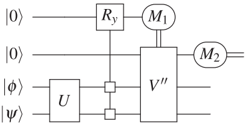
“ur quantum circuit learning and an analogy with a neural network structure is given in in Fig1. Recently, unitary architectures have also been considered for the training of classical neural networks [23,24]. Figure 1: Universal quantum circuit learning construction can be viewed as quantum neural networks. The unitar…”
BackgroundDesigning optimal quantum detectors via semidefinite programming
Eldar, Y. C., Megretski, A., & Verghese, G. C. (2003) · IEEE Transactions on Information Theory · doi:10.1109/tit.2003.809510 · Cited by 167 · cited 1×
“to allow for some small but non-zero errors to happen. We rely here on the formulation of the QSD problem as numerical optimization problem, where one attempts to optimize one of the figures of merit [37,38]. However, rather than performing solely the optimisation, we use a machine learning approach to build a hybrid o…”
MethodVariational algorithms for linear algebra
Xu, X., Sun, J., Endo, S., Li, Y., Benjamin, S. C., & Yuan, X. (2021) · Science Bulletin · doi:10.1016/j.scib.2021.06.023 · Cited by 163 · cited 1×
“Since fully error corrected quantum computers are not available yet, a recent stream of works proposed various applications for circuit learning (Banchi et al. 2016; Wan et al. 2017; Innocenti et al. 2018; Romero et al. 2017; Mitarai et al. 2018; Farhi and Neven 2018; Verdon et al. 2017; Li and Benjamin 2017; Grant et…”
BackgroundQuantum linear systems algorithms: a primerPreprint
Dervovic, D., Herbster, M., Mountney, P., Severini, S., Usher, N., & Wossnig, L. (2018) · arXiv (Cornell University) · doi:10.48550/arxiv.1802.08227 · Cited by 157 · cited 1×
“The underlying property which results in such quantum advantage is the ability of quantum computers to perform certain linear algebra operations faster than classical machines [8, 9, 10, 11, 12].”
BackgroundSelf-citationAn Adaptive Optimizer for Measurement-Frugal Variational Algorithms
Kübler, J. M., Arrasmith, A., Cincio, L., & Coles, P. J. (2020) · Quantum · doi:10.22331/q-2020-05-11-263 · Cited by 141
Optical Realization of Optimal Unambiguous Discrimination for Pure and Mixed Quantum States
Mohseni, M., Steinberg, A. M., & Bergou, J. A. (2004) · Physical Review Letters · doi:10.1103/physrevlett.93.200403 · Cited by 119
Self-citationSynthesis of quantum logic circuits
Shende, V. V., Bullock, S. S., & Markov, I. L. (2005) · Proceedings of the 2005 conference on Asia South Pacific design automation - ASP-DAC '05 · doi:10.1145/1120725.1120847 · Cited by 113
Quantum state discrimination and selected applications
Bergou, J. A. (2007) · Journal of Physics Conference Series · doi:10.1088/1742-6596/84/1/012001 · Cited by 108 · cited 1×
“defined as follows: one is given a quantum device in an unknown state ˆwhich is believed to be from a family of non-orthogonal states fˆ ig; the task is to design a measurement to optimally identify ˆ[33,34]. Our fundamental inability to perfectly discriminate non-orthogonal quantum states is one of the key features of…”
BackgroundLearning hard quantum distributions with variational autoencoders
Rocchetto, A., Grant, E., Strelchuk, S., Carleo, G., & Severini, S. (2018) · npj Quantum Information · doi:10.1038/s41534-018-0077-z · Cited by 107 · cited 1×
“Similar optimization procedures have been used in the context of variational auto-encoders both in classical machine learning (Sønderby et al. 2016), and in quantum machine learning applications (Rocchetto et al. 2018).”
MethodChen, J., Habif, J. L., Dutton, Z., Lazarus, R. S., & Guha, S. (2012) · Nature Photonics · doi:10.1038/nphoton.2012.113 · Cited by 104 · cited 2×
“chines or GANS [32]. Small-scale discriminative quantum circuit learning could be used for constructing non-trivial (e.g., POVM-based) receivers in quantum meteorology [28], sensing [29], and imaging [31]. 6 Acknowledgements We want to thank Raban Iten, Oliver Reardon-Smith and Roger Colbeck for valuable insights in p…”
MethodA quantum algorithm to train neural networks using low-depth circuits
Verdon, G., Broughton, M., & Biamonte, J. (2017) · arXiv · doi:10.48550/arxiv.1712.05304 · Cited by 87
A Semidefinite Programming Approach to Optimal Unambiguous Discrimination of Quantum States
Eldar, Y. C. (2002) · CERN Document Server (European Organization for Nuclear Research) · Cited by 87
Reduction theorems for optimal unambiguous state discrimination of density matrices
Raynal, P., Lütkenhaus, N., & van Enk, S. J. (2003) · Physical Review A · doi:10.1103/physreva.68.022308 · Cited by 79
Quantum gate learning in qubit networks: Toffoli gate without time-dependent control
Banchi, L., Pancotti, N., & Bose, S. (2016) · npj Quantum Information · doi:10.1038/npjqi.2016.19 · Cited by 74
Smoothed Analysis of Algorithms: Why the Simplex Algorithm Usually Takes Polynomial TimePreprint
Spielman, D. A., & Teng, S. (2001) · arXiv (Cornell University) · doi:10.48550/arxiv.cs/0111050 · Cited by 74
Learning hard quantum distributions with variational autoencoders
Rocchetto, A., Grant, E., Strelchuk, S., Carleo, G., & Severini, S. (2018) · UCL Discovery (University College London) · doi:10.3929/ethz-b-000276431 · Cited by 67
Ambainis, A. (2010) · arXiv (Cornell University) · doi:10.48550/arxiv.1010.4458 · Cited by 55 · cited 1×
“The underlying property which results in such quantum advantage is the ability of quantum computers to perform certain linear algebra operations faster than classical machines [8, 9, 10, 11, 12].”
BackgroundSupervised learning of time-independent Hamiltonians for gate design
Innocenti, L., Banchi, L., Ferraro, A., Bose, S., & Paternostro, M. (2020) · New Journal of Physics · doi:10.1088/1367-2630/ab8aaf · Cited by 49 · cited 1×
“Since fully error corrected quantum computers are not available yet, a recent stream of works proposed various applications for circuit learning (Banchi et al. 2016; Wan et al. 2017; Innocenti et al. 2018; Romero et al. 2017; Mitarai et al. 2018; Farhi and Neven 2018; Verdon et al. 2017; Li and Benjamin 2017; Grant et…”
BackgroundQuantum circuits for quantum channels
Iten, R., Colbeck, R., & Christandl, M. (2017) · Physical Review A · doi:10.1103/physreva.95.052316 · Cited by 38
Equation solving by simulation
Childs, A. M. (2009) · Nature Physics · doi:10.1038/nphys1473 · Cited by 31
Quantum circuit structure learningPreprint
Ostaszewski, M., Grant, E., & Benedetti, M. (2019) · arXiv (Cornell University) · Cited by 30
Optimal Universal Learning Machines for Quantum State Discrimination
Fanizza, M., Mari, A., & Giovannetti, V. (2019) · IEEE Transactions on Information Theory · doi:10.1109/tit.2019.2916646 · Cited by 30 · cited 1×
“This in particular distinguishes our work from previous results on quantum circuit learning, in particular very recent study in e.g. [ 43], who only optimise circuits for specific inputs.”
ResultSmaller two-qubit circuits for quantum communication and computation
Shende, V., Markov, I. L., & Bullock, S. S. (2004) · Design, Automation, and Test in Europe · doi:10.1109/date.2004.1269020 · Cited by 24 · cited 1×
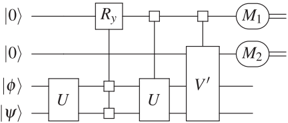
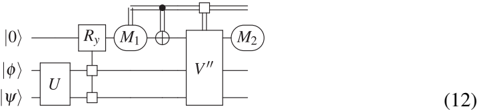
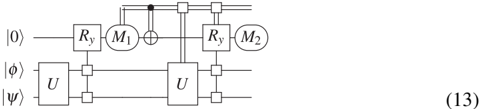
“0i R y M 1 y M 2 j˚i U U j i (A.6) The uniformly-controlled rotations and remaining two qubit unitary gates could be easily parametrised by CNOTs and single qubit rotations. For example, see [44] and [45]. B Adam algorithm for stochastic optimisation Here we provide a brief introduction to the Adam algorithm for stoch…”
MethodQuantum Inspired Training for Boltzmann Machines
Wiebe, N., Kapoor, A., Granade, C., & Svore, K. M. (2015) · arXiv (Cornell University) · doi:10.48550/arxiv.1507.02642 · Cited by 21 · cited 1×
“The circuit model of universal fault-tolerant quantum computers has been shown to offer a range of machine learning algorithms [4, 5, 6, 7] which could lead to considerable speed-ups under certain assumptions over classical counterparts.”
BackgroundQuantum algorithm for optical-template recognition with noise filtering
Schaller, G., & Schützhold, R. (2006) · Physical Review A · doi:10.1103/physreva.74.012303 · Cited by 21
Smaller two-qubit circuits for quantum communication and computation
Shende, V., Markov, I. L., & Bullock, S. S. (2004) · Design, Automation, and Test in Europe · doi:10.5555/968879.969163 · Cited by 17
Learning Unitary Operators with Help From u(n)
Hyland, S. L., & Rätsch, G. (2017) · Proceedings of the AAAI Conference on Artificial Intelligence · doi:10.1609/aaai.v31i1.10928 · Cited by 14 · cited 2×
“Recently, unitary architectures have also been considered for the training of classical neural networks [23, 24].”
BackgroundMitarai, K., Negoro, M., Kitagawa, M., et al. (2018) · Institutional Repositories DataBase (IRDB) · doi:10.48550/arxiv.1803.00745 · Cited by 9 · cited 3×
“Recent works focused on using quantum-classical hybrid methods for training quantum circuits for a range of tasks [15, 16, 17, 18, 19, 20, 21, 22].”
BackgroundMethodSaddle-free Hessian-free OptimizationPreprint
Arjovsky, M. (2015) · arXiv (Cornell University) · doi:10.48550/arxiv.1506.00059 · Cited by 3 · cited 1×
“pothesis. Since methods like Adam and RMSProp have been shown to perform particularly well in high-dimensional landscapes we suggest that the widely believed proliferation of saddle-points hypothesis [49,50,51,52,53] might also apply to quantum circuit training. However, in many practical applications stochastic gradi…”
MethodQuantum-classical truncated Newton method for high-dimensional energy landscapesPreprint
Wossnig, L., Tschiatschek, S., & Zohren, S. (2017) · arXiv (Cornell University) · doi:10.48550/arxiv.1710.07063 · Cited by 2 · cited 1×
“Since methods like Adam and RMSProp have been shown to perform particularly well in high-dimensional landscapes we suggest that the widely believed proliferation of saddle-points hypothesis [49, 50, 51, 52, 53] might also apply to quantum circuit training.”
MethodSelf-citationSupervised learning of time-independent Hamiltonians for gate design
Innocenti, L., Banchi, L., Ferraro, A., Bose, S., & Paternostro, M. (2019) · Quantum Information and Measurement (QIM) · doi:10.1364/qim.2019.f5a.28 · Cited by 2
Supervised Quantum State Discrimination
Fanizza, M., Mari, A., & Giovannetti, V. (2019) · Italian Quantum Information Science Conference (IQIS) · doi:10.3390/proceedings2019012021 · Cited by 1
Research works printed but not linked: 2
- Bennett CH (1992a) Quantum cryptography using any two nonorthog- onal states. Phys Rev Lett 68(21):3121 · DOI · Paper page
- Li Y, Benjamin SC (2017) Efficient variational quantum simulator incorporating active error minimization. Phys Rev X 7(2):021050
Cited by
Parameterized quantum circuits as machine learning models
Benedetti, M., Lloyd, E., Sack, S., & Fiorentini, M. (2019) · Quantum Science and Technology · doi:10.1088/2058-9565/ab4eb5 · Cited by 1,144
“Chen et al. [91] simulate the training of PQC models to classify quantum states as pure or mixed, including a third possible output associated with an inconclusive result.”
BackgroundEffect of data encoding on the expressive power of variational quantum-machine-learning models
Schuld, M., Sweke, R., & Meyer, J. J. (2021) · Physical Review A · doi:10.1103/physreva.103.032430 · Cited by 739
“[20] Hongxiang Chen, Leonard Wossnig, Simone Severini, Hartmut Neven, and Masoud Mohseni, “Universal discriminative quantum neural networks,” arXiv preprint arXiv:1805.”
BackgroundPennyLane: Automatic differentiation of hybrid quantum-classical computations
Bergholm, V., Izaac, J., Schuld, M., Gogolin, C., Ahmed, S., Ajith, V., Alam, M. S., Alonso-Linaje, G., AkashNarayanan, B., Asadi, A., et al. (2018) · arXiv · doi:10.48550/arxiv.1811.04968 · Cited by 732
“[16] Hongxiang Chen, Leonard Wossnig, Simone Severini, Hartmut Neven, and Masoud Mohseni, “Universal discriminative quantum neural networks,” arXiv preprint (2018), arxiv:1805.”
BackgroundQuantum Machine Learning for 6G Communication Networks: State-of-the-Art and Vision for the Future
Nawaz, S. J., Sharma, S. K., Wyne, S., Patwary, M. N., & Asaduzzaman, M. (2019) · IEEE Access · doi:10.1109/access.2019.2909490 · Cited by 658
“In this emerging framework, the ML techniques benefit from exploiting the quantum speedups, whereas the quantum devices’ uncertainties can be resolved with assistance from ML techniques [40].”
MethodContinuous-variable quantum neural networks
Killoran, N., Bromley, T. R., Arrazola, J. M., Schuld, M., Quesada, N., & Lloyd, S. (2018) · DSpace@MIT (Massachusetts Institute of Technology) · Cited by 360
Metadata
- Authors
- Chen, H., Wossnig, L., Severini, S., Neven, H., & Mohseni, M.
- Affiliations
- Rahko (United Kingdom) (GB)
- Google (United States) (US)
- Corresponding author
- Wossnig, L.
- Venue
- Quantum Machine Intelligence
- Published
- 2020-12-15
- Volume
- 3
- Issue
- 1
- ISSN
- 2524-4906 (ISSN-L)
- 2524-4914
- OpenAlex
- W2803434569
- Cited by
- 89
- References
- 77
- Citations by year
- 2026: 1 · 2025: 14 · 2024: 13 · 2023: 17 · 2022: 15 · 2021: 16 · 2020: 3
- FWCI
- 5.01
- Type
- journal article
- Language
- en
- Open access
- hybrid
- doi.org
- Licence
- cc-by
- creativecommons.org/licenses/by/4.0 (tdm)
- creativecommons.org/licenses/by/4.0 (vor)
- Locations
- Quantum Machine Intelligence (publishedVersion, cc-by)
- arXiv (Cornell University) (submittedVersion)
- arXiv (Cornell University)
- Funders
- Royal Society (Research Fellows enhancement award 180271)
- Engineering and Physical Sciences Research Council
- National Natural Science Foundation of China
- U.S. Department of Defense, UK Ministry of Defence and UK Engineering and Physical Sciences Research Council (ARO-MURI W911NF-17-1-0304)
- Topics
- Physical Sciences › Computer Science › Artificial Intelligence › Quantum Computing Algorithms and Architecture
- Physical Sciences › Physics and Astronomy › Atomic and Molecular Physics, and Optics › Quantum Information and Cryptography
- Physical Sciences › Physics and Astronomy › Atomic and Molecular Physics, and Optics › Quantum many-body systems
- Keywords
- quantum neural networks, quantum state discrimination, non-orthogonal quantum states, quantum circuit training, quantum machine learning, hybrid quantum-classical algorithms, quantum circuit optimization
About these checks
Registry, retraction, Cites and statistics results are computed, not judged, with one exception: a printed reference that no index lists is read once by a model before it counts as a citation error. Claims are extracted by a model and kept only when their quote appears verbatim in the text; each cited source is then checked, with a model’s help, for whether it says what the claim relies on. Those verdicts can be wrong — read the claim’s quote and the cited source before relying on one.
Statistics and arithmetic are recomputed, not judged.
Confidence bands are shown only for fields calibrated on our annotated test set. None is calibrated yet, so no band is shown.
What counts as a claim ›How we measure confidence ›How we check this ›
Are you an author, or do you see a problem with this page? Request a review
Data sources
Bibliographic data: Semantic Scholar, OpenAlex, Crossref.
Contains information from the Semantic Scholar Academic Graph Datasets, made available under the ODC Attribution License (ODC-BY 1.0).
Semantic Scholar’s data is described in: Kinney, R., et al. (2023). The Semantic Scholar Open Data Platform. arXiv:2301.10140.
