

Review of organic and inorganic pollutants removal by biochar and biochar-based composites
Open accessThe DOI matches its Crossref record; 213 of the 213 references it cites were found in a registry or an index; 2 of the 139 sources its claims cite were checked for support.
Abstract
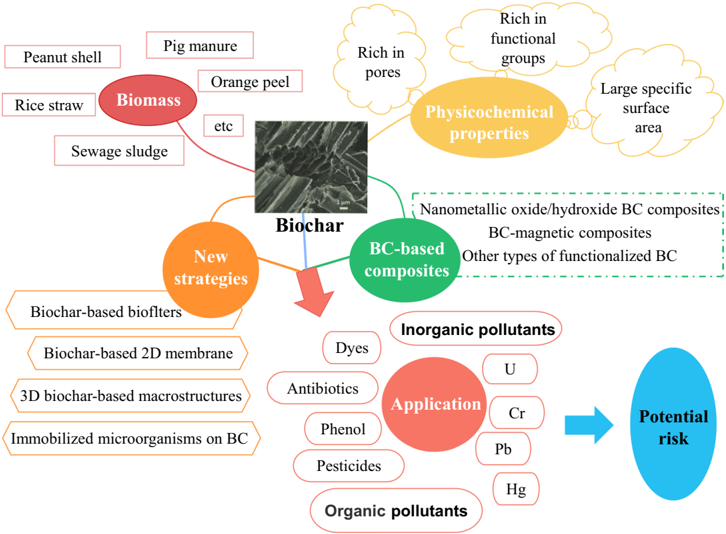
Abstract Biochar (BC) has exhibited a great potential to remove water contaminants due to its wide availability of raw materials, high surface area, developed pore structure, and low cost. However, the application of BC for water remediation has many limitations. Driven by the intense desire of overcoming unfavorable factors, a growing number of researchers have carried out to produce BC-based composite materials, which not only improved the physicochemical properties of BC, but also obtained a new composite material which combined the advantages of BC and other materials.
Overview
CoChat Summary
## TL;DR
This review summarizes how biochar and biochar-based composites are prepared, what physicochemical properties matter, and how they remove inorganic and organic pollutants from water and soil. It concludes that composite materials generally outperform pristine biochar, but stability, biological toxicity, and field validation remain major concerns.
## Key findings
- Pristine biochar showed pollutant removal capacities that the review reports as ranging from 7 × 10^-3 to 161.9 mg/g for inorganic pollutants and 10.4 to 610.1 mg/g for organic pollutants.
- Biochar-based composites improved removal performance: the review reports inorganic pollutant Qmax of 31 to 904 mg/g and that organic pollutant removal by composites was “more than 90%.”
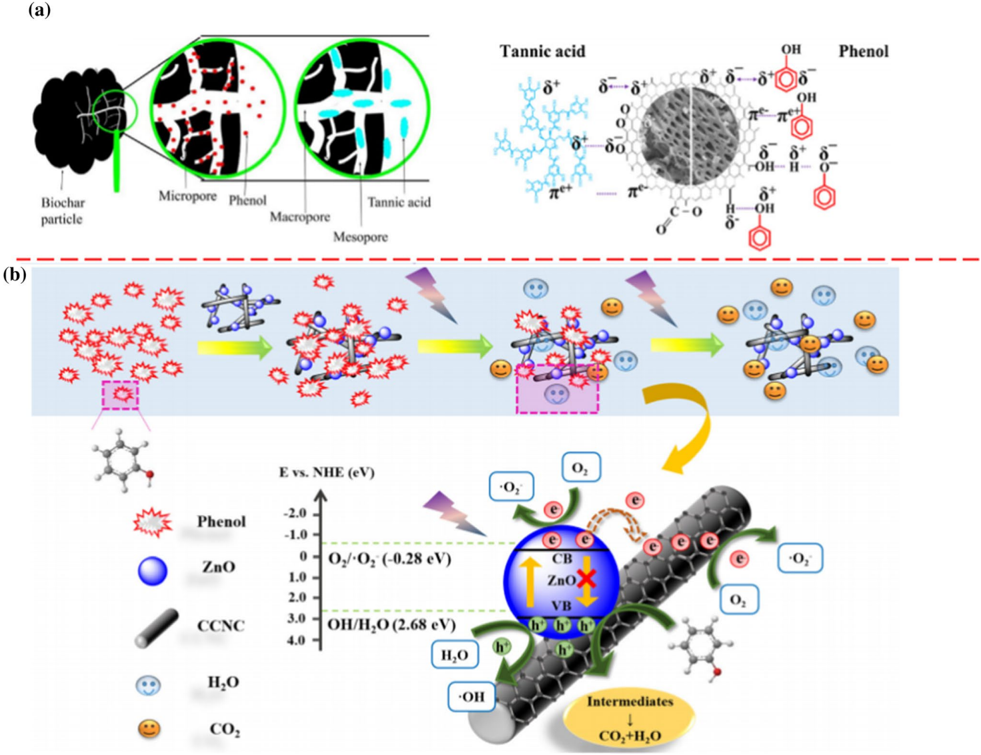
- Examples given include MnO2-biochar removing 100% U(VI) with qmax = 904 mg/g; TiO2-biochar raising Reactive Blue 69 removal from 63.8% to 98.1%; and ZnO-modified biochar achieving 95% photodegradation efficiency after 5 cycles for phenol.
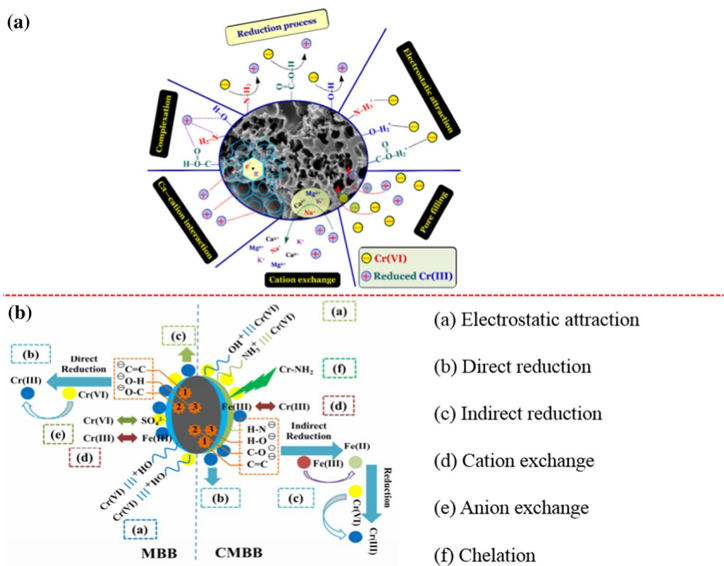
- For specific contaminants, the review reports Cr(VI) removal by pristine biochar through electrostatic attraction, reduction, and complexation, and gives examples such as BC450 removing almost 100% Cd(II) within 1 h and BC700 reducing soil soluble Cr by 93%.
## Methods
- This is a narrative review of prior studies on biochar and biochar-based composite materials, organized around preparation methods, physicochemical properties, contaminant removal performance, and adsorption/removal mechanisms.
- The review draws on published studies and summarizes them in tables (e.g., Tables 1–9), covering biochar preparation conditions, biochar/composite types, and reported adsorption capacities or removal rates.
- Main analysis is comparative synthesis of reported results across contaminant classes: heavy metals/inorganic pollutants and organic pollutants (dyes, phenols, antibiotics, pesticides), plus discussion of potential risks.
## Limitations
- The paper explicitly states that stability and biological toxicity of biochar-based composite materials still need attention and further study.
- It states that field trials are lacking and that most studies are laboratory-based, so laboratory conclusions may not translate directly to field conditions.
- It also states that the mechanisms are still inconclusive and that the relationships among biomass, preparation methods, and material properties are not clear enough.
- Evident from the text: the review is largely qualitative and literature-synthesizing, so it does not present a single controlled experimental dataset of its own.
Model-written summary. Check it against the paper before relying on it.
Integrity signals
Registry
Cites
Statistics
Figures

Verification
Claims the paper makes
2 Valid · 5 Not valid · 120 Not checked · 44 Own results and interpretations
In the paper
“Gao etal. (2020) co-pyrolyzed the mixture of rape straw and KH 2PO4 to prepare BC and the BC displayed a high immobilization capacity to heavy metals (Pb, Cu, and Cd).”
What the sources say
- Not matchedcites Gao etal. (2020)
An author–year citation the paper’s reference list doesn’t settle. We don’t search these by name.
plainstates an association- Asserted: passes — The authors put it forward as true.
- Checkable: passes — It can be checked against evidence.
- Load-bearing: unclear — It is unclear whether the paper’s conclusions depend on it.
- Based: passes — The paper gives a reason why it holds.
- Not matched
A result the paper states — it cites no source for it, so there is none to check. The quote shows it is in the paper.
In the paper
“The Q max of inorganic pollutants removal by BC-based composites ranged from 31 to 904mg/g.”
plain- Asserted: passes — The authors put it forward as true.
- Checkable: passes — It can be checked against evidence.
- Load-bearing: unclear — It is unclear whether the paper’s conclusions depend on it.
- Based: passes — The paper gives a reason why it holds.
A result the paper states — it cites no source for it, so there is none to check. The quote shows it is in the paper.
In the paper
“BC450 (produced at 450°C) showed a good removal efficiency (almost 100% Cd(II) from the aqueous solution within 1h).”
plainstates a cause- Asserted: passes — The authors put it forward as true.
- Checkable: passes — It can be checked against evidence.
- Load-bearing: unclear — It is unclear whether the paper’s conclusions depend on it.
- Based: passes — The paper gives a reason why it holds.
A result the paper states — it cites no source for it, so there is none to check. The quote shows it is in the paper.
In the paper
“the Q max of organic pollutant removal by the pristine BC ranged from 10.4 to 610.1mg/g”
plain- Asserted: passes — The authors put it forward as true.
- Checkable: passes — It can be checked against evidence.
- Load-bearing: unclear — It is unclear whether the paper’s conclusions depend on it.
- Based: passes — The paper gives a reason why it holds.
In the paper
“Wahab etal. (2013) reported that the melanoma cancer cells produced reactive oxygen species (ROS) and apoptosis after contact with nZnO.”
What the sources say
- Not matchedcites Wahab etal. (2013)
An author–year citation the paper’s reference list doesn’t settle. We don’t search these by name.
plainstates a cause- Asserted: passes — The authors put it forward as true.
- Checkable: passes — It can be checked against evidence.
- Load-bearing: unclear — It is unclear whether the paper’s conclusions depend on it.
- Based: passes — The paper gives a reason why it holds.
- Not matched
58 more claims
Create a free account to see all 171 claims and every source verdict.
- Probably not a substantial claim. 30
- It may state two separate claims as one. 88
- The quote only partly states this claim. 3
Self-check
Percentages, sums and reported differences re-computed from the paper’s own numbers.
Self-check results appear here once an independent check has confirmed them.
Cited works that were retracted
Works this paper cites that were later retracted, from the retraction notices publishers deposit. Major when the notice came out before this paper was published.
A note, not an issue: for example, a cited work that was retracted only after this paper was published, which its authors could not have known.
In the paper
“El-Naggar A, Lee MH, Hur J, Lee HY, Igalavithana AD, Shaheen SM, Ryu C, Rinklebe J, Tsang DCW, Ok YS (2019b) Biochar-induced metal immobilization and soil biogeochemical process: an integrated mechanistic approach. Sci Total Environ 698:134112”
Cited work 10.1016/j.scitotenv.2019.134112 · retracted 2026-08-26 · notice 10.1016/j.scitotenv.2026.182256 · this paper published 2021-07-07
Citations
Cites
1 retracted
Items 201–213 of 213
Effects of Temperature and Heating Rate on the Characteristics of Molded Bio-char
Li, A., Liu, H., Wang, H., Xu, H.-B., Jin, L.-F., Liu, J.-L., & Hu, J. (2016) · BioResources · doi:10.15376/biores.11.2.3259-3274 · Cited by 43
Biochar as an (Im)mobilizing Agent for the Potentially Toxic Elements in Contaminated Soils
Shaheen, S. M., El-Naggar, A., Wang, J., Hassan, N. E. E., Niazi, N. K., Wang, H., Tsang, D. C. W., Ok, Y. S., Bolan, N., & Rinklebe, J. (2019) · Biochar from Biomass and Waste · doi:10.1016/b978-0-12-811729-3.00014-5 · Cited by 43
Bioremediation of Crude Oil Contaminated Soil by Bioaugmentation ofPseudomonas fluorescensNS1
Barathi, S., & Vasudevan, N. (2003) · Journal of Environmental Science and Health Part A · doi:10.1081/ese-120022884 · Cited by 42 · cited 1×
“However, the microorganisms have low efficiency in removing high-concentration contaminants and compete with the indigenous microorganisms (Barathi and Vasudevan 2003).”
BackgroundYi, S., Sun, Y., Hu, X., Xu, H., Gao, B., & Wu, J. (2017) · Environmental Science and Pollution Research · doi:10.1007/s11356-016-8342-1 · Cited by 42
Potential Toxic Compounds in Biochar
Zheng, H., Liu, B., Liu, G., Cai, Z.-H., & Zhang, C. (2018) · Elsevier eBooks · doi:10.1016/b978-0-12-811729-3.00019-4 · Cited by 41
Bioaugmentation with Immobilized Microorganisms to Enhance Phytoremediation of PCB-Contaminated Soil
Pino, N. J., Múnera-Porras, L. M., & Peñuela, G. A. (2016) · Soil and Sediment Contamination An International Journal · doi:10.1080/15320383.2016.1148010 · Cited by 39
Baltrėnas, P., Baltrėnaitė, E., Kleiza, J., & Švedienė, J. (2016) · Journal of the Air & Waste Management Association · doi:10.1080/10962247.2016.1162227 · Cited by 39 · cited 3×
“1 3 effect on the yields (Braadbaart and Poole 2008). Zhao et al. (2018) claimed that the surface area and morphology were significantly influenced by residence time. The specific surface area increased with the increase of residence time, then decreased slightly, which may be owing to the fact that a longer residence…”
BackgroundResultInfluentialLiu, H.-Y., Song, C., Zhao, S., & Wang, S.-G. (2020) · Science of The Total Environment · doi:10.1016/j.scitotenv.2019.136086 · Cited by 27
Zhu, Y., Zheng, C. Q., Wu, S., Song, Y., & Hu, B. (2018) · Journal of Radioanalytical and Nuclear Chemistry · doi:10.1007/s10967-018-5839-8 · Cited by 26
Self-citationEnhanced Bio-Immobilization of Pb Contaminated Soil by Immobilized Bacteria with Biochar as Carrier
Zhang, X., Li, Y., & Li, H. (2017) · Polish Journal of Environmental Studies · doi:10.15244/pjoes/64908 · Cited by 25
Deepa, A., Prakash, P., & Mishra, B. K. (2019) · Environmental Technology · doi:10.1080/09593330.2019.1626912 · Cited by 18
Analisis Abrasi Pantai Pada Akses Jalan Bahumbelu – Morowali Sulawesi Tengah
Irwan, A. (2019) · JOURNAL OF APPLIED SCIENCE (JAPPS) · doi:10.36870/japps.v1i2.46 · Cited by 4
Adsorption of arsenic by birnessite-loaded biochar in water and soil
Wang, H. Y., Chen, P., & Sun, G. (2019) · CRC Press eBooks · doi:10.1201/9781351046633-97
Research works printed but not linked: 1
- NS1. J Environ Sci Health Part A Toxic/hazard Subst Environ Eng 38:1857-1866
Cited by
Biochar for the removal of contaminants from soil and water: a review
Qiu, M., Liu, L., Ling, Q., Cai, Y., Yu, S., Wang, S., Fu, D., Hu, B., & Wang, X. (2022) · Biochar · doi:10.1007/s42773-022-00146-1 · Cited by 690
Self-citationRecent advances in metal-organic framework membranes for water treatment: A review
Yu, S., Pang, H., Huang, S., Tang, H., Wang, S., Qiu, M., Chen, Z., Yang, H., Song, G., Fu, D., et al. (2021) · Science of The Total Environment · doi:10.1016/j.scitotenv.2021.149662 · Cited by 682
Self-citationModified biochar: synthesis and mechanism for removal of environmental heavy metals
Liu, Z., Xu, Z., Xu, L., Buyong, F., Chay, T. C., Li, Z., Cai, Y., Hu, B., Zhu, Y., & Wang, X. (2022) · Carbon Research · doi:10.1007/s44246-022-00007-3 · Cited by 426
Self-citationBilal, M., Ihsanullah, I., Younas, M., & Ul Hassan Shah, M. (2021) · Separation and Purification Technology · doi:10.1016/j.seppur.2021.119510 · Cited by 361
Lu, Y., Cai, Y., Zhang, S., Zhuang, L., Hu, B., Wang, S., Chen, J., & Wang, X. (2022) · Biochar · doi:10.1007/s42773-022-00173-y · Cited by 312
Self-citation
Metadata
- Authors
- Liang, L., Xi, F., Tan, W., Meng, X., Hu, B., & Wang, X.
- Affiliations
- Shaoxing University (CN)
- Corresponding author
- Hu, Baowei
- Wang, Xiangke
- Venue
- Biochar
- Published
- 2021-07-07
- Volume
- 3
- Issue
- 3
- Pages
- 255-281
- ISSN
- 2524-7867 (ISSN-L)
- 2524-7972
- OpenAlex
- W3177766267
- Cited by
- 662
- References
- 211
- Citations by year
- 2026: 83 · 2025: 104 · 2024: 124 · 2023: 122 · 2022: 172 · 2021: 57
- FWCI
- 35.30
- Type
- journal article
- Language
- en
- Open access
- hybrid
- doi.org
- Licence
- cc-by
- creativecommons.org/licenses/by/4.0 (tdm)
- creativecommons.org/licenses/by/4.0 (vor)
- Locations
- Biochar (publishedVersion, cc-by)
- Funders
- National Natural Science Foundation of China (41807468)
- Natural Science Foundation of Zhejiang Province (LY18E080018)
- Key Laboratory of Jiangsu Province for Chemical Pollution Control and Resources Reuse (PCRRF18021)
- Topics
- Physical Sciences › Environmental Science › Water Science and Technology › Adsorption and biosorption for pollutant removal
- Physical Sciences › Environmental Science › Environmental Engineering › Environmental remediation with nanomaterials
- Physical Sciences › Environmental Science › Water Science and Technology › Environmental and Analytical Chemistry Studies
- Keywords
- water pollutant removal, organic pollutants, inorganic contaminants, adsorption mechanism, water remediation, biochar physicochemical properties, biochar stability, biotoxicity
About these checks
Registry, retraction, Cites and statistics results are computed, not judged, with one exception: a printed reference that no index lists is read once by a model before it counts as a citation error. Claims are extracted by a model and kept only when their quote appears verbatim in the text; each cited source is then checked, with a model’s help, for whether it says what the claim relies on. Those verdicts can be wrong — read the claim’s quote and the cited source before relying on one.
The claim verdicts this report counts are experimental: their accuracy is not yet measured.
A language model drew the claims from the paper on 2026-10-10, under version 3 of the claim definition (model deepseek-v4.1-flash, prompt extract-v3).
A second model labelled each claim on 2026-10-10 (model jev-1.13-20260917, definition revision gold-guideline-v0.2).
Statistics and arithmetic are recomputed, not judged.
Confidence bands are shown only for fields calibrated on our annotated test set. None is calibrated yet, so no band is shown.
What counts as a claim ›How we measure confidence ›How we check this ›
Are you an author, or do you see a problem with this page? Request a review
Data sources
Bibliographic data: Semantic Scholar, OpenAlex, Crossref.
Contains information from the Semantic Scholar Academic Graph Datasets, made available under the ODC Attribution License (ODC-BY 1.0).
Semantic Scholar’s data is described in: Kinney, R., et al. (2023). The Semantic Scholar Open Data Platform. arXiv:2301.10140.
