

A review and analysis of extraction methods for aluminum and oxygen from Lunar Regolith
Open accessThe DOI matches its Crossref record; 58 of the 58 references it cites were found in a registry or an index; 4 of the 55 sources its claims cite were checked for support.
Abstract
This review compares three prominent ISRU technologies—Carbothermal Reduction (CTR), Molten Salt Electrolysis (MSE), and Molten Regolith Electrolysis (MRE)—for producing aluminum and oxygen from lunar regolith, highlighting outputs, energy needs, lunar adaptability, and technological gaps.
Overview
CoChat Summary
TL;DR
This review and thermodynamic analysis compares carbothermal reduction (CTR), molten salt electrolysis (MSE, via LISAP-MSE), and molten regolith electrolysis (MRE) for co-producing aluminum and oxygen from lunar anorthite. It reports that all three pathways are endothermic and non-spontaneous under the evaluated conditions, with LISAP-MSE stated to have the lowest energy requirement but slower oxygen production, while CTR and MRE offer high oxygen output and low-purity alloys.
Key findings
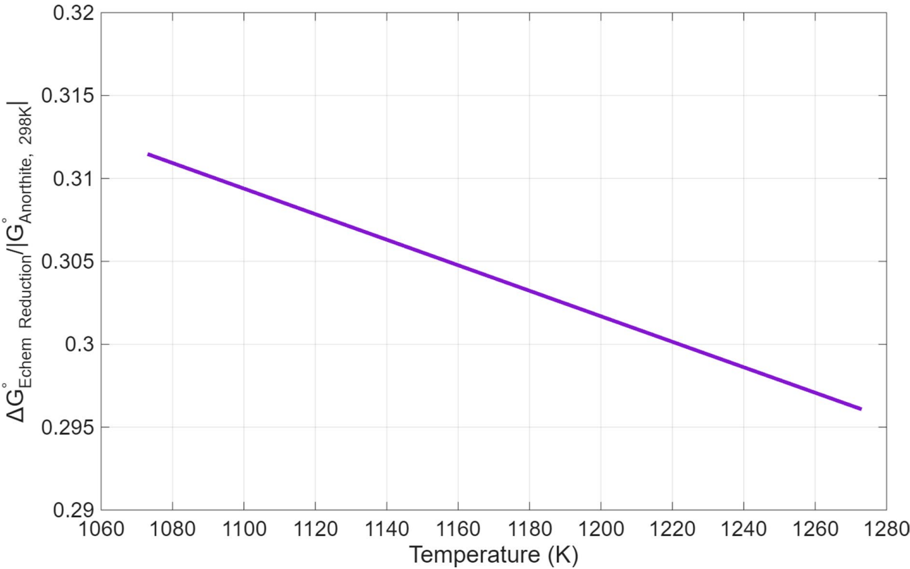
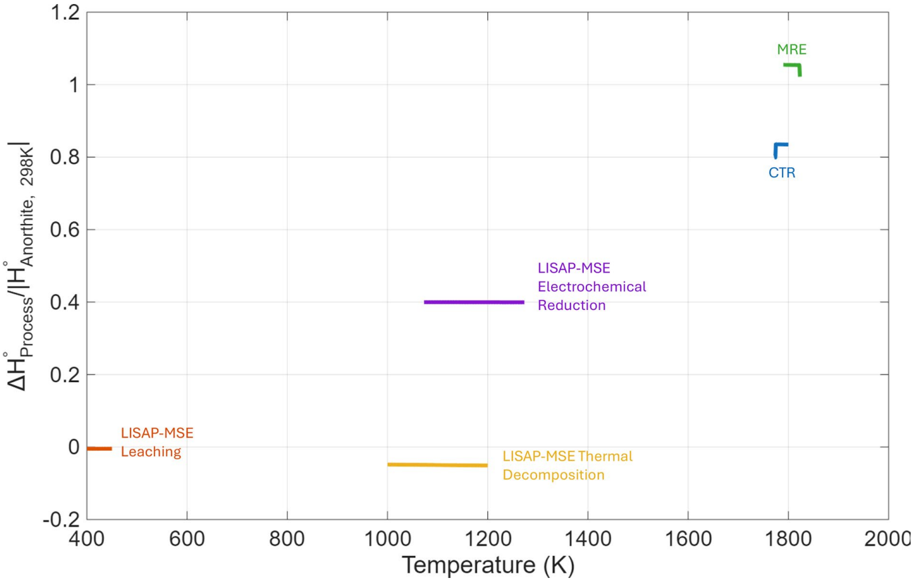
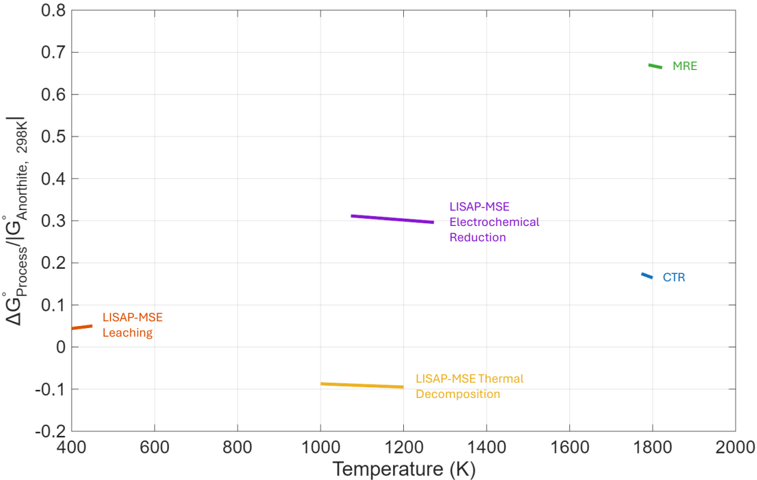
- For anorthite feedstock, all three processes show positive ΔH and ΔG, requiring external energy. The paper states LISAP-MSE has the lowest overall ΔH and ΔG among the three; Table 2 reports per kg Al: CTR <65,562 kJ ΔH and <13,867 kJ ΔG; LISAP-MSE [26,941, 27,240] kJ ΔH and [19,501, 21,823] kJ ΔG; MRE <80,195 kJ ΔH and <52,775 kJ ΔG.
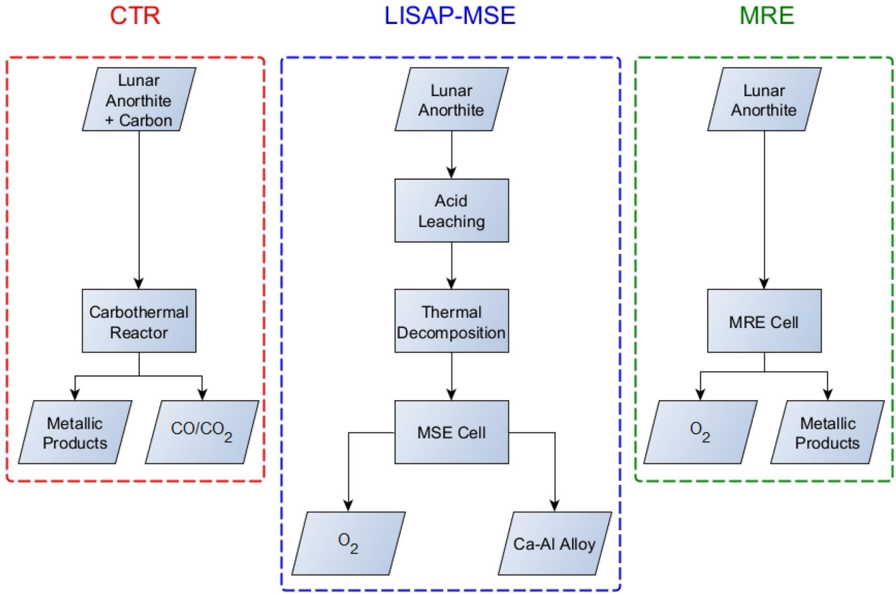
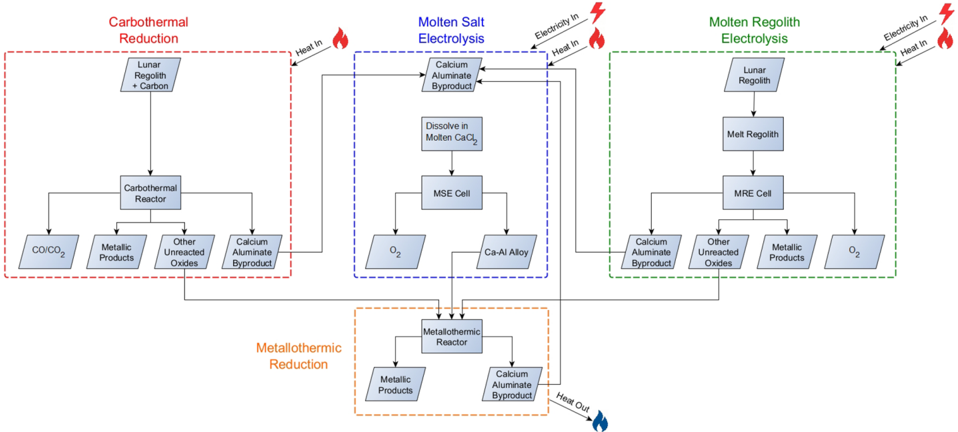
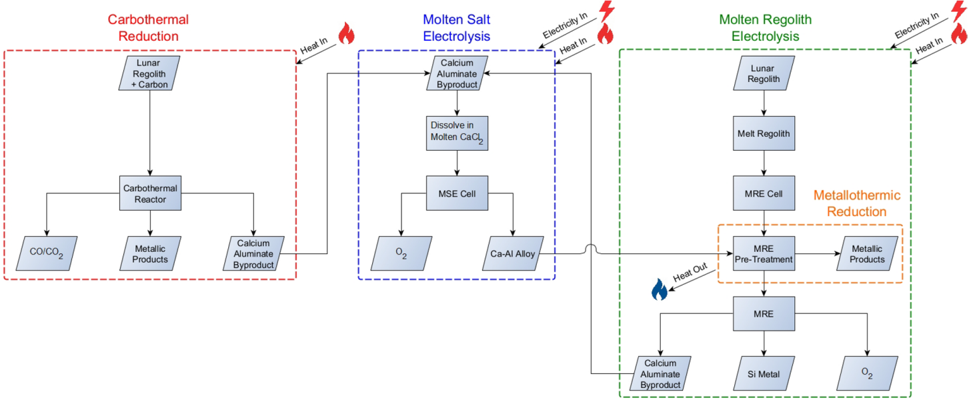
- Operating conditions and products differ: CTR operates at minimum 1773 K, uses carbon, and produces metal alloy + COx + slag; LISAP-MSE operates at maximum 1273 K, uses beneficiated anorthite + CaCl2, and produces Al metal + O2; MRE operates at minimum 1823 K, processes unrefined regolith, and produces metal alloy + O2 + slag.
- TRLs are reported as CTR 6, MSE 4, and MRE 5. Key gaps include carbon sourcing, CaCl2 melt durability, electrode durability, material survivability, power optimization, scalability, I/O automation, and thermal uniformity.
- Prior CTR studies report oxygen yields of only 2.4–7.9 wt% of feedstock, corresponding to 5.4–17.5% of total available oxygen. Pilot systems require at least 2.54 kg/hr regolith delivery for 10,000 kg O2/yr assuming bulk regolith is 45% O2 by mass.
Methods
- Review and first-principles thermodynamic comparison using anorthite (CaAl2Si2O8) as a representative highlands feedstock, assuming complete conversion to elemental products as an upper-bound theoretical extraction limit.
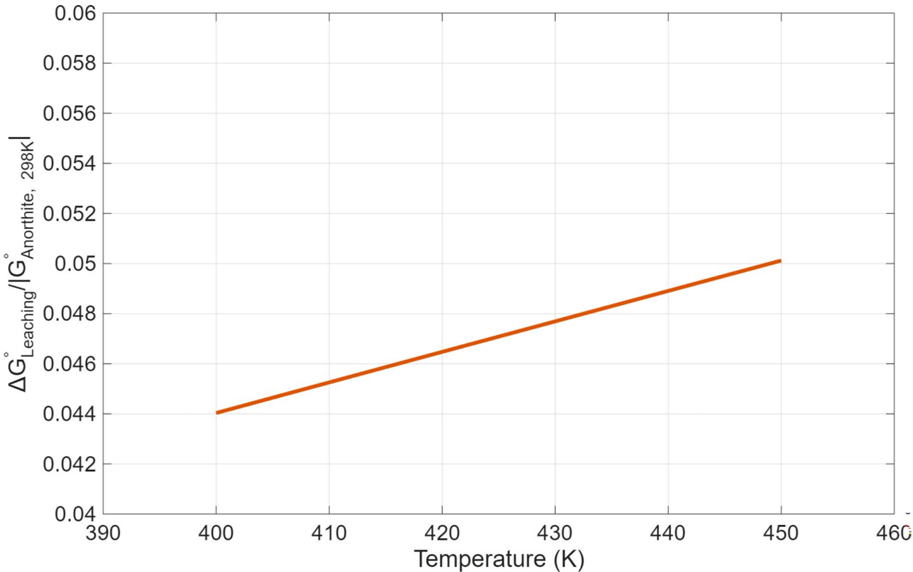
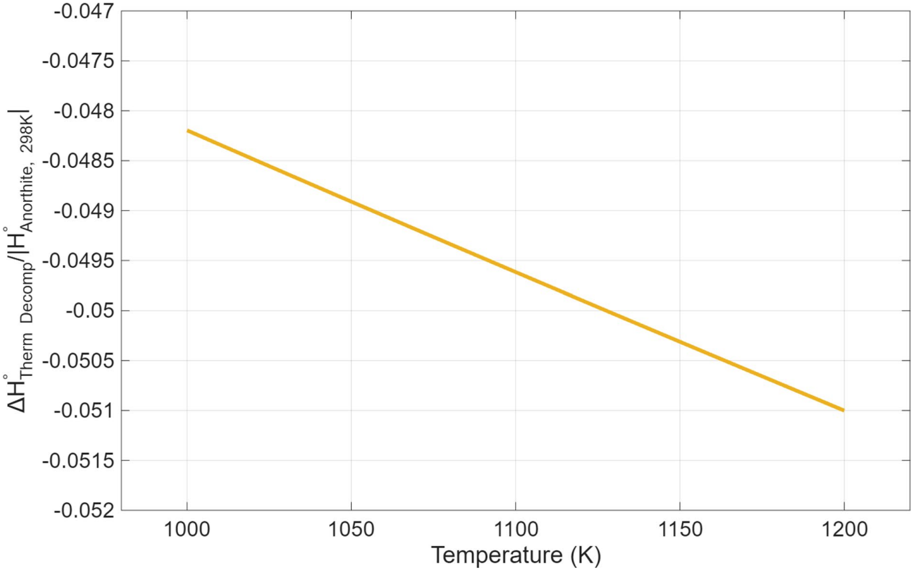
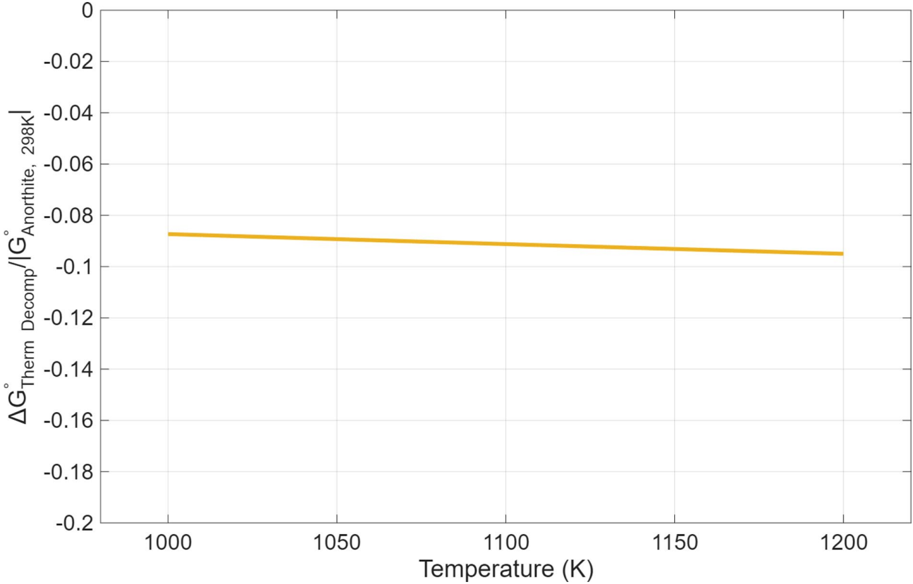
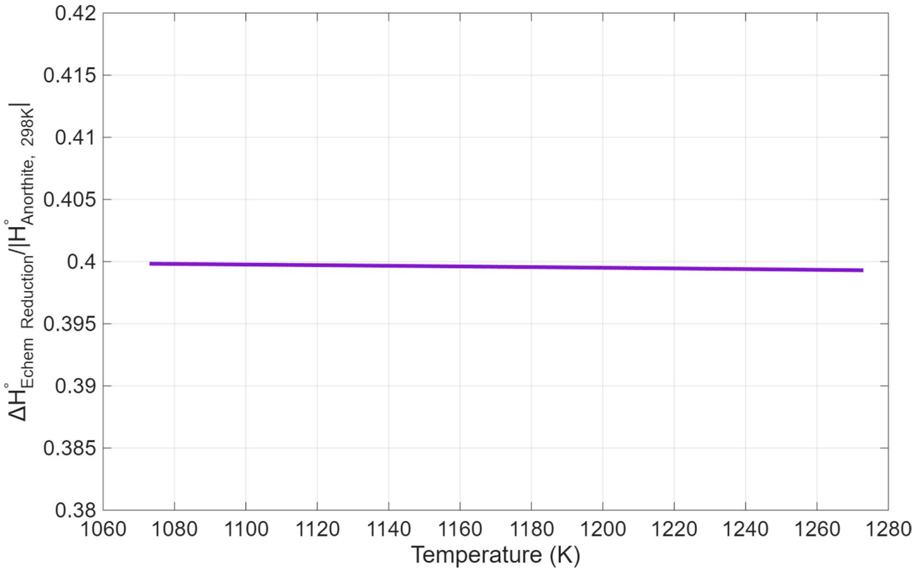
- Temperature-adjusted enthalpy, entropy, and Gibbs free energy were calculated using heat-capacity integrals, Shomate equation fits, supplemental thermochemical data, and phase-change latent heats; CTR, LISAP-MSE stages (acid leaching, thermal decomposition, electrolytic reduction), and MRE were evaluated and normalized per kg Al/O and per mole anorthite.
- Data availability states no datasets were generated or analysed; thermodynamic parameters are compiled in Appendix A.
Limitations
- Stated: comparisons are specific to simultaneous aluminum and oxygen production from anorthositic feedstock; rankings may shift if oxygen is prioritized, if Fe/Si/Ti extraction is targeted, or if mare-derived regolith compositions are considered.
- Stated: the complete-reduction assumption gives theoretical upper bounds; practical efficiencies vary due to kinetics, mass transport, and reactor-specific conditions, and the analysis neglects radiative losses, minor side reactions, and interfacial/transport effects.
- Stated: anorthite thermodynamic data are reliable only to approximately 1800 K, with extension to 1823 K introducing minimal uncertainty; pre-processing is treated explicitly for LISAP-MSE, but some feedstock conditioning is likely required for all approaches, so the apparent simplicity of CTR and MRE may underrepresent operational preparation requirements. Evident: no experimental validation is presented; conclusions are thermodynamic and system-level review findings.
Model-written summary. Check it against the paper before relying on it.
Integrity signals
Registry
Cites
Statistics
Figures
Verification
Claims the paper makes
3 Valid · 6 Not valid · 25 Not checked · 147 Own results and interpretations
The cited sources that could be checked couldn’t confirm or dispute this claim.
In the paper
“For CaCl 2 , a commonly researched salt, this operating temperature typically falls between 800 • C and 1000 • C.”
- Also stated in: § Introduction · plain
“It allows for the reduction of metal oxides from lunar regolith at temperatures ranging from 800-1000 • C (Chen 2020; Mohandas and Fray 2004;Schwandt et al. 2012;Kilby et al. 2006;Jin et al. 2004;Jiang et al. 2006;Liu et al. 2017).”
§ A review and analysis of extraction methods for aluminum and oxygen from Lunar Regolith > Abstract
What the sources say
- Could not verifycites Chen 2020 matched to “Interactions of molten salts with cathode products in the FFC Cambridge Process” (2020) sourceExperimental — accuracy not yet measured
The available overview says molten salts provide high temperatures for electrolysis but gives no operating range for CaCl2. Searches for 800°C, 1000°C, and CaCl2 operating temperature returned no passage establishing that 800–1000°C is typical; the temperature-bearing reference entry concerns a CaCl2–NaCl mixture at 550°C. (LLM, conf=0.71)
- Not matchedcites Mohandas and Fray 2004
An author–year citation the paper’s reference list doesn’t settle. We don’t search these by name.
- Not checked — no full text of the sourcecites Schwandt et al. 2012 matched to “The production of oxygen and metal from lunar regolith” (2012) source
plain- Asserted: passes — The authors put it forward as true.
- Checkable: passes — It can be checked against evidence.
- Load-bearing: unclear — It is unclear whether the paper’s conclusions depend on it.
- Based: passes — The paper gives a reason why it holds.
- Also stated in: § Introduction · plain
Every source the paper cites for this claim was checked and supports it.
In the paper
“prior studies of carbothermal reduction applied to lunar regolith report oxygen yields of only 2.4 7.9 wt % of the feedstock, corresponding to 5.4 17.5 % of the total available oxygen, with strong dependence on operating conditions and mineralogy Troisi et al. (2022).”
§ A review and analysis of extraction methods for aluminum and oxygen from Lunar Regolith > Framework and thermodynamic evaluation of CTR, MSE, and MRE
What the sources say
- Supportedcites Troisi et al. (2022) matched to “Oxygen extraction from lunar dry regolith: Thermodynamic numerical characterization of the carbothermal reduction” (2022) source
Split into 2 atoms — 2 confirmed, 0 partially supported, 0 disputed, 0 misattributed, 0 unverifiable. Expand the claim to see per-atom verdicts.
plainstates an association- Asserted: passes — The authors put it forward as true.
- Checkable: passes — It can be checked against evidence.
- Load-bearing: passes — The paper’s conclusions depend on it.
- Based: passes — The paper gives a reason why it holds.
- Supported
A result the paper states — it cites no source for it, so there is none to check. The quote shows it is in the paper.
In the paper
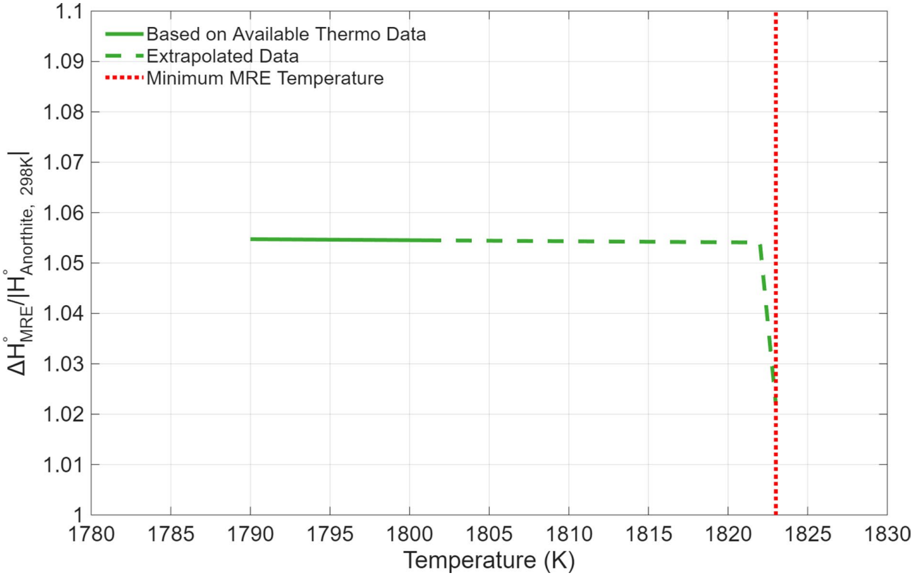
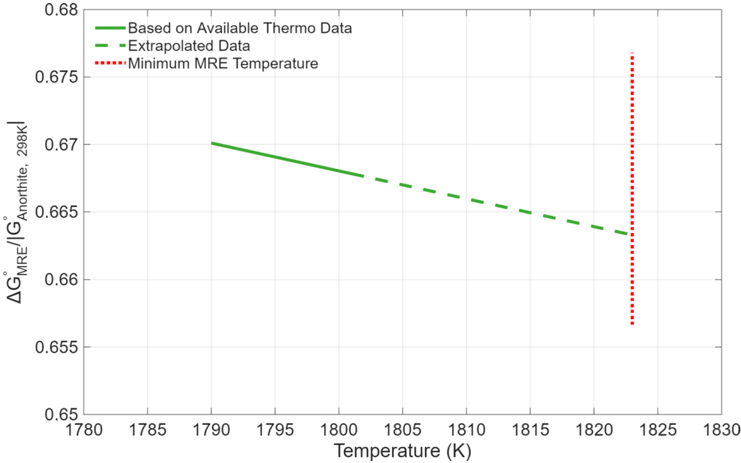
“The changes in heat capacity and enthalpy over this narrow temperature range are small relative to the total energy of the system and do not meaningfully affect the calculated spontaneity.”
§ A review and analysis of extraction methods for aluminum and oxygen from Lunar Regolith > MRE
plain- Asserted: passes — The authors put it forward as true.
- Checkable: passes — It can be checked against evidence.
- Load-bearing: passes — The paper’s conclusions depend on it.
- Based: passes — The paper gives a reason why it holds.
A result the paper reports from its own data — it cites no other source for it, so there is none to check. The quote shows it is in the paper.
In the paper
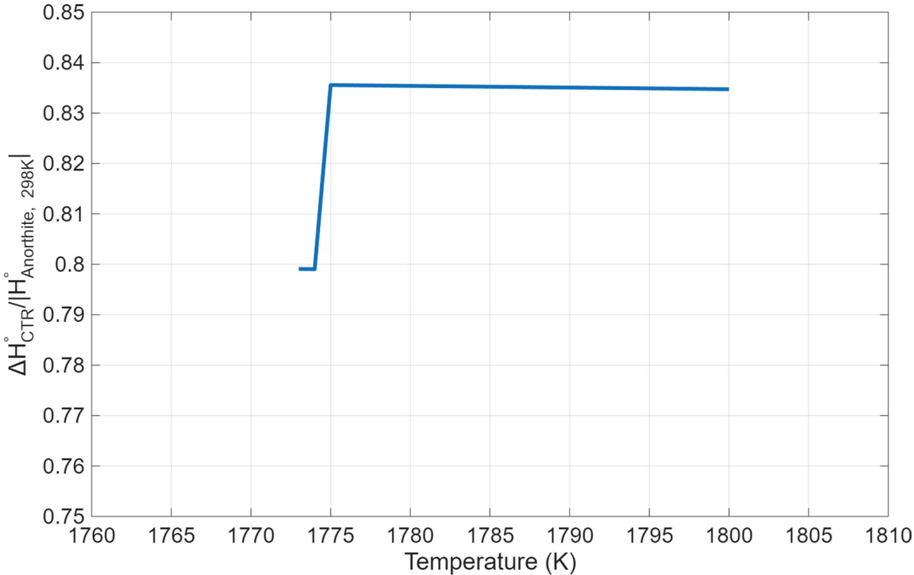
“The enthalpy shows a small increase associated with the phase transition and thermal input, consistent with the endothermic nature of the process.”
§ A review and analysis of extraction methods for aluminum and oxygen from Lunar Regolith > MRE
plainstates an association- Asserted: passes — The authors put it forward as true.
- Checkable: passes — It can be checked against evidence.
- Load-bearing: unclear — It is unclear whether the paper’s conclusions depend on it.
- Based: passes — The paper gives a reason why it holds.
A result the paper reports from its own data — it cites no other source for it, so there is none to check. The quote shows it is in the paper.
In the paper
“The thermal decomposition reaction remains spontaneous across the evaluated temperature range.”
§ A review and analysis of extraction methods for aluminum and oxygen from Lunar Regolith > Thermal decomposition processes
plain- Asserted: passes — The authors put it forward as true.
- Checkable: passes — It can be checked against evidence.
- Load-bearing: passes — The paper’s conclusions depend on it.
- Based: passes — The paper gives a reason why it holds.
79 more claims
Create a free account to see all 181 claims and to verify the 5 references still open.
- It may state two separate claims as one. 70
- Probably not a substantial claim. 39
- The quote only partly states this claim. 1
Self-check
Percentages, sums and reported differences re-computed from the paper’s own numbers.
Each contradiction between two passages listed here was confirmed by an independent check.
Rated major: it would touch a result — a value a result rests on, reported and recomputed p-values on opposite sides of the significance level, two passages that conflict with no sign which is right, or a cited work retracted before this paper was published.
In the paper
§ A review and analysis of extraction methods for aluminum and oxygen from Lunar Regolith > Conclusions
“The thermodynamic evaluation indicates that LISAP-MSE requires the lowest ∆H • and ∆G • among the three pathways at relevant operating temperatures”
§ A review and analysis of extraction methods for aluminum and oxygen from Lunar Regolith > Appendix A summary of thermodynamic parameters
“| ∆G • per mole Anorthite (kJ) | < 748.24 | [1,052.3, 1,177.6] | < 2,847.8 | |”
Rated minor: it would not touch a result — a value no result rests on, a p-value that stays on the same side of the significance level, or a conflict that is clerical, resolved elsewhere in the paper, or outside its own findings.
In the paper
§ A review and analysis of extraction methods for aluminum and oxygen from Lunar Regolith > Appendix A summary of thermodynamic parameters
“| ∆H • per mole Anorthite (kJ) | < 3,537.7 | [1,453.8, 1,469.9] | < 4,327.3 | |”
§ A review and analysis of extraction methods for aluminum and oxygen from Lunar Regolith > Appendix A summary of thermodynamic parameters
“| MRE | 1790 | 4.4657×10 6 | 887.55 | 2.8770×10 6 |”
Rated minor: it would not touch a result — a value no result rests on, a p-value that stays on the same side of the significance level, or a conflict that is clerical, resolved elsewhere in the paper, or outside its own findings.
In the paper
§ A review and analysis of extraction methods for aluminum and oxygen from Lunar Regolith > MRE
“The enthalpy shows a small increase associated with the phase transition and thermal input, consistent with the endothermic nature of the process.”
§ A review and analysis of extraction methods for aluminum and oxygen from Lunar Regolith > Appendix A summary of thermodynamic parameters
“| MRE | 1790 | 4.4657×10 6 | 887.55 | 2.8770×10 6 | | | 1823 | 4.3273×10 6 | 811.60 | 2.8478×10 6 |”
Rated minor: it would not touch a result — a value no result rests on, a p-value that stays on the same side of the significance level, or a conflict that is clerical, resolved elsewhere in the paper, or outside its own findings.
In the paper
§ A review and analysis of extraction methods for aluminum and oxygen from Lunar Regolith > Comparison of thermodynamic quantities for simultaneous aluminum and oxygen production using CTR, LISAP-MSE, and MRE
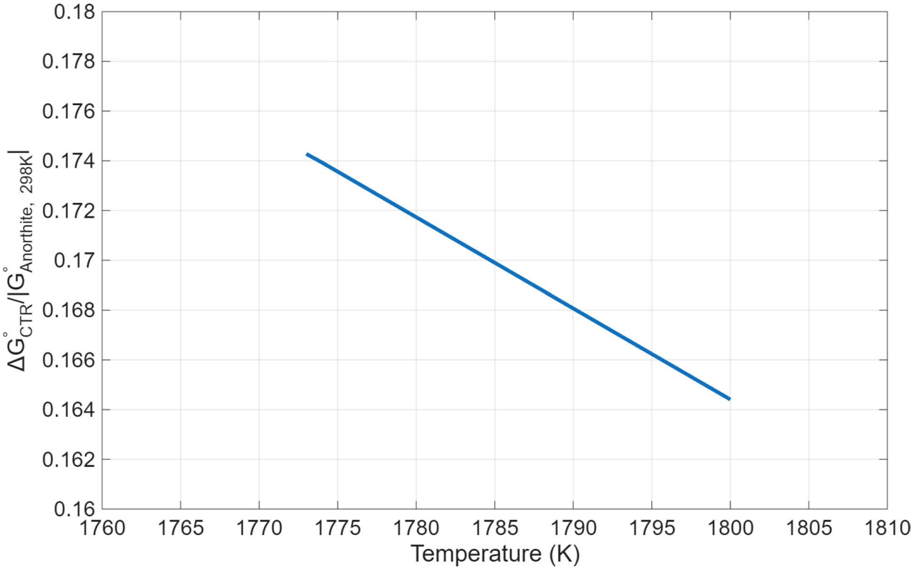
“For CTR and MRE, both ∆H • and ∆G • decrease with increasing temperature once melting has begun.”
§ A review and analysis of extraction methods for aluminum and oxygen from Lunar Regolith > Appendix A summary of thermodynamic parameters
“| CTR | 1773 | 3.3833×10 6 | 1,486.2 | 7.4824×10 5 | | | 1800 | 3.5342×10 6 | 1,571.3 | 7.0587×10 5 |”
Citations
Cites
Direct electrochemical reduction of titanium dioxide to titanium in molten calcium chloride
Chen, G. Z., Fray, D. J., & Farthing, T. W. (2000) · Nature · doi:10.1038/35030069 · Cited by 1,537
Crawford, I. A. (2015) · Progress in Physical Geography: Earth and Environment · doi:10.1177/0309133314567585 · Cited by 348 · cited 1×
“Given the 14-day lunar night, reactors may remain dormant for extended periods; dust-resistant covers or hibernation protocols will be critical to protect equipment during these off-cycles (Crawford 2015; Sanders and Larson 2013).”
A new concept for producing Ti sponge: Calciothermic reduction
Ono, K., & Suzuki, R. O. (2002) · JOM · doi:10.1007/bf02701078 · Cited by 308
Electrochemical Preparation of Silicon and Its Alloys from Solid Oxides in Molten Calcium Chloride
Jin, X., Gao, P., Wang, D., Hu, X., & Chen, G. Z. (2004) · Angewandte Chemie International Edition · doi:10.1002/anie.200352786 · Cited by 214
The production of oxygen and metal from lunar regolith
Schwandt, C., Hamilton, J. A., Fray, D. J., & Crawford, I. A. (2012) · Planetary and Space Science · doi:10.1016/j.pss.2012.06.011 · Cited by 186
Sanders, G. B., & Larson, W. E. (2013) · Journal of Aerospace Engineering · doi:10.1061/(asce)as.1943-5525.0000208 · Cited by 173 · cited 5×
“ISRU pathways that minimize exotic materials are more logistically viable, suggesting early systems will rely heavily on imported components until in-situ ceramic processing becomes feasible (Sanders and Larson 2013; Yu et al. 2025; Chen et al. 2000).”
InfluentialNovel metallurgical process for titanium production
Jiao, S., & Zhu, H. (2006) · Journal of Materials Research · doi:10.1557/jmr.2006.0268 · Cited by 162
Lomax, B. A., Conti, M., Khan, N., Bennett, N. S., Ganin, A. Y., & Symes, M. D. (2020) · Planetary and Space Science · doi:10.1016/j.pss.2019.104748 · Cited by 161 · cited 2×
“MSE is an electrochemical process that enables the reduction of oxide species within a molten salt electrolyte, offer - ing a controllable and efficient pathway for lunar ISRU applications (Lomax et al. 2025, 2020; Schild et al. 2025; Burke et al. 2024; Ortega et al. 2025).”
The specific heat of graphite: An evaluation of measurements
(1973) · doi:10.1016/0022-3115(73)90060-3 · Cited by 157
Halmann, M. M., Frei, A., & Steinfeld, A. (2007) · Energy · doi:10.1016/j.energy.2007.06.002 · Cited by 117
Research works printed but not linked: 9
- 12. Dean, J.A.: Lange's Handbook of Chemistry, McGraw-Hill Inc (1999). (15th edn)
- 23. X Heiken, G., Vaniman, D., French, B.M.: Lunar Sourcebook: A User's Guide to the Moon, Cambridge University Press (2005)
- 29. Kilby, K.C.T., Centeno, L., Doughty, G., et al.: The Electrochemical Production of Oxygen and Metal via the FFC-Cambridge Pro- cess. Space Resources Roundtable 8, 64-65 (2006)
- 31. Koziol, A.M., Newton, R.C.: Redetermination of the Anorthite Break- down Reaction and Improvement of the Plagioclase-Garnet-Al 2 SiO 5 -Quartz Geobarometer. Am. Miner. 73, 216-223 (1988)
- 32. Krupka, K.M., Robie, R.A., Hemingway, B.S.: High-temperature heat capacities of corundum, periclase, anorthite, CaAl 2 SiO 8 glass, muscovite, pyrophtllite, KAlSi 3 O 8 glass, grossular, and NaAlSi 3 O 8 glass. Am. Miner. 64(86), 101 (1979)
- 33. Lide, D.R.: CRC Handbook of Chemistry and Physics, 85th edn. CRC Press, Boca Raton (2004)
- 42. Mohandas, K.S., Fray, D.: FFC Cambridge Process and Removal of Oxygen from Metal-Oxygen Systems by Molten Salt Electroly- sis: an Overview. Trans. Indian Inst. Met. 57(6), 579-592 (2004)
- 44. Moon to Mars Objectives. NASA (2022). (Tech report) Space and Planetary Resources (2026) 2:5 Multiple industry contributors (Fibertek, Redwire, Blue Origin, Hon- eybee Robotics, et al.) (2025) The Commercial Lunar Economy Field Guide: a Vision for Industry on the Moon in the Next Decade. Air University Press, Maxwell Air Force Base, AL, URL h t t p s : / / w w w . 2020) NASA's plan for sustained lunar exploration and devel- opment. Tech report, NASA, URL h t / /
- 52. Rosenberg, S.D., Musbah, O., Rice, E.E.: Carbothermal Reduction of Lunar Materials for Oxygen Production on the Moon: reduc- tion of Lunar Simulants with Carbon. In: Proceedings of the 27th Lunar and Planetary Science Conference (1996)
Cited by
Coffman, B. A., Ortega, J. N., Bachle, P. F., Smith, J., Rezaei, F., Bayless, D., Schonberg, W. P., Runyon, K. D., & Han, D. (2026) · Acta Astronautica · doi:10.1016/j.actaastro.2026.09.032
Self-citation
Metadata
- Authors
- Ortega, J. N., Rupp, B., & Han, F. D.
- Affiliations
- Missouri University of Science and Technology (US)
- Marshall Space Flight Center (US)
- Corresponding author
- Ortega, Jacob N.
- Rupp, Benjamin
- Han, Frank D.
- ORCID
- Rupp, Benjamin
- Venue
- Space and Planetary Resources
- Published
- 2026-06-03
- Volume
- 2
- Issue
- 1
- ISSN
- 3059-4502 (ISSN-L)
- OpenAlex
- W7163326083
- Cited by
- 1
- References
- 53
- Citations by year
- 2026: 1
- FWCI
- 3.09
- Type
- journal article
- Language
- en
- Open access
- hybrid
- doi.org
- Licence
- cc-by-nc-nd
- creativecommons.org/licenses/by-nc-nd/4.0 (tdm)
- creativecommons.org/licenses/by-nc-nd/4.0 (vor)
- Locations
- Space and Planetary Resources (publishedVersion, cc-by-nc-nd)
- Funders
- NASA (80NSSC25K0260)
- Missouri University of Science and Technology
- Topics
- Physical Sciences › Earth and Planetary Sciences › Space and Planetary Science › Planetary Science and Exploration
- Physical Sciences › Chemistry › Electrochemistry › Molten salt chemistry and electrochemical processes
- Physical Sciences › Engineering › Aerospace Engineering › Space Exploration and Technology
- Keywords
- lunar regolith, in-situ resource utilization, aluminum extraction, oxygen production, carbothermal reduction, molten salt electrolysis, energy requirements
About these checks
Registry, retraction, Cites and statistics results are computed, not judged, with one exception: a printed reference that no index lists is read once by a model before it counts as a citation error. Claims are extracted by a model and kept only when their quote appears verbatim in the text; each cited source is then checked, with a model’s help, for whether it says what the claim relies on. Those verdicts can be wrong — read the claim’s quote and the cited source before relying on one.
The claim verdicts this report counts are experimental: their accuracy is not yet measured.
A language model drew the claims from the paper on 2026-10-10, under version 3 of the claim definition (model deepseek-v4.1-flash, prompt extract-v3).
A second model labelled each claim on 2026-10-10 (model jev-1.13-20260917, definition revision gold-guideline-v0.2).
Cited sources are checked with a language model’s help (gpt-6-sol).
Statistics and arithmetic are recomputed, not judged.
Confidence bands are shown only for fields calibrated on our annotated test set. None is calibrated yet, so no band is shown.
What counts as a claim ›How we measure confidence ›How we check this ›
Are you an author, or do you see a problem with this page? Request a review
How to cite
Cite CoChat for the checks on this page, and the paper for its own findings.
- This page
- CoChat. (2026). Citation check: A review and analysis of extraction methods for aluminum and oxygen from Lunar Regolith. https://app.cochat.ai/papers/10.1007/s44461-026-00010-1
- The paper
- Ortega, J. N., Rupp, B., & Han, F. D. (2026). A review and analysis of extraction methods for aluminum and oxygen from Lunar Regolith. Space and Planetary Resources. https://doi.org/10.1007/s44461-026-00010-1
Data sources
Bibliographic data: Semantic Scholar, OpenAlex, Crossref.
Contains information from the Semantic Scholar Academic Graph Datasets, made available under the ODC Attribution License (ODC-BY 1.0).
Semantic Scholar’s data is described in: Kinney, R., et al. (2023). The Semantic Scholar Open Data Platform. arXiv:2301.10140.
