

Risk of cardiac events in family members of patients with long QT syndrome
Open accessThe DOI matches its Crossref record; 27 of the 29 references it cites were found in a registry or an index.
Abstract
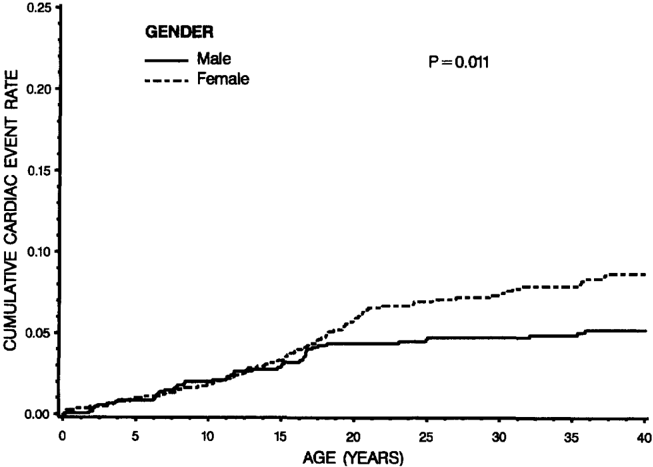
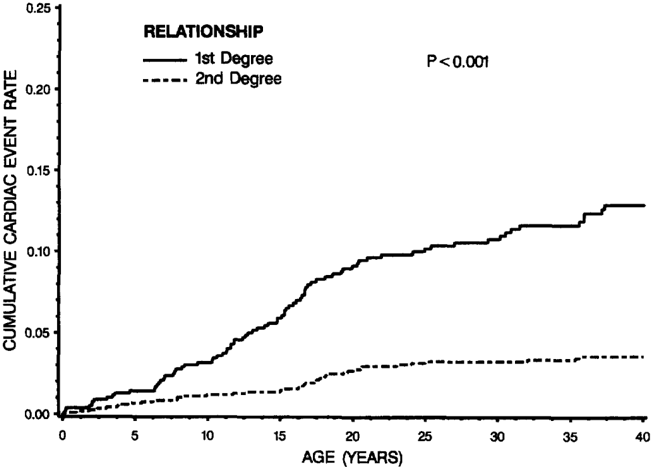
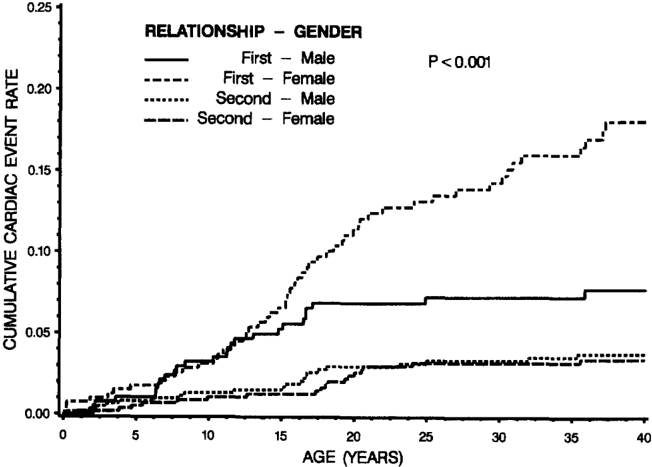
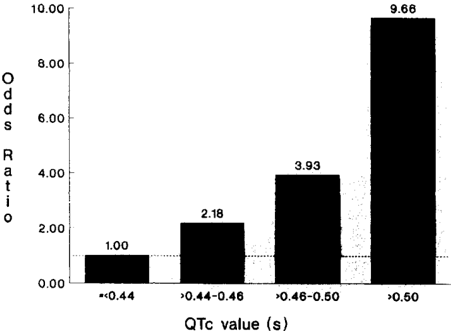
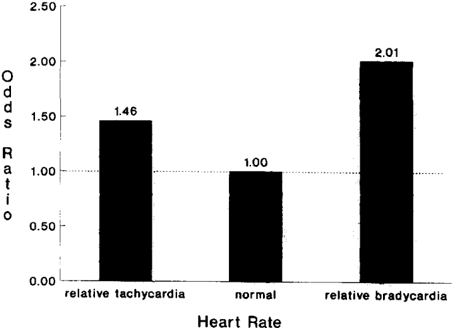
OBJECTIVES: This study sought to identify risk factors for cardiac events (syncope, aborted cardiac arrest or sudden cardiac death) in family members of patients with the long QT syndrome. BACKGROUND: Patients with the long QT syndrome are known to be at high risk for cardiac events. Whenever the first member of a family is identified as having the long QT syndrome (proband), there is concern regarding the likelihood of cardiac events in other family members. METHODS: A multivariate logistic regression model was used to evaluate the risk of cardiac events in 637 family members who were first- and second-degree relatives of 151 probands with the long QT syndrome and in a subset of 513 family members who were not receiving beta-adrenergic blocking agents. There were 293 first-degree (46%) and 344 second-degree relatives (54%) (293 men [46%], 344 women [54%]). Fifteen percent of the family members had a corrected QT interval (QTc) > 0.44 s, and relative tachycardia and bradycardia were observed in 12% and 25%, respectively. RESULTS: The risk of cardiac events occurring before age 40 in family members not taking beta-blockers was influenced by the QTc interval (odds ratio [OR] 1.18/0.01 increase in QTc value; 95% confidence interval [CI] 1.12 to 1.24), relative tachycardia (OR 2.21, 95% CI 0.97 to 5.02) or bradycardia (OR 2.24, 95% CI 1.10 to 4.56) and an interaction term combining gender and closeness of the relationship to the proband (OR for female first-degree relative 3.23 vs. all second-degree relatives, 95% CI 1.67-6.22). CONCLUSIONS: Female first-degree relatives of patients with the long QT syndrome have a higher risk of cardiac events than male first- or second-degree relatives, independent of recorded electrocardiographic findings. Not only bradycardia, but also tachycardia increases risk of cardiac events in family members of patients with the long QT syndrome.
Overview
The claims and statistics of this paper haven’t been checked yet.
Free: it reads the open-access text and checks the first 5 claims that cite a source we can check. Create a free account to check every claim.
Integrity signals
Registry
Cites
Statistics
Figures
Verification
Claims the paper makes
The claims and statistics of this paper haven’t been checked yet.
Free: it reads the open-access text and checks the first 5 claims that cite a source we can check. Create a free account to check every claim.
Claims other papers make about this one
Each is checked against this paper’s own text: does it say what the citing paper says it does?
The source backs part of the claim, not all of it — or backs it for a different population, condition or comparison.
In the citing paper
“A prolonged QT interval predisposes to the development of ventricular tachyarrhythmias such as torsade de pointes and ventricular fibrillation, which could cause syncope, cardiac arrest, or SCD (Haverkamp et al., 2000;Moss, 1999;Zareba et al., 1995).”
From 2017 ISHNE-HRS expert consensus statement on ambulatory ECG and external cardiac monitoring/telemetry (2017) · cites this paper as Zareba et al., 1995
Experimental — accuracy not yet measured
Self-check
Percentages, sums and reported differences re-computed from the paper’s own numbers.
The self-check needs the paper’s full text.
Citations
Cites
Nonparametric Estimation from Incomplete Observations
Kaplan, E. L., & Meier, P. (1992) · Springer Series in Statistics · doi:10.1007/978-1-4612-4380-9_25 · Cited by 45,181
Nonparametric Estimation from Incomplete Observations
Kaplan, E. L., & Meier, P. (1958) · Journal of the American Statistical Association · doi:10.1080/01621459.1958.10501452 · Cited by 39,158
Jervell, A., & Lange-Nielsen, F. (1957) · American Heart Journal · doi:10.1016/0002-8703(57)90079-0 · Cited by 1,596
Diagnostic criteria for the long QT syndrome. An update.
Schwartz, P. J., Moss, A. J., Vincent, G. M., & Crampton, R. S. (1993) · Circulation · doi:10.1161/01.cir.88.2.782 · Cited by 1,181
Self-citationThe long QT syndrome. Prospective longitudinal study of 328 families.
Moss, A. J., Schwartz, P. J., Crampton, R. S., Tzivoni, D., Locati, E. H., MacCluer, J., Hall, W. J., Weitkamp, L., Vincent, G. M., & Garson, A. (1991) · Circulation · doi:10.1161/01.cir.84.3.1136 · Cited by 968
Self-citationSchwartz, P. J., Periti, M., & Malliani, A. (1975) · American Heart Journal · doi:10.1016/0002-8703(75)90089-7 · Cited by 910
A NEW FAMILIAL CARDIAC SYNDROME IN CHILDREN.
Ward, O. C. (1964) · PubMed · Cited by 826
Schwartz, P. J. (1997) · Current Problems in Cardiology · doi:10.1016/s0146-2806(97)80009-6 · Cited by 693
Sex differences in the evolution of the electrocardiographic QT interval with age.
Rautaharju, P. M., Sh, Z., Wong, S., Hp, C., Berenson, G. S., Prineas, R., & Davignon, A. (1992) · PubMed · Cited by 635
The Spectrum of Symptoms and QT Intervals in Carriers of the Gene for the Long-QT Syndrome
Vincent, G. M., Timothy, K. W., Leppert, M., & Keating, M. (1992) · New England Journal of Medicine · doi:10.1056/nejm199209173271204 · Cited by 622
Research works printed but not linked: 2
- 6. Romano C, Gemme G, Pongiglione R. Aritmie cardiache rare dell'eta' pediatrica. I1. Accessi sincopali per fibrillazione ventricolare parossistica. Clin Pediat (Bologna) 1963;45:656-83.
- 13. Bazett HC. An analysis of the time relations of electrocardiograms. Heart 1920;7:353-67.
Cited by
Items 101–141 of 141
Prevalence of prolonged QT interval in patients with HCV-related chronic liver disease
Gaafar, A. E., El-Aal, A. A., Alboraie, M. A. A., Hassan, H. M., Tahan, A. E., AbdelRahman, Y., Wifi, M.-N. A., Omran, D., Afify, S., Hassan, W. M., et al. (2019) · The Egyptian Heart Journal · doi:10.1186/s43044-019-0016-0 · Cited by 3
Congenital long QT syndrome presenting as unexplained bradycardia
Silva, R. A., Sousa, A. R., Carvalho, M. S., & Anjos, R. T. (2022) · BMJ Case Reports · doi:10.1136/bcr-2021-242362 · Cited by 2
Zaręba, W., & Cygankiewicz, I. (2010) · Springer eBooks · doi:10.1007/978-1-84882-046-3_19 · Cited by 5
L'Amérique face à l'information génétique
Deroin, P. (1998) · Biofutur · doi:10.1016/s0294-3506(98)80165-8 · Cited by 2
L’intervalle QT : standardisation, limites et interprétation
Ouali, S., Salem, H. B., Gribaa, R., Kacem, S., Hammas, S., Fradi, S., Neffeti, E., Remedi, F., & Boughzéla, E. (2011) · Annales de Cardiologie et d Angéiologie · doi:10.1016/j.ancard.2010.12.015 · Cited by 2
The Role of the Implantable Cardioverter-Defibrillator in the Long QT Syndrome
Zaręba, W., Goldenberg, I., & Moss, A. J. (2012) · Cardiac Electrophysiology Clinics · doi:10.1016/j.ccep.2011.12.004 · Cited by 2
Self-citationPolekowe wydłużenie odstępu QT
Zaręba, W. (2008) · Folia Cardiologica · Cited by 4
Acquired (Drug-Induced) Long and Short QT Syndromes
Shah, R. R., & Gussak, I. B. (2013) · Springer eBooks · doi:10.1007/978-1-4471-4978-1_6 · Cited by 2
Hypoxaemic load in sleep apnoea is associated with acute changes in T-wave amplitude
Sillanmäki, S., Ebrahimian, S., Hietakoste, S., Hernando, D., Bailón, R., Leppänen, T., & Kainulainen, S. (2024) · ERJ Open Research · doi:10.1183/23120541.00341-2024 · Cited by 3
“Women have naturally longer QT times than men and long QT syndrome is more prevalent in women [28].”
Bailey, B. P. (1996) · Australian and New Zealand Journal of Medicine · doi:10.1111/j.1445-5994.1996.tb00634.x · Cited by 2
Q-T Interval, QT Dynamicity, and QT Variability
Zaręba, W., Cygankiewicz, I., & de Luna, A. B. (2012) · Elsevier eBooks · doi:10.1016/b978-1-4377-0285-9.00070-3 · Cited by 1
Traditional risk factors for QT interval prolongation and torsades de pointes
Sowinski, K. M., Kovacs, R. J., & Tisdale, J. E. (2022) · Elsevier eBooks · doi:10.1016/b978-0-12-821446-6.00014-6 · Cited by 1
The Variations in Electrical Cardiac Systole and Its Impact on Sudden Cardiac Death
R., F., & Pardo, M. (2012) · InTech eBooks · doi:10.5772/30348 · Cited by 1
Syndrome du QT long congénital
Lupoglazoff, J., & Denjoy, I. (2006) · EMC - Pédiatrie - Maladies infectieuses · doi:10.1016/s1637-5017(06)74501-x · Cited by 1
Long QT Syndrome and Other Channelopathies
Cygankiewicz, I., & Zaręba, W. (2010) · Springer eBooks · doi:10.1007/978-0-387-92775-6_19 · Cited by 1
“Risk stratification of the LQTS patients is based on several factors including QTc duration, history of cardiac events (timing and frequency of syncopal events, cardiac arrest), gender, age, genotype, and family history [4, 21, 23, 27, 28, 48 ].”
BackgroundZaręba, W., & Platonov, P. G. (2018) · doi:10.1093/med/9780198784906.003.0074 · Cited by 1
Die prognostische Bedeutung der QT-Verlängerung
Brandes, A., Potratz, J., & Bethge, K.-P. (1998) · Herzschrittmachertherapie + Elektrophysiologie · doi:10.1007/s003990050031 · Cited by 1
Should We Use Drugs to Decrease Drug-Induced QT Prolongation? ∗
Zaręba, W. (2016) · JACC. Clinical electrophysiology · doi:10.1016/j.jacep.2016.07.013 · Cited by 1
Interpretation of ECG and Subjective Responses (Chest Pain)
Froelicher, V. F., & MYERS, J. N. (2006) · Elsevier eBooks · doi:10.1016/b978-1-4160-0311-3.50009-7 · Cited by 1
Couderc, J. (2013) · Elsevier eBooks · doi:10.1016/b978-0-12-391496-5.00017-x
GENETIC VARIANTS PREDISPOSING TO CARDIAC ARRHYTHMIA DISORDERS AND SUDDEN CARDIAC DEATH
Lahtinen, A. M. (2012) · Helda - University of Helsinki Institutional Repository
Phenotypic Correlation of Genetic Mutations with Ventricular Arrhythmias
Krishnan, Y., Chen, J., & McDonald, T. V. (2012) · InTech eBooks · doi:10.5772/32342
“increased risk for women of reproductive age with LQT1 and LQT2 mutations to have arrhythmic events (Zareba et al., 1995); (Lehmann et al.”
BackgroundGenetic and Functional Studies of Severe Ventricular Arrhythmias
Fodstad, H. (2005) · Työväentutkimus Vuosikirja
Le syndrome du QT long : qu’est-ce que c’est ? Quels en sont les risques ?
Aya, A. G. M., Cochery-Nouvellon, É., & COUSSAYE, J. E. D. L. (2007) · Le Praticien en Anesthésie Réanimation · doi:10.1016/s1279-7960(07)91493-x
Síndrome del QT largo congénito
Lupoglazoff, J., & Denjoy, I. (2001) · EMC - Pediatría · doi:10.1016/s1245-1789(01)72029-x
WEISSENBURGER, J., & Davy, J. (2013) · EMC - Cardiologie · doi:10.1016/s1166-4568(13)53177-9
“[77] Zareba W, Moss AJ, Lecessie S, Locati EH, Robinson JL, Hall WJ, et al.”
BackgroundGender differences in cardiac electrophysiology and arrhythmias. Part 1.
Gowda, R. M., Wilbur, S. L., & Schweitzer, P. (2006) · Cited by 4
Nonsustained Ventricular Tachycardia
Moss, A. J. (1997) · Annals of Noninvasive Electrocardiology · doi:10.1111/j.1542-474x.1997.tb00302.x
Self-citationBeleslin, B., Deljanin, M., Kanjuh, V., Parapid, B. J., Giga, V. L., Prostran, M. S., Angelkov, L., Balinovac, J., Bikicki, M., Ambrosio, G., et al. (2013)
The Role of the Implantable Defibrillator in the Long QT Syndrome
Zaręba, W., Goldenberg, I., & Moss, A. J. (2012)
Self-citationATRIОVENTRICULAR NODAL REENTRY TACHYCARDIA
Bockeria, O. L., Сергеев, А. В., Bakoulev, A. N., Russian Federation, Ol, B., & Viktorovich, S. A. (2015)
Bakun, J., & Karpowicz, M. (1999) · Folia Cardiologica
Antoine, G. M., Aya, Nouvellon, E., & Coussaye, J.-E. D. L. (2007) · Le Praticien en Anesthésie Réanimation · doi:10.1016/s1279-7960(07)91474-6
Almahameed, S., & Kaufman, E. S. (2020) · Elsevier eBooks · doi:10.1016/b978-0-12-817728-0.00022-x
INFLUENCE OF THE GENOTYPE ON THE CLINICAL COURSE OF THE LONG-QT SYNDROME
Areba, W. O. Z., Oss, J. M., Chwartz, E. J. S., Incent, G. M. I. V., Ennifer, J., Obinson, L. R., Riori, S. I. G. P., Esaia, J., Enhorin, B., Ocati, E. M. H. L., et al. (1998)
Atrial fibrillation and Walid Saliba
(2007) · CRC Press eBooks · doi:10.3109/9780203089866-16
Zaręba, W., & Cygankiewicz, I. (2011) · Springer eBooks · doi:10.1007/978-0-85729-874-4_7
Holter study of heart rate variability in children and adolescents with long QT syndrome
Lundström, A., Eliasson, H., Karlsson, M., Wiklund, U., & Rydberg, A. (2024) · Annals of Noninvasive Electrocardiology · doi:10.1111/anec.13132
“Additionally, age is known to influence the risk of cardiac events and patients with LQTS often experience their first cardiac event before the age of 16 (Zareba et al., 1995).”
BackgroundRashba, E. J., Link, M. S., & Estes, N. A. M. (2002) · Contemporary cardiology · doi:10.1007/978-1-59259-090-2_18
Evaluation of Ventricular Repolarization
Němec, J., Hammill, S. C., & Shen, W.-K. (2003) · Contemporary cardiology · doi:10.1007/978-1-59259-362-0_12
Metadata
- Authors
- Zareba, W., Moss, A. J., le Cessie, S., Locati, E. H., Robinson, J. L., Hall, W. J., & Andrews, M. L.
- Affiliations
- University of Rochester Medicine (US)
- University of Milan (IT)
- Venue
- Journal of the American College of Cardiology
- Publisher
- Elsevier BV
- Published
- 1995-12
- Volume
- 26
- Issue
- 7
- Pages
- 1685-1691
- ISSN
- 0735-1097 (ISSN-L)
- OpenAlex
- W2018414627
- Cited by
- 142
- References
- 29
- Citations by year
- 2024: 3 · 2022: 3 · 2021: 1 · 2020: 2 · 2019: 3 · 2018: 3 · 2017: 2 · 2016: 3 · 2015: 4 · 2014: 2 · 2013: 8 · 2012: 9
- FWCI
- 7.32
- Type
- journal article
- Language
- en
- Open access
- hybrid
- doi.org
- Licence
- cc-by-nc-nd
- www.elsevier.com/tdm/userlicense/1.0/ (tdm)
- www.elsevier.com/legal/tdmrep-license (tdm)
- creativecommons.org/licenses/by-nc-nd/4.0/ (vor, 1518 d)
- Locations
- Journal of the American College of Cardiology (publishedVersion, cc-by-nc-nd)
- PubMed (publishedVersion)
- Funders
- National Heart, Lung, and Blood Institute (HL 33843, R01HL033843)
- Topics
- Health Sciences › Medicine › Cardiology and Cardiovascular Medicine › Cardiac electrophysiology and arrhythmias
- Health Sciences › Medicine › Cardiology and Cardiovascular Medicine › Cardiovascular Effects of Exercise
- Health Sciences › Medicine › Cardiology and Cardiovascular Medicine › Cardiac Health and Mental Health
- Keywords
- long QT syndrome, family members, sudden cardiac death, aborted cardiac arrest, syncope, QTc interval, bradycardia, tachycardia, sex differences, first-degree relatives, second-degree relatives, beta-adrenergic blocking agents, risk factors
- MeSH terms
- Adolescent, Adult, Child, Child, Preschool, Female, Heart Arrest, Humans, Infant, Long QT Syndrome, Male, Prognosis, Risk Factors, Syncope, Multivariate Analysis, Odds Ratio, Death, Sudden, Cardiac
About these checks
Registry, retraction, Cites and statistics results are computed, not judged, with one exception: a printed reference that no index lists is read once by a model before it counts as a citation error. Claims are extracted by a model and kept only when their quote appears verbatim in the text; each cited source is then checked, with a model’s help, for whether it says what the claim relies on. Those verdicts can be wrong — read the claim’s quote and the cited source before relying on one.
Statistics and arithmetic are recomputed, not judged.
Confidence bands are shown only for fields calibrated on our annotated test set. None is calibrated yet, so no band is shown.
What counts as a claim ›How we measure confidence ›How we check this ›
Are you an author, or do you see a problem with this page? Request a review
Data sources
Bibliographic data: Semantic Scholar, OpenAlex, Crossref.
Contains information from the Semantic Scholar Academic Graph Datasets, made available under the ODC Attribution License (ODC-BY 1.0).
Semantic Scholar’s data is described in: Kinney, R., et al. (2023). The Semantic Scholar Open Data Platform. arXiv:2301.10140.
