

Mood effects on limbic blood flow correlate with emotional self-rating: A PET study with oxygen-15 labeled water
Open accessThe DOI matches its Crossref record; 75 of the 76 references it cites were found in a registry or an index.
Abstract
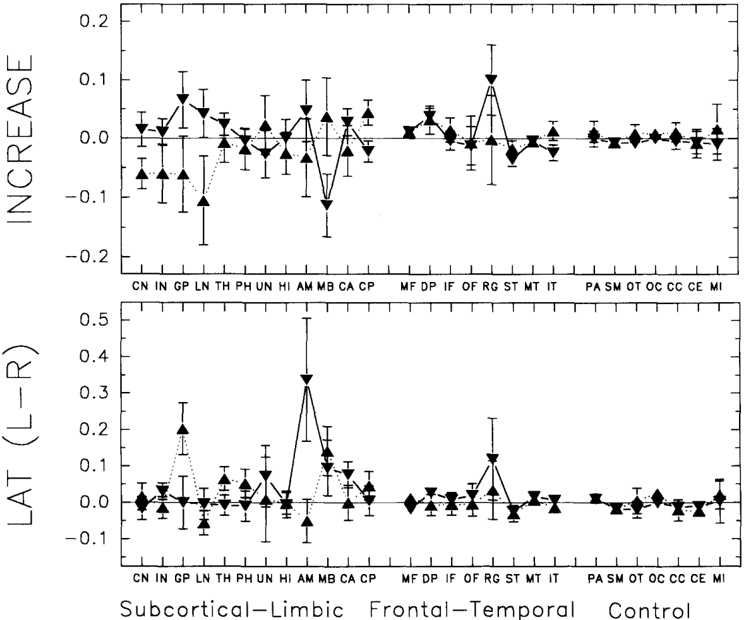
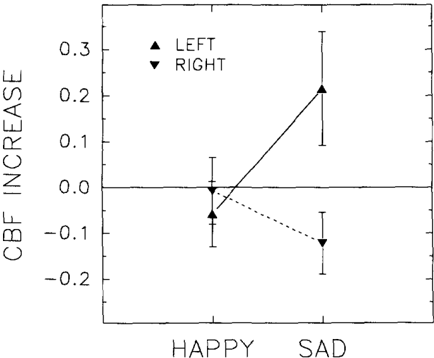
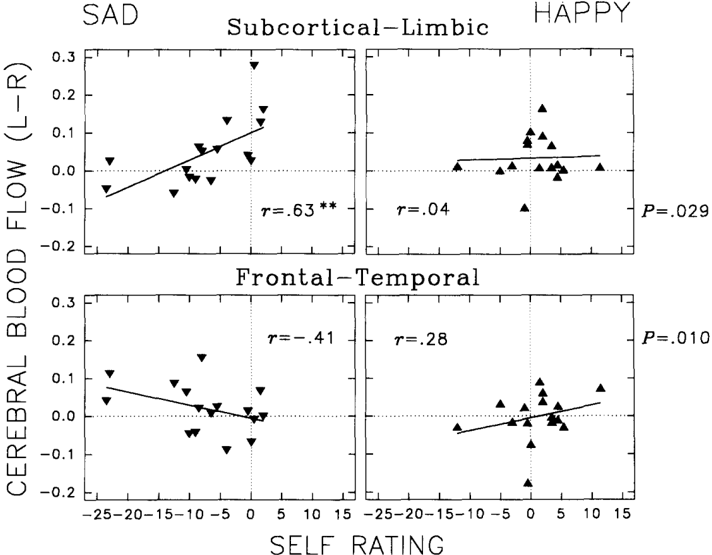
Positron emission tomography was used to study the effects of experimentally controlled mood states on cerebral blood flow (CBF), measured with the quantitative equilibrium infusion method and 15O-labeled water. Twenty-seven brain regions in each hemisphere were assessed in 16 normal subjects. CBF and heart rate were measured during happy and sad mood induction, and during two nonemotional control conditions: sex differentiation and resting baseline. Valence-specific effects of mood on CBF were obtained for subcortical, but not for frontal-temporal or control regions. CBF increased in left amygdala and decreased in right amygdala during sad mood relative to the averaged control conditions. These changes correlated with shifts toward negative affect. Correlations were opposite for subcortical (negative affect associated with lower left hemispheric CBF) compared with frontal-temporal cortical regions. Results support limbic involvement in regulating emotional states and suggest some reciprocity between subcortical and frontal-temporal regulation of emotional experience.
Overview
The claims and statistics of this paper haven’t been checked yet.
Free: it reads the open-access text and checks the first 5 claims that cite a source we can check. Create a free account to check every claim.
Integrity signals
Registry
Cites
Statistics
Figures

Verification
Claims the paper makes
The claims and statistics of this paper haven’t been checked yet.
Free: it reads the open-access text and checks the first 5 claims that cite a source we can check. Create a free account to check every claim.
Claims other papers make about this one
Each is checked against this paper’s own text: does it say what the citing paper says it does?
The source backs part of the claim, not all of it — or backs it for a different population, condition or comparison.
In the citing paper
“An inverse relationship between posterior orbital cortex activity and the intensity of emotional experience also is evident during anxiety provocation in subjects with obsessive–complusive disorder and induced sadness in healthy humans (Rauch et al. 1994; Schneider et al. 1995).”
From Brain structural and functional abnormalities in mood disorders: implications for neurocircuitry models of depression (2008) · cites this paper as Schneider et al. 1995
Experimental — accuracy not yet measured
Self-check
Percentages, sums and reported differences re-computed from the paper’s own numbers.
The self-check needs the paper’s full text.
Citations
Cites
The assessment and analysis of handedness: The Edinburgh inventory
Oldfield, R. C. (1971) · Neuropsychologia · doi:10.1016/0028-3932(71)90067-4 · Cited by 35,900
Development and validation of brief measures of positive and negative affect: The PANAS scales.
Watson, D., Clark, L. A., & Tellegen, A. (1988) · Journal of Personality and Social Psychology · doi:10.1037/0022-3514.54.6.1063 · Cited by 32,433
Co-Planar Stereotaxic Atlas of the Human Brain
Talairach, J., & Tournoux, P. (1988) · Medical Entomology and Zoology · Cited by 11,798
Talairach, J., Tournoux, P., & Rayport, M. (1988) · Thieme eBooks · Cited by 5,058
Berti, A. (1992) · Neuropsychologia · doi:10.1016/0028-3932(92)90076-x · Cited by 4,162
A PROPOSED MECHANISM OF EMOTION
PAPEZ, J. W. (1937) · Archives of Neurology And Psychiatry · doi:10.1001/archneurpsyc.1937.02260220069003 · Cited by 3,563 · cited 1×
“The CBF data supported the hypothesis of greater subcortical than cortical involvement in emotional processes (Papez, 1937; Heilman et al., 1975; Ross and Mesulam, 1979; Macci, 1989; Rolls, 1990).”
ResultPhenomenology and Psychological Research
Giorgi, A., & Aanstoos, C. M. (1991) · Medical Entomology and Zoology · Cited by 2,204
Approach^withdrawal and cerebral asymmetry: Emotional expression and brain physiology: I.
Davidson, R. J., Ekman, P., Saron, C. D., & Senulis, J. A. (1990) · Journal of Personality and Social Psychology · doi:10.1037//0022-3514.58.2.330 · Cited by 1,637
The amygdala: Neurobiological aspects of emotion, memory, and mental dysfunction.
Aggleton, J. P. (1992) · Wiley-Liss eBooks · Cited by 1,536
Localization of Cognitive Operations in the Human Brain
Posner, M. I., Petersen, S. E., Fox, P. T., & Raichle, M. E. (1988) · Science · doi:10.1126/science.3289116 · Cited by 1,429 · cited 1×
“Activation procedures have been applied primarily with cognitive tasks (Gur and Reivich, 1980; Wood et al., 1980; Risberg, 1986; Posner et al., 1988; Buchsbaum et al., 1990; Frith et al., 1991).”
Method
Research works printed but not linked: 3
- 23. Frith, C.D., Friston, K.J., Liddle, P.F. and Frackowiak, R.S. (1991) Willed action and the prefrontal cortex in man. Proc R Soc Lend (Bial) 244(1311), 241-246.
- 24. Gainotti, G. (1989) Disorders of emotions and affect in patients with unilateral brain damage. In: Boiler, F. and Grafman, J. (Eds.), Handbook of Neuropsychology, Vol. 3. Elsevier, Amsterdam, pp. 345-361.
- 41. Macei, G. (1989) Anatomical substrate of emotional reactions. In: Boiler, F. and Grafman, J. (Eds.), Handbook of Neuro- psychology, Vol. 3. Elsevier, Amsterdam, pp. 283-303.
Cited by
Items 101–185 of 185
Sex, hormones and affective arousal circuitry dysfunction in schizophrenia
Goldstein, J. M. (2006) · Hormones and Behavior · doi:10.1016/j.yhbeh.2006.06.029 · Cited by 79
Impact of self-esteem and sex on stress reactions
Kogler, L., Seidel, E., Metzler, H., Thaler, H., Boubela, R. N., Pruessner, J. C., Kryspin‐Exner, I., Gur, R. C., Windischberger, C., Moser, E., et al. (2017) · Scientific Reports · doi:10.1038/s41598-017-17485-w · Cited by 73
Self-citationNeural correlates of sexual arousal in heterosexual and homosexual women and men
Sylva, D., Safron, A., Rosenthal, A. M., Reber, P. J., Parrish, T. B., & Bailey, J. M. (2013) · Hormones and Behavior · doi:10.1016/j.yhbeh.2013.08.003 · Cited by 71
Hemispheric asymmetry in depression and mania A longitudinal QEEG study in bipolar disorder
Koek, R. J., Yerevanian, B. I., Tachiki, K. H., Smith, J. C., Alcock, J., & Kopelowicz, A. (1999) · Journal of Affective Disorders · doi:10.1016/s0165-0327(98)00171-2 · Cited by 74
Subjective Ratings of Pain Correlate with Subcortical-Limbic Blood Flow: An fMRI Study
Schneider, F., Habel, U., Holthusen, H., Kessler, C., Posse, S., Müller-Gärtner, H.-W., & Arndt, J. O. (2001) · Neuropsychobiology · doi:10.1159/000054887 · Cited by 64
Self-citationEffects of Yohimbine on Cerebral Blood Flow, Symptoms, and Physiological Functions in Humans
Cameron, O. G., Zubieta, J. K., Grunhaus, L., & Minoshima, S. (2000) · Psychosomatic Medicine · doi:10.1097/00006842-200007000-00014 · Cited by 61
Aftanas, L. I., Lotova, N. V., Koshkarov, V. I., & Popov, S. A. (1998) · Biological Psychology · doi:10.1016/s0301-0511(98)00015-5 · Cited by 67
Cerebral haemodynamics and depression in the elderly
Tiemeier, H. (2002) · Journal of Neurology, Neurosurgery & Psychiatry · doi:10.1136/jnnp.73.1.34 · Cited by 58
Amygdala hypersensitivity in response to emotional faces in Tourette's patients
Neuner, I., Kellermann, T., Stöcker, T., Kircher, T. T. J., Habel, U., Shah, N. J., & Schneider, F. W. (2010) · The World Journal of Biological Psychiatry · doi:10.3109/15622975.2010.480984 · Cited by 61
“Amygdala activation however is not limited to fearful faces or negative emotions such as anger (Hariri et al. 2000) or sadness (Schneider et al. 1995; Baird et al. 1999).”
BackgroundSelf-citationBraun, C. M. J., Rocque, C. L. L., Daigneault, S., & Montour‐Proulx, I. (1999) · PubMed · Cited by 56
Zangara, A., Blair, J., & Curran, V. H. (2002) · Psychopharmacology · doi:10.1007/s00213-002-1120-4 · Cited by 67
“Neuroimaging work has indicated amygdala activation to sad expressions (Schneider et al. 1995; Blair et al. 1999).”
BackgroundFacial expression perception: an objective outcome measure for treatment studies in mood disorders?
Venn, H. R., Watson, S., Gallagher, P., & Young, A. H. (2005) · The International Journal of Neuropsychopharmacology · doi:10.1017/s1461145705006012 · Cited by 52
“PET studies among healthy volunteers have revealed enhanced activation in the left amygdala that correlates with intensity of sad expressions presented (Blair et al., 1999 ; Schneider et al., 1995).”
BackgroundMelcher, T., Born, C., & Gruber, O. (2011) · Neuroscience Research · doi:10.1016/j.neures.2011.05.007 · Cited by 56
A neuroanatomic model for depression.
Byrum, C. E., Ahearn, E. P., & Krishnan, K. (1999) · Progress in Neuro-psychopharmacology and Biological Psychiatry · doi:10.1016/s0278-5846(98)00106-7 · Cited by 50
Hemispheric Asymmetry in the Experience of Emotion: A Perspective from Functional Imaging
Canli, T. (1999) · The Neuroscientist · doi:10.1177/107385849900500409 · Cited by 49
Neural correlates of effective and ineffective mood induction
Kohn, N., Falkenberg, I., Kellermann, T., Eickhoff, S. B., Gur, R. C., & Habel, U. (2014) · Social Cognitive and Affective Neuroscience · doi:10.1093/scan/nst055 · Cited by 45
“…described in detail and used in several studies to investigate emotional processing in healthy controls and different clinical groups (Erwin et al., 1992; Gur et al., 1992, 1994; Heimberg et al., 1992; Schneider et al., 1994a, 1995; Weiss et al., 1999; Habel et al., 2005, 2004; Reske et al., 2007).”
BackgroundSelf-citationPapadaki, E. Z., Mastorodemos, V. C., Amanakis, E. Z., Tsekouras, K. C., Papadakis, A., Tsavalas, N., Simos, P. G., Karantanas, A. H., Plaitakis, A., & Maris, T. G. (2012) · Magnetic Resonance in Medicine · doi:10.1002/mrm.24194 · Cited by 53
“values of CBF and MTT of the dentate gyrus of the hippocampi—set at 45 mL/100 mL/min and 4 s, respectively (38,39).”
BackgroundBroad Band Spectral Measurements of EEG During Emotional Tasks
Marox, E., Rodríguez, H., Yáñez, G., Bernal, J., Rodríguez, M., Fernández, T., Silva, J., Reyes, A., & Guerrero, V. (2001) · International Journal of Neuroscience · doi:10.3109/00207450108986517 · Cited by 48
Roesmann, K., Zwitserlood, P., Rehbein, M. A., Eden, A. S., Laeger, I., Junghöfer, M., Zwanzger, P., & Dobel, C. (2013) · PLoS ONE · doi:10.1371/journal.pone.0070788 · Cited by 50
“[46,50–53]; but see [54–56]).”
Martin, L., Clair, J., Davis, P., O’Ryan, D., Hoshi, R., & Curran, H. V. (2006) · Addiction · doi:10.1111/j.1360-0443.2006.01574.x · Cited by 43
Applications of positron emission tomography in psychiatry
Parsey, R. V., & Mann, J. J. (2003) · Seminars in Nuclear Medicine · doi:10.1053/snuc.2003.127302 · Cited by 47
The role of the anterior cingulate cortex in pitch variation during sad affect
Barrett, J., Pike, G. B., & Paus, T. (2004) · European Journal of Neuroscience · doi:10.1111/j.0953-816x.2003.03113.x · Cited by 38
Nin, M. S., Salles, F., de Azeredo, L. A., Frazon, A., Gomez, R., & Barros, H. (2008) · Journal of Psychopharmacology · doi:10.1177/0269881107081525 · Cited by 41
“In these studies, mood activation tasks increased blood flow in the left amygdala and decreased blood flow in the right amygdala (Schneider et al., 1995).”
BackgroundHuettel, S. A., & Payne, J. W. (2009) · Journal of Marketing Research · doi:10.1509/jmkr.46.1.14 · Cited by 36
“Similarly, in prior research, it would have been difficult to identify the cerebral area associated with negative emotion in the absence of some theory about what constitutes negative emotion, such as sadness (Schneider et al. 1995) or aversive olfactory stimulation (Zald and Pardo 1996).”
ResultNeuroimaging of mood disorders
Grasby, P. M., & Bench, C. J. (1997) · Current Opinion in Psychiatry · doi:10.1097/00001504-199703000-00003 · Cited by 32
Brain Mapping: The Applications
Mayberg, H., & McGinnis, S. (2000) · Elsevier eBooks · doi:10.1016/b978-012692545-6/50018-0 · Cited by 24
Brain Correlates of Antidepressant Treatment Outcome from Neuroimaging Studies in Depression
Dougherty, D. D., & Rauch, S. L. (2007) · Psychiatric Clinics of North America · doi:10.1016/j.psc.2006.12.007 · Cited by 37
Functional MRI changes before and after onset of reported emotions
Prohovnik, I., Skudlarski, P., Fulbright, R. K., Gore, J. C., & Wexler, B. E. (2004) · Psychiatry Research Neuroimaging · doi:10.1016/j.pscychresns.2004.03.005 · Cited by 35
The resting frontal alpha asymmetry across the menstrual cycle: A magnetoencephalographic study
Hwang, R.-J., Chen, L., Yeh, T., Tu, P., Tu, C., & Hsieh, J. (2007) · Hormones and Behavior · doi:10.1016/j.yhbeh.2007.11.007 · Cited by 34
“The modulation can also simultaneously exert its general arousal effect on the rewarding stimulus (Dreher et al., 2007; Schneider et al., 1995).”
Mancini-Marïe, A., Potvin, S., Fahim, C., Beauregard, M., Mensour, B., & Stip, É. (2006) · The Journal of Clinical Psychiatry · doi:10.4088/jcp.v67n0302 · Cited by 36
Correspondence of emotional self-rating with facial expression
Weiss, U., Salloum, J. B., & Schneider, F. W. (1999) · Psychiatry Research · doi:10.1016/s0165-1781(99)00026-8 · Cited by 35
Self-citationCritchley, H., Daly, E., Phillips, M. L., Brammer, M. J., Bullmore, E. T., Williams, S., van Amelsvoort, T., Robertson, D., David, A. S., & Murphy, D. (2000) · Human Brain Mapping · doi:10.1002/(sici)1097-0193(200002)9:2<93::aid-hbm4>3.3.co;2-q · Cited by 28
Effect of MAOA Genotype on Resting-State Networks in Healthy Participants
Clemens, B., Voss, B., Pawliczek, C. M., Mingoia, G., Weyer, D., Repple, J., Eggermann, T., Zerres, K., Reetz, K., & Habel, U. (2014) · Cerebral Cortex · doi:10.1093/cercor/bht366 · Cited by 31
“Nevertheless, areas like the amygdala have been shown to play an important role in emotion regulation and aggression (Schneider et al. 1995; Habel et al. 2004; Buckholtz and Meyer-Lindenberg 2008).”
BackgroundFlo, E., Steine, I. M., Blågstad, T., Grønli, J., Pallesen, S., & Portas, C. M. (2010) · Brain Research · doi:10.1016/j.brainres.2010.09.090 · Cited by 34
Neuroimaging and Neuropathological Studies of Mood Disorders
Drevets, W. C., & Price, J. L. (2005) · Biology of Depression · doi:10.1002/9783527619672.ch17 · Cited by 26
Reciprocal Links between Emotion and Attention
(2004) · Elsevier eBooks · doi:10.1016/b978-012264841-0/50022-6 · Cited by 35
Single photon emission tomography with 99m Tc-HMPAO in Arab patients with depression
Abou‐Saleh, M. T., Al-Suhaili, A. R., Karim, L., Prais, V., & Hamdi, E. (1999) · Journal of Affective Disorders · doi:10.1016/s0165-0327(98)00209-2 · Cited by 28
Neuroimaging Bipolar Illness With Positron Emission Tomography and Magnetic Resonance Imaging
Buchsbaum, M. S., Someya, T., Wu, J. C., Tang, C. Y., & Bunney, W. E. (1997) · Psychiatric Annals · doi:10.3928/0048-5713-19970701-10 · Cited by 26
Mozley, P. D., Sadek, A. M., Alavi, A. A., Gurt, R. C., Muenz, L. R., Bunow, B. J., Kim, H. J., Stecker, M. H., Jolles, P., & Newberg, A. B. (1997) · European Journal of Nuclear Medicine and Molecular Imaging · doi:10.1007/bf00879663 · Cited by 28
Self-citationAmygdala responses to unpleasant pictures are influenced by task demands and positive affect trait
Sanchez, T. A., Mocaiber, I., Erthal, F. S., Joffily, M., Volchan, E., Pereira, M. G., de Araújo, D. B., & Oliveira, L. (2015) · Frontiers in Human Neuroscience · doi:10.3389/fnhum.2015.00107 · Cited by 26
“Humans exhibit involuntary co-occurring brain and peripheral responses to emotional stimuli, such as faces with fearful expressions or unpleasant pictures (Schneider et al., 1995; Cuthbert et al., 2000; Hagemann et al., 2003).”
BackgroundInfluentialImaging strategies in depression
Grasby, P. M. (1999) · Journal of Psychopharmacology · doi:10.1177/026988119901300407 · Cited by 26
“…mood induction by the presentation of affect-laden faces, activation effects were seen in subcortical but not cortical regions, with an increase of left amygdala rCBF and decrease in right amygdala rCBF during sad mood, which correlated with self ratings of negative mood (Schneider et al., 1995).”
BackgroundFunctional neuroimaging of emotional learning and autonomic reactions
Peper, M., Herpers, M., Spreer, J., Hennig, J., & Zentner, J. (2006) · Journal of Physiology-Paris · doi:10.1016/j.jphysparis.2006.03.006 · Cited by 23
Dopaminergic dysfunction in the left putamen of patients with major depressive disorder
D’Onofrio, A. M., Pizzuto, D. A., Batir, R., Perrone, E., Cocciolillo, F., Cavallo, F., Kotzalidis, G. D., Simonetti, A., d’Andrea, G., Pettorruso, M., et al. (2024) · Journal of Affective Disorders · doi:10.1016/j.jad.2024.04.044 · Cited by 22
Emotionally evoked changes in cerebral hemodynamics measured by transcranial Doppler sonography
Stoll, M., Hamann, G. F., Mangold, R., Huf, O., & Winterhoff-Spurk, P. (1999) · Journal of Neurology · doi:10.1007/s004150050319 · Cited by 21
“The studies of Schneider et al. [15, 16 ], George et al. [6], and Partiot et al. [14] showed more complex activation patterns during emotional processes, which would not explain a pronounced flow increase in the right MCA.”
BackgroundMethodExcitability of Motor Cortices as a Function of Emotional Sounds
Komeilipoor, N., Pizzolato, F., Daffertshofer, A., & Cesari, P. (2013) · PLoS ONE · doi:10.1371/journal.pone.0063060 · Cited by 22
“In fact, there are many studies suggesting emotion-related activation patterns in the brain cannot be merely appointed to either the valence or the motivational hypothesis [49–54].”
BackgroundEmotional processing in Parkinson's disease
Troisi, E., Peppe, A., Pierantozzi, M., Matteis, M., Vernieri, F., Stanzione, P., Silvestrini, M., & Caltagirone, C. (2002) · Journal of Neurology · doi:10.1007/s00415-002-0769-2 · Cited by 21
A neurocognitive model of the psychopathic individual
Blair, J. (2003) · Cambridge University Press eBooks · doi:10.1017/cbo9780511550072.019 · Cited by 17
Geruchs- und emotionale Reiz-Bewertung bei Patienten mit Major Depression
Pause, B. M., Miranda, A., Nysterud, M., & Ferstl, R. (2000) · Zeitschrift für Klinische Psychologie und Psychotherapie · doi:10.1026//0084-5345.29.1.16 · Cited by 17
Sanchez, T. A., Ramos, L. R., Araujo, F., Schenberg, E. E., Yonamine, M., Lobo, I., de Araújo, D. B., & Luna, L. E. (2023) · Journal of Ethnopharmacology · doi:10.1016/j.jep.2023.117430 · Cited by 16
Neuro-Cognitive Models of Acquired Sociopathy and Developmental Psychopathy
James, R., & Blair, J. (2002) · Neurobiological foundation of aberrant behaviors · doi:10.1007/978-1-4615-0943-1_7 · Cited by 15
FMRI of the Emotions: Towards an Improved Understanding of Amygdala Function
Robinson, S., Hoheisel, B., Windischberger, C., Habel, U., Lanzenberger, R. R., & Moser, E. (2005) · Current Medical Imaging Formerly Current Medical Imaging Reviews · doi:10.2174/1573405054038717 · Cited by 17
Mood Modulates Auditory Laterality of Hemodynamic Mismatch Responses during Dichotic Listening
Schock, L., Dyck, M., Demenescu, L. R., Edgar, J. C., Hertrich, I., Sturm, W., & Mathiak, K. (2012) · PLoS ONE · doi:10.1371/journal.pone.0031936 · Cited by 13
“Neural activity in these regions during mood induction has been previously reported [32–34].”
ResultMayberg, H. S. (2000) · Elsevier eBooks · doi:10.1016/b978-012481460-8/50022-6 · Cited by 17
Sensor Measures of Affective Leaning
Martens, T., Niemann, M., & Dick, U. (2020) · Frontiers in Psychology · doi:10.3389/fpsyg.2020.00379 · Cited by 11
Transcranial magnetic stimulation: no effect on mood with single pulse during learned helplessness
Habel, U., Wild, B., Topka, H. R., Kircher, T. T. J., Salloum, J. B., & Schneider, F. W. (2001) · Progress in Neuro-Psychopharmacology and Biological Psychiatry · doi:10.1016/s0278-5846(00)00182-2 · Cited by 15
Self-citationOnishi, O., Ikoma, K., Oda, R., Yamazaki, T., Fujiwara, H., Yamada, S., Tanaka, M., & Kubo, T. (2018) · Neuroscience Letters · doi:10.1016/j.neulet.2018.03.003 · Cited by 12
Deng, Q., Haszard, J. J., Conner, T. S., Rapsey, C. M., Peng, M., & Venn, B. J. (2020) · European Journal of Clinical Nutrition · doi:10.1038/s41430-020-00749-6 · Cited by 10
Funktionelle Bildgebung von emotionalem Verhalten und Erleben bei schizophrenen Patienten
Habel, U., Kircher, T. T. J., & Schneider, F. W. (2005) · Der Radiologe · doi:10.1007/s00117-004-1167-9 · Cited by 10
Self-citationUsing arterial spin labeling to examine mood states in youth
Mikita, N., Mehta, M. A., Zelaya, F. O., & Stringaris, A. K. (2015) · Brain and Behavior · doi:10.1002/brb3.339 · Cited by 9
Atypical EEG Responses to Nonverbal Emotionally Charged Stimuli in Children with ASD
Portnova, G. V., & Maslennikova, A. V. (2020) · Behavioural Neurology · doi:10.1155/2020/2807946 · Cited by 14
“However, the participants showed impairment in discrimination of happy expressions [29] and in the perception of crying sounds [30].”
BackgroundCarbon‐11, Nitrogen‐13, and Oxygen‐15 Chemistry
Miller, P. W., Kato, K., & Långström, B. (2014) · Wiley eBooks · doi:10.1002/9781118854754.ch4 · Cited by 10
Cortical-Limbic-Striatal Dysfunction in Depression
Stefurak, T. L., & Mayberg, H. (2003) · Humana Press eBooks · doi:10.1007/978-1-59259-326-2_25 · Cited by 2
Neurobiological processes in depressive disorders: links with adolescent brain development
Forbes, E. E., Silk, J. S., & Dahl, R. E. (2008) · doi:10.1017/cbo9780511551963.007 · Cited by 4
Affect development as a need to preserve homeostasis
Dönmez, A., Ceylan, M. E., & Ünsalver, B. Ö. (2016) · Journal of Integrative Neuroscience · doi:10.1142/s0219635216300018 · Cited by 4
Funktionelle Kernspintomographie von Emotionen bei psychiatrischen Patienten
Schneider, F. W., Weiss, U., & Kessler, C. (1998) · Springer eBooks · doi:10.1007/978-3-7091-6472-3_8 · Cited by 3
Self-citationAristotle's Anxiety: Choosing among Methods to Study Choice
Hedgcock, W. M., & Rao, A. R. (2009) · Journal of Marketing Research · doi:10.1509/jmkr.46.1.20 · Cited by 2
“Similarly, in prior research, it would have been difficult to identify the cerebral area associated with negative emotion in the absence of some theory about what constitutes negative emotion, such as sadness (Schneider et al. 1995) or aversive olfactory stimulation (Zald and Pardo 1996).”
ResultBildgebende Verfahren und deren Bedeutung für die Psychotherapie
Gauggel, S. (2010) · Springer eBooks · doi:10.1007/978-3-540-72340-0_23 · Cited by 2
Vollmayr, B., Gass, P., Henn, F. A., Rujescu, D., Möller, H.-J., Riederer, P. F., Lesch, K., Sobanski, T., Volz, H., & Sauer, H. (2002) · Springer eBooks · doi:10.1007/978-3-7091-6150-0_1 · Cited by 2
Bildgebende Verfahren und deren Bedeutung für die Psychotherapie
Gauggel, S. (2004) · Springer eBooks · doi:10.1007/978-3-662-08959-0_20 · Cited by 3
Determination of the rCBF in the Amygdala and Rhinal Cortex Using a FAIR-TrueFISP Sequence
Ludescher, B., Martirosian, P., Klose, U., Nägele, T., Schick, F., & Ernemann, U. (2011) · Korean Journal of Radiology · doi:10.3348/kjr.2011.12.5.554 · Cited by 1
“, 1995 (16) Left amygdala (15)O PET 57.”
ResultInfluentialSchneider, F. W., Habel, U., & Bestmann, S. (2002) · Springer eBooks · doi:10.1007/978-3-662-21917-1_9 · Cited by 3
Self-citationEmotionale Dysfunktionen schizophrener Patienten: Ergebnisse der funktionellen Kernspintomographie
Schneider, F. W., & Habel, U. (2003) · Steinkopff eBooks · doi:10.1007/978-3-642-57417-7_16 · Cited by 1
Self-citationSchneider, F. W., & Gur, R. C. (2008) · Higher Education in Europe · doi:10.1080/03797720802228167
Self-citationPositron emissie tomografie (PET) bij stemmingsstoornissen: een overzicht
Eyken, N. V., & D’Haenen, H. (1999) · Acta Neuropsychiatrica · doi:10.1017/s0924270800036048
“Dit geldt niet voor activiteiten die gestuurd worden op corticaal niveau.(39) Gezonde proefpersonen, bij wie een dysfore toestand werd geinduceerd, vertoonden een activatie, dit wil zeggen een toegenomen r-CBF in de inferieure en orbitofrontale cortex.”
BackgroundFunktionelle Aktivierungsstudien mit der Kernspintomographie
Schneider, F. W., Grodd, W., & Klose, U. (1996) · Springer eBooks · doi:10.1007/978-3-7091-6889-9_177
Self-citationMikita, N. K. (2016) · Research Portal (King's College London)
Alshuhri, M. S. (2021) · Enlighten: Theses (The University of Glasgow) · doi:10.5525/gla.thesis.82303
Habel, U., & Schneider, F. W. (2007) · Springer eBooks · doi:10.1007/978-3-540-68558-6_25
Self-citationSchneider, F. W., Habel, U., & Bestmannc, S. (2005) · Springer eBooks · doi:10.1007/3-540-26841-3_11 · Cited by 2
Self-citationYeh, S. H., Lin, C., Chang, P., Lin, L., Tang, S.-E., & Chiu, C. (2023) · Journal of Medical Sciences · doi:10.4103/jmedsci.jmedsci_256_22
Wu, H., Lu, B., Xiang, N., Qiu, M., Da, H., Xiao, Q., Zhang, Y., & Shi, H. (2025) · Frontiers in Psychology · doi:10.3389/fpsyg.2025.1495821 · Cited by 1
Neurobehavioral Probes as Applied in Physiological Neuroimaging Studies
Gur, R. C., Gutierrez, J. M., Holdnack, J. A., & Mahr, R. N. (1996) · Springer eBooks · doi:10.1007/978-1-4899-1701-0_10
Self-citationEmotionen: Neuropsychologische und funktionell bildgebende Korrelate
Schneider, F. W., & Habel, U. (2002) · Steinkopff eBooks · doi:10.1007/978-3-642-57392-7_11
Self-citationShort-term mood regulation: Cognitive, neural, and genetic associations
Gillihan, S. J. (2008) · Scholarly Commons (University of Pennsylvania)
Metadata
- Authors
- Schneider, F., Gur, R. E., Mozley, L. H., Smith, R. J., Mozley, P. D., Censits, D. M., Alavi, A., & Gur, R. C.
- Affiliations
- University of Tübingen (DE)
- University of Pennsylvania (US)
- Corresponding author
- Schneider, Frank
- Venue
- Psychiatry Research: Neuroimaging
- Publisher
- Elsevier BV
- Published
- 1995-11
- Volume
- 61
- Issue
- 4
- Pages
- 265-283
- ISSN
- 0925-4927 (ISSN-L)
- OpenAlex
- W2112268199
- Semantic Scholar
- b51138e256535ff1b78dcc9cf4a9a115ec4d6dd7
- Cited by
- 188
- References
- 76
- Citations by year
- 2025: 1 · 2024: 1 · 2023: 2 · 2021: 2 · 2020: 4 · 2018: 1 · 2017: 1 · 2016: 2 · 2015: 3 · 2014: 2 · 2013: 5 · 2012: 4
- FWCI
- 6.21
- Type
- journal article
- Language
- en
- Open access
- hybrid
- doi.org
- Licence
- cc-by-nc-nd
- www.elsevier.com/tdm/userlicense/1.0/ (tdm)
- www.elsevier.com/legal/tdmrep-license (tdm)
- creativecommons.org/licenses/by-nc-nd/4.0/ (vor, 1617 d)
- Locations
- Psychiatry Research Neuroimaging (publishedVersion, cc-by-nc-nd)
- PubMed (publishedVersion)
- Funders
- John D. and Catherine T. MacArthur Foundation
- National Institutes of Health (5p30mh048539-05)
- National Institute of Mental Health (MH 43880, M01RR0040, MH-48539)
- National Center for Research Resources (5M01RR0040, M01RR000040)
- Topics
- Life Sciences › Neuroscience › Cognitive Neuroscience › Neural and Behavioral Psychology Studies
- Life Sciences › Neuroscience › Cellular and Molecular Neuroscience › Neurotransmitter Receptor Influence on Behavior
- Social Sciences › Psychology › Experimental and Cognitive Psychology › Anxiety, Depression, Psychometrics, Treatment, Cognitive Processes
- Keywords
- mood, limbic system, cerebral blood flow, amygdala, negative affect, sad mood, happy mood, hemispheric lateralization, heart rate
- MeSH terms
- Adolescent, Adult, Affect, Amygdala, Brain Mapping, Dominance, Cerebral, Female, Frontal Lobe, Homeostasis, Humans, Limbic System, Male, Oxygen Radioisotopes, Regional Blood Flow, Temporal Lobe, Tomography, Emission-Computed
About these checks
Registry, retraction, Cites and statistics results are computed, not judged, with one exception: a printed reference that no index lists is read once by a model before it counts as a citation error. Claims are extracted by a model and kept only when their quote appears verbatim in the text; each cited source is then checked, with a model’s help, for whether it says what the claim relies on. Those verdicts can be wrong — read the claim’s quote and the cited source before relying on one.
Statistics and arithmetic are recomputed, not judged.
Confidence bands are shown only for fields calibrated on our annotated test set. None is calibrated yet, so no band is shown.
What counts as a claim ›How we measure confidence ›How we check this ›
Are you an author, or do you see a problem with this page? Request a review
Data sources
Bibliographic data: Semantic Scholar, OpenAlex, Crossref.
Contains information from the Semantic Scholar Academic Graph Datasets, made available under the ODC Attribution License (ODC-BY 1.0).
Semantic Scholar’s data is described in: Kinney, R., et al. (2023). The Semantic Scholar Open Data Platform. arXiv:2301.10140.
