

Mood effects on limbic blood flow correlate with emotional self-rating: A PET study with oxygen-15 labeled water
Open accessThe DOI matches its Crossref record; 75 of the 76 references it cites were found in a registry or an index.
Abstract
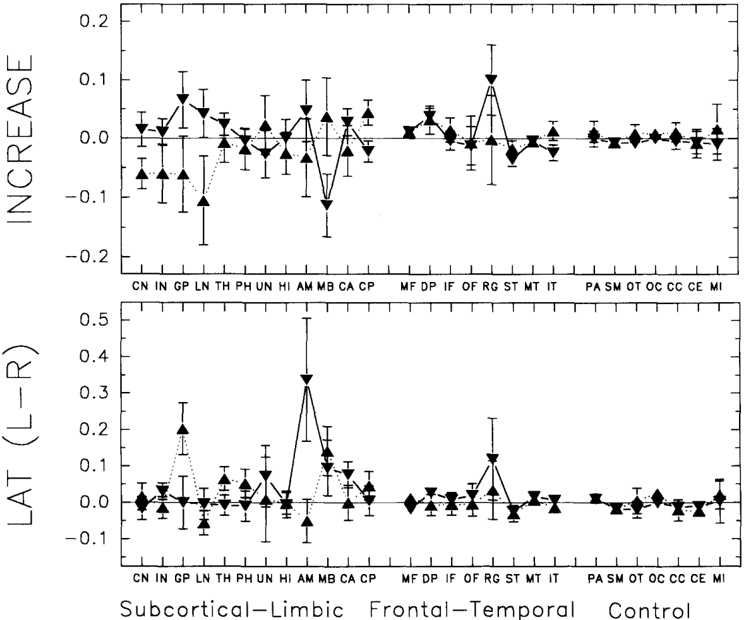
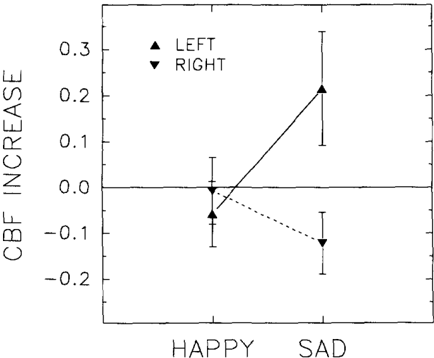
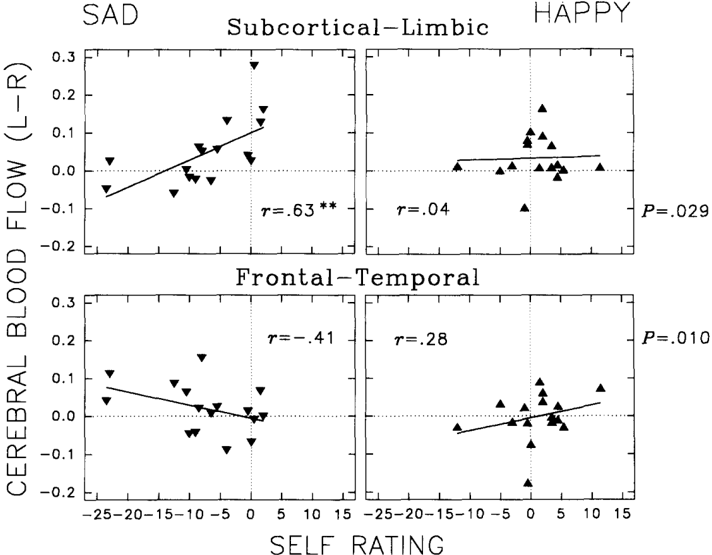
Positron emission tomography was used to study the effects of experimentally controlled mood states on cerebral blood flow (CBF), measured with the quantitative equilibrium infusion method and 15O-labeled water. Twenty-seven brain regions in each hemisphere were assessed in 16 normal subjects. CBF and heart rate were measured during happy and sad mood induction, and during two nonemotional control conditions: sex differentiation and resting baseline. Valence-specific effects of mood on CBF were obtained for subcortical, but not for frontal-temporal or control regions. CBF increased in left amygdala and decreased in right amygdala during sad mood relative to the averaged control conditions. These changes correlated with shifts toward negative affect. Correlations were opposite for subcortical (negative affect associated with lower left hemispheric CBF) compared with frontal-temporal cortical regions. Results support limbic involvement in regulating emotional states and suggest some reciprocity between subcortical and frontal-temporal regulation of emotional experience.
Overview
The claims and statistics of this paper haven’t been checked yet.
Free: it reads the open-access text and checks the first 5 claims that cite a source we can check. Create a free account to check every claim.
Integrity signals
Registry
Cites
Statistics
Figures

Verification
Claims the paper makes
The claims and statistics of this paper haven’t been checked yet.
Free: it reads the open-access text and checks the first 5 claims that cite a source we can check. Create a free account to check every claim.
Claims other papers make about this one
Each is checked against this paper’s own text: does it say what the citing paper says it does?
The source backs part of the claim, not all of it — or backs it for a different population, condition or comparison.
In the citing paper
“An inverse relationship between posterior orbital cortex activity and the intensity of emotional experience also is evident during anxiety provocation in subjects with obsessive–complusive disorder and induced sadness in healthy humans (Rauch et al. 1994; Schneider et al. 1995).”
From Brain structural and functional abnormalities in mood disorders: implications for neurocircuitry models of depression (2008) · cites this paper as Schneider et al. 1995
Experimental — accuracy not yet measured
Self-check
Percentages, sums and reported differences re-computed from the paper’s own numbers.
The self-check needs the paper’s full text.
Citations
Cites
The assessment and analysis of handedness: The Edinburgh inventory
Oldfield, R. C. (1971) · Neuropsychologia · doi:10.1016/0028-3932(71)90067-4 · Cited by 35,900
Development and validation of brief measures of positive and negative affect: The PANAS scales.
Watson, D., Clark, L. A., & Tellegen, A. (1988) · Journal of Personality and Social Psychology · doi:10.1037/0022-3514.54.6.1063 · Cited by 32,433
Co-Planar Stereotaxic Atlas of the Human Brain
Talairach, J., & Tournoux, P. (1988) · Medical Entomology and Zoology · Cited by 11,798
Talairach, J., Tournoux, P., & Rayport, M. (1988) · Thieme eBooks · Cited by 5,058
Berti, A. (1992) · Neuropsychologia · doi:10.1016/0028-3932(92)90076-x · Cited by 4,162
A PROPOSED MECHANISM OF EMOTION
PAPEZ, J. W. (1937) · Archives of Neurology And Psychiatry · doi:10.1001/archneurpsyc.1937.02260220069003 · Cited by 3,563 · cited 1×
“The CBF data supported the hypothesis of greater subcortical than cortical involvement in emotional processes (Papez, 1937; Heilman et al., 1975; Ross and Mesulam, 1979; Macci, 1989; Rolls, 1990).”
ResultPhenomenology and Psychological Research
Giorgi, A., & Aanstoos, C. M. (1991) · Medical Entomology and Zoology · Cited by 2,204
Approach^withdrawal and cerebral asymmetry: Emotional expression and brain physiology: I.
Davidson, R. J., Ekman, P., Saron, C. D., & Senulis, J. A. (1990) · Journal of Personality and Social Psychology · doi:10.1037//0022-3514.58.2.330 · Cited by 1,637
The amygdala: Neurobiological aspects of emotion, memory, and mental dysfunction.
Aggleton, J. P. (1992) · Wiley-Liss eBooks · Cited by 1,536
Localization of Cognitive Operations in the Human Brain
Posner, M. I., Petersen, S. E., Fox, P. T., & Raichle, M. E. (1988) · Science · doi:10.1126/science.3289116 · Cited by 1,429 · cited 1×
“Activation procedures have been applied primarily with cognitive tasks (Gur and Reivich, 1980; Wood et al., 1980; Risberg, 1986; Posner et al., 1988; Buchsbaum et al., 1990; Frith et al., 1991).”
Method
Research works printed but not linked: 3
- 23. Frith, C.D., Friston, K.J., Liddle, P.F. and Frackowiak, R.S. (1991) Willed action and the prefrontal cortex in man. Proc R Soc Lend (Bial) 244(1311), 241-246.
- 24. Gainotti, G. (1989) Disorders of emotions and affect in patients with unilateral brain damage. In: Boiler, F. and Grafman, J. (Eds.), Handbook of Neuropsychology, Vol. 3. Elsevier, Amsterdam, pp. 345-361.
- 41. Macei, G. (1989) Anatomical substrate of emotional reactions. In: Boiler, F. and Grafman, J. (Eds.), Handbook of Neuro- psychology, Vol. 3. Elsevier, Amsterdam, pp. 283-303.
Cited by
Bardo, M. T., & Hammer, R. P. (1991) · Neuroscience · doi:10.1016/0306-4522(91)90226-e · Cited by 3,219
The amygdala: vigilance and emotion
Davis, M., & Whalen, P. J. (2001) · Molecular Psychiatry · doi:10.1038/sj.mp.4000812 · Cited by 2,882
Mayberg, H. S., Liotti, M., Brannan, S. K., McGinnis, S., Mahurin, R. K., Jerabek, P. A., Silva, J. A., Tekell, J. L., Martin, C. C., Lancaster, J. L., et al. (1999) · American Journal of Psychiatry · doi:10.1176/ajp.156.5.675 · Cited by 2,416
Drevets, W. C., Price, J. L., & Furey, M. L. (2008) · Brain Structure and Function · doi:10.1007/s00429-008-0189-x · Cited by 2,241
“An inverse relationship between posterior orbital cortex activity and the intensity of emotional experience also is evident during anxiety provocation in subjects with obsessive–complusive disorder and induced sadness in healthy humans (Rauch et al. 1994; Schneider et al. 1995).”
BackgroundThe functional neuroanatomy of emotion and affective style
Davidson, R. J., & Irwin, W. (1999) · Trends in Cognitive Sciences · doi:10.1016/s1364-6613(98)01265-0 · Cited by 1,684
Limbic-cortical dysregulation: a proposed model of depression
(1997) · The Journal of Neuropsychiatry and Clinical Neurosciences · doi:10.1176/jnp.9.3.471 · Cited by 1,585
Limbic Activation During Cue-Induced Cocaine Craving
Childress, A. R., Mozley, P. D., McElgin, W., Fitzgerald, J., Reivich, M., & O’Brien, C. P. (1999) · American Journal of Psychiatry · doi:10.1176/ajp.156.1.11 · Cited by 1,513
“The CBF for each region of interest was determined through a multistage process involving cross-registration of each subject’s MRI with the functional PET image (25).”
MethodSelf-citationAffective style and affective disorders: Perspectives from affective neuroscience
Davidson, R. J. (1998) · Cognition & Emotion · doi:10.1080/026999398379628 · Cited by 1,496
“Using positron emission tomography (PET) to measure regional blood ¯ ow, several groups have reported increased blood ¯ ow in the amygdala in response to both behavioural (e.g. Schneider et al., 1995 ) and pharmacologic al (e.g. Ketter et al., 1996) elicitors of negative affect.”
Neuroimaging studies of mood disorders
Drevets, W. C. (2000) · Biological Psychiatry · doi:10.1016/s0006-3223(00)01020-9 · Cited by 1,313
“Posterior orbital cortex CBF increases in subjects with obsessive–compulsive disorder or animal phobias during exposure to phobic stimuli and in healthy subjects during induced sadness (Drevets et al 1995b; Rauch et al 1994; Schneider et al 1995).”
BackgroundDrevets, W. C. (2001) · Current Opinion in Neurobiology · doi:10.1016/s0959-4388(00)00203-8 · Cited by 1,146
The human amygdala and the emotional evaluation of sensory stimuli
Zald, D. H. (2003) · Brain Research Reviews · doi:10.1016/s0165-0173(02)00248-5 · Cited by 1,062
Amygdala activity at encoding correlated with long-term, free recall of emotional information.
Cahill, L., Haier, R. J., Fallon, J., Alkire, M. T., Tang, C., Keator, D., Wu, J., & McGaugh, J. L. (1996) · Proceedings of the National Academy of Sciences · doi:10.1073/pnas.93.15.8016 · Cited by 905
Synthesis of 11C, 18F, 15O, and 13N Radiolabels for Positron Emission Tomography
Miller, P. W., Long, N. J., Vilar, R., & Gee, A. D. (2008) · Angewandte Chemie International Edition · doi:10.1002/anie.200800222 · Cited by 894
Neuroanatomical correlates of pleasant and unpleasant emotion
Lane, R. D., Reiman, E. M., Bradley, M. M., Lang, P. J., Ahern, G. L., Davidson, R. J., & Schwartz, G. E. (1997) · Neuropsychologia · doi:10.1016/s0028-3932(97)00070-5 · Cited by 830
Zald, D. H., & Pardo, J. V. (1997) · Proceedings of the National Academy of Sciences · doi:10.1073/pnas.94.8.4119 · Cited by 826
Fear, Vigilance, and Ambiguity: Initial Neuroimaging Studies of the Human Amygdala
Whalen, P. J. (1998) · Current Directions in Psychological Science · doi:10.1111/1467-8721.ep10836912 · Cited by 788
Neuroanatomical correlates of happiness, sadness, and disgust
(1997) · American Journal of Psychiatry · doi:10.1176/ajp.154.7.926 · Cited by 750
Drevets, W. C., & Raichle, M. E. (1998) · Cognition & Emotion · doi:10.1080/026999398379646 · Cited by 702
Neural circuitry underlying voluntary suppression of sadness
Lévesque, J., Eugène, F., Joanette, Y., Paquette, V., Mensour, B., Beaudoin, G., Leroux, J.-M., Bourgouin, P., & Beauregard, M. (2003) · Biological Psychiatry · doi:10.1016/s0006-3223(02)01817-6 · Cited by 689
“…here is consistent with the results obtained in previous positron emission tomography (PET) (Blair et al 1999; Lane et al 1997b; Reiman et al 1997; Schneider et al 1995) and fMRI (Beauregard et al 2001; Karama et al 2002; Schneider et al 1997; Whalen et al 1998) studies on positive and negative…”
ResultLane, R. D., Reiman, E. M., Axelrod, B., Yun, L.-S., Holmes, A., & Schwartz, G. E. (1998) · Journal of Cognitive Neuroscience · doi:10.1162/089892998562924 · Cited by 671
“Functional imaging studies of emotion have recently been performed that begin to identify the neural correlates of emotion in intact human volunteers (Breiter et al., 1996; George et al., 1995; Morris et al. 1996; Pardo, Pardo, & Raichle, 1993; Schneider et al., 1995).”
BackgroundFunctional anatomical abnormalities in limbic and prefrontal cortical structures in major depression
Drevets, W. C. (2000) · Progress in Brain Research · doi:10.1016/s0079-6123(00)26027-5 · Cited by 659
In Search of the Emotional Self: An fMRI Study Using Positive and Negative Emotional Words
Fossati, P., Hevenor, S. J., Graham, S. J., Grady, C., Keightley, M. L., Craik, F., & Mayberg, H. (2003) · American Journal of Psychiatry · doi:10.1176/appi.ajp.160.11.1938 · Cited by 635
Drevets, W. (2002) · European Neuropsychopharmacology · doi:10.1016/s0924-977x(02)00102-5 · Cited by 581
Critchley, H., Daly, E., Phillips, M., Brammer, M., Bullmore, E., Williams, S., Van Amelsvoort, T., Robertson, D., David, A., & Murphy, D. (2000) · Human Brain Mapping · doi:10.1002/(sici)1097-0193(200002)9:2<93::aid-hbm4>3.0.co;2-z · Cited by 553
“However, mood induction studies [e.g., Pardo et al. 1993; Schneider et al. 1995; Lane et al. 1997b], and studies employing symptom provocation in obsessive-compulsive disorder or posttraumatic stress disorder [e.g., McGuire et al., 1994; Rauch et al., 1996] reported increased activity in limbic…”
BackgroundResultInfluentialPrefrontal cortical-amygdalar metabolism in major depression.
DREVETS, W. C. (1999) · Annals of the New York Academy of Sciences · doi:10.1111/j.1749-6632.1999.tb09292.x · Cited by 557
Neuroimaging Abnormalities in the Amygdala in Mood Disorders
DREVETS, W. C. (2003) · Annals of the New York Academy of Sciences · doi:10.1111/j.1749-6632.2003.tb07098.x · Cited by 544
Lateralization of amygdala activation: a systematic review of functional neuroimaging studies
Baas, D., Aleman, A., & Kahn, R. S. (2004) · Brain Research Reviews · doi:10.1016/j.brainresrev.2004.02.004 · Cited by 506
“A number of studies that did test the Condition Hemisphere interaction report greater left than right amygdala [35,65,76] and two studies report stronger right than left amygdala activation [63,64].”
BackgroundAn fMRI Study of Facial Emotion Processing in Patients With Schizophrenia
Gur, R. E., McGrath, C., Chan, R. M., Schroeder, L., Turner, T., Turetsky, B. I., Kohler, C., Alsop, D., Maldjian, J., Ragland, J. D., et al. (2002) · American Journal of Psychiatry · doi:10.1176/appi.ajp.159.12.1992 · Cited by 511
“discrimination (11) and mood induction (12) and when”
BackgroundSelf-citationEvidence of abnormal amygdala functioning in borderline personality disorder: a functional MRI study
Herpertz, S. C., Dietrich, T. M., Wenning, B., Krings, T., Erberich, S. G., Willmes, K., Thron, A., & Sass, H. (2001) · Biological Psychiatry · doi:10.1016/s0006-3223(01)01075-7 · Cited by 508
Functional neuroimaging studies of depression: The anatomy of melancholia
Drevets, W. C. (1998) · Annual Review of Medicine · doi:10.1146/annurev.med.49.1.341 · Cited by 500
Processing emotional pictures and words: Effects of valence and arousal
KENSINGER, E. A., & SCHACTER, D. L. (2006) · Cognitive, Affective, & Behavioral Neuroscience · doi:10.3758/cabn.6.2.110 · Cited by 442
“…in the processing of positive and negative pictures (Canli, Desmond, Zhao, Glover, & Gabrieli, 1998; Dolcos et al., 2004) or the generation of positive and negative emotion (Sutton et al., 1997), but others have not (e.g., Lane, Fink, et al., 1997; Schneider et al., 1995; Teasdale et al., 1999).”
BackgroundDolcos, F., LaBar, K. S., & Cabeza, R. (2004) · NeuroImage · doi:10.1016/j.neuroimage.2004.05.015 · Cited by 439
“This notion is consistent with evidence supporting medial PFC involvement in processing emotionally arousing stimuli irrespective of valence (Lane et al., 1997a,b,c; Reiman, 1997; Reiman et al., 1997; Schneider et al., 1995; Teasdale et al., 1999).”
ResultOrbitofrontal cortex function and structure in depression
DREVETS, W. C. (2007) · Annals of the New York Academy of Sciences · doi:10.1196/annals.1401.029 · Cited by 417
Neural and behavioral substrates of mood and mood regulation
Davidson, R. J., Lewis, D. A., Alloy, L. B., Amaral, D. G., Bush, G., Cohen, J. D., Drevets, W. C., Farah, M. J., Kagan, J., McClelland, J. L., et al. (2002) · Biological Psychiatry · doi:10.1016/s0006-3223(02)01458-0 · Cited by 411
Mitchell, D. G. V., Colledge, E., Leonard, A., & Blair, R. J. R. (2002) · Neuropsychologia · doi:10.1016/s0028-3932(02)00056-8 · Cited by 395
“Functional imaging studies suggest that the amygdala responds to sad and fearful expressions, but not to those depicting anger or disgust [17,54,55,61] .”
BackgroundDifferential remoteness and emotional tone modulate the neural correlates of autobiographical memory
Piefke, M. (2003) · Brain · doi:10.1093/brain/awg064 · Cited by 393
“For example, while some studies imply the left amygdala in negative emotion processing (e.g. Schneider et al., 1995; Breiter et al., 1996; Ketter et al., 1996; Morris et al., 1996), others have reported the opposite functional lateralization (Canli et al., 1998; Zalla et al., 2000).”
BackgroundThe functional neuroanatomy of mood disorders
Soares, J. C., & Mann, J. J. (1997) · Journal of Psychiatric Research · doi:10.1016/s0022-3956(97)00016-2 · Cited by 379
Keil, A., Müller, M. M., Gruber, T., Wienbruch, C., Stolarova, M., & Elbert, T. (2001) · Clinical Neurophysiology · doi:10.1016/s1388-2457(01)00654-x · Cited by 352
“For example, viewing affectively arousing stimuli has been reported to be associated with activation in the bilateral amygdaloid complex (Schneider et al., 1995, 1997) medial pre-frontal cortex, thalamus, hypothalamus and midbrain (Lane et al., 1997b), anterior cingulate (Lane et al., 1997a, 1998),…”
BackgroundRegional brain function, emotion and disorders of emotion
Davidson, R. J., Abercrombie, H., Nitschke, J. B., & Putnam, K. (1999) · Current Opinion in Neurobiology · doi:10.1016/s0959-4388(99)80032-4 · Cited by 341
Brain Activation during Facial Emotion Processing
Gur, R. C., Schroeder, L., Turner, T., McGrath, C., Chan, R. M., Turetsky, B. I., Alsop, D., Maldjian, J., & Gur, R. E. (2002) · NeuroImage · doi:10.1006/nimg.2002.1097 · Cited by 329
Self-citationRecall of emotional states in posttraumatic stress disorder: an fMRI investigation
Lanius, R. A., Williamson, P. C., Hopper, J., Densmore, M., Boksman, K., Gupta, M. A., Neufeld, R. W. J., Gati, J. S., & Menon, R. S. (2003) · Biological Psychiatry · doi:10.1016/s0006-3223(02)01466-x · Cited by 311
“…of human emotions, including happiness, sadness, anxiety, and disgust (Gemar et al 1996; George et al 1995; Kimbrell et al 1999; Lane et al 1997; Liotti et al 2000; Mayberg et al 1995, 1999; Paradiso et al 1997; Pardo et al 1993; Partiot et al 1995; Reiman et al 1997; Schneider et al 1995).”
BackgroundAge-related differences in brain activation during emotional face processing
Gunning-Dixon, F. M., Gur, R. C., Perkins, A. C., Schroeder, L., Turner, T., Turetsky, B. I., Chan, R. M., Loughead, J. W., Alsop, D. C., Maldjian, J., et al. (2003) · Neurobiology of Aging · doi:10.1016/s0197-4580(02)00099-4 · Cited by 294
“Functional neuroimaging studies have used diverse paradigms to examine emotion processing, including emotion discrimination [29,30,41], mood induction [24,59,68–70], fear conditioning [44,52], prosodic identification [9], reward and punishment conditions [42,57,80] and viewing of emotionally provocative stimuli [7,14,…”
BackgroundSelf-citationFunctional MRI Study of the Cognitive Generation of Affect
Teasdale, J. D., Howard, R. J., Cox, S. G., Ha, Y., Brammer, M. J., Williams, S. C. R., & Checkley, S. A. (1999) · American Journal of Psychiatry · doi:10.1176/ajp.156.2.209 · Cited by 290
Neumeister, A., Nugent, A. C., Waldeck, T., Geraci, M., Schwarz, M., Bonne, O., Bain, E. E., Luckenbaugh, D. A., Herscovitch, P., Charney, D. S., et al. (2004) · Archives of General Psychiatry · doi:10.1001/archpsyc.61.8.765 · Cited by 273
Abnormalities in emotion processing within cortical and subcortical regions in criminal psychopaths
Müller, J. L., Sommer, M., Wagner, V., Lange, K., Taschler, H., Röder, C. H., Schuierer, G., Klein, H. E., & Hajak, G. (2003) · Biological Psychiatry · doi:10.1016/s0006-3223(02)01749-3 · Cited by 273
“…cortex, the cingulate gyrus, the hippocampus, the insula, temporal regions, and the amygdala in response to emotional stimuli (Canli et al 1998; Grodd et al 1995; Lane et al 1998; Maddock and Buonocore 1997; Paradiso et al 1999; Phillips et al 1998; Schneider et al 1995; Wright et al 2001).”
BackgroundReduced olfactory performance in patients with major depression
Pause, B. M., Miranda, A., Göder, R., Aldenhoff, J. B., & Ferstl, R. (2001) · Journal of Psychiatric Research · doi:10.1016/s0022-3956(01)00029-2 · Cited by 266
Differential amygdala activation in schizophrenia during sadness
Schneider, F., Weiss, U., Kessler, C., Salloum, J. B., Posse, S., Grodd, W., & Müller-Gärtner, H. W. (1998) · Schizophrenia Research · doi:10.1016/s0920-9964(98)00085-1 · Cited by 265
Self-citationEmotional processing in schizophrenia: Neurobehavioral probes in relation to psychopathology
Schneider, F., Gur, R. C., Gur, R. E., & Shtasel, D. L. (1995) · Schizophrenia Research · doi:10.1016/0920-9964(95)00031-g · Cited by 261
“We then studied healthy subjects in neuroimaging studies with 133Xenon (Gur et al., 1994; Schneider et al., 1994b) and PET ~5Oxygen for measuring CBF (Schneider et al., 1995) The results encourage the application of the emotion discrimination task to schizophrenia (Heimberg et al., 1992).”
BackgroundSelf-citationPosse, S., Fitzgerald, D., Gao, K., Habel, U., Rosenberg, D., Moore, G. J., & Schneider, F. (2003) · NeuroImage · doi:10.1016/s1053-8119(03)00004-1 · Cited by 256
“These findings support previous studies implicating amygdala involvement in self-induced sad mood state and reported correlation of amygdala activation with emotional experience (Davis and Whalen, 2001; Schneider et al., 1994, 1995, 1998, 1999, 2000).”
MethodResultInfluentialSelf-citationActivation of anterior paralimbic structures during guilt-related script-driven imagery
Shin, L. M., Dougherty, D. D., Orr, S. P., Pitman, R. K., Lasko, M., Macklin, M. L., Alpert, N. M., Fischman, A. J., & Rauch, S. L. (2000) · Biological Psychiatry · doi:10.1016/s0006-3223(00)00251-1 · Cited by 252
“…activated during the induction of positive and negative emotional states in healthy participants (e.g., Chua et al 1999; Fischer et al 1996; George et al 1995, 1996; Kimbrell et al 1999; Lane et al 1997a, 1997b; Paradiso et al 1997; Pardo et al 1993; Reiman et al 1997; Schneider et al 1995, 1997).”
BackgroundAnderson, A. K., & Phelps, E. A. (2002) · Journal of Cognitive Neuroscience · doi:10.1162/08989290260138618 · Cited by 231
“Similar activations have been demonstrated in healthy volunteers during various affective challenges, such as the induction of sad moods (Lane et al., 1997; Schneider et al., 1995) and the viewing of unpleasant relative to neutral pictures (Irwin et al.”
BackgroundElectroconvulsive therapy reduces frontal cortical connectivity in severe depressive disorder
Perrin, J. S., Merz, S., Bennett, D. M., Currie, J., Steele, D. J., Reid, I. C., & Schwarzbauer, C. (2012) · Proceedings of the National Academy of Sciences · doi:10.1073/pnas.1117206109 · Cited by 234
MARKOWITSCH, H., VANDEKERCKHOVE, M., LANFERMANN, H., & RUSS, M. (2003) · Cortex · doi:10.1016/s0010-9452(08)70858-x · Cited by 232
“…the left amygdala while negative emotions were being processed (Breiter et al., 1996; Ketter et al., 1996; Morris et al., 1996; Phelps et al., 2001; Schneider et al., 1995), whereas other authors reported the opposite pattern of lateralization: positive emotions leading to an increased left…”
BackgroundSame or different? Neural correlates of happy and sad mood in healthy males
Habel, U., Klein, M., Kellermann, T., Shah, N. J., & Schneider, F. (2005) · NeuroImage · doi:10.1016/j.neuroimage.2005.01.014 · Cited by 229
“, 1994b), H2O (15)-PET (Schneider et al., 1995), and functional magnetic resonance imaging (fMRI; Habel et al.”
BackgroundMethodInfluentialSelf-citationCentral and autonomic nervous system integration in emotion
Hagemann, D., Waldstein, S. R., & Thayer, J. F. (2003) · Brain and Cognition · doi:10.1016/s0278-2626(03)00011-3 · Cited by 225
“For example, a variety of discrete emotions such as happiness, sadness, anger, fear, and disgust have been elicited with procedures such as presentation of film clips (Lane, Reiman, Ahern, & Thayer, 2000), presentation of pictures of respective facial expressions (Schneider et al., 1995), recall and re-experience of p…”
InfluentialSchneider, F., Weiss, U., Kessler, C., Müller-Gärtner, H.-W., Posse, S., Salloum, J. B., Grodd, W., Himmelmann, F., Gaebel, W., & Birbaumer, N. (1999) · Biological Psychiatry · doi:10.1016/s0006-3223(98)00269-8 · Cited by 224
Self-citationFunctional MRI reveals left amygdala activation during emotion
Schneider, F., Grodd, W., Weiss, U., Klose, U., Mayer, K. R., Nägele, T., & Gur, R. C. (1997) · Psychiatry Research: Neuroimaging · doi:10.1016/s0925-4927(97)00063-2 · Cited by 219
Self-citationPositron Emission Tomography Studies of Abnormal Glucose Metabolism in Schizophrenia
Buchsbaum, M. S., & Hazlett, E. A. (1998) · Schizophrenia Bulletin · doi:10.1093/oxfordjournals.schbul.a033331 · Cited by 211
“The frontal lobe has also shown significant change during mood-induction experiments in normal subjects (Schneider et al. 1994, 1995; George et al. 1995), but methods for evaluating intensity of mood induction in patients with schizophrenia, whose ability to recognize and report emotional states…”
Differential Contribution of Right and Left Amygdala to Affective Information Processing
Markowitsch, H. J. (1999) · Behavioural Neurology · doi:10.1155/1999/180434 · Cited by 199
Kosaka, H., Omori, M., Murata, T., Iidaka, T., Yamada, H., Okada, T., Takahashi, T., Sadato, N., Itoh, H., Yonekura, Y., et al. (2002) · Schizophrenia Research · doi:10.1016/s0920-9964(01)00324-3 · Cited by 184
“Recent neuroimaging studies using positron emission tomography (PET) or functional magnetic resonance imaging (fMRI) reported that the amygdala was activated during emotional face perception (Schneider et al., 1995; Morris et al., 1998; Paradiso et al., 1999; Blair et al., 1999).”
BackgroundDeafness to fear in boys with psychopathic tendencies
Blair, R. J. R., Budhani, S., Colledge, E., & Scott, S. (2005) · Journal of Child Psychology and Psychiatry · doi:10.1111/j.1469-7610.2004.00356.x · Cited by 181
“It seems surprising that the experienced aversion to the sound of another’s sadness does not involve an amygdala response, especially since the aversion to sad facial expressions does (Blair et al., 1999; Schneider et al., 1995 ).”
BackgroundNeural abnormalities during cognitive generation of affect in Treatment-Resistant depression
Kumari, V., Mitterschiffthaler, M. T., Teasdale, J. D., Malhi, G. S., Brown, R. G., Giampietro, V., Brammer, M. J., Poon, L., Simmons, A., Williams, S. C. R., et al. (2003) · Biological Psychiatry · doi:10.1016/s0006-3223(02)01785-7 · Cited by 166
Cognitive generation of affect in bipolar depression: an fMRI study
Malhi, G. S., Lagopoulos, J., Ward, P. B., Kumari, V., Mitchell, P. B., Parker, G. B., Ivanovski, B., & Sachdev, P. (2004) · European Journal of Neuroscience · doi:10.1111/j.0953-816x.2003.03159.x · Cited by 165
Gender differences in regional cerebral activity during sadness
Schneider, F., Habel, U., Kessler, C., Salloum, J. B., & Posse, S. (2000) · Human Brain Mapping · doi:10.1002/(sici)1097-0193(200004)9:4<226::aid-hbm4>3.0.co;2-k · Cited by 163
“Previously, we described blood flow increases in the left amygdala during sad mood in a mixed group of males (n 5 11) and females (n 5 5) in an H2 15O PET study [Schneider et al., 1995].”
MethodResultInfluentialSelf-citationGamma, A. (2000) · Neuropsychopharmacology · doi:10.1016/s0893-133x(00)00130-5 · Cited by 162
“…a num- ber of functional imaging studies reported a positive correlation or association of left amygdalar activity with anxiety or sadness (Schneider et al. 1995; Ketter et al. 1996; Kalin et al. 1997), which is also in tentative agreement with the present, non-significant correlation…”
Functional Imaging of Conditioned Aversive Emotional Responses in Antisocial Personality Disorder
Schneider, F., Habel, U., Kessler, C., Posse, S., Grodd, W., & Müller-Gärtner, H.-W. (2000) · Neuropsychobiology · doi:10.1159/000026693 · Cited by 165
Self-citationFunctional Anatomy of Dominance for Speech Comprehension in Left Handers vs Right Handers
Tzourio‐Mazoyer, N., Crivello, F., Mellet, E., Nkanga-Ngila, B., & Mazoyer, B. M. (1998) · NeuroImage · doi:10.1006/nimg.1998.0343 · Cited by 164
Fear recognition deficits after focal brain damage: A cautionary note
Rapcsak, S. Z., Galper, S. R., Comer, J. F., Reminger, S. L., Nielsen, L., Kaszniak, A. W., Verfaellie, M., Laguna, J. F., Labiner, D. M., & Cohen, R. A. (2000) · Neurology · doi:10.1212/wnl.54.3.575 · Cited by 150
Synthese von 11C‐, 18F‐, 15O‐ und 13N‐Radiotracern für die Positronenemissionstomographie
Miller, P. W., Long, N. J., Vilar, R., & Gee, A. D. (2008) · Angewandte Chemie · doi:10.1002/ange.200800222 · Cited by 155
Neural Substrates of Emotion as Revealed by Functional Magnetic Resonance Imaging
Lee, G. P., Meador, K. J., Loring, D. W., Allison, J. D., Brown, W. S., Paul, L. K., Pillai, J. J., & Lavin, T. B. (2004) · Cognitive and Behavioral Neurology · doi:10.1097/00146965-200403000-00002 · Cited by 145
Deep Brain Stimulation of the Subthalamic Nucleus Enhances Emotional Processing in Parkinson Disease
Schneider, F., Habel, U., Volkmann, J., Regel, S., Kornischka, J., Sturm, V., & Freund, H.-J. (2003) · Archives of General Psychiatry · doi:10.1001/archpsyc.60.3.296 · Cited by 141
Self-citationHo, A. P. (1996) · Archives of General Psychiatry · doi:10.1001/archpsyc.1996.01830070095014 · Cited by 131
Brain mechanisms of hallucinogens and entactogens
Vollenweider, F. X. (2001) · Dialogues in Clinical Neuroscience · doi:10.31887/dcns.2001.3.4/fxvollenweider · Cited by 130
“In this network, the amygdala appears to play a pivotal role in the mediation of both positive and negative emotions.(102,103,105) Acute administration of MDMA also facilitated social communication, as measured by a significant increase in the “extroversion” subscale of the Adjective Mood Rating Scale.”
MethodAnatomic location and laterality of MRI signal hyperintensities in late-life depression
Tupler, L. A., Krishnan, K. R., McDonald, W. M., Dombeck, C., D'Souza, S., & Steffens, D. C. (2002) · Journal of Psychosomatic Research · doi:10.1016/s0022-3999(02)00425-7 · Cited by 135
Wang, L., McCarthy, G., Song, A. W., & LaBar, K. S. (2005) · Emotion · doi:10.1037/1528-3542.5.1.12 · Cited by 122
Increased xanthine oxidase in the thalamus and putamen in depression
Michel, T. M., Camara, S., Tatschner, T., Frangou, S., Sheldrick, A. J., Riederer, P., & Grünblatt, E. (2010) · The World Journal of Biological Psychiatry · doi:10.3109/15622970802123695 · Cited by 114
“Moreover, Schneider et al. (1995) showed that the thalamus and the putamen play a role in the neuroanatomic brain circuitry involved in normal mood regulation.”
BackgroundHabel, U., Klein, M., Shah, N. J., Toni, I., Zilles, K., Falkai, P., & Schneider, F. (2004) · American Journal of Psychiatry · doi:10.1176/ajp.161.10.1806 · Cited by 111
Self-citationEmotions in Negotiation: How to Manage Fear and Anger
Adler, R. S., Rosen, B., & Silverstein, E. M. (1998) · Negotiation Journal · doi:10.1111/j.1571-9979.1998.tb00156.x · Cited by 147
Carhart-Harris, R. L., Mayberg, H. S., Malizia, A. L., & Nutt, D. (2008) · Annals of General Psychiatry · doi:10.1186/1744-859x-7-9 · Cited by 99
Cognitive generation of affect in hypomania: an fMRI study
Malhi, G. S., Lagopoulos, J., Sachdev, P., Mitchell, P. B., Ivanovski, B., & Parker, G. B. (2004) · Bipolar Disorders · doi:10.1111/j.1399-5618.2004.00123.x · Cited by 105
Localized Cortical Thinning in Patients with Obstructive Sleep Apnea Syndrome
Joo, E. Y., Jeon, S., Kim, S. T., Lee, J., & Hong, S. B. (2013) · SLEEP · doi:10.5665/sleep.2876 · Cited by 111
Schaefer, A., Collette, F., Philippot, P., der Linden, M. V., Laureys, S., Delfiore, G., Degueldre, C., Maquet, P., Luxen, A., & Salmon, É. (2003) · NeuroImage · doi:10.1016/s1053-8119(03)00009-0 · Cited by 119
“…et al., 2002; Blair et al., 1999; Canli et al., 1998; Damasio et al., 2000; Dougherty et al., 1999; George et al., 1995, 1996; Kimbrell et al., 1999; Kesler et al., 2001; Lane et al., 1997a, b; Northoff et al., 2000; Paradiso et al., 1999; Schneider et al., 1995, 1996, 2000; Shin et al., 2000).”
Canli, T., Zhao, Z., Desmond, J. E., Glover, G., & Gabrieli, J. D. E. (1999) · Psychobiology · doi:10.3758/bf03332139 · Cited by 98
Convergent and divergent effects of odors and emotions in depression
Pause, B. M., Raack, N., Sojka, B., Göder, R., Aldenhoff, J. B., & Ferstl, R. (2003) · Psychophysiology · doi:10.1111/1469-8986.00023 · Cited by 100
Goodwin, G. M., Cavanagh, J. T. O., Glabus, M. F., Kehoe, R. F., O'Carroll, R. E., & Ebmeier, K. P. (1997) · British Journal of Psychiatry · doi:10.1192/bjp.170.5.426 · Cited by 97
Gender differences in aging: cognition, emotions, and neuroimaging studies
Gur, R. E., & Gur, R. C. (2002) · Dialogues in Clinical Neuroscience · doi:10.31887/dcns.2002.4.2/rgur · Cited by 104
“These changes correlated again with a shift in affect.(114) Subsequent studies with PET and functional MRI (fMRI) have confirmed the lesion data, implicating amygdala and anterior brain regions in mood, while posterior regions seem activated in visual emotion discrimination.”
ResultSelf-citationMandal, M. K., Jain, A., Haque-Nizamie, S., Weiss, U., & Schneider, F. W. (1999) · Psychiatry Research · doi:10.1016/s0165-1781(99)00047-5 · Cited by 88
Self-citationAcute Psychological and Neurophysiological Effects of MDMA in Humans
Vollenweider, F. X., Liechti, M. E., Gamma, A., Greer, G., & Geyer, M. (2002) · Journal of Psychoactive Drugs · doi:10.1080/02791072.2002.10399951 · Cited by 92
“In this network, the amygdala appears to play a pivotal role in the mediation of both positive and negative emotions (Le Doux, 1995; Schneider et al. 1995; Ketter et al. 1996).”
BackgroundResultSocial cognition as an RDoC domain
Gur, R. C., & Gur, R. E. (2016) · American Journal of Medical Genetics Part B: Neuropsychiatric Genetics · doi:10.1002/ajmg.b.32394 · Cited by 85
“For example, mood induction effects were seen in a corticolimbic system that correlatedwith subjective ratings [Schneider et al., 1994, 1995] and was triggered by the experience of confronting unsolvable anagrams [Schneider et al., 1996].”
BackgroundSelf-citationCerebral blood flow changes in limbic regions induced by unsolvable anagram tasks
(1996) · American Journal of Psychiatry · doi:10.1176/ajp.153.2.206 · Cited by 86
Self-citationAntoniou, P. E., Arfaras, G., Pandria, N., Athanasiou, A., Ntakakis, G., Babatsikos, E., Nigdelis, V. D., & Bamidis, P. D. (2020) · JMIR Serious Games · doi:10.2196/17823 · Cited by 88
“Today, ever-increasing neuroimaging data verify the importance of specific emotion-related brain regions, such as the orbitofrontal cortex, the dorsolateral prefrontal cortex, the cingulate gyrus, the hippocampus, the insula, the temporal regions, and the amygdala, in forming emotions and in the process of learning [2…”
BackgroundFahim, C., Stip, E., Mancini-Marïe, A., Mensour, B., Boulay, L. J., Leroux, J.-M., Beaudoin, G., Bourgouin, P., & Beauregard, M. (2005) · Psychiatry Research: Neuroimaging · doi:10.1016/j.pscychresns.2005.06.003 · Cited by 78
“The amygdala activation noted in FA subjects is consistent with the results obtained in previous PET (Schneider et al., 1995; Lane et al., 1997a; Reiman et al., 1997; Blair et al., 1999) and fMRI (Schneider et al.”
ResultVerbal pragmatics following unilateral stroke: Emotional content and valence.
Borod, J. C., Rorie, K. D., Pick, L. H., Bloom, R. L., Andelman, F., Campbell, A. L., Obler, L. K., Tweedy, J. R., Welkowitz, J., & Sliwinski, M. J. (2000) · Neuropsychology · doi:10.1037//0894-4105.14.1.112 · Cited by 78
Emotional processing in psychopathic personality
Habel, U., Kühn, E., Salloum, J. B., Devos, H., & Schneider, F. W. (2002) · Aggressive Behavior · doi:10.1002/ab.80015 · Cited by 76
Self-citationReciprocal links between emotion and attention
Vuilleumier, P. O., Armony, J. L., & Dolan, R. J. (2003) · UCL Discovery (University College London) · Cited by 91
Neuropsychiatric symptoms from the temporolimbic lobes
(1997) · The Journal of Neuropsychiatry and Clinical Neurosciences · doi:10.1176/jnp.9.3.429 · Cited by 74
Restoring melancholia in the classification of mood disorders
Taylor, M. A., & Fink, M. (2007) · Journal of Affective Disorders · doi:10.1016/j.jad.2007.05.023 · Cited by 84
“Lesions in this cortical area result in a disinhibited syndrome similar to mania (Drevets et al., 1995; Rauch et al., 1994; Schneider et al., 1995).”
BackgroundDirect imaging of glymphatic transport using H217O MRI
Alshuhri, M. S., Gallagher, L., Work, L. M., & Holmes, W. M. (2021) · JCI Insight · doi:10.1172/jci.insight.141159 · Cited by 81
“H2(15)O has been imaged with Positron Emission Topography (17), though its short half-life (122.”
Hemispheric Asymmetry for Affective Stimulus Processing in Healthy Subjects–A fMRI Study
Beraha, E. M., Eggers, J., Attar, C. H., Gutwinski, S., Schlagenhauf, F., Stoy, M., Sterzer, P., Kienast, T., Heinz, A., & Bermpohl, F. (2012) · PLoS ONE · doi:10.1371/journal.pone.0046931 · Cited by 86
“testing for condition-by-hemisphere interaction: Some studies report lateralization towards the left [29,50], others towards the right [51] and still others bilateral activation [52,53] during negative stimulus processing.”
BackgroundNeuroplasticity in mood disorders
Drevets, W. C. (2004) · Dialogues in Clinical Neuroscience · doi:10.31887/dcns.2004.6.2/wdrevets · Cited by 73
Metadata
- Authors
- Schneider, F., Gur, R. E., Mozley, L. H., Smith, R. J., Mozley, P. D., Censits, D. M., Alavi, A., & Gur, R. C.
- Affiliations
- University of Tübingen (DE)
- University of Pennsylvania (US)
- Corresponding author
- Schneider, Frank
- Venue
- Psychiatry Research: Neuroimaging
- Publisher
- Elsevier BV
- Published
- 1995-11
- Volume
- 61
- Issue
- 4
- Pages
- 265-283
- ISSN
- 0925-4927 (ISSN-L)
- OpenAlex
- W2112268199
- Semantic Scholar
- b51138e256535ff1b78dcc9cf4a9a115ec4d6dd7
- Cited by
- 188
- References
- 76
- Citations by year
- 2025: 1 · 2024: 1 · 2023: 2 · 2021: 2 · 2020: 4 · 2018: 1 · 2017: 1 · 2016: 2 · 2015: 3 · 2014: 2 · 2013: 5 · 2012: 4
- FWCI
- 6.21
- Type
- journal article
- Language
- en
- Open access
- hybrid
- doi.org
- Licence
- cc-by-nc-nd
- www.elsevier.com/tdm/userlicense/1.0/ (tdm)
- www.elsevier.com/legal/tdmrep-license (tdm)
- creativecommons.org/licenses/by-nc-nd/4.0/ (vor, 1617 d)
- Locations
- Psychiatry Research Neuroimaging (publishedVersion, cc-by-nc-nd)
- PubMed (publishedVersion)
- Funders
- John D. and Catherine T. MacArthur Foundation
- National Institutes of Health (5p30mh048539-05)
- National Institute of Mental Health (MH 43880, M01RR0040, MH-48539)
- National Center for Research Resources (5M01RR0040, M01RR000040)
- Topics
- Life Sciences › Neuroscience › Cognitive Neuroscience › Neural and Behavioral Psychology Studies
- Life Sciences › Neuroscience › Cellular and Molecular Neuroscience › Neurotransmitter Receptor Influence on Behavior
- Social Sciences › Psychology › Experimental and Cognitive Psychology › Anxiety, Depression, Psychometrics, Treatment, Cognitive Processes
- Keywords
- mood, limbic system, cerebral blood flow, amygdala, negative affect, sad mood, happy mood, hemispheric lateralization, heart rate
- MeSH terms
- Adolescent, Adult, Affect, Amygdala, Brain Mapping, Dominance, Cerebral, Female, Frontal Lobe, Homeostasis, Humans, Limbic System, Male, Oxygen Radioisotopes, Regional Blood Flow, Temporal Lobe, Tomography, Emission-Computed
About these checks
Registry, retraction, Cites and statistics results are computed, not judged, with one exception: a printed reference that no index lists is read once by a model before it counts as a citation error. Claims are extracted by a model and kept only when their quote appears verbatim in the text; each cited source is then checked, with a model’s help, for whether it says what the claim relies on. Those verdicts can be wrong — read the claim’s quote and the cited source before relying on one.
Statistics and arithmetic are recomputed, not judged.
Confidence bands are shown only for fields calibrated on our annotated test set. None is calibrated yet, so no band is shown.
What counts as a claim ›How we measure confidence ›How we check this ›
Are you an author, or do you see a problem with this page? Request a review
Data sources
Bibliographic data: Semantic Scholar, OpenAlex, Crossref.
Contains information from the Semantic Scholar Academic Graph Datasets, made available under the ODC Attribution License (ODC-BY 1.0).
Semantic Scholar’s data is described in: Kinney, R., et al. (2023). The Semantic Scholar Open Data Platform. arXiv:2301.10140.
