

The DOI matches its Crossref record; 18 of the 18 references it cites were found in a registry or an index.
The vomeronasal (Jacobson's) organ in man: ultrastructure and frequency of occurence
Open accessAbstract
These investigations address three major questions: (1) What is the frequency of occurrence of the vomeronasal (Jacobson's) organ (VNO) in man? (2) what is the ultrastructure of the human VNO? and (3) does the VNO contain sensory receptor cells? Macroscopic and microscopic intranasal clinical examinations of over 200 persons revealed paired bilateral vomeronasal pits on the anterior 1/3 of the nasal septum in all cases. Biopsies of the vomeronasal pits and surrounding tissues were examined by light and electron microscopy. These studies showed that the vomeronasal pit leads to a closed tube, 2-8 mm long, lined by a unique pseudostratified columnar epithelium unlike any other in the human body. The anterior end of the tube is lined by tall, columnar cells with a sparse population of short microvilli. The posterior end of the VNO is lined by an epithelium that contains three morphologically distinct cell types: (1) basal cells; (2) "dark cells--tall, slender cells with heterochromatic nuclei and electron-dense cytoplasm that often contain mucigen-like granules; and (3) "light" cells--large, clear cells, extending from the basement membrane to the organ's lumen. Each "light" cell has a round, euchromatic nucleus and a clear cytoplasm that often contains many Golgi stacks and membrane-limited vesicles filled with material of modest electron density. The cell apex is tipped by a few short microvilli. Whether these cells subserve any sensory function awaits further investigation.
Overview
The claims and statistics of this paper haven’t been checked yet.
Run the check — free, no account needed. It reads the open-access text and checks the sources it cites.
Integrity signals
Registry
Cites
Statistics
Figures
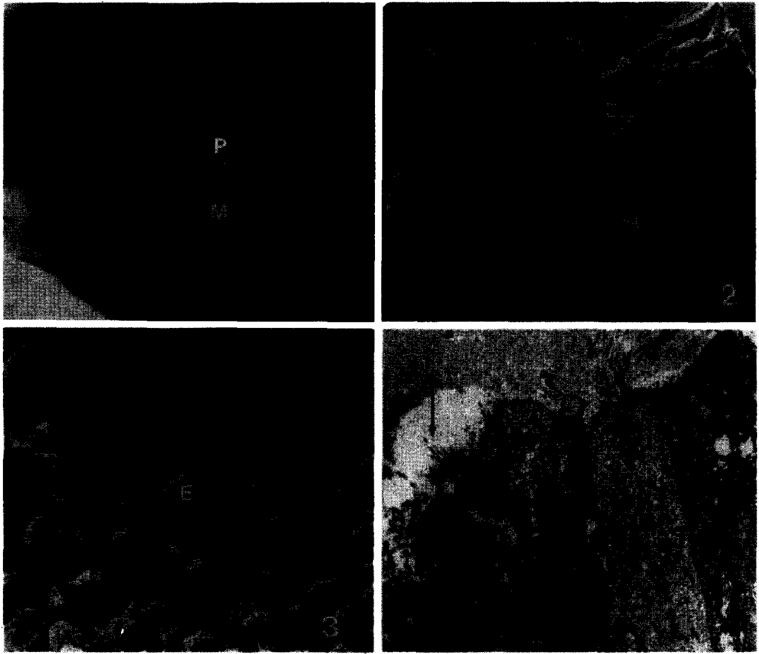
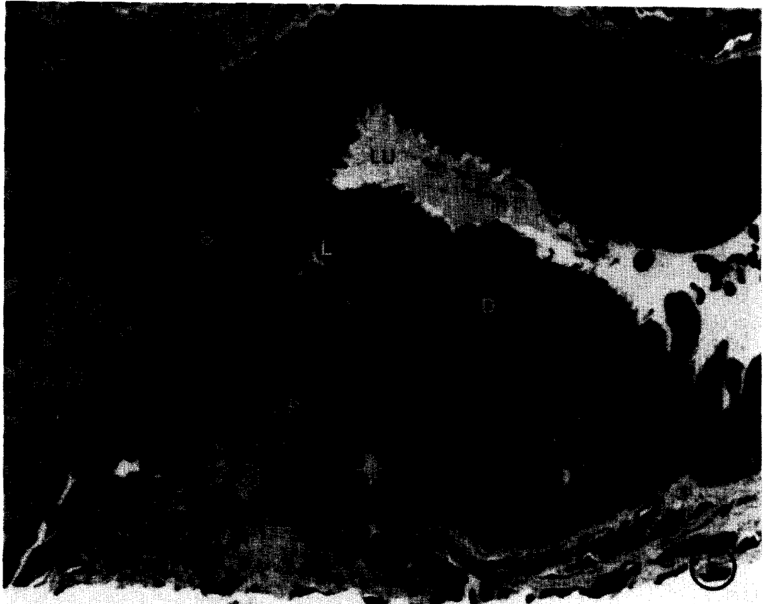
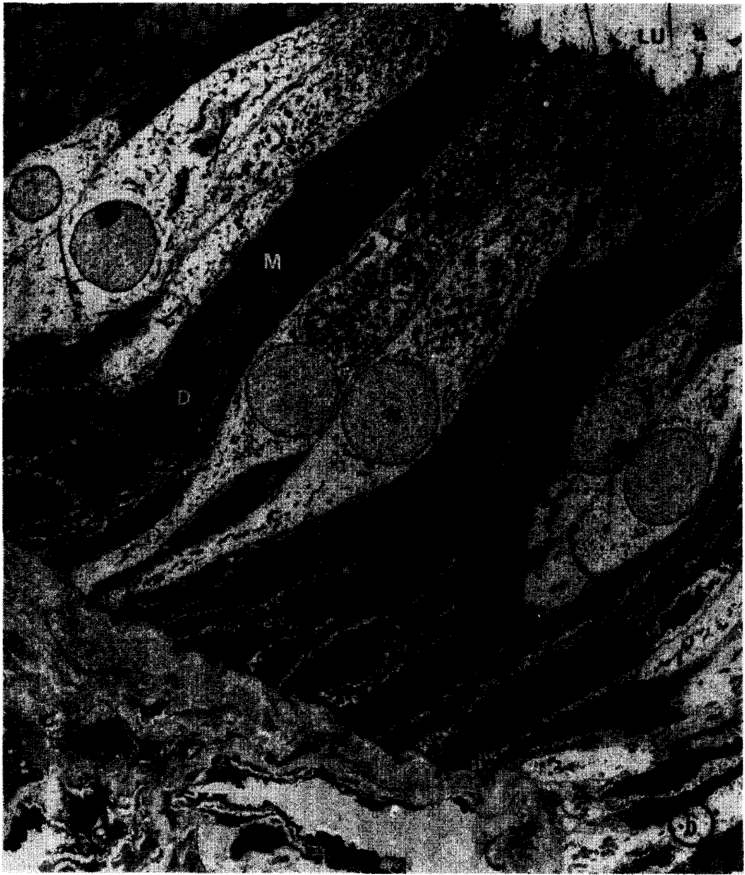
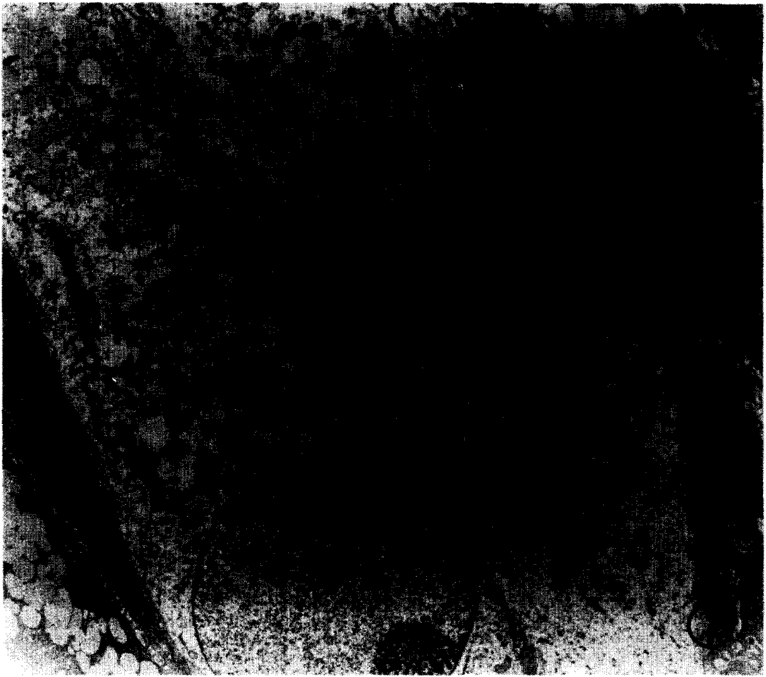
Verification
Claims the paper makes
The claims and statistics of this paper haven’t been checked yet.
Run the check — free, no account needed. It reads the open-access text and checks the sources it cites.
Claims other papers make about this one
Each is checked against this paper’s own text: does it say what the citing paper says it does?
The source backs part of the claim, not all of it — or backs it for a different population, condition or comparison.
In the citing paper
“The epithelium lining the human VNO is unlike that of VNOs in other species and unlike that of olfactory or respiratory epithelium in humans (Moran et al., 1991;Stensaas et al., 1991).”
From Human Vomeronasal Organ Function: A Critical Review of Best and Worst Cases (2001) · cites this paper as Moran et al., 1991
Experimental — accuracy not yet measuredThe source backs part of the claim, not all of it — or backs it for a different population, condition or comparison.
In the citing paper
“The human vomeronasal epithelium differs in appearance from both the sensory and non-sensory epithelia in the VNOs of other species and from nasal 'respiratory' epithelium (Moran et al., 1991;Stensaas et al., 1991).”
From Human Vomeronasal Organ Function: A Critical Review of Best and Worst Cases (2001) · cites this paper as Moran et al., 1991
Experimental — accuracy not yet measured
Self-check
Percentages, sums and reported differences re-computed from the paper’s own numbers.
The self-check needs the paper’s full text.
Citations
Cites
A low-viscosity epoxy resin embedding medium for electron microscopy.
Spurr, A. (1969) · Journal of Ultrastructure Research · doi:10.1016/s0022-5320(69)90033-1 · Cited by 13,268
Neurobiology of Taste and Smell
Anholt, R. R. H. (1988) · Trends in Neurosciences · doi:10.1016/0166-2236(88)90170-1 · Cited by 796
Graziadei, G. A. M., & Graziadei, P. P. C. (1979) · Journal of Neurocytology · doi:10.1007/bf01175561 · Cited by 528
Neurobehavioral evidence for the involvement of the vomeronasal system in mammalian reproduction.
Wysocki, C. (1979) · Neuroscience and Biobehavioral Reviews · doi:10.1016/0149-7634(79)90015-0 · Cited by 478
Vomeronasal Organ: Critical Role in Mediating Sexual Behavior of the Male Hamster
Powers, J. B., & Winans, S. S. (1975) · Science · doi:10.1126/science.1145182 · Cited by 351
THE ROLE OF THE VOMERONASAL ORGAN IN MAMMALIAN REPRODUCTION
ESTES, R. D. (1972) · Mammalia · doi:10.1515/mamm.1972.36.3.315 · Cited by 305
The fine structure of the olfactory mucosa in man
Moran, D. T., Rowley, J. C., Jafek, B. W., & Lovell, M. A. (1982) · Journal of Neurocytology · doi:10.1007/bf01153516 · Cited by 280
Self-citationEfferent control of stimulus access to the hamster vomeronasal organ.
Meredith, M. J., & O’Connell, R. J. (1979) · The Journal of Physiology · doi:10.1113/jphysiol.1979.sp012620 · Cited by 260
Nonolfactory Responses from the Nasal Cavity: Jacobson’s Organ and the Trigeminal System
Tucker, D. M. (1971) · Handbook of sensory physiology · doi:10.1007/978-3-642-65126-7_7 · Cited by 176
Urine-induced reflex ovulation in anovulatory rats may be a vomeronasal effect
JOHNS, M. A., Feder, H. H., Komisaruk, B. R., & Mayer, A. D. (1978) · Nature · doi:10.1038/272446a0 · Cited by 154
Cited by
Sorted by citations
A novel family of genes encoding putative pheromone receptors in mammals
Dulac, C., & Axel, R. (1995) · Cell · doi:10.1016/0092-8674(95)90161-2 · Cited by 1,001
Molecular detection of pheromone signals in mammals: from genes to behaviour
Dulac, C. G., & Torello, A. T. (2003) · Nature reviews. Neuroscience · doi:10.1038/nrn1140 · Cited by 662
Structure and function of the vomeronasal system: an update
Halpern, M. (2003) · Progress in Neurobiology · doi:10.1016/s0301-0082(03)00103-5 · Cited by 639
Tirindelli, R., Dibattista, M., Pifferi, S., & Menini, A. (2009) · Physiological Reviews · doi:10.1152/physrev.00037.2008 · Cited by 393
Human Vomeronasal Organ Function: A Critical Review of Best and Worst Cases
Meredith, M. (2001) · Chemical Senses · doi:10.1093/chemse/26.4.433 · Cited by 280
Peretto, P. M., Merighi, A., Fasolo, A., & Bonfanti, L. (1999) · Brain Research Bulletin · doi:10.1016/s0361-9230(99)00037-4 · Cited by 218
Eisthen, H. L. (1992) · Microscopy Research and Technique · doi:10.1002/jemt.1070230102 · Cited by 179
The Vomeronasal Cavity in Adult Humans
Trotier, D. (2000) · Chemical Senses · doi:10.1093/chemse/25.4.369 · Cited by 168
Biopsies of Human Olfactory Epithelium
Jafek, B. W. (2002) · Chemical Senses · doi:10.1093/chemse/27.7.623 · Cited by 161
Self-citationMonti-Bloch, L., Jennings-White, C. L. D., Dolberg, D. S., & Berliner, D. L. (1994) · Psychoneuroendocrinology · doi:10.1016/0306-4530(94)90049-3 · Cited by 151
The Roles of Androgens in Humans: Biology, Metabolic Regulation and Health
Alemany, M. (2022) · International Journal of Molecular Sciences · doi:10.3390/ijms231911952 · Cited by 150
The risk to olfaction from nasal surgery
Kimmelman, C. P. (1994) · The Laryngoscope · doi:10.1288/00005537-199408000-00012 · Cited by 128
Understanding the Nasal Airway: Principles and Practice
Howard, B. K., & Rohrich, R. J. (2002) · Plastic & Reconstructive Surgery · doi:10.1097/00006534-200203000-00054 · Cited by 102
Smith, T. D., Siegel, M. I., & Bhatnagar, K. P. (2001) · The Anatomical Record · doi:10.1002/ar.1152 · Cited by 98
Location and gross morphology of the nasopalatine duct in human adults.
Jacob, S., Zelano, B., Gungor, A., Abbott, D. J., Naclerio, R., & Mcclintock, M. K. (2000) · Archives of Otolaryngology - Head and Neck Surgery · doi:10.1001/archotol.126.6.741 · Cited by 94
Recent progress in the neurobiology of the vomeronasal organ
Takami, S. (2002) · Microscopy Research and Technique · doi:10.1002/jemt.10094 · Cited by 96
Olfaction and human neonatal behaviour: clinical implications
Winberg, J., & Porter, R. (1998) · Acta paediatrica · doi:10.1111/j.1651-2227.1998.tb01376.x · Cited by 98
Olfactory sensitivity in mammalian species.
Wackermannova, M., Pinc, L., & Jebavý, L. (2016) · Physiological Research · doi:10.33549/physiolres.932955 · Cited by 75
Human pheromones: integrating neuroendocrinology and ethology.
Kohl, J. V., Atzmüller, M., Fink, B., & Grammer, K. (2001) · PubMed · Cited by 78
The human vomeronasal organ. III. Postnatal development from infancy to the ninth decade
Bhatnagar, K. P., & Smith, T. D. (2001) · Journal of Anatomy · doi:10.1046/j.1469-7580.2001.19930289.x · Cited by 77
Bonfanti, L., Peretto, P., Merighi, A., & Fasolo, A. (1997) · Neuroscience · doi:10.1016/s0306-4522(97)00090-0 · Cited by 76
Vomeronasal Versus Olfactory Epithelium: Is There a Cellular Basis for Human Vomeronasal Perception?
Witt, M., & Hummel, T. R. (2006) · International review of cytology · doi:10.1016/s0074-7696(06)48004-9 · Cited by 77
Aujard, F. (1997) · Physiology & Behavior · doi:10.1016/s0031-9384(97)00206-0 · Cited by 73
On the chemosensory nature of the vomeronasal epithelium in adult humans
Witt, M., Georgiewa, B., Knecht, M., & Hummel, T. R. (2002) · Histochemistry and Cell Biology · doi:10.1007/s00418-002-0407-1 · Cited by 71
Ultrastructural neurobiology of the olfactory mucosa of the brown trout, Salmo trutta
Moran, D. T., Rowley, J. C., Aiken, G. R., & Jafek, B. W. (1992) · Microscopy Research and Technique · doi:10.1002/jemt.1070230104 · Cited by 68
Self-citationDudley, C. A., Rajendren, G. V., & Moss, R. L. (1992) · Molecular and Cellular Neuroscience · doi:10.1016/1044-7431(92)90034-y · Cited by 65
Pheromones, Odors, and Vasanas
McClintock, M. K. (2002) · Elsevier eBooks · doi:10.1016/b978-012532104-4/50017-2 · Cited by 63
The human vomeronasal organ. Part II: prenatal development
Smith, T. D., & Bhatnagar, K. P. (2000) · Journal of Anatomy · doi:10.1046/j.1469-7580.2000.19730421.x · Cited by 63
The functionality of the human vomeronasal organ (VNO): Evidence for steroid receptors
Berliner, D. L., Monti-Bloch, L., Jennings-White, C., & Diaz-Sanchez, V. (1996) · The Journal of Steroid Biochemistry and Molecular Biology · doi:10.1016/0960-0760(96)00062-3 · Cited by 87
Human pheromones: have they been demonstrated?
Hays, W. S. T. (2003) · Behavioral Ecology and Sociobiology · doi:10.1007/s00265-003-0613-4 · Cited by 71
The vomeronasal organ is not involved in the perception of endogenous odors
Frasnelli, J., Lundström, J. N., Boyle, J. A., Katsarkas, A., & Jones‐Gotman, M. (2010) · Human Brain Mapping · doi:10.1002/hbm.21035 · Cited by 53
Characterization of nonfunctional V1R-like pheromone receptor sequences in human.Preprint
Giorgi, D., Friedman, C., Trask, B. J., & Rouquier, S. (2000) · Genome Research · doi:10.1101/gr.10.12.1979 · Cited by 52
Smith, T. D., Siegel, M. I., Bonar, C. J., Bhatnagar, K. P., Mooney, M. P., Burrows, A. M., Smith, M. A., & Maico, L. M. (2001) · Journal of Anatomy · doi:10.1046/j.1469-7580.2001.19810077.x · Cited by 47
Pheromones in sex and reproduction: Do they have a role in humans?
Mostafa, T., El-Khouly, G., & Hassan, A. (2011) · Journal of Advanced Research · doi:10.1016/j.jare.2011.03.003 · Cited by 46
Das vomeronasale Organ des Menschen
Knecht, M., Witt, M., Abolmaali, N., Hüttenbrink, K., & Hummel, T. R. (2003) · Der Nervenarzt · doi:10.1007/s00115-003-1573-7 · Cited by 45
Jansen, H. T., Iwamoto, G. A., & Jackson, G. L. (1998) · Brain Research Bulletin · doi:10.1016/s0361-9230(97)00279-7 · Cited by 45
The risk of extrapolation in neuroanatomy: the case of the mammalian accessory olfactory bulb
Salazar, I. (2009) · Frontiers in Neuroanatomy · doi:10.3389/neuro.05.022.2009 · Cited by 41
Sato, Y., Sakai, H., Kobayashi, Y., Shibasaki, Y., & Sasaki, T. (2000) · The Anatomical Record · doi:10.1002/1097-0185(20000901)260:1 · Cited by 44
Frequency and Localization of the Putative Vomeronasal Organ in Humans in Relation to Age and Gender
Knecht, M., Kühnau, D., Hüttenbrink, K., Witt, M., & Hummel, T. R. (2001) · The Laryngoscope · doi:10.1097/00005537-200103000-00013 · Cited by 40
Structure and Function of the Vomeronasal Organ
Witt, M., & Wozniak, W. (2006) · KARGER eBooks · doi:10.1159/000093751 · Cited by 39
The anatomy and functional role of the circumvallate papilla/von Ebner gland complex.
Sbarbati, A., Crescimanno, C., & Osculati, F. (1999) · Medical Hypotheses · doi:10.1054/mehy.1997.0708 · Cited by 36
Expression of candidate pheromone receptor genes in vomeronasal neurons.
Dulac, C., & Axel, R. (1998) · Chemical Sensors · doi:10.1093/chemse/23.4.467 · Cited by 41
In search of human skin pheromones.
Cohn, B. A. (1994) · Archives of Dermatology · doi:10.1001/archderm.1994.01690080114018 · Cited by 42
The Vomeronasal Organ: A Neglected Organ
D'Aniello, B., Gun, S., Scandurra, A., & Pinelli, C. (2017) · Frontiers in Neuroanatomy · doi:10.3389/fnana.2017.00070 · Cited by 30
ROLE OF THE VOMERONASAL INPUT IN MATERNAL BEHAVIOR
del Cerro, M. C. R. (1998) · Psychoneuroendocrinology · doi:10.1016/s0306-4530(98)00060-2 · Cited by 36
Pheromone Sensing in Mammals: A Review of the Vomeronasal System
Torres, M. V., Ortiz‐Leal, I., & Sánchez‐Quinteiro, P. (2023) · Anatomia · doi:10.3390/anatomia2040031 · Cited by 37
cDNA sequence and expression pattern of the putative pheromone carrier aphrodisin.
Mägert, H., Hadrys, T., Cieslak, A., Gröger, A., Feller, S. M., & Forssmann, W. (1995) · Proceedings of the National Academy of Sciences · doi:10.1073/pnas.92.6.2091 · Cited by 36
Pheromone transduction in the vomeronasal organ.
Liman, E. (1996) · Current Opinion in Neurobiology · doi:10.1016/s0959-4388(96)80054-7 · Cited by 39
Phylogenic outline of the olfactory system in vertebrates.
Taniguchi, K., Saito, S., & Taniguchi, K. (2011) · Journal of Veterinary Medical Science · doi:10.1292/jvms.10-0316 · Cited by 34
The vomeronasal (Jacobson's) organ in adult humans: frequency of occurrence and enzymatic study.
Gaafar, H. A., Tantawy, A. A., Melis, A., Hennawy, D. M., & Shehata, H. M. (1998) · Acta Oto-Laryngologica · doi:10.1080/00016489850183520 · Cited by 35
Krishna, N. S. R., Getchell, M. L., & Getchell, T. V. (1994) · Journal of Neuroscience Research · doi:10.1002/jnr.490390303 · Cited by 32
Pheromones and Mammalian Reproduction
Vandenbergh, J. G. (2006) · Elsevier eBooks · doi:10.1016/b978-012515400-0/50042-7 · Cited by 31
A Classification Schema for the Vomeronasal Organ in Humans
Zbar, R. I. S., Zbar, L. I. S., Dudley, C. A., Trott, S. A., Rohrich, R. J., & Moss, R. L. (2000) · Plastic & Reconstructive Surgery · doi:10.1097/00006534-200004000-00004 · Cited by 28
Loi, P. K., & Tublitz, N. J. (2000) · The Journal of Comparative Neurology · doi:10.1002/(sici)1096-9861(20000515)420:4 · Cited by 38
Bhatnagar, K. P., Smith, T. D., & Winstead, W. I. (2002) · American Journal of Rhinology · doi:10.1177/194589240201600611 · Cited by 27
Electron Microscopic and Functional Aspects of the Human Vomeronasal Organ
Jahnke, V., & Merker, H.-J. (2000) · American Journal of Rhinology · doi:10.2500/105065800781602957 · Cited by 27
The Golden Hamster Aphrodisin Gene
Mägert, H., Cieslak, A., Alkan, O., Lüscher, B., Kauffels, W., & Forssmann, W. (1999) · Journal of Biological Chemistry · doi:10.1074/jbc.274.1.444 · Cited by 26
Genetics of Nonsyndromic Oral Clefts Revisited
Wyszynski, D. F., Beaty, T. H., & Maestri, N. E. (1996) · The Cleft Palate-Craniofacial Journal · doi:10.1597/1545-1569(1996)033 · Cited by 204
Fine structure of the vomeronasal organ in the chinchilla (Chinchilla laniger).
Oikawa, T., Shimamura, K., Saito, T. R., & Taniguchi, K. (1994) · Jikken dobutsu. Experimental animals · doi:10.1538/expanim1978.43.4_487 · Cited by 24
TANIGUCHI, K., Tohru, A. R. A. I., & OGAWA, K. (1993) · Journal of Veterinary Medical Science · doi:10.1292/jvms.55.107 · Cited by 22
Anatomical position of the vomeronasal organ in postnatal humans.
Smith, T., Buttery, T. A., Bhatnagar, K. P., Burrows, A., Mooney, M., & Siegel, M. (2001) · Annals of Anatomy · doi:10.1016/s0940-9602(01)80209-0 · Cited by 19
Calbindin-like immunoreactivity in epithelial cells of the newborn and adult human vomeronasal organ
Johnson, E. W., Eller, P. M., & Jafek, B. W. (1994) · Brain Research · doi:10.1016/0006-8993(94)90666-1 · Cited by 20
Self-citationThe Vomeronasal Organ: An Objective Anatomic Analysis of its Prevalence
Won, J., Mair, E. A., Bolger, W. E., & Conran, R. M. (2000) · Ear Nose & Throat Journal · doi:10.1177/014556130007900814 · Cited by 20
Salazar, I., Quinteiro, P. S., Cifuentes, J. M., & Lombardero, M. (1998) · Anatomia Histologia Embryologia · doi:10.1111/j.1439-0264.1998.tb00197.x · Cited by 19
Wellness in women after 40 years of age: The role of sex hormones and pheromones
Cutler, W. B., & Genovese-Stone, E. (1998) · Disease-a-Month · doi:10.1016/s0011-5029(98)90016-5 · Cited by 19
Foltán, R., & Šedý, J. (2009) · Head & Face Medicine · doi:10.1186/1746-160x-5-5 · Cited by 17
The vomeronasal organ and chemical sensitivity: a hypothesis.
Greene, G. J., & Kipen, H. M. (2002) · Environmental Health Perspectives · doi:10.1289/ehp.02110s4655 · Cited by 17
Prenatal development of the mammalian vomeronasal organ
Garrosa, M., Gayoso, M. J., & Esteban, F. J. (1998) · Microscopy Research and Technique · doi:10.1002/(sici)1097-0029(19980615)41:6 · Cited by 45
Elektronenmikroskopische Untersuchungen des menschlichen vomeronasalen Organs
Jahnke, V., & Merker, H. (1998) · HNO (Berlin. Print) · doi:10.1007/s001060050258 · Cited by 18
Development and Developmental Disorders of the Forebrain
ten Donkelaar, H. J., Lammens, M. M. Y., Cruysberg, J. R. M., Ulzen, K. K.-V., Hori, A., & Shiota, K. (2014) · Springer eBooks · doi:10.1007/978-3-642-54687-7_9 · Cited by 16
The clinical significance of the human vomeronasal organ
Bruintjes, T. D., & Bleys, R. L. A. W. (2023) · Surgical and Radiologic Anatomy · doi:10.1007/s00276-023-03101-2 · Cited by 14
Fate and Development of Human Vomeronasal Organ - A Microscopic Fetal Study.
Manickavasuki, A., Fenn, T. K. A., Devi, M., Hebzibah, T. D. J., Jamuna, M., & Sundaram, K. (2016) · Journal of clinical and diagnostic research : JCDR · doi:10.7860/jcdr/2016/15930.7373 · Cited by 9
Salazar, I., Lombardero, M., Sánchez‐Quinteiro, P., Roel, P., & Cifuentes, J. M. (1998) · Annals of Anatomy - Anatomischer Anzeiger · doi:10.1016/s0940-9602(98)80023-x · Cited by 13
[Fine structure of the vomeronasal organ in the house musk shrew (Suncus murinus)].
Oikawa, T., Shimamura, K., Saito, T. R., & Taniguchi, K. (1993) · Jikken dobutsu. Experimental animals · doi:10.1538/expanim1978.42.3_411 · Cited by 15
Sherwood, R. J., McLachlan, J. C., Aiton, J., & Scarborough, J. A. (1999) · Journal of Anatomy · doi:10.1046/j.1469-7580.1999.19530413.x · Cited by 12
Primary and secondary olfactory centres in human ontogeny
Kharlamova, A. S., Godovalova, O. S., Otlyga, E., & Proshchina, A. E. (2022) · Neuroscience Research · doi:10.1016/j.neures.2022.12.005 · Cited by 12
Giere, P., Freyer, C., & Zeller, U. (2008) · Zoosystematics and Evolution · doi:10.1002/mmnz.19990750206 · Cited by 9
Giere, P., Freyer, C., & Zeller, U. (1999) · Zoosystematics and Evolution · doi:10.1002/mmnz.4850750206 · Cited by 8
Ecological Validity in the Study of Human Pheromones
Saxton, T. K., Little, A. C., & Roberts, S. C. (2007) · Springer eBooks · doi:10.1007/978-0-387-73945-8_10 · Cited by 8
The Effect of Ammonia on Olfactory Epithelium and Vomeronasal Organ Neuroepithelium of Rabbits
Gaafar, H., Tantawy, A., Hamza, M., & Shaaban, M. (1998) · ORL · doi:10.1159/000027571 · Cited by 8
Smith, T. D., Burrows, A. M., Siegel, M. I., Mooney, M. P., Burdi, A. R., Fabrizio, P. A., & Clemente, F. R. (1999) · Springer eBooks · doi:10.1007/978-1-4615-4733-4_52 · Cited by 8
Immunolocalization of VEGF/VEGFR system in human fetal vomeronasal organ during early development
Marini, M., Manetti, M., & Sgambati, E. (2018) · Acta Histochemica · doi:10.1016/j.acthis.2018.11.001 · Cited by 6
Takami, S., Yukimatsu, M., Matsumura, G., Horie, S., & Nishiyama, F. (2015) · The Anatomical Record · doi:10.1002/ar.23290 · Cited by 5
The Impact of Olfaction on Human Social Functioning
Malaspina, D., Corcoran, C. M., & Goudsmit, N. (2006) · Cambridge University Press eBooks · doi:10.1017/cbo9780511543623.014 · Cited by 5
Vespers and vampires: A lifelong microscopic search for the smallest of things
Smith, T. D. (2022) · The Anatomical Record · doi:10.1002/ar.24907 · Cited by 4
Olfaction, Taste, and Cognition: Assessing Putative Human Pheromones
Jacob, S., Zelano, B., Hayreh, D., & McClintock, M. (2002) · Cambridge University Press eBooks · doi:10.1017/cbo9780511546389.017 · Cited by 3
Adult structural plasticity and neurogenesis in the mammalian olfactory system
Bonfanti, L., Peretto, P. M., & Fasolo, A. (2002) · RENDICONTI LINCEI · doi:10.1007/bf02904491 · Cited by 2
Cosmological dark matter and ensoulment
Irmak, M. K. (2013) · Journal of Experimental and Integrative Medicine · doi:10.5455/jeim.110813.hp.006 · Cited by 1
Development and Developmental Disorders of the Forebrain
ten Donkelaar, H. J., Lammens, M. M. Y., Cruysberg, J. R. M., Ulzen, K. K.-V., Hori, A., Shiota, K., Itoh, K., & Willemsen, M. A. A. P. (2023) · Springer eBooks · doi:10.1007/978-3-031-26098-8_9 · Cited by 2
Personal Human Life Begins with the Formation of Adult Type Hippocampus at 13th Week of Development
Irmak, M. K. (2016) · Springer eBooks · doi:10.1007/978-3-319-14874-8_14 · Cited by 1
The effects of pubertal timing and dominance on the mating strategy, appearance and behaviour of men
Lawson, J. F. (2008) · St Andrews Research Repository (St Andrews Research Repository) · Cited by 1
Pheromones cause disease: pheromone/odourant transduction
Nicholson, B. (2001) · Medical Hypotheses · doi:10.1054/mehy.2001.1357 · Cited by 1
Oliva, D. (2002) · PubMed · Cited by 1
Gower, D. B. (1997) · Springer eBooks · doi:10.1007/978-94-009-1567-1_22 · Cited by 1
Cavaggioni, A., Mucignat-Caretta, C., Sartor, G., & Tirindelli, R. (1996) · Springer eBooks · doi:10.1007/978-1-4615-5899-6_13
Biologie moléculaire et perception des phéromones chez les mammifères.
Dulac, C. (1997) · médecine/sciences · doi:10.4267/10608/336
Soussi‐Yanicostas, N., Hardelin, J., Levilliers, J., Ardouin, O., Legouis, R., Cohen‐Salmon, M., & Petit, C. (1995) · Annales de l Institut Pasteur / Actualités · doi:10.1016/0924-4204(96)83385-3
EL AMOR ENTRE LA FISIOLOGÍA Y EL APRENDIZAJE
López, J. B. (2005) · LA Referencia (Red Federada de Repositorios Institucionales de Publicaciones Científicas)
Geburtshilfe / Frauen-Heilkunde / Strahlen-Heilkunde / Forschung / Konsequenzen
Atzmüller, M., & Grammer, K. (2000)
Metadata
- Authors
- Moran, D. T., Jafek, B. W., & Rowley, J. C.
- Affiliations
- Hospital of the University of Pennsylvania (US)
- University of Colorado Anschutz (US)
- Corresponding author
- Moran, David T.
- ORCID
- Moran, David T.
- Venue
- The Journal of Steroid Biochemistry and Molecular Biology
- Publisher
- Elsevier BV
- Published
- 1991-10
- Volume
- 39
- Issue
- 4
- Pages
- 545-552
- ISSN
- 0960-0760 (ISSN-L)
- OpenAlex
- W2039091321
- Cited by
- 109
- References
- 18
- Citations by year
- 2025: 1 · 2023: 3 · 2022: 3 · 2021: 1 · 2018: 1 · 2017: 2 · 2016: 5 · 2015: 1 · 2014: 1 · 2013: 1
- FWCI
- 2.29
- Type
- journal article
- Language
- en
- Open access
- hybrid
- doi.org
- Licence
- Locations
- The Journal of Steroid Biochemistry and Molecular Biology (publishedVersion, cc-by-nc-nd)
- PubMed (publishedVersion)
- Funders
- National Institutes of Health (2p01ns020486-04)
- National Institute of Neurological Disorders and Stroke (2-PO1-NS20486)
- Topics
- Life Sciences › Neuroscience › Sensory Systems › Olfactory and Sensory Function Studies
- Life Sciences › Neuroscience › Sensory Systems › Ion Channels and Receptors
- Health Sciences › Medicine › Surgery › Nasal Surgery and Airway Studies
- Keywords
- vomeronasal organ, ultrastructure, vomeronasal epithelium, dark cells, light cells, frequency of occurrence, nasal septum, olfaction
- MeSH terms
- Adult, Chemoreceptor Cells, Female, Humans, Male, Microscopy, Electron, Microscopy, Electron, Scanning, Nasal Septum, Olfactory Pathways
About these checks
Registry, retraction, Cites and statistics results are computed, not judged, with one exception: a printed reference that no index lists is read once by a model before it counts as a citation error. Claims are extracted by a model and kept only when their quote appears verbatim in the text; each cited source is then checked, with a model’s help, for whether it says what the claim relies on. Those verdicts can be wrong — read the claim’s quote and the cited source before relying on one.
Statistics and arithmetic are recomputed, not judged.
Confidence bands are shown only for fields calibrated on our annotated test set. None is calibrated yet, so no band is shown.
What counts as a claim ›How we measure confidence ›How we check this ›
Are you an author, or do you see a problem with this page? Request a review
