

The DOI matches its Crossref record; 18 of the 18 references it cites were found in a registry or an index.
The vomeronasal (Jacobson's) organ in man: ultrastructure and frequency of occurence
Open accessAbstract
These investigations address three major questions: (1) What is the frequency of occurrence of the vomeronasal (Jacobson's) organ (VNO) in man? (2) what is the ultrastructure of the human VNO? and (3) does the VNO contain sensory receptor cells? Macroscopic and microscopic intranasal clinical examinations of over 200 persons revealed paired bilateral vomeronasal pits on the anterior 1/3 of the nasal septum in all cases. Biopsies of the vomeronasal pits and surrounding tissues were examined by light and electron microscopy. These studies showed that the vomeronasal pit leads to a closed tube, 2-8 mm long, lined by a unique pseudostratified columnar epithelium unlike any other in the human body. The anterior end of the tube is lined by tall, columnar cells with a sparse population of short microvilli. The posterior end of the VNO is lined by an epithelium that contains three morphologically distinct cell types: (1) basal cells; (2) "dark cells--tall, slender cells with heterochromatic nuclei and electron-dense cytoplasm that often contain mucigen-like granules; and (3) "light" cells--large, clear cells, extending from the basement membrane to the organ's lumen. Each "light" cell has a round, euchromatic nucleus and a clear cytoplasm that often contains many Golgi stacks and membrane-limited vesicles filled with material of modest electron density. The cell apex is tipped by a few short microvilli. Whether these cells subserve any sensory function awaits further investigation.
Overview
The claims and statistics of this paper haven’t been checked yet.
Run the check — free, no account needed. It reads the open-access text and checks the sources it cites.
Integrity signals
Registry
Cites
Statistics
Figures
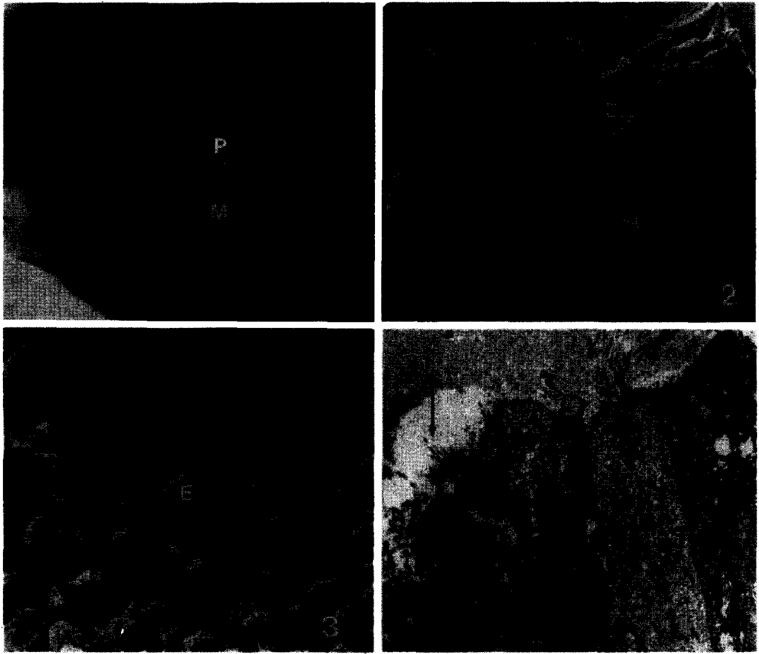
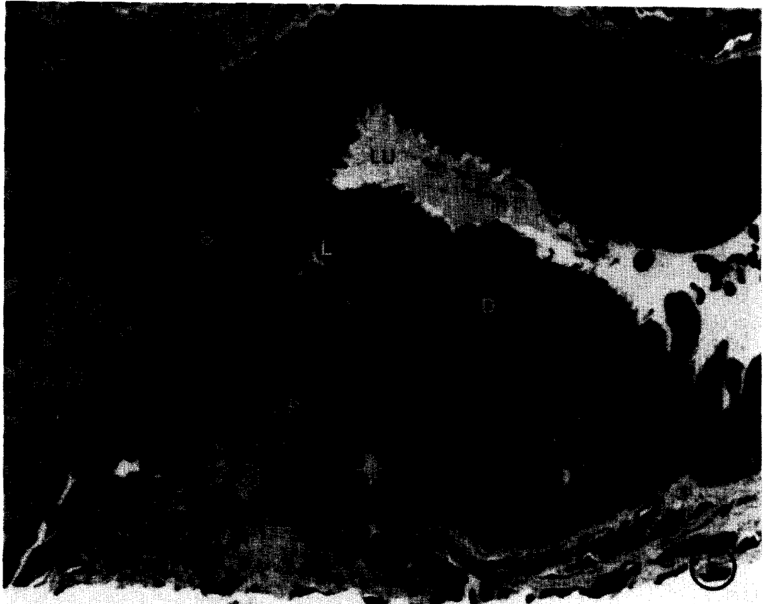
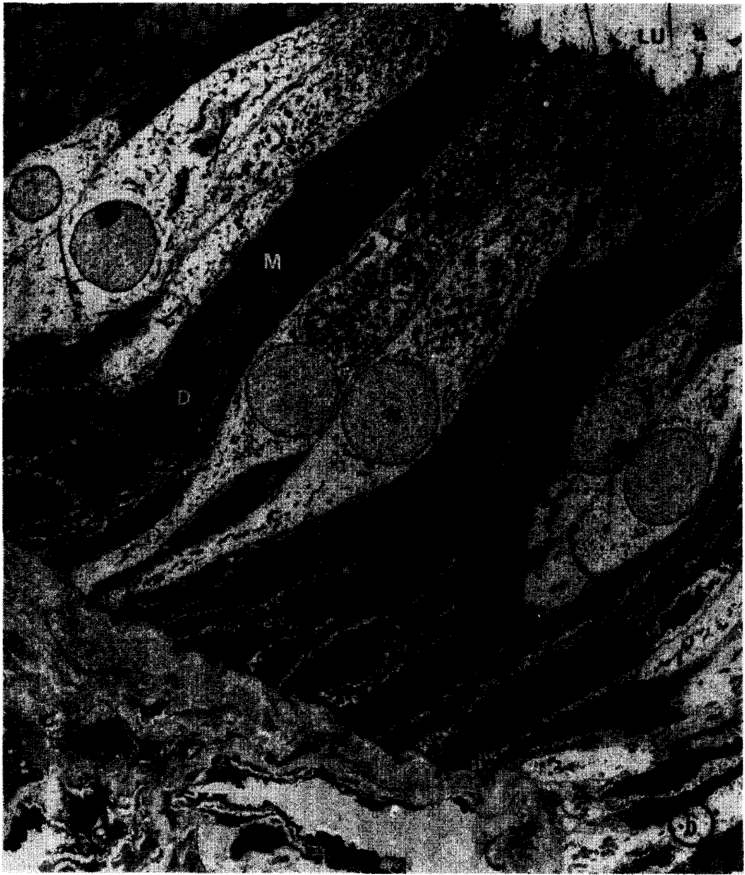
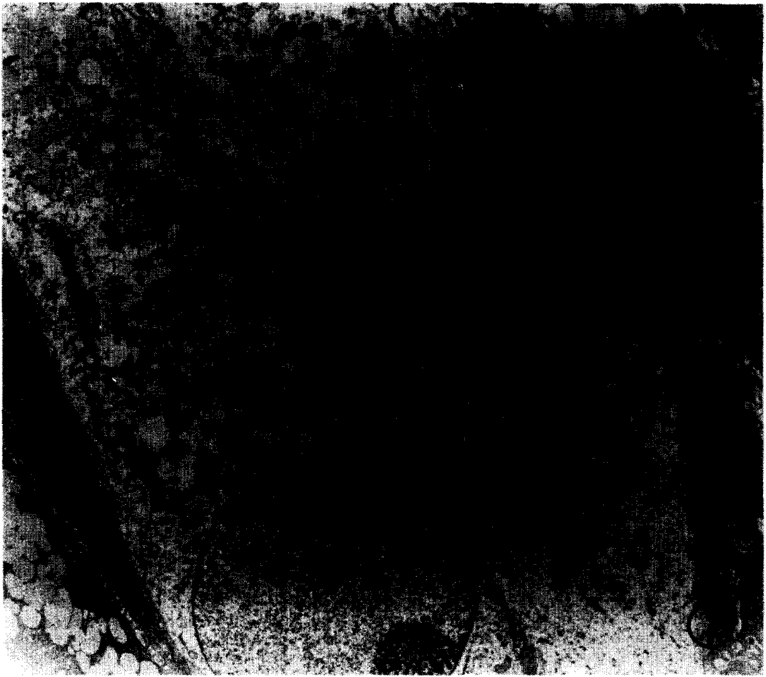
Verification
Claims the paper makes
The claims and statistics of this paper haven’t been checked yet.
Run the check — free, no account needed. It reads the open-access text and checks the sources it cites.
Claims other papers make about this one
Each is checked against this paper’s own text: does it say what the citing paper says it does?
The source backs part of the claim, not all of it — or backs it for a different population, condition or comparison.
In the citing paper
“The epithelium lining the human VNO is unlike that of VNOs in other species and unlike that of olfactory or respiratory epithelium in humans (Moran et al., 1991;Stensaas et al., 1991).”
From Human Vomeronasal Organ Function: A Critical Review of Best and Worst Cases (2001) · cites this paper as Moran et al., 1991
Experimental — accuracy not yet measuredThe source backs part of the claim, not all of it — or backs it for a different population, condition or comparison.
In the citing paper
“The human vomeronasal epithelium differs in appearance from both the sensory and non-sensory epithelia in the VNOs of other species and from nasal 'respiratory' epithelium (Moran et al., 1991;Stensaas et al., 1991).”
From Human Vomeronasal Organ Function: A Critical Review of Best and Worst Cases (2001) · cites this paper as Moran et al., 1991
Experimental — accuracy not yet measured
Self-check
Percentages, sums and reported differences re-computed from the paper’s own numbers.
The self-check needs the paper’s full text.
Citations
Cites
A low-viscosity epoxy resin embedding medium for electron microscopy.
Spurr, A. (1969) · Journal of Ultrastructure Research · doi:10.1016/s0022-5320(69)90033-1 · Cited by 13,268
Neurobiology of Taste and Smell
Anholt, R. R. H. (1988) · Trends in Neurosciences · doi:10.1016/0166-2236(88)90170-1 · Cited by 796
Graziadei, G. A. M., & Graziadei, P. P. C. (1979) · Journal of Neurocytology · doi:10.1007/bf01175561 · Cited by 528
Neurobehavioral evidence for the involvement of the vomeronasal system in mammalian reproduction.
Wysocki, C. (1979) · Neuroscience and Biobehavioral Reviews · doi:10.1016/0149-7634(79)90015-0 · Cited by 478
Vomeronasal Organ: Critical Role in Mediating Sexual Behavior of the Male Hamster
Powers, J. B., & Winans, S. S. (1975) · Science · doi:10.1126/science.1145182 · Cited by 351
THE ROLE OF THE VOMERONASAL ORGAN IN MAMMALIAN REPRODUCTION
ESTES, R. D. (1972) · Mammalia · doi:10.1515/mamm.1972.36.3.315 · Cited by 305
The fine structure of the olfactory mucosa in man
Moran, D. T., Rowley, J. C., Jafek, B. W., & Lovell, M. A. (1982) · Journal of Neurocytology · doi:10.1007/bf01153516 · Cited by 280
Self-citationEfferent control of stimulus access to the hamster vomeronasal organ.
Meredith, M. J., & O’Connell, R. J. (1979) · The Journal of Physiology · doi:10.1113/jphysiol.1979.sp012620 · Cited by 260
Nonolfactory Responses from the Nasal Cavity: Jacobson’s Organ and the Trigeminal System
Tucker, D. M. (1971) · Handbook of sensory physiology · doi:10.1007/978-3-642-65126-7_7 · Cited by 176
Urine-induced reflex ovulation in anovulatory rats may be a vomeronasal effect
JOHNS, M. A., Feder, H. H., Komisaruk, B. R., & Mayer, A. D. (1978) · Nature · doi:10.1038/272446a0 · Cited by 154
The vomeronasal organ of the rat.
Vaccarezza, O. L., Sepich, L. N., & Tramezzani, J. H. (1981) · PubMed · Cited by 140
Crosby, E. C., & Humphrey, T. (1939) · The Journal of Comparative Neurology · doi:10.1002/cne.900710108 · Cited by 131
Ultrastructure of the human vomeronasal organ
Stensaas, L. J., Lavker, R. M., Monti-Bloch, L., Grosser, B. I., & Berliner, D. L. (1991) · The Journal of Steroid Biochemistry and Molecular Biology · doi:10.1016/0960-0760(91)90252-z · Cited by 118
Johnson, A., Josephson, R. L., & Hawke, M. (1985) · PubMed · Cited by 96
Neural control of reproductive function
(1990) · Electroencephalography and Clinical Neurophysiology · doi:10.1016/0013-4694(90)90067-t · Cited by 96
Loussert-Fonta, C., & Humbel, B. M. (2015) · Archives of Biochemistry and Biophysics · doi:10.1016/j.abb.2015.05.017 · Cited by 92
Replacement of receptor neurones after section of the vomeronasal nerves in the adult mouse
Barber, P. C., & Raisman, G. (1978) · Brain Research · doi:10.1016/0006-8993(78)90841-7 · Cited by 91
Biological Specimen Preparation for Correlative Light and Electron Microscopy
Moran, D. T., & Rowley, J. C. (1987) · Elsevier eBooks · doi:10.1016/b978-0-12-333922-5.50050-8 · Cited by 24
Self-citation
Cited by
Sorted by citations
A novel family of genes encoding putative pheromone receptors in mammals
Dulac, C., & Axel, R. (1995) · Cell · doi:10.1016/0092-8674(95)90161-2 · Cited by 1,001
Molecular detection of pheromone signals in mammals: from genes to behaviour
Dulac, C. G., & Torello, A. T. (2003) · Nature reviews. Neuroscience · doi:10.1038/nrn1140 · Cited by 662
Structure and function of the vomeronasal system: an update
Halpern, M. (2003) · Progress in Neurobiology · doi:10.1016/s0301-0082(03)00103-5 · Cited by 639
Tirindelli, R., Dibattista, M., Pifferi, S., & Menini, A. (2009) · Physiological Reviews · doi:10.1152/physrev.00037.2008 · Cited by 393
Human Vomeronasal Organ Function: A Critical Review of Best and Worst Cases
Meredith, M. (2001) · Chemical Senses · doi:10.1093/chemse/26.4.433 · Cited by 280
Metadata
- Authors
- Moran, D. T., Jafek, B. W., & Rowley, J. C.
- Affiliations
- Hospital of the University of Pennsylvania (US)
- University of Colorado Anschutz (US)
- Corresponding author
- Moran, David T.
- ORCID
- Moran, David T.
- Venue
- The Journal of Steroid Biochemistry and Molecular Biology
- Publisher
- Elsevier BV
- Published
- 1991-10
- Volume
- 39
- Issue
- 4
- Pages
- 545-552
- ISSN
- 0960-0760 (ISSN-L)
- OpenAlex
- W2039091321
- Cited by
- 109
- References
- 18
- Citations by year
- 2025: 1 · 2023: 3 · 2022: 3 · 2021: 1 · 2018: 1 · 2017: 2 · 2016: 5 · 2015: 1 · 2014: 1 · 2013: 1
- FWCI
- 2.29
- Type
- journal article
- Language
- en
- Open access
- hybrid
- doi.org
- Licence
- Locations
- The Journal of Steroid Biochemistry and Molecular Biology (publishedVersion, cc-by-nc-nd)
- PubMed (publishedVersion)
- Funders
- National Institutes of Health (2p01ns020486-04)
- National Institute of Neurological Disorders and Stroke (2-PO1-NS20486)
- Topics
- Life Sciences › Neuroscience › Sensory Systems › Olfactory and Sensory Function Studies
- Life Sciences › Neuroscience › Sensory Systems › Ion Channels and Receptors
- Health Sciences › Medicine › Surgery › Nasal Surgery and Airway Studies
- Keywords
- vomeronasal organ, ultrastructure, vomeronasal epithelium, dark cells, light cells, frequency of occurrence, nasal septum, olfaction
- MeSH terms
- Adult, Chemoreceptor Cells, Female, Humans, Male, Microscopy, Electron, Microscopy, Electron, Scanning, Nasal Septum, Olfactory Pathways
About these checks
Registry, retraction, Cites and statistics results are computed, not judged, with one exception: a printed reference that no index lists is read once by a model before it counts as a citation error. Claims are extracted by a model and kept only when their quote appears verbatim in the text; each cited source is then checked, with a model’s help, for whether it says what the claim relies on. Those verdicts can be wrong — read the claim’s quote and the cited source before relying on one.
Statistics and arithmetic are recomputed, not judged.
Confidence bands are shown only for fields calibrated on our annotated test set. None is calibrated yet, so no band is shown.
What counts as a claim ›How we measure confidence ›How we check this ›
Are you an author, or do you see a problem with this page? Request a review
