

The DOI matches its Crossref record; 105 of the 106 references it cites were found in a registry or an index.
Why 90% of clinical drug development fails and how to improve it?
Open accessAbstract
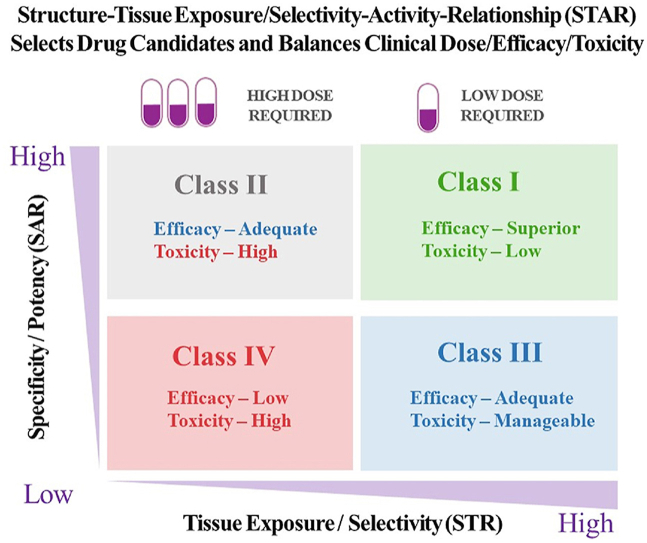
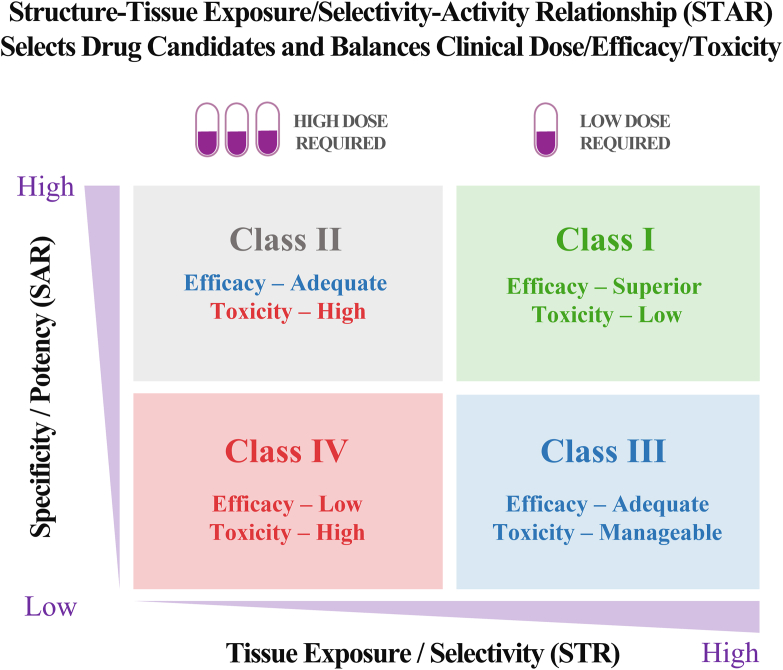
Ninety percent of clinical drug development fails despite implementation of many successful strategies, which raised the question whether certain aspects in target validation and drug optimization are overlooked? Current drug optimization overly emphasizes potency/specificity using structure‒activity-relationship (SAR) but overlooks tissue exposure/selectivity in disease/normal tissues using structure‒tissue exposure/selectivity-relationship (STR), which may mislead the drug candidate selection and impact the balance of clinical dose/efficacy/toxicity. We propose structure‒tissue exposure/selectivity-activity relationship (STAR) to improve drug optimization, which classifies drug candidates based on drug's potency/selectivity, tissue exposure/selectivity, and required dose for balancing clinical efficacy/toxicity. Class I drugs have high specificity/potency and high tissue exposure/selectivity, which needs low dose to achieve superior clinical efficacy/safety with high success rate. Class II drugs have high specificity/potency and low tissue exposure/selectivity, which requires high dose to achieve clinical efficacy with high toxicity and needs to be cautiously evaluated. Class III drugs have relatively low (adequate) specificity/potency but high tissue exposure/selectivity, which requires low dose to achieve clinical efficacy with manageable toxicity but are often overlooked. Class IV drugs have low specificity/potency and low tissue exposure/selectivity, which achieves inadequate efficacy/safety, and should be terminated early. STAR may improve drug optimization and clinical studies for the success of clinical drug development.
Overview
The claims and statistics of this paper haven’t been checked yet.
Run the check — free, no account needed. It reads the open-access text and checks the sources it cites.
Integrity signals
Registry
Cites
Statistics
Figures

Verification
Claims the paper makes
The claims and statistics of this paper haven’t been checked yet.
Run the check — free, no account needed. It reads the open-access text and checks the sources it cites.
Claims other papers make about this one
Each is checked against this paper’s own text: does it say what the citing paper says it does?
The source backs part of the claim, not all of it — or backs it for a different population, condition or comparison.
In the citing paper
“Despite these investments, less than 1% of compounds are expected to enter clinical trials, let alone reach the market.13–15”
From Drug repurposing for cancer therapy (2024) · cites this paper as [15]
Experimental — accuracy not yet measuredThe cited source says what the claim attributes to it.
In the citing paper
“As such, it takes 10–15 years and costs $1–2 billion to produce a new drug approved for clinical use.”
From Drug repurposing for cancer therapy (2024) · cites this paper as [15]
Self-check
Percentages, sums and reported differences re-computed from the paper’s own numbers.
The self-check needs the paper’s full text.
Citations
Cites
Highly accurate protein structure prediction with AlphaFold
Jumper, J., Evans, R., Pritzel, A., Green, T., Figurnov, M., Ronneberger, O., Tunyasuvunakool, K., Bates, R., Žídek, A., Potapenko, A., et al. (2021) · Nature · doi:10.1038/s41586-021-03819-2 · Cited by 43,764
Wang, M., Cao, R., Zhang, L., Yang, X., Liu, J., Xu, M., Shi, Z., Hú, Z., Zhong, W., & Xiao, G. (2020) · Cell Research · doi:10.1038/s41422-020-0282-0 · Cited by 6,994
Lead- and drug-like compounds: the rule-of-five revolution
Lipinski, C. A. (2004) · Drug Discovery Today Technologies · doi:10.1016/j.ddtec.2004.11.007 · Cited by 6,455
Amidon, G. L., Lennernäs, H., Shah, V. P., & Crison, J. R. (1995) · Pharmaceutical Research · doi:10.1023/a:1016212804288 · Cited by 5,430
Can the pharmaceutical industry reduce attrition rates?
Kola, I., & Landis, J. (2004) · Nature Reviews Drug Discovery · doi:10.1038/nrd1470 · Cited by 4,167
Membrane transporters in drug development
The International Transporter Consortium, Giacomini, K. M., Huang, S.-M., Tweedie, D. J., Benet, L. Z., Brouwer, K. L. R., Chu, X., Dahlin, A., Evers, R., Fischer, V., et al. (2010) · Nature Reviews Drug Discovery · doi:10.1038/nrd3028 · Cited by 3,340
Bhatia, S. N., & Ingber, D. E. (2014) · Nature Biotechnology · doi:10.1038/nbt.2989 · Cited by 3,305
Applications of machine learning in drug discovery and development
Vamathevan, J., Clark, D., Czodrowski, P., Dunham, I., Ferran, E., Lee, G., Li, B., Madabhushi, A., Shah, P., Spitzer, M., et al. (2019) · Nature Reviews Drug Discovery · doi:10.1038/s41573-019-0024-5 · Cited by 3,228
Principles of early drug discovery
Hughes, J., Rees, S., Kalindjian, S., & Philpott, K. (2011) · British Journal of Pharmacology · doi:10.1111/j.1476-5381.2010.01127.x · Cited by 2,859
Kinase drug discovery 20 years after imatinib: progress and future directions
Cohen, P., Cross, D. A. E., & Janne, P. A. (2021) · Nature Reviews Drug Discovery · doi:10.1038/s41573-021-00195-4 · Cited by 1,092
Research works printed but not linked: 3
- Kerns, 2008, Chapter 2—advantages of good drug-like properties, 6
- Kerns, 2008, Chapter 19 - pharmacokinetics, 228
- Wei Gao, 2022, Structure‒tissue exposure/selectivity relationship (STR) may correlate with clinical efficacy/safety, Acta Pharm Sin B
Cited by
Sorted by citations
Computational approaches streamlining drug discovery
Sadybekov, A., & Katritch, V. (2023) · Nature · doi:10.1038/s41586-023-05905-z · Cited by 1,424
Self-Driving Laboratories for Chemistry and Materials Science
Tom, G., Schmid, S. P., Baird, S. G., Cao, Y., Darvish, K., Hao, H., Lo, S., Pablo-García, S., Rajaonson, E. M., Skreta, M., et al. (2024) · Chemical Reviews · doi:10.1021/acs.chemrev.4c00055 · Cited by 707
Drug repurposing for cancer therapy
Xia, Y., Sun, M., Huang, H., & Jin, W.-L. (2024) · Signal Transduction and Targeted Therapy · doi:10.1038/s41392-024-01808-1 · Cited by 443
“15 The strategies of drug repurposing involve exploring new therapeutic applications for drugs that have already been approved.”
BackgroundMarques, L., Costa, B., Pereira, M., Silva, A., Santos, J., Saldanha, L., da Silva, I. C. B., Magalhães, P., Schmidt, S., & Vale, N. (2024) · Pharmaceutics · doi:10.3390/pharmaceutics16030332 · Cited by 444
Attention is all you need: utilizing attention in AI-enabled drug discovery
Zhang, Y., Liu, C., Liu, M., Liu, T., Lin, H., Cheng-bing, H., & Lin, N. (2023) · Briefings in Bioinformatics · doi:10.1093/bib/bbad467 · Cited by 391
Metadata
- Authors
- Sun, D., Gao, W., Hu, H., & Zhou, S.
- Affiliations
- University of Michigan (US)
- Bristol-Myers Squibb (United States) (US)
- Corresponding author
- Sun, Duxin
- Venue
- Acta Pharmaceutica Sinica B
- Publisher
- Elsevier BV
- Published
- 2022-07
- Volume
- 12
- Issue
- 7
- Pages
- 3049-3062
- ISSN
- 2211-3835 (ISSN-L)
- PMC
- PMC9293739
- OpenAlex
- W4211238337
- Cited by
- 1,763
- References
- 106
- Citations by year
- 2026: 482 · 2025: 550 · 2024: 456 · 2023: 230 · 2022: 45
- FWCI
- 27.77
- Type
- journal article
- Language
- en
- Open access
- gold
- doi.org
- Licence
- Locations
- Acta Pharmaceutica Sinica B (publishedVersion, cc-by-nc-nd)
- PubMed Central (publishedVersion, cc-by-nc-nd)
- PubMed (publishedVersion)
- DOAJ (DOAJ: Directory of Open Access Journals) (submittedVersion, cc-by-sa)
- Topics
- Life Sciences › Pharmacology, Toxicology and Pharmaceutics › Drug Discovery › Computational Drug Discovery Methods
- Health Sciences › Veterinary › Small Animals › Animal testing and alternatives
- Physical Sciences › Mathematics › Statistics and Probability › Statistical Methods in Clinical Trials
- Keywords
- medication optimization, tissue selectivity, structure-activity relationship, target validation
About these checks
Registry, retraction, Cites and statistics results are computed, not judged, with one exception: a printed reference that no index lists is read once by a model before it counts as a citation error. Claims are extracted by a model and kept only when their quote appears verbatim in the text; each cited source is then checked, with a model’s help, for whether it says what the claim relies on. Those verdicts can be wrong — read the claim’s quote and the cited source before relying on one.
Statistics and arithmetic are recomputed, not judged.
Confidence bands are shown only for fields calibrated on our annotated test set. None is calibrated yet, so no band is shown.
What counts as a claim ›How we measure confidence ›How we check this ›
Are you an author, or do you see a problem with this page? Request a review
