

The DOI matches its Crossref record; 118 of the 118 references it cites were found in a registry or an index.
A cognitive model of pathological worry
Open accessAbstract
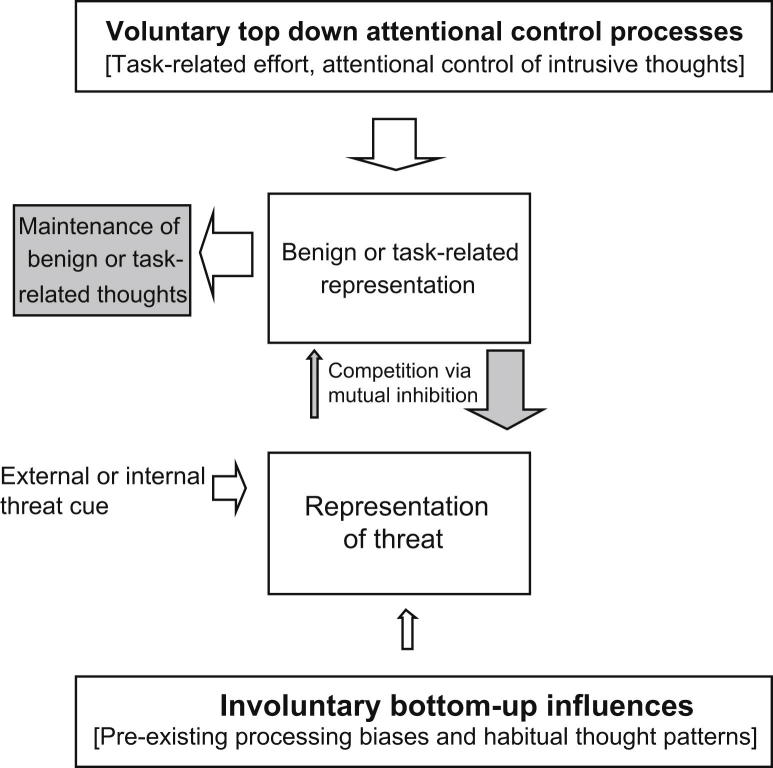
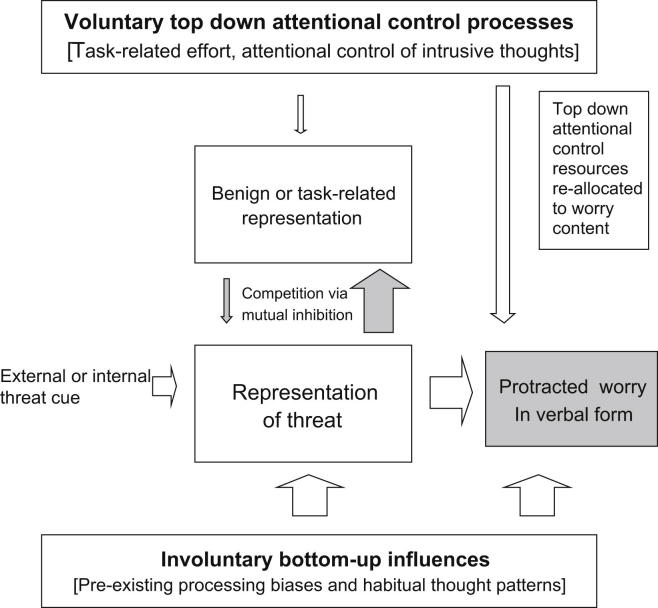
We present an evidence-based model of pathological worry in which worry arises from an interaction between involuntary (bottom-up) processes, such as habitual biases in attention and interpretation favouring threat content, and voluntary (top-down) processes, such as attentional control. At a pre-conscious level, these processes influence the competition between mental representations when some correspond to the intended focus of attention and others to threat distracters. Processing biases influence the probability of threat representations initially intruding into awareness as negative thoughts. Worry in predominantly verbal form then develops, influenced by conscious processes such as attempts to resolve the perceived threat and the redirection of attentional control resources to worry content, as well as the continuing influence of habitual processing biases. After describing this model, we present evidence for each component process and for their causal role in pathological worry, together with implications for new directions in the treatment of pathological worry.
Overview
The claims and statistics of this paper haven’t been checked yet.
Run the check — free, no account needed. It reads the open-access text and checks the sources it cites.
Integrity signals
Registry
Cites
Statistics
Figures
Verification
Claims the paper makes
The claims and statistics of this paper haven’t been checked yet.
Run the check — free, no account needed. It reads the open-access text and checks the sources it cites.
Claims other papers make about this one
Each is checked against this paper’s own text: does it say what the citing paper says it does?
The cited source says what the claim attributes to it.
In the citing paper
“Nevertheless we found some evidence (across the sample) that increases in negative thought intrusions were associated with subsequent increases in subjective anxiety, consistent with cognitive models of pathological worry in anxiety (Hirsch & Mathews, 2012).”
From Testing the differential effects of acceptance and attention-based psychological interventions on intrusive thoughts and worry (2017) · cites this paper as Hirsch & Mathews, 2012
Self-check
Percentages, sums and reported differences re-computed from the paper’s own numbers.
The self-check needs the paper’s full text.
Citations
Cites
2 retracted
Persson, J., & Reuter‐Lorenz, P. A. (2008) · Psychological Science · doi:10.1111/j.1467-9280.2008.02172.x · Cited by 109 · cited 1×
“In any case, training intended to enhance general capacity to ignore salient cues is not always successful (Persson & Reuter-Lorenz, 2008).”
BackgroundRetracted(2011) · Psychological Science · doi:10.1177/0956797611404902 · Cited by 6
RetractedMiyake, A., Friedman, N. P., Emerson, M. J., Witzki, A. H., Howerter, A., & Wager, T. D. (2000) · Cognitive Psychology · doi:10.1006/cogp.1999.0734 · Cited by 15,798 · cited 1×
“We use the term attentional control in this paper to refer to processes underlying the ability to intentionally ignore distracting information (e.g. external noises when trying to work), or shift attention from one topic to another (Miyake et al., 2000).”
MethodTelling more than we can know: Verbal reports on mental processes.
Nisbett, R. E., & Wilson, T. D. (1977) · Psychological Review · doi:10.1037/0033-295x.84.3.231 · Cited by 11,317 · cited 1×
“Furthermore, it may be that some reported beliefs about worry are post-hoc attempts at explaining or understanding the experience of worry, rather than being causes of worry (see Nisbett & Wilson, 1977; for a discussion of how post-hoc rationalizations can arise).”
BackgroundBaddeley, A. D., & Hitch, G. (1974) · Psychology of Learning and Motivation · doi:10.1016/s0079-7421(08)60452-1 · Cited by 9,860
Anxiety and cognitive performance: Attentional control theory
Eysenck, M. W., Derakshan, N., Santos, R., & Calvo, M. G. (2007) · Emotion · doi:10.1037/1528-3542.7.2.336 · Cited by 5,289 · cited 1×
“The latter effect has been revealed in studies in which tasks requiring attentional control capacity for their performance are particularly susceptible to interference from worry (Eysenck et al., 2007; Hayes et al., 2008; Leigh & Hirsch, 2011).”
BackgroundResponses to depression and their effects on the duration of depressive episodes
Nolen-Hoeksema, S. (1991) · Journal of Abnormal Psychology · doi:10.1037/0021-843x.100.4.569 · Cited by 4,529 · cited 1×
“Pathological worry has much in common with what has been described as rumination, more often studied in the context of depression (Nolen-Hoeksema, 1991).”
BackgroundThreat-related attentional bias in anxious and nonanxious individuals: a meta-analytic study.
Bar-Haim, Y., Lamy, D., Pergamin, L., Bakermans-Kranenburg, M. J., & van IJzendoorn, M. H. (2007) · Psychological Bulletin · doi:10.1037/0033-2909.133.1.1 · Cited by 3,721
Attentional bias in emotional disorders
MacLeod, C., Mathews, A., & Tata, P. (1986) · Journal of Abnormal Psychology · doi:10.1037/0021-843x.95.1.15 · Cited by 3,152
Self-citationAttentional bias in emotional disorders.
MacLeod, C., Mathews, A., & Tata, P. R. (1986) · Journal of Abnormal Psychology · doi:10.1037//0021-843x.95.1.15 · Cited by 2,553 · cited 2×
“Faster responding to targets replacing threatening cues, indicating selective attention toward threat, occurs in individuals with pathological worry (Bradley, Mogg, White, Groom, & DeBono, 1999; MacLeod, Mathews, & Tata, 1986; Mogg, Mathews, & Eysenck, 1992).”
BackgroundSelf-citation
Cited by
Sorted by citations
Anxiety and working memory capacity: A meta-analysis and narrative review.
Moran, T. P. (2016) · Psychological Bulletin · doi:10.1037/bul0000051 · Cited by 776
Ogunbode, C. A., Doran, R., Hanss, D., Ojala, M., Salmela-Aro, K., van den Broek, K. L., Bhullar, N., Aquino, S. D., Marot, T., Schermer, J. A., et al. (2022) · Journal of Environmental Psychology · doi:10.1016/j.jenvp.2022.101887 · Cited by 549
Resolving Ambiguity in Emotional Disorders: The Nature and Role of Interpretation Biases
Hirsch, C. R., Meeten, F., Krahé, C., & Reeder, C. (2016) · Annual Review of Clinical Psychology · doi:10.1146/annurev-clinpsy-021815-093436 · Cited by 331
Self-citationHot and cold executive functions in the brain: A prefrontal-cingular network
Salehinejad, M. A., Ghanavati, E., Rashid, M. H. A., & Nitsche, M. A. (2021) · Brain and Neuroscience Advances · doi:10.1177/23982128211007769 · Cited by 413
“Two well-known theories in this respect are the ‘Attentional Control Theory’ (Eysenck and Derakshan, 2011) and the ‘Cognitive Model’ of pathological worry (Hirsch and Mathews, 2012).”
Psychometric Properties of the Climate Change Worry Scale
Stewart, A. E. (2021) · International Journal of Environmental Research and Public Health · doi:10.3390/ijerph18020494 · Cited by 286
Metadata
- Authors
- Hirsch, C. R., & Mathews, A.
- Affiliations
- The University of Western Australia (AU)
- King's College London (GB)
- Corresponding author
- Hirsch, Colette R.
- ORCID
- Hirsch, Colette R.
- Venue
- Behaviour Research and Therapy
- Publisher
- Elsevier BV
- Published
- 2012-10
- Volume
- 50
- Issue
- 10
- Pages
- 636-646
- ISSN
- 0005-7967 (ISSN-L)
- PMC
- PMC3444754
- OpenAlex
- W2026506811
- Cited by
- 400
- References
- 114
- Citations by year
- 2026: 37 · 2025: 44 · 2024: 31 · 2023: 34 · 2022: 30 · 2021: 50 · 2020: 34 · 2019: 33 · 2018: 22 · 2017: 24 · 2016: 24 · 2015: 15 · 2014: 11 · 2013: 10
- FWCI
- 15.31
- Type
- journal article
- Language
- en
- Open access
- hybrid
- doi.org
- Locations
- Behaviour Research and Therapy (publishedVersion, cc-by)
- PubMed Central (publishedVersion, cc-by)
- PubMed (publishedVersion)
- Funders
- Wellcome Trust (WT083204)
- National Institute for Health Research (NIHR)
- Mental Health Biomedical Research Centre at South London
- Maudsley NHS Foundation Trust
- King's College London
- Topics
- Social Sciences › Psychology › Experimental and Cognitive Psychology › Anxiety, Depression, Psychometrics, Treatment, Cognitive Processes
- Life Sciences › Neuroscience › Cognitive Neuroscience › Mind wandering and attention
- Social Sciences › Psychology › Clinical Psychology › Obsessive-Compulsive Spectrum Disorders
- Keywords
- pathological worry, worry, cognitive models, attentional bias, threat processing, attentional control, top-down control, bottom-up processing, threat representation, intrusive thoughts, cognitive bias modification
- MeSH terms
- Anxiety Disorders, Attention, Cognition Disorders, Emotions, Humans, Models, Psychological, Evidence-Based Medicine, Executive Function
About these checks
Registry, retraction, Cites and statistics results are computed, not judged, with one exception: a printed reference that no index lists is read once by a model before it counts as a citation error. Claims are extracted by a model and kept only when their quote appears verbatim in the text; each cited source is then checked, with a model’s help, for whether it says what the claim relies on. Those verdicts can be wrong — read the claim’s quote and the cited source before relying on one.
Statistics and arithmetic are recomputed, not judged.
Confidence bands are shown only for fields calibrated on our annotated test set. None is calibrated yet, so no band is shown.
What counts as a claim ›How we measure confidence ›How we check this ›
Are you an author, or do you see a problem with this page? Request a review
