

The DOI matches its Crossref record; 118 of the 118 references it cites were found in a registry or an index.
A cognitive model of pathological worry
Open accessAbstract
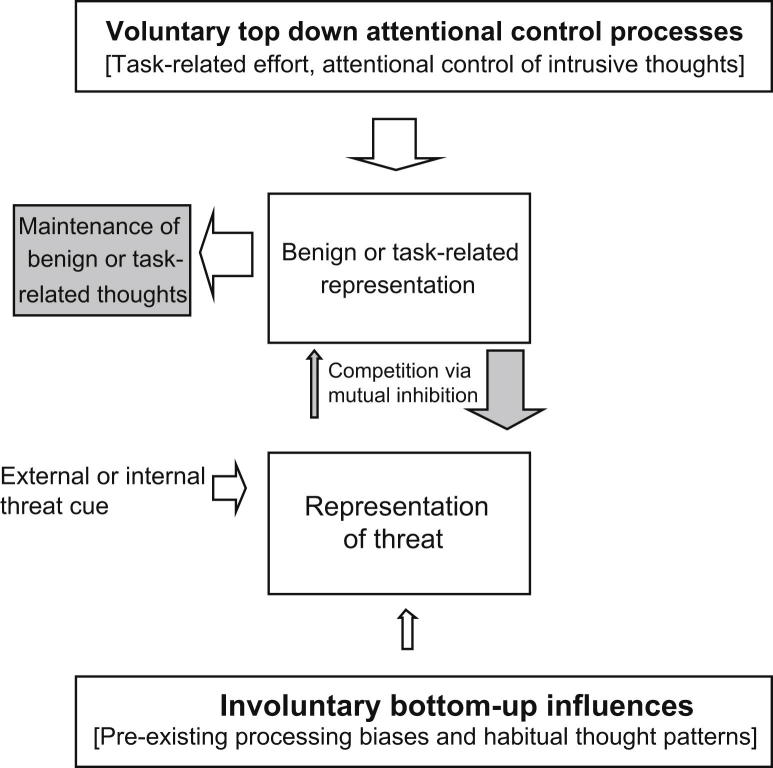
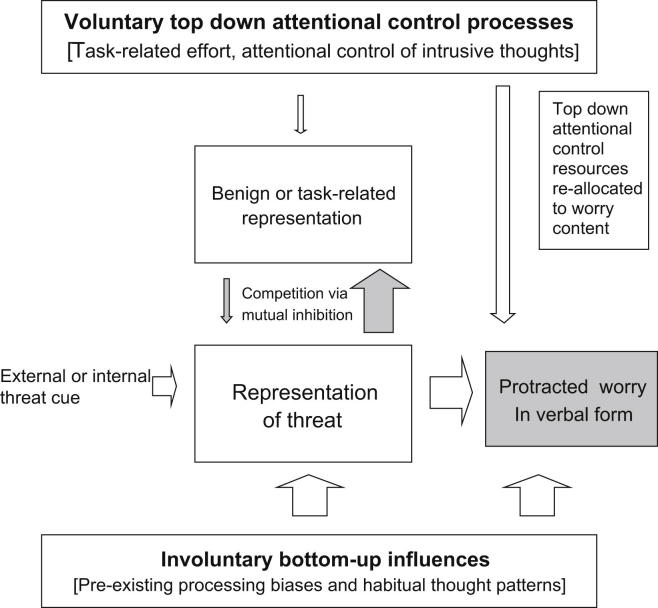
We present an evidence-based model of pathological worry in which worry arises from an interaction between involuntary (bottom-up) processes, such as habitual biases in attention and interpretation favouring threat content, and voluntary (top-down) processes, such as attentional control. At a pre-conscious level, these processes influence the competition between mental representations when some correspond to the intended focus of attention and others to threat distracters. Processing biases influence the probability of threat representations initially intruding into awareness as negative thoughts. Worry in predominantly verbal form then develops, influenced by conscious processes such as attempts to resolve the perceived threat and the redirection of attentional control resources to worry content, as well as the continuing influence of habitual processing biases. After describing this model, we present evidence for each component process and for their causal role in pathological worry, together with implications for new directions in the treatment of pathological worry.
Overview
The claims and statistics of this paper haven’t been checked yet.
Run the check — free, no account needed. It reads the open-access text and checks the sources it cites.
Integrity signals
Registry
Cites
Statistics
Figures
Verification
Claims the paper makes
The claims and statistics of this paper haven’t been checked yet.
Run the check — free, no account needed. It reads the open-access text and checks the sources it cites.
Claims other papers make about this one
Each is checked against this paper’s own text: does it say what the citing paper says it does?
The cited source says what the claim attributes to it.
In the citing paper
“Nevertheless we found some evidence (across the sample) that increases in negative thought intrusions were associated with subsequent increases in subjective anxiety, consistent with cognitive models of pathological worry in anxiety (Hirsch & Mathews, 2012).”
From Testing the differential effects of acceptance and attention-based psychological interventions on intrusive thoughts and worry (2017) · cites this paper as Hirsch & Mathews, 2012
Self-check
Percentages, sums and reported differences re-computed from the paper’s own numbers.
The self-check needs the paper’s full text.
Citations
Cites
2 retracted
Persson, J., & Reuter‐Lorenz, P. A. (2008) · Psychological Science · doi:10.1111/j.1467-9280.2008.02172.x · Cited by 109 · cited 1×
“In any case, training intended to enhance general capacity to ignore salient cues is not always successful (Persson & Reuter-Lorenz, 2008).”
BackgroundRetracted(2011) · Psychological Science · doi:10.1177/0956797611404902 · Cited by 6
RetractedMiyake, A., Friedman, N. P., Emerson, M. J., Witzki, A. H., Howerter, A., & Wager, T. D. (2000) · Cognitive Psychology · doi:10.1006/cogp.1999.0734 · Cited by 15,798 · cited 1×
“We use the term attentional control in this paper to refer to processes underlying the ability to intentionally ignore distracting information (e.g. external noises when trying to work), or shift attention from one topic to another (Miyake et al., 2000).”
MethodTelling more than we can know: Verbal reports on mental processes.
Nisbett, R. E., & Wilson, T. D. (1977) · Psychological Review · doi:10.1037/0033-295x.84.3.231 · Cited by 11,317 · cited 1×
“Furthermore, it may be that some reported beliefs about worry are post-hoc attempts at explaining or understanding the experience of worry, rather than being causes of worry (see Nisbett & Wilson, 1977; for a discussion of how post-hoc rationalizations can arise).”
BackgroundBaddeley, A. D., & Hitch, G. (1974) · Psychology of Learning and Motivation · doi:10.1016/s0079-7421(08)60452-1 · Cited by 9,860
Anxiety and cognitive performance: Attentional control theory
Eysenck, M. W., Derakshan, N., Santos, R., & Calvo, M. G. (2007) · Emotion · doi:10.1037/1528-3542.7.2.336 · Cited by 5,289 · cited 1×
“The latter effect has been revealed in studies in which tasks requiring attentional control capacity for their performance are particularly susceptible to interference from worry (Eysenck et al., 2007; Hayes et al., 2008; Leigh & Hirsch, 2011).”
BackgroundResponses to depression and their effects on the duration of depressive episodes
Nolen-Hoeksema, S. (1991) · Journal of Abnormal Psychology · doi:10.1037/0021-843x.100.4.569 · Cited by 4,529 · cited 1×
“Pathological worry has much in common with what has been described as rumination, more often studied in the context of depression (Nolen-Hoeksema, 1991).”
BackgroundThreat-related attentional bias in anxious and nonanxious individuals: a meta-analytic study.
Bar-Haim, Y., Lamy, D., Pergamin, L., Bakermans-Kranenburg, M. J., & van IJzendoorn, M. H. (2007) · Psychological Bulletin · doi:10.1037/0033-2909.133.1.1 · Cited by 3,721
Attentional bias in emotional disorders
MacLeod, C., Mathews, A., & Tata, P. (1986) · Journal of Abnormal Psychology · doi:10.1037/0021-843x.95.1.15 · Cited by 3,152
Self-citationAttentional bias in emotional disorders.
MacLeod, C., Mathews, A., & Tata, P. R. (1986) · Journal of Abnormal Psychology · doi:10.1037//0021-843x.95.1.15 · Cited by 2,553 · cited 2×
“Faster responding to targets replacing threatening cues, indicating selective attention toward threat, occurs in individuals with pathological worry (Bradley, Mogg, White, Groom, & DeBono, 1999; MacLeod, Mathews, & Tata, 1986; Mogg, Mathews, & Eysenck, 1992).”
BackgroundSelf-citationCognitive vulnerability to emotional disorders
Mathews, A., & MacLeod, C. (2005) · Annual Review of Clinical Psychology · doi:10.1146/annurev.clinpsy.1.102803.143916 · Cited by 2,100 · cited 2×
“High levels of anxiety and worry (e.g. in GAD) are characterized by selective attention to threatening cues matching emotional concerns (Mathews & MacLeod, 2005), or internally generated representations, such as bodily sensations, mental images or worrisome thoughts (Hayes, Hirsch, & Mathews, 2010;…”
BackgroundSelf-citationAnxiety-related attentional biases and their regulation by attentional control.
Derryberry, D., & Reed, M. A. (2002) · Journal of Abnormal Psychology · doi:10.1037/0021-843x.111.2.225 · Cited by 1,729 · cited 3×
“For example, highly anxious individuals reporting good attentional control disengage more rapidly from threat cues than equally anxious individuals with poor control (Derryberry & Reed, 2002; Lonigan & Vasey, 2009; Peers & Lawrence, 2009).”
BackgroundA cognitive-motivational analysis of anxiety.
Mogg, K., & Bradley, B. P. (1998) · Behaviour Research and Therapy · doi:10.1016/s0005-7967(98)00063-1 · Cited by 1,642 · cited 5×
“Involuntary “ bottom-up ” in fl uences Earlier models of emotional processing biases have assumed that attention to threat is promoted directly by anxiety or by hypothetical “ threat evaluation systems ” (e.g. Mathews & Mackintosh, 1998; Mogg & Bradley, 1998).”
BackgroundInfluentialDo threatening stimuli draw or hold visual attention in subclinical anxiety?
Fox, E., Russo, R., Bowles, R., & Dutton, K. (2001) · Journal of Experimental Psychology: General · doi:10.1037/0096-3445.130.4.681 · Cited by 1,469
Preliminary exploration of worry: Some characteristics and processes
Borkovec, T. D., Robinson, E., Pruzinsky, T., & DePree, J. A. (1983) · Behaviour Research and Therapy · doi:10.1016/0005-7967(83)90121-3 · Cited by 1,468 · cited 1×
“Crown Copyright (cid:1) 2012 Published by Elsevier Ltd. Worry is a primary cognitive characteristic of anxiety, and has been described as ‘ a chain of thoughts and images, negatively affect-laden and relatively uncontrollable ’ (Borkovec, Robinson, Pruzinsky, & DePree,1983, p.10).”
BackgroundMacLeod, C., Rutherford, E., Campbell, L., Ebsworthy, G., & Holker, L. (2002) · Journal of Abnormal Psychology · doi:10.1037/0021-843x.111.1.107 · Cited by 1,334 · cited 4×
“Hence the more threatening the thought content, or the more catastrophic the interpretation, the more likely it is to capture attention, promoting escalation of negative thoughts into a full-blown and protracted worry episode.”
BackgroundMethodInfluentialZacks, C. M., Abbott, R. L., & Fine, M. (1990) · Cornea · doi:10.1097/00003226-199004000-00002 · Cited by 1,240
Generalized anxiety disorder: A preliminary test of a conceptual model
Dugas, M. J., Gagnon, F., Ladouceur, R., & Freeston, M. H. (1998) · Behaviour Research and Therapy · doi:10.1016/s0005-7967(97)00070-3 · Cited by 1,072 · cited 3×
“The present model borrows from several other theoretical views and incorporates the contribution of inappropriate beliefs about worry (Wells, 2006), intolerance of uncertainty (Dugas et al.,1998), and the role of verbal processing in worry (Borkovec & Inz, 1990).”
BackgroundArousal-Biased Competition in Perception and Memory
Mather, M., & Sutherland, M. R. (2011) · Perspectives on Psychological Science · doi:10.1177/1745691611400234 · Cited by 1,013 · cited 1×
“Furthermore, the outcome of this competitive process is ‘ biased ’ by top-down (e.g. current goals), as well as bottom-up in fl uences (e.g. salience, arousal; for a review see Mather & Sutherland, 2011).”
BackgroundSelective processing of threat cues in anxiety states
Mathews, A., & MacLeod, C. (1985) · Behaviour Research and Therapy · doi:10.1016/0005-7967(85)90104-4 · Cited by 1,001 · cited 1×
“Typically, pathological worry (e.g. in GAD) is associated with longer latencies to name the colours of threatening compared to healthy controls (e.g., Becker, Rinck, Margraf, & Roth, 2001; Mathews & MacLeod, 1985; Mogg, Mathews, & Weinman, 1989).”
BackgroundSelf-citationMental imagery in emotion and emotional disorders
Holmes, E. A., & Mathews, A. (2010) · Clinical Psychology Review · doi:10.1016/j.cpr.2010.01.001 · Cited by 976 · cited 1×
“It might seem that there is a con fl ict between these fi ndings and the evidence that images typically provoke more emotion than does verbal processing of the same events (e.g. Holmes & Mathews, 2010).”
BackgroundSelf-citationPreliminary evidence for an emotion dysregulation model of generalized anxiety disorder
Mennin, D. S., Heimberg, R. G., Turk, C. L., & Fresco, D. M. (2005) · Behaviour Research and Therapy · doi:10.1016/j.brat.2004.08.008 · Cited by 919 · cited 1×
“Worry in predominantly verbal form then develops, in fl uenced by conscious processes such as attempts to resolve the perceived threat and the redirection of attentional control resources to worry content, as well as the continuing in fl uence of habitual processing biases.”
BackgroundA meta-analysis of the effect of cognitive bias modification on anxiety and depression
Hallion, L. S., & Ruscio, A. M. (2011) · Psychological Bulletin · doi:10.1037/a0024355 · Cited by 891 · cited 1×
“In contrast, a recent meta-analysis (Hallion & Ruscio, 2011) led to the conclusion that the overall effect of cognitive bias modi fi cation across different populations is relatively weak, although it might be useful as an adjunct treatment.”
ResultTrait anxiety and impoverished prefrontal control of attention.
Bishop, S. J. (2009) · Nature Neuroscience · doi:10.1038/nn.2242 · Cited by 869 · cited 4×
“In a neuro-imaging study (Bishop, 2009), participants had to respond to a target letter while ignoring other distracting letters under conditions when targets were either easy or dif fi cult to fi nd. High trait-anxious individuals were slowed more by the presence of competing distracters (although…”
BackgroundInfluentialMeta-Cognition and worry: A cognitive model of generalized anxiety disorder
Wells, A. (1995) · Behavioural and Cognitive Psychotherapy · doi:10.1017/s1352465800015897 · Cited by 866 · cited 3×
“Several research groups (e.g., Davey, 2006; Ruscio & Borkovec, 2004; Wells, 1995) have noted that excessive worriers sometimes endorse certain advantages for worry (e.g. that worry helps them to solve problems, or allows dangers to be avoided), despite also endorsing negative beliefs (e.g., that…”
Background(2004) · Cited by 863
Why worry? The cognitive function of anxiety
Mathews, A. (1990) · Behaviour Research and Therapy · doi:10.1016/0005-7967(90)90132-3 · Cited by 827 · cited 1×
“…characterized by selective attention to threatening cues matching emotional concerns (Mathews & MacLeod, 2005), or internally generated representations, such as bodily sensations, mental images or worrisome thoughts (Hayes, Hirsch, & Mathews, 2010; Krebs, Hirsch, & Mathews, 2010; Mathews, 1990).”
BackgroundSelf-citationA cognitive model of selective processing in anxiety
Mathews, A., & Mackintosh, B. (1998) · Cognitive Therapy and Research · doi:10.1023/a:1018738019346 · Cited by 756 · cited 1×
“Involuntary “ bottom-up ” in fl uences Earlier models of emotional processing biases have assumed that attention to threat is promoted directly by anxiety or by hypothetical “ threat evaluation systems ” (e.g. Mathews & Mackintosh, 1998; Mogg & Bradley, 1998).”
BackgroundSelf-citationInduced emotional interpretation bias and anxiety.
Mathews, A., & Mackintosh, B. (2000) · Journal of Abnormal Psychology · doi:10.1037/0021-843x.109.4.602 · Cited by 739 · cited 1×
“2).”
Self-citationVerbruggen, F., & Logan, G. D. (2008) · Journal of Experimental Psychology General · doi:10.1037/a0013170 · Cited by 685 · cited 1×
“…instructions are later reversed, responses are slowed to the previous “ no-go ” word cues in comparison to baseline, revealing that memories of previously practiced responses (or of withholding responses) were unintentionally retrieved and interfered with current goals (Verbruggen & Logan, 2008).”
Induced processing biases have causal effects on anxiety
Mathews, A., & MacLeod, C. (2002) · Cognition & Emotion · doi:10.1080/02699930143000518 · Cited by 660 · cited 1×
“…modify biases of attention (Dandeneau, Baldwin, Baccus, Sakellaropoulo, & Pruessner, 2007; MacLeod, Rutherford, Campbell, Ebsworthy, & Holker, 2002; Mathews & MacLeod, 2002) and interpretation (Grey & Mathews, 2000, 2011; Mathews & Mackintosh, 2000; Murphy, Hirsch, Mathews, Smith, & Clark, 2007;…”
Self-citationThe nature of worry in generalized anxiety disorder: A predominance of thought activity
Borkovec, T. D., & Inz, J. (1990) · Behaviour Research and Therapy · doi:10.1016/0005-7967(90)90027-g · Cited by 634 · cited 3×
“A fi nal therapeutic direction is suggested by the dominance of verbal linguistic processing and lack of imagery in worry (Borkovec & Inz, 1990; Hirsch, Hayes, Mathews, Perman, & Borkovec, 2012; Hoyer et al., 2001).”
BackgroundA DYNAMIC THEORY OF PERSONALITY
Lewis, N. D. (1936) · Journal of Heredity · doi:10.1093/oxfordjournals.jhered.a104156 · Cited by 600
Worry and rumination: Repetitive thought as a concomitant and predictor of negative mood
Segerstrom, S. C., Tsao, J. C. I., Alden, L. E., & Craske, M. G. (2000) · Cognitive Therapy and Research · doi:10.1023/a:1005587311498 · Cited by 599
Newman, M. G., & Llera, S. J. (2011) · Clinical Psychology Review · doi:10.1016/j.cpr.2011.01.008 · Cited by 598 · cited 2×
“In a modi fi ed version of the avoidance model, Newman and Llera (2011) present evidence that, rather than avoiding imagery, worry is maintained by the perception that it serves to avoid further increases in distress should a feared event actually occur.”
BackgroundAttention modification program in individuals with generalized anxiety disorder
Amir, N., Beard, C., Burns, M., & Bomyea, J. (2009) · Journal of Abnormal Psychology · doi:10.1037/a0012589 · Cited by 539 · cited 2×
“However, the few studies that targeted pathological worry with multiple sessions of CBM (e.g. Amir et al., 2009) had at least moderate effect sizes, and it remains to be seen whether improved forms of CBM have even greater effects.”
BackgroundExperimental manipulation of intolerance of uncertainty: a study of a theoretical model of worry
Ladouceur, R., Gosselin, P., & Dugas, M. J. (2000) · Behaviour Research and Therapy · doi:10.1016/s0005-7967(99)00133-3 · Cited by 524 · cited 1×
“Ladouceur, Gosselin, and Dugas (2000) attempted a more direct test of the intolerance of uncertainty hypothesis by manipulating uncertainty in a gambling task and showed that this was associated with increased worry.”
BackgroundBias in interpretation of ambiguous sentences related to threat in anxiety
Eysenck, M. W., Mogg, K., May, J., Richards, A., & Mathews, A. (1991) · Journal of Abnormal Psychology · doi:10.1037/0021-843x.100.2.144 · Cited by 516 · cited 2×
“2).”
BackgroundSelf-citationAnxiety and attention to threatening pictures
Yiend, J., & Mathews, A. (2001) · The Quarterly Journal of Experimental Psychology Section A · doi:10.1080/713755991 · Cited by 472 · cited 1×
“Research using the Posner task (e.g. Fox, Russo, Bowles, & Dutton, 2001; Yiend & Mathews, 2001), in which a single threatening or benign cue is followed by a target either in the same location as the preceding cue, or to a different location has suggested that anxiety is characterized mainly by…”
MethodSelf-citationAttentional bias for emotional faces in generalized anxiety disorder
Bradley, B. P., Mogg, K., White, J., Groom, C. J., & Bono, J. D. (1999) · British Journal of Clinical Psychology · doi:10.1348/014466599162845 · Cited by 448
Koster, E. H. W., Crombez, G., Verschuere, B., Van Damme, S., & Wiersema, J. R. (2006) · Behaviour Research and Therapy · doi:10.1016/j.brat.2005.12.011 · Cited by 413 · cited 1×
“However others have reported evidence for selective engagement (Koster, Crombez, Verschuere, van Damme, & Wiersema, 2006), or have pointed out that what appears to be slowed disengagement may be confounded with general slowing due to emotional interference effects (Mogg, Holmes, Garner, & Bradley,…”
BackgroundOn finished and unfinished tasks.
Zeigarnik, B. (1938) · Kegan Paul, Trench, Trubner & Company eBooks · doi:10.1037/11496-025 · Cited by 388 · cited 2×
“In experimental studies, unresolved problems are particularly likely to be remembered (the Zeigarnik effect; Zeigarnik, 1938).”
BackgroundWells, A., & Carter, K. (2001) · Behavior Therapy · doi:10.1016/s0005-7894(01)80045-9 · Cited by 373 · cited 1×
“Such capture effects may be compounded by reduced motivation to exert such control due to maladaptive beliefs about worry (Ruscio & Borkovec, 2004; Wells, 1995; Wells & Carter, 2001).”
BackgroundComparisons between rumination and worry in a non-clinical population
Watkins, E. R., Moulds, M. L., & Mackintosh, B. (2005) · Behaviour Research and Therapy · doi:10.1016/j.brat.2004.11.008 · Cited by 367 · cited 1×
“However, the content typically labelled as worry concerns thoughts of possible future threats impinging on the individual, whereas the term rumination is more often applied to thoughts of past negative events or negative personal attributes (Watkins, Moulds, & Mackintosh, 2005).”
BackgroundDiscrimination of threat cues without awareness in anxiety states.
Mathews, A., & MacLeod, C. (1986) · Journal of Abnormal Psychology · doi:10.1037//0021-843x.95.2.131 · Cited by 366 · cited 1×
“…target that was always in the prior location of the benign word (cf. MacLeod et al., 2002); and the second involved listening to benign descriptions presented to one ear whilst ignoring worry-related content presented at the same time to the other (dichotic listening, cf. Mathews & MacLeod, 1986).”
BackgroundSelf-citationImagery and interpretations in social phobia: support for the combined cognitive biases hypothesis.
Hirsch, C., Clark, D., & Mathews, A. (2006) · The Behavior Therapist · doi:10.1016/j.beth.2006.02.001 · Cited by 361 · cited 1×
“In keeping with the combined cognitive biases hypothesis (Hirsch, Clark, & Mathews, 2006), we suppose that emotional processing biases and impaired attentional control combine to maintain worry.”
BackgroundSelf-citationDandeneau, S. D., Baldwin, M. W., Baccus, J. R., Sakellaropoulo, M., & Pruessner, J. C. (2007) · Journal of Personality and Social Psychology · doi:10.1037/0022-3514.93.4.651 · Cited by 341 · cited 1×
“In the last decade a number of methods have been developed to experimentally modify biases of attention (Dandeneau, Baldwin, Baccus, Sakellaropoulo, & Pruessner, 2007; MacLeod, Rutherford, Campbell, Ebsworthy, & Holker, 2002; Mathews & MacLeod, 2002) and interpretation (Grey & Mathews, 2000, 2011;…”
MethodCognitive Bias Modification: Past Perspectives, Current Findings, and Future Applications
Hertel, P. T., & Mathews, A. (2011) · Perspectives on Psychological Science · doi:10.1177/1745691611421205 · Cited by 321
Self-citationEPS Mid-Career Award 2004: Brain mechanisms of attention
Duncan, J. (2005) · Quarterly Journal of Experimental Psychology · doi:10.1080/17470210500260674 · Cited by 307 · cited 2×
“2).”
BackgroundGeneralized Anxiety Disorder: Advances in Research and Practice
Storch, D. D. (2005) · Psychiatric Services · doi:10.1176/appi.ps.56.5.620 · Cited by 303
Selective processing of threat cues in anxiety states: A replication
Mogg, K., Mathews, A., & Weinman, J. A. (1989) · Behaviour Research and Therapy · doi:10.1016/0005-7967(89)90001-6 · Cited by 287 · cited 1×
“Typically, pathological worry (e.g. in GAD) is associated with longer latencies to name the colours of threatening compared to healthy controls (e.g., Becker, Rinck, Margraf, & Roth, 2001; Mathews & MacLeod, 1985; Mogg, Mathews, & Weinman, 1989).”
BackgroundSelf-citationCognitive vulnerability to anxiety: A review and an integrative model
Ouimet, A. J., Gawronski, B., & Dozois, D. J. A. (2009) · Clinical Psychology Review · doi:10.1016/j.cpr.2009.05.004 · Cited by 283 · cited 1×
“However, attention can be consciously directed as well (and emotional interpretations can be consciously endorsed or rejected; Ouimet, Gawronski, & Dozois, 2009): in the present paper we therefore consider both automated and controlled in fl uences on worry.”
BackgroundNegative Affectivity, Effortful Control, and Attention to Threat-Relevant Stimuli
Lonigan, C. J., & Vasey, M. W. (2008) · Research on Child and Adolescent Psychopathology · doi:10.1007/s10802-008-9284-y · Cited by 279 · cited 2×
“For example, highly anxious individuals reporting good attentional control disengage more rapidly from threat cues than equally anxious individuals with poor control (Derryberry & Reed, 2002; Lonigan & Vasey, 2009; Peers & Lawrence, 2009).”
BackgroundInterpretation of homophones related to threat in anxiety states.
Mathews, A., Richards, A., & Eysenck, M. W. (1989) · Journal of Abnormal Psychology · doi:10.1037//0021-843x.98.1.31 · Cited by 275 · cited 1×
“Mathews, Richards, and Eysenck (1989) showed that individuals with GAD wrote down more threat spellings of ambiguously threatening homophones (words that sound the same but are spelled differently e for example die/dye).”
BackgroundSelf-citationImpaired positive inferential bias in social phobia
Hirsch, C. R., & Mathews, A. (2000) · Journal of Abnormal Psychology · doi:10.1037/0021-843x.109.4.705 · Cited by 267 · cited 1×
“Similarly, in the context of an ambiguous description of a job interview, socially anxious individuals were relatively faster to identify words matching threatening rather than benign inferences about the outcome (e.g. ‘ fail ’ rather than ‘ succeed ’ ; Hirsch & Mathews, 1997; 2000).”
BackgroundSelf-citationMogg, K., Holmes, A., Garner, M. J., & Bradley, B. P. (2008) · Behaviour Research and Therapy · doi:10.1016/j.brat.2008.02.011 · Cited by 262 · cited 1×
“…others have reported evidence for selective engagement (Koster, Crombez, Verschuere, van Damme, & Wiersema, 2006), or have pointed out that what appears to be slowed disengagement may be confounded with general slowing due to emotional interference effects (Mogg, Holmes, Garner, & Bradley, 2008).”
BackgroundThe causal role of interpretive bias in anxiety reactivity
Wilson, E. J., MacLeod, C., Mathews, A., & Rutherford, E. M. (2006) · Journal of Abnormal Psychology · doi:10.1037/0021-843x.115.1.103 · Cited by 262
Self-citationAttentional bias to threat in clinical anxiety states
Mogg, K., Mathews, A., & Eysenck, M. W. (1992) · Cognition & Emotion · doi:10.1080/02699939208411064 · Cited by 256
Self-citationWatkins, E. R., Baeyens, C., & Read, R. (2009) · Journal of Abnormal Psychology · doi:10.1037/a0013642 · Cited by 252 · cited 1×
“Similarly, Watkins, Baeyens, and Read (2009) found that training dysphoric individuals to ruminate in an abstract manner (that is, in similar form to verbal worry) resulted in a more negative mood than did equivalent practice in concrete thinking (which is more likely to be accompanied by imagery).”
BackgroundEffect of psychological treatment on cognitive bias in generalized anxiety disorder
Mathews, A., Mogg, K., Kentish, J., & Eysenck, M. (1995) · Behaviour Research and Therapy · doi:10.1016/0005-7967(94)e0022-b · Cited by 249
Self-citationDiscrimination of threat cues without awareness in anxiety states.
Mathews, A., & MacLeod, C. (1986) · Journal of Abnormal Psychology · doi:10.1037/0021-843x.95.2.131 · Cited by 249
Self-citationThe face of fear: Effects of eye gaze and emotion on visual attention
Mathews, A., Fox, E., Yiend, J., & Calder, A. (2003) · Visual Cognition · doi:10.1080/13506280344000095 · Cited by 239
Self-citationWorry and its psychological disorders theory, assessment and treatment
Davey, G. C. L. (2006) · Cited by 232
A taxometric investigation of the latent structure of worry.
Ruscio, A. M., Borkovec, T. D., & Ruscio, J. (2001) · Journal of Abnormal Psychology · doi:10.1037/0021-843x.110.3.413 · Cited by 231 · cited 1×
“Reported proneness to worry varies continuously across the normal population, without any sudden discontinuity (Ruscio, Borkovec, & Ruscio, 2001).”
BackgroundWilson, E., & MacLeod, C. (2003) · Journal of Abnormal Psychology · doi:10.1037/0021-843x.112.2.212 · Cited by 230 · cited 2×
“2).”
BackgroundFrewen, P., Dozois, D. J. A., Joanisse, M. F., & Neufeld, R. W. J. (2007) · Clinical Psychology Review · doi:10.1016/j.cpr.2007.05.006 · Cited by 230
FALES, C. L., BARCH, D. M., BURGESS, G. C., SCHAEFER, A., MENNIN, D. S., GRAY, J. R., & BRAVER, T. S. (2008) · Cognitive, Affective, & Behavioral Neuroscience · doi:10.3758/cabn.8.3.239 · Cited by 227 · cited 1×
“…slowing was associated with less activation in dorso-lateral pre-frontal cortex, suggesting that anxious individuals recruit less effortful attentional control resources to inhibit competing distracters than non-anxious people, particularly when task demands are low (see also Fales et al., 2008).”
BackgroundExperience and appraisal of worry among high worriers with and without generalized anxiety disorder
Ruscio, A. M., & Borkovec, T. D. (2004) · Behaviour Research and Therapy · doi:10.1016/j.brat.2003.10.007 · Cited by 222 · cited 2×
“Several research groups (e.g., Davey, 2006; Ruscio & Borkovec, 2004; Wells, 1995) have noted that excessive worriers sometimes endorse certain advantages for worry (e.g. that worry helps them to solve problems, or allows dangers to be avoided), despite also endorsing negative beliefs (e.g., that…”
BackgroundThe emotional Stroop effect in anxiety disorders
Becker, E. S., Rinck, M., Margraf, J., & Roth, W. T. (2001) · Journal of Anxiety Disorders · doi:10.1016/s0887-6185(01)00055-x · Cited by 218 · cited 1×
“Typically, pathological worry (e.g. in GAD) is associated with longer latencies to name the colours of threatening compared to healthy controls (e.g., Becker, Rinck, Margraf, & Roth, 2001; Mathews & MacLeod, 1985; Mogg, Mathews, & Weinman, 1989).”
BackgroundAnxiety and sensitivity to gaze direction in emotionally expressive faces.
Fox, E., Mathews, A., Calder, A. J., & Yiend, J. (2007) · Emotion · doi:10.1037/1528-3542.7.3.478 · Cited by 216 · cited 1×
“Both faster engagement and slowed attentional disengagement have been found in experiments using fearful gaze as a directional cue (Fox, Mathews, Calder, & Yiend, 2007; Mathews, Fox, Yiend, & Calder, 2003).”
MethodSelf-citationRestriction of working memory capacity during worry.
Hayes, S., Hirsch, C. R., & Mathews, A. (2008) · Journal of Abnormal Psychology · doi:10.1037/a0012908 · Cited by 209 · cited 3×
“In a direct study of the latter possibility (Hayes et al., 2008) groups reporting high or low levels of worry were asked to worry, or think about a positive topic, while performing a random key-press task.”
BackgroundSelf-citationFacilitating a benign interpretation bias in a high socially anxious population
Murphy, R., Hirsch, C. R., Mathews, A., Smith, K., & Clark, D. M. (2007) · Behaviour Research and Therapy · doi:10.1016/j.brat.2007.01.007 · Cited by 198 · cited 1×
“…Baccus, Sakellaropoulo, & Pruessner, 2007; MacLeod, Rutherford, Campbell, Ebsworthy, & Holker, 2002; Mathews & MacLeod, 2002) and interpretation (Grey & Mathews, 2000, 2011; Mathews & Mackintosh, 2000; Murphy, Hirsch, Mathews, Smith, & Clark, 2007; Wilson, MacLeod, Mathews, & Rutherford, 2006).”
Self-citationSchweizer, S., Hampshire, A., & Dalgleish, T. (2011) · PLoS ONE · doi:10.1371/journal.pone.0024372 · Cited by 198 · cited 1×
“…to increase general control resources, current evidence suggests that it may be more effective to train the speci fi c control operations required such as ignoring threatening cues, in order to achieve the goal of avoiding capture of attention by worry (Schweizer, Hampshire, & Dalgliesh, 2011).”
BackgroundA follow-up study of cognitive bias in generalized anxiety disorder.
Mogg, K., Bradley, B., Millar, N., & White, J. F. (1995) · Behaviour Research and Therapy · doi:10.1016/0005-7967(95)00031-r · Cited by 193
Interpretation of homophones related to threat in anxiety states.
Mathews, A., Richards, A., & Eysenck, M. W. (1989) · Journal of Abnormal Psychology · doi:10.1037/0021-843x.98.1.31 · Cited by 193
Self-citationAn Anxiety-Related Bias in Semantic Activation When Processing Threat/Neutral Homographs
Richards, A., & French, C. C. (1992) · The Quarterly Journal of Experimental Psychology Section A · doi:10.1080/02724989208250625 · Cited by 187 · cited 2×
“…word), anxious individuals were relatively faster than non-anxious controls to endorse ‘ cancer ’ (versus ‘ plant ’ ) as a word when it followed the priming word ‘ growth ’ , indicating that the ambiguous prime had been interpreted in terms of its more threatening meaning (Richards & French,1992).”
BackgroundBeevers, C., Wells, T. T., Ellis, A., & McGeary, J. (2009) · Journal of Abnormal Psychology · doi:10.1037/a0016198 · Cited by 187 · cited 1×
“Genetic variations, such as the low expression allele of the serotonin transporter gene, are associated with emotional processing biases, which in turn mediate increased emotional vulnerability to negative life events (Beevers, Wells, Ellis, & McGeary, 2009).”
BackgroundReduced Concreteness of Worry in Generalized Anxiety Disorder: Findings from a Therapy Study
Stöber, J., & Borkovec, T. D. (2002) · Cognitive Therapy and Research · doi:10.1023/a:1013845821848 · Cited by 176 · cited 1×
“Verbal and image representations differ in several respects: emotional images are usually concrete representations of speci fi c outcomes, whereas verbalworryismoreabstract,withthefearedoutcome(s)lessexactly speci fi ed (Stöber & Borkovec, 2002).”
BackgroundLooking on the bright side: Accessing benign meanings reduces worry
Hirsch, C. R., Hayes, S., & Mathews, A. (2009) · Journal of Abnormal Psychology · doi:10.1037/a0013473 · Cited by 175 · cited 4×
“As reviewed in the previous section, modifying negative interpretation bias reduces negative intrusive thoughts (Hirsch et al., 2009).”
BackgroundInfluentialThe Structure of Borders in a Small World
Thiemann, C., Theis, F. J., Grady, D., Brune, R. L., & Brockmann, D. (2010) · PLoS ONE · doi:10.1371/journal.pone.0015422 · Cited by 172
Interpretative inferences when reading about emotional events
Hirsch, C. R., & Mathews, A. (1997) · Behaviour Research and Therapy · doi:10.1016/s0005-7967(97)80006-x · Cited by 167 · cited 1×
“Similarly, in the context of an ambiguous description of a job interview, socially anxious individuals were relatively faster to identify words matching threatening rather than benign inferences about the outcome (e.g. ‘ fail ’ rather than ‘ succeed ’ ; Hirsch & Mathews, 1997; 2000).”
BackgroundSelf-citationThe effects of modifying interpretation bias on worry in generalized anxiety disorder
Hayes, S., Hirsch, C. R., Krebs, G., & Mathews, A. (2010) · Behaviour Research and Therapy · doi:10.1016/j.brat.2009.10.006 · Cited by 167
Self-citationMacLeod, C., & Mathews, A. (1991) · Behaviour Research and Therapy · doi:10.1016/0005-7967(91)90009-r · Cited by 162 · cited 1×
“When only one word (or non-word letter string) was presented, no comparable differences were found between groups (Macleod & Mathews, 1991; Mogg, Mathews, Eysenck, & May, 1991).”
BackgroundSelf-citationElevated evidence requirements and worry
Tallis, F., Eysenck, M. W., & Mathews, A. (1991) · Personality and Individual Differences · doi:10.1016/0191-8869(91)90128-x · Cited by 159 · cited 1×
“Support for this hypothesis comes from evidence that high worriers require more evidence in uncertain categorization tasks before arriving at a decision (Tallis, Eysenck, & Mathews, 1991).”
BackgroundSelf-citationThe Cognitive Avoidance Theory of Worry
Sibrava, N. J., & Borkovec, T. D. (2006) · Worry and its Psychological Disorders · doi:10.1002/9780470713143.ch14 · Cited by 149 · cited 1×
“The content of worry typically concerns future events whose outcomes are uncertain, but contain the possibility of one or more negative outcomes (Sibrava & Borkovec, 2006).”
BackgroundHuppert, J. D., Pasupuleti, R. V., Foa, E. B., & Mathews, A. (2007) · Behaviour Research and Therapy · doi:10.1016/j.brat.2007.01.006 · Cited by 146
Self-citationDifferential effects of worry and imagery after exposure to a stressful stimulus: A pilot study
Butler, G., Wells, A., & Dewick, H. (1995) · Behavioural and Cognitive Psychotherapy · doi:10.1017/s1352465800017628 · Cited by 145 · cited 4×
“In non-anxious groups, experiments on viewing aversive fi lms have shown that instructions to worry afterwards lead to a greater frequency of subsequent intrusive thoughts related to the fi lm than imagery instructions (Butler, Wells, & Dewick, 1995).”
BackgroundInfluentialMackintosh, B., Mathews, A., Yiend, J., Ridgeway, V., & Cook, E. (2006) · Behavior Therapy · doi:10.1016/j.beth.2006.03.001 · Cited by 143 · cited 1×
“Use of these methods has shown that cognitive bias modi fi cation (CBM) has signi fi cant effects on later emotional reactions to a stressful experience, even 24 h later (Mackintosh, Mathews, Yiend, Ridgeway, & Cook, 2006).”
MethodSelf-citationEffects of Training on Interpretation of Emotional Ambiguity
Grey, S. J., & Mathews, A. (2000) · The Quarterly Journal of Experimental Psychology Section A · doi:10.1080/713755937 · Cited by 142 · cited 2×
“…the benign training condition, participants fi rst resolved homographs (single ambiguous words with both threatening and non-threatening meanings such as “ growth ” ; cf. Grey & Mathews, 2000) as cues for solving word fragments corresponding to the homographs ’ benign meaning (e.g. growth e pl_nt).”
BackgroundSelf-citationIndividual differences in anxiety and the restriction of working memory capacity
MacLeod, C., & Donnellan, A. M. (1993) · Personality and Individual Differences · doi:10.1016/0191-8869(93)90023-v · Cited by 140 · cited 2×
“However, in several experimental studies, anxious individuals have been found to perform less well on tasks requiring executive control (e.g. Bishop, 2009; MacLeod & Donnellan, 1993), even when any externally imposed threat is absent.”
BackgroundAttentional retraining: A randomized clinical trial for pathological worry
Hazen, R. A., Vasey, M. W., & Schmidt, N. B. (2008) · Journal of Psychiatric Research · doi:10.1016/j.jpsychires.2008.07.004 · Cited by 140
Fox, E., Zougkou, K., Ridgewell, A., & Garner, K. (2011) · Biological Psychiatry · doi:10.1016/j.biopsych.2011.07.004 · Cited by 135 · cited 1×
“In an experimental study, Fox, Zougkou, Ridgewell, and Garner (2011) have further shown that attentional biases are acquired more readily in those with the low expression allele of the serotonin transporter gene.”
BackgroundThe utilisation of working memory by worry
Rapee, R. M. (1993) · Behaviour Research and Therapy · doi:10.1016/0005-7967(93)90114-a · Cited by 122 · cited 1×
“Another cognitive characteristic associated with worry is an impairment of the central executive function of working memory (Baddeley & Hitch, 1974), or ‘ attentional control ’ (Darke, 1988; MacLeod & Donnellan, 1993; Rapee, 1993).”
BackgroundEffects of anxiety on inferential reasoning task performance.
Darke, S. G. (1988) · Journal of Personality and Social Psychology · doi:10.1037//0022-3514.55.3.499 · Cited by 121 · cited 1×
“Another cognitive characteristic associated with worry is an impairment of the central executive function of working memory (Baddeley & Hitch, 1974), or ‘ attentional control ’ (Darke, 1988; MacLeod & Donnellan, 1993; Rapee, 1993).”
BackgroundWhite, C. N., Ratcliff, R., Vasey, M. W., & McKoon, G. (2010) · Emotion · doi:10.1037/a0019474 · Cited by 115 · cited 1×
“Similarly, with more sensitive methods based on a model that draws on both accuracy and speed data, some evidence has suggested that single threat words can be better detected by anxious participants (White, Ratcliff, Vasey, & McKoon, 2010).”
MethodPreconscious processing biases predict emotional reactivity to stress
Fox, E., Cahill, S., & Zougkou, K. (2010) · Biological Psychiatry · doi:10.1016/j.biopsych.2009.11.018 · Cited by 112 · cited 1×
“…are usually regarded as partially automatic in that they typically operate without awareness or deliberate intent: indeed, pre-conscious attention to emotional stimuli may be a better predictor of later physiological stress reactions than self report anxiety measures (Fox, Cahill, & Zougkou, 2010).”
BackgroundCognitive bias modification: Induced interpretive biases affect memory.
Tran, T. B., Hertel, P. T., & Joormann, J. (2011) · Emotion · doi:10.1037/a0021754 · Cited by 102 · cited 1×
“Thus ambiguous threats that have been repeatedly interpreted previously in particular ways become more likely to be interpreted in that same way when encountered later, via bottom-up in fl uences (e.g. Tran, Hertel, & Joormann, 2011).”
BackgroundWorry in imagery and verbal form: Effect on residual working memory capacity
Leigh, E., & Hirsch, C. R. (2010) · Behaviour Research and Therapy · doi:10.1016/j.brat.2010.11.005 · Cited by 101 · cited 3×
“As noted earlier, Leigh and Hirsch (2011) demonstrated that verbal worry had more marked deleterious effects on attentional control than imagery of worry content, but that use of imagery eliminated any differences between high and low worriers.”
BackgroundSelf-citationSelective interpretation in anxiety: Uncertainty for threatening events
Calvo, M. G., & Castillo, M. D. (2001) · Cognition & Emotion · doi:10.1080/02699930126040 · Cited by 99 · cited 1×
“As with attentional bias, differential interpretation biases emerge when the threatening meaning of an ambiguous event is not completely dominant, but is less apparent to everyone (Calvo & Castillo, 2001).”
BackgroundAn initiation–termination two-phase model of worrying
Berenbaum, H. (2010) · Clinical Psychology Review · doi:10.1016/j.cpr.2010.06.011 · Cited by 88
Characteristics of worry in GAD patients, social phobics, and controls
Hoyer, J., Becker, E. S., & Roth, W. T. (2001) · Depression and Anxiety · doi:10.1002/da.1021 · Cited by 86 · cited 2×
“A fi nal therapeutic direction is suggested by the dominance of verbal linguistic processing and lack of imagery in worry (Borkovec & Inz, 1990; Hirsch, Hayes, Mathews, Perman, & Borkovec, 2012; Hoyer et al., 2001).”
BackgroundStokes, C., & Hirsch, C. R. (2010) · Behaviour Research and Therapy · doi:10.1016/j.brat.2009.12.011 · Cited by 84 · cited 3×
“…when high worriers were directly instructed to think about a worry topic in the form of images, rather than in their usual verbal manner, they re-ported fewer subsequent negative intrusions when trying to focus attention elsewhere (Hayes, Perman, Mathews, & Hirsch, 2011; Stokes & Hirsch, 2010).”
BackgroundResultSelf-citationEffects of anxiety on inferential reasoning task performance.
Darke, S. G. (1988) · Journal of Personality and Social Psychology · doi:10.1037/0022-3514.55.3.499 · Cited by 83
The automatic orienting of attention to goal-relevant stimuli
Vogt, J., Houwer, J. D., Moors, A., Damme, S. V., & Crombez, G. (2010) · Acta Psychologica · doi:10.1016/j.actpsy.2009.12.006 · Cited by 82
Facilitating a benign attentional bias reduces negative thought intrusions.
Hayes, S., Hirsch, C. R., & Mathews, A. (2010) · Journal of Abnormal Psychology · doi:10.1037/a0018264 · Cited by 79 · cited 1×
“The training used by Hayes, Hirsch, Krebs, et al. (2010) and Hayes, Hirsch, and Mathews (2010) consisted of two consecutive tasks: the fi rst involved pairs of one worry-related and one benign word followed by a to-be-detected neutral target that was always in the prior location of the benign word…”
MethodSelf-citationThe effect of attention modification with explicit vs. minimal instructions on worry
Krebs, G., Hirsch, C. R., & Mathews, A. (2010) · Behaviour Research and Therapy · doi:10.1016/j.brat.2009.10.009 · Cited by 79 · cited 2×
“The role of attention in worry has been investigated by allocating high worriers to either experimental training designed to reduce attention to worry-related information, or a control condition not intended to modify attention (Hayes, Hirsch, & Mathews, 2010; see also Krebs et al., 2010).”
BackgroundMethodSelf-citationAttentional control of emotional distraction in rapid serial visual presentation.
Peers, P. V., & Lawrence, A. D. (2009) · Emotion · doi:10.1037/a0014507 · Cited by 76 · cited 2×
“For example, highly anxious individuals reporting good attentional control disengage more rapidly from threat cues than equally anxious individuals with poor control (Derryberry & Reed, 2002; Lonigan & Vasey, 2009; Peers & Lawrence, 2009).”
BackgroundHirsch, C. R., MacLeod, C., Mathews, A., Sandher, O., Siyani, A., & Hayes, S. (2011) · Journal of Anxiety Disorders · doi:10.1016/j.janxdis.2010.09.013 · Cited by 65 · cited 2×
“2).”
BackgroundSelf-citationBiased cognitive operations in anxiety: Artefact, processing priorities or attentional search?
Mogg, K., Mathews, A., Eysenck, M. W., & May, J. (1991) · Behaviour Research and Therapy · doi:10.1016/0005-7967(91)90130-u · Cited by 63
Self-citationThe extent and nature of imagery during worry and positive thinking in generalized anxiety disorder.
Hirsch, C. R., Hayes, S., Mathews, A., Perman, G., & Borkovec, T. D. (2011) · Journal of Abnormal Psychology · doi:10.1037/a0024947 · Cited by 58
Self-citationThe Metacognitive Model of Worry and Generalised Anxiety Disorder
Adrian Wells, A. (2006) · Wiley eBooks · doi:10.1002/9780470713143.ch11 · Cited by 50 · cited 3×
“The present model borrows from several other theoretical views and incorporates the contribution of inappropriate beliefs about worry (Wells, 2006), intolerance of uncertainty (Dugas et al., 1998), and the role of verbal processing in worry (Borkovec & Inz, 1990).”
BackgroundWeir, Ε. K., Hong, Z., & Varghese, A. (2004) · Circulation Research · doi:10.1161/01.res.0000129568.71027.fc · Cited by 50
Effects of modifying the interpretation of emotional ambiguity
Mathews, A. (2012) · Journal of Cognitive Psychology · doi:10.1080/20445911.2011.584527 · Cited by 43 · cited 4×
“Instead of this process being restrained by intentional top-down control, as in a non-vulnerable individual, attention to negative thought content takes up the very cognitive resources that would be needed to re-focus attention elsewhere.”
BackgroundInfluentialSelf-citationClarke, P., Chen, N. T. M., & Guastella, A. J. (2011) · Emotion · doi:10.1037/a0025592 · Cited by 36 · cited 1×
“The ease with which processing bias can be modi fi ed has been found to predict success in the treatment of anxiety (Clarke, Chen, & Guastella, 2012) suggesting that some treatment failures may be attributable to lack of changes in these underlying processing biases.”
BackgroundAttention orientation in parents exposed to the 9/11 terrorist attacks and their children
Lindström, K. M., Mandell, D. J., Musa, G. J., Britton, J. C., Sankin, L. S., Mogg, K., Bradley, B. P., Ernst, M., Doan, T., Bar‐Haim, Y., et al. (2010) · Psychiatry Research · doi:10.1016/j.psychres.2010.09.005 · Cited by 27 · cited 1×
“Traumatic experiences in adults or children can also result in negative processing biases (e.g. Lindstrom et al., 2011).”
BackgroundThe Impact of Worry on Attention to Threat
Oathes, D. J., Squillante, C. M., Ray, W. J., & Nitschke, J. B. (2010) · PLoS ONE · doi:10.1371/journal.pone.0013411 · Cited by 26 · cited 1×
“Conversely, engaging in worry can have the effect of inducing attention to threat: interference effects due to threat were found to be greater after a worry period that after a control period of mental arithmetic (Oathes, Squillante, Ray, & Nitschke, 2010).”
BackgroundA Mood‐as‐Input Account of Perseverative Worrying
Davey, G. C. L. (2006) · Worry and its Psychological Disorders · doi:10.1002/9780470713143.ch13 · Cited by 20 · cited 2×
“Several research groups (e.g., Davey, 2006; Ruscio & Borkovec, 2004; Wells, 1995) have noted that excessive worriers sometimes endorse certain advantages for worry (e.g. that worry helps them to solve problems, or allows cense. dangers to be avoided), despite also endorsing negative beliefs (e.g.,…”
BackgroundDifferential encoding of affective and nonaffective content information in trait anxiety
Pury, C. L. S., & Mineka, S. (2001) · Cognition & Emotion · doi:10.1080/02699930126123 · Cited by 16 · cited 1×
“…evidence of differential bias was absent when emotional categorizations were predictable (i.e. when only decisions of one type occurred in a block), but was present when the decision required was unpredictable (i.e. when decision types are mixed within presentation blocks; Pury & Mineka, 2001).”
Background
Cited by
Sorted by citations
Anxiety and working memory capacity: A meta-analysis and narrative review.
Moran, T. P. (2016) · Psychological Bulletin · doi:10.1037/bul0000051 · Cited by 776
Ogunbode, C. A., Doran, R., Hanss, D., Ojala, M., Salmela-Aro, K., van den Broek, K. L., Bhullar, N., Aquino, S. D., Marot, T., Schermer, J. A., et al. (2022) · Journal of Environmental Psychology · doi:10.1016/j.jenvp.2022.101887 · Cited by 549
Resolving Ambiguity in Emotional Disorders: The Nature and Role of Interpretation Biases
Hirsch, C. R., Meeten, F., Krahé, C., & Reeder, C. (2016) · Annual Review of Clinical Psychology · doi:10.1146/annurev-clinpsy-021815-093436 · Cited by 331
Self-citationHot and cold executive functions in the brain: A prefrontal-cingular network
Salehinejad, M. A., Ghanavati, E., Rashid, M. H. A., & Nitsche, M. A. (2021) · Brain and Neuroscience Advances · doi:10.1177/23982128211007769 · Cited by 413
“Two well-known theories in this respect are the ‘Attentional Control Theory’ (Eysenck and Derakshan, 2011) and the ‘Cognitive Model’ of pathological worry (Hirsch and Mathews, 2012).”
Psychometric Properties of the Climate Change Worry Scale
Stewart, A. E. (2021) · International Journal of Environmental Research and Public Health · doi:10.3390/ijerph18020494 · Cited by 286
Metadata
- Authors
- Hirsch, C. R., & Mathews, A.
- Affiliations
- The University of Western Australia (AU)
- King's College London (GB)
- Corresponding author
- Hirsch, Colette R.
- ORCID
- Hirsch, Colette R.
- Venue
- Behaviour Research and Therapy
- Publisher
- Elsevier BV
- Published
- 2012-10
- Volume
- 50
- Issue
- 10
- Pages
- 636-646
- ISSN
- 0005-7967 (ISSN-L)
- PMC
- PMC3444754
- OpenAlex
- W2026506811
- Cited by
- 400
- References
- 114
- Citations by year
- 2026: 37 · 2025: 44 · 2024: 31 · 2023: 34 · 2022: 30 · 2021: 50 · 2020: 34 · 2019: 33 · 2018: 22 · 2017: 24 · 2016: 24 · 2015: 15 · 2014: 11 · 2013: 10
- FWCI
- 15.31
- Type
- journal article
- Language
- en
- Open access
- hybrid
- doi.org
- Locations
- Behaviour Research and Therapy (publishedVersion, cc-by)
- PubMed Central (publishedVersion, cc-by)
- PubMed (publishedVersion)
- Funders
- Wellcome Trust (WT083204)
- National Institute for Health Research (NIHR)
- Mental Health Biomedical Research Centre at South London
- Maudsley NHS Foundation Trust
- King's College London
- Topics
- Social Sciences › Psychology › Experimental and Cognitive Psychology › Anxiety, Depression, Psychometrics, Treatment, Cognitive Processes
- Life Sciences › Neuroscience › Cognitive Neuroscience › Mind wandering and attention
- Social Sciences › Psychology › Clinical Psychology › Obsessive-Compulsive Spectrum Disorders
- Keywords
- pathological worry, worry, cognitive models, attentional bias, threat processing, attentional control, top-down control, bottom-up processing, threat representation, intrusive thoughts, cognitive bias modification
- MeSH terms
- Anxiety Disorders, Attention, Cognition Disorders, Emotions, Humans, Models, Psychological, Evidence-Based Medicine, Executive Function
About these checks
Registry, retraction, Cites and statistics results are computed, not judged, with one exception: a printed reference that no index lists is read once by a model before it counts as a citation error. Claims are extracted by a model and kept only when their quote appears verbatim in the text; each cited source is then checked, with a model’s help, for whether it says what the claim relies on. Those verdicts can be wrong — read the claim’s quote and the cited source before relying on one.
Statistics and arithmetic are recomputed, not judged.
Confidence bands are shown only for fields calibrated on our annotated test set. None is calibrated yet, so no band is shown.
What counts as a claim ›How we measure confidence ›How we check this ›
Are you an author, or do you see a problem with this page? Request a review
