

The DOI matches its Crossref record; 118 of the 118 references it cites were found in a registry or an index.
A cognitive model of pathological worry
Open accessAbstract
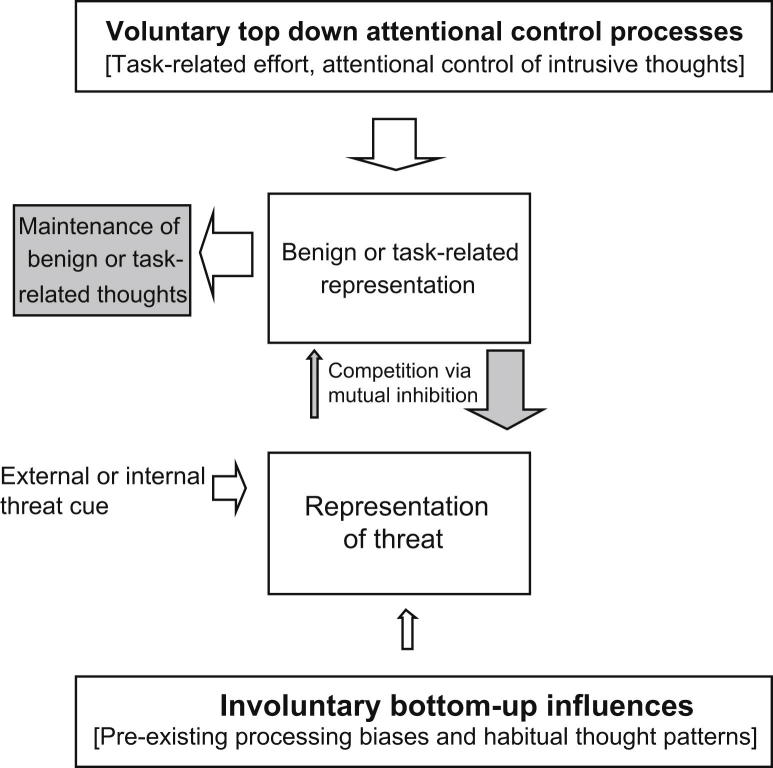
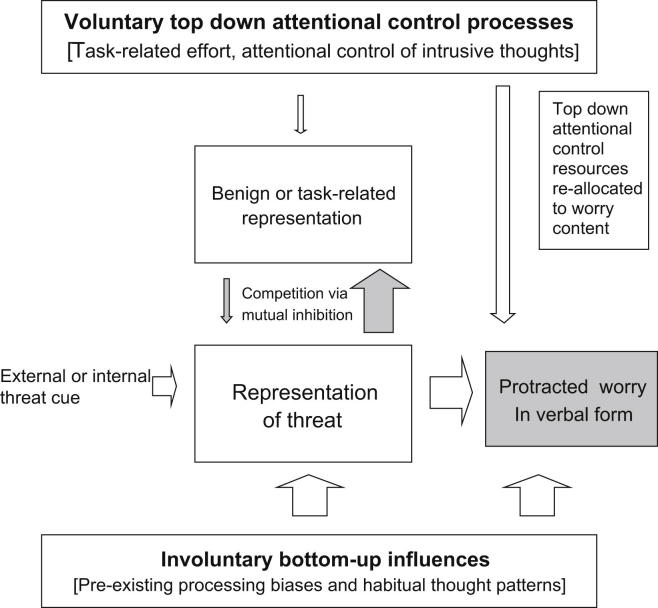
We present an evidence-based model of pathological worry in which worry arises from an interaction between involuntary (bottom-up) processes, such as habitual biases in attention and interpretation favouring threat content, and voluntary (top-down) processes, such as attentional control. At a pre-conscious level, these processes influence the competition between mental representations when some correspond to the intended focus of attention and others to threat distracters. Processing biases influence the probability of threat representations initially intruding into awareness as negative thoughts. Worry in predominantly verbal form then develops, influenced by conscious processes such as attempts to resolve the perceived threat and the redirection of attentional control resources to worry content, as well as the continuing influence of habitual processing biases. After describing this model, we present evidence for each component process and for their causal role in pathological worry, together with implications for new directions in the treatment of pathological worry.
Overview
The claims and statistics of this paper haven’t been checked yet.
Run the check — free, no account needed. It reads the open-access text and checks the sources it cites.
Integrity signals
Registry
Cites
Statistics
Figures
Verification
Claims the paper makes
The claims and statistics of this paper haven’t been checked yet.
Run the check — free, no account needed. It reads the open-access text and checks the sources it cites.
Claims other papers make about this one
Each is checked against this paper’s own text: does it say what the citing paper says it does?
The cited source says what the claim attributes to it.
In the citing paper
“Nevertheless we found some evidence (across the sample) that increases in negative thought intrusions were associated with subsequent increases in subjective anxiety, consistent with cognitive models of pathological worry in anxiety (Hirsch & Mathews, 2012).”
From Testing the differential effects of acceptance and attention-based psychological interventions on intrusive thoughts and worry (2017) · cites this paper as Hirsch & Mathews, 2012
Self-check
Percentages, sums and reported differences re-computed from the paper’s own numbers.
The self-check needs the paper’s full text.
Citations
Cites
2 retracted
Persson, J., & Reuter‐Lorenz, P. A. (2008) · Psychological Science · doi:10.1111/j.1467-9280.2008.02172.x · Cited by 109 · cited 1×
“In any case, training intended to enhance general capacity to ignore salient cues is not always successful (Persson & Reuter-Lorenz, 2008).”
BackgroundRetracted(2011) · Psychological Science · doi:10.1177/0956797611404902 · Cited by 6
RetractedMiyake, A., Friedman, N. P., Emerson, M. J., Witzki, A. H., Howerter, A., & Wager, T. D. (2000) · Cognitive Psychology · doi:10.1006/cogp.1999.0734 · Cited by 15,798 · cited 1×
“We use the term attentional control in this paper to refer to processes underlying the ability to intentionally ignore distracting information (e.g. external noises when trying to work), or shift attention from one topic to another (Miyake et al., 2000).”
MethodTelling more than we can know: Verbal reports on mental processes.
Nisbett, R. E., & Wilson, T. D. (1977) · Psychological Review · doi:10.1037/0033-295x.84.3.231 · Cited by 11,317 · cited 1×
“Furthermore, it may be that some reported beliefs about worry are post-hoc attempts at explaining or understanding the experience of worry, rather than being causes of worry (see Nisbett & Wilson, 1977; for a discussion of how post-hoc rationalizations can arise).”
BackgroundBaddeley, A. D., & Hitch, G. (1974) · Psychology of Learning and Motivation · doi:10.1016/s0079-7421(08)60452-1 · Cited by 9,860
Anxiety and cognitive performance: Attentional control theory
Eysenck, M. W., Derakshan, N., Santos, R., & Calvo, M. G. (2007) · Emotion · doi:10.1037/1528-3542.7.2.336 · Cited by 5,289 · cited 1×
“The latter effect has been revealed in studies in which tasks requiring attentional control capacity for their performance are particularly susceptible to interference from worry (Eysenck et al., 2007; Hayes et al., 2008; Leigh & Hirsch, 2011).”
BackgroundResponses to depression and their effects on the duration of depressive episodes
Nolen-Hoeksema, S. (1991) · Journal of Abnormal Psychology · doi:10.1037/0021-843x.100.4.569 · Cited by 4,529 · cited 1×
“Pathological worry has much in common with what has been described as rumination, more often studied in the context of depression (Nolen-Hoeksema, 1991).”
BackgroundThreat-related attentional bias in anxious and nonanxious individuals: a meta-analytic study.
Bar-Haim, Y., Lamy, D., Pergamin, L., Bakermans-Kranenburg, M. J., & van IJzendoorn, M. H. (2007) · Psychological Bulletin · doi:10.1037/0033-2909.133.1.1 · Cited by 3,721
Attentional bias in emotional disorders
MacLeod, C., Mathews, A., & Tata, P. (1986) · Journal of Abnormal Psychology · doi:10.1037/0021-843x.95.1.15 · Cited by 3,152
Self-citationAttentional bias in emotional disorders.
MacLeod, C., Mathews, A., & Tata, P. R. (1986) · Journal of Abnormal Psychology · doi:10.1037//0021-843x.95.1.15 · Cited by 2,553 · cited 2×
“Faster responding to targets replacing threatening cues, indicating selective attention toward threat, occurs in individuals with pathological worry (Bradley, Mogg, White, Groom, & DeBono, 1999; MacLeod, Mathews, & Tata, 1986; Mogg, Mathews, & Eysenck, 1992).”
BackgroundSelf-citation
Cited by
Sorted by citations
Anxiety and working memory capacity: A meta-analysis and narrative review.
Moran, T. P. (2016) · Psychological Bulletin · doi:10.1037/bul0000051 · Cited by 776
Ogunbode, C. A., Doran, R., Hanss, D., Ojala, M., Salmela-Aro, K., van den Broek, K. L., Bhullar, N., Aquino, S. D., Marot, T., Schermer, J. A., et al. (2022) · Journal of Environmental Psychology · doi:10.1016/j.jenvp.2022.101887 · Cited by 549
Resolving Ambiguity in Emotional Disorders: The Nature and Role of Interpretation Biases
Hirsch, C. R., Meeten, F., Krahé, C., & Reeder, C. (2016) · Annual Review of Clinical Psychology · doi:10.1146/annurev-clinpsy-021815-093436 · Cited by 331
Self-citationHot and cold executive functions in the brain: A prefrontal-cingular network
Salehinejad, M. A., Ghanavati, E., Rashid, M. H. A., & Nitsche, M. A. (2021) · Brain and Neuroscience Advances · doi:10.1177/23982128211007769 · Cited by 413
“Two well-known theories in this respect are the ‘Attentional Control Theory’ (Eysenck and Derakshan, 2011) and the ‘Cognitive Model’ of pathological worry (Hirsch and Mathews, 2012).”
Psychometric Properties of the Climate Change Worry Scale
Stewart, A. E. (2021) · International Journal of Environmental Research and Public Health · doi:10.3390/ijerph18020494 · Cited by 286
Putman, P., Verkuil, B., Arias-Garcia, E., Pantazi, I., & van Schie, C. C. (2013) · Cognitive Affective & Behavioral Neuroscience · doi:10.3758/s13415-013-0238-7 · Cited by 286
Ogunbode, C. A., Pallesen, S., Böhm, G., Doran, R., Bhullar, N., Aquino, S., Marot, T., Schermer, J. A., Wlodarczyk, A., Lu, S., et al. (2023) · Current Psychology · doi:10.1007/s12144-021-01385-4 · Cited by 255
Clarke, P., Browning, M. D., Hammond, G., Notebaert, L., & MacLeod, C. (2014) · Biological Psychiatry · doi:10.1016/j.biopsych.2014.03.003 · Cited by 181
“Cognitive and neurological models of anxiety implicate attentional bias to threat in the development, maintenance, and remediation of anxiety pathology (6-8).”
Frontal EEG theta/beta ratio during mind wandering episodes
Son, D. V., Blasio, F. M. D., Fogarty, J. S., Angelidis, A., Barry, R. J., & Putman, P. (2018) · Biological Psychology · doi:10.1016/j.biopsycho.2018.11.003 · Cited by 172
Generalized Anxiety Disorder, worry and attention to threat: A systematic review.
Goodwin, H., Yiend, J., & Hirsch, C. (2017) · Clinical Psychology Review · doi:10.1016/j.cpr.2017.03.006 · Cited by 137
“Hirsch and Mathews (2012) reviewed evidence that trait worriers have an increased tendency to engage with threatening information than non-worriers and also have greater difficulty disengaging from it, either due to impaired attentional control ability or a goal-driven focus on threat.”
BackgroundSelf-citationClimate anxiety: Conceptual considerations, and connections with climate hope and action
Sangervo, J., Jylhä, K. M., & Pihkala, P. (2022) · Global Environmental Change · doi:10.1016/j.gloenvcha.2022.102569 · Cited by 196
Are attentional control resources reduced by worry in generalized anxiety disorder?
Stefanopoulou, E., Hirsch, C. R., Hayes, S., Adlam, A., & Coker, S. (2014) · Journal of Abnormal Psychology · doi:10.1037/a0036343 · Cited by 120
Self-citationHirsch, C. R., Krahé, C., Whyte, J., Loizou, S., Bridge, L., Norton, S., & Mathews, A. (2018) · Journal of Consulting and Clinical Psychology · doi:10.1037/ccp0000310 · Cited by 108
“Hirsch and Mathews (2012) suggest that worry episodes can be triggered by negative interpretations and, once begun, subsequent interpretations direct worry to increasingly negative content.”
BackgroundInfluentialSelf-citationSchoth, D. E., & Liossi, C. (2017) · Frontiers in Psychology · doi:10.3389/fpsyg.2017.00171 · Cited by 108
“Interpretation biases have been extensively studied in relation to psychopathology, where they are argued to have a role in the onset and maintenance of disorders such as anxiety and depression (e.g., Beck and Clarke, 1988; Mathews and Mackintosh, 2000; Clark, 2001; Hirsch and Mathews, 2012; Hirsch et al., 2016).”
BackgroundApolinário-Hagen, J., Drüge, M., & Fritsche, L. (2020) · Advances in Experimental Medicine and Biology · doi:10.1007/978-981-32-9705-0_17 · Cited by 100
Son, D. V., de Rover, M., Blasio, F. M. D., van der Does, W. A. J., Barry, R. J., & Putman, P. (2019) · Annals of the New York Academy of Sciences · doi:10.1111/nyas.14180 · Cited by 107
Weber-Goericke, F., & Muehlhan, M. (2018) · Journal of Affective Disorders · doi:10.1016/j.jad.2018.09.049 · Cited by 98
The neural correlates of worry in association with individual differences in neuroticism
Servaas, M. N., Riese, H., Ormel, J., & Aleman, A. (2014) · Human Brain Mapping · doi:10.1002/hbm.22476 · Cited by 96
“Excessive worry features in a number of emotional disorders [Hirsch and Mathews, 2012] and results from studies that elucidate its neural basis may help explain how and why neuroticism contributes to vulnerability for psychopathology.”
BackgroundInfluentialZainal, N. H., & Newman, M. G. (2017) · Psychological Medicine · doi:10.1017/s0033291717003579 · Cited by 92
“The cognitive model (Hirsch & Mathews, 2012) and attentional control theory (Eysenck & Derakshan, 2011) postulate that compromised executive function (EF) and other cognitive constructs are negatively linked to increased excessive and uncontrollable worry, the core symptom of generalized anxiety…”
BackgroundMethodInfluentialHallion, L. S., Tolin, D. F., Assaf, M., Goethe, J. W., & Diefenbach, G. J. (2017) · Cognitive Therapy and Research · doi:10.1007/s10608-017-9832-2 · Cited by 93
“In keeping with the model proposed by Hirsch and Mathews (2012), we found that GAD status predicted impaired “cold” inhibition and, debatably, impaired cognitive inhibition specifically, with additional variance explained by trait anxiety, although not by trait worry.”
BackgroundMethodInfluentialEffects of cognitive bias modification on social anxiety: A meta-analysis
Liu, H., Li, X., Han, B., & Liu, X. (2017) · PLoS ONE · doi:10.1371/journal.pone.0175107 · Cited by 106
“Cognitive models of SAD propose that individuals with higher levels of social anxiety automatically and selectively attend to socially threatening information (attention bias) and interpret emotionally ambiguous events as threatening (interpretation bias) [18,19].”
BackgroundBallesio, A., Bacaro, V., Vacca, M., Chirico, A., Lucidi, F., Riemann, D., Baglioni, C., & Lombardo, C. (2021) · Sleep Medicine Reviews · doi:10.1016/j.smrv.2020.101378 · Cited by 87
A network approach to climate change anxiety and its key related features
Heeren, A., Mouguiama-Daouda, C., & McNally, R. J. (2023) · Journal of Anxiety Disorders · doi:10.1016/j.janxdis.2022.102625 · Cited by 88
Course-Choi, J., Saville, H., & Derakshan, N. (2016) · Behaviour Research and Therapy · doi:10.1016/j.brat.2016.11.002 · Cited by 96
Koerner, N., Mejia, T., & Kusec, A. (2017) · Cognitive Behaviour Therapy · doi:10.1080/16506073.2016.1211172 · Cited by 81
“…processes that initiate and maintain the pathological worrying that characterizes GAD (See Behar, DiMarco, Hekler, Mohlman, & Staples, 2009; Hirsch & Mathews, 2012 for KEYWORDS intolerance of uncertainty; worry; generalized anxiety disorder; process; construct ARTICLE HISTORY received 10…”
BackgroundBuff, C., Brinkmann, L., Neumeister, P., Feldker, K., Heitmann, C. Y., Gathmann, B., Andor, T., & Straube, T. (2016) · NeuroImage Clinical · doi:10.1016/j.nicl.2016.09.023 · Cited by 86
“Thus, GAD patients appeared particularly sensitive to threat, as they may have recruited additional appraisal, attention allocation and response preparation processes, possibly resulting in overestimation or over-interpretation of threat (Hirsch and Mathews, 2012).”
BackgroundHow imagining personal future scenarios influences affect: Systematic review and meta-analysis
Schubert, T., Eloo, R., Scharfen, J., & Nexhmedin Morina, B. (2019) · Clinical Psychology Review · doi:10.1016/j.cpr.2019.101811 · Cited by 96
Angelidis, A., Solis, E. C., Lautenbach, F., van der Does, W. A. J., & Putman, P. (2019) · PLoS ONE · doi:10.1371/journal.pone.0210824 · Cited by 100
“Thoughts about threat may also be processed automatically and preferentially [14,15].”
BackgroundAttentional bias and attentional control in Posttraumatic Stress Disorder
Schoorl, M., Putman, P., van der Werff, S. J., & van der Does, W. A. J. (2013) · Journal of Anxiety Disorders · doi:10.1016/j.janxdis.2013.10.001 · Cited by 84
“Anxious individuals are more easily distracted by task-irrelevant internal (e.g., worrying thoughts) or external (threatening) stimuli (Hirsch & Mathews, 2012; Mogg & Bradley, 1998).”
BackgroundAltered food-cue processing in chronically ill and recovered women with anorexia nervosa
Sanders, N., Smeets, P. A. M., van Elburg, A. A., Danner, U. N., van Meer, F., Hoek, H. W., & Adan, R. A. H. (2015) · Frontiers in Behavioral Neuroscience · doi:10.3389/fnbeh.2015.00046 · Cited by 72
“In many mental disorders, researchers have proposed bottomup (BU) and top-down (TD) models to explain information processing (Cohen et al., 2012; Hirsch and Mathews, 2012).”
BackgroundRumination and postnatal depression: A systematic review and a cognitive model
DeJong, H., Fox, E., & Stein, A. L. (2016) · Behaviour Research and Therapy · doi:10.1016/j.brat.2016.05.003 · Cited by 84
Multidimensional Perfectionism and the Big Five Personality Traits: A Meta–Analysis
Stricker, J., Buecker, S., Schneider, M., & Preckel, F. (2019) · European Journal of Personality · doi:10.1002/per.2186 · Cited by 88
Characteristics of worry in Generalized Anxiety Disorder
Hirsch, C. R., Mathews, A., Lequertier, B., Perman, G., & Hayes, S. (2013) · Journal of Behavior Therapy and Experimental Psychiatry · doi:10.1016/j.jbtep.2013.03.004 · Cited by 72
Self-citationEffects of modifying interpretation bias on transdiagnostic repetitive negative thinking.
Hirsch, C., Krahé, C., Whyte, J., Bridge, L., Loizou, S., Norton, S., & Mathews, A. (2020) · Journal of Consulting and Clinical Psychology · doi:10.1037/ccp0000455 · Cited by 56
Self-citationO’Toole, M. S., Renna, M. E., Mennin, D. S., & Fresco, D. M. (2019) · Behavior Therapy · doi:10.1016/j.beth.2018.12.005 · Cited by 66
Eagleson, C., Hayes, S., Mathews, A., Perman, G., & Hirsch, C. R. (2016) · Behaviour Research and Therapy · doi:10.1016/j.brat.2015.12.017 · Cited by 70
“In Hirsch and Mathews' (2012) model of pathological worry three processes combine to maintain uncontrollable worry: emotional processing biases, impaired attentional control and the tendency to represent possible negative outcomes in over-general verbal form.”
BackgroundSelf-citationDoes rumination mediate the relationship between attentional control and symptoms of depression?
DeJong, H., Fox, E., & Stein, A. (2019) · Journal of Behavior Therapy and Experimental Psychiatry · doi:10.1016/j.jbtep.2018.12.007 · Cited by 67
Taylor, M. M., & Snyder, H. R. (2021) · Journal of Psychopathology and Behavioral Assessment · doi:10.1007/s10862-021-09898-9 · Cited by 78
Verbal worry facilitates attention to threat in high-worriers
Williams, M. O., Mathews, A., & Hirsch, C. (2014) · Journal of Behavior Therapy and Experimental Psychiatry · doi:10.1016/j.jbtep.2013.05.006 · Cited by 53
“Crown Copyright 2013 Published by Elsevier Ltd. Open access under CC BY license.”
BackgroundMethodSelf-citationAre Rumination and Worry Two Sides of the Same Coin? A Structural Equation Modelling Approach
Topper, M., Molenaar, D., Emmelkamp, P. M. G., & Ehring, T. W. (2014) · Journal of Experimental Psychopathology · doi:10.5127/jep.038813 · Cited by 71
“Promising candidates include the processing mode account of RNT (Watkins, 2008), the meta-cognitive model (Papageorgiou & Wells, 2003), and information processing models (Hirsch & Mathews, 2012; Joormann, 2010).”
MethodApplication of a cognitive neuroscience perspective of cognitive control to late-life anxiety
Beaudreau, S. A., MacKay-Brandt, A., & Reynolds, J. (2013) · Journal of Anxiety Disorders · doi:10.1016/j.janxdis.2013.03.006 · Cited by 62
“Deficient top-down processing has been shown to increase processing of threat information, and thus represents one possible contributor to states such as pathological worry (Hirsch & Mathews, 2012), including generalized anxiety disorder (GAD; MacLeod & Rutherford, 1992, 2004).”
BackgroundMethodThe Attention Training Technique: A Review of a Neurobehavioral Therapy for Emotional Disorders
Fergus, T. A., & Bardeen, J. R. (2015) · Cognitive and Behavioral Practice · doi:10.1016/j.cbpra.2015.11.001 · Cited by 62
“If such threat representations do enter into conscious awareness, Hirsch and Mathews (2012) suggest that increased attentional control can be used to disengage and shift attentional focus from worry toward goal-directed behavior.”
Attentional control and suppressing negative thought intrusions in pathological worry
Fox, E., Dutton, K., Yates, A., Georgiou, G. A., & Mouchlianitis, E. (2015) · Clinical Psychological Science · doi:10.1177/2167702615575878 · Cited by 57
“These results add to a growing body of evidence that high worry is characterized by deficits in attentional control (Hayes et al., 2008), which is a central prediction of current cognitive models of pathological worry and anxiety (Eysenck et al., 2007; Hirsch & Mathews, 2012).”
BackgroundMethodResultInfluentialFeurer, C., Jimmy, J., Chang, F., Langenecker, S. A., Phan, K. L., Ajilore, O., & Klumpp, H. (2021) · Depression and Anxiety · doi:10.1002/da.23142 · Cited by 56
“Other putative neural mechanisms of RNT involve interactions between bottom‐up emotional reactivity and top‐down inhibitory control (Disner et al., 2011; Hirsch & Mathews, 2012) that may contribute to the negative content and self‐focus of RNT.”
BackgroundHallion, L. S., Steinman, S. A., & Kusmierski, S. N. (2017) · Journal of Anxiety Disorders · doi:10.1016/j.janxdis.2017.10.007 · Cited by 55
“The assertion that worrymight lead to difficulty concentrating is supported by several prominent theoretical models of anxiety (e.g., Eysenck, Derakshan, Santos, & Calvo, 2007; Hirsch & Mathews, 2012; Sarason, 1984).”
BackgroundResultHirsch, C. R., Krahé, C., Whyte, J., Krzyzanowski, H., Meeten, F., Norton, S., & Mathews, A. (2021) · Journal of Consulting and Clinical Psychology · doi:10.1037/ccp0000660 · Cited by 60
Self-citationKusec, A., Tallon, K., & Koerner, N. (2016) · Cognitive Behaviour Therapy · doi:10.1080/16506073.2016.1171391 · Cited by 56
“…and behavioral consequences such as difficulty concentrating, affective dysregulation, muscle tension, gastrointestinal distress, and difficulty solving problems (Aldao, Mennin, Linardatos, & Fresco, 2010; Andrews et al., 2010; Borkovec, Robinson, Pruzinsky, & DePree, 1983; Hirsch & Mathews, 2012).”
BackgroundThinking about threats: Memory and prospection in human threat management
Bulley, A., Henry, J. D., & Suddendorf, T. (2017) · Consciousness and Cognition · doi:10.1016/j.concog.2017.01.005 · Cited by 53
“…of negative future possibilities, and a large body of research now underscores the centrality of prospective representations to threatmanagement and anxiety disorders (Borkovec & Inz, 1990; Borkovec & Ray, 1998; Finnbogad & Berntsen, 2011; Hirsch & Mathews, 2012; Szabó & Lovibond, 2002).”
BackgroundFractionating the role of executive control in control over worry: A preliminary investigation
Hallion, L. S., Ruscio, A. M., & Jha, A. P. (2013) · Behaviour Research and Therapy · doi:10.1016/j.brat.2013.12.002 · Cited by 50
Zainal, N. H., & Newman, M. G. (2017) · Journal of Affective Disorders · doi:10.1016/j.jad.2017.11.084 · Cited by 56
“Indeed, the cognitive model (Hirsch and Mathews, 2012) asserts that pathological worry in GAD is intrinsically linked to the proclivity to attend to and difficulty disengaging from negative social material.”
Abnormal dynamic functional connectivity density in patients with generalized anxiety disorder
Chen, Y., Cui, Q., Xie, A., Pang, Y., Sheng, W., Tang, Q., Li, D., Huang, J., He, Z., Wang, Y., et al. (2019) · Journal of Affective Disorders · doi:10.1016/j.jad.2019.09.084 · Cited by 52
“…findings are consistent with the cognitive models of GAD, which propose that GAD patients show obvious impairments in cognitive control (Hirsch and Mathews, 2012), including negative attention bias (Fonzo et al., 2015; McClure et al., 2007; Monk et al., 2008), inhibition impairments (Hallion et…”
ResultAttentional control, attentional network functioning, and emotion regulation styles
Tortella‐Feliu, M., Morillas-Romero, A., Balle, M., Bornas, X., Llabrés, J., & Pacheco‐Unguetti, A. P. (2013) · Cognition & Emotion · doi:10.1080/02699931.2013.860889 · Cited by 57
Social anxiety and information processing biases: An integrated theoretical perspective
Peschard, V., & Philippot, P. (2015) · Cognition & Emotion · doi:10.1080/02699931.2015.1028335 · Cited by 52
“Moreover, theories of anxiety (Bishop, 2007; Eysenck et al., 2007; Hirsch & Mathews, 2012) and empirical data (for reviews, see Berggren & Derakshan, 2013; Eysenck & Derakshan, 2011) suggest that anxiety disorders may be associated with impaired attentional control component of WM.”
BackgroundGorday, J. Y., Rogers, M. L., & Joiner, T. E. (2018) · Journal of Psychiatric Research · doi:10.1016/j.jpsychires.2018.10.004 · Cited by 50
Advancing emotion regulation perspectives on psychopathology: the challenge of distress disorders
Mennin, D. S., & Fresco, D. M. (2015) · Psychological Inquiry · doi:10.1080/1047840x.2015.969624 · Cited by 46
“…responses produce increases in internal regulatory efforts often characterized by worry, rumination, and other forms of cognitive effort (e.g., Berenbaum, 2010; Hirsch & Mathews, 2012; Mennin & Fresco, 2014; Newman & Llera, 2011; Nolen-Hoeksema, Wisco, & Lyubomirsky, 2008; Tamir, 2005).”
BackgroundKrahé, C., Whyte, J., Bridge, L., Loizou, S., & Hirsch, C. R. (2019) · Clinical Psychological Science · doi:10.1177/2167702619851808 · Cited by 46
“…process posited to maintain worry and rumination, but this process is thought to operate in interaction with other biases (see the combined-cognitive-biases hypothesis; Hirsch, Clark, & Mathews, 2006) as well as levels of attentional control and types of mentation style (Hirsch & Mathews, 2012).”
BackgroundResultInfluentialSelf-citationRepetitive negative thinking as a transdiagnostic cognitive process
Moulds, M. L., & McEvoy, P. M. (2025) · Nature Reviews Psychology · doi:10.1038/s44159-024-00399-6 · Cited by 55
“Numerous theories have been put forward to account for the onset and persistence of chronic worry 31,32 .”
The effects of active worrying on working memory capacity
Sarı, B. A., Koster, E. H. W., & Derakshan, N. (2016) · Cognition & Emotion · doi:10.1080/02699931.2016.1170668 · Cited by 61
“…worrying on a measure of WMC and in this sense have direct implications for theories of anxiety and worry (e.g. Berggren & Derakshan, 2013; Eysenck et al., 2007; Hirsch & Mathews, 2012) that attempt to understand the main mechanism by which anxiety-related effects impair performance outcome(s).”
BackgroundDelineating the Role of Negative Verbal Thinking in Promoting Worry, Perceived Threat, and Anxiety
Hirsch, C. R., Perman, G., Hayes, S., Eagleson, C., & Mathews, A. (2015) · Clinical Psychological Science · doi:10.1177/2167702615577349 · Cited by 44
“One candidate explanation is that verbal processing, unlike imagery, simultaneously primes a wide range of semantically related potential threats, and so increases the range of possible negative thoughts that can intrude later (for a discussion of this possibility, see Hirsch & Mathews, 2012).”
BackgroundResultInfluentialSelf-citationAttentional control, rumination and recurrence of depression
Figueroa, C. A., DeJong, H., Mocking, R. J. T., Fox, E., Rive, M. M., Schene, A. H., Stein, A. L., & Ruhé, H. G. (2019) · Journal of Affective Disorders · doi:10.1016/j.jad.2019.05.072 · Cited by 45
Hirsch, C. R., Beale, S., Grey, N., & Liness, S. (2019) · Frontiers in Psychiatry · doi:10.3389/fpsyt.2019.00796 · Cited by 43
“Attention Bias Another key emotional processing bias proposed in Hirsch and Mathews’ (41) model is selective attention to threatening information (attention bias), which heightens perceived threat in the environment, presumably leading to more worry.”
BackgroundInfluentialSelf-citationPan, D., Hoid, D., Gu, R., & Li, X. (2020) · NeuroImage Clinical · doi:10.1016/j.nicl.2020.102488 · Cited by 53
“…would disempower the capableness of removing distracting negative information from working memory, thus circumscribe the possibilities to encode new information that was helpful to mood improvement, and thereby exacerbating worry and anxiety (Hirsch and Mathews, 2012; Whitmer and Banich, 2007).”
BackgroundPhilippot, P., Bouvard, M., Baeyens, C., & Dethier, V. (2019) · Clinical Psychology & Psychotherapy · doi:10.1002/cpp.2340 · Cited by 40
“This concept of a hierarchy in cognitive deficits and biases that could produce a snowball effect is also reflected in the idea of combined cognitive biases developed by Hirsch & Mathews (2012).”
BackgroundHotton, M., Derakshan, N., & Fox, E. (2017) · Behaviour Research and Therapy · doi:10.1016/j.brat.2017.10.011 · Cited by 42
“However, given that worry is often verbal in nature (Hirsch & Mathews, 2012), future studies investigating cognitive training effects may be maximised by using the single verbal n -back task or dual n -back tasks.”
InfluentialTeng, M.-H., Hou, Y.-M., Chang, S.-H., & Cheng, H.-J. (2019) · Journal of Affective Disorders · doi:10.1016/j.jad.2018.12.118 · Cited by 37
Brain mechanisms underlying the inhibitory control of thought
Anderson, M. C., Crespo‐García, M., & Subbulakshmi, S. (2025) · Nature reviews. Neuroscience · doi:10.1038/s41583-025-00929-y · Cited by 52
Zainal, N. H., & Newman, M. G. (2022) · Current Psychiatry Reports · doi:10.1007/s11920-022-01390-9 · Cited by 40
“Vulnerability models, such as the cognitive model of pathological worry, theorize that attentional control deficits predict and lead to the initiation and maintenance of excessive and uncontrollable worry [18].”
BackgroundNetwork Analysis Reveals Central Symptoms of Adolescent Depression and Anxiety in Sub-Saharan AfricaPreprint
Osborn, T. L., Campbell, S., Ndetei, D. M., & Weisz, J. R. (2020) · PsyArXiv (OSF Preprints) · doi:10.31234/osf.io/dv6c9 · Cited by 41
A Cognitive Model of Pathological Worry in Children and Adolescents: A Systematic Review
Songco, A., Hudson, J. L., & Fox, E. (2020) · Clinical Child and Family Psychology Review · doi:10.1007/s10567-020-00311-7 · Cited by 44
Otkhmezuri, B., Boffo, M., Siriaraya, P., Matsangidou, M., Wiers, R. W. H. J., Mackintosh, B., Ang, C. S., & Salemink, E. (2018) · JMIR Mental Health · doi:10.2196/11517 · Cited by 42
“Whereas nonanxious individuals tend to favor positive or benign interpretations of ambiguous stimuli and situations, anxious individuals favor more threatening interpretations (ie, negative interpretative bias) and tend to exaggeratedly anticipate possible negative events in the future [2,4-7].”
BackgroundClarke, P., & Todd, J. (2021) · Cognition & Emotion · doi:10.1080/02699931.2021.1987861 · Cited by 38
Davey, G. C. L., & Meeten, F. (2016) · Biological Psychology · doi:10.1016/j.biopsycho.2016.04.003 · Cited by 34
“…hatched boxes indicate how attentional and interpretational biases can facilitate the identification of potential worries by directly influencing how stimuli and events are evaluated or by increasing the frequency with which intrusive negative thoughts are experienced (e.g. Hirsch & Mathews, 2012).”
InfluentialGrol, M., Schwenzfeier, A., Stricker, J., Booth, C., Temple-McCune, A., Derakshan, N., Hirsch, C. R., Becker, E. S., & Fox, E. (2018) · Behaviour Research and Therapy · doi:10.1016/j.brat.2018.01.005 · Cited by 38
“This supports cognitive models of worry and anxiety positing that, in worry-prone individuals, negative emotion processing biases, impaired attentional control, and their interplay contribute to excessive worry (Berggren & Derakshan, 2013; Hirsch & Mathews, 2012).”
InfluentialSelf-citationIndividual differences in affective flexibility predict future anxiety and worry
Twivy, E., Grol, M., & Fox, E. (2020) · Cognition & Emotion · doi:10.1080/02699931.2020.1843407 · Cited by 38
Intolerance of uncertainty and attentional networks: Unique associations with alerting
Fergus, T. A., & Carleton, R. N. (2016) · Journal of Anxiety Disorders · doi:10.1016/j.janxdis.2016.03.010 · Cited by 42
“Such a possibility is consistent with the idea that strong bottom-up influences lead threat representations to dominate attentional focus and exacerbate anxiety (Eysenck et al., 2007; Hirsch & Mathews, 2012).”
BackgroundDifferential replay of reward and punishment paths predicts approach and avoidance
McFadyen, J., Liu, Y., & Dolan, R. J. (2023) · Nature Neuroscience · doi:10.1038/s41593-023-01287-7 · Cited by 38
Mind wandering in anxiety disorders: A status report
Fell, J., Chaieb, L., & Hoppe, C. (2023) · Neuroscience & Biobehavioral Reviews · doi:10.1016/j.neubiorev.2023.105432 · Cited by 48
“Finally, in a more recent account of the etiology of GAD in adults, Hirsch and Mathews (2012) proposed that negative information-processing biases, reduced executive functions, and verbal worry are critical factors.”
An Exploratory Pilot Study on Choking Episodes in Archery
Diotaiuti, P., Corrado, S., Mancone, S., Falese, L., Dominski, F. H., & Andrade, A. (2021) · Frontiers in Psychology · doi:10.3389/fpsyg.2021.585477 · Cited by 37
Kofler, M. J., Groves, N. B., Chan, E. S. M., Marsh, C. L., Cole, A. M., Gaye, F., Cibrian, E., Tatsuki, M. O., & Singh, L. J. (2024) · Frontiers in Psychiatry · doi:10.3389/fpsyt.2024.1277583 · Cited by 35
“Support for working memory-focused models would include signi fi cant reductions in inhibitory control performance when working memory demands are experimentally induced (14, 45).”
Zainal, N. H., & Newman, M. G. (2022) · Clinical Psychological Science · doi:10.1177/21677026221114076 · Cited by 39
“Network-centrality analyses showed that reduced attention or verbal short-term memory repetition predicted elevated anxious mood (but not other psychopathology nodes), suggesting that the cognitive model of worry (Hirsch & Mathews, 2012) could apply to late-life anxiety.”
BackgroundPreoccupation as psychopathological process and symptom in adjustment disorder: A scoping review
Eberle, D. J., & Maercker, A. R. A. (2021) · Clinical Psychology & Psychotherapy · doi:10.1002/cpp.2657 · Cited by 33
Mental imagery in generalized anxiety disorder: A comparison with healthy control participants
Tallon, K., Ovanessian, M. M., Koerner, N., & Dugas, M. J. (2020) · Behaviour Research and Therapy · doi:10.1016/j.brat.2020.103571 · Cited by 37
Casteràs, D. P., Fullana, M. A., Tinoco, D. H., Martínez‐Zalacaín, I., Pujol, J., Vidal, D. P., Soriano‐Mas, C., Harrison, B. J., Via, E., & Cardoner, N. (2020) · Journal of Affective Disorders · doi:10.1016/j.jad.2020.02.029 · Cited by 34
The relationship between worry and intolerance of uncertainty subtypes
Groves, D., Clark, L. H., & Clark, G. I. (2019) · Australian Psychologist · doi:10.1111/ap.12421 · Cited by 31
Wyatt, L. E., Hewan, P., Hogeveen, J., Spreng, R. N., & Turner, G. R. (2023) · Neuropsychologia · doi:10.1016/j.neuropsychologia.2023.108740 · Cited by 39
“…(Artiges, et al., 2000; Cathomas et al., 2021; Martinelli et al., 2018; Salame et al., 1998; Strauss et al., 2011), pathological worry (Hirsch and Mathews, 2012), and atypical neurodevelopment (Addicott, et al., 2021; Elison et al., 2012; Pellicano et al., 2011; Pierce and Courchesne,…”
Meeten, F., Davey, G. C. L., Makovac, E., Watson, D. R., Garfinkel, S. N., Critchley, H., & Ottaviani, C. (2016) · Frontiers in Human Neuroscience · doi:10.3389/fnhum.2016.00553 · Cited by 30
“However, on amoremechanistic level, proximal models of individual pathological worry have only recently been developed (Hirsch and Mathews, 2012; Davey and Meeten, in press), and will be required to understand the individual neurological and psychological mechanisms that generate a worry experience…”
BackgroundPang, Q., Sun, G., Xin, T., Zhang, R., & Liu, C. (2020) · Pharmacognosy Magazine · doi:10.4103/pm.pm_318_19 · Cited by 28
Hills, T. T. (2019) · Proceedings of the Royal Society B Biological Sciences · doi:10.1098/rspb.2019.0510 · Cited by 30
“People under time pressure or who suffer from unwanted thoughts also produce more predictable sequences [66], as do individuals with impairment in areas of the brain associated with executive control [63,67,68].”
BackgroundIntelligence and aggression: The role of cognitive control and test related stress
Zajenkowski, M., & Zajenkowska, A. M. (2015) · Personality and Individual Differences · doi:10.1016/j.paid.2014.12.062 · Cited by 27
Perseverative cognition, distracted communication, and well‐being in everyday social interaction
Merolla, A. J., Hall, J. A., & Bernhold, Q. S. (2019) · Personal Relationships · doi:10.1111/pere.12286 · Cited by 27
EEG Theta/Beta Ratio Neurofeedback Training in Healthy Females
Son, D. V., van der Does, W. A. J., Band, G. P. H., & Putman, P. (2020) · Applied Psychophysiology and Biofeedback · doi:10.1007/s10484-020-09472-1 · Cited by 28
Cognitive processes predict worry and anxiety under different stressful situations
Feng, Y.-C., Krahé, C., Koster, E. H. W., Lau, J. Y. F., & Hirsch, C. R. (2022) · Behaviour Research and Therapy · doi:10.1016/j.brat.2022.104168 · Cited by 33
Self-citationDemertzis, K. H., & Craske, M. G. (2006) · Springer eBooks · doi:10.1007/978-0-387-28370-8_30 · Cited by 27
Peril, prudence and planning as risk, avoidance and worry
Gagne, C., & Dayan, P. (2021) · Journal of Mathematical Psychology · doi:10.1016/j.jmp.2021.102617 · Cited by 28
Owens, M., Derakshan, N., & Richards, A. (2015) · Emotion · doi:10.1037/emo0000052 · Cited by 26
Automaticity of Attentional Bias to Threat in High and Low Worriers
Goodwin, H., Eagleson, C., Mathews, A., Yiend, J., & Hirsch, C. (2016) · Cognitive Therapy and Research · doi:10.1007/s10608-016-9818-5 · Cited by 18
“Selective attention to threat has been postulated as a causal factor in Hirsch and Mathews’ (2012) cognitive model of pathological worry.”
BackgroundResultInfluentialSelf-citationContrast avoidance model of worry and generalized anxiety disorder: A theoretical perspective
Rashtbari, A., & Saed, O. (2020) · Cogent Psychology · doi:10.1080/23311908.2020.1800262 · Cited by 28
“According to deficit-based cognitive models (Hirsch & Mathews, 2012), pathological worry is mainly maintained by deficits in cognitive control, especially in the context of negative emotional information.”
MethodCarr, I., & Szabó, M. (2014) · The Journal of Early Adolescence · doi:10.1177/0272431614529366 · Cited by 25
“Indeed, although different theoretical approaches emphasize alternative characteristics of worry (e.g., Davey, 1994; Dugas, Gagnon, Ladouceur, & Freeston, 1998; Hirsch & Mathews, 2012; Wells, 1999), they all tend to agree that normal worrying involves problem-solving or coping attempts.”
BackgroundYan, Y., Lin, R., Tang, X., He, F., Cai, W., & Su, Y. (2013) · Journal of Health Psychology · doi:10.1177/1359105313479628 · Cited by 26
“…Knepp and Friedman, 2008; Peasley-Miklus et al., 2012), which refers to a consistent and stable cognitive style of worrying about uncertain future events (Hirsch and Mathews, 2012), and integrates the specific worry contents with the features of an enduring trait or tendency (Lin et al., 2012).”
Background
Metadata
- Authors
- Hirsch, C. R., & Mathews, A.
- Affiliations
- The University of Western Australia (AU)
- King's College London (GB)
- Corresponding author
- Hirsch, Colette R.
- ORCID
- Hirsch, Colette R.
- Venue
- Behaviour Research and Therapy
- Publisher
- Elsevier BV
- Published
- 2012-10
- Volume
- 50
- Issue
- 10
- Pages
- 636-646
- ISSN
- 0005-7967 (ISSN-L)
- PMC
- PMC3444754
- OpenAlex
- W2026506811
- Cited by
- 400
- References
- 114
- Citations by year
- 2026: 37 · 2025: 44 · 2024: 31 · 2023: 34 · 2022: 30 · 2021: 50 · 2020: 34 · 2019: 33 · 2018: 22 · 2017: 24 · 2016: 24 · 2015: 15 · 2014: 11 · 2013: 10
- FWCI
- 15.31
- Type
- journal article
- Language
- en
- Open access
- hybrid
- doi.org
- Locations
- Behaviour Research and Therapy (publishedVersion, cc-by)
- PubMed Central (publishedVersion, cc-by)
- PubMed (publishedVersion)
- Funders
- Wellcome Trust (WT083204)
- National Institute for Health Research (NIHR)
- Mental Health Biomedical Research Centre at South London
- Maudsley NHS Foundation Trust
- King's College London
- Topics
- Social Sciences › Psychology › Experimental and Cognitive Psychology › Anxiety, Depression, Psychometrics, Treatment, Cognitive Processes
- Life Sciences › Neuroscience › Cognitive Neuroscience › Mind wandering and attention
- Social Sciences › Psychology › Clinical Psychology › Obsessive-Compulsive Spectrum Disorders
- Keywords
- pathological worry, worry, cognitive models, attentional bias, threat processing, attentional control, top-down control, bottom-up processing, threat representation, intrusive thoughts, cognitive bias modification
- MeSH terms
- Anxiety Disorders, Attention, Cognition Disorders, Emotions, Humans, Models, Psychological, Evidence-Based Medicine, Executive Function
About these checks
Registry, retraction, Cites and statistics results are computed, not judged, with one exception: a printed reference that no index lists is read once by a model before it counts as a citation error. Claims are extracted by a model and kept only when their quote appears verbatim in the text; each cited source is then checked, with a model’s help, for whether it says what the claim relies on. Those verdicts can be wrong — read the claim’s quote and the cited source before relying on one.
Statistics and arithmetic are recomputed, not judged.
Confidence bands are shown only for fields calibrated on our annotated test set. None is calibrated yet, so no band is shown.
What counts as a claim ›How we measure confidence ›How we check this ›
Are you an author, or do you see a problem with this page? Request a review
