

The DOI matches its Crossref record; 77 of the 78 references it cites were found in a registry or an index.
Homophobia is online: Sexual victimization and risks on the internet and mental health among bisexual, homosexual, pansexual, asexual, and queer adolescents
Open accessAbstract
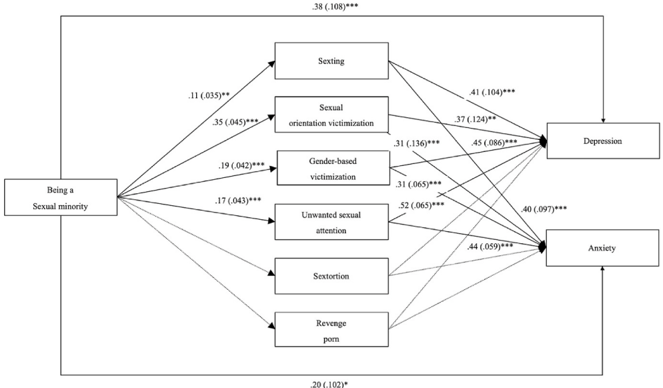
The first aim of this study was to analyze the prevalence and frequency of different forms of online sexual victimization and risks among sexual minorities, including sexting, sexual orientation- and gender-based victimization, unwanted sexual attention, sextortion, and revenge porn. The second aim was to examine whether online sexual victimization and risks mediate the relationship between being a sexual minority and mental health outcomes, including depression and anxiety. The sample was composed of 1779 adolescents (50.9% girls) between 12 and 18 years old (mean age = 13.92, SD = 1.27), and 146 of them (8.2%) were sexual minorities (specifically, bisexual, homosexual, pansexual, asexual, or queer adolescents). About 17.3% of sexual minority adolescents have sent a sext. Four out of ten adolescents (41.1%) had experienced online sexual orientation discrimination and 28.4% gender-based victimization. More than forty percent (45.2%) experienced unwanted sexual attention, 9% were victims of sextortion, and 5.5% had been targets of revenge porn. Sexting, online sexual orientation victimization and gender-based victimization, and unwanted sexual attention partially mediated the relationship between being a sexual minority and mental health outcomes (i.e., depression and anxiety). More prevention programs aimed to reduce online sexual victimization and risks for sexual minorities are needed.
Overview
The claims and statistics of this paper haven’t been checked yet.
Run the check — free, no account needed. It reads the open-access text and checks the sources it cites.
Integrity signals
Registry
Cites
Statistics
Figures
Verification
Claims the paper makes
The claims and statistics of this paper haven’t been checked yet.
Run the check — free, no account needed. It reads the open-access text and checks the sources it cites.
Claims other papers make about this one
Each is checked against this paper’s own text: does it say what the citing paper says it does?
The cited source says what the claim attributes to it.
In the citing paper
“Findings across these studies show that sexual minorities were more likely to experience sextortion victimization than their heterosexual counterparts (Eaton et al., 2022; Gámez-Guadix & Incera, 2021; Henry et al., 2019; Pacheco et al., 2019; Patchin & Hinduja, 2020).”
From Sextortion: A Scoping Review (2025) · cites this paper as Gámez-Guadix & Incera, 2021
The cited source says what the claim attributes to it.
In the citing paper
“A preliminary version of the forms of victimization has shown adequate exploratory factorial validity in a previous study (Gámez -Guadix & Incera, 2021).”
From Assessing image-based sexual abuse: Measurement, prevalence, and temporal stability of sextortion and nonconsensual sexting (“revenge porn”) among adolescents (2022) · cites this paper as Gámez -Guadix & Incera, 2021
Self-check
Percentages, sums and reported differences re-computed from the paper’s own numbers.
The self-check needs the paper’s full text.
Citations
Cites
Statistical power analysis for the behavioral sciences
Cohen, J. (1990) · Computers Environment and Urban Systems · doi:10.1016/0198-9715(90)90050-4 · Cited by 65,417
Discovering Statistics Using SPSS
Field, A. P., & Miles, J. N. V. (2000) · Medical Entomology and Zoology · Cited by 28,269
Statistical Power Analysis for the Behavioral Sciences
Cohen, J. (2013) · doi:10.4324/9780203771587 · Cited by 25,373
Meyer, I. H. (2003) · Psychological Bulletin · doi:10.1037/0033-2909.129.5.674 · Cited by 14,736
Structural Equation Modeling With AMOS: Basic Concepts, Applications, and Programming, Third Edition
Byrne, B. M. (2016) · doi:10.4324/9781315757421 · Cited by 4,653
Cole, D. A., & Maxwell, S. E. (2003) · Journal of Abnormal Psychology · doi:10.1037/0021-843x.112.4.558 · Cited by 3,605
King, M., Semlyen, J., Tai, S. S., Killaspy, H., Osborn, D., Popelyuk, D., & Nazareth, I. (2008) · BMC Psychiatry · doi:10.1186/1471-244x-8-70 · Cited by 2,300
How Big is a Big Odds Ratio? Interpreting the Magnitudes of Odds Ratios in Epidemiological Studies
Chen, H., Cohen, P., & Chen, S. (2010) · Communications in Statistics - Simulation and Computation · doi:10.1080/03610911003650383 · Cited by 1,952
The Use of Psychological Testing for Treatment Planning and Outcomes Assessment
(2004) · doi:10.4324/9781410610614 · Cited by 1,503
Bostwick, W. B., Boyd, C. J., Hughes, T. L., & McCabe, S. E. (2010) · American Journal of Public Health · doi:10.2105/ajph.2008.152942 · Cited by 829
Research works printed but not linked: 2
- Bentler, 1995, Vol. 6
- Orue, 2018, Adaptación de la "escala de acoso escolar homofobico" y magnitud del problema en adolescentes españoles, Behavioral Psychology, 26, 437
Cited by
Sorted by citations
The outcomes of sexting for children and adolescents: A systematic review of the literature
Doyle, C., Douglas, E., & O’Reilly, G. (2021) · Journal of Adolescence · doi:10.1016/j.adolescence.2021.08.009 · Cited by 115
Gámez‐Guadix, M., Mateos‐Pérez, E., Wachs, S., Wright, M., Martínez, J., & Íncera, D. (2022) · Journal of Adolescence · doi:10.1002/jad.12064 · Cited by 125
Self-citationRay, A., & Henry, N. (2025) · Trauma, Violence, & Abuse · doi:10.1177/15248380241277271 · Cited by 76
“Findings across these studies show that sexual minorities were more likely to experience sextortion victimization than their heterosexual counterparts (Eaton et al., 2022; Gámez-Guadix & Incera, 2021; Henry et al., 2019; Pacheco et al., 2019; Patchin & Hinduja, 2020).”
InfluentialGámez-Guadix, M., Sorrel, M. A., & Martínez-Bacaicoa, J. (2023) · Sexuality Research and Social Policy · doi:10.1007/s13178-022-00775-y · Cited by 65
“The relationship between being a victim of unwanted sexual attention and being a victim of sexuality-based harassment among adolescents was also reported by Gámez-Guadix and Íncera (2021).”
BackgroundInfluentialSelf-citationMaheux, A. J., Burnell, K., Maza, M. T., Fox, K. A., Telzer, E. H., & Prinstein, M. J. (2024) · Journal of Child Psychology and Psychiatry · doi:10.1111/jcpp.14085 · Cited by 66
Metadata
- Authors
- Gámez-Guadix, M., & Incera, D.
- Venue
- Computers in Human Behavior
- Publisher
- Elsevier BV
- Published
- 2021-06
- Volume
- 119
- Pages
- 106728
- ISSN
- 0747-5632 (ISSN-L)
- OpenAlex
- W3127618208
- Cited by
- 110
- References
- 78
- Citations by year
- 2026: 22 · 2025: 27 · 2024: 26 · 2023: 22 · 2022: 8 · 2021: 5
- FWCI
- 14.97
- Type
- journal article
- Language
- en
- Open access
- hybrid
- doi.org
- Licence
- Locations
- Computers in Human Behavior (publishedVersion, cc-by-nc-nd)
- Biblos-e Archivo (Universidad Autónoma de Madrid) (submittedVersion, public-domain)
- Hispana (submittedVersion)
- Funders
- Government of Spain Ministry of Science and Innovation
- Topics
- Social Sciences › Psychology › Social Psychology › LGBTQ Health, Identity, and Policy
- Social Sciences › Gender Studies › Sexual Assault and Victimization Studies
- Social Sciences › Psychology › Social Psychology › Bullying, Victimization, and Aggression
- Keywords
- online sexual victimization, sexual minorities, adolescents, sexting, sextortion, revenge porn, unwanted sexual attention, sexual orientation discrimination, depression, anxiety, mental health, mediation, homophobia, queer youth
About these checks
Registry, retraction, Cites and statistics results are computed, not judged, with one exception: a printed reference that no index lists is read once by a model before it counts as a citation error. Claims are extracted by a model and kept only when their quote appears verbatim in the text; each cited source is then checked, with a model’s help, for whether it says what the claim relies on. Those verdicts can be wrong — read the claim’s quote and the cited source before relying on one.
Statistics and arithmetic are recomputed, not judged.
Confidence bands are shown only for fields calibrated on our annotated test set. None is calibrated yet, so no band is shown.
What counts as a claim ›How we measure confidence ›How we check this ›
Are you an author, or do you see a problem with this page? Request a review
