

The DOI matches its Crossref record; 77 of the 78 references it cites were found in a registry or an index.
Homophobia is online: Sexual victimization and risks on the internet and mental health among bisexual, homosexual, pansexual, asexual, and queer adolescents
Open accessAbstract
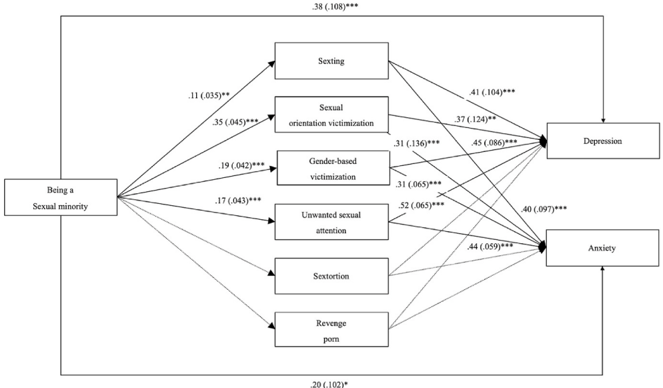
The first aim of this study was to analyze the prevalence and frequency of different forms of online sexual victimization and risks among sexual minorities, including sexting, sexual orientation- and gender-based victimization, unwanted sexual attention, sextortion, and revenge porn. The second aim was to examine whether online sexual victimization and risks mediate the relationship between being a sexual minority and mental health outcomes, including depression and anxiety. The sample was composed of 1779 adolescents (50.9% girls) between 12 and 18 years old (mean age = 13.92, SD = 1.27), and 146 of them (8.2%) were sexual minorities (specifically, bisexual, homosexual, pansexual, asexual, or queer adolescents). About 17.3% of sexual minority adolescents have sent a sext. Four out of ten adolescents (41.1%) had experienced online sexual orientation discrimination and 28.4% gender-based victimization. More than forty percent (45.2%) experienced unwanted sexual attention, 9% were victims of sextortion, and 5.5% had been targets of revenge porn. Sexting, online sexual orientation victimization and gender-based victimization, and unwanted sexual attention partially mediated the relationship between being a sexual minority and mental health outcomes (i.e., depression and anxiety). More prevention programs aimed to reduce online sexual victimization and risks for sexual minorities are needed.
Overview
The claims and statistics of this paper haven’t been checked yet.
Run the check — free, no account needed. It reads the open-access text and checks the sources it cites.
Integrity signals
Registry
Cites
Statistics
Figures

Verification
Claims the paper makes
The claims and statistics of this paper haven’t been checked yet.
Run the check — free, no account needed. It reads the open-access text and checks the sources it cites.
Claims other papers make about this one
Each is checked against this paper’s own text: does it say what the citing paper says it does?
The cited source says what the claim attributes to it.
In the citing paper
“Findings across these studies show that sexual minorities were more likely to experience sextortion victimization than their heterosexual counterparts (Eaton et al., 2022; Gámez-Guadix & Incera, 2021; Henry et al., 2019; Pacheco et al., 2019; Patchin & Hinduja, 2020).”
From Sextortion: A Scoping Review (2025) · cites this paper as Gámez-Guadix & Incera, 2021
The cited source says what the claim attributes to it.
In the citing paper
“A preliminary version of the forms of victimization has shown adequate exploratory factorial validity in a previous study (Gámez -Guadix & Incera, 2021).”
From Assessing image-based sexual abuse: Measurement, prevalence, and temporal stability of sextortion and nonconsensual sexting (“revenge porn”) among adolescents (2022) · cites this paper as Gámez -Guadix & Incera, 2021
Self-check
Percentages, sums and reported differences re-computed from the paper’s own numbers.
The self-check needs the paper’s full text.
Citations
Cites
Statistical power analysis for the behavioral sciences
Cohen, J. (1990) · Computers Environment and Urban Systems · doi:10.1016/0198-9715(90)90050-4 · Cited by 65,417
Discovering Statistics Using SPSS
Field, A. P., & Miles, J. N. V. (2000) · Medical Entomology and Zoology · Cited by 28,269
Statistical Power Analysis for the Behavioral Sciences
Cohen, J. (2013) · doi:10.4324/9780203771587 · Cited by 25,373
Meyer, I. H. (2003) · Psychological Bulletin · doi:10.1037/0033-2909.129.5.674 · Cited by 14,736
Structural Equation Modeling With AMOS: Basic Concepts, Applications, and Programming, Third Edition
Byrne, B. M. (2016) · doi:10.4324/9781315757421 · Cited by 4,653
Cole, D. A., & Maxwell, S. E. (2003) · Journal of Abnormal Psychology · doi:10.1037/0021-843x.112.4.558 · Cited by 3,605
King, M., Semlyen, J., Tai, S. S., Killaspy, H., Osborn, D., Popelyuk, D., & Nazareth, I. (2008) · BMC Psychiatry · doi:10.1186/1471-244x-8-70 · Cited by 2,300
How Big is a Big Odds Ratio? Interpreting the Magnitudes of Odds Ratios in Epidemiological Studies
Chen, H., Cohen, P., & Chen, S. (2010) · Communications in Statistics - Simulation and Computation · doi:10.1080/03610911003650383 · Cited by 1,952
The Use of Psychological Testing for Treatment Planning and Outcomes Assessment
(2004) · doi:10.4324/9781410610614 · Cited by 1,503
Bostwick, W. B., Boyd, C. J., Hughes, T. L., & McCabe, S. E. (2010) · American Journal of Public Health · doi:10.2105/ajph.2008.152942 · Cited by 829
Research works printed but not linked: 2
- Bentler, 1995, Vol. 6
- Orue, 2018, Adaptación de la "escala de acoso escolar homofobico" y magnitud del problema en adolescentes españoles, Behavioral Psychology, 26, 437
Cited by
Sorted by citations
The outcomes of sexting for children and adolescents: A systematic review of the literature
Doyle, C., Douglas, E., & O’Reilly, G. (2021) · Journal of Adolescence · doi:10.1016/j.adolescence.2021.08.009 · Cited by 115
Gámez‐Guadix, M., Mateos‐Pérez, E., Wachs, S., Wright, M., Martínez, J., & Íncera, D. (2022) · Journal of Adolescence · doi:10.1002/jad.12064 · Cited by 125
Self-citationRay, A., & Henry, N. (2025) · Trauma, Violence, & Abuse · doi:10.1177/15248380241277271 · Cited by 76
“Findings across these studies show that sexual minorities were more likely to experience sextortion victimization than their heterosexual counterparts (Eaton et al., 2022; Gámez-Guadix & Incera, 2021; Henry et al., 2019; Pacheco et al., 2019; Patchin & Hinduja, 2020).”
InfluentialGámez-Guadix, M., Sorrel, M. A., & Martínez-Bacaicoa, J. (2023) · Sexuality Research and Social Policy · doi:10.1007/s13178-022-00775-y · Cited by 65
“The relationship between being a victim of unwanted sexual attention and being a victim of sexuality-based harassment among adolescents was also reported by Gámez-Guadix and Íncera (2021).”
BackgroundInfluentialSelf-citationMaheux, A. J., Burnell, K., Maza, M. T., Fox, K. A., Telzer, E. H., & Prinstein, M. J. (2024) · Journal of Child Psychology and Psychiatry · doi:10.1111/jcpp.14085 · Cited by 66
Gámez-Guadix, M., De Santisteban, P., Wachs, S., & Wright, M. (2021) · Child Abuse & Neglect · doi:10.1016/j.chiabu.2021.105250 · Cited by 43
Self-citationEaton, A. A., Ramjee, D., & Saunders, J. F. (2023) · Victims & Offenders · doi:10.1080/15564886.2021.2022057 · Cited by 40
“…especially important in communities that serve sexual and racial minority men and women, as the data from this study reinforce the finding that both groups are at increased risk for both in-person IPV and TFSV (Cho, 2012; Daigle & Hawk, 2021; Gámez-Guadix & Incera, 2021; Tjaden & Thoennes, 2000).”
BackgroundSextortion: Prevalence and correlates in 10 countries
Henry, N., & Umbach, R. (2024) · Computers in Human Behavior · doi:10.1016/j.chb.2024.108298 · Cited by 32
Sciacca, B., Mazzone, A., Loftsson, M., Norman, J. O., & Foody, M. (2023) · Journal of Interpersonal Violence · doi:10.1177/08862605231165777 · Cited by 35
“This distinction is not always present in the literature, which often collapses different forms of victimization (Gámez-Guadix & Incera, 2021).”
BackgroundOnline Sexual Harassment in Adolescence: A Scoping Review
Angela, F., María-Luisa, R.-D., Annalaura, N., & Ersilia, M. (2024) · Sexuality Research and Social Policy · doi:10.1007/s13178-023-00869-1 · Cited by 29
“Only two studies (Gámez-Guadix & Incera, 2021; Guerra et al., 2021) used phrases such as “behaviors that make you feel uncomfortable” or “make you feel bad”.”
Zheng, Q., Guo, Y., Wang, Z., Andrasik, F., Kuang, Z., Li, J., Xu, S. H., & Hu, X. (2021) · Computers in Human Behavior · doi:10.1016/j.chb.2021.107021 · Cited by 31
Detection of homophobia and transphobia in YouTube comments
Chakravarthi, B. R. (2023) · International Journal of Data Science and Analytics · doi:10.1007/s41060-023-00400-0 · Cited by 32
“The detrimental impacts of online homophobic and transphobic speech on individual psychological well-being, as well as wider intergroup relations, have been the subject of empirical studies conducted by social scientists [25, 26].”
Increases in LGB Identification Among US Adults, 2014–2021
Twenge, J. M., Wells, B. E., & Le, J. (2023) · Sexuality Research and Social Policy · doi:10.1007/s13178-023-00874-4 · Cited by 30
“Online spaces may also shape reluctance to disclose identity as they could be sources of bullying, harassment, and victimization (Escobar-Viera et al., 2018; Gámez-Guadix & Incera, 2021), perhaps especially in online venues that do not offer anonymity (Cho, 2018).”
Amadori, A., Intra, F. S., Taverna, L., & Brighi, A. (2023) · International Journal of Bullying Prevention · doi:10.1007/s42380-023-00198-2 · Cited by 37
“…physical interactions to virtual relationships exposes individuals to greater vulnerability to cyberviolence; scientific studies emphasize that those identifying as non-hetero-normative face an elevated risk of becoming targets of such violence (Elipe et al., 2018; Gámez-Guadix & Incera, 2021).”
Martínez‐Bacaicoa, J., Real-Brioso, N., Mateos‐Pérez, E., & Gámez‐Guadix, M. (2023) · Computers in Human Behavior · doi:10.1016/j.chb.2023.108060 · Cited by 30
Self-citationSexual and gender identity work on social media
Colosi, R., Cowen, N., & Todd, M. (2023) · Sociology Compass · doi:10.1111/soc4.13073 · Cited by 23
Experiences of Technology-Facilitated Abuse Among Sexual and Gender Minorities
Vogler, S., Kappel, R., & Mumford, E. A. (2023) · Journal of Interpersonal Violence · doi:10.1177/08862605231179724 · Cited by 19
“One study of SGM adolescents found that 40% reported online sexual orientation victimization (Gámez-Guadix & Incera, 2021).”
BackgroundAn Intersectional Perspective on Cyberbullying: Victimization Experiences Among Marginalized Youth
Amadori, A., Real, A. G., Brighi, A., & Russell, S. T. (2025) · Journal of Adolescence · doi:10.1002/jad.12466 · Cited by 22
Amadori, A., & Brighi, A. (2025) · Computers in Human Behavior · doi:10.1016/j.chb.2025.108576 · Cited by 19
Chan, R. C. H. (2021) · Journal of Interpersonal Violence · doi:10.1177/08862605211021962 · Cited by 17
“Given the intensive use of social media and the growing importance of online communities, heterosexism on the internet appears to be an escalating social problem that warrants greater attention and action (DeSmet et al., 2018; Gámez-Guadix & Incera, 2021).”
BackgroundA scoping review of technological tools for supporting victims of online sexual harassment
Tan, Y., Vandebosch, H., Pabian, S., & Poels, K. (2024) · Aggression and Violent Behavior · doi:10.1016/j.avb.2024.101953 · Cited by 20
Martínez-Bacaicoa, J., Sorrel, M. A., & Gámez-Guadix, M. (2024) · Assessment · doi:10.1177/10731911241229575 · Cited by 15
“In addition, we reviewed previous scales that had demonstrated good psychometric properties in the adolescent population (Ga´mez-Guadix et al., 2022; Ga´mez-Guadix & Incera, 2021) and adapted them to the adult population (e.g., the word ‘‘girl’’ was substituted with ‘‘woman’’).”
Self-citationMartínez‐Bacaicoa, J., Henry, N., Mateos‐Pérez, E., & Gámez‐Guadix, M. (2024) · Psicothema · doi:10.7334/psicothema2023.315 · Cited by 20
Self-citationMartínez‐Bacaicoa, J., Alonso-Fernández, M., Wachs, S., & Gámez‐Guadix, M. (2023) · Sex Roles · doi:10.1007/s11199-023-01412-7 · Cited by 16
“In the field of TFGSV, information on the function of vio - lence is scarce, as most research has focused on victimization and capturing and assessing the heterogeneity of forms that aggression can take (e.g., Cripps, 2016; Gámez-Guadix & Íncera, 2021).”
BackgroundSelf-citationOuytsel, J. V., & Dhoest, A. (2021) · Computers in Human Behavior · doi:10.1016/j.chb.2021.107031 · Cited by 13
Bedrosova, M. J., Dufková, E., Macháčková, H., Huang, Y., & Blaya, C. (2024) · Trauma Violence & Abuse · doi:10.1177/15248380241275971 · Cited by 12
“Specifically, this concerns the relationship between negative well-being outcomes (e.g., depressive and anxiety symptoms, feeling worried and on guard), exposure, and both types of victimization (e.g., Cano et al., 2021; English et al., 2020; Gámez-Guadix & Incera, 2021; Tao & Fisher, 2022).”
InfluentialRisks and Protective Factors Associated to Homophobic Cyberbullying Among Youth
Amadori, A., Sherwood, S. H., Russell, S. T., & Brighi, A. (2025) · Aggressive Behavior · doi:10.1002/ab.70034 · Cited by 10
Maimaitituoheti, A. (2022) · Workshop on Language Technology for Equality, Diversity, Inclusion (LT-EDI) · doi:10.18653/v1/2022.ltedi-1.19 · Cited by 10
The online environments of sexual and gender minority youth: Contexts of risk and resilience
Martin‐Storey, A., Lapointe, A. A., Girouard, A., Paquette, M., & Bergeron, S. (2022) · Journal of Family Strengths · doi:10.58464/2168-670x.1445 · Cited by 9
Íncera-Fernández, D., Román, F. J., Moreno, S., & Gámez‐Guadix, M. (2023) · Drugs Education Prevention and Policy · doi:10.1080/09687637.2023.2225245 · Cited by 9
“This theory states that sexual minorities are chronically exposed to different stress factors—such as prejudice, discrimination, harassment, and victimization—due to their sexual orientation (e.g. Gámez-Guadix & Incera, 2021).”
Self-citationHOMO-MEX: A Mexican Spanish Annotated Corpus for LGBT+phobia Detection on Twitter
Vásquez, J., Andersen, S., Bel-Enguix, G., Gómez-Adorno, H., & Ojeda-Trueba, S.-L. (2023) · doi:10.18653/v1/2023.woah-1.20 · Cited by 12
Lebedíková, M. Š., Olveira-Araujo, R., Mýlek, V., Šmahel, D., & Dědková, L. (2023) · Computers in Human Behavior · doi:10.1016/j.chb.2023.108048 · Cited by 13
Online Child Sexual Exploitation and the Role of Computer-Mediated Communication: A Scoping Review
Shiau, A. Y. A., Holden, O. L., Musacchio, S., Talwar, V., & Williams, S. (2024) · Journal of Child Sexual Abuse · doi:10.1080/10538712.2024.2388655 · Cited by 9
“Outcomes of OSS included increased revictimization (Gámez-Guadix & Mateos-Pérez, 2019), symptoms of depression and anxiety (Dahlqvist & Gädin, 2018; Gámez-Guadix & Incera, 2021), risk of developing psychopathology (Say et al., 2015), and lower health-related quality of life (Ortega-Barón et al.,…”
InfluentialMcCain, J. L., Herbst, J. H., Merrill-Francis, M., Willis, L. A., Miedema, S. S., & Shortt, J. W. (2024) · Journal of Child Sexual Abuse · doi:10.1080/10538712.2024.2381457 · Cited by 9
“LGBTQ+ youth are especially at risk for sextortion, as others may threaten to “out” them to family or friends (Gámez-Guadix & Incera, 2021).”
Chen, Y., & Chen, H. (2024) · Journal of Interpersonal Violence · doi:10.1177/08862605241270081 · Cited by 7
“We adapted Bedrosova et al. (2022) and Gámez-Guadix and Incera (2021)’s measurements and further divided them into two levels.”
Parzniewski, S., Luo, X., Ru, S., Ozbilge, N., Breen, K., & Wu, H. (2025) · Frontiers in Sociology · doi:10.3389/fsoc.2025.1541039 · Cited by 10
Miguel-Álvaro, A., Martínez‐Bacaicoa, J., Wachs, S., & Gámez‐Guadix, M. (2024) · Sexuality Research and Social Policy · doi:10.1007/s13178-024-01071-7 · Cited by 11
“In addition, based on previous research findings (Gámez-Guadix & Incera, 2021), we postulated that being a sexual minority would be associated with worse outcomes following victimization and that older people would suffer greater negative repercussions due to less normalization and familiarity with…”
Self-citationNagy, L., Bergeron, S., Koós, M., Gewirtz‐Meydan, A., Vaillancourt‐Morel, M., Kraus, S. W., Potenza, M. N., Demetrovics, Z., Dupuis-Fortier, F., Ballester‐Arnal, R., et al. (2025) · International Journal of Clinical and Health Psychology · doi:10.1016/j.ijchp.2024.100535 · Cited by 7
Biernesser, C. L., Win, E., Escobar-Viera, C. G., Rose, M., & Goldstein, T. R. (2025) · Journal of Adolescent Research · doi:10.1177/07435584251330809 · Cited by 6
“Online sexual harassment, such as unwelcomed and inappropriate sexual remarks or advances, is reported among 25% of LGBTQ + adolescents (Gámez-Guadix & Incera, 2021), considerably higher than estimates from national surveys, on which 15% of adolescents ages 10 to 18 report online sexual harassment…”
Gámez‐Guadix, M., & Machimbarrena, J. M. (2025) · Journal for the Study of Education and Development Infancia y Aprendizaje · doi:10.1177/02103702251358182 · Cited by 9
“…y discriminación por razón de género incluyen el acoso basado en la identidad de género, los roles de género o la expresión de género, así como el acoso y la discriminación contra personas en función de su orientación sexual o su pertenen-cia a una minoría sexual (Gámez-Guadix & Incera, 2021).”
Self-citationSchroeder, G. E., McMillan, I. F., Jules, B. N., & Langhinrichsen‐Rohling, J. (2024) · Journal of Interpersonal Violence · doi:10.1177/08862605231225522 · Cited by 6
“This is particularly concerning given that SM are at increased risk for victimization from intimate partner violence (IPV), including T-IPV such as revenge porn and cyber harassment (Gámez-Guadix & Incera, 2021; Srivastava et al., 2022).”
BackgroundFalduti, M., & Tessaris, S. (2023) · Digital Threats Research and Practice · doi:10.1145/3608483 · Cited by 5
Otero, A. Á., & Pereda, N. (2025) · Journal for the Study of Education and Development Infancia y Aprendizaje · doi:10.1177/02103702251341261 · Cited by 5
“…belonging to a sexual minority are also associated with a higher risk of online sexual victimization since many young people turn to the internet to explore their sexual behaviour and identity, which places them in a position of vulnerability to possible perpetrators (Gámez-Guadix & Incera, 2021).”
InfluentialCyberhate Dissemination: A Systematic Literature Map
Almaliki, M. (2023) · IEEE Access · doi:10.1109/access.2023.3326254 · Cited by 5
“%) consists of papers that offer Empirical Evidence related to the topic of this study such as behavioral studies, observational studies, experiments and surveys [17], [18], [19], [20].”
BackgroundCarson, I., Wu, W., Knopf, A., Crawford, C. A., & Zapolski, T. C. B. (2024) · Archives of Sexual Behavior · doi:10.1007/s10508-023-02800-6 · Cited by 5
“Lastly, most research has focused on examining OHD among adolescents between the ages of 12 and 18 (Ash-Houchen & Lo, 2018; Gámez-Guadix & Incera, 2021; Kahle, 2020).”
InfluentialValidation of the Chinese version of the coping strategies for victims of cyberbullying scale
Chen, Q., Lu, Z., Liu, B., Xiao, Q., Zhu, Y., & Chan, K. L. (2024) · BMC Psychology · doi:10.1186/s40359-024-01766-x · Cited by 5
Lin, H., Wang, Y., Wang, H., & Zheng, H. X. (2024) · International Journal of Sexual Health · doi:10.1080/19317611.2024.2364662 · Cited by 5
Szczuka, J. M., & Mühl, L. (2024) · Current Sexual Health Reports · doi:10.1007/s11930-024-00383-4 · Cited by 4
Alessi, E. J., Cheung, S., Dentato, M. P., Eaton, A. D., & Craig, S. L. (2022) · Emerging Adulthood · doi:10.1177/21676968221087072 · Cited by 4
“The ubiquity of digital media consumption has brought about considerable scholarly interest associated with the social bene fi ts of ICTs (Craig et al., 2021), as well as their positive and negative impact upon health and development (G´amez-Guadix & Incera, 2021; Kaiser et al., 2021).”
BackgroundResultLirola, F. V. (2024) · Education Sciences · doi:10.3390/educsci14090971 · Cited by 5
Noon, E. J., Amadori, A., & Ioverno, S. (2025) · Media Psychology · doi:10.1080/15213269.2025.2528897 · Cited by 4
“Researchers exploring this topic often modify scales regarding offline victimization (e.g., Wright et al., 2022), or develop their own scales based on existing qualitative evidence (e.g., Gamez-Guadix & Incera, 2021).”
Technology-Facilitated Sexual Violence and Health Correlates Among Gay Men in China
Zhang, J. (2025) · Sexuality Research and Social Policy · doi:10.1007/s13178-025-01104-9 · Cited by 3
“This higher frequency of sexual victimization can seriously affect mental health and increase the frequency of substance use (Gámez-Guadix & Incera, 2021; Hequem-bourg et al., 2011; Kammer-Kerwick et al., 2021; Lehavot & Simoni, 2011).”
InfluentialSexting Behaviors and Fear of Missing out Among Young Adults
Morelli, M., Ragona, A., Chirumbolo, A., Nappa, M. R., Babore, A., Trumello, C., Sciabica, G. M., & Cattelino, E. (2025) · Behavioral Sciences · doi:10.3390/bs15040454 · Cited by 3
“The relationship between FoMO and each type of sexting behavior would be stronger among LGB+ individuals compared to heterosexual individuals (Bianchi et al., 2021b; Gámez-Guadix & Incera, 2021; Kokkinos & Krommida, 2022; Morelli et al., 2024; Paquette et al., 2022).”
Gámez Guadix, M., Incera Fernández, D., Román, F. J., Mateos Pérez, E., Borrajo, E., & Martínez, K. (2023) · Revista española de drogodependencias · doi:10.54108/10059 · Cited by 5
Self-citationChoi, J., Zhu, Y., & Kim, K. (2024) · Victims & Offenders · doi:10.1080/15564886.2024.2398588 · Cited by 3
McInroy, L. B., Scheadler, T. R., McDonald, M., Eaton, A. D., & Craig, S. L. (2025) · Educational Psychology · doi:10.1080/01443410.2025.2541743 · Cited by 3
“Another study found 41% of sexual minority youth experienced discrimination via ICTs (compared to 3% of heterosexual youth) and 45% experienced unwanted sexual attention via ICTs (compared to 22% of heterosexual youth) (Gámez-Guadix & Incera, 2021).”
Technology-Facilitated Sexual Violence: Typologies, Prevalence, and Associated Variables
Gámez‐Guadix, M., & Martínez‐Bacaicoa, J. (2023) · Springer eBooks · doi:10.1007/978-3-031-31547-3_20 · Cited by 4
Self-citationDurán-Guerrero, E., Nocentini, A., Menesini, E., & Sánchez-Jiménez, V. (2025) · Behavioral Sciences · doi:10.3390/bs15070969 · Cited by 2
“Similar results were found also by Gámez-Guadix and Incera (2021) in their study on online victimisation.”
Cybersecurity Issues among High School Students: A Thematic Review
Diana, I., Ismail, I. A., & Noor, M. Z. M. (2023) · International Journal of Academic Research in Business and Social Sciences · doi:10.6007/ijarbss/v13-i14/18336 · Cited by 2
“, 2018) / / 6 (Incera et al., 2021) / 7 (Bautista et al.”
Alonso-Fernández, M., Martínez‐Bacaicoa, J., Romero-Suárez, M., Mateos‐Pérez, E., & Gámez‐Guadix, M. (2025) · Behavioral Sciences · doi:10.3390/bs15121642 · Cited by 3
Self-citationUmbach, R., & Henry, N. (2025) · Journal of Cybersecurity · doi:10.1093/cybsec/tyaf033 · Cited by 6
Martin‐Storey, A., Dirks, M. A., Holfeld, B. J., Craig, W., Paquette, G., Exner‐Cortens, D., Zaine, Y.-L. N., & Morgan, R. (2026) · Aggression and Violent Behavior · doi:10.1016/j.avb.2026.102138 · Cited by 2
Quayle, E., Schwannauer, M., Varese, F., Allsopp, K., Cartwright, K. L., Chan, C., Chitsabesan, P., Green, V., Hewins, W., Larkin, A., et al. (2024) · Child Abuse & Neglect · doi:10.1016/j.chiabu.2024.106883 · Cited by 2
Nothing for us, except by us – Support for queer ethnic young people in Aotearoa New Zealand
Nakhid, C., Long, T. S., Fu, M., Tuwe, M., Ali, Z. A., Vano, L., Subramanian, P., Yachinta, C., & Farrugia, C. (2024) · Equality Diversity and Inclusion An International Journal · doi:10.1108/edi-11-2023-0387 · Cited by 3
Safer Sexting Strategies in Technology-Mediated Sexual Interactions: Findings from a National Study
Rothmüller, B. (2024) · Sexuality Research and Social Policy · doi:10.1007/s13178-024-01015-1 · Cited by 2
“Sexual and gender minority adolescents face even greater risks and safety concerns than their peers (Coyne et al., 2023; Jozsa et al., 2021), and experiences of online sexual victimization negatively impact the mental health of sexual minorities (Gámez-Guadix & Incera, 2021).”
Wongsomboon, V., Veldhuis, C. B., Gordon, J. D., & Macapagal, K. R. (2024) · Psychology and Sexuality · doi:10.1080/19419899.2024.2387639 · Cited by 3
“Research has consistently shown that exposure to minority stressors, such as microaggressions and discrimination, is linked to increased rates of CDA victimisation in SGM youth and adults (Gámez-Guadix & Incera, 2021; Ronzón-Tirado et al., 2021; Yang et al., 2023).”
Morelli, M., Rosati, F., Chirumbolo, A., Baiocco, R., Nappa, M. R., & Cattelino, E. (2024) · Journal of Social and Personal Relationships · doi:10.1177/02654075241303854 · Cited by 5
“Indeed, within the realm of sexting research, prior studies have demonstrated that LGB+ individuals are inclined to participate in risky sexting behaviors to a greater extent than heterosexual individuals (G´amez-Guadix & Incera, 2021; Morelli et al., 2023).”
‘Risky visibility’: the online harassment of queer politicians
Stephenson, E., Williams, B., Mikołajczak, G., & Hayes, J. (2025) · European Journal of Politics and Gender · doi:10.1332/25151088y2025d000000075 · Cited by 2
Kalwani, N., Dietzel, C., & Dunn, S. (2025) · Canadian Journal of Communication · doi:10.3138/cjc-2024-0017 · Cited by 2
The 7th Workshop on Online Abuse and Harms (WOAH)
(2023) · doi:10.18653/v1/2023.woah-1 · Cited by 2
BOU-Guard: Uma Abordagem para Detecção de Conteúdo Impróprio na Internet
Bou, G., Rocha, A. M., Quincozes, V. E., Quincozes, S. E., & Kazienko, J. F. (2023) · Simpósio Brasileiro de Cibersegurança (SBSeg) · doi:10.5753/sbseg_estendido.2023.235046 · Cited by 1
Langarita, J. A., Méndez, R. L. P., & Montserrat, C. (2025) · European Journal of Social Work · doi:10.1080/13691457.2025.2461624 · Cited by 1
“…through the internet, as other research has also shown (Gómez-Baya et al., 2022; O’Reilly et al., 2023) – something which also involves certain risks (Gámez-Guadiz & Incera, 2021; Tortajada et al., 2021) – and they do identify some supportive adult figures who act as allies (Fingerhut, 2011).”
Bragard, E., Paradise, D., & Fisher, C. B. (2025) · Archives of Sexual Behavior · doi:10.1007/s10508-025-03185-4 · Cited by 1
“Sexting, defined as the sending of sexual text messages, images, or videos via online instant messaging platforms, occurs more frequently among sexual minority youth compared to heterosexual youth (Gámez-Guadix & Incera, 2021; Howard et al., 2021; Needham, 2021; Van Ouytsel et al., 2019, 2020a, b).”
InfluentialVelicu, A., & Tőkés, G. E. (2025) · Computers in Human Behavior Reports · doi:10.1016/j.chbr.2025.100871 · Cited by 1
Garaigordobil, M., Mollo-Torrico, J. P., & Rodríguez-Enríquez, M. (2025) · Healthcare · doi:10.3390/healthcare13233119 · Cited by 1
Vogler, S., Johns, M. M., Khanna, S., Lancaster, C., Sheridan-Johnson, J., Beach, L. B., & Mumford, E. A. (2025) · Journal of Interpersonal Violence · doi:10.1177/08862605251399680 · Cited by 1
Alonso-Fernández, M., Wachs, S., Mateos‐Pérez, E., & Gámez‐Guadix, M. (2026) · Cyberpsychology Behavior and Social Networking · doi:10.1177/21522715261425526 · Cited by 3
Self-citationDigital Violations: Technology-Facilitated Sexual Violence in Canadian Sport
Quinlan, A., & Fogel, C. (2026) · Violence Against Women · doi:10.1177/10778012261425945 · Cited by 1
Sextortion and suicide: Implications for adolescent image-based abuse
Patchin, J. W., & Hinduja, S. (2026) · Child Abuse & Neglect · doi:10.1016/j.chiabu.2026.107981 · Cited by 2
Understanding Online Hate Toward Sexual and Gender Minorities: A Systematic Review
Mariotto, M., Costa, S., Brango, N. D., Corbelli, G., Verbena, S., Palladino, B. E., Zuffianò, A., & Ioverno, S. (2026) · Trauma Violence & Abuse · doi:10.1177/15248380261429520 · Cited by 1
Technology-Facilitated Sexual Violence: Typologies, Prevalence, and Associated Variables
Gámez‐Guadix, M., & Martínez‐Bacaicoa, J. (2022) · Springer eBooks · doi:10.1007/978-3-030-98711-4_20-1 · Cited by 1
Self-citationCyber Risk among High School Students: A Thematic Review
Diana, I., Ismail, I. A., & Noor, M. Z. M. (2023) · Malaysian Journal of Social Sciences and Humanities (MJSSH) · doi:10.47405/mjssh.v8i4.2251 · Cited by 1
Gurusamy, D., Janarthanan, M., & Chakrabarti, P. (2024) · Universal Journal of Public Health · doi:10.13189/ujph.2024.120115 · Cited by 1
Gámez Guadix, M., Incera-Fernández, D., Román González, F. J., Mateos-Pérez, E., Borrajo, E., & Martínez Rodríguez, K. (2023) · Revista española de drogodependencias · doi:10.54108/10060 · Cited by 3
Self-citationStolle, L., & Lievens, E. (2023) · International Review of Law Computers & Technology · doi:10.1080/13600869.2023.2286558 · Cited by 2
“…and Coddington 2020; OSCE 2016; Stahel and Schoen 2019), cyber violence against sexual, ethnic and racial minorities (Francisco and Felmlee 2022; Gamez-Guadix and Incera 2021; Powell, Scott, and Henry 2020; Tong, Stoyche ff , and Mitra 2022), online hate against academics and scientists…”
Factores de riesgo vinculados a la cibervictimización en población joven y adolescente
Mora, J. G. M., & Moren, M. A. C. (2024) · Justicia · doi:10.17081/just.29.45.7116
Clancy, E. M., Thomas, B., Kelly, D., Hu, Y., & Klettke, B. (2026) · Technology in Society · doi:10.1016/j.techsoc.2026.103493
Meier, L. M., Westerhold, K., Edwards, C., Shaw, T. J., & Brem, M. J. (2025) · Violence and Victims · doi:10.1891/vv-2024-0019
Technology Facilitated Sexual Violence in Adolescence
Gkantona, G., & Ntagkas, F. (2025) · Advances in social networking and online communities book series · doi:10.4018/979-8-3693-4191-9.ch008
Body-Focused Process and Sexting Among LGBTQ+ Adolescents and Emerging Adults
Dodaj, A., Sesar, K., Bošnjak, M., Šilić, N., Marušić, M., Leko, A., Topić, P., Vukoja, A., Šaravanja, M., & Benković, A. (2025) · Journal of Homosexuality · doi:10.1080/00918369.2025.2541011
“Existing research suggests that it is more common and socially accepted among non-exclusively heterosexual adolescents Gámez-Guadix et al. (2017); Gámez-Guadix and Incera (2021); Hertlein et al. (2015); Kim et al. (2020); Ojeda et al. (2020); Van Ouytsel et al. (2019); Ybarra and Mitchell (2016).”
Amadori, A., Bullough, C., Eisenberg, M. E., Russell, S. T., & Brighi, A. (2025) · Journal of Homosexuality · doi:10.1080/00918369.2025.2543845
“Despite existing quantitative research documenting the prevalence of online homophobia (Elipe et al., 2018; Gámez-Guadix & Incera, 2021; Hinduja & Patchin, 2020), there remains a gap in understanding the social mechanisms that drive these behaviors.”
Durán-Guerrero, E., Sánchez, V., & Muñoz‐Fernández, N. (2025) · Computers in Human Behavior · doi:10.1016/j.chb.2025.108889
CHEN, Q., LU, Z., Liu, B., Xiao, Q., Zhu, Y., & Chan, K. L. (2024) · Figshare · doi:10.6084/m9.figshare.26718519
Bystander Responses on Online Homophobic Bullying Among Adolescents and Youth: A Scoping Review
Basak, S., Farrell, N., Aşçı, S., Reynolds, M., & Norman, J. O. (2026) · Journal of Homosexuality · doi:10.1080/00918369.2025.2603467
“%) experienced online sexual orientation discrimination (Gámez-Guadix & Incera, 2021).”
Unprotected and Unheard: Professionals’ Perspectives on Sexual Violence Against SGM Youth
Gewirtz‐Meydan, A., Berkowitz, R., & Maoz, S. (2026) · Journal of Child Sexual Abuse · doi:10.1080/10538712.2026.2615992
“Sexual violence victimization rates among SGM youth are even higher (Blackburn et al., 2023; Gámez-Guadix & Incera, 2021).”
‘Boys need to be strong’: A mixed method study on online gendered violence and regulation
Amadori, A., Russell, S. T., & Brighi, A. (2026) · International journal of LGBTQ+ youth studies. · doi:10.1080/29968992.2026.2618036
“In the specific context of gender based victimization, a study conducted among Spanish adolescents found that 28.4% of sexual minority adolescents reported experiencing online gender-based victimization, compared to just 8.8% of their heterosexual peers (Gámez-Guadix & Incera, 2021).”
InfluentialMental Health on Victims of Non-consensual Intimate Image-sharing: A Scoping Review
Almeida, T. C., Cardoso, J., Caridade, S., Pires, A. R., Matos, A. F., Costa, M., & Cunha, O. S. (2026) · Sexuality Research and Social Policy · doi:10.1007/s13178-026-01312-x · Cited by 1
Chen, K., & Chen, Q. (2026) · International Journal of Bullying Prevention · doi:10.1007/s42380-026-00362-4
Zhang, J., Wu, Y., & Shi, X. (2026) · Psychology and Sexuality · doi:10.1080/19419899.2026.2678903
Metadata
- Authors
- Gámez-Guadix, M., & Incera, D.
- Venue
- Computers in Human Behavior
- Publisher
- Elsevier BV
- Published
- 2021-06
- Volume
- 119
- Pages
- 106728
- ISSN
- 0747-5632 (ISSN-L)
- OpenAlex
- W3127618208
- Cited by
- 110
- References
- 78
- Citations by year
- 2026: 22 · 2025: 27 · 2024: 26 · 2023: 22 · 2022: 8 · 2021: 5
- FWCI
- 14.97
- Type
- journal article
- Language
- en
- Open access
- hybrid
- doi.org
- Licence
- Locations
- Computers in Human Behavior (publishedVersion, cc-by-nc-nd)
- Biblos-e Archivo (Universidad Autónoma de Madrid) (submittedVersion, public-domain)
- Hispana (submittedVersion)
- Funders
- Government of Spain Ministry of Science and Innovation
- Topics
- Social Sciences › Psychology › Social Psychology › LGBTQ Health, Identity, and Policy
- Social Sciences › Gender Studies › Sexual Assault and Victimization Studies
- Social Sciences › Psychology › Social Psychology › Bullying, Victimization, and Aggression
- Keywords
- online sexual victimization, sexual minorities, adolescents, sexting, sextortion, revenge porn, unwanted sexual attention, sexual orientation discrimination, depression, anxiety, mental health, mediation, homophobia, queer youth
About these checks
Registry, retraction, Cites and statistics results are computed, not judged, with one exception: a printed reference that no index lists is read once by a model before it counts as a citation error. Claims are extracted by a model and kept only when their quote appears verbatim in the text; each cited source is then checked, with a model’s help, for whether it says what the claim relies on. Those verdicts can be wrong — read the claim’s quote and the cited source before relying on one.
Statistics and arithmetic are recomputed, not judged.
Confidence bands are shown only for fields calibrated on our annotated test set. None is calibrated yet, so no band is shown.
What counts as a claim ›How we measure confidence ›How we check this ›
Are you an author, or do you see a problem with this page? Request a review
