

The DOI matches its Crossref record; 20 of the 25 references it cites were found in a registry or an index.
Quantitative SARS-CoV-2 anti-spike responses to Pfizer–BioNTech and Oxford–AstraZeneca vaccines by previous infection status
Open accessPublished version of a preprint
Abstract
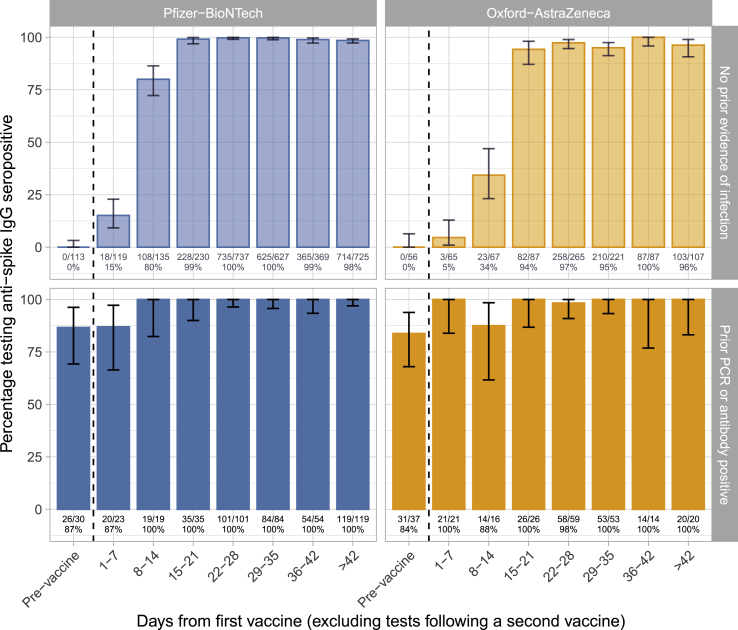
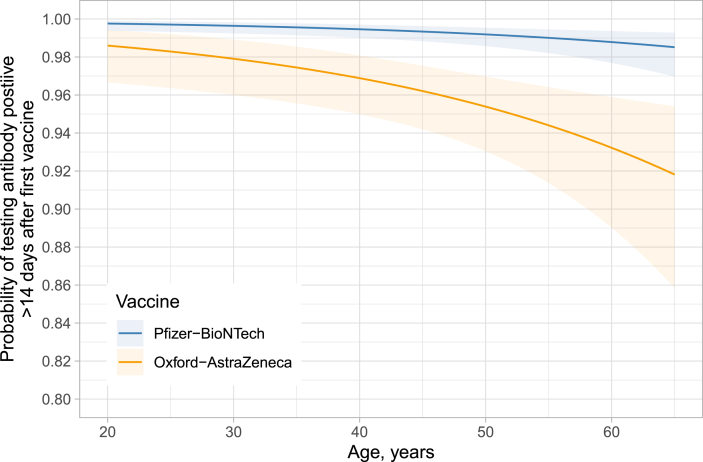
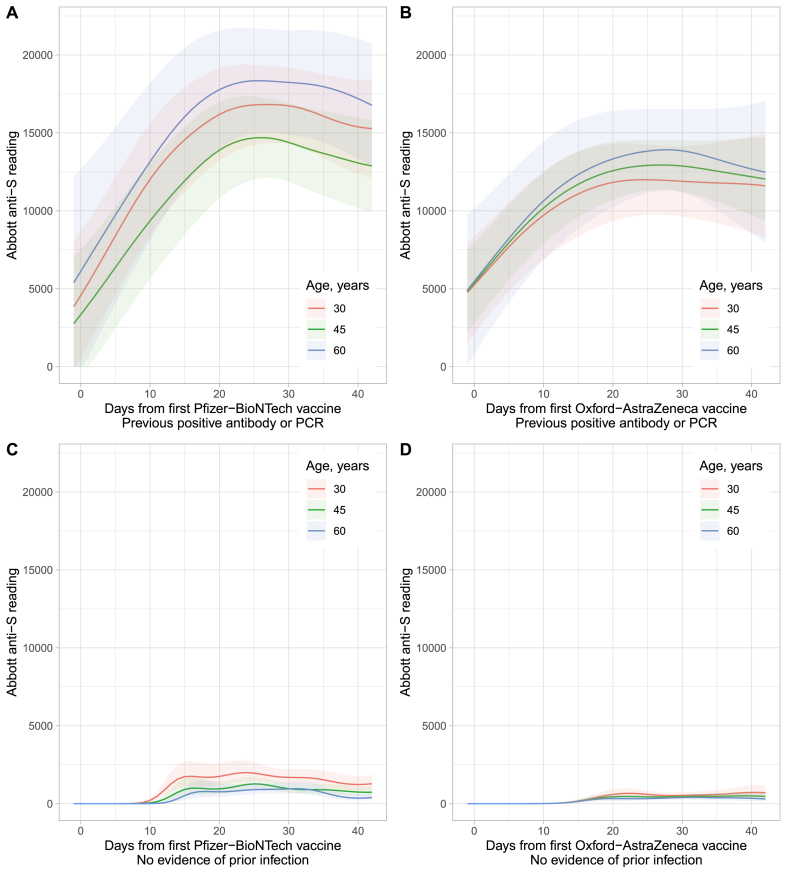
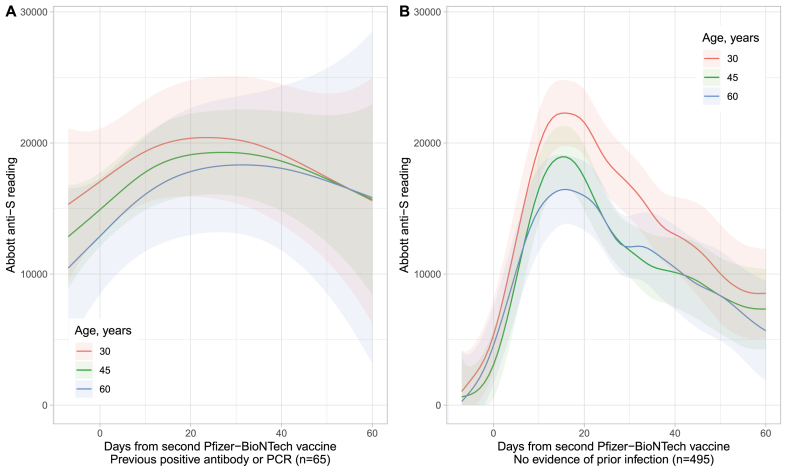
OBJECTIVES: We investigated determinants of severe acute respiratory syndrome coronavirus 2 (SARS-CoV-2) anti-spike IgG responses in healthcare workers (HCWs) following one or two doses of Pfizer-BioNTech or Oxford-AstraZeneca vaccines. METHODS: HCWs participating in regular SARS-CoV-2 PCR and antibody testing were invited for serological testing prior to first and second vaccination, and 4 weeks post-vaccination if receiving a 12-week dosing interval. Quantitative post-vaccination anti-spike antibody responses were measured using the Abbott SARS-CoV-2 IgG II Quant assay (detection threshold: ≥50 AU/mL). We used multivariable logistic regression to identify predictors of seropositivity and generalized additive models to track antibody responses over time. RESULTS: 3570/3610 HCWs (98.9%) were seropositive >14 days post first vaccination and prior to second vaccination: 2706/2720 (99.5%) were seropositive after the Pfizer-BioNTech and 864/890 (97.1%) following the Oxford-AstraZeneca vaccines. Previously infected and younger HCWs were more likely to test seropositive post first vaccination, with no evidence of differences by sex or ethnicity. All 470 HCWs tested >14 days after the second vaccination were seropositive. Quantitative antibody responses were higher after previous infection: median (IQR) >21 days post first Pfizer-BioNTech 14 604 (7644-22 291) AU/mL versus 1028 (564-1985) AU/mL without prior infection (p < 0.001). Oxford-AstraZeneca vaccine recipients had lower readings post first dose than Pfizer-BioNTech recipients, with and without previous infection, 10 095 (5354-17 096) and 435 (203-962) AU/mL respectively (both p < 0.001 versus Pfizer-BioNTech). Antibody responses >21 days post second Pfizer vaccination in those not previously infected, 10 058 (6408-15 582) AU/mL, were similar to those after prior infection followed by one vaccine dose. CONCLUSIONS: SARS-CoV-2 vaccination leads to detectable anti-spike antibodies in nearly all adult HCWs. Whether differences in response impact vaccine efficacy needs further study.
Overview
The claims and statistics of this paper haven’t been checked yet.
Run the check — free, no account needed. It reads the open-access text and checks the sources it cites.
Integrity signals
Registry
Cites
Statistics
Figures
Verification
Claims the paper makes
The claims and statistics of this paper haven’t been checked yet.
Run the check — free, no account needed. It reads the open-access text and checks the sources it cites.
Claims other papers make about this one
Each is checked against this paper’s own text: does it say what the citing paper says it does?
In the citing paper
“Seroprevalence surveys were corrected for vaccination, because vaccination generates a positive anti-spike antibody test in most individuals who receive the vaccine.27”
From Estimating global, regional, and national daily and cumulative infections with SARS-CoV-2 through Nov 14, 2021: a statistical analysis (2022) · cites this paper as [27]
Self-check
Percentages, sums and reported differences re-computed from the paper’s own numbers.
The self-check needs the paper’s full text.
Citations
Cites
RNA-Based COVID-19 Vaccine BNT162b2 Selected for a Pivotal Efficacy Study
Walsh, E. E., Frenck, R., Falsey, A. R., Kitchin, N., Absalon, J., Gurtman, A., Lockhart, S., Neuzil, K., Mulligan, M. J., Bailey, R., et al. (2020) · doi:10.1101/2020.08.17.20176651 · Cited by 2,615
Folegatti, P. M., Ewer, K. J., Aley, P. K., Angus, B., Becker, S., Belij-Rammerstorfer, S., Bellamy, D., Bibi, S., Bittaye, M., Clutterbuck, E. A., et al. (2020) · The Lancet · doi:10.1016/s0140-6736(20)31604-4 · Cited by 2,419
Ramasamy, M. N., Minassian, A. M., Ewer, K. J., Flaxman, A. L., Folegatti, P. M., Owens, D. R., Voysey, M., Aley, P. K., Angus, B., Babbage, G., et al. (2020) · The Lancet · doi:10.1016/s0140-6736(20)32466-1 · Cited by 1,324
Robust neutralizing antibodies to SARS-CoV-2 infection persist for months
Wajnberg, A., Amanat, F., Firpo, A., Altman, D. R., Bailey, M. J., Mansour, M., McMahon, M., Meade, P., Mendu, D. R., Muellers, K., et al. (2020) · Science · doi:10.1126/science.abd7728 · Cited by 1,195
Voysey, M., Costa Clemens, S. A., Madhi, S. A., Weckx, L. Y., Folegatti, P. M., Aley, P. K., Angus, B., Baillie, V. L., Barnabas, S. L., Bhorat, Q. E., et al. (2021) · The Lancet · doi:10.1016/s0140-6736(21)00432-3 · Cited by 1,119
Antibody Status and Incidence of SARS-CoV-2 Infection in Health Care Workers
Lumley, S. F., O’Donnell, D., Stoesser, N. E., Matthews, P. C., Howarth, A., Hatch, S. B., Marsden, B. D., Cox, S., James, T., Warren, F., et al. (2021) · New England Journal of Medicine · doi:10.1056/nejmoa2034545 · Cited by 940
Self-citationHall, V. J., Foulkes, S., Saei, A., Andrews, N., Oguti, B., Charlett, A., Wellington, E., Stowe, J., Gillson, N., Atti, A., et al. (2021) · The Lancet · doi:10.1016/s0140-6736(21)00790-x · Cited by 767
Self-citationAntibody Responses in Seropositive Persons after a Single Dose of SARS-CoV-2 mRNA Vaccine
Krammer, F., Srivastava, K., Alshammary, H., Amoako, A. A., Awawda, M. H., Beach, K. F., Bermúdez-González, M. C., Bielak, D. A., Carreño, J. M., Chernet, R. L., et al. (2021) · New England Journal of Medicine · doi:10.1056/nejmc2101667 · Cited by 696
Monin, L., Laing, A. G., Muñoz‐Ruiz, M., McKenzie, D. R., del Barrio, I. D. M., Alaguthurai, T., Domingo‐Vila, C., Hayday, T. S., Graham, C., Seow, J., et al. (2021) · The Lancet Oncology · doi:10.1016/s1470-2045(21)00213-8 · Cited by 611
Antibody response to first BNT162b2 dose in previously SARS-CoV-2-infected individuals
Manisty, C., Otter, A. D., Treibel, T. A., McKnight, Á., Altmann, D. M., Brooks, T., Noursadeghi, M., Boyton, R. J., Semper, A., & Moon, J. C. (2021) · The Lancet · doi:10.1016/s0140-6736(21)00501-8 · Cited by 369
Research works printed but not linked: 4
- Walsh, 2020, Safety and immunogenicity of two RNA-based Covid-19 vaccine candidates, N Engl J Med, 383, 2439, 10.1056/NEJMoa2027906 · DOI · Paper page
- Saadat, 2021, Single dose vaccination in healthcare workers previously infected with SARS-CoV-2, medRxiv
- Pritchard, 2021, Impact of vaccination on SARS-CoV-2 cases in the community: a population-based study using the UK’s COVID-19 Infection Survey, medRxiv, 4
- Monin-Aldama, 2021, Interim results of the safety and immune-efficacy of 1 versus 2 doses of COVID-19 vaccine BNT162b2 for cancer patients in the context of the UK vaccine priority guidelines, bioRxiv, vol. 3
Cited by
Sorted by citations
Efficacy of covid-19 vaccines in immunocompromised patients: systematic review and meta-analysis
Li, Y., Wong, S., Chai, L., Lee, S. C., Lee, M., Muthiah, M. D., Tay, S., Teo, C., Tan, B., Chan, Y., et al. (2022) · British medical journal · doi:10.1136/bmj-2021-068632 · Cited by 446
Wei, J., Stoesser, N. E., Matthews, P. C., Ayoubkhani, D., Studley, R., Bell, I., Bell, J. I., Newton, J. N., Farrar, J., Diamond, I. D., et al. (2021) · Nature Microbiology · doi:10.1038/s41564-021-00947-3 · Cited by 330
Self-citationBarber, R. M., Sorensen, R. J. D., Pigott, D. M., Bisignano, C., Carter, A., Amlag, J. O., Collins, J. K., Abbafati, C., Adolph, C., Allorant, A., et al. (2022) · The Lancet · doi:10.1016/s0140-6736(22)00484-6 · Cited by 298
Self-citationCOVID-19 vaccine strategies must focus on severe disease and global equity
McIntyre, P. B., Aggarwal, R., Jani, I. V., Jawad, J. S., Kochhar, S., MacDonald, N. E., Madhi, S. A., Mohsni, E., Mulholland, K., Neuzil, K. M., et al. (2021) · The Lancet · doi:10.1016/s0140-6736(21)02835-x · Cited by 84
Wang, W., Balfe, P., Eyre, D. W., Lumley, S., O’Donnell, D., Warren, F., Crook, D. W., Jeffery, K. J., Matthews, P. C., Klerman, E. B., et al. (2021) · Journal of Biological Rhythms · doi:10.1177/07487304211059315 · Cited by 60
Self-citation
Metadata
- Authors
- Eyre, D. W., Lumley, S. F., Wei, J., Cox, S., James, T., Justice, A., Jesuthasan, G., O'Donnell, D., Howarth, A., Hatch, S. B., Marsden, B. D., Jones, E. Y., Stuart, D. I., Ebner, D., Hoosdally, S., Crook, D. W., Peto, T. E. A., Walker, T. M., Stoesser, N. E., Matthews, P. C., Pouwels, K. B., Walker, A. S., & Jeffery, K.
- Affiliations
- Public Health England (GB)
- University of Oxford (GB)
- Oxford University Hospitals NHS Trust (GB)
- Corresponding author
- Eyre, David W.
- ORCID
- Venue
- Clinical Microbiology and Infection
- Publisher
- Elsevier BV
- Published
- 2021-10
- Volume
- 27
- Issue
- 10
- Pages
- 1516.e7-1516.e14
- ISSN
- 1198-743X (ISSN-L)
- PMC
- PMC8180449
- OpenAlex
- W3170306142
- Cited by
- 131
- References
- 25
- Citations by year
- 2025: 4 · 2024: 13 · 2023: 11 · 2022: 76 · 2021: 27
- FWCI
- 10.06
- Type
- journal article
- Language
- en
- Open access
- hybrid
- doi.org
- Licence
- Locations
- Clinical Microbiology and Infection (publishedVersion, cc-by)
- PubMed Central (publishedVersion, cc-by)
- PubMed (publishedVersion)
- Funders
- National Institute for Health Research
- United Kingdom Department of Health and Social Care
- Topics
- Health Sciences › Medicine › Infectious Diseases › SARS-CoV-2 and COVID-19 Research
- Social Sciences › Health › Vaccine Coverage and Hesitancy
- Life Sciences › Immunology and Microbiology › Immunology › Immune responses and vaccinations
- Keywords
- SARS-CoV-2, COVID-19 vaccines, anti-spike IgG, prior SARS-CoV-2 infection, hybrid immunity, BNT162b2, Oxford-AstraZeneca vaccine, healthcare workers, seropositivity, antibody kinetics, vaccine dosing interval, ChAdOx1 nCoV-19 vaccine, SARS-CoV-2 spike protein
- MeSH terms
- Immunogenicity, Vaccine, COVID-19, SARS-CoV-2, COVID-19 Vaccines, BNT162 Vaccine, ChAdOx1 nCoV-19, Adult, Antibodies, Viral, Female, Health Personnel, Humans, Immunoglobulin G, Male, Middle Aged, Vaccination, Spike Glycoprotein, Coronavirus
About these checks
Registry, retraction, Cites and statistics results are computed, not judged, with one exception: a printed reference that no index lists is read once by a model before it counts as a citation error. Claims are extracted by a model and kept only when their quote appears verbatim in the text; each cited source is then checked, with a model’s help, for whether it says what the claim relies on. Those verdicts can be wrong — read the claim’s quote and the cited source before relying on one.
Statistics and arithmetic are recomputed, not judged.
Confidence bands are shown only for fields calibrated on our annotated test set. None is calibrated yet, so no band is shown.
What counts as a claim ›How we measure confidence ›How we check this ›
Are you an author, or do you see a problem with this page? Request a review
