

The DOI matches its Crossref record; 40 of the 40 references it cites were found in a registry or an index.
The impact of hybrid yeasts on the aroma profile of cool climate Riesling wines
Open accessAbstract
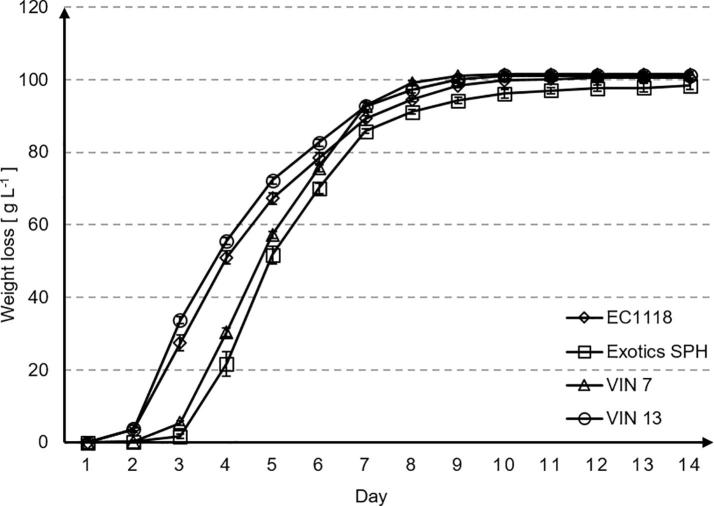
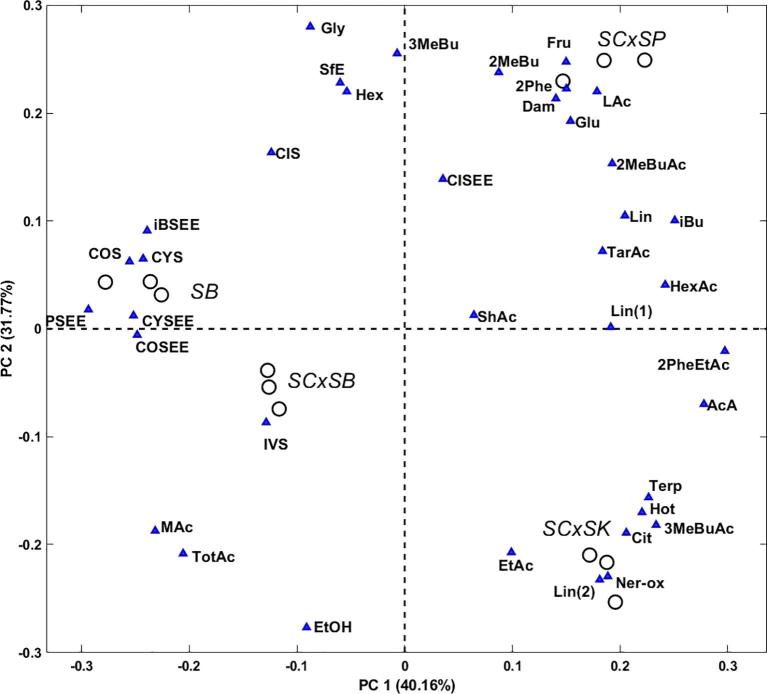
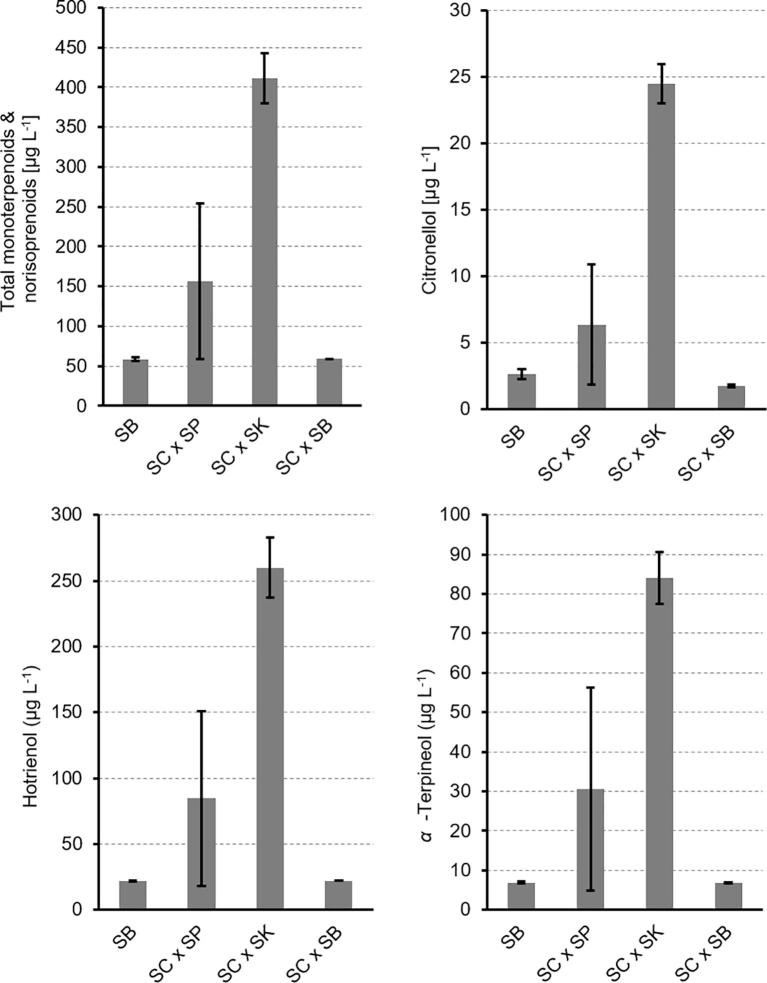
The current study highlights the effects of intra- and interspecific hybrid yeasts of the genus Saccharomyces (S.) on the alcoholic fermentation and formation of aroma compounds in cool climate Riesling wines. Three different hybrid yeasts: S. cerevisiae × S. paradoxus (SC × SP), S. cerevisiae × S. kudriavzevii (SC × SK) and S. cerevisiae var. cerevisiae × S. cerevisiae var. bayanus (SC × SB) were investigated. The species S. cerevisiae var. bayanus (SB) was chosen as control variant. It has been demonstrated that the hybrid yeasts have the ability to preserve positive properties while, suppressing undesired properties from the parental yeast species. The hybrid SC × SK showed an increase of desired acetate esters and monoterpenes. The concentrations of higher alcohols were higher in wines fermented by SC × SP, compared to the other variants. SC × SP fermentations resulted in decreased concentrations of l-malate and sulphites.
Overview
The claims and statistics of this paper haven’t been checked yet.
Run the check — free, no account needed. It reads the open-access text and checks the sources it cites.
Integrity signals
Registry
Cites
Statistics
Figures
Verification
Claims the paper makes
The claims and statistics of this paper haven’t been checked yet.
Run the check — free, no account needed. It reads the open-access text and checks the sources it cites.
Claims other papers make about this one
Each is checked against this paper’s own text: does it say what the citing paper says it does?
The source backs part of the claim, not all of it — or backs it for a different population, condition or comparison.
In the citing paper
“Higher alcohols undergo esterification reactions to produce ester compounds under the catalysis of alcohol acetyltransferase (AAT). In yeast cells, acetic acid first binds to coenzyme A (CoA) to form acetyl-CoA. Subsequently, AAT catalyzes the esterification of acetyl-CoA with higher alcohols, such as isoamyl alcohol and active amyl alcohol. This reaction transfers the acetyl group from acetyl-CoA”
From The Metabolic Pathways of Yeast and Acetic Acid Bacteria During Fruit Vinegar Fermentation and Their Influence on Flavor Development (2025) · cites this paper as [22]
Experimental — accuracy not yet measured
Self-check
Percentages, sums and reported differences re-computed from the paper’s own numbers.
The self-check needs the paper’s full text.
Citations
Cites
Microbe domestication and the identification of the wild genetic stock of lager-brewing yeast
Libkind, D., Hittinger, C. T., Valério, E., Gonçalves, C., Dover, J., Johnston, M., Gonçalves, P., & Sampaio, J. P. (2011) · Proceedings of the National Academy of Sciences · doi:10.1073/pnas.1105430108 · Cited by 636
Waterhouse, A. L., Sacks, G. L., & Jeffery, D. W. (2016) · Wiley eBooks · doi:10.1002/9781118730720 · Cited by 581
Determining wine aroma from compositional data
Francis, I. L., & NEWTON, J. L. (2005) · Australian Journal of Grape and Wine Research · doi:10.1111/j.1755-0238.2005.tb00283.x · Cited by 552
Monoterpenes in grape juice and wines
Mateo, J. J., & Jiménez, M. (2000) · Journal of Chromatography A · doi:10.1016/s0021-9673(99)01342-4 · Cited by 525
Microbial Contribution to Wine Aroma and Its Intended Use for Wine Quality Improvement
Belda, I., Ruiz, J., Esteban-Fernández, A., Navascués, E., Marquina, D., Santos, A., & Moreno-Arribas, M. (2017) · Molecules · doi:10.3390/molecules22020189 · Cited by 324
Oenological properties of non-Saccharomyces yeasts associated with wine-making
Ciani, M., & Maccarelli, F. (1997) · World Journal of Microbiology and Biotechnology · doi:10.1023/a:1008825928354 · Cited by 322
González, S. S., Barrio, E., Gafner, J., & Querol, A. (2006) · FEMS Yeast Research · doi:10.1111/j.1567-1364.2006.00126.x · Cited by 253
De novo synthesis of monoterpenes by Saccharomyces cerevisiae wine yeasts
Carrau, F. M., Medina, K., Boido, E., Farina, L., Gaggero, C., Dellacassa, E., Versini, G., & Henschke, P. A. (2005) · FEMS Microbiology Letters · doi:10.1016/j.femsle.2004.11.050 · Cited by 245
Formation of ethyl acetate and isoamyl acetate by various species of wine yeasts
Plata, C., Millán, C., Mauricio, J. C., & Ortega, J. M. (2003) · Food Microbiology · doi:10.1016/s0740-0020(02)00101-6 · Cited by 223
Benito, S., Hofmann, T., Laier, M., Lochbühler, B.-C., Schüttler, A., Ebert, K., Fritsch, S., Röcker, J., & Rauhut, D. (2015) · European Food Research and Technology · doi:10.1007/s00217-015-2497-8 · Cited by 213
Self-citationThe influence of yeast on the aroma of Sauvignon Blanc wine
Swiegers, J. H., Kievit, R. L., Siebert, T. E., Lattey, K. A., Bramley, B. R., Francis, I. L., King, E. S., & Pretorius, I. S. (2008) · Food Microbiology · doi:10.1016/j.fm.2008.08.004 · Cited by 167
Redžepović, S., Orlić, S., Majdak, A., Kozina, B., Volschenk, H., & Viljoen‐Bloom, M. (2003) · International Journal of Food Microbiology · doi:10.1016/s0168-1605(02)00320-3 · Cited by 162
Williams, P. J., Strauss, C. R., Wilson, B., & MASSY‐WESTROPP, R. A. (1982) · Journal of Chromatography A · doi:10.1016/s0021-9673(00)85911-7 · Cited by 157
Interspecies hybridization and recombination inSaccharomyceswine yeasts
Sipiczki, M. (2008) · FEMS Yeast Research · doi:10.1111/j.1567-1364.2008.00369.x · Cited by 141
Câmara, J. S., Alves, A., & Marques, J. C. (2005) · Analytica Chimica Acta · doi:10.1016/j.aca.2005.09.001 · Cited by 137
Belda, I., Ruíz, J., Beisert, B., Navascués, E., Marquina, D., Calderón, F., Rauhut, D., Benito, S., & Santos, A. (2017) · International Journal of Food Microbiology · doi:10.1016/j.ijfoodmicro.2017.06.028 · Cited by 134
Self-citationEnological characterization of natural hybrids from Saccharomyces cerevisiae and S. kudriavzevii
González, S. S., Gallo, L., Climent, M. D., Barrio, E., & Querol, A. (2007) · International Journal of Food Microbiology · doi:10.1016/j.ijfoodmicro.2006.10.047 · Cited by 129
A Rapid HPLC Method for Separation and Determination of Major Organic Acids in Grape Musts and Wines
Schneider, A., Gerbi, V., & Redoglia, M. (1987) · American Journal of Enology and Viticulture · doi:10.5344/ajev.1987.38.2.151 · Cited by 122
Glycerol and other fermentation products of apiculate wine yeasts
Romano, P., Suzzi, G., Comi, G., Zironi, R., & Maifreni, M. (1997) · Journal of Applied Microbiology · doi:10.1111/j.1365-2672.1997.tb02870.x · Cited by 105
Borneman, A. R., Desany, B. A., Riches, D., Affourtit, J. P., Forgan, A. H., Pretorius, I. S., Egholm, M., & Chambers, P. J. (2011) · FEMS Yeast Research · doi:10.1111/j.1567-1364.2011.00773.x · Cited by 105
Newly generated interspecific wine yeast hybrids introduce flavour and aroma diversity to wines
Bellon, J. R., Eglinton, J. M., Siebert, T. E., Pollnitz, A. P., Rose, L., Lopes, M. D. B., & Chambers, P. J. (2011) · Applied Microbiology and Biotechnology · doi:10.1007/s00253-011-3294-3 · Cited by 97
Belda, I., Ruíz, J., Navascués, E., Marquina, D., & Santos, A. (2016) · International Journal of Food Microbiology · doi:10.1016/j.ijfoodmicro.2016.03.001 · Cited by 76
Osborne, J., Morneau, A. D., & de Orduña, R. M. (2006) · Journal of Applied Microbiology · doi:10.1111/j.1365-2672.2006.02947.x · Cited by 70
Alternative yeasts for winemaking:Saccharomycesnon-cerevisiaeand its hybrids
Pérez‐Torrado, R., Barrio, E., & Querol, A. (2017) · Critical Reviews in Food Science and Nutrition · doi:10.1080/10408398.2017.1285751 · Cited by 69
On the Complexity of the Saccharomyces bayanus Taxon: Hybridization and Potential Hybrid Speciation
Pérez‐Través, L., Lopes, C. A., Querol, A., & Barrio, E. (2014) · PLoS ONE · doi:10.1371/journal.pone.0093729 · Cited by 63
Influence of indigenous Saccharomyces paradoxus strains on Chardonnay wine fermentation aroma
Orlić, S., Redžepović, S., Jeromel, A., Herjavec, S., & Iacumin, L. (2006) · International Journal of Food Science & Technology · doi:10.1111/j.1365-2621.2006.01217.x · Cited by 57
SOME IMPORTANT AROMA COMPONENTS OF WHITE WINE
Simpson, R. F. (1979) · Cited by 57
New Trends in the Uses of Yeasts in Oenology
Querol, A., Pérez‐Torrado, R., Alonso‐del‐Real, J., Minebois, R., Stříbný, J., Oliveira, B. M., & Barrio, E. (2018) · Advances in food and nutrition research · doi:10.1016/bs.afnr.2018.03.002 · Cited by 56
Stříbný, J., Querol, A., & Pérez‐Torrado, R. (2016) · Frontiers in Microbiology · doi:10.3389/fmicb.2016.00897 · Cited by 54
Monoterpene alcohols release and bioconversion by Saccharomyces species and hybrids
Gamero, A., Manzanares, P., Querol, A., & Belloch, C. (2010) · International Journal of Food Microbiology · doi:10.1016/j.ijfoodmicro.2010.11.034 · Cited by 52
Herjavec, S., Orlić, S., Redžepović, S., Mirošević, N., & Majdak, A. (2002) · University of Zagreb University Computing Centre (SRCE) · Cited by 48
Benito, S. (2019) · Fermentation · doi:10.3390/fermentation5020033 · Cited by 48
Self-citationOrlić, S., Arroyo‐López, F. N., Huić-Babić, K., Iacumin, L., Querol, A., & Barrio, E. (2009) · Journal of Applied Microbiology · doi:10.1111/j.1365-2672.2009.04406.x · Cited by 40
Wine analysis with FTIR spectrometry
Patz, C., Dávid, A., Thente, K., Kürbel, P., & Dietrich, H. (1999) · Dialnet (Universidad de la Rioja) · Cited by 39
Self-citationRuíz, J., Ortega, N., Martín‐Santamaría, M., Acedo, A., Marquina, D., Pascual, O., Rozés, N., Zamora, F., Santos, A., & Belda, I. (2019) · International Journal of Food Microbiology · doi:10.1016/j.ijfoodmicro.2019.108255 · Cited by 38
Palomero, F., Gálvez, L., Morata, A., Calderón, F., Palmero, D., Suárez-Lepe, J. A., & Benito, S. (2014) · DOAJ (DOAJ: Directory of Open Access Journals) · Cited by 36
Self-citationRapp, A., Yavaş, İ., & Hastrich, U. H. (1994) · Deutsche Lebensmittel-Rundschau · Cited by 26
MOLECULAR MARKERS FOR GENOTYPING GRAPEVINE AND FOR IDENTIFYING CLONES OF TRADITIONAL VARIETIES
Regner, F., Stadlbauer, A., & Eisenheld, C. (2001) · Acta Horticulturae · doi:10.17660/actahortic.2001.546.41 · Cited by 23
Gamero, A., Belloch, C., & Querol, A. (2015) · Microbial Cell Factories · doi:10.1186/s12934-015-0314-5 · Cited by 21
European dissent over GM crops
Groß, M. (2009) · Current Biology · doi:10.1016/j.cub.2009.03.045 · Cited by 5
Research works printed but not linked: 8
- Baumgartner, 2001, Traubenmostanalyse mit Hilfe der FTIR-Spektroskopie, Schweizer Zeitschrift für Obst- und Weinbau, 2, 46
- Bellon, 2008, Summary from the winemaking with non-conventional yeasts workshops, 13 AWITC, Australian and New Zealand Grapegrower and Winemaker, 72
- Brandt, M., Scheidweiler, M., Patz, C. -D., Rauhut, D., Zorn, D., & Stoll, M. (2018). HEAT BERRY: The influence of abiotic factors on the composition of berries, must and wine in Vitis vinifera L. cv. Riesling (2018) Poster Abstract (P-33) Proceedings Macrowine 2018, Zaragoza (Spain) from 28 to 31 May 2018.
- [EC] European Commission, 2008, Regulation (EC) No 1333/2008 of the European Parliament and of the Council of 16 December 2008 on food additives, Official Journal of the European Union, 354, 16
- Rauhut, D., Beisert, B., Berres, M., Gawron-Scibek, M., & Kürbel, H. (2005). Pulse flame photometric detection: an innovative technique to analyse volatile sulfur compounds in wine and other beverages. State of the art in flavour chemistry and biology. Hofmann, T., Rothe, M., Schieberle, P. (Eds.) Deutsche Forschungsanstalt für Lebensmittelchemie, Garching, Germany, 363–368.
- Regulation, C. (2008). No 479/2008 of 29 April 2008 on the common organisation of the market in wine, amending Regulations (EC) No 1493/1999,(EC) No 1782/2003,(EC) No 1290/2005,(EC) No 3/2008 and repealing Regulations (EEC) No 2392/86 and (EC) No 1493/1999. Official Journal of the European Union, 1–61.
- Strauss, C. R., Wilson, B., Gooley, P. R., & Williams, P. J. (1986). Role of monoterpenes in grape and wine flavor. In: ACS Symposium Series-American Chemical Society (USA). · DOI
- Vaughan-Martini, A., & Martini, A. (2011). Saccharomyces Meyen ex Reess (1870). The Yeasts, 733–746: Elsevier. · DOI
Cited by
Ge, Y., Wu, Y., Aihaiti, A., Wang, L., Wang, Y., Xing, J., Zhu, M., & Hong, J. (2025) · Microorganisms · doi:10.3390/microorganisms13030477 · Cited by 49
Metadata
- Authors
- Kanter, J.-P., Benito, S., Brezina, S., Beisert, B., Fritsch, S., Patz, C.-D., & Rauhut, D.
- Affiliations
- Hochschule Geisenheim University (DE)
- Universidad Politécnica de Madrid (ES)
- Corresponding author
- Benito, Santiago
- Venue
- Food Chemistry: X
- Publisher
- Elsevier BV
- Published
- 2020-03
- Volume
- 5
- Pages
- 100072
- ISSN
- 2590-1575 (ISSN-L)
- PMC
- PMC6926337
- OpenAlex
- W2991395572
- Cited by
- 27
- References
- 40
- Citations by year
- 2025: 4 · 2024: 5 · 2023: 3 · 2022: 3 · 2021: 6 · 2020: 6
- FWCI
- 2.89
- Type
- journal article
- Language
- en
- Open access
- gold
- doi.org
- Licence
- cc-by-nc-nd
- www.elsevier.com/tdm/userlicense/1.0/ (tdm)
- www.elsevier.com/legal/tdmrep-license (tdm)
- creativecommons.org/licenses/by-nc-nd/4.0/ (vor)
- Locations
- Food Chemistry X (publishedVersion, cc-by-nc-nd)
- PubMed Central (publishedVersion, cc-by-nc-nd)
- PubMed (publishedVersion)
- DOAJ (DOAJ: Directory of Open Access Journals) (submittedVersion, cc-by-sa)
- Funders
- Centre for Industrial Technological Development
- Topics
- Life Sciences › Agricultural and Biological Sciences › Food Science › Fermentation and Sensory Analysis
- Life Sciences › Agricultural and Biological Sciences › Plant Science › Horticultural and Viticultural Research
- Life Sciences › Immunology and Microbiology › Microbiology › Yeasts and Rust Fungi Studies
- Keywords
- yeast hybrids, Saccharomyces cerevisiae, Saccharomyces paradoxus, Saccharomyces kudriavzevii, wine aroma, alcoholic fermentation, cool climate viticulture, acetate esters, monoterpenes, higher alcohols, L-malate, sulfite
About these checks
Registry, retraction, Cites and statistics results are computed, not judged, with one exception: a printed reference that no index lists is read once by a model before it counts as a citation error. Claims are extracted by a model and kept only when their quote appears verbatim in the text; each cited source is then checked, with a model’s help, for whether it says what the claim relies on. Those verdicts can be wrong — read the claim’s quote and the cited source before relying on one.
Statistics and arithmetic are recomputed, not judged.
Confidence bands are shown only for fields calibrated on our annotated test set. None is calibrated yet, so no band is shown.
What counts as a claim ›How we measure confidence ›How we check this ›
Are you an author, or do you see a problem with this page? Request a review
Data sources
Bibliographic data: Semantic Scholar, OpenAlex, Crossref.
Contains information from the Semantic Scholar Academic Graph Datasets, made available under the ODC Attribution License (ODC-BY 1.0).
Semantic Scholar’s data is described in: Kinney, R., et al. (2023). The Semantic Scholar Open Data Platform. arXiv:2301.10140.
