

The DOI matches its Crossref record; 29 of the 29 references it cites were found in a registry or an index; none of the 62 sources its claims cite is checked for support yet.
Fiber burden and asbestos-related diseases: an umbrella review
Open accessAbstract
OBJECTIVE: What are the levels of asbestos exposure that cause each type of health effect? The objective of this study was to review the available scientific evidence on exposure levels for asbestos and their relationship to health effects. METHOD: An umbrella review of English-language reviews and meta-analyses, from 1980 to March 2021 was conducted. We included reviews involving quantified asbestos exposures and health outcomes. The review has been adapted to the indications of the PRISMA declaration. Methodological quality of the selected studies was assessed using the AMSTAR instrument. RESULTS: We retrieved 196 references. After applying the search strategy and quality analysis, 10 reviews were selected for in-depth analysis. For lung cancer, the highest risk was observed with exposure to amphiboles. Longer, thinner fibers had the greatest capacity to cause lung cancer, especially those > 10 μm in length. For mesothelioma, longer and thinner fibers were also more pathogenic; amphiboles ≥ 5 μm are especially associated with increased mesothelioma risk. No studies observed an increased risk for lung cancer or mesothelioma at asbestos exposure levels <0.1 f/ml. No reviews provided information on exposure concentrations for pulmonary fibrosis. Currently, there is limited evidence in humans to establish the causal relationship between gastrointestinal cancer and asbestos exposure. CONCLUSIONS: Banning all asbestos exposure remains the best measure to preventing its negative health effects. The highest quality reviews and meta-analyses support that there is little risk of lung cancer or mesothelioma at daily exposure levels below 0.1 f/ml.
Overview
AI snapshot
Written from the paper’s full text.
TL;DR
This umbrella review synthesized 10 systematic reviews/meta-analyses on quantified asbestos exposure and health outcomes. It found the highest risks with amphibole fibers and longer, thinner fibers, with little risk of lung cancer or mesothelioma reported below 0.1 f/ml, while still advocating a global ban on all asbestos exposure.
Key findings
- Among 10 selected reviews, 9 assessed asbestos–lung cancer, 6 pleural mesothelioma, 1 pulmonary fibrosis, and 1 gastrointestinal cancer. The highest lung cancer risk was observed with amphibole fibers, followed by mixed fibers, then chrysotile; fibers >10 μm in length were more carcinogenic, and thinner fibers had greater capacity to cause lung cancer.
- For mesothelioma, longer and thinner fibers were more pathogenic, especially amphiboles ≥5 μm. One study reported expected mortality risk proportionality of 1:100:500 for chrysotile, amosite, and crocidolite, respectively; another non-occupational exposure study found amphibole fibers had a meta-RR 2.5–3.2 times greater than mixed fibers and 5.3–5.6 times greater than pure chrysotile.
- No studies observed increased risk for lung cancer or mesothelioma at asbestos exposure levels <0.1 f/ml. One study concluded the highest cumulative chrysotile exposure without lung cancer effect was 25 f/ml-y, and without mesothelioma effect was 15 f/ml-y.
- For pulmonary fibrosis, long fibers >5 μm were associated with asbestosis and cancer, with no evidence of pathogenicity for fibers ≤5 μm. For gastrointestinal cancer, the association was absent or very low (RR, OR, and SMR around 1), though gastric cancer SMR was 1.43 for chrysotile >140 f/ml-y and 3.21 for amosite >1000 mppcf-y, and colon cancer SMR was 2.31 at >140 f/ml-y.
Methods
- Umbrella review of English-language systematic reviews and meta-analyses published from 1980 to March 2021, searching MEDLINE/PubMed, Google Scholar, IARC, ATSDR, EPA, HSE, and IWH; both human and experimental animal studies were included. The review followed PRISMA indications and was registered at PROSPERO.
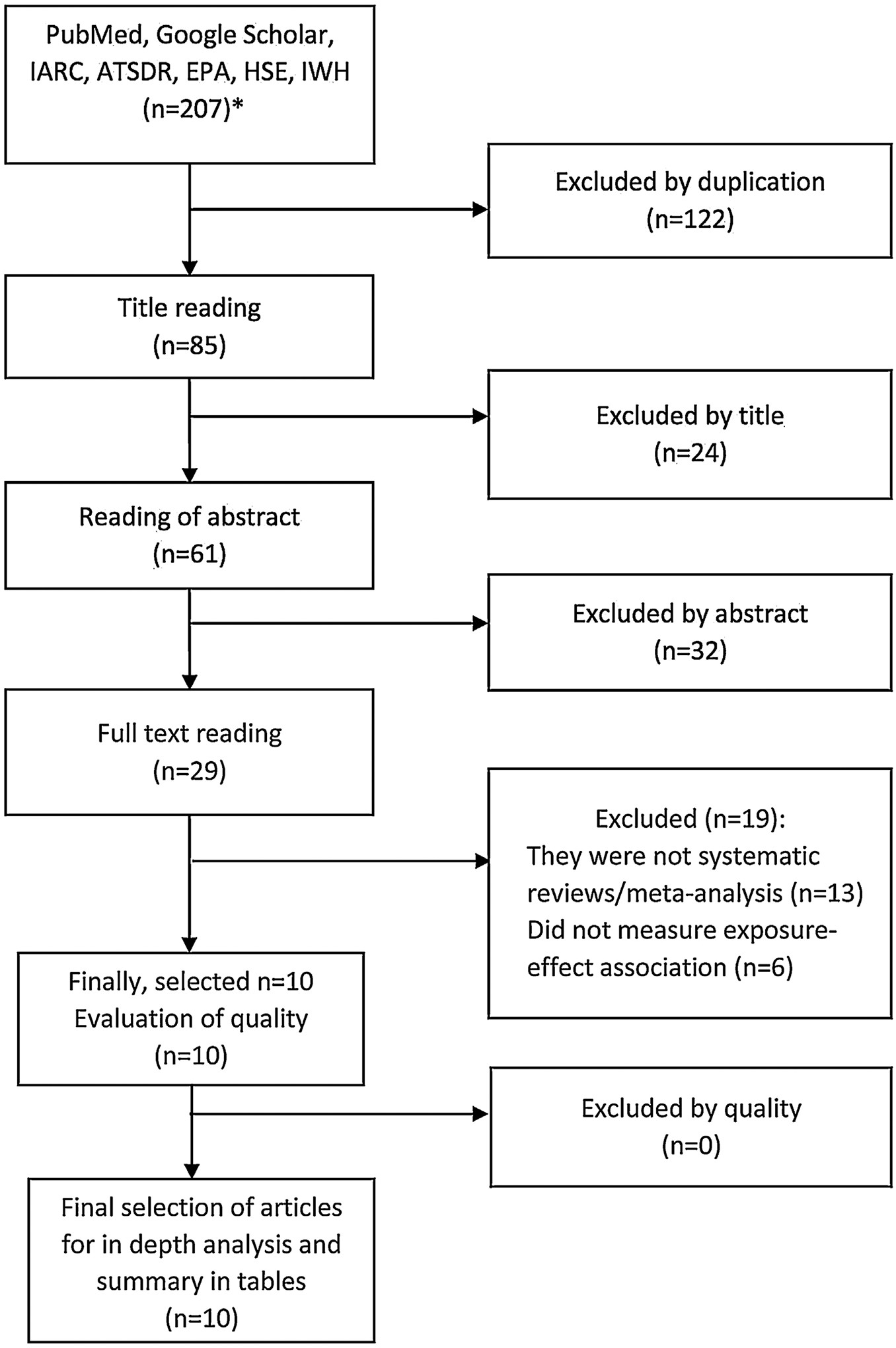
- From 207 initially retrieved references, 122 duplicates were removed, leaving 85; after title and abstract screening and full-text review, 10 articles were selected for in-depth analysis. Methodological quality was assessed with the AMSTAR instrument.
Limitations
- The paper states that publication bias is possible because unpublished studies may be overlooked, though it argues this is unlikely given the inclusion of leading institutional websites.
- The paper notes that exposure measures are often reconstructions made decades after exposure, which can have a large margin of error when applied to individual patients.
- The text makes evident that no reviews provided exposure concentrations for pulmonary fibrosis, human evidence for gastrointestinal cancer causality is limited, and no systematic reviews or meta-analyses were found on laryngeal or ovarian cancer exposure levels. The abstract reports 196 retrieved references while the Results section reports 207 initially retrieved.
Model-written summary. Check it against the paper before relying on it.
Integrity signals
Registry
Cites
Statistics
Figures
Verification
Claims the paper makes
11 Not checked yet · 9 Check pending · 9 No full text of the sources · 8 No basis given · 6 Own method · 4 Own result · 2 Own interpretation
In the paper
“The study by Gamble27 (Table 6) found that the association between gastrointestinal cancer and asbestos exposure does not exist or it is very low (RR, OR, and SMR around 1).”
§ Fiber burden and asbestos-related diseases: an umbrella review > Results > Association between asbestos exposure and other cancers by fiber type
What the sources say
- Not checked yetcites [27] Gamble J Risk of gastrointestinal cancers from inhalation and ingestion of asbestos. Regul Toxicol Pharmacol. 2008; 52 1 Suppl: S124– 53. 18078700
plain- Asserted: passes — The authors put it forward as true.
- Checkable: passes — It can be checked against evidence.
- Load-bearing: unclear — It is unclear whether the paper’s conclusions depend on it.
- Based: passes — The paper gives a reason why it holds.
In the paper
“In addition, the meta-analysis with the highest methodological quality31 concludes that little risk of mesothelioma would be observed with asbestos exposure below 0.1 f/ml.”
§ Fiber burden and asbestos-related diseases: an umbrella review > Results > Association between asbestos exposure and pleural mesothelioma by fiber type
What the sources say
- Not checked — no full text of the sourcecites [31] Marsh GM, Riordan AS, Keeton KA, Non-occupational exposure to asbestos and risk of pleural mesothelioma: review and meta-analysis. Occup Environ Med. 2017; 74: 838– 46. 28935666 source
hedged- Asserted: passes — The authors put it forward as true.
- Checkable: passes — It can be checked against evidence.
- Load-bearing: unclear — It is unclear whether the paper’s conclusions depend on it.
- Based: passes — The paper gives a reason why it holds.
- Rests on an assumption: A no-observed-adverse-effect level (NOAEL) from the included studies indicates a level below which there is no increased risk of disease.
In the paper
“In general, we observed that the effect of chrysotile on lung cancer is characterized by being weaker than the effect of amphibole fibers or mixed fibers.22–29”
§ Fiber burden and asbestos-related diseases: an umbrella review > Results > Association between asbestos exposure and lung cancer by fiber type
What the sources say
- Check pendingcites [22] Lash TL, Crouch EA, Green LC. A meta-analysis of the relation between cumulative exposure to asbestos and relative risk of lung cancer. Occup Environ Med. 1997; 54: 254– 63. 9166131 PMC1128699 source
- Not checked — no full text of the sourcecites [23] Hodgson J, Darnton A. The quantitative risks of mesothelioma and lung cancer in relation to asbestos exposure. Ann Occup Hyg. 2000; 44: 565– 601. 11108782 source
- Not checked — no full text of the sourcecites [24] Berry G, Gibbs GW. An overview of the risk of lung cancer in relation to exposure to asbestos and of taconite miners. Regul Toxicol Pharmacol. 2008; 52 1 Suppl: S218– 22. 17998152 source
- Check pendingcites [25] Berman DW, Crump KS. A meta-analysis of asbestos-related cancer risk that addresses fiber size and mineral type. Crit Rev Toxicol. 2008; 38 Suppl 1: 49– 73. 18686078 source
- Not checked — no full text of the sourcecites [26] Pierce JS, McKinley MA, Paustenbach DJ, An evaluation of reported no-effect chrysotile asbestos exposures for lung cancer and mesothelioma. Crit Rev Toxicol. 2008; 38: 191– 214. 18324516 source
- Not checked yetcites [27] Gamble J Risk of gastrointestinal cancers from inhalation and ingestion of asbestos. Regul Toxicol Pharmacol. 2008; 52 1 Suppl: S124– 53. 18078700
- Check pendingcites [28] Lenters V, Vermeulen R, Dogger S, A meta-analysis of asbestos and lung cancer: is better quality exposure assessment associated with steeper slopes of the exposure-response relationships? Environ Health Perspect. 2011; 119: 1547– 55. 21708512 PMC3226488 source
- Not checked — no full text of the sourcecites [29] van der Bij S, Koffijberg H, Lenters V, Lung cancer risk at low cumulative asbestos exposure: meta-regression of the exposure-response relationship. Cancer Causes Control. 2013; 24: 1– 12. 23187858 source
plaindirect- Asserted: passes — The authors put it forward as true.
- Checkable: passes — It can be checked against evidence.
- Load-bearing: passes — The paper’s conclusions depend on it.
- Based: passes — The paper gives a reason why it holds.
The paper states this without a source or data behind it here, so there is nothing to check it against. The quote shows it is in the paper.
In the paper
“The thinner the fiber, the higher its capacity to cause lung cancer, as the fiber can better penetrate the lung tissue.”
§ Fiber burden and asbestos-related diseases: an umbrella review > Results > Association between asbestos exposure and lung cancer by fiber type
plaindirect- Asserted: passes — The authors put it forward as true.
- Checkable: passes — It can be checked against evidence.
- Load-bearing: unclear — It is unclear whether the paper’s conclusions depend on it.
- Based: passes — The paper gives a reason why it holds.
In the paper
“In one study,23 the proportionality in the expected mortality risk for mesothelioma was 1:100:500 due to exposures to chrysotile, amosite and crocidolite, respectively.”
§ Fiber burden and asbestos-related diseases: an umbrella review > Results > Association between asbestos exposure and pleural mesothelioma by fiber type
What the sources say
- Not checked — no full text of the sourcecites [23] Hodgson J, Darnton A. The quantitative risks of mesothelioma and lung cancer in relation to asbestos exposure. Ann Occup Hyg. 2000; 44: 565– 601. 11108782 source
plaincorrelational- Asserted: passes — The authors put it forward as true.
- Checkable: passes — It can be checked against evidence.
- Load-bearing: unclear — It is unclear whether the paper’s conclusions depend on it.
- Based: passes — The paper gives a reason why it holds.
In the paper
“In terms of exposure time, only one study23 showed that exposure to 2 or more years to amosite fibers had a higher SMR (SMR = 11.7) than exposure to less than one month (SMR = 2.64).”
§ Fiber burden and asbestos-related diseases: an umbrella review > Results > Association between asbestos exposure and lung cancer by fiber type
What the sources say
- Not checked — no full text of the sourcecites [23] Hodgson J, Darnton A. The quantitative risks of mesothelioma and lung cancer in relation to asbestos exposure. Ann Occup Hyg. 2000; 44: 565– 601. 11108782 source
plaincorrelational- Asserted: passes — The authors put it forward as true.
- Checkable: passes — It can be checked against evidence.
- Load-bearing: unclear — It is unclear whether the paper’s conclusions depend on it.
- Based: passes — The paper gives a reason why it holds.
In the paper
“The only association with gastric cancer was observed with very high exposures (>140 f/ml-y) to chrysotile (SMR = 1.43) and to amosite (SMR = 3.21) at exposures > 1000 mppcf-y).”
§ Fiber burden and asbestos-related diseases: an umbrella review > Results > Association between asbestos exposure and other cancers by fiber type
What the sources say
- Not checked yetcites [27] Gamble J Risk of gastrointestinal cancers from inhalation and ingestion of asbestos. Regul Toxicol Pharmacol. 2008; 52 1 Suppl: S124– 53. 18078700
plaincorrelational- Asserted: passes — The authors put it forward as true.
- Checkable: passes — It can be checked against evidence.
- Load-bearing: passes — The paper’s conclusions depend on it.
- Based: passes — The paper gives a reason why it holds.
The paper states this without a source or data behind it here, so there is nothing to check it against. The quote shows it is in the paper.
In the paper
“The studies included in this review do not provide information about exposure levels of asbestos and other cancers, such as larynx or ovarian cancers.”
§ Fiber burden and asbestos-related diseases: an umbrella review > Results > Association between asbestos exposure and other cancers by fiber type
plain- Asserted: passes — The authors put it forward as true.
- Checkable: passes — It can be checked against evidence.
- Load-bearing: unclear — It is unclear whether the paper’s conclusions depend on it.
- Based: passes — The paper gives a reason why it holds.
A result the paper reports from its own data — it cites no other source for it, so there is none to check. The quote shows it is in the paper.
In the paper
“According to the highest cumulative exposure level at which no effect was observed (NOAEL), results evaluating the exposure-response among the studies were also inconsistent.”
§ Fiber burden and asbestos-related diseases: an umbrella review > Results > Association between asbestos exposure and pleural mesothelioma by fiber type
plain- Asserted: passes — The authors put it forward as true.
- Checkable: passes — It can be checked against evidence.
- Load-bearing: passes — The paper’s conclusions depend on it.
- Based: passes — The paper gives a reason why it holds.
A result the paper reports from its own data — it cites no other source for it, so there is none to check. The quote shows it is in the paper.
In the paper
“In general, we observed some inconsistency in the results from the different studies regarding exposure-response (Tables 4 and 5).”
§ Fiber burden and asbestos-related diseases: an umbrella review > Results > Association between asbestos exposure and pleural mesothelioma by fiber type
hedged- Asserted: passes — The authors put it forward as true.
- Checkable: passes — It can be checked against evidence.
- Load-bearing: unclear — It is unclear whether the paper’s conclusions depend on it.
- Based: passes — The paper gives a reason why it holds.
- It may state two separate claims as one. 21
- Probably not a substantial claim. 9
- The quote only partly states this claim. 1
None of the sources cited for this claim have been checked yet.
In the paper
“It is noteworthy that in general, longer and thinner fibers are more pathogenic than short ones, in particular amphiboles ≥5 μm have been associated with increased mesothelioma RR and OR.25,30”
§ Fiber burden and asbestos-related diseases: an umbrella review > Results > Association between asbestos exposure and pleural mesothelioma by fiber type
What the sources say
- Not checked yetcites [25] Berman DW, Crump KS. A meta-analysis of asbestos-related cancer risk that addresses fiber size and mineral type. Crit Rev Toxicol. 2008; 38 Suppl 1: 49– 73. 18686078 source
- Not checked yetcites [30] Roggli VL. The so-called short-fiber controversy: literature review and critical analysis. Arch Pathol Lab Med. 2015; 139: 1052– 7. 26230599
plaincorrelational- Asserted: passes — The authors put it forward as true.
- Checkable: passes — It can be checked against evidence.
- Load-bearing: passes — The paper’s conclusions depend on it.
- Based: passes — The paper gives a reason why it holds.
It may state two separate claims as one.
In the paper
“That study showed that amphibole fibers were those with the highest capacity to produce mesothelioma since exposure to amphibole fibers showed a meta-RR 2.5–3.2 times greater than exposure to mixed fibers, and a meta-RR 5.3–5.6 times greater than exposure to pure chrysotile fibers.”
§ Fiber burden and asbestos-related diseases: an umbrella review > Results > Association between asbestos exposure and pleural mesothelioma by fiber type
What the sources say
- Not checked — no full text of the sourcecites [31] Marsh GM, Riordan AS, Keeton KA, Non-occupational exposure to asbestos and risk of pleural mesothelioma: review and meta-analysis. Occup Environ Med. 2017; 74: 838– 46. 28935666 source
plaindirect- Asserted: passes — The authors put it forward as true.
- Checkable: passes — It can be checked against evidence.
- Load-bearing: passes — The paper’s conclusions depend on it.
- Based: passes — The paper gives a reason why it holds.
It may state two separate claims as one.
In the paper
“In the same study, the dose-response correlation for amphibole fibers suggested a nonlinear relationship for pleural mesothelioma, and that short-term exposures to high fiber concentrations were at higher risk than exposure to low fiber concentrations with long exposure time.”
§ Fiber burden and asbestos-related diseases: an umbrella review > Results > Association between asbestos exposure and pleural mesothelioma by fiber type
What the sources say
- Not checked — no full text of the sourcecites [23] Hodgson J, Darnton A. The quantitative risks of mesothelioma and lung cancer in relation to asbestos exposure. Ann Occup Hyg. 2000; 44: 565– 601. 11108782 source
hedgedcorrelational- Asserted: passes — The authors put it forward as true.
- Checkable: passes — It can be checked against evidence.
- Load-bearing: unclear — It is unclear whether the paper’s conclusions depend on it.
- Based: passes — The paper gives a reason why it holds.
It may state two separate claims as one.
In the paper
“However, one of the studies26 concluded that the highest cumulative exposure to chrysotile without an effect of lung cancer is 25 f/ml-y, which means that at this concentration of chrysotile fibers, lung cancer has not yet been observed.”
§ Fiber burden and asbestos-related diseases: an umbrella review > Results > Association between asbestos exposure and lung cancer by fiber type
What the sources say
- Not checked — no full text of the sourcecites [26] Pierce JS, McKinley MA, Paustenbach DJ, An evaluation of reported no-effect chrysotile asbestos exposures for lung cancer and mesothelioma. Crit Rev Toxicol. 2008; 38: 191– 214. 18324516 source
hedged- Asserted: passes — The authors put it forward as true.
- Checkable: passes — It can be checked against evidence.
- Load-bearing: fails — The paper’s conclusions may not depend on it.
- Based: passes — The paper gives a reason why it holds.
Probably not a substantial claim. The paper’s conclusions may not depend on it.
The paper states this without a source or data behind it here, so there is nothing to check it against. The quote shows it is in the paper.
In the paper
“A second finding is that the risk, varies depending on the type of asbestos, the physicochemical characteristics of these fibers, the intensity of exposure and, for some pathologies, co-exposures with other carcinogens, especially tobacco.”
§ Fiber burden and asbestos-related diseases: an umbrella review > Discussion
plaincorrelational- Asserted: passes — The authors put it forward as true.
- Checkable: passes — It can be checked against evidence.
- Load-bearing: passes — The paper’s conclusions depend on it.
- Based: passes — The paper gives a reason why it holds.
It may state two separate claims as one.
In the paper
“Long fibers (>5 μm) are associated with pulmonary fibrosis (asbestosis) and cancer (mesothelioma and lung cancer), with no evidence of pathogenicity for pulmonary fibrosis when exposed to fibers with a length ≤5 μm.”
§ Fiber burden and asbestos-related diseases: an umbrella review > Results > Association between asbestos exposure and pulmonary fibrosis by fiber type
What the sources say
- Not checked yetcites [30] Roggli VL. The so-called short-fiber controversy: literature review and critical analysis. Arch Pathol Lab Med. 2015; 139: 1052– 7. 26230599
plaincorrelational- Asserted: passes — The authors put it forward as true.
- Checkable: passes — It can be checked against evidence.
- Load-bearing: passes — The paper’s conclusions depend on it.
- Based: passes — The paper gives a reason why it holds.
It may state two separate claims as one.
In the paper
“One of the studies26 concluded that the highest level of cumulative exposure to chrysotile without the effect of mesothelioma is 15 f/ml-y, meaning that at this concentration of chrysotile fibers no risk of mesothelioma was observed.”
§ Fiber burden and asbestos-related diseases: an umbrella review > Results > Association between asbestos exposure and pleural mesothelioma by fiber type
What the sources say
- Not checked — no full text of the sourcecites [26] Pierce JS, McKinley MA, Paustenbach DJ, An evaluation of reported no-effect chrysotile asbestos exposures for lung cancer and mesothelioma. Crit Rev Toxicol. 2008; 38: 191– 214. 18324516 source
plain- Asserted: passes — The authors put it forward as true.
- Checkable: passes — It can be checked against evidence.
- Load-bearing: fails — The paper’s conclusions may not depend on it.
- Based: passes — The paper gives a reason why it holds.
Probably not a substantial claim. The paper’s conclusions may not depend on it.
The paper states this without a source or data behind it here, so there is nothing to check it against. The quote shows it is in the paper.
In the paper
“After reading the full text of these studies, 13 were excluded because they were not systematic reviews or meta-analysis and six because they did not have measures of exposure-effect association, obtaining a total of 10 articles for in-depth analysis”
§ Fiber burden and asbestos-related diseases: an umbrella review > Results > Selection of articles
plain- Asserted: passes — The authors put it forward as true.
- Checkable: passes — It can be checked against evidence.
- Load-bearing: fails — The paper’s conclusions may not depend on it.
- Based: passes — The paper gives a reason why it holds.
Probably not a substantial claim. The paper’s conclusions may not depend on it.
The paper states this without a source or data behind it here, so there is nothing to check it against. The quote shows it is in the paper.
In the paper
“However, when analyzing the risk that occurs depending on the intensity of asbestos exposure, some studies suggest that for mesothelioma and lung cancer there may be a threshold below which there is no significantly increased risk of suffering the pathology, whereas other studies cannot conclude the existence of a threshold.”
§ Fiber burden and asbestos-related diseases: an umbrella review > Discussion
hedgedconditional- Asserted: passes — The authors put it forward as true.
- Checkable: passes — It can be checked against evidence.
- Load-bearing: passes — The paper’s conclusions depend on it.
- Based: passes — The paper gives a reason why it holds.
It may state two separate claims as one.
In the paper
“Fibers with a length > 10 μm are more carcinogenic than those < 10 μm in length, and chrysotile has been found to be less carcinogenic than amphibole fibers.25”
§ Fiber burden and asbestos-related diseases: an umbrella review > Results > Association between asbestos exposure and lung cancer by fiber type
What the sources say
- Not checked yetcites [25] Berman DW, Crump KS. A meta-analysis of asbestos-related cancer risk that addresses fiber size and mineral type. Crit Rev Toxicol. 2008; 38 Suppl 1: 49– 73. 18686078 source
plaindirect- Asserted: passes — The authors put it forward as true.
- Checkable: passes — It can be checked against evidence.
- Load-bearing: passes — The paper’s conclusions depend on it.
- Based: passes — The paper gives a reason why it holds.
It may state two separate claims as one.
In the paper
“Two cohorts included in the review by Pierce et al.26 did not observe increased risk with the highest cumulative exposures: NOAEL > 400 and ≥ 112 f/cc-y (latency 20 years); and two cohorts included in the same review26 observed a NOAEL risk for mesothelioma at 800–1599 f/cc-y and < 15 f/cc-y.”
§ Fiber burden and asbestos-related diseases: an umbrella review > Results > Association between asbestos exposure and pleural mesothelioma by fiber type
What the sources say
- Not checked — no full text of the sourcecites [26] Pierce JS, McKinley MA, Paustenbach DJ, An evaluation of reported no-effect chrysotile asbestos exposures for lung cancer and mesothelioma. Crit Rev Toxicol. 2008; 38: 191– 214. 18324516 source
plain- Asserted: passes — The authors put it forward as true.
- Checkable: passes — It can be checked against evidence.
- Load-bearing: unclear — It is unclear whether the paper’s conclusions depend on it.
- Based: passes — The paper gives a reason why it holds.
It may state two separate claims as one.
A result the paper reports from its own data — it cites no other source for it, so there is none to check. The quote shows it is in the paper.
In the paper
“In relation to laryngeal and ovarian cancer the causality of asbestos has also been demonstrated, but we did not find any systematic reviews or meta-analyses on these two pathologies to be able to draw conclusions about exposure levels.”
§ Fiber burden and asbestos-related diseases: an umbrella review > Discussion
boosteddirect- Asserted: passes — The authors put it forward as true.
- Checkable: passes — It can be checked against evidence.
- Load-bearing: passes — The paper’s conclusions depend on it.
- Based: passes — The paper gives a reason why it holds.
It may state two separate claims as one.
In the paper
“Specifically, the highest risk for lung cancer was observed with exposure to amphibole fibers, followed by mixed-fibers and finally chrysotile.31”
§ Fiber burden and asbestos-related diseases: an umbrella review > Results > Association between asbestos exposure and lung cancer by fiber type
What the sources say
- Not checked — no full text of the sourcecites [31] Marsh GM, Riordan AS, Keeton KA, Non-occupational exposure to asbestos and risk of pleural mesothelioma: review and meta-analysis. Occup Environ Med. 2017; 74: 838– 46. 28935666 source
plaincorrelational- Asserted: passes — The authors put it forward as true.
- Checkable: passes — It can be checked against evidence.
- Load-bearing: passes — The paper’s conclusions depend on it.
- Based: passes — The paper gives a reason why it holds.
It may state two separate claims as one.
A result the paper reports from its own data — it cites no other source for it, so there is none to check. The quote shows it is in the paper.
In the paper
“Nine systematic reviews/meta-analyses assessed the association between asbestos and lung cancer,22–30 six between asbestos and pleural mesothelioma,23,25–27,30,31 one between asbestos and pulmonary fibrosis,30 and one between asbestos and other gastrointestinal cancers.27”
§ Fiber burden and asbestos-related diseases: an umbrella review > Results > Characteristics of the studies
plaincorrelational- Asserted: passes — The authors put it forward as true.
- Checkable: passes — It can be checked against evidence.
- Load-bearing: unclear — It is unclear whether the paper’s conclusions depend on it.
- Based: passes — The paper gives a reason why it holds.
It may state two separate claims as one.
In the paper
“None of the selected reviews scored low in the assessment of their methodological quality; some of them obtained intermediate quality scores (4 ≥ P ≤ 5) [22–27,30] and 50% of the reviews obtained middle25,26 or high quality scores (P ≥ 8),28,29,31 supporting a reasonably good quality of the included studies.”
§ Fiber burden and asbestos-related diseases: an umbrella review > Discussion
What the sources say
- Check pendingcites [22] Lash TL, Crouch EA, Green LC. A meta-analysis of the relation between cumulative exposure to asbestos and relative risk of lung cancer. Occup Environ Med. 1997; 54: 254– 63. 9166131 PMC1128699 source
- Not checked — no full text of the sourcecites [23] Hodgson J, Darnton A. The quantitative risks of mesothelioma and lung cancer in relation to asbestos exposure. Ann Occup Hyg. 2000; 44: 565– 601. 11108782 source
- Not checked — no full text of the sourcecites [24] Berry G, Gibbs GW. An overview of the risk of lung cancer in relation to exposure to asbestos and of taconite miners. Regul Toxicol Pharmacol. 2008; 52 1 Suppl: S218– 22. 17998152 source
- Check pendingcites [25] Berman DW, Crump KS. A meta-analysis of asbestos-related cancer risk that addresses fiber size and mineral type. Crit Rev Toxicol. 2008; 38 Suppl 1: 49– 73. 18686078 source
- Not checked — no full text of the sourcecites [26] Pierce JS, McKinley MA, Paustenbach DJ, An evaluation of reported no-effect chrysotile asbestos exposures for lung cancer and mesothelioma. Crit Rev Toxicol. 2008; 38: 191– 214. 18324516 source
- Not checked yetcites [27] Gamble J Risk of gastrointestinal cancers from inhalation and ingestion of asbestos. Regul Toxicol Pharmacol. 2008; 52 1 Suppl: S124– 53. 18078700
- Not checked yetcites [30] Roggli VL. The so-called short-fiber controversy: literature review and critical analysis. Arch Pathol Lab Med. 2015; 139: 1052– 7. 26230599
- Check pendingcites [28] Lenters V, Vermeulen R, Dogger S, A meta-analysis of asbestos and lung cancer: is better quality exposure assessment associated with steeper slopes of the exposure-response relationships? Environ Health Perspect. 2011; 119: 1547– 55. 21708512 PMC3226488 source
- Not checked — no full text of the sourcecites [29] van der Bij S, Koffijberg H, Lenters V, Lung cancer risk at low cumulative asbestos exposure: meta-regression of the exposure-response relationship. Cancer Causes Control. 2013; 24: 1– 12. 23187858 source
- Not checked — no full text of the sourcecites [31] Marsh GM, Riordan AS, Keeton KA, Non-occupational exposure to asbestos and risk of pleural mesothelioma: review and meta-analysis. Occup Environ Med. 2017; 74: 838– 46. 28935666 source
plain- Asserted: passes — The authors put it forward as true.
- Checkable: passes — It can be checked against evidence.
- Load-bearing: passes — The paper’s conclusions depend on it.
- Based: passes — The paper gives a reason why it holds.
It may state two separate claims as one.
What the paper did — it cites no source for this, so there is none to check. The quote shows it is in the paper.
In the paper
“It is possible in this type of studies, based on systematic search for scientific publications, to overlook unpublished studies (publication bias).”
§ Fiber burden and asbestos-related diseases: an umbrella review > Discussion
hedged- Asserted: passes — The authors put it forward as true.
- Checkable: passes — It can be checked against evidence.
- Load-bearing: fails — The paper’s conclusions may not depend on it.
- Based: passes — The paper gives a reason why it holds.
Probably not a substantial claim. The paper’s conclusions may not depend on it.
In the paper
“As a recent review has shown,34 asbestos and other fibers remain in the affected tissue for months to years, triggering a chronic inflammatory process and consequent release of high mobility group protein B1 and other cytokines that maintain this process which may ensue in cancer.”
§ Fiber burden and asbestos-related diseases: an umbrella review > Discussion
What the sources say
- Check pendingcites [34] Carbone M, Adusumilli PS, Alexander A Jr, Mesothelioma: scientific clues for prevention, diagnosis, and therapy. CA Cancer J Clin. 2019; 69: 402– 29. 31283845 PMC8192079 source
hedgedconditional- Asserted: passes — The authors put it forward as true.
- Checkable: passes — It can be checked against evidence.
- Load-bearing: passes — The paper’s conclusions depend on it.
- Based: passes — The paper gives a reason why it holds.
It may state two separate claims as one.
What the paper did — it cites no source for this, so there is none to check. The quote shows it is in the paper.
In the paper
“After evaluating their methodological quality with the AMSTAR instrument, two of them obtained a global score of 10, one a score of 8 and the rest of the studies obtained global scores varying from four to six”
§ Fiber burden and asbestos-related diseases: an umbrella review > Results > Selection of articles
plain- Asserted: passes — The authors put it forward as true.
- Checkable: passes — It can be checked against evidence.
- Load-bearing: unclear — It is unclear whether the paper’s conclusions depend on it.
- Based: passes — The paper gives a reason why it holds.
It may state two separate claims as one. The quote only partly states this claim.
None of the sources cited for this claim have been checked yet.
In the paper
“The instrument is a reliable and valid measure for the evaluation of the methodological quality of systematic reviews and has proven good face and content validity.20”
§ Fiber burden and asbestos-related diseases: an umbrella review > Method
What the sources say
- Not checked yetcites [19] Shea BJ, Grimshaw JM, Wells GA, Development of AMSTAR: a measurement tool to assess the methodological quality of systematic reviews. BMC Med Res Methodol. 2007; 7: 10. 17302989 PMC1810543 source
- Not checked yetcites [20] Shea BJ, Hamel C, Wells GA, AMSTAR is a reliable and valid measurement tool to assess the methodological quality of systematic reviews. J Clin Epidemiol. 2009; 62: 1013– 20. 19230606 source
boosted- Asserted: passes — The authors put it forward as true.
- Checkable: passes — It can be checked against evidence.
- Load-bearing: passes — The paper’s conclusions depend on it.
- Based: passes — The paper gives a reason why it holds.
It may state two separate claims as one.
What the paper did — it cites no source for this, so there is none to check. The quote shows it is in the paper.
In the paper
“Titles and abstracts were screened using independent peer-review. A third expert resolved discrepancies and independently decided final inclusion for full text analysis.”
§ Fiber burden and asbestos-related diseases: an umbrella review > Method
plain- Asserted: passes — The authors put it forward as true.
- Checkable: passes — It can be checked against evidence.
- Load-bearing: fails — The paper’s conclusions may not depend on it.
- Based: passes — The paper gives a reason why it holds.
Probably not a substantial claim. The paper’s conclusions may not depend on it. It may state two separate claims as one.
In the paper
“However, most times the measures are reconstructions made decades after the exposure has taken place, which can have a large margin of error when applied to individual patients.33”
§ Fiber burden and asbestos-related diseases: an umbrella review > Discussion
What the sources say
- Check pendingcites [33] Takahashi K, Case BW, Dufresne A, Relation between lung asbestos fibre burden and exposure indices based on job history. Occup Environ Med. 1994; 51: 461– 9. 8044245 PMC1128015 source
plain- Asserted: passes — The authors put it forward as true.
- Checkable: passes — It can be checked against evidence.
- Load-bearing: unclear — It is unclear whether the paper’s conclusions depend on it.
- Based: passes — The paper gives a reason why it holds.
It may state two separate claims as one.
What the paper did — it cites no source for this, so there is none to check. The quote shows it is in the paper.
In the paper
“Likewise, the fact that the first article included in the review was published in 1997 and the last in 2017 ensures that our review of reviews included all the reviews and meta-analyses published over the last 40 years.”
§ Fiber burden and asbestos-related diseases: an umbrella review > Discussion
plaindirect- Asserted: passes — The authors put it forward as true.
- Checkable: passes — It can be checked against evidence.
- Load-bearing: passes — The paper’s conclusions depend on it.
- Based: unclear — It is unclear why the paper says it holds.
It may state two separate claims as one.
What the paper did — it cites no source for this, so there is none to check. The quote shows it is in the paper.
In the paper
“This study has been registered at PROSPERO (https://www.crd.york.ac.uk/prospero/display_record.php?RecordID=185349).”
§ Fiber burden and asbestos-related diseases: an umbrella review > Method
plain- Asserted: passes — The authors put it forward as true.
- Checkable: passes — It can be checked against evidence.
- Load-bearing: fails — The paper’s conclusions may not depend on it.
- Based: passes — The paper gives a reason why it holds.
Probably not a substantial claim. The paper’s conclusions may not depend on it.
In the paper
“The health hazard of asbestos depends on several factors such as its concentration in the air, the exposure time, the type and the size of the fibers, the respiratory rate associated with physical exertion and thermo-hygrometric conditions, the anatomical and functional conditions of exposed workers and there exists a tobacco smoke modulating effect.6”
§ Fiber burden and asbestos-related diseases: an umbrella review > Background
What the sources say
- Not checked yetcites [6] Ministerio de Trabajo y Asuntos Sociales. Instituto Nacional de Seguridad e Higiene en el Trabajo (INSHT). Nota Técnica de Prevención (NTP) 463: Exposición a fibras de amianto en ambientes interiores. 1995 [ Accessed 2021 April 01]. Available at: https://cutt.ly/8ryw1G2.
boosteddirect- Asserted: passes — The authors put it forward as true.
- Checkable: passes — It can be checked against evidence.
- Load-bearing: unclear — It is unclear whether the paper’s conclusions depend on it.
- Based: passes — The paper gives a reason why it holds.
It may state two separate claims as one.
None of the sources cited for this claim have been checked yet.
In the paper
“However, as both the ILO and the WHO have stated, there is no safe level of exposure to a carcinogen and, in concordance with them, we advocate for the global ban and eradication of all types of asbestos and demand the complete elimination of asbestos-related diseases as a global public health priority.43,44”
§ Fiber burden and asbestos-related diseases: an umbrella review > Discussion
What the sources say
- Not checked yetcites [43] International Labour Organization (ILO). The ILO Asbestos Convention. 1986;(No. 162). The ILO position on safety in the use of asbestos. Available at: https://www.ilo.org/global/topics/safety-and-health-at-work/areasofwork/occupational-health/WCMS_360580/lang–en/index.htm.
- Not checked yetcites [44] International Labour Organization (ILO). Thirteenth Session of the Joint ILO/WHO Committee on Occupational Health Geneva, 9–12 December 2003. International Labor Office. 2006. Outline for the Development of National Programmes for Elimination of Asbestos-Related Diseases. Available at: https://www.ilo.org/global/topics/safety-and-health-at-work/resources-library/publications/WCMS_108555/lang–en/index.htm.
plain- Asserted: passes — The authors put it forward as true.
- Checkable: passes — It can be checked against evidence.
- Load-bearing: passes — The paper’s conclusions depend on it.
- Based: passes — The paper gives a reason why it holds.
Probably not a substantial claim.
What the paper did — it cites no source for this, so there is none to check. The quote shows it is in the paper.
In the paper
“The reviews and meta-analyses included cohort and case-control studies of reasonably good or very good quality.”
§ Fiber burden and asbestos-related diseases: an umbrella review > Results > Characteristics of the studies
plain- Asserted: passes — The authors put it forward as true.
- Checkable: passes — It can be checked against evidence.
- Load-bearing: fails — The paper’s conclusions may not depend on it.
- Based: fails — The paper may give no reason why it holds.
Probably not a substantial claim. The paper’s conclusions may not depend on it. The paper may give no reason why it holds.
In the paper
“Other naturally occurring fibers are present in the environment and some of them (e.g. erionite) are as or more carcinogenic than asbestos.34,35”
§ Fiber burden and asbestos-related diseases: an umbrella review > Discussion
What the sources say
- Check pendingcites [34] Carbone M, Adusumilli PS, Alexander A Jr, Mesothelioma: scientific clues for prevention, diagnosis, and therapy. CA Cancer J Clin. 2019; 69: 402– 29. 31283845 PMC8192079 source
- Check pendingcites [35] Carbone M, Baris YI, Bertino P, Erionite exposure in North Dakota and Turkish villages with mesothelioma. Proc Natl Acad Sci U S A. 2011; 108: 13618– 23. 21788493 PMC3158231 source
plaincorrelational- Asserted: passes — The authors put it forward as true.
- Checkable: passes — It can be checked against evidence.
- Load-bearing: fails — The paper’s conclusions may not depend on it.
- Based: passes — The paper gives a reason why it holds.
Probably not a substantial claim. The paper’s conclusions may not depend on it. It may state two separate claims as one.
None of the sources cited for this claim have been checked yet.
In the paper
“It is well known that exposure to asbestos fibers can lead to diseases such as asbestosis (or diffuse interstitial pulmonary fibrosis), diffuse pleural fibrosis, rounded atelectasis (Blesovski’s syndrome), malignant mesothelioma and also ovary, lung and laryngeal cancer.”
§ Fiber burden and asbestos-related diseases: an umbrella review > Background
What the sources say
- Not checked — no full text of the sourcecites [1] Agudo A, González CA. Exposición al amianto y sus efectos sobre la salud. Arch Prev Riesgos Labor. 2001; 2: 55– 7.
- Not checked yetcites [3] International Agency for Research on Cancer (IARC). IARC monographs on the identification of carcinogenic hazards to humans. Volume 100C: Asbestos (chrysolite, amosite, crocidolite, tremolite, actinolite and anthophillite). Lyon (France): IARC;; 2012. p. 219– 309 [ Accessed 2021 April 01]. Available at: https://monographs.iarc.fr/monographs-available/#25.
- Not checked yetcites [6] Ministerio de Trabajo y Asuntos Sociales. Instituto Nacional de Seguridad e Higiene en el Trabajo (INSHT). Nota Técnica de Prevención (NTP) 463: Exposición a fibras de amianto en ambientes interiores. 1995 [ Accessed 2021 April 01]. Available at: https://cutt.ly/8ryw1G2.
- Not checked — no full text of the sourcecites [7] Delclos G, Buffler PA, Greenberg SD, Asbestos-associated diseases: a review. Tex Med. 1989; 85: 50– 9. 2660312
- Not checked — no full text of the sourcecites [8] Delclos J, Alarcón M, Casanovas A, Identificación de los riesgos laborales asociados a enfermedad sospechosa de posible origen laboral atendida en el Sistema Nacional de Salud. Aten Primaria. 2012; 44: 611– 27. 22626585 PMC7025942 source
boosteddirect- Asserted: passes — The authors put it forward as true.
- Checkable: passes — It can be checked against evidence.
- Load-bearing: passes — The paper’s conclusions depend on it.
- Based: passes — The paper gives a reason why it holds.
It may state two separate claims as one.
The paper relies on this without support.
The exposure levels reported in the included reviews are valid proxies for actual individual asbestos exposure, despite being reconstructed decades after exposure.
“However, most times the measures are reconstructions made decades after the exposure has taken place, which can have a large margin of error when applied to individual patients.33”
The paper relies on this without support.
A no-observed-adverse-effect level (NOAEL) from the included studies indicates a level below which there is no increased risk of disease.
“According to the highest cumulative exposure level at which no effect was observed (NOAEL), results evaluating the exposure-response among the studies were also inconsistent.”
The paper relies on this without support.
Findings from occupational and non-occupational studies can be combined to infer risk at daily environmental exposure levels below 0.1 f/ml.
“The joint assessment of the analyzed systematic reviews and meta-analyses leads us to the conclusion that there is little risk of lung cancer or mesothelioma at daily exposure levels below 0.1 f/ml (daily environmental exposure limit value).”
Self-check
Percentages, sums and reported differences re-computed from the paper’s own numbers.
Each contradiction between two passages listed here was confirmed by an independent check.
Rated minor: it would not touch a result — a value no result rests on, a p-value that stays on the same side of the significance level, or a conflict that is clerical, resolved elsewhere in the paper, or outside its own findings.
In the paper
§ Fiber burden and asbestos-related diseases: an umbrella review > Abstract > Results:
“We retrieved 196 references.”
§ Fiber burden and asbestos-related diseases: an umbrella review > Results > Selection of articles
“Initially, 207 references were retrieved (170 from PubMed/MEDLINE and 37 from international agencies)”
Citations
Cites
Preferred Reporting Items for Systematic Reviews and Meta-Analyses: the PRISMA statement
Moher, D., Liberati, A., Tetzlaff, J., Altman, D. G., & for the PRISMA Group (2009) · BMJ · doi:10.1136/bmj.b2535 · Cited by 83,823
Preferred Reporting Items for Systematic Reviews and Meta-Analyses: The PRISMA Statement
Moher, D., Liberati, A., Tetzlaff, J., Altman, D. G., & The PRISMA Group (2009) · PLoS Medicine · doi:10.1371/journal.pmed.1000097 · Cited by 64,042
Wang, G., Ma, R., Qiao, G., Wada, K., Aizawa, Y., & Satoh, T. (2015) · Integrative Medicine International · doi:10.1159/000368408 · Cited by 18,762
Development of AMSTAR: A measurement tool to assess the methodological quality of systematic reviews
Shea, B. J., Grimshaw, J. M., Wells, G. A., Boers, M., Andersson, N., Hamel, C., Porter, A. C., Tugwell, P., Moher, D., & Bouter, L. M. (2007) · BMC Medical Research Methodology · doi:10.1186/1471-2288-7-10 · Cited by 4,374
Shea, B. J., Hamel, C., Wells, G. A., Bouter, L. M., Kristjansson, E., Grimshaw, J., Henry, D. A., & Boers, M. (2009) · Journal of Clinical Epidemiology · doi:10.1016/j.jclinepi.2008.10.009 · Cited by 1,755
The quantitative risks of mesothelioma and lung cancer in relation to asbestos exposure
Hodgson, J. (2000) · The Annals of Occupational Hygiene · doi:10.1016/s0003-4878(00)00045-4 · Cited by 661
Carbone, M., Yang, H., Pass, H. I., Krausz, T., Testa, J. R., & Gaudino, G. (2013) · Nature Reviews Cancer · doi:10.1038/nrc3459 · Cited by 590
Mesothelioma: Scientific clues for prevention, diagnosis, and therapy
Carbone, M., Adusumilli, P. S., Alexander, H. R., Baas, P., Bardelli, F., Bononi, A., Bueno, R., Felley‐Bosco, E., Galateau‐Salle, F., Jablons, D., et al. (2019) · CA: A Cancer Journal for Clinicians · doi:10.3322/caac.21572 · Cited by 335
Hunt, H., Pollock, A., Campbell, P., Estcourt, L., & Brunton, G. (2018) · Systematic Reviews · doi:10.1186/s13643-018-0695-8 · Cited by 314
A Meta-Analysis of Asbestos-Related Cancer Risk That Addresses Fiber Size and Mineral Type
Berman, D. W., & Crump, K. S. (2008) · Critical Reviews in Toxicology · doi:10.1080/10408440802273156 · Cited by 246
Erionite exposure in North Dakota and Turkish villages with mesothelioma
Carbone, M., Baris, Y. I., Bertino, P., Brass, B., Comertpay, S., Dogan, A. U., Gaudino, G., Jube, S., Kanodia, S., Partridge, C. R., et al. (2011) · Proceedings of the National Academy of Sciences · doi:10.1073/pnas.1105887108 · Cited by 211
Multicentric study on malignant pleural mesothelioma and non-occupational exposure to asbestos
Magnani, C., Agudo, A., González, C. A., Andrion, A., Calleja, A., Chellini, E., Dalmasso, P., Escolar, A., Hernandez, S., Ivaldi, C., et al. (2000) · British Journal of Cancer · doi:10.1054/bjoc.2000.1161 · Cited by 175
The National Institute for Occupational Safety and Health (NIOSH)
(2015) · Choice Reviews Online · doi:10.5860/choice.188912 · Cited by 171
Tumour predisposition and cancer syndromes as models to study gene–environment interactions
Carbone, M., Arron, S. T., Beutler, B., Bononi, A., Cavenee, W., Cleaver, J. E., Croce, C. M., D’Andrea, A., Foulkes, W. D., Gaudino, G., et al. (2020) · Nature Reviews Cancer · doi:10.1038/s41568-020-0265-y · Cited by 147
Lenters, V., Vermeulen, R., Dogger, S., Stayner, L., Portengen, L., Burdorf, A., & Heederik, D. (2011) · Environmental Health Perspectives · doi:10.1289/ehp.1002879 · Cited by 79
Exposure to asbestos: past, present and future
Pira, E., Donato, F., Maida, L., & Discalzi, G. (2018) · Journal of Thoracic Disease · doi:10.21037/jtd.2017.10.126 · Cited by 68
Non-occupational exposure to asbestos and risk of pleural mesothelioma: review and meta-analysis
Marsh, G. M., Riordan, A. S., Keeton, K. A., & Benson, S. M. (2017) · Occupational and Environmental Medicine · doi:10.1136/oemed-2017-104383 · Cited by 62
An Evaluation of Reported No-Effect Chrysotile Asbestos Exposures for Lung Cancer and Mesothelioma
Pierce, J. S., McKinley, M. A., Paustenbach, D. J., & Finley, B. L. (2008) · Critical Reviews in Toxicology · doi:10.1080/10408440701845609 · Cited by 61
The So-called Short-Fiber Controversy: Literature Review and Critical Analysis
Roggli, V. L. (2015) · Archives of Pathology & Laboratory Medicine · doi:10.5858/arpa.2014-0466-ra · Cited by 49
Risk of gastrointestinal cancers from inhalation and ingestion of asbestos
Gamble, J. F. (2007) · Regulatory Toxicology and Pharmacology · doi:10.1016/j.yrtph.2007.10.009 · Cited by 44
Lash, T. L., Crouch, E. A., & Green, L. C. (1997) · Occupational and Environmental Medicine · doi:10.1136/oem.54.4.254 · Cited by 34
van der Bij, S., Koffijberg, H., Lenters, V., Portengen, L., Moons, K. G. M., Heederik, D., & Vermeulen, R. C. H. (2013) · Cancer Causes & Control · doi:10.1007/s10552-012-0107-7 · Cited by 28
Relation between lung asbestos fibre burden and exposure indices based on job history.
Takahashi, K., Case, B. W., Dufresne, A., Fraser, R., Higashi, T., & Siemiatycki, J. (1994) · Occupational and Environmental Medicine · doi:10.1136/oem.51.7.461 · Cited by 22
An overview of the risk of lung cancer in relation to exposure to asbestos and of taconite miners
Berry, G., & Gibbs, G. W. (2008) · Regulatory Toxicology and Pharmacology · doi:10.1016/j.yrtph.2007.09.012 · Cited by 11
Cohorte poblacional de trabajadores expuestos a amianto: Navarra 1999-2004
Artieda, L., Basterra, A. B., & Lezáun, M. (2005) · Anales del Sistema Sanitario de Navarra · doi:10.4321/s1137-66272005000500004 · Cited by 8
Delclòs, J., Alarcón, M., Casanovas, A., Serra, C., Fernández, R., de Peray, J. L., & Benavides, F. G. (2012) · Atención Primaria · doi:10.1016/j.aprim.2011.11.006 · Cited by 8
Self-citationYamani, M. E., Boulanger, G., Nerrière-Catelinois, É., Paillat, A., Modelon, H., Soyez, A., Paquet, F., Binet, S., Paris, C., & Brochard, P. (2012) · Critical Reviews in Environmental Science and Technology · doi:10.1080/10643389.2011.556895 · Cited by 5
(1989) · PubMed
Self-citation(2001) · Archivos de Prevención de Riesgos Laborales
Research works printed but not linked: 7
- 1995, Instituto Nacional de Seguridad e Higiene en el Trabajo (INSHT). Nota Técnica de Prevención (NTP) 463: Exposición a fibras de amianto en ambientes interiores
- American Conference of Governmental Industrial Hygienists (ACGIH). TLV/BEI Guidelines. [Updated on 2021]. [Accessed 2021 January 8]. Available at: https://www.acgih.org/tlv-bei-guidelines/policies-procedures-presentations/overview.
- 2014, Fact Sheet: Asbestos.
- 2009, Directive 2009/148/EC of the European Parliament and of the Council on the protection of workers from the risks related to exposure to asbestos at work.
- 2019, Ministerio de Trabajo, Migraciones y Seguridad Social. Instituto Nacional de Seguridad y Salud en el Trabajo (INSST), Límites de exposición profesional para agentes químicos en España.
- 1986, The ILO Asbestos Convention
- 2006, Thirteenth Session of the Joint ILO/WHO Committee on Occupational Health Geneva, 9-12 December 2003, International Labor Office
Cited by
Sorted by citations
A critical review of asbestos concentrations in water and air, according to exposure sources
Peña-Castro, M., Montero-Acosta, M., & Saba, M. (2023) · Heliyon · doi:10.1016/j.heliyon.2023.e15730 · Cited by 58
Dimensions of elongate mineral particles and cancer: A review.
Wylie, A. G., & Korchevskiy, A. A. (2023) · Environmental Research · doi:10.1016/j.envres.2022.114688 · Cited by 48
Sahu, R. K., Ruhi, S., Jeppu, A. K., Al-Goshae, H. A. A., Syed, A., Nagdev, S. A., Widyowati, R., Ekasari, W., Khan, J., Bhattacharjee, B., et al. (2023) · Frontiers in Oncology · doi:10.3389/fonc.2023.1204722 · Cited by 34
Martínez, D., Saba, M., & Gil, L. K. T. (2024) · Heliyon · doi:10.1016/j.heliyon.2024.e25612 · Cited by 26
Macher, G. Z., Torma, A., & Beke, D. (2025) · International Journal of Environmental Research and Public Health · doi:10.3390/ijerph22040505 · Cited by 12
Metadata
- Authors
- Ramada Rodilla, J. M., Calvo Cerrada, B., Serra Pujadas, C., Delclos, G. L., & Benavides, F. G.
- Affiliations
- Universitat Pompeu Fabra (ES)
- Venue
- Gaceta Sanitaria
- Publisher
- Elsevier BV
- Published
- 2022-03
- Volume
- 36
- Issue
- 2
- Pages
- 173-183
- ISSN
- 0213-9111 (ISSN-L)
- PMC
- PMC8882348
- OpenAlex
- W3169983245
- Semantic Scholar
- 9d8cebe8d31ddafb8436df2bb78f9ec058604fb9
- Cited by
- 46
- References
- 29
- Citations by year
- 2026: 7 · 2025: 4 · 2024: 17 · 2023: 13 · 2022: 4
- FWCI
- 1.43
- Type
- journal article
- Language
- en
- Open access
- gold
- doi.org
- Licence
- Locations
- Gaceta Sanitaria (publishedVersion, cc-by)
- PubMed (publishedVersion)
- PubMed Central (acceptedVersion, cc-by)
- Digital Commons-TMC (Texas Medical Center) (submittedVersion)
- DOAJ (DOAJ: Directory of Open Access Journals) (submittedVersion, cc-by-sa)
- Repositori digital de la UPF (Universitat Pompeu Fabra) (submittedVersion, cc-by)
- Funders
- Instituto de Salud Carlos III (PI16/00061)
- Topics
- Health Sciences › Medicine › Pulmonary and Respiratory Medicine › Occupational and environmental lung diseases
- Social Sciences › Health › Occupational Health and Global Justice
- Health Sciences › Medicine › Pulmonary and Respiratory Medicine › Interstitial Lung Diseases and Idiopathic Pulmonary Fibrosis
- Keywords
- asbestos exposure, asbestos-related diseases, lung cancer, mesothelioma, pulmonary fibrosis, gastrointestinal cancer, amphibole fibers, exposure thresholds, asbestos ban
- MeSH terms
- Asbestos, Humans, Lung Neoplasms, Mesothelioma, Occupational Exposure, Asbestos, Amphibole, Risk Assessment
About these checks
Registry, retraction, Cites and statistics results are computed, not judged, with one exception: a printed reference that no index lists is read once by a model before it counts as a citation error. Claims are extracted by a model and kept only when their quote appears verbatim in the text; each cited source is then checked, with a model’s help, for whether it says what the claim relies on. Those verdicts can be wrong — read the claim’s quote and the cited source before relying on one.
A language model drew the claims from the paper on 2026-11-11, under version 3 of the claim definition (model deepseek-v4.1-flash, prompt extract-v3).
A second model labelled each claim on 2026-11-11 (model jev-1.13-20260917, definition revision gold-guideline-v0.2).
Statistics and arithmetic are recomputed, not judged.
Confidence bands are shown only for fields calibrated on our annotated test set. None is calibrated yet, so no band is shown.
What counts as a claim ›How we measure confidence ›How we check this ›
Are you an author, or do you see a problem with this page? Request a review
