

The DOI matches its Crossref record; 1 of the 1 references it cites were found in a registry or an index.
Assessing reliability and validity of food safety culture assessment tools
Open accessAbstract
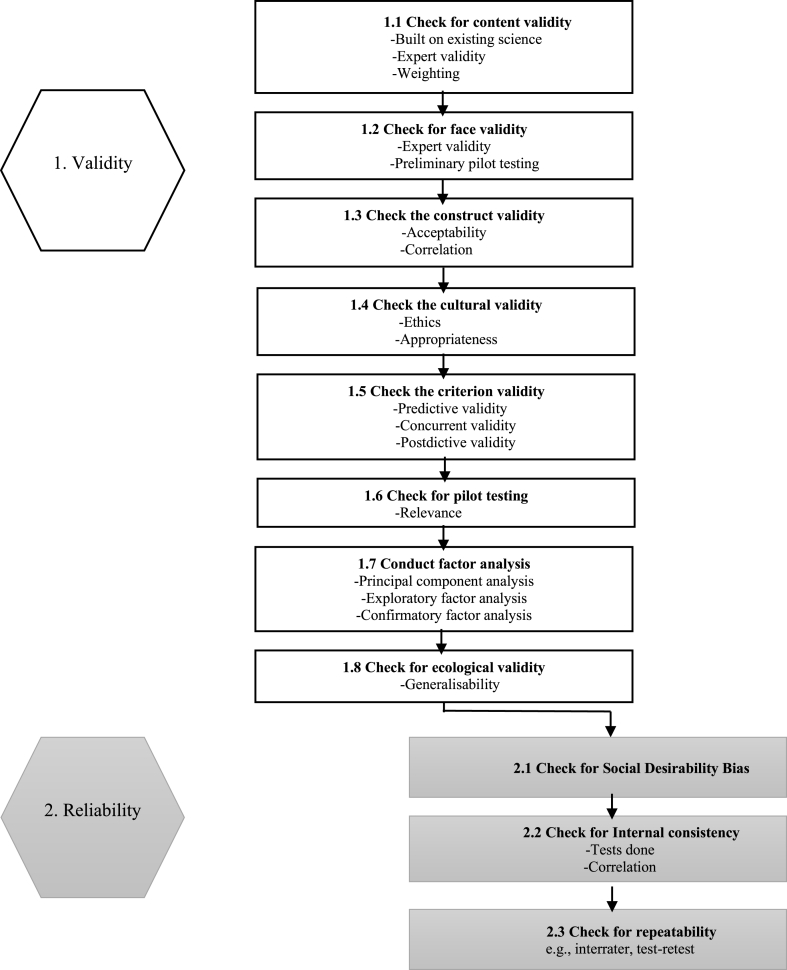
Since its recognition as a plausible direction to assure food safety, food safety culture research has evolved with several commercial and scientific assessment tools developed to evaluate the food safety culture in food businesses. However, existing research does not specify the validity and reliability checks required to demonstrate rigor in the tool development process and there is no unified methodology to confirm robustness of the tools to ensure trustworthiness and usefulness of findings and inferences generated. The purpose of the study was to develop a method to evaluate food safety culture assessment tools and to assess the reliability and validity of existing food safety culture assessment tools using the developed method. Eleven elements were found to be key in validating food safety culture assessment tools. Of the eight tools assessed, only one tool (CT2) was validated on each of the elements. The depth of validation strategies differed for each tool. Three out of the five commercial tools published peer reviewed publications that demonstrated the validation checks that were done. Face validation, and pilot testing were evident and appeared to be done the most. Whilst content, ecological, and cultural validity were the least validated for scientific tools, factor analysis and reliability checks were the least evaluated for commercial tools. None of the tools were assessed for postdictive validity, concurrent validity and the correlation coefficient relating to construct validity. Having an established science-based approach is key as it provides a way to determine the trustworthiness of established assessment tools against accepted methods.
Overview
The claims and statistics of this paper haven’t been checked yet.
Run the check — free, no account needed. It reads the open-access text and checks the sources it cites.
Integrity signals
Registry
Cites
Statistics
Figures
Verification
Claims the paper makes
The claims and statistics of this paper haven’t been checked yet.
Run the check — free, no account needed. It reads the open-access text and checks the sources it cites.
Self-check
Percentages, sums and reported differences re-computed from the paper’s own numbers.
The self-check needs the paper’s full text.
Citations
Cites
Definition of criteria for overall assessment of animal welfare
Botreau, R., Veissier, I., Butterworth, A., Bracke, M., & Keeling, L. (2007) · Animal Welfare · doi:10.1017/s0962728600031390 · Cited by 304
Research works printed but not linked: 67
- Ball, 2010, Tool for measuring food safety climate, J. Food Protect., 73, 84
- De Boeck, 2015, Food safety climate in food processing organizations: development and validation of a self-assessment tool, Trends Food Sci. Technol., 46, 242, 10.1016/j.tifs.2015.09.006 · DOI
- Fatimah, 2014, Food safety culture in onsite foodservices: development and validation of a measurement scale, Journal of Foodservice Management and Education, 8, 1
- Wu, 2020, Retail deli managers and associates have better food safety culture in stores with lower Listeria monocytogenes contamination, Food Control, 110, 10.1016/j.foodcont.2019.106983 · DOI
- Zanin, 2021, Influence of educational actions on transitioning of food safety culture in a food service context: Part 1 – triangulation and data interpretation of food safety culture elements, Food Control, 119, 10.1016/j.foodcont.2020.107447 · DOI · Paper page
- Zanin, 2021, The evolvement of food safety culture assessment: a mixed-methods systematic review, Trends Food Sci. Technol., 118, 125, 10.1016/j.tifs.2021.08.013 · DOI
- Aithal, 2020, Development and validation of survey questionnaire & experimental data–A systematical review-based statistical approach, International Journal of Management, Technology, and Social Sciences (IJMTS), 5, 233
- Roberts, 2006, Reliability and validity in research, Nurs. Stand., 20, 41, 10.7748/ns.20.44.41.s56 · DOI
- Trochim, 2001, Research methods knowledge base, vol. 2
- Fitzner, 2007, Reliability and validity A quick review, Diabetes Educat., 33, 775, 10.1177/0145721707308172 · DOI
- Tsang, 2017, Guidelines for developing, translating, and validating a questionnaire in perioperative and pain medicine, Saudi J. Anaesth., 11, 80, 10.4103/sja.SJA_203_17 · DOI · Paper page
- Jespersen, 2017, Comparative analysis of existing food safety culture evaluation systems, Food Control, 79, 371, 10.1016/j.foodcont.2017.03.037 · DOI
- Tawfik, 2019, A step by step guide for conducting a systematic review and meta-analysis with simulation data, Trop. Med. Health, 47, 1, 10.1186/s41182-019-0165-6 · DOI
- Grewal, 2016, Literature search for research planning and identification of research problem, Indian J. Anaesth., 60, 635, 10.4103/0019-5049.190618 · DOI
- Palinkas, 2015, Purposeful sampling for qualitative data collection and analysis in mixed method implementation research, Administration and policy in mental health, 42, 533, 10.1007/s10488-013-0528-y · DOI · Paper page
- Tiku, 2010, Validation of reliability capability evaluation model using a quantitative assessment process, Int. J. Qual. Reliab. Manag., 27, 938, 10.1108/02656711011075125 · DOI
- Kirezieva, 2013, Assessment of food safety management systems in the global fresh produce chain, Food Res. Int., 52, 230, 10.1016/j.foodres.2013.03.023 · DOI
- Wiegmann, 2004, Safety culture: an integrative review, Int. J. Aviat. Psychol., 14, 117, 10.1207/s15327108ijap1402_1 · DOI
- Kirezieva, 2015, Exploring the influence of context on food safety management: case studies of leafy greens production in Europe, Food Pol., 51, 158, 10.1016/j.foodpol.2015.01.005 · DOI
- Grimm, 2010, 2, 258
- Almanasreh, 2019, Evaluation of methods used for estimating content validity, Res. Soc. Adm. Pharm., 15, 214, 10.1016/j.sapharm.2018.03.066 · DOI
- Nyarugwe, 2016, Determinants for conducting food safety culture research, Trends Food Sci. Technol., 56, 77, 10.1016/j.tifs.2016.07.015 · DOI
- Alrobaish, 2022, Assessment of food integrity culture in food businesses through method triangulation, Food Control, 141, 10.1016/j.foodcont.2022.109168 · DOI
- De Boeck, 2017, Towards an extended food safety culture model: studying the moderating role of burnout and jobstress, the mediating role of food safety knowledge and motivation in the relation between food safety climate and food safety behavior, Trends Food Sci. Technol., 62, 202, 10.1016/j.tifs.2017.01.004 · DOI
- Spagnoli, 2023, Towards a food safety culture improvement roadmap: diagnosis and gap analysis through a conceptual framework as the first steps, Food Control, 145, 10.1016/j.foodcont.2022.109398 · DOI
- Spagnoli, 2024, The relationship between food safety culture maturity and cost of quality: an empirical pilot study in the food industry, Foods, 13, 571, 10.3390/foods13040571 · DOI
- Taylor, 2015, An industry perspective: a new model of food safety culture excellence and the impact of audit on food safety standards, Worldwide Hospitality and Tourism Themes, 7, 78, 10.1108/WHATT-12-2014-0041 · DOI
- Jespersen, 2016, Measurement of food safety culture using survey and maturity profiling tools, Food Control, 66, 174, 10.1016/j.foodcont.2016.01.030 · DOI
- Kirezieva, 2013, Context factors affecting design and operation of food safety management systems in the fresh produce chain, Trends Food Sci. Technol., 32, 108, 10.1016/j.tifs.2013.06.001 · DOI
- Quatrini Carvalho Passos Guimarães, 2016, Experts for validation studies in nursing: new proposal and selection criteria, International Journal of Nursing Knowledge, 27, 130, 10.1111/2047-3095.12089 · DOI
- Nyarugwe, 2018, Food safety culture assessment using a comprehensive mixed-methods approach: a comparative study in dairy processing organisations in an emerging economy, Food Control, 84, 186, 10.1016/j.foodcont.2017.07.038 · DOI
- Manning, 2018, The value of food safety culture to the hospitality industry, Worldwide Hospitality and Tourism Themes, 10, 284, 10.1108/WHATT-02-2018-0008 · DOI
- Oluwatayo, 2012, Validity and reliability issues in educational research, Journal of educational and social research, 2
- Cotter, 2023, A systematic characterization of food safety training interventions using the analyze, design, develop, implement, evaluate (ADDIE) instructional design framework, Food Control, 145, 10.1016/j.foodcont.2022.109415 · DOI
- Desye, 2023, Food safety knowledge, attitude, and practice of street food vendors and associated factors in low-and middle-income countries: a Systematic review and Meta-analysis, PLoS One, 18, 10.1371/journal.pone.0287996 · DOI
- Kramer, 2023, Development of an empirically derived measure of food safety culture in restaurants, J. Food Protect., 86, 10.1016/j.jfp.2023.100043 · DOI
- Zanin, 2022, A roadmap for developing educational actions using food safety culture assessment–A case of an institutional food service, Food Res. Int., 155, 10.1016/j.foodres.2022.111064 · DOI · Paper page
- Joomun, 2024, Food safety culture and climate prevailing in micro and small food manufacturing enterprises in Mauritius and Rodrigues, Int. J. Food Sci. Technol., 59, 685, 10.1111/ijfs.16851 · DOI
- de Andrade, 2020, Food safety culture in food services with different degrees of risk for foodborne diseases in Brazil, Food Control, 112, 10.1016/j.foodcont.2020.107152 · DOI
- Fatimah, 2014, An empirical investigation of food safety culture in onsite foodservice operations, Food Control, 46, 255, 10.1016/j.foodcont.2014.05.029 · DOI
- Wiśniewska, 2019, The assessment of food safety culture in small franchise restaurant in Poland: the case study, British Food Journal, 121, 2365
- Nyarugwe, 2020, Prevailing food safety culture in companies operating in a transition economy-Does product riskiness matter?, Food Control, 107, 10.1016/j.foodcont.2019.106803 · DOI
- Jespersen, 2017, Development and validation of a scale to capture social desirability in food safety culture, Food Control, 82, 42, 10.1016/j.foodcont.2017.06.010 · DOI · Paper page
- Solano‐Flores, 2001, On the cultural validity of science assessments, J. Res. Sci. Teach.: The Official Journal of the National Association for Research in Science Teaching, 38, 553, 10.1002/tea.1018 · DOI
- Hoa, 2018, Development and validation of the Vietnamese primary care assessment tool, PLoS One, 13, 10.1371/journal.pone.0191181 · DOI
- Fujisaki, 2019, Factors related to food safety culture among school food handlers in Tokyo, Japan: a qualitative study, J. Foodserv. Bus. Res., 22, 66, 10.1080/15378020.2018.1546075 · DOI
- Nayak, 2017, The Assessment of Food Safety Culture: an investigation of current challenges, barriers and future opportunities within the food industry, Food Control, 73, 1114, 10.1016/j.foodcont.2016.10.061 · DOI
- Taylor, 2011, An exploration of food safety culture in a multi‐cultural environment: next steps?, Worldwide Hospitality and Tourism Themes, 3, 455, 10.1108/17554211111185836 · DOI
- Meyer, 2017, Being the boss in Brussels, Boston, and beijing, Harv. Bus. Rev., 95, 70
- Jenkinson, 1994, Criterion validity and reliability of the SF-36 in a population sample, Qual. Life Res., 3, 7, 10.1007/BF00647843 · DOI · Paper page
- Song, 2023, Examining the concurrent and predictive validity of single items in ecological momentary assessments, Assessment, 30, 1662, 10.1177/10731911221113563 · DOI
- In, 2017, Introduction of a pilot study, Korean journal of anesthesiology, 70, 601, 10.4097/kjae.2017.70.6.601 · DOI
- Worthington, 2006, Scale development research: a content analysis and recommendations for best practices, Counsel. Psychol., 34, 806, 10.1177/0011000006288127 · DOI · Paper page
- Williams, 2010, Exploratory factor analysis: a five-step guide for novices, Australasian journal of paramedicine, 8, 1
- Izquierdo, 2014, Exploratory factor analysis in validation studies: uses and recommendations, Psychothema, , 26 (3), 395
- Shrestha, 2021, Factor analysis as a tool for survey analysis, Am. J. Appl. Math. Stat., 9, 4, 10.12691/ajams-9-1-2 · DOI
- Brown, 2012, Confirmatory factor analysis, Handbook of structural equation modeling, 361, 379
- Dziuban, 1974, When is a correlation matrix appropriate for factor analysis? Some decision rules, Psychol. Bull., 81, 358, 10.1037/h0036316 · DOI
- Schmuckler, 2001, What is ecological validity? A dimensional analysis, Infancy, 2, 419, 10.1207/S15327078IN0204_02 · DOI
- Sireci, 1998, The construct of content validity, Soc. Indicat. Res., 45, 83, 10.1023/A:1006985528729 · DOI · Paper page
- Schaufeli, 2020, Burnout Assessment Tool (BAT)—development, validity, and reliability, Int. J. Environ. Res. Publ. Health, 17, 9495, 10.3390/ijerph17249495 · DOI · Paper page
- Hinsz, 2007, The role of work habits in the motivation of food safety behaviors, J. Exp. Psychol. Appl., 13, 105, 10.1037/1076-898X.13.2.105 · DOI
- Jespersen, 2017, Triangulation and the importance of establishing valid methods for food safety culture evaluation, Food Res. Int., 100, 244, 10.1016/j.foodres.2017.07.009 · DOI
- Cooper, 2000, Towards a model of safety culture, Saf. Sci., 36, 111, 10.1016/S0925-7535(00)00035-7 · DOI
- Jespersen, 2019, The impact of maturing food safety culture and a pathway to economic gain, Food Control, 98, 367, 10.1016/j.foodcont.2018.11.041 · DOI
- Duedahl-Olesen, 2021, Case study teaching for active learning on analytical quality assurance concepts in relation to food safety exposure assessment, J. Chem. Educ., 98, 3776, 10.1021/acs.jchemed.1c00200 · DOI
- Muca, 2023, Integrating new learning methods into equine nutrition classrooms: the importance of students' perceptions, J. Equine Vet. Sci., 126, 10.1016/j.jevs.2023.104537 · DOI
Metadata
- Authors
- Nyarugwe, S. P., & Jespersen, L.
- Affiliations
- University of Lancashire (GB)
- Corresponding author
- Jespersen, Lone
- Venue
- Heliyon
- Publisher
- Elsevier BV
- Published
- 2024-06
- Volume
- 10
- Issue
- 12
- Pages
- e32226
- ISSN
- 2405-8440 (ISSN-L)
- PMC
- PMC11252860
- OpenAlex
- W4399219335
- Cited by
- 14
- References
- 1
- Citations by year
- 2026: 11 · 2025: 3
- FWCI
- 2.74
- Type
- journal article
- Language
- en
- Open access
- gold
- doi.org
- Licence
- Locations
- Heliyon (publishedVersion, public-domain)
- SSRN Electronic Journal (acceptedVersion)
- PubMed Central (publishedVersion, cc-by-nc-nd)
- PubMed (publishedVersion)
- DOAJ (DOAJ: Directory of Open Access Journals) (acceptedVersion)
- CLOK (University of Central Lancashire) (submittedVersion, public-domain)
- Topics
- Life Sciences › Agricultural and Biological Sciences › Food Science › Food Safety and Hygiene
- Health Sciences › Nursing › Research and Theory › Health Education and Validation
- Social Sciences › Decision Sciences › Management Science and Operations Research › Psychometric Methodologies and Testing
- Keywords
- food safety culture, tool validation, reliability statistics, validity, content validity, ecological validity, cultural validity, construct validity, concurrent validity, food business
About these checks
Registry, retraction, Cites and statistics results are computed, not judged, with one exception: a printed reference that no index lists is read once by a model before it counts as a citation error. Claims are extracted by a model and kept only when their quote appears verbatim in the text; each cited source is then checked, with a model’s help, for whether it says what the claim relies on. Those verdicts can be wrong — read the claim’s quote and the cited source before relying on one.
Statistics and arithmetic are recomputed, not judged.
Confidence bands are shown only for fields calibrated on our annotated test set. None is calibrated yet, so no band is shown.
What counts as a claim ›How we measure confidence ›How we check this ›
Are you an author, or do you see a problem with this page? Request a review
How to cite
Cite CoChat for the checks on this page, and the paper for its own findings.
- This page
- CoChat. (2026). Citation check: Assessing reliability and validity of food safety culture assessment tools. https://app.cochat.ai/papers/10.1016/j.heliyon.2024.e32226
- The paper
- Nyarugwe, S. P., & Jespersen, L. (2024). Assessing reliability and validity of food safety culture assessment tools. Heliyon. https://doi.org/10.1016/j.heliyon.2024.e32226
