

Sleep deprivation and memory: A neurobiological perspective
Open accessThe DOI matches its Crossref record; 142 of the 142 references it cites were found in a registry or an index; none of the 223 sources its claims cite is checked for support yet.
Abstract
Memory consolidation and the preservation of cognitive function are fundamentally influenced by sleep. Lack of sleep affects synaptic plasticity and neurogenesis, as well as oxidative stress and neuroinflammation, all of which impair memory accuracy, cognitive flexibility, and attention. The behavioural repercussions include decreased learning ability, attentional problems, emotional dysregulation, and heightened vulnerability to false memories. This review examines the neurobiological impact of sleep deprivation on memory and cognition, emphasising how the brain systems performing these functions are disrupted by insufficient sleep. The distinct sleep stages that are in support of declarative, procedural, and emotional memory, drawing on contemporary concepts such as the synaptic homeostasis hypothesis and the active system consolidation theory, were emphasised. We highlighted how sleep deprivation can affect important areas, especially the hippocampus, and cause problems with neurotransmitter systems and immune regulation. Preventative and therapeutic approaches, such as pharmacological supports, behavioural interventions, and the cognitive advantages of recovery sleep and naps, were also enumerated. These insights on how sleep and memory interact are vital for enhancing learning outcomes, mental health, and long-term brain resilience.
Overview
CoChat Summary
TL;DR
This narrative review synthesizes evidence that sleep deprivation impairs memory by disrupting hippocampal-neocortical function, synaptic plasticity, neurochemical signalling, immune regulation, and glymphatic clearance. It emphasizes NREM/REM contributions to declarative, procedural, and emotional memory and highlights understudied African contexts and lifespan vulnerabilities.
Key findings
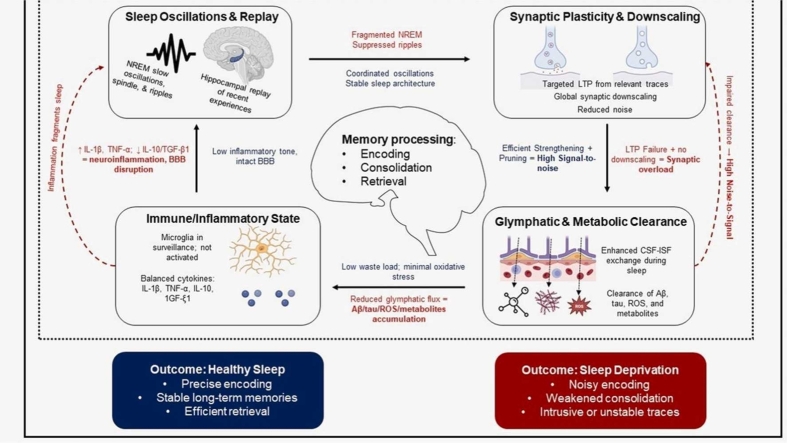
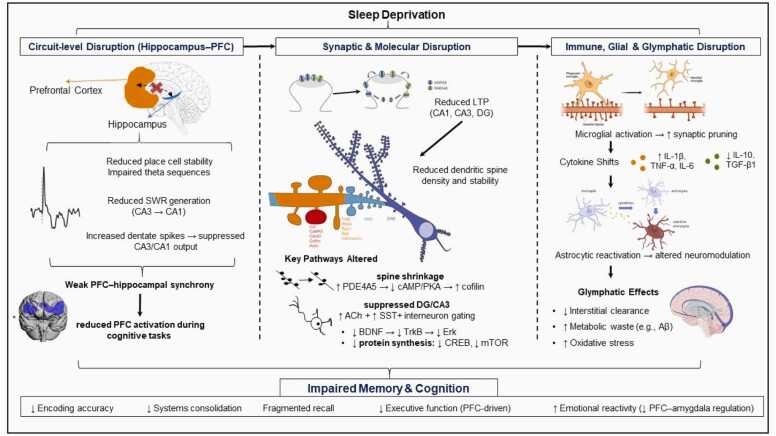
- Sleep loss disrupts hippocampal and neocortical memory systems: it reduces sharp wave-ripple frequency and amplitude, destabilizes place-cell activity, weakens hippocampal-PFC synchrony, and impairs encoding, consolidation, and retrieval; it also increases false memories via diminished pattern separation and impaired source monitoring.
- Synaptic and molecular mechanisms include impaired LTP, reduced dendritic spine density in CA1, CA3, and DG, altered BDNF/TrkB/Erk and cAMP-PDE4-PKA-LIMK-cofilin pathways, downregulated CREB and mTOR, disrupted AMPA/NMDA receptor phosphorylation, and reduced ribosomal protein S6 phosphorylation in DG, CA1, and CA3 after brief sleep loss.
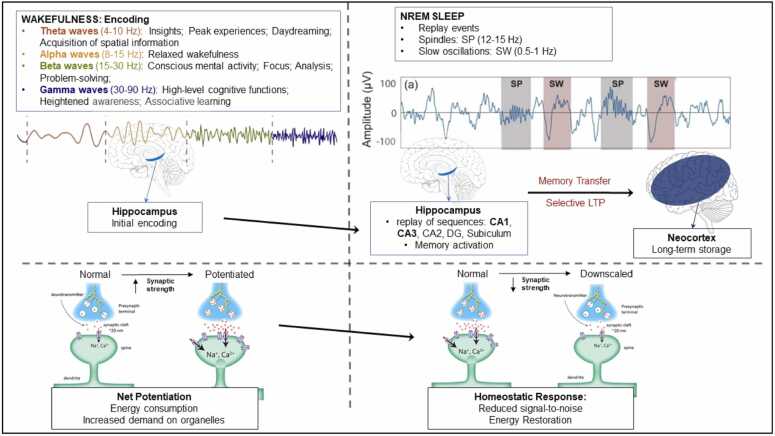
- NREM sleep primarily stabilizes and strengthens declarative memories, while REM sleep refines memories and supports procedural and emotional learning; sleep cycles alternate approximately every 90 min, completing around five full cycles per night. The active system consolidation theory and synaptic homeostasis hypothesis are described as complementary but making distinct predictions.
- Sleep deprivation elevates pro-inflammatory cytokines (IL-1β, TNF-α, IL-6), reduces anti-inflammatory cytokines such as IL-10 and TGF-β1, and reduces glymphatic clearance; recommended sleep is 8–10 h for teenagers, 7–9 h for young/middle-aged adults, and around 7–8 h for older adults, with African adolescents facing chronic unpredictable sleep loss whose neurobiological consequences remain poorly understood.
Methods
- Narrative review integrating conceptual frameworks and experimental studies using a flexible narrative approach.
- Literature identified through PubMed, Google Scholar, and ScienceDirect using keywords such as “sleep deprivation,” “memory consolidation,” “hippocampus,” “neuroplasticity,” and “cognitive impairment”; priority was given to studies published between 2000 and 2025, with searches last updated in July 2025, Boolean operators, and screening of reference lists.
- Inclusion covered English-language empirical and theoretical studies focused on memory-related neurobiological mechanisms of sleep; non-peer-reviewed literature and studies unrelated to cognitive function were excluded, and selection was based on relevance and methodological rigour, including reviews and meta-analyses.
Limitations
- Stated: human studies are limited by individual differences in chronotype, cognitive resilience, and sleep needs; ethical restrictions on deprivation severity and length; task selection; low ecological validity of laboratory-induced sleep loss; circadian confounders; subjective or resource-intensive measurement issues; small sample sizes; generalizability mainly to young, healthy adults; and participant compensation. Animal models are limited by species differences, stress/fatigue/sensory stimulation from deprivation techniques, ethical/practical/financial sample-size limits, and cognitive tests that may not represent human memory complexity.
- Stated gaps: ongoing debate and integration challenge between the synaptic homeostasis hypothesis and active systems consolidation theory; insufficient investigation of synaptic vesicle proteins; lack of longitudinal human research; limited lifespan and African-context research; and no studies directly examining neuroinflammation, synaptic integrity, or hippocampal function in African youth with sleep loss.
- Evident from the text: as a narrative review, no systematic search, formal quality appraisal, or meta-analysis is reported; conclusions synthesize heterogeneous human and animal studies, so effect sizes and causality are not quantified.
Model-written summary. Check it against the paper before relying on it.
Integrity signals
Registry
Cites
Statistics
Figures
Verification
Claims the paper makes
0 Valid · 12 Not valid · 117 Not checked · 42 Own results and interpretations
None of the sources cited for this claim have been checked yet.
In the paper
“Sleep deprivation impairs synaptic plasticity, reduces neurogenesis, and alters neurotransmitter signalling in hippocampal circuits, producing memory deficits in both humans and animal models (Sippel et al., 2020a, Sippel et al., 2020b; Nagai et al., 2021; Kang et al., 2024).”
§ Sleep deprivation and memory: A neurobiological perspective > Introduction
What the sources say
- Not matchedcites Sippel et al., 2020a
More than one paper fits this citation.
- Not matchedcites Sippel et al., 2020b
More than one paper fits this citation.
- Not checked yetcites Nagai et al., 2021 matched to “Effects of severe sleep disruption on the synaptic ultrastructure of young mice” (2021) source
plainstates a cause- Asserted: passes — The authors put it forward as true.
- Checkable: passes — It can be checked against evidence.
- Load-bearing: passes — The paper’s conclusions depend on it.
- Based: passes — The paper gives a reason why it holds.
- Not matched
A statement the paper makes itself — it cites no source for it, so there is none to check. The quote shows it is in the paper.
In the paper
“Lack of sleep affects synaptic plasticity and neurogenesis, as well as oxidative stress and neuroinflammation, all of which impair memory accuracy, cognitive flexibility, and attention.”
§ Sleep deprivation and memory: A neurobiological perspective > Abstract
plainstates a cause- Asserted: passes — The authors put it forward as true.
- Checkable: passes — It can be checked against evidence.
- Load-bearing: passes — The paper’s conclusions depend on it.
- Based: passes — The paper gives a reason why it holds.
None of the sources cited for this claim have been checked yet.
In the paper
“Sleep deprivation impairs synaptic plasticity, reduces neurogenesis, and alters neurotransmitter signalling in hippocampal circuits, producing memory deficits in both humans and animal models (Sippel et al., 2020a, Sippel et al., 2020b; Nagai et al., 2021; Kang et al., 2024).”
§ Sleep deprivation and memory: A neurobiological perspective > Introduction
What the sources say
- Not matchedcites Sippel et al., 2020a
More than one paper fits this citation.
- Not matchedcites Sippel et al., 2020b
More than one paper fits this citation.
- Not checked yetcites Nagai et al., 2021 matched to “Effects of severe sleep disruption on the synaptic ultrastructure of young mice” (2021) source
plainstates a cause- Asserted: passes — The authors put it forward as true.
- Checkable: passes — It can be checked against evidence.
- Load-bearing: passes — The paper’s conclusions depend on it.
- Based: passes — The paper gives a reason why it holds.
- Not matched
51 more claims
Create a free account to see all 171 claims and to verify the 197 references still open.
- It may state two separate claims as one. 98
- Probably not a substantial claim. 28
Self-check
Percentages, sums and reported differences re-computed from the paper’s own numbers.
Each contradiction between two passages listed here was confirmed by an independent check.
Rated minor: it would not touch a result — a value no result rests on, a p-value that stays on the same side of the significance level, or a conflict that is clerical, resolved elsewhere in the paper, or outside its own findings.
In the paper
§ Sleep deprivation and memory: A neurobiological perspective > References
“112. Sippel D. Schwabedal J. Snyder J.C. Oyanedel C.N. Bernas S.N. Garthe A. Tröndle A. Storch A. Kempermann G. Brandt M.D. Disruption of NREM sleep and sleep-related spatial memory consolidation in mice lacking adult hippocampal neurogenesis Sci. Rep. 10 1 2020 16467 10.1038/S41598-020-72362-3 PMC7536189 33020501”
§ Sleep deprivation and memory: A neurobiological perspective > References
“113. Sippel D. Schwabedal J. Snyder J.C. Oyanedel C.N. Bernas S.N. Garthe A. Tröndle A. Storch A. Kempermann G. Brandt M.D. Disruption of NREM sleep and sleep-related spatial memory consolidation in mice lacking adult hippocampal neurogenesis Sci. Rep. 2020 1 2020 1 14 10.1038/s41598-020-72362-3 PMC7536189 33020501”
Rated minor: it would not touch a result — a value no result rests on, a p-value that stays on the same side of the significance level, or a conflict that is clerical, resolved elsewhere in the paper, or outside its own findings.
In the paper
§ Sleep deprivation and memory: A neurobiological perspective > References
“19. Chen P. Ban W. Wang W. You Y. Yang Z. The devastating effects of sleep deprivation on memory: lessons from rodent models Clocks Sleep. 5 2 2023 276 294 10.3390/CLOCKSSLEEP5020022 37218868 PMC10204456”
§ Sleep deprivation and memory: A neurobiological perspective > References
“20. Chen P. Ban W. Wang W. You Y. Yang Z. The devastating effects of sleep deprivation on memory: lessons from rodent models Clocks Sleep. 5 2 2023 276 10.3390/CLOCKSSLEEP5020022 37218868 PMC10204456”
Citations
Cites
Rasch, B., & Born, J. (2013) · Physiological Reviews · doi:10.1152/physrev.00032.2012 · Cited by 2,783 · cited 4×
“It is distinct from wakefulness in terms of metabolism, neural activity, and responsiveness to stimuli, and promotes processes such as energy conservation, cellular repair, immune regulation, and, notably, memory (Rasch and Born, 2013; Miletínov ´ a and Bu ˇ skov ´ a, 2021).”
InfluentialTononi, G., & Cirelli, C. (2014) · Neuron · doi:10.1016/j.neuron.2013.12.025 · Cited by 2,356
National Sleep Foundation’s updated sleep duration recommendations: final report
Hirshkowitz, M., Whiton, K., Albert, S. M., Alessi, C., Bruni, O., DonCarlos, L., Hazen, N., Herman, J., Adams Hillard, P. J., Katz, E. S., et al. (2015) · Sleep Health · doi:10.1016/j.sleh.2015.10.004 · Cited by 2,348
The role of prefrontal cortex in cognitive control and executive function
Friedman, N. P., & Robbins, T. W. (2022) · Neuropsychopharmacology · doi:10.1038/s41386-021-01132-0 · Cited by 1,737 · cited 1×
“Its extensive connectivity with cortical and subcortical areas like the hippocampus, fronto-parietal cortex, visual cortex, and thalamus enables it to coordinate the diverse processes required for adaptive cognition and behaviour (Friedman and Robbins, 2021; Jobson et al., 2021).”
Maturation of the adolescent brain
Sharma, S., Arain, Mathur, Rais, Nel, Sandhu, Haque, & Johal (2013) · Neuropsychiatric Disease and Treatment · doi:10.2147/ndt.s39776 · Cited by 1,249
Mechanisms of systems memory consolidation during sleep
Klinzing, J. G., Niethard, N., & Born, J. (2019) · Nature Neuroscience · doi:10.1038/s41593-019-0467-3 · Cited by 1,176
Sleep in Adolescents: The Perfect Storm
Carskadon, M. A. (2011) · Pediatric Clinics of North America · doi:10.1016/j.pcl.2011.03.003 · Cited by 1,122 · cited 1×
“These skills are essential for academic success and social adjustment (Carskadon, 2011; Logan et al., 2017; Wang et al., 2024).”
The role of sleep in emotional brain function
Goldstein, A. N., & Walker, M. P. (2014) · Annual Review of Clinical Psychology · doi:10.1146/annurev-clinpsy-032813-153716 · Cited by 1,052 · cited 1×
“During REM sleep, the brain processes and consolidates emotionally salient experiences, helping individuals contextualise and make sense of their feelings (Goldstein and Walker, 2014; Vandekerckhove and Wang, 2017).”
The Global Problem of Insufficient Sleep and Its Serious Public Health Implications
Chattu, V. K., Manzar, M. D., Kumary, S., Burman, D., Spence, D. W., & Pandi-Perumal, S. R. (2018) · Healthcare · doi:10.3390/healthcare7010001 · Cited by 1,028
The role of sleep hygiene in promoting public health: a review of empirical evidence
Irish, L. A., Kline, C. E., Gunn, H. E., Buysse, D. J., & Hall, M. H. (2015) · Sleep Medicine Reviews · doi:10.1016/j.smrv.2014.10.001 · Cited by 931 · cited 2×
“Adopting healthy sleep habits is essential for improving sleep quality and supporting cognitive and emotional health (Irish et al., 2014).”
Research works printed but not linked: 3
- Chen P. Ban W. Wang W. You Y. Yang Z. The devastating effects of sleep deprivation on memory: lessons from rodent models Clocks Sleep. 5 2 2023 276 10.3390/CLOCKSSLEEP5020022 37218868 PMC10204456 · DOI
- Patel A.K. Reddy V. Shumway K.R. Araujo J.F. Physiol. Sleep. Stages StatPearls. 2024 〈https://www.ncbi.nlm.nih.gov/books/NBK526132/〉 30252388
- Sippel D. Schwabedal J. Snyder J.C. Oyanedel C.N. Bernas S.N. Garthe A. Tröndle A. Storch A. Kempermann G. Brandt M.D. Disruption of NREM sleep and sleep-related spatial memory consolidation in mice lacking adult hippocampal neurogenesis Sci. Rep. 2020 1 2020 1 14 10.1038/s41598-020-72362-3 PMC7536189 33020501 · DOI
Cited by
Application of Electroencephalography for Assessing Adaptation Processes in Humans (Review)
Панков, М. Н., Гудков, А. Б., Pestov, Y. S., Попова, О. Н., & Кожевникова, И. С. (2026) · Journal of Medical and Biological Research · doi:10.37482/2687-1491-z299
BDNF-mediated amelioration of sleep disruption–induced behavioral disorders by Ginkgo biloba
Hasandoust, N., Hassanpour, R., Bahrami, F., Mohammadi, A., Shankayi, Z., & Farrokhpour, Y. (2026) · IBRO Neuroscience Reports · doi:10.1016/j.ibneur.2026.10.017
Znf804a is a regulator of circadian behaviors in zebrafishPreprint
Bastien, B. L., Li, E. H., Capps, M. E., & Thyme, S. B. (2026) · bioRxiv (Cold Spring Harbor Laboratory) · doi:10.64898/2026.04.29.721668
STAYING UP LATE AMONG GEN Z: HEALTH IMPACTS ON FUSI STUDENTS THROUGH QUR'ANIC PERSPECTIVES
Nurpadila, & Monang, S. (2026) · Qolamuna : Jurnal Studi Islam · doi:10.55120/qolamuna.v12i01.2775
Szymański, P., Hajduk, A., Stańska, J., Baranowska, A., Dobrzańska, A., Kmieciak, K., Borycka, K., Szymańska, A., Kostanek, F., & Berek, M. (2026) · Quality in Sport · doi:10.12775/qs.2026.72.75153
Metadata
- Authors
- Adeniji, K. O., Igado, O. O., Olopade, F. E., & Femi-Akinlosotu, O. M.
- Affiliations
- University of Ibadan (NG)
- Corresponding author
- Femi-Akinlosotu, Omowumi M.
- Venue
- IBRO Neuroscience Reports
- Publisher
- Elsevier BV
- Published
- 2026-06
- Volume
- 20
- Pages
- 170-180
- ISSN
- 2667-2421 (ISSN-L)
- PMC
- PMC12861214
- OpenAlex
- W7124812528
- Semantic Scholar
- 1d4c90fa4812288eea15e048ee3ed885853f86f5
- Cited by
- 6
- References
- 140
- Citations by year
- 2026: 6
- FWCI
- 10.23
- Type
- journal article
- Language
- en
- Open access
- gold
- doi.org
- Licence
- cc-by-nc-nd
- www.elsevier.com/tdm/userlicense/1.0/ (tdm)
- www.elsevier.com/legal/tdmrep-license (tdm)
- creativecommons.org/licenses/by-nc-nd/4.0/ (vor)
- Locations
- IBRO Neuroscience Reports (publishedVersion, cc-by-nc-nd)
- PubMed Central (publishedVersion, cc-by-nc-nd)
- Europe PMC (PubMed Central) (publishedVersion, cc-by-nc-nd)
- PubMed (publishedVersion)
- DOAJ (DOAJ: Directory of Open Access Journals) (submittedVersion)
- Topics
- Life Sciences › Neuroscience › Cognitive Neuroscience › Sleep and Wakefulness Research
- Social Sciences › Psychology › Experimental and Cognitive Psychology › Sleep and Work-Related Fatigue
- Life Sciences › Neuroscience › Cognitive Neuroscience › Memory and Neural Mechanisms
- Keywords
- sleep deprivation, memory consolidation, synaptic plasticity, neurogenesis, oxidative stress, neuroinflammation, false memory, hippocampus, synaptic homeostasis hypothesis, declarative memory, procedural memory, emotional memory, neurotransmitter systems, immune regulation, cognitive flexibility, attention, recovery sleep, NAP, pharmacological interventions, behavioral interventions
About these checks
Registry, retraction, Cites and statistics results are computed, not judged, with one exception: a printed reference that no index lists is read once by a model before it counts as a citation error. Claims are extracted by a model and kept only when their quote appears verbatim in the text; each cited source is then checked, with a model’s help, for whether it says what the claim relies on. Those verdicts can be wrong — read the claim’s quote and the cited source before relying on one.
A language model drew the claims from the paper on 2026-11-23, under version 3 of the claim definition (model deepseek-v4.1-flash, prompt extract-v3).
A second model labelled each claim on 2026-11-23 (model jev-1.13-20260917, definition revision gold-guideline-v0.2).
Statistics and arithmetic are recomputed, not judged.
Confidence bands are shown only for fields calibrated on our annotated test set. None is calibrated yet, so no band is shown.
What counts as a claim ›How we measure confidence ›How we check this ›
Are you an author, or do you see a problem with this page? Request a review
How to cite
Cite CoChat for the checks on this page, and the paper for its own findings.
- This page
- CoChat. (2026). Citation check: Sleep deprivation and memory: A neurobiological perspective. https://app.cochat.ai/papers/10.1016/j.ibneur.2026.01.010
- The paper
- Adeniji, K. O., Igado, O. O., Olopade, F. E., & Femi-Akinlosotu, O. M. (2026). Sleep deprivation and memory: A neurobiological perspective. IBRO Neuroscience Reports. https://doi.org/10.1016/j.ibneur.2026.01.010
Data sources
Bibliographic data: Semantic Scholar, OpenAlex, Crossref.
Contains information from the Semantic Scholar Academic Graph Datasets, made available under the ODC Attribution License (ODC-BY 1.0).
Semantic Scholar’s data is described in: Kinney, R., et al. (2023). The Semantic Scholar Open Data Platform. arXiv:2301.10140.
