

Sleep deprivation and memory: A neurobiological perspective
Open accessThe DOI matches its Crossref record; 142 of the 142 references it cites were found in a registry or an index; none of the 223 sources its claims cite is checked for support yet.
Abstract
Memory consolidation and the preservation of cognitive function are fundamentally influenced by sleep. Lack of sleep affects synaptic plasticity and neurogenesis, as well as oxidative stress and neuroinflammation, all of which impair memory accuracy, cognitive flexibility, and attention. The behavioural repercussions include decreased learning ability, attentional problems, emotional dysregulation, and heightened vulnerability to false memories. This review examines the neurobiological impact of sleep deprivation on memory and cognition, emphasising how the brain systems performing these functions are disrupted by insufficient sleep. The distinct sleep stages that are in support of declarative, procedural, and emotional memory, drawing on contemporary concepts such as the synaptic homeostasis hypothesis and the active system consolidation theory, were emphasised. We highlighted how sleep deprivation can affect important areas, especially the hippocampus, and cause problems with neurotransmitter systems and immune regulation. Preventative and therapeutic approaches, such as pharmacological supports, behavioural interventions, and the cognitive advantages of recovery sleep and naps, were also enumerated. These insights on how sleep and memory interact are vital for enhancing learning outcomes, mental health, and long-term brain resilience.
Overview
CoChat Summary
TL;DR
This narrative review synthesizes evidence that sleep deprivation impairs memory by disrupting hippocampal-neocortical function, synaptic plasticity, neurochemical signalling, immune regulation, and glymphatic clearance. It emphasizes NREM/REM contributions to declarative, procedural, and emotional memory and highlights understudied African contexts and lifespan vulnerabilities.
Key findings
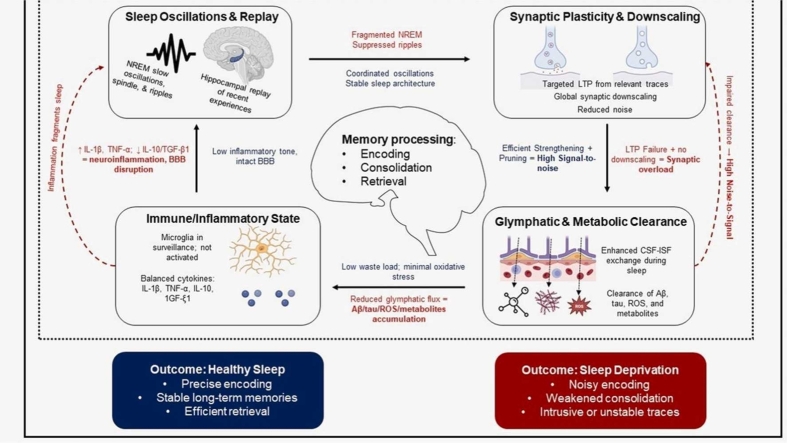
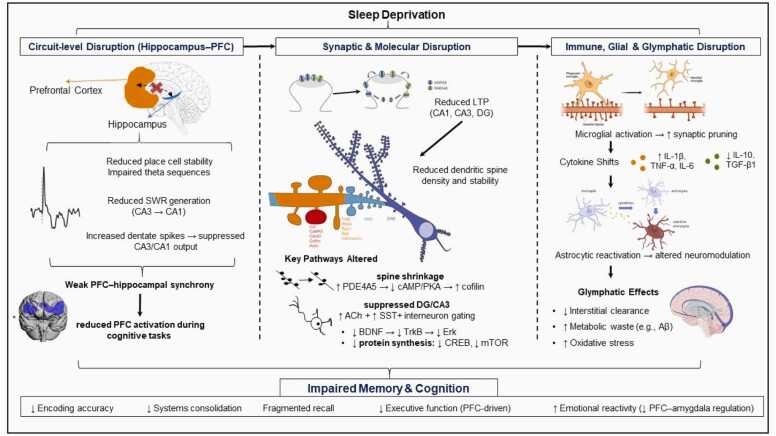
- Sleep loss disrupts hippocampal and neocortical memory systems: it reduces sharp wave-ripple frequency and amplitude, destabilizes place-cell activity, weakens hippocampal-PFC synchrony, and impairs encoding, consolidation, and retrieval; it also increases false memories via diminished pattern separation and impaired source monitoring.
- Synaptic and molecular mechanisms include impaired LTP, reduced dendritic spine density in CA1, CA3, and DG, altered BDNF/TrkB/Erk and cAMP-PDE4-PKA-LIMK-cofilin pathways, downregulated CREB and mTOR, disrupted AMPA/NMDA receptor phosphorylation, and reduced ribosomal protein S6 phosphorylation in DG, CA1, and CA3 after brief sleep loss.
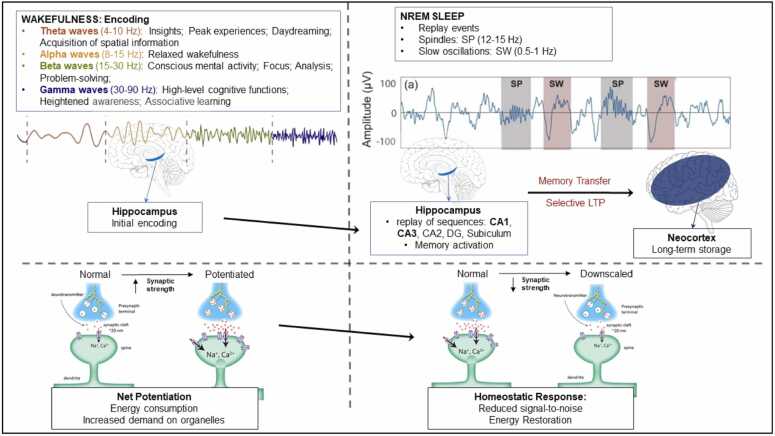
- NREM sleep primarily stabilizes and strengthens declarative memories, while REM sleep refines memories and supports procedural and emotional learning; sleep cycles alternate approximately every 90 min, completing around five full cycles per night. The active system consolidation theory and synaptic homeostasis hypothesis are described as complementary but making distinct predictions.
- Sleep deprivation elevates pro-inflammatory cytokines (IL-1β, TNF-α, IL-6), reduces anti-inflammatory cytokines such as IL-10 and TGF-β1, and reduces glymphatic clearance; recommended sleep is 8–10 h for teenagers, 7–9 h for young/middle-aged adults, and around 7–8 h for older adults, with African adolescents facing chronic unpredictable sleep loss whose neurobiological consequences remain poorly understood.
Methods
- Narrative review integrating conceptual frameworks and experimental studies using a flexible narrative approach.
- Literature identified through PubMed, Google Scholar, and ScienceDirect using keywords such as “sleep deprivation,” “memory consolidation,” “hippocampus,” “neuroplasticity,” and “cognitive impairment”; priority was given to studies published between 2000 and 2025, with searches last updated in July 2025, Boolean operators, and screening of reference lists.
- Inclusion covered English-language empirical and theoretical studies focused on memory-related neurobiological mechanisms of sleep; non-peer-reviewed literature and studies unrelated to cognitive function were excluded, and selection was based on relevance and methodological rigour, including reviews and meta-analyses.
Limitations
- Stated: human studies are limited by individual differences in chronotype, cognitive resilience, and sleep needs; ethical restrictions on deprivation severity and length; task selection; low ecological validity of laboratory-induced sleep loss; circadian confounders; subjective or resource-intensive measurement issues; small sample sizes; generalizability mainly to young, healthy adults; and participant compensation. Animal models are limited by species differences, stress/fatigue/sensory stimulation from deprivation techniques, ethical/practical/financial sample-size limits, and cognitive tests that may not represent human memory complexity.
- Stated gaps: ongoing debate and integration challenge between the synaptic homeostasis hypothesis and active systems consolidation theory; insufficient investigation of synaptic vesicle proteins; lack of longitudinal human research; limited lifespan and African-context research; and no studies directly examining neuroinflammation, synaptic integrity, or hippocampal function in African youth with sleep loss.
- Evident from the text: as a narrative review, no systematic search, formal quality appraisal, or meta-analysis is reported; conclusions synthesize heterogeneous human and animal studies, so effect sizes and causality are not quantified.
Model-written summary. Check it against the paper before relying on it.
Integrity signals
Registry
Cites
Statistics
Figures
Verification
Claims the paper makes
0 Valid · 12 Not valid · 117 Not checked · 42 Own results and interpretations
None of the sources cited for this claim have been checked yet.
In the paper
“Sleep deprivation impairs synaptic plasticity, reduces neurogenesis, and alters neurotransmitter signalling in hippocampal circuits, producing memory deficits in both humans and animal models (Sippel et al., 2020a, Sippel et al., 2020b; Nagai et al., 2021; Kang et al., 2024).”
§ Sleep deprivation and memory: A neurobiological perspective > Introduction
What the sources say
- Not matchedcites Sippel et al., 2020a
More than one paper fits this citation.
- Not matchedcites Sippel et al., 2020b
More than one paper fits this citation.
- Not checked yetcites Nagai et al., 2021 matched to “Effects of severe sleep disruption on the synaptic ultrastructure of young mice” (2021) source
plainstates a cause- Asserted: passes — The authors put it forward as true.
- Checkable: passes — It can be checked against evidence.
- Load-bearing: passes — The paper’s conclusions depend on it.
- Based: passes — The paper gives a reason why it holds.
- Not matched
A statement the paper makes itself — it cites no source for it, so there is none to check. The quote shows it is in the paper.
In the paper
“Lack of sleep affects synaptic plasticity and neurogenesis, as well as oxidative stress and neuroinflammation, all of which impair memory accuracy, cognitive flexibility, and attention.”
§ Sleep deprivation and memory: A neurobiological perspective > Abstract
plainstates a cause- Asserted: passes — The authors put it forward as true.
- Checkable: passes — It can be checked against evidence.
- Load-bearing: passes — The paper’s conclusions depend on it.
- Based: passes — The paper gives a reason why it holds.
None of the sources cited for this claim have been checked yet.
In the paper
“Sleep deprivation impairs synaptic plasticity, reduces neurogenesis, and alters neurotransmitter signalling in hippocampal circuits, producing memory deficits in both humans and animal models (Sippel et al., 2020a, Sippel et al., 2020b; Nagai et al., 2021; Kang et al., 2024).”
§ Sleep deprivation and memory: A neurobiological perspective > Introduction
What the sources say
- Not matchedcites Sippel et al., 2020a
More than one paper fits this citation.
- Not matchedcites Sippel et al., 2020b
More than one paper fits this citation.
- Not checked yetcites Nagai et al., 2021 matched to “Effects of severe sleep disruption on the synaptic ultrastructure of young mice” (2021) source
plainstates a cause- Asserted: passes — The authors put it forward as true.
- Checkable: passes — It can be checked against evidence.
- Load-bearing: passes — The paper’s conclusions depend on it.
- Based: passes — The paper gives a reason why it holds.
- Not matched
51 more claims
Create a free account to see all 171 claims and to verify the 197 references still open.
- It may state two separate claims as one. 98
- Probably not a substantial claim. 28
Self-check
Percentages, sums and reported differences re-computed from the paper’s own numbers.
Each contradiction between two passages listed here was confirmed by an independent check.
Rated minor: it would not touch a result — a value no result rests on, a p-value that stays on the same side of the significance level, or a conflict that is clerical, resolved elsewhere in the paper, or outside its own findings.
In the paper
§ Sleep deprivation and memory: A neurobiological perspective > References
“112. Sippel D. Schwabedal J. Snyder J.C. Oyanedel C.N. Bernas S.N. Garthe A. Tröndle A. Storch A. Kempermann G. Brandt M.D. Disruption of NREM sleep and sleep-related spatial memory consolidation in mice lacking adult hippocampal neurogenesis Sci. Rep. 10 1 2020 16467 10.1038/S41598-020-72362-3 PMC7536189 33020501”
§ Sleep deprivation and memory: A neurobiological perspective > References
“113. Sippel D. Schwabedal J. Snyder J.C. Oyanedel C.N. Bernas S.N. Garthe A. Tröndle A. Storch A. Kempermann G. Brandt M.D. Disruption of NREM sleep and sleep-related spatial memory consolidation in mice lacking adult hippocampal neurogenesis Sci. Rep. 2020 1 2020 1 14 10.1038/s41598-020-72362-3 PMC7536189 33020501”
Rated minor: it would not touch a result — a value no result rests on, a p-value that stays on the same side of the significance level, or a conflict that is clerical, resolved elsewhere in the paper, or outside its own findings.
In the paper
§ Sleep deprivation and memory: A neurobiological perspective > References
“19. Chen P. Ban W. Wang W. You Y. Yang Z. The devastating effects of sleep deprivation on memory: lessons from rodent models Clocks Sleep. 5 2 2023 276 294 10.3390/CLOCKSSLEEP5020022 37218868 PMC10204456”
§ Sleep deprivation and memory: A neurobiological perspective > References
“20. Chen P. Ban W. Wang W. You Y. Yang Z. The devastating effects of sleep deprivation on memory: lessons from rodent models Clocks Sleep. 5 2 2023 276 10.3390/CLOCKSSLEEP5020022 37218868 PMC10204456”
Citations
Cites
Rasch, B., & Born, J. (2013) · Physiological Reviews · doi:10.1152/physrev.00032.2012 · Cited by 2,783 · cited 4×
“It is distinct from wakefulness in terms of metabolism, neural activity, and responsiveness to stimuli, and promotes processes such as energy conservation, cellular repair, immune regulation, and, notably, memory (Rasch and Born, 2013; Miletínov ´ a and Bu ˇ skov ´ a, 2021).”
InfluentialTononi, G., & Cirelli, C. (2014) · Neuron · doi:10.1016/j.neuron.2013.12.025 · Cited by 2,356
National Sleep Foundation’s updated sleep duration recommendations: final report
Hirshkowitz, M., Whiton, K., Albert, S. M., Alessi, C., Bruni, O., DonCarlos, L., Hazen, N., Herman, J., Adams Hillard, P. J., Katz, E. S., et al. (2015) · Sleep Health · doi:10.1016/j.sleh.2015.10.004 · Cited by 2,348
The role of prefrontal cortex in cognitive control and executive function
Friedman, N. P., & Robbins, T. W. (2022) · Neuropsychopharmacology · doi:10.1038/s41386-021-01132-0 · Cited by 1,737 · cited 1×
“Its extensive connectivity with cortical and subcortical areas like the hippocampus, fronto-parietal cortex, visual cortex, and thalamus enables it to coordinate the diverse processes required for adaptive cognition and behaviour (Friedman and Robbins, 2021; Jobson et al., 2021).”
Maturation of the adolescent brain
Sharma, S., Arain, Mathur, Rais, Nel, Sandhu, Haque, & Johal (2013) · Neuropsychiatric Disease and Treatment · doi:10.2147/ndt.s39776 · Cited by 1,249
Mechanisms of systems memory consolidation during sleep
Klinzing, J. G., Niethard, N., & Born, J. (2019) · Nature Neuroscience · doi:10.1038/s41593-019-0467-3 · Cited by 1,176
Sleep in Adolescents: The Perfect Storm
Carskadon, M. A. (2011) · Pediatric Clinics of North America · doi:10.1016/j.pcl.2011.03.003 · Cited by 1,122 · cited 1×
“These skills are essential for academic success and social adjustment (Carskadon, 2011; Logan et al., 2017; Wang et al., 2024).”
The role of sleep in emotional brain function
Goldstein, A. N., & Walker, M. P. (2014) · Annual Review of Clinical Psychology · doi:10.1146/annurev-clinpsy-032813-153716 · Cited by 1,052 · cited 1×
“During REM sleep, the brain processes and consolidates emotionally salient experiences, helping individuals contextualise and make sense of their feelings (Goldstein and Walker, 2014; Vandekerckhove and Wang, 2017).”
The Global Problem of Insufficient Sleep and Its Serious Public Health Implications
Chattu, V. K., Manzar, M. D., Kumary, S., Burman, D., Spence, D. W., & Pandi-Perumal, S. R. (2018) · Healthcare · doi:10.3390/healthcare7010001 · Cited by 1,028
The role of sleep hygiene in promoting public health: a review of empirical evidence
Irish, L. A., Kline, C. E., Gunn, H. E., Buysse, D. J., & Hall, M. H. (2015) · Sleep Medicine Reviews · doi:10.1016/j.smrv.2014.10.001 · Cited by 931 · cited 2×
“Adopting healthy sleep habits is essential for improving sleep quality and supporting cognitive and emotional health (Irish et al., 2014).”
Miller, A. H., Haroon, E., Raison, C. L., & Felger, J. C. (2013) · Depression and Anxiety · doi:10.1002/da.22084 · Cited by 892 · cited 1×
“…and contribute to synaptic plasticity; however, when chronically elevated during stress, infection, or brain injury, they alter neurotransmitter signalling, compromise the blood-brain barrier, and impair memory, attention, and executive function (Miller et al., 2013; Bourgognon & Cavanagh, 2020).”
Staresina, B. P., Bergmann, T. O., Bonnefond, M., van der Meij, R., Jensen, O., Deuker, L., Elger, C. E., Axmacher, N., & Fell, J. (2015) · Nature Neuroscience · doi:10.1038/nn.4119 · Cited by 831 · cited 1×
“…different brain rhythms work together to “ replay ” recent experiences, helping move memories from the hippocampus to the cortex for longer-term storage; when sleep is cut short, this replay and the related strengthening of memories are weakened (Staresina et al., 2015; Tononi and Cirelli, 2014).”
Spear, L. P. (2013) · Journal of Adolescent Health · doi:10.1016/j.jadohealth.2012.05.006 · Cited by 744
System consolidation of memory during sleep
Born, J., & Wilhelm, I. (2012) · Psychological Research · doi:10.1007/s00426-011-0335-6 · Cited by 667
Role of sleep deprivation in immune-related disease risk and outcomes
Garbarino, S., Lanteri, P., Bragazzi, N. L., Magnavita, N., & Scoditti, E. (2021) · Communications Biology · doi:10.1038/s42003-021-02825-4 · Cited by 571
Sleep, circadian rhythms, and the pathogenesis of Alzheimer disease
Musiek, E. S., Xiong, D. D., & Holtzman, D. M. (2015) · Experimental & Molecular Medicine · doi:10.1038/emm.2014.121 · Cited by 529 · cited 1×
“For instance, short-term sleep deprivation can increase beta-amyloid accumulation in brain regions susceptible to Alzheimer ’ s pathology, such as the hippocampus (Musiek et al., 2015; Havekes et al., 2019).”
Working Memory From the Psychological and Neurosciences Perspectives: A Review
Chai, W. J., Abd Hamid, A. I., & Abdullah, J. M. (2018) · Frontiers in Psychology · doi:10.3389/fpsyg.2018.00401 · Cited by 517
Lo, J. C., Ong, J. L., Leong, R. L. F., Gooley, J. J., & Chee, M. W. L. (2016) · Sleep · doi:10.5665/sleep.5552 · Cited by 446
The role of prefrontal cortex in working memory: a mini review
Lara, A. H., & Wallis, J. D. (2015) · Frontiers in Systems Neuroscience · doi:10.3389/fnsys.2015.00173 · Cited by 402
Sleep—A brain-state serving systems memory consolidation
Brodt, S., Inostroza, M., Niethard, N., & Born, J. (2023) · Neuron · doi:10.1016/j.neuron.2023.03.005 · Cited by 343
The role of the medial prefrontal cortex in cognition, ageing and dementia
Jobson, D. D., Hase, Y., Clarkson, A. N., & Kalaria, R. N. (2021) · Brain Communications · doi:10.1093/braincomms/fcab125 · Cited by 338
Raven, F., Van der Zee, E. A., Meerlo, P., & Havekes, R. (2018) · Sleep Medicine Reviews · doi:10.1016/j.smrv.2017.05.002 · Cited by 331 · cited 3×
“These alterations include attenuation of spine density, reduced dendritic length, and fluctuating spine numbers, particularly in the CA1 region of the hippocampus, which is important for information processing and memory (Raven et al., 2018; Nagai et al., 2021; Schr ¨ oder et al., 2023).”
Insufficient sleep in adolescents: causes and consequences
Owens, J. A., & Weiss, M. R. (2017) · Minerva Pediatrics · doi:10.23736/s0026-4946.17.04914-3 · Cited by 308
Sleep Deprivation and Oxidative Stress in Animal Models: A Systematic Review
Villafuerte, G., Miguel-Puga, A., Murillo Rodríguez, E., Machado, S., Manjarrez, E., & Arias-Carrión, O. (2015) · Oxidative Medicine and Cellular Longevity · doi:10.1155/2015/234952 · Cited by 303
Havekes, R., Park, A. J., Tudor, J. C., Luczak, V. G., Hansen, R. T., Ferri, S. L., Bruinenberg, V. M., Poplawski, S. G., Day, J. P., Aton, S. J., et al. (2016) · eLife · doi:10.7554/elife.13424 · Cited by 292
Exploring the Role of Neuroplasticity in Development, Aging, and Neurodegeneration
Marzola, P., Melzer, T., Pavesi, E., Gil-Mohapel, J., & Brocardo, P. S. (2023) · Brain Sciences · doi:10.3390/brainsci13121610 · Cited by 281
The role of REM sleep theta activity in emotional memory
Hutchison, I. C., & Rathore, S. (2015) · Frontiers in Psychology · doi:10.3389/fpsyg.2015.01439 · Cited by 245 · cited 1×
“REM-rich sleep may also be involved in procedural and emotional memory (Hutchison & Rathore, 2015), while NREM-rich sleep is beneficial for declarative memory (Frazer et al., 2021).”
Neuroinflammation, Sleep, and Circadian Rhythms
Zielinski, M. R., & Gibbons, A. J. (2022) · Frontiers in Cellular and Infection Microbiology · doi:10.3389/fcimb.2022.853096 · Cited by 244
The role of cytokines in modulating learning and memory and brain plasticity
Bourgognon, J.-M., & Cavanagh, J. (2020) · Brain and Neuroscience Advances · doi:10.1177/2398212820979802 · Cited by 242
Sleep disorders in the elderly: Diagnosis and management
Suzuki, K., Miyamoto, M., & Hirata, K. (2017) · Journal of General and Family Medicine · doi:10.1002/jgf2.27 · Cited by 233
Emotion, Emotion Regulation and Sleep: An Intimate Relationship
Vandekerckhove, M., 1 Faculty of Psychology and Educational Sciences, V. U. B., Wang, Y.-L., & 2 Department of Data Analysis, F. O. P. A. P. S. (2017) · AIMS Neuroscience · doi:10.3934/neuroscience.2018.5.1 · Cited by 223
Sleep and synaptic down-selection
Tononi, G., & Cirelli, C. (2020) · European Journal of Neuroscience · doi:10.1111/ejn.14335 · Cited by 217 · cited 2×
“…many connections across the brain, which is demanding and eventually limits further learning, while slow-wave sleep globally “ downscales ” or trims these connections to restore balance, improve signal-to-noise, and keep the brain efficient (Kim and Park, 2025; Tononi and Cirelli, 2020).”
Dimsdale-Zucker, H. R., Ritchey, M., Ekstrom, A. D., Yonelinas, A. P., & Ranganath, C. (2018) · Nature Communications · doi:10.1038/s41467-017-02752-1 · Cited by 205
The influence of blue light on sleep, performance and wellbeing in young adults: A systematic review
Silvani, M. I., Werder, R., & Perret, C. (2022) · Frontiers in Physiology · doi:10.3389/fphys.2022.943108 · Cited by 199
Impact of Sleep and Circadian Rhythms on Addiction Vulnerability in Adolescents
Logan, R. W., Hasler, B. P., Forbes, E. E., Franzen, P. L., Torregrossa, M. M., Huang, Y. H., Buysse, D. J., Clark, D. B., & McClung, C. A. (2018) · Biological Psychiatry · doi:10.1016/j.biopsych.2017.11.035 · Cited by 194 · cited 1×
“These skills are essential for academic success and social adjustment (Carskadon, 2011; Logan et al., 2017; Wang et al., 2024).”
Structural and functional plasticity of dendritic spines – root or result of behavior?
Gipson, C. D., & Olive, M. F. (2017) · Genes, Brain and Behavior · doi:10.1111/gbb.12324 · Cited by 191
Emotion, emotion regulation and sleep: An intimate relationship
Vandekerckhove, M., 1 Faculty of Psychology and Educational Sciences, V. U. B., Wang, Y.-L., & 2 Department of Data Analysis, F. O. P. A. P. S. (2018) · AIMS Neuroscience · doi:10.3934/neuroscience.2018.1.1 · Cited by 189
Sleep deprivation leads to a loss of functional connectivity in frontal brain regions
Verweij, I. M., Romeijn, N., Smit, D. J., Piantoni, G., Van Someren, E. J., & van der Werf, Y. D. (2014) · BMC Neuroscience · doi:10.1186/1471-2202-15-88 · Cited by 180 · cited 1×
“Cognitive control in the PFC is critically modulated by dopamine, norepinephrine, acetylcholine, and serotonin, each contributing to the stabilisation of neural representations, facilitation of attention and working memory, and regulation of emotional and social behaviours (Verweij et al., 2014).”
Poza, J. J., Pujol, M., Ortega-Albás, J. J., & Romero, O. (2020) · Neurología (English Edition) · doi:10.1016/j.nrleng.2018.08.004 · Cited by 172
Bonnet, M. H., Balkin, T. J., Dinges, D. F., Roehrs, T., Rogers, N. L., & Wesensten, N. J. (2005) · Sleep · doi:10.1093/sleep/28.9.1163 · Cited by 163
Dendritic Spines Shape Analysis—Classification or Clusterization? Perspective
Pchitskaya, E., & Bezprozvanny, I. (2020) · Frontiers in Synaptic Neuroscience · doi:10.3389/fnsyn.2020.00031 · Cited by 163
Prefrontal neurons transmit signals to parietal neurons that reflect executive control of cognition
Crowe, D. A., Goodwin, S. J., Blackman, R. K., Sakellaridi, S., Sponheim, S. R., MacDonald, A. W., & Chafee, M. V. (2013) · Nature Neuroscience · doi:10.1038/nn.3509 · Cited by 159
Acetylcholine bidirectionally regulates learning and memory
Huang, Q., Liao, C., Ge, F., Ao, J., & Liu, T. (2022) · Journal of Neurorestoratology · doi:10.1016/j.jnrt.2022.100002 · Cited by 158
Cognitive-behavioral therapy for insomnia: an effective and underutilized treatment for insomnia
Rossman, J. (2019) · American Journal of Lifestyle Medicine · doi:10.1177/1559827619867677 · Cited by 156
Sleep recalibrates homeostatic and associative synaptic plasticity in the human cortex
Kuhn, M., Wolf, E., Maier, J. G., Mainberger, F., Feige, B., Schmid, H., Bürklin, J., Maywald, S., Mall, V., Jung, N. H., et al. (2016) · Nature Communications · doi:10.1038/ncomms12455 · Cited by 152
Memory and Sleep: How Sleep Cognition Can Change the Waking Mind for the Better
Paller, K. A., Creery, J. D., & Schechtman, E. (2021) · Annual Review of Psychology · doi:10.1146/annurev-psych-010419-050815 · Cited by 150 · cited 4×
“…reactivation while an organism is asleep has little to no interference or contamination from external stimuli and this optimises the brain for consolidating the processes that translate the newly encoded information into more durable and stable forms (Paller et al., 2020; Brodt et al., 2023).”
InfluentialThe tired hippocampus: the molecular impact of sleep deprivation on hippocampal function
Havekes, R., & Abel, T. (2017) · Current Opinion in Neurobiology · doi:10.1016/j.conb.2017.02.005 · Cited by 143
The Neurobiological Bases of Memory Formation: From Physiological Conditions to Psychopathology
Bisaz, R., Travaglia, A., & Alberini, C. M. (2014) · Psychopathology · doi:10.1159/000363702 · Cited by 140
The impact of sleep loss on hippocampal function
Prince, T.-M., & Abel, T. (2013) · Learning & Memory · doi:10.1101/lm.031674.113 · Cited by 138
Sleep enhances false memories depending on general memory performance
Diekelmann, S., Born, J., & Wagner, U. (2010) · Behavioural Brain Research · doi:10.1016/j.bbr.2009.12.021 · Cited by 133
Costello, R. B., Lentino, C. V., Boyd, C. C., O’Connell, M. L., Crawford, C. C., Sprengel, M. L., & Deuster, P. A. (2014) · Nutrition Journal · doi:10.1186/1475-2891-13-106 · Cited by 133
Sleep Deprivation and Insomnia in Adolescence: Implications for Mental Health
Uccella, S., Cordani, R., Salfi, F., Gorgoni, M., Scarpelli, S., Gemignani, A., Geoffroy, P. A., De Gennaro, L., Palagini, L., Ferrara, M., et al. (2023) · Brain Sciences · doi:10.3390/brainsci13040569 · Cited by 131
Whitney, P., Hinson, J. M., Jackson, M. L., & Van Dongen, H. P. A. (2015) · Sleep · doi:10.5665/sleep.4668 · Cited by 131
Linking Network Activity to Synaptic Plasticity during Sleep: Hypotheses and Recent Data
Puentes-Mestril, C., & Aton, S. J. (2017) · Frontiers in Neural Circuits · doi:10.3389/fncir.2017.00061 · Cited by 127
Synaptic plasticity during systems memory consolidation
Goto, A. (2022) · Neuroscience Research · doi:10.1016/j.neures.2022.05.008 · Cited by 121
Neurobiological Consequences of Sleep Deprivation
Alkadhi, K., Zagaar, M., Alhaider, I., Salim, S., & Aleisa, A. (2013) · Current Neuropharmacology · doi:10.2174/1570159x11311030001 · Cited by 120
Cognitive control, motivation and fatigue: a cognitive neuroscience perspective
Kok, A. (2022) · Brain and Cognition · doi:10.1016/j.bandc.2022.105880 · Cited by 111
Newbury, C. R., Crowley, R., Rastle, K., & Tamminen, J. (2021) · Psychological Bulletin · doi:10.1037/bul0000348 · Cited by 110
Interindividual variability in neurobehavioral response to sleep loss: A comprehensive review
Tkachenko, O., & Dinges, D. F. (2018) · Neuroscience & Biobehavioral Reviews · doi:10.1016/j.neubiorev.2018.03.017 · Cited by 108
Cognitive Behavioral Therapy for Insomnia (CBT-I): A Primer
Walker, J., Muench, A., Perlis, M. L., & Vargas, I. (2022) · Clinical Psychology and Special Education · doi:10.17759/cpse.2022110208 · Cited by 106
Cognitive flexibility: a distinct element of performance impairment due to sleep deprivation
Honn, K. A., Hinson, J. M., Whitney, P., & Van Dongen, H. P. A. (2019) · Accident Analysis & Prevention · doi:10.1016/j.aap.2018.02.013 · Cited by 105
Sleep Loss Produces False Memories
Diekelmann, S., Landolt, H.-P., Lahl, O., Born, J., & Wagner, U. (2008) · PLoS ONE · doi:10.1371/journal.pone.0003512 · Cited by 103
The role of the hippocampus in the consolidation of emotional memories during sleep
Pronier, É., Morici, J. F., & Girardeau, G. (2023) · Trends in Neurosciences · doi:10.1016/j.tins.2023.08.003 · Cited by 102
Ma, J., Chen, M., Liu, G.-H., Gao, M., Chen, N.-H., Toh, C. H., Hsu, J.-L., Wu, K.-Y., Huang, C.-M., Lin, C.-M., et al. (2025) · Molecular Psychiatry · doi:10.1038/s41380-024-02778-0 · Cited by 96
Adolescent sleep and the foundations of prefrontal cortical development and dysfunction
Anastasiades, P. G., de Vivo, L., Bellesi, M., & Jones, M. W. (2022) · Progress in Neurobiology · doi:10.1016/j.pneurobio.2022.102338 · Cited by 84
Delorme, J., Wang, L., Kuhn, F. R., Kodoth, V., Ma, J., Martinez, J. D., Raven, F., Toth, B. A., Balendran, V., Vega Medina, A., et al. (2021) · Proceedings of the National Academy of Sciences · doi:10.1073/pnas.2019318118 · Cited by 83
The Dynamic Relationship between the glymphatic system, aging, memory, and sleep
Voumvourakis, K. I., Sideri, E., Papadimitropoulos, G. N., Tsantzali, I., Hewlett, P., Kitsos, D., Stefanou, M., Bonakis, A., Giannopoulos, S., Tsivgoulis, G., et al. (2023) · Biomedicines · doi:10.3390/biomedicines11082092 · Cited by 82
Cognitive neuroscience perspective on memory: overview and summary
Sridhar, S., Khamaj, A., & Asthana, M. K. (2023) · Frontiers in Human Neuroscience · doi:10.3389/fnhum.2023.1217093 · Cited by 80
The effects of insufficient sleep and adequate sleep on cognitive function in healthy adults
Zimmerman, M. E., Benasi, G., Hale, C., Yeung, L.-K., Cochran, J., Brickman, A. M., & St-Onge, M.-P. (2024) · Sleep Health · doi:10.1016/j.sleh.2023.11.011 · Cited by 80
The Ontogeny of Hippocampus-Dependent Memories
Donato, F., Alberini, C. M., Amso, D., Dragoi, G., Dranovsky, A., & Newcombe, N. S. (2021) · The Journal of Neuroscience · doi:10.1523/jneurosci.1651-20.2020 · Cited by 75
Killgore, W. D. S., McBride, S. A., Killgore, D. B., & Balkin, T. J. (2006) · Sleep · doi:10.1093/sleep/29.6.841 · Cited by 71
Wang, W., Zhu, Y., Yu, H., Wu, C., Li, T., Ji, C., Jiang, Y., & Ding, D. (2024) · BMC Public Health · doi:10.1186/s12889-024-19400-1 · Cited by 69
Early Life Sleep Deprivation and Brain Development: Insights From Human and Animal Studies
Alrousan, G., Hassan, A., Pillai, A. A., Atrooz, F., & Salim, S. (2022) · Frontiers in Neuroscience · doi:10.3389/fnins.2022.833786 · Cited by 57
Contributions of post-learning REM and NREM sleep to memory retrieval
MacDonald, K. J., & Cote, K. A. (2021) · Sleep Medicine Reviews · doi:10.1016/j.smrv.2021.101453 · Cited by 56
Leenaars, C. H. C., Demattéis, M., Joosten, R. N. J. M. A., Eggels, L., Sandberg, H., Schirris, M., Feenstra, M. G. P., & Someren, E. J. W. V. (2011) · Journal of Neuroscience Methods · doi:10.1016/j.jneumeth.2011.01.014 · Cited by 54
Sleep and inflammatory markers in different psychiatric disorders
Krysta, K., Krzystanek, M., Bratek, A., & Krupka-Matuszczyk, I. (2017) · Journal of Neural Transmission · doi:10.1007/s00702-015-1492-3 · Cited by 53
Sleep in humans stabilizes pattern separation performance
Hanert, A., Weber, F. D., Pedersen, A., Born, J., & Bartsch, T. (2017) · The Journal of Neuroscience · doi:10.1523/jneurosci.1189-17.2017 · Cited by 52 · cited 3×
“…between the hippocampus and the PFC, responsible for higher-order evaluation of memories, further compromises the brain ’ s ability to verify the authenticity of retrieved information, making memory errors more frequent in sleep-deprived states (Diekelmann et al., 2010; Hanert et al., 2017).”
Feng, P., Becker, B., Zheng, Y., & Feng, T. (2018) · Social Cognitive and Affective Neuroscience · doi:10.1093/scan/nsx148 · Cited by 42
The Devastating Effects of Sleep Deprivation on Memory: Lessons from Rodent Models
Chen, P., Ban, W., Wang, W., You, Y., & Yang, Z. (2023) · Clocks & Sleep · doi:10.3390/clockssleep5020022 · Cited by 42
Overview of Sleep: The Neurologic Processes of the Sleep-Wake Cycle
Scammell, T. E. (2015) · The Journal of Clinical Psychiatry · doi:10.4088/jcp.14046tx1c · Cited by 41
Hwaun, E., & Colgin, L. L. (2019) · Hippocampus · doi:10.1002/hipo.23090 · Cited by 40
Sleep loss alters synaptic and intrinsic neuronal properties in mouse prefrontal cortex
Winters, B. D., Huang, Y. H., Dong, Y., & Krueger, J. M. (2011) · Brain Research · doi:10.1016/j.brainres.2011.08.078 · Cited by 39
Smith, M. G., Wusk, G. C., Nasrini, J., Baskin, P., Dinges, D. F., Roma, P. G., & Basner, M. (2021) · Sleep · doi:10.1093/sleep/zsab051 · Cited by 37
Sleep deprivation induces fragmented memory loss.
Ashton, J. E., Harrington, M. O., Langthorne, D., Ngo, H.-V. V., & Cairney, S. A. (2020) · Learning & Memory · doi:10.1101/lm.050757.119 · Cited by 36 · cited 1×
“Weak integration of newly learned information Disrupted hippocampal replay; impaired REM/NREM-dependent mechanisms (Ashton et al., 2020; Newbury et al., 2021)”
Hippocampal sleep features: relations to human memory function
Ferrara, M., Moroni, F., De Gennaro, L., & Nobili, L. (2012) · Frontiers in Neurology · doi:10.3389/fneur.2012.00057 · Cited by 36
Crosstalk between aging, circadian rhythm, and melatonin
Verma, A. K., Khan, M. I., Ashfaq, F., & Rizvi, S. I. (2023) · Rejuvenation Research · doi:10.1089/rej.2023.0047 · Cited by 35
Song, J., Feng, P., Wu, X., Li, B., Su, Y., Liu, Y., & Zheng, Y. (2019) · Frontiers in Neurology · doi:10.3389/fneur.2019.00514 · Cited by 34
Micklesfield, L. K., Hanson, S. K., Lobelo, F., Cunningham, S. A., Hartman, T. J., Norris, S. A., & Stein, A. D. (2021) · BMC Pediatrics · doi:10.1186/s12887-020-02451-9 · Cited by 34
Jiao, Q., Dong, X., Guo, C., Wu, T., Chen, F., Zhang, K., Ma, Z., Sun, Y., Cao, H., Tian, C., et al. (2022) · Behavioural Brain Research · doi:10.1016/j.bbr.2021.113621 · Cited by 33
The effects of sleep on the neural correlates of pattern separation
Doxey, C. R., Hodges, C. B., Bodily, T. A., Muncy, N. M., & Kirwan, C. B. (2018) · Hippocampus · doi:10.1002/hipo.22814 · Cited by 32
A systematic review of sleep deprivation and neurobehavioral function in young adults
Griggs, S. A., Harper, A., & Hickman, R. L. (2021) · Applied Nursing Research · doi:10.1016/j.apnr.2021.151552 · Cited by 32
Havekes, R., Heckman, P. R. A., Wams, E. J., Stasiukonyte, N., Meerlo, P., & Eisel, U. L. M. (2019) · Cellular Signalling · doi:10.1016/j.cellsig.2019.109420 · Cited by 29
Effects of sleep deprivation on spatial learning and memory in juvenile and young adult rats.
Ward, C. P., Wooden, J. I., & Kieltyka, R. (2017) · Psychology & Neuroscience · doi:10.1037/pne0000075 · Cited by 28
The amygdala, sleep debt, sleep deprivation, and the emotion of anger: a possible connection?
Saghir, Z., Syeda, J. N., Muhammad, A. S., & Balla Abdalla, T. H. (2018) · Cureus · doi:10.7759/cureus.2912 · Cited by 28
Diao, H., Li, Y., Sun, W., Zhang, J., Wang, M., Chen, Y., Zhou, F., & Li, X. (2023) · Behavioural Brain Research · doi:10.1016/j.bbr.2023.114652 · Cited by 26
Chronic Sleep Deprivation in Mouse Pups by Means of Gentle Handling
Lemons, A. H. S., Saré, R. M., & Smith, C. B. (2018) · Journal of Visualized Experiments · doi:10.3791/58150 · Cited by 26
Kang, J.-Y., Lee, J., Wang, J., & Son, C. (2024) · SLEEP · doi:10.1093/sleep/zsae143 · Cited by 26
Olorunmoteni, O. E., Fatusi, A. O., Komolafe, M. A., & Omisore, A. (2018) · Sleep Health · doi:10.1016/j.sleh.2018.09.002 · Cited by 24
Miletínová, E., & Bušková, J. (2021) · Physiological Research · doi:10.33549/physiolres.934470 · Cited by 24
Rhythmic memory consolidation in the hippocampus
Nokia, M. S., & Penttonen, M. (2022) · Frontiers in Neural Circuits · doi:10.3389/fncir.2022.885684 · Cited by 23
The effects of sleep restriction and sleep deprivation in producing false memories
Chatburn, A., Kohler, M. J., Payne, J. D., & Drummond, S. P. A. (2017) · Neurobiology of Learning and Memory · doi:10.1016/j.nlm.2016.11.017 · Cited by 22
Serino, S., & Riva, G. (2014) · Frontiers in Aging Neuroscience · doi:10.3389/fnagi.2014.00033 · Cited by 22
Memory control deficits in the sleep-deprived human brain
Harrington, M. O., Karapanagiotidis, T., Phillips, L., Smallwood, J., Anderson, M. C., & Cairney, S. A. (2025) · Proceedings of the National Academy of Sciences · doi:10.1073/pnas.2400743122 · Cited by 22
Huang, B., Sun, B., Yang, R., Liang, S., Li, X., Guo, Y., Meng, Q., Fu, Y., Li, W., Zhao, P., et al. (2022) · Neuropharmacology · doi:10.1016/j.neuropharm.2022.109164 · Cited by 21
Sleep pattern and practice among adolescents school children in Nigerian secondary schools
Maduabuchi, J. C., Obu, H. A., Chukwu, B. F., Ebele, A., Manyike, P. C., & Chinawa, A. T. (2014) · Pan African Medical Journal · doi:10.11604/pamj.2014.19.313.4603 · Cited by 21
Lensu, S., Waselius, T., Penttonen, M., & Nokia, M. S. (2019) · Journal of Neurophysiology · doi:10.1152/jn.00696.2018 · Cited by 20
Schröder, J. K., Abdel‐Hafiz, L., Ali, A. A. H., Cousin, T. C., Hallenberger, J., Almeida, F. R., Anstötz, M., Lenz, M., Vlachos, A., von Gall, C., et al. (2023) · Cells · doi:10.3390/cells12131758 · Cited by 20
The function of REM and NREM sleep on memory distortion and consolidation
Kaida, K., Mori, I., Kihara, K., & Kaida, N. (2023) · Neurobiology of Learning and Memory · doi:10.1016/j.nlm.2023.107811 · Cited by 20
Post-Synapses in the Brain: Role of Dendritic and Spine Structures
Meldolesi, J. (2022) · Biomedicines · doi:10.3390/biomedicines10081859 · Cited by 20
Dickinson, D. L., Drummond, S. P. A., & McElroy, T. (2017) · PLOS ONE · doi:10.1371/journal.pone.0174367 · Cited by 20
Sleep loss disrupts the neural signature of successful learning
Guttesen, A. Á. V., Gaskell, M. G., Madden, E. V., Appleby, G., Cross, Z. R., & Cairney, S. A. (2023) · Cerebral Cortex · doi:10.1093/cercor/bhac159 · Cited by 19
Sippel, D., Schwabedal, J. T. C., Snyder, J. C., Oyanedel, C. N., Bernas, S. N., Garthe, A., Tröndle, A., Storch, A., Kempermann, G., & Brandt, M. (2020) · Scientific Reports · doi:10.1038/s41598-020-72362-3 · Cited by 19
Why do levels of anti-inflammatory cytokines increase during memory acquisition?
Levin, S. G., Pershina, E. V., Bugaev-Makarovskiy, N. A., Chernomorets, I. Y., Konakov, M. V., & Arkhipov, V. I. (2021) · Neuroscience · doi:10.1016/j.neuroscience.2021.08.007 · Cited by 18
Effects of severe sleep disruption on the synaptic ultrastructure of young mice
Nagai, H., de Vivo, L., Marshall, W., Tononi, G., & Cirelli, C. (2021) · eneuro · doi:10.1523/eneuro.0077-21.2021 · Cited by 16
Shahveisi, K., Khazaie, H., Farnia, V., & Khodamoradi, M. (2019) · Pharmacology Biochemistry and Behavior · doi:10.1016/j.pbb.2019.172759 · Cited by 16
Sun, X., Qu, Z., Zhang, X., Zhang, Y., Zhang, X., Zhao, H., & Zhang, H. (2025) · Frontiers in Neuroscience · doi:10.3389/fnins.2025.1626309 · Cited by 16
Shining a Light on the Mechanisms of Sleep for Memory Consolidation
Frazer, M. A., Cabrera, Y., Guthrie, R. S., & Poe, G. R. (2021) · Current Sleep Medicine Reports · doi:10.1007/s40675-021-00204-3 · Cited by 15 · cited 2×
“NREM sleep primarily sta-bilises and strengthens declarative memories, while REM sleep refines memories and supports procedural and emotional learning (MacDonald and Cote, 2021; Frazer et al., 2021; Kaida et al., 2023).”
Sleep Hygiene Practices: Where to Now?
Chow, C. M. (2022) · Hygiene · doi:10.3390/hygiene2030013 · Cited by 15
Publisher Correction: Mechanisms of systems memory consolidation during sleep
Klinzing, J. G., Niethard, N., & Born, J. (2019) · Nature Neuroscience · doi:10.1038/s41593-019-0507-z · Cited by 15
Xu, L., Yang, X., Peng, Z., Song, T., Wang, L., Dai, C., Xu, M., Shao, Y., & Lv, J. (2022) · Neurobiology of Learning and Memory · doi:10.1016/j.nlm.2022.107625 · Cited by 14
Systems memory consolidation during sleep: oscillations, neuromodulators, and synaptic remodeling
Kim, J., & Park, M. (2025) · BMB Reports · doi:10.5483/bmbrep.2025-0033 · Cited by 14
Ru, T., Qian, L., Chen, Q., Sun, H., & Zhou, G. (2022) · International Journal of Psychophysiology · doi:10.1016/j.ijpsycho.2022.06.013 · Cited by 13
Recovery sleep attenuates impairments in working memory following total sleep deprivation
Peng, Z., Hou, Y., Xu, L., Wang, H., Wu, S., Song, T., Shao, Y., & Yang, Y. (2023) · Frontiers in Neuroscience · doi:10.3389/fnins.2023.1056788 · Cited by 13
Wolde, A., & Aydiko, A. (2022) · Global Pediatric Health · doi:10.1177/2333794x221125075 · Cited by 13
Olorunmoteni, O. E., Gómez-Olivé, F.-X., Fatusi, A. O., & Scheuermaier, K. (2024) · Sleep Health · doi:10.1016/j.sleh.2023.11.006 · Cited by 11
Ayalew, T. L., Walle, B. G., & Haile, K. E. (2022) · Sleep Science and Practice · doi:10.1186/s41606-022-00080-y · Cited by 11
Ahinkorah, B. O., Aboagye, R. G., Arthur-Holmes, F., Seidu, A.-A., Frimpong, J. B., Budu, E., Amoako, B. M., & Hagan, J. E. (2021) · Behavioral Sciences · doi:10.3390/bs11020020 · Cited by 9
Oriyama, S. (2023) · Scientific Reports · doi:10.1038/s41598-023-37061-9 · Cited by 6
Sleep deprivation-induced memory impairment: exploring potential interventions
Fan, Y., Li, J., & Qiao, S. (2024) · Frontiers in Psychiatry · doi:10.3389/fpsyt.2024.1470976 · Cited by 6
Hong, J., Ha, G. E., Kwak, H., Lee, Y., Jeong, H., Suh, P.-G., & Cheong, E. (2020) · Scientific Reports · doi:10.1038/s41598-020-64377-7 · Cited by 6
To sleep perchance to spike: a functional role for dentate spikes in memory
Ewell, L. A. (2017) · The Journal of Physiology · doi:10.1113/jp274502 · Cited by 6
Havekes, R., Park, A. J., Tudor, J. C., Luczak, V. G., Hansen, R. T., Ferri, S. L., Bruinenberg, V. M., Poplawski, S. G., Day, J. P., Aton, S. J., et al. (2016) · doi:10.7554/elife.13424.024 · Cited by 6
Boost Your Brainpower: 24 Daily Sleep Hacks for Active Lifestyles
Migliaccio, G. M., Di Filippo, G., Sancassiani, F., Padulo, J., & Russo, L. (2024) · Applied Sciences · doi:10.3390/app14156701 · Cited by 4
Innocent, B. R., Lorraine, O., Katabira, E., Sajatovic, M., Catherine, A., & Mark, K. (2025) · Sleep Epidemiology · doi:10.1016/j.sleepe.2024.100104 · Cited by 4
Sleep insufficiency among adolescents in Africa: a narrative review
Bello, B., Useh, U., & Abdurrahaman, M. A. (2023) · Bayero Journal of Nursing and Health Care · doi:10.4314/bjnhc.v5i1.23 · Cited by 3
Cash, E. D., Beck, I. T., & Davis, C. J. (2023) · Research Directions Sleep Psychology · doi:10.1017/slp.2023.6 · Cited by 2
Abdeta, C., Deksisa, A., Hailu, M., Diro, D. T., Westerman, L., Okely, A. D., Reilly, J. J., & Tremblay, M. S. (2025) · BMC Pediatrics · doi:10.1186/s12887-025-05785-4 · Cited by 1
Olorunmoteni, O. E., Scheuermaier, K., Fatusi, A. O., Akande, J. I., & Gómez-Olivé, F. X. (2025) · Scientific Reports · doi:10.1038/s41598-025-25659-0 · Cited by 1
Pace-Schott, E. F. (2010) · Elsevier eBooks · doi:10.1016/b978-0-08-045396-5.00229-3 · Cited by 1
Lankrew Ayalew, T., Walle, B. G., & Haile, K. E. (2022) · Figshare · doi:10.6084/m9.figshare.c.6226812 · Cited by 1
Younis, S. (2022) · Egyptian Journal of Health Care · doi:10.21608/ejhc.2022.267161
(2021) · doi:10.5935/1984-0063.20200049
Research works printed but not linked: 3
- Chen P. Ban W. Wang W. You Y. Yang Z. The devastating effects of sleep deprivation on memory: lessons from rodent models Clocks Sleep. 5 2 2023 276 10.3390/CLOCKSSLEEP5020022 37218868 PMC10204456 · DOI
- Patel A.K. Reddy V. Shumway K.R. Araujo J.F. Physiol. Sleep. Stages StatPearls. 2024 〈https://www.ncbi.nlm.nih.gov/books/NBK526132/〉 30252388
- Sippel D. Schwabedal J. Snyder J.C. Oyanedel C.N. Bernas S.N. Garthe A. Tröndle A. Storch A. Kempermann G. Brandt M.D. Disruption of NREM sleep and sleep-related spatial memory consolidation in mice lacking adult hippocampal neurogenesis Sci. Rep. 2020 1 2020 1 14 10.1038/s41598-020-72362-3 PMC7536189 33020501 · DOI
Cited by
Application of Electroencephalography for Assessing Adaptation Processes in Humans (Review)
Панков, М. Н., Гудков, А. Б., Pestov, Y. S., Попова, О. Н., & Кожевникова, И. С. (2026) · Journal of Medical and Biological Research · doi:10.37482/2687-1491-z299
BDNF-mediated amelioration of sleep disruption–induced behavioral disorders by Ginkgo biloba
Hasandoust, N., Hassanpour, R., Bahrami, F., Mohammadi, A., Shankayi, Z., & Farrokhpour, Y. (2026) · IBRO Neuroscience Reports · doi:10.1016/j.ibneur.2026.10.017
Znf804a is a regulator of circadian behaviors in zebrafishPreprint
Bastien, B. L., Li, E. H., Capps, M. E., & Thyme, S. B. (2026) · bioRxiv (Cold Spring Harbor Laboratory) · doi:10.64898/2026.04.29.721668
STAYING UP LATE AMONG GEN Z: HEALTH IMPACTS ON FUSI STUDENTS THROUGH QUR'ANIC PERSPECTIVES
Nurpadila, & Monang, S. (2026) · Qolamuna : Jurnal Studi Islam · doi:10.55120/qolamuna.v12i01.2775
Szymański, P., Hajduk, A., Stańska, J., Baranowska, A., Dobrzańska, A., Kmieciak, K., Borycka, K., Szymańska, A., Kostanek, F., & Berek, M. (2026) · Quality in Sport · doi:10.12775/qs.2026.72.75153
Metadata
- Authors
- Adeniji, K. O., Igado, O. O., Olopade, F. E., & Femi-Akinlosotu, O. M.
- Affiliations
- University of Ibadan (NG)
- Corresponding author
- Femi-Akinlosotu, Omowumi M.
- Venue
- IBRO Neuroscience Reports
- Publisher
- Elsevier BV
- Published
- 2026-06
- Volume
- 20
- Pages
- 170-180
- ISSN
- 2667-2421 (ISSN-L)
- PMC
- PMC12861214
- OpenAlex
- W7124812528
- Semantic Scholar
- 1d4c90fa4812288eea15e048ee3ed885853f86f5
- Cited by
- 6
- References
- 140
- Citations by year
- 2026: 6
- FWCI
- 10.23
- Type
- journal article
- Language
- en
- Open access
- gold
- doi.org
- Licence
- cc-by-nc-nd
- www.elsevier.com/tdm/userlicense/1.0/ (tdm)
- www.elsevier.com/legal/tdmrep-license (tdm)
- creativecommons.org/licenses/by-nc-nd/4.0/ (vor)
- Locations
- IBRO Neuroscience Reports (publishedVersion, cc-by-nc-nd)
- PubMed Central (publishedVersion, cc-by-nc-nd)
- Europe PMC (PubMed Central) (publishedVersion, cc-by-nc-nd)
- PubMed (publishedVersion)
- DOAJ (DOAJ: Directory of Open Access Journals) (submittedVersion)
- Topics
- Life Sciences › Neuroscience › Cognitive Neuroscience › Sleep and Wakefulness Research
- Social Sciences › Psychology › Experimental and Cognitive Psychology › Sleep and Work-Related Fatigue
- Life Sciences › Neuroscience › Cognitive Neuroscience › Memory and Neural Mechanisms
- Keywords
- sleep deprivation, memory consolidation, synaptic plasticity, neurogenesis, oxidative stress, neuroinflammation, false memory, hippocampus, synaptic homeostasis hypothesis, declarative memory, procedural memory, emotional memory, neurotransmitter systems, immune regulation, cognitive flexibility, attention, recovery sleep, NAP, pharmacological interventions, behavioral interventions
About these checks
Registry, retraction, Cites and statistics results are computed, not judged, with one exception: a printed reference that no index lists is read once by a model before it counts as a citation error. Claims are extracted by a model and kept only when their quote appears verbatim in the text; each cited source is then checked, with a model’s help, for whether it says what the claim relies on. Those verdicts can be wrong — read the claim’s quote and the cited source before relying on one.
A language model drew the claims from the paper on 2026-11-23, under version 3 of the claim definition (model deepseek-v4.1-flash, prompt extract-v3).
A second model labelled each claim on 2026-11-23 (model jev-1.13-20260917, definition revision gold-guideline-v0.2).
Statistics and arithmetic are recomputed, not judged.
Confidence bands are shown only for fields calibrated on our annotated test set. None is calibrated yet, so no band is shown.
What counts as a claim ›How we measure confidence ›How we check this ›
Are you an author, or do you see a problem with this page? Request a review
Data sources
Bibliographic data: Semantic Scholar, OpenAlex, Crossref.
Contains information from the Semantic Scholar Academic Graph Datasets, made available under the ODC Attribution License (ODC-BY 1.0).
Semantic Scholar’s data is described in: Kinney, R., et al. (2023). The Semantic Scholar Open Data Platform. arXiv:2301.10140.
