

The DOI matches its Crossref record; 110 of the 118 references it cites were found in a registry or an index; 23 of the 67 sources its claims cite were checked for support.
Limitations of Animal Studies for Predicting Toxicity in Clinical Trials
Open accessAbstract
Animal testing is used in pharmaceutical and industrial research to predict human toxicity, and yet analysis suggests that animal models are poor predictors of drug safety in humans. The cost of animal research is high-in dollars, delays in drug approval, and in the loss of potentially beneficial drugs for human use. Human subjects have been harmed in the clinical testing of drugs that were deemed safe by animal studies. Increasingly, investigators are questioning the scientific merit of animal research. This review discusses issues in using animals to predict human toxicity in pharmaceutical development. Part 1 focuses on scientific concerns over the validity of animal research. Part 2 will discuss alternatives to animal research and their validation and use in production of human pharmaceuticals.
Overview
AI snapshot
Written from the paper’s full text.
TL;DR
This review argues that animal toxicity testing is a poor predictor of human drug safety, citing low animal-human concordance, high clinical trial failure rates, and cases of severe human harm after animal tests deemed drugs safe. It concludes that animal testing should be abandoned or significantly curtailed in favor of more reliable alternatives, with alternatives to be discussed in Part 2.
Key findings
- Concordance between animal and human results is low: a 2006 review of 76 animal studies found ~20% were contradicted in humans and only 37% were ever replicated in humans; a review of 221 animal experiments found agreement with human studies just 50% of the time. In 37 chemicals from the U.S. National Toxicology Program, average positive predictive value from mouse to rat was 55.3% for long-term and 44.8% for short-term studies, hovering around 50%—no greater than random chance.
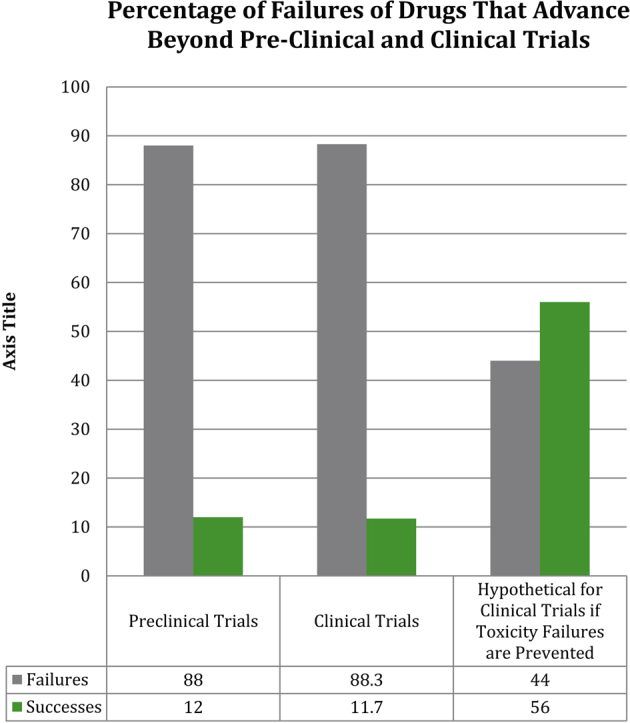
- Drug development failure rates raise doubts about animal predictivity: about 12% of pharmaceuticals pass preclinical testing to enter clinical trials, only 60% of those complete phase I, and approximately 89% of novel drugs fail human clinical trials, with about one-half of those failures due to unanticipated human toxicity. An analysis of 2,366 drugs concluded animal tests are highly inconsistent predictors of human toxic responses and “little better than what would result merely by chance—or tossing a coin.”
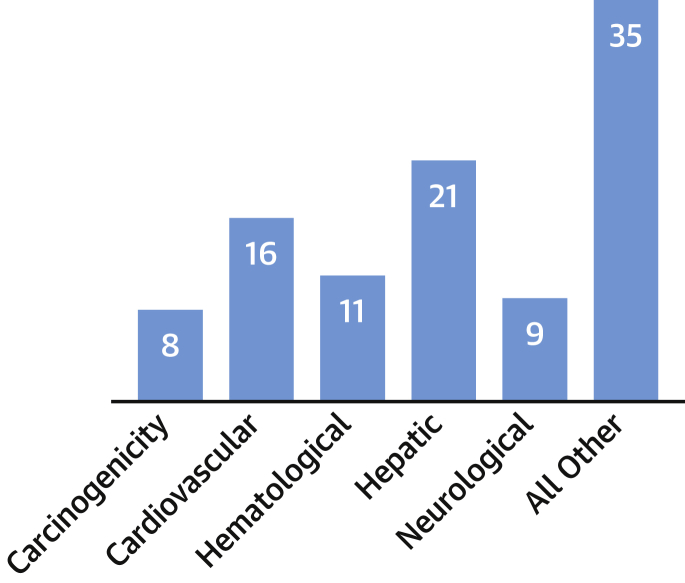
- Post-approval toxicity is common: of 578 discontinued and withdrawn drugs in Europe and the United States, almost one-half were withdrawn or discontinued in post-approval actions due to toxicity; of 93 post-marketing serious adverse outcomes, only 19% were identified in preclinical animal studies. The most common toxicity types associated with U.S. and European drug withdrawals are hepatic (21%), cardiovascular (16%), hematological (11%), neurological (9%), and carcinogenicity (8%).
- Costs and delays are substantial: rodent testing in cancer therapeutics adds an estimated 4 to 5 years and $2 to $4 million; registering a single pesticide takes about 10 years and $3 million in required animal studies; animal tests range from 1.5× to >30× as expensive as in vitro testing. A single 2-generation reproductive animal toxicity study averages €318,295 worldwide and €285,842 in Europe (roughly $349,890 and $314,215).
Methods
- Design: narrative review focused on scientific concerns over the validity of animal research for predicting human toxicity in pharmaceutical development; Part 2 is stated to discuss alternatives.
- Data: published analyses and reviews of animal-to-human toxicity concordance, drug failure and withdrawal statistics, regulatory and historical examples, and cost estimates; no new primary data are collected.
- Analysis: narrative synthesis, including use of positive predictive value, negative predictive value, and likelihood ratios to assess the evidentiary value of animal toxicity tests for human outcomes.
Limitations
- Stated in the paper: no comprehensive reviews of the total overall cost of animal testing in pharmaceutical development appear to exist; even the total number of animals or studies is unknown. The paper also states that a comprehensive study of the accuracy, likelihood ratios, and costs of alternative testing methods compared with animal toxicity testing has not been published, and that the prevalence of human toxicity is unknown once a drug tests positive in animals.
- Stated in the paper: in some analyses, likelihood ratios could not be determined due to a lack of specificity reporting on the tests.
- Evident from the text: this is a narrative review rather than a systematic review, it presents no new primary data, and it includes selected historical and contemporary examples; the second part on alternatives is not included in this paper.
Model-written summary. Check it against the paper before relying on it.
Integrity signals
Registry
Cites
Statistics
Figures
Verification
Claims the paper makes
20 No full text of the sources · 14 Own interpretation · 12 Partly supported · 8 Sources not found · 6 Couldn’t confirm · 4 No basis given · 2 Not checked yet · 1 Supported · 1 Supported so far · 1 Not supported · accuracy not yet measured
The cited sources support only part of this claim — read each source’s verdict below.
In the paper
“The most common toxicity types associated with drug withdrawals in the United States and Europe are hepatic (21%), cardiovascular (16%), hematological (11%), neurological (9%), and carcinogenicity (8%) (Figure 2) (20).”
§ Limitations of Animal Studies for Predicting Toxicity in Clinical Trials > The Price of Wrong Decisions
What the sources say
- Partly supportedcites [20] Siramshetty B.V. Nickel J. Omieczynski C. WITHDRAWN—a resource for withdrawn and discontinued drugs Nucl Acids Res 44 2016 D1080 D1086 26553801 PMC4702851 sourceExperimental — accuracy not yet measured
The Materials and Methods section (‘Toxicity types’; page unavailable) classifies withdrawn drugs using all five named toxicity types. The Introduction says most drugs were reported withdrawn in the United States and European countries. Our copy does not give the claimed percentages or establish that these are the five most common types in those regions. (LLM, conf=0.85)
plaincorrelational- Asserted: passes — The authors put it forward as true.
- Checkable: passes — It can be checked against evidence.
- Load-bearing: unclear — It is unclear whether the paper’s conclusions depend on it.
- Based: passes — The paper gives a reason why it holds.
- Partly supported
The cited sources that could be checked couldn’t confirm or dispute this claim.
In the paper
“Of those, only 60% successfully complete phase I trials (16).”
§ Limitations of Animal Studies for Predicting Toxicity in Clinical Trials > Historical Perspective
What the sources say
- Could not verifycites [16] Van Norman G.A. Drugs, devices and the FDA: part 1: an overview of approval processes for drugs J Am Coll Cardiol Basic Trans Science 1 2016 170 179 PMC6113160 30167510 sourceExperimental — accuracy not yet measured
The ‘Phase I trials’ section describes the purpose and size of these trials but gives no completion rate. I searched the indexed copy for ‘60%’ and Phase I success rates; the Figure 1 caption discusses failure rates generally but does not state that 60% complete Phase I. No page numbers were available for these passages. (LLM, conf=0.73)
plain- Asserted: passes — The authors put it forward as true.
- Checkable: passes — It can be checked against evidence.
- Load-bearing: passes — The paper’s conclusions depend on it.
- Based: passes — The paper gives a reason why it holds.
- Could not verify
The cited sources support only part of this claim — read each source’s verdict below.
In the paper
“In the first decade of the 21st century, approximately one-third of FDA-approved drugs were subsequently cited for safety or toxicity issues. or a combination of both, including human cardiovascular toxicity and brain damage, after remaining on the market for a median of 4.2 years (22,23).”
§ Limitations of Animal Studies for Predicting Toxicity in Clinical Trials > The Price of Wrong Decisions
What the sources say
- Not checked — no full text of the sourcecites [22] Lupkin S. One-Third of New Drugs Had Safety Problems After FDA Approval. NPR: Shots: Health News From NPR Available at: https://www.npr.org/sections/health-shots/2017/05/09/527575055/one-third-of-new-drugs-had-safety-problems-after-fda-approval May 9, 2017
- Partly supportedcites [23] Downing N.S. Shah N.D. Aminawung J.A. Postmarket safety events among novel therapeutics approved by the US Food and Drug Administration between 2001 and 2010 JAMA 317 2017 1854 1863 28492899 PMC5815036 sourceExperimental — accuracy not yet measured
The Results report that 71 of 222 novel therapeutics approved from 2001 through 2010 (32.0%) had a postmarket safety event. The 4.2-year median is the time from approval to the first event among affected therapeutics, not the median time that all approved drugs remained on the market; the paper reports 11.7 years of median market availability overall. Its Results describe cardiovascular safety concerns, but do not identify the cited events as “brain damage.” (LLM, conf=0.88)
plain- Asserted: passes — The authors put it forward as true.
- Checkable: passes — It can be checked against evidence.
- Load-bearing: passes — The paper’s conclusions depend on it.
- Based: passes — The paper gives a reason why it holds.
The cited sources that could be checked couldn’t confirm or dispute this claim.
In the paper
“Review of 37 chemicals studied in the U.S. National Toxicology Program concluded that toxicities other than carcinogenesis were not reproducible between rats and mice, between sexes, or compared with historic control animals.”
§ Limitations of Animal Studies for Predicting Toxicity in Clinical Trials > Historical Perspective
What the sources say
- Could not verifycites [12] Wang B. Gray G. Concordance of noncarcinogenic endpoints in rodent chemical bioassays Risk Anal 35 2015 1154 1166 25545328 sourceExperimental — accuracy not yet measured
The clinical-trials section discusses animal safety studies and single-dose toxicity trials, but not a review of 37 National Toxicology Program chemicals. Searches for that review and for reproducibility across rats, mice, sexes, and historic controls found no passage addressing the claim. (LLM, conf=0.75)
plain- Asserted: passes — The authors put it forward as true.
- Checkable: passes — It can be checked against evidence.
- Load-bearing: passes — The paper’s conclusions depend on it.
- Based: passes — The paper gives a reason why it holds.
- Could not verify
The cited sources support only part of this claim — read each source’s verdict below.
In the paper
“Isuprel for treatment of asthma caused over 3,500 deaths in Great Britain alone, despite safety in rats, guinea pigs, dog, and monkeys, all of which had received doses far exceeding those administered in humans (2,28).”
§ Limitations of Animal Studies for Predicting Toxicity in Clinical Trials > The Price of Wrong Decisions
What the sources say
- Partly supportedcites [2] Greek R. Pippus A. Hansen L.A. The Nuremberg Code subverts human health and safety by requiring animal modeling BMC Med Ethics 13 2012 16 22769234 PMC3532312 sourceExperimental — accuracy not yet measured
The Discussion (Science – empirical evidence) says 3,500 asthmatics died in Great Britain and reports that high-dose studies in rats, guinea pigs, dogs, and monkeys did not elicit similar results. It does not say *over* 3,500 died or establish that the drug was generally safe in those animals; it compares their doses with commercial metered-dose vials, rather than doses administered to humans. (LLM, conf=0.86)
- Could not verifycites [28] Stolley P.D. Asthma mortality: why the United States was spared an epidemic of deaths due to asthma Am Rev Respir Dis 105 1972 883 890 5032708 sourceExperimental — accuracy not yet measured
The IN VIVO STUDIES and THE FIRST DOSE DISASTER sections describe animal testing and severe reactions to TGN1412, not Isuprel. Searches for Isuprel, the claimed 3,500 deaths in Great Britain, and the listed test animals found no passage addressing the claim; page numbers were unavailable in our copy. (LLM, conf=0.75)
plaindirect- Asserted: passes — The authors put it forward as true.
- Checkable: passes — It can be checked against evidence.
- Load-bearing: passes — The paper’s conclusions depend on it.
- Based: passes — The paper gives a reason why it holds.
- Partly supported
The cited sources support only part of this claim — read each source’s verdict below.
In the paper
“A review of 221 animal experiments found agreement in human studies just 50% of the time—essentially randomly (11).”
§ Limitations of Animal Studies for Predicting Toxicity in Clinical Trials > Historical Perspective
What the sources say
- Partly supportedcites [11] Perel P. Roberts I. Sena E. Comparison of treatment effects between animal experiments and clinical trials: systematic review BMJ 334 2007 197 203 17175568 PMC1781970 sourceExperimental — accuracy not yet measured
The Discussion reports agreement for three of six interventions, which supports the 50% figure at the intervention level—not as a rate across 221 individual experiments. The Methodological strengths and weaknesses section says the authors cannot provide a precise estimate of agreement or generalize from six interventions. Our copy does not substantiate the 221 figure or the conclusion that agreement was essentially random. (LLM, conf=0.88)
plainn = 221- Asserted: passes — The authors put it forward as true.
- Checkable: passes — It can be checked against evidence.
- Load-bearing: passes — The paper’s conclusions depend on it.
- Based: passes — The paper gives a reason why it holds.
- Partly supported
The cited sources support only part of this claim — read each source’s verdict below.
In the paper
“Many concerns regarding reliability of animal models in predicting human toxicity are not based on the scientific underpinnings of interspecies translation, but rather call out collateral, potentially correctable issues, such as technical competence in executing animal research, the soundness of animal research study design, and publication bias (Table 2) (67, 68, 69, 70, 71).”
§ Limitations of Animal Studies for Predicting Toxicity in Clinical Trials > Is the Scientific Premise Behind Animal Models Valid?
What the sources say
- Not checked — no full text of the sourcecites [67] Bracken M.B. Why animal studies are often poor predictors of human reactions to exposure J R Soc Med 102 2009 120 122 19297654 PMC2746847 source
- Partly supportedcites [68] van der Worp H.B. Howells D.W. Sena E.S. Can animal models of disease reliably inform human studies? PLoS Med 7 2010 e10000245 PMC2846855 20361020 sourceExperimental — accuracy not yet measured
Split into 2 atoms — 0 confirmed, 2 partially supported, 0 disputed, 0 misattributed, 0 unverifiable. Expand the claim to see per-atom verdicts.
- Not matchedcites [69] Greek R. Kramer L.A. How to evaluate the science of non-human animal use in biomedical research and testing: a proposed format for debate Herrmann K. Jayne K. Animal Experimentation: Working Towards a Paradigm of Change Vol. 22 2019 Brill Open Boston, MA 65 87
Couldn’t be matched to a paper in Crossref, so it can’t be checked.
plain- Asserted: passes — The authors put it forward as true.
- Checkable: passes — It can be checked against evidence.
- Load-bearing: passes — The paper’s conclusions depend on it.
- Based: passes — The paper gives a reason why it holds.
- Rests on an assumption: Animal models are used to predict human toxicity.
The cited sources support only part of this claim — read each source’s verdict below.
In the paper
“Using a database of more than 800,000 animal toxicity studies performed for 350 chemicals under rigorous guidelines, a reviewer found toxicity was repeatable just 70% of the time in the same species (45).”
§ Limitations of Animal Studies for Predicting Toxicity in Clinical Trials > Reproducibility and Interspecies Reliability of Animal Tests
What the sources say
- Partly supportedcites [45] Meigs L. Smirova L. Rovida C. Leist M. Hartung T. Animal testing and its alternatives—the most important omics is economics ALTEX 35 2018 275 305 30008008 sourceExperimental — accuracy not yet measured
In “Abandoned or withdrawn because of false-positive test results” (page unavailable), the paper reports that a repeat guideline animal test identified a toxic compound in 70% of cases. But it describes 800,000 studies associated with 10,000 chemicals in the full database; the repeatability analysis used 350 to 750 chemicals, not 800,000 studies of 350 chemicals. The 70% figure concerns repeat detection of toxic compounds, not overall repeatability of toxicity results. (LLM, conf=0.90)
plainn = 800,000- Asserted: passes — The authors put it forward as true.
- Checkable: passes — It can be checked against evidence.
- Load-bearing: passes — The paper’s conclusions depend on it.
- Based: passes — The paper gives a reason why it holds.
- Partly supported
The cited sources support only part of this claim — read each source’s verdict below.
In the paper
“aspirin (embryo toxicity in rats and rhesus monkeys) (41)”
§ Limitations of Animal Studies for Predicting Toxicity in Clinical Trials > The Price of Wrong Decisions
What the sources say
- Partly supportedcites [41] Wilson J.G. Ritter E.J. Scott W.J. Fradkin R. Comparative distribution and embryotoxicity of acetylsalicylic acid in pregnant rats and rhesus monkeys Toxicol Appl Pharmacol 41 1977 67 78 408942 sourceExperimental — accuracy not yet measured
Section 7, under “False positive drug toxicity,” says aspirin produced birth defects in rats and monkeys. It does not identify the monkeys as rhesus monkeys, so the species-specific part of the claim is unsupported. (LLM, conf=0.88)
plaindirect- Asserted: passes — The authors put it forward as true.
- Checkable: passes — It can be checked against evidence.
- Load-bearing: passes — The paper’s conclusions depend on it.
- Based: passes — The paper gives a reason why it holds.
- Partly supported
The cited sources support only part of this claim — read each source’s verdict below.
In the paper
“Compared with the costs of in vitro testing, animal tests range from 1.5× to >30× as expensive (44,45).”
§ Limitations of Animal Studies for Predicting Toxicity in Clinical Trials > The Price of Wrong Decisions > Time and dollars
What the sources say
- Not matchedcites [44] Humane Society International Costs of Animal and Non-animal Testing. Humane Society International Available at: https://www.hsi.org/news-media/time_and_cost/ October 23, 2012
Couldn’t be matched to a paper in Crossref, so it can’t be checked.
- Partly supportedcites [45] Meigs L. Smirova L. Rovida C. Leist M. Hartung T. Animal testing and its alternatives—the most important omics is economics ALTEX 35 2018 275 305 30008008 sourceExperimental — accuracy not yet measured
Table 4 (section 4; page not supplied) lists a $30,000 animal test against a $20,000 in vitro test (1.5×), and a $700,000 animal test against a $22,000 in vitro test (about 32×). But it also lists a $1,800 rabbit eye test against a $1,400 in vitro test (about 1.3×), so 1.5× is not the lower end of the comparisons shown. (LLM, conf=0.86)
plaincorrelational- Asserted: passes — The authors put it forward as true.
- Checkable: passes — It can be checked against evidence.
- Load-bearing: unclear — It is unclear whether the paper’s conclusions depend on it.
- Based: passes — The paper gives a reason why it holds.
- Not matched
- It may state two separate claims as one. 25
- Probably not a substantial claim. 13
At least one cited source doesn’t support this claim or points to a different paper, and none confirmed it — see the verdicts below.
In the paper
“the average cost of a single, 2-generation reproductive animal toxicity study worldwide is €318,295 and for Europe alone is €285,842 (45), or roughly $349,890 and $314,215, respectively.”
§ Limitations of Animal Studies for Predicting Toxicity in Clinical Trials > The Price of Wrong Decisions > Time and dollars
What the sources say
- Disputedcites [45] Meigs L. Smirova L. Rovida C. Leist M. Hartung T. Animal testing and its alternatives—the most important omics is economics ALTEX 35 2018 275 305 30008008 sourceExperimental — accuracy not yet measured
Section 4 gives the same two euro figures for a two-generation OECD TG 416 study, but assigns them to the opposite regions: €285,842 worldwide and €318,295 in Europe. The citing sentence reverses those assignments. (LLM, conf=0.95)
Checked by a reasoning model — may be wrong.
plain- Asserted: passes — The authors put it forward as true.
- Checkable: passes — It can be checked against evidence.
- Load-bearing: unclear — It is unclear whether the paper’s conclusions depend on it.
- Based: passes — The paper gives a reason why it holds.
It may state two separate claims as one.
- Disputed
The cited sources support only part of this claim — read each source’s verdict below.
In the paper
“An antibody to treat human autoimmune disease, TGN1412, was given at 1/500th the dose found safe in animal testing to 6 human volunteers in a phase I trial (30,31), rendering them all critically ill within minutes and leaving them all with long-term complications (32, 33, 34).”
§ Limitations of Animal Studies for Predicting Toxicity in Clinical Trials > The Price of Wrong Decisions
What the sources say
- Not checked — no full text of the sourcecites [30] Suntharalingam G. Perry M.R. Ward S. Cytokine storm in phase 1 trial of the anti-CD28 monoclonal antibody TGN1312 N Engl J Med 355 2006 1018 1028 16908486 source
- Partly supportedcites [31] Dayan C.M. Wraith D.C. Preparing for first-in-man studies: the challenges for translational immunology post TGN1412 Clin Exp Immunol 151 2008 231 234 18190459 PMC2276942 sourceExperimental — accuracy not yet measured
The paper’s Abstract and Table 1 describe TGN1412 as an anti-CD28 antibody tested in a Phase 1 study of healthy volunteers, with a starting dose calculated as a fraction of an animal-derived no-adverse-effect level. They do not give the claimed 1/500th fraction or specify six recipients. The subsequent claims about illness and long-term complications are attached to different citations in the citing sentence, so they are not assessed here. (LLM, conf=0.85)
- Supportedcites [32] Attarwala H. TGN1412: from discovery to disaster J Young Pharm 2 2010 332 336 21042496 PMC2964774 source
The Abstract states that six volunteers received TGN1412 in a phase I trial at a dose 500 times smaller than one found safe in animal studies. The Introduction describes its proposed use for autoimmune disease. The later claim about long-term complications is attached to different citations, so it is not assessed against this source. (LLM, conf=0.94)
plaindirectn = 6- Asserted: passes — The authors put it forward as true.
- Checkable: passes — It can be checked against evidence.
- Load-bearing: passes — The paper’s conclusions depend on it.
- Based: passes — The paper gives a reason why it holds.
It may state two separate claims as one.
The cited sources support only part of this claim — read each source’s verdict below.
In the paper
“Overall, approximately 89% of novel drugs fail human clinical trials, with approximately one-half of those failures due to unanticipated human toxicity (Figure 1) (17).”
§ Limitations of Animal Studies for Predicting Toxicity in Clinical Trials > Historical Perspective
What the sources say
- Partly supportedcites [17] Van Norman G.A. Phase II trials in drug development and adaptive trial design J Am Coll Cardiol Basic Trans Science 4 2019 428 437 PMC6609997 31312766 sourceExperimental — accuracy not yet measured
The Abstract (page unavailable) says only 9.6% of drugs entering phase I reach the market, broadly supporting the claim that roughly nine in ten fail. But “Why Drugs Fail in Clinical Trials” (page unavailable) attributes previously unknown toxic side effects to 50% of phase II failures, not to half of failures across all human clinical trials. (LLM, conf=0.87)
plaindirect- Asserted: passes — The authors put it forward as true.
- Checkable: passes — It can be checked against evidence.
- Load-bearing: passes — The paper’s conclusions depend on it.
- Based: passes — The paper gives a reason why it holds.
It may state two separate claims as one.
- Partly supported
The cited sources that could be checked couldn’t confirm or dispute this claim.
In the paper
“Combining organ, length of exposure, and sex, PPV between mice and rats hovered around 50%, which is no greater than random chance (12).”
§ Limitations of Animal Studies for Predicting Toxicity in Clinical Trials > Historical Perspective
What the sources say
- Could not verifycites [12] Wang B. Gray G. Concordance of noncarcinogenic endpoints in rodent chemical bioassays Risk Anal 35 2015 1154 1166 25545328 sourceExperimental — accuracy not yet measured
The clinical-trials section discusses animal safety studies as a basis for initial human doses, but does not report predictive values between mice and rats. Searches for PPV, organ, exposure duration, sex, and interspecies toxicity found no passage addressing the claimed approximately 50% result or its comparison with chance. Page numbers were not available in our copy. (LLM, conf=0.76)
plain- Asserted: passes — The authors put it forward as true.
- Checkable: passes — It can be checked against evidence.
- Load-bearing: passes — The paper’s conclusions depend on it.
- Based: passes — The paper gives a reason why it holds.
It may state two separate claims as one.
- Could not verify
The cited sources support only part of this claim — read each source’s verdict below.
In the paper
“BIA-102474-101, a drug developed for a range of disorders from anxiety to Parkinsonism, caused deep brain hemorrhage and necrosis in all 5 human volunteers during a phase I clinical trial after it was administered in doses that were 1/500th of the safe dose for dogs. One volunteer died (35).”
§ Limitations of Animal Studies for Predicting Toxicity in Clinical Trials > The Price of Wrong Decisions
What the sources say
- Partly supportedcites [35] Eddleston M. Cohen A.F. Webb D.J. Implications of the BIA-102474-101 study for review of first-into-human clinical trials Brit J Clin Pharm 81 2016 582 586 PMC4799914 26996741 sourceExperimental — accuracy not yet measured
The clinical-trial section reports deep-brain haemorrhage and necrosis on MRI in five symptomatic participants, one of whom died. The risk-assessment section reports a human dose of 0.67 mg/kg and dog no-observed-adverse-effect levels of 20 and 50 mg/kg/day—not a human dose 1/500th of the dog dose. The paper also describes eight participants in the affected cohort, rather than five volunteers in the trial. (LLM, conf=0.90)
plaindirectn = 5- Asserted: passes — The authors put it forward as true.
- Checkable: passes — It can be checked against evidence.
- Load-bearing: passes — The paper’s conclusions depend on it.
- Based: passes — The paper gives a reason why it holds.
It may state two separate claims as one.
- Partly supported
The cited sources that could be checked couldn’t confirm or dispute this claim.
In the paper
“Average positive predictive value (PPV) from mouse to rat was 55.3% and 44.8% for long-term and short-term studies, respectively.”
§ Limitations of Animal Studies for Predicting Toxicity in Clinical Trials > Historical Perspective
What the sources say
- Could not verifycites [12] Wang B. Gray G. Concordance of noncarcinogenic endpoints in rodent chemical bioassays Risk Anal 35 2015 1154 1166 25545328 sourceExperimental — accuracy not yet measured
The Clinical Trials section discusses animal safety studies and human trial phases, but does not report mouse-to-rat positive predictive values. Searches for both percentages and for mouse-to-rat predictive value in long- and short-term studies found no matching passage in our copy. (LLM, conf=0.75)
plain- Asserted: passes — The authors put it forward as true.
- Checkable: passes — It can be checked against evidence.
- Load-bearing: passes — The paper’s conclusions depend on it.
- Based: passes — The paper gives a reason why it holds.
It may state two separate claims as one.
- Could not verify
The cited sources that could be checked couldn’t confirm or dispute this claim.
In the paper
“An analysis of 2,366 drugs concluded that “results from tests on animals (specifically rat, mouse and rabbit models) are highly inconsistent predictors of toxic responses in humans, and are little better than what would result merely by chance—or tossing a coin—in providing a basis to decide whether a compound should proceed to testing in humans” (13).”
§ Limitations of Animal Studies for Predicting Toxicity in Clinical Trials > Historical Perspective
What the sources say
- Could not verifycites [13] Bailey J. Thew M. Balls M. An analysis of the use of animal models in predicting human toxicology and drug safety Altern Lab Anim 42 2014 189 199 25068930 sourceExperimental — accuracy not yet measured
The supplied passages on phase II and III attrition and false positives discuss clinical-trial results, not animal tests. Searches for 2,366 drugs, rat/mouse/rabbit models, and whether animal tests predict human toxicity found no passage addressing the claim in our copy. (LLM, conf=0.76)
plain- Asserted: passes — The authors put it forward as true.
- Checkable: passes — It can be checked against evidence.
- Load-bearing: passes — The paper’s conclusions depend on it.
- Based: passes — The paper gives a reason why it holds.
It may state two separate claims as one.
- Could not verify
The cited sources that could be checked couldn’t confirm or dispute this claim.
In the paper
“In a review of 2,366 drugs, including data from 3 of the most common animal research species—rat, mouse, and rabbit—PLRs were generally high (i.e., there is a likelihood that positive toxicity tests in animals would show toxicity in humans). But median NLRs were very low—1.12 (rabbit), 1.39 (mouse), and 1.82 (rat); in other words, they were of little or no value in excluding human toxicity (13).”
§ Limitations of Animal Studies for Predicting Toxicity in Clinical Trials > Reproducibility and Interspecies Reliability of Animal Tests > PPV, NPV, and LR
What the sources say
- Could not verifycites [13] Bailey J. Thew M. Balls M. An analysis of the use of animal models in predicting human toxicology and drug safety Altern Lab Anim 42 2014 189 199 25068930 sourceExperimental — accuracy not yet measured
Split into 2 atoms — 0 confirmed, 0 partially supported, 0 disputed, 0 misattributed, 2 unverifiable. Expand the claim to see per-atom verdicts.
plain- Asserted: passes — The authors put it forward as true.
- Checkable: passes — It can be checked against evidence.
- Load-bearing: passes — The paper’s conclusions depend on it.
- Based: passes — The paper gives a reason why it holds.
It may state two separate claims as one.
- Could not verify
The cited sources support only part of this claim — read each source’s verdict below.
In the paper
“The biological sciences have increasingly embraced theories regarding complex systems (e.g., chaos theory and complexity theory) to explain mechanisms in evolution, the biology of cancer, the divergent properties of animal species, as well as the failures of translation of drug therapeutics from animal species to humans (75,76).”
§ Limitations of Animal Studies for Predicting Toxicity in Clinical Trials > Is the Scientific Premise Behind Animal Models Valid?
What the sources say
- Not checked — no full text of the sourcecites [75] Miquel P.A. Extended physics as a theoretical framework for systems biology? Prog Biophys Mol Biol 106 2011 348 352 21463648 source
- Partly supportedcites [76] Soto A.M. Sonnenschein C. Maini P.K. Novle D. Systems biology and cancer Prog Biophys Mol Biol 106 2011 337 346 21843772 PMC4021577 sourceExperimental — accuracy not yet measured
Split into 2 atoms — 0 confirmed, 2 partially supported, 0 disputed, 0 misattributed, 0 unverifiable. Expand the claim to see per-atom verdicts.
plain- Asserted: passes — The authors put it forward as true.
- Checkable: passes — It can be checked against evidence.
- Load-bearing: passes — The paper’s conclusions depend on it.
- Based: passes — The paper gives a reason why it holds.
Probably not a substantial claim.
The paper states this without a source or data behind it here, so there is nothing to check it against. The quote shows it is in the paper.
In the paper
“A comprehensive study of the accuracy, LR, and costs of alternative testing methods compared with animal toxicity testing has not been published”
§ Limitations of Animal Studies for Predicting Toxicity in Clinical Trials > Alternatives to Animal Testing
plain- Asserted: passes — The authors put it forward as true.
- Checkable: passes — It can be checked against evidence.
- Load-bearing: fails — The paper’s conclusions may not depend on it.
- Based: fails — The paper may give no reason why it holds.
Probably not a substantial claim. The paper’s conclusions may not depend on it. The paper may give no reason why it holds.
In the paper
“A 2006 review of 76 animal studies, for example, found that approximately 20% were contradicted in humans and only 37% were ever replicated in humans (10).”
§ Limitations of Animal Studies for Predicting Toxicity in Clinical Trials > Historical Perspective
What the sources say
- Not checked — no full text of the sourcecites [10] Hackam D.G. Redelmeier D.A. Translation of research evidence from animals to humans JAMA 296 2006 1731 1732 17032985 source
plainn = 76- Asserted: passes — The authors put it forward as true.
- Checkable: passes — It can be checked against evidence.
- Load-bearing: passes — The paper’s conclusions depend on it.
- Based: passes — The paper gives a reason why it holds.
It may state two separate claims as one.
A conclusion the paper draws from its own results — it cites no other source for it, so there is none to check. The quote shows it is in the paper.
In the paper
“Because a drug that shows toxicity in animal models is unlikely to ever undergo human testing, the magnitude of this type of “error” is unknown.”
§ Limitations of Animal Studies for Predicting Toxicity in Clinical Trials > The Price of Wrong Decisions
hedgeddirect- Asserted: passes — The authors put it forward as true.
- Checkable: passes — It can be checked against evidence.
- Load-bearing: passes — The paper’s conclusions depend on it.
- Based: passes — The paper gives a reason why it holds.
It may state two separate claims as one.
A conclusion the paper draws from its own results — it cites no other source for it, so there is none to check. The quote shows it is in the paper.
In the paper
“When a human-toxic drug is identified as “safe” by animal testing, the most likely outcome by far is that the drug will fail in clinical testing, often due to unacceptable adverse human effects, and sometimes significantly harming volunteer research subjects in the process.”
§ Limitations of Animal Studies for Predicting Toxicity in Clinical Trials > The Price of Wrong Decisions
boosteddirect- Asserted: passes — The authors put it forward as true.
- Checkable: passes — It can be checked against evidence.
- Load-bearing: passes — The paper’s conclusions depend on it.
- Based: passes — The paper gives a reason why it holds.
It may state two separate claims as one.
In the paper
“paracetamol (toxic in dogs and cats) (40)”
§ Limitations of Animal Studies for Predicting Toxicity in Clinical Trials > The Price of Wrong Decisions
What the sources say
- Not checked — no full text of the sourcecites [40] Villar D. Buck W.B. Gonzalez J.M. Ibuprofen, aspirin and acetaminophen toxicosis and treatment in dogs and cats Vet Human Toxicol 40 1998 156 162 9610496
plaindirect- Asserted: passes — The authors put it forward as true.
- Checkable: passes — It can be checked against evidence.
- Load-bearing: passes — The paper’s conclusions depend on it.
- Based: passes — The paper gives a reason why it holds.
It may state two separate claims as one.
In the paper
“Paglialunga et al. (56) examined translatability of respiratory safety pharmacology studies from animal models to humans and found that PPV and PLR were so low that animal tests provided little value in predicting human toxicity.”
§ Limitations of Animal Studies for Predicting Toxicity in Clinical Trials > Reproducibility and Interspecies Reliability of Animal Tests > PPV, NPV, and LR
What the sources say
- Not checked — no full text of the sourcecites [56] Paglialunga S. Morimoto B.H. Clark M. Friedrichs G.S. Translatability of the S7A core battery respiratory safety pharmacology studies: preclinical respiratory and related clinical adverse events J Pharmacol Toxicol Methods 2019 Jun 5 [E-pub ahead of print] 31173885 source
plain- Asserted: passes — The authors put it forward as true.
- Checkable: passes — It can be checked against evidence.
- Load-bearing: passes — The paper’s conclusions depend on it.
- Based: passes — The paper gives a reason why it holds.
It may state two separate claims as one.
In the paper
“Rodent testing in cancer therapeutics adds an estimated 4 to 5 years to drug development and costs $2 to $4 million.”
§ Limitations of Animal Studies for Predicting Toxicity in Clinical Trials > The Price of Wrong Decisions > Time and dollars
What the sources say
- Not matchedcites [43] Humane Society International Limitations of Animal Tests. Humane Society International Available at: https://www.hsi.org/news-media/limitations-of-animal-tests/ February 24, 2019
Couldn’t be matched to a paper in Crossref, so it can’t be checked.
hedgeddirect- Asserted: passes — The authors put it forward as true.
- Checkable: passes — It can be checked against evidence.
- Load-bearing: unclear — It is unclear whether the paper’s conclusions depend on it.
- Based: passes — The paper gives a reason why it holds.
It may state two separate claims as one.
- Not matched
A claim is checked only against the cited paper’s full text, never its abstract, and none is available for its sources.
In the paper
“The 2019 West Coast Regional Safety Pharmacology Society Meeting discussed concerns about the lack of concordance between animal and human safety studies, including lack of canine and human concordance for proarrhythmia risks of new cardiovascular drugs and the failure of animal research to predict drug-related risks in the human central nervous and respiratory systems (60,61).”
§ Limitations of Animal Studies for Predicting Toxicity in Clinical Trials > Growing Scientific Criticism
What the sources say
- Not checked — no full text of the sourcecites [60] Abi-Gerges N. McMahon C. Vargas H. The west coast regional safety pharmacology society meeting update: filling in the translational gaps in safety assessment J Pharmacol Toxicol Methods 98 2019 106582 31077805 source
- Not checked — no full text of the sourcecites [61] Ewert L. Aylott M. Deurinck M. The concordance between nonclinical and phase I clinical cardiovascular assessment from a cross-company data sharing initiative Toxicol Sci 142 2014 427 435 25246669 source
plain- Asserted: passes — The authors put it forward as true.
- Checkable: passes — It can be checked against evidence.
- Load-bearing: fails — The paper’s conclusions may not depend on it.
- Based: passes — The paper gives a reason why it holds.
Probably not a substantial claim. The paper’s conclusions may not depend on it. It may state two separate claims as one.
In the paper
“Lichtfield (57) examined 6 drugs studied in animal models and found that rats and dogs demonstrated PPVs (for human response) of 0.49 and 0.55, respectively, essentially random chance.”
§ Limitations of Animal Studies for Predicting Toxicity in Clinical Trials > Growing Scientific Criticism
What the sources say
- Not checked — no full text of the sourcecites [57] Lichtfield J.T. Jr. Symposium on clinical drug evaluation and human pharmacology. XVI. Evaluation of the safety of new drugs by means of tests in animals Clin Pharmacol Ther 3 1962 665 672 14465857 source
plainn = 6- Asserted: passes — The authors put it forward as true.
- Checkable: passes — It can be checked against evidence.
- Load-bearing: passes — The paper’s conclusions depend on it.
- Based: passes — The paper gives a reason why it holds.
It may state two separate claims as one.
In the paper
“Bailey et al. (14) found that the presence of toxicity in a species sometimes added evidentiary weight to the risk of toxicity in another, but the reverse was not true: negative toxicity tests in animals did not significantly increase the probability that a toxic test would also be negative in humans, and a lack of toxicity in any species would not reliably indicate a probable lack of toxicity in”
§ Limitations of Animal Studies for Predicting Toxicity in Clinical Trials > Reproducibility and Interspecies Reliability of Animal Tests > PPV, NPV, and LR
What the sources say
- Not checked — no full text of the sourcecites [14] Bailey J. Thew M. Balls M. Predicting human drug toxicity and safety via animal tests: can any one species predict drug toxicity in any other, and do monkeys help? Altern Lab Anim 43 2015 393 403 26753942 source
hedgedcorrelational- Asserted: passes — The authors put it forward as true.
- Checkable: passes — It can be checked against evidence.
- Load-bearing: passes — The paper’s conclusions depend on it.
- Based: passes — The paper gives a reason why it holds.
It may state two separate claims as one.
In the paper
“but the FDA delayed clinical trials for more than a year due to lack of animal studies. The drug was finally approved after a 4-year delay (42).”
§ Limitations of Animal Studies for Predicting Toxicity in Clinical Trials > The Price of Wrong Decisions
What the sources say
- Not checked — no full text of the sourcecites [42] Buhles W.C. Compassionate use: a story of ethics and science in the development of a new drug Monticello M. Perspectives and Biology in Medicine Vol. 54 2011 Johns Hopkins University Press Baltimore, MD 304 315 21857123 source
plaindirect- Asserted: passes — The authors put it forward as true.
- Checkable: passes — It can be checked against evidence.
- Load-bearing: passes — The paper’s conclusions depend on it.
- Based: passes — The paper gives a reason why it holds.
It may state two separate claims as one.
In the paper
“The investigators also examined canine models and found that PPV and PLR for human toxicity were not correlated with 1 another: NLR were low, indicating that the dog provided little evidentiary weight to ruling out toxicity in humans (52).”
§ Limitations of Animal Studies for Predicting Toxicity in Clinical Trials > Reproducibility and Interspecies Reliability of Animal Tests > PPV, NPV, and LR
What the sources say
- Not checked — no full text of the sourcecites [52] Bailey J. Thew M. Balls M. An analysis of the use of dogs in predicting human toxicology and drug safety Altern Lab Anim 2013 335 350 24329742 source
hedged- Asserted: passes — The authors put it forward as true.
- Checkable: passes — It can be checked against evidence.
- Load-bearing: unclear — It is unclear whether the paper’s conclusions depend on it.
- Based: passes — The paper gives a reason why it holds.
It may state two separate claims as one.
A conclusion the paper draws from its own results — it cites no other source for it, so there is none to check. The quote shows it is in the paper.
In the paper
“Once a drug tests positive for toxicity in animals, it is rarely tested against humans, and the prevalence of the real condition the test is being used to “detect”—human toxicity—remains unknown.”
§ Limitations of Animal Studies for Predicting Toxicity in Clinical Trials > Reproducibility and Interspecies Reliability of Animal Tests > PPV, NPV, and LR
plaindirect- Asserted: passes — The authors put it forward as true.
- Checkable: passes — It can be checked against evidence.
- Load-bearing: passes — The paper’s conclusions depend on it.
- Based: unclear — It is unclear why the paper says it holds.
It may state two separate claims as one.
A conclusion the paper draws from its own results — it cites no other source for it, so there is none to check. The quote shows it is in the paper.
In the paper
“Increasingly, scientific organizations and government regulatory agencies are recognizing that alternative methods may replace animal testing and improve the flow and safety of new therapeutics to human use.”
§ Limitations of Animal Studies for Predicting Toxicity in Clinical Trials > Conclusions
hedgedconditional- Asserted: passes — The authors put it forward as true.
- Checkable: passes — It can be checked against evidence.
- Load-bearing: passes — The paper’s conclusions depend on it.
- Based: passes — The paper gives a reason why it holds.
Probably not a substantial claim. It may state two separate claims as one.
A conclusion the paper draws from its own results — it cites no other source for it, so there is none to check. The quote shows it is in the paper.
In the paper
“The quality of methodology in an individual experiment cannot be extrapolated to the question of whether animal experimentation as a whole is invalid, merely to whether the individual experiment is yielding true results.”
§ Limitations of Animal Studies for Predicting Toxicity in Clinical Trials > Is the Scientific Premise Behind Animal Models Valid?
plain- Asserted: passes — The authors put it forward as true.
- Checkable: fails — It may be too vague to check against evidence.
- Load-bearing: fails — The paper’s conclusions may not depend on it.
- Based: passes — The paper gives a reason why it holds.
Probably not a substantial claim. It may be too vague to check against evidence. The paper’s conclusions may not depend on it.
A conclusion the paper draws from its own results — it cites no other source for it, so there is none to check. The quote shows it is in the paper.
In the paper
“To determine whether animal modeling is reliable in current science, we need to use modern scientific knowledge and examine modern methodology to determine whether animal modeling is predictive of human outcomes today.”
§ Limitations of Animal Studies for Predicting Toxicity in Clinical Trials > Is the Scientific Premise Behind Animal Models Valid?
plain- Asserted: passes — The authors put it forward as true.
- Checkable: fails — It may be too vague to check against evidence.
- Load-bearing: passes — The paper’s conclusions depend on it.
- Based: fails — The paper may give no reason why it holds.
Probably not a substantial claim. It may be too vague to check against evidence. The paper may give no reason why it holds.
A conclusion the paper draws from its own results — it cites no other source for it, so there is none to check. The quote shows it is in the paper.
In the paper
“The invalidity of using certain specific animals does not necessarily rule out animal models as a whole.”
§ Limitations of Animal Studies for Predicting Toxicity in Clinical Trials > Is the Scientific Premise Behind Animal Models Valid?
plain- Asserted: passes — The authors put it forward as true.
- Checkable: passes — It can be checked against evidence.
- Load-bearing: fails — The paper’s conclusions may not depend on it.
- Based: passes — The paper gives a reason why it holds.
Probably not a substantial claim. The paper’s conclusions may not depend on it.
A conclusion the paper draws from its own results — it cites no other source for it, so there is none to check. The quote shows it is in the paper.
In the paper
“Although animal toxicity testing has been the stalwart basis of “ensuring” safety of in-human clinical testing and use, examination of the published data raises significant questions about whether it is reliable and should be abandoned or at least significantly curtailed in favor of other potentially more reliable methods.”
§ Limitations of Animal Studies for Predicting Toxicity in Clinical Trials > Conclusions
hedged- Asserted: passes — The authors put it forward as true.
- Checkable: fails — It may be too vague to check against evidence.
- Load-bearing: passes — The paper’s conclusions depend on it.
- Based: passes — The paper gives a reason why it holds.
Probably not a substantial claim. It may be too vague to check against evidence. It may state two separate claims as one.
- Rests on an assumption: Animal toxicity testing has been the stalwart basis of “ensuring” safety of in-human clinical testing and use.
- Rests on an assumption: The published data on animal toxicity testing are sufficient to assess its reliability.
- Rests on an assumption: Animal models are used to predict human toxicity.
In the paper
“The Interagency Coordinating Committee on Validation of Alternative Methods and the National Toxicology Program Interagency Center for the Evaluation of Alternative Toxicological Methods were established in 1997 to coordinate the development, validation, acceptance, and harmonization of alternative toxicological test methods throughout the U.S. government (85) and have as a part of their mission”
§ Limitations of Animal Studies for Predicting Toxicity in Clinical Trials > Alternatives to Animal Testing
What the sources say
- Not matchedcites [85] U.S. ICCVAM Interagency Coordinating Committee on Validation of Alternative Methods. Research Triangle Park, NC: U.S. ICCVAM, 2019 Available at: https://www.niehs.nih.gov/health/materials/interagency_coordinating_committee_on_the_validation_of_alternative_methods_508.pdf
Couldn’t be matched to a paper in Crossref, so it can’t be checked.
plain- Asserted: passes — The authors put it forward as true.
- Checkable: passes — It can be checked against evidence.
- Load-bearing: fails — The paper’s conclusions may not depend on it.
- Based: passes — The paper gives a reason why it holds.
Probably not a substantial claim. The paper’s conclusions may not depend on it. It may state two separate claims as one.
- Not matched
A conclusion the paper draws from its own results — it cites no other source for it, so there is none to check. The quote shows it is in the paper.
In the paper
“Historical use of animal modeling is a poor measure of the validity of current experimentation and methods.”
§ Limitations of Animal Studies for Predicting Toxicity in Clinical Trials > Is the Scientific Premise Behind Animal Models Valid?
plain- Asserted: passes — The authors put it forward as true.
- Checkable: fails — It may be too vague to check against evidence.
- Load-bearing: fails — The paper’s conclusions may not depend on it.
- Based: passes — The paper gives a reason why it holds.
Probably not a substantial claim. It may be too vague to check against evidence. The paper’s conclusions may not depend on it.
None of the sources cited for this claim have been checked yet.
In the paper
“however, there is data suggesting that in vitro testing and other methods are significantly faster and less expensive than animal models (42,44).”
§ Limitations of Animal Studies for Predicting Toxicity in Clinical Trials > Alternatives to Animal Testing
What the sources say
- Not checked — no full text of the sourcecites [42] Buhles W.C. Compassionate use: a story of ethics and science in the development of a new drug Monticello M. Perspectives and Biology in Medicine Vol. 54 2011 Johns Hopkins University Press Baltimore, MD 304 315 21857123 source
- Not matchedcites [44] Humane Society International Costs of Animal and Non-animal Testing. Humane Society International Available at: https://www.hsi.org/news-media/time_and_cost/ October 23, 2012
Couldn’t be matched to a paper in Crossref, so it can’t be checked.
hedgedcorrelational- Asserted: passes — The authors put it forward as true.
- Checkable: passes — It can be checked against evidence.
- Load-bearing: unclear — It is unclear whether the paper’s conclusions depend on it.
- Based: passes — The paper gives a reason why it holds.
It may state two separate claims as one.
In the paper
“A 2019 spending bill passed by the U.S. House of Representatives includes a directive to the National Institutes of Health to accelerate the replacement of nonhuman primates in research with alternative research models (83).”
§ Limitations of Animal Studies for Predicting Toxicity in Clinical Trials > Alternatives to Animal Testing
What the sources say
- Not checked — no full text of the sourcecites [83] Reardon S. U.S. Lawmakers Propose Plan to Reduce Primate Research at the National Institutes of Health. Nature Available at: https://www.nature.com/articles/d41586-019-01511-0?utm_source=twt_nnc and utm_medium=social and utm_campaign=naturenews and sf212424116=1 May 9, 2019 32382118 source
plain- Asserted: passes — The authors put it forward as true.
- Checkable: passes — It can be checked against evidence.
- Load-bearing: fails — The paper’s conclusions may not depend on it.
- Based: passes — The paper gives a reason why it holds.
Probably not a substantial claim. The paper’s conclusions may not depend on it.
A conclusion the paper draws from its own results — it cites no other source for it, so there is none to check. The quote shows it is in the paper.
In the paper
“This argument does not address whether continued use of animal models is scientifically valid, regardless of alternative methods”
§ Limitations of Animal Studies for Predicting Toxicity in Clinical Trials > Is the Scientific Premise Behind Animal Models Valid?
plain- Asserted: passes — The authors put it forward as true.
- Checkable: fails — It may be too vague to check against evidence.
- Load-bearing: passes — The paper’s conclusions depend on it.
- Based: passes — The paper gives a reason why it holds.
Probably not a substantial claim. It may be too vague to check against evidence.
The paper states this without a source or data behind it here, so there is nothing to check it against. The quote shows it is in the paper.
In the paper
“Whereas alternatives to animal research exist or are developing in many areas of medical research, in many instances such alternatives do not exist.”
§ Limitations of Animal Studies for Predicting Toxicity in Clinical Trials > Is the Scientific Premise Behind Animal Models Valid?
plain- Asserted: passes — The authors put it forward as true.
- Checkable: passes — It can be checked against evidence.
- Load-bearing: fails — The paper’s conclusions may not depend on it.
- Based: fails — The paper may give no reason why it holds.
Probably not a substantial claim. The paper’s conclusions may not depend on it. The paper may give no reason why it holds. It may state two separate claims as one.
The paper relies on this without support.
Animal testing is used in pharmaceutical and industrial research to predict human toxicity.
“Animal testing is used in pharmaceutical and industrial research to predict human toxicity”
The paper relies on this without support.
Animal toxicity testing has been the stalwart basis of “ensuring” safety of in-human clinical testing and use.
“Although animal toxicity testing has been the stalwart basis of “ensuring” safety of in-human clinical testing and use”
The paper relies on this without support.
The published data on animal toxicity testing are sufficient to assess its reliability.
“examination of the published data raises significant questions about whether it is reliable”
The paper relies on this without support.
Animal models are used to predict human toxicity.
“reliability of animal models in predicting human toxicity”
Claims other papers make about this one
Each is checked against this paper’s own text: does it say what the citing paper says it does?
The source backs part of the claim, not all of it — or backs it for a different population, condition or comparison.
In the citing paper
“The absence of pharmacokinetic exposure control further confounds interpretation, as toxicities observed in animal models, often at high doses, may not accurately represent risks relevant to clinical settings with relevant efficacious doses (Van Norman, 2019).”
From A large-scale concordance study of toxicity findings across preclinical species and humans for small molecules and biologics (2026) · cites this paper as Van Norman, 2019
Experimental — accuracy not yet measuredThe source backs part of the claim, not all of it — or backs it for a different population, condition or comparison.
In the citing paper
“These events often lack precise analogs in animal models, are subject to broad etiologic variability, or are under-detected due to behavioral and physiological differences across species (Van Norman, 2019; Lu et al., 2023; Wu et al., 2023).”
From A large-scale concordance study of toxicity findings across preclinical species and humans for small molecules and biologics (2026) · cites this paper as Van Norman, 2019
Experimental — accuracy not yet measuredThe source backs part of the claim, not all of it — or backs it for a different population, condition or comparison.
In the citing paper
“Such limitations align with broader critiques of the challenges in predicting certain human toxicities from animal studies, especially for nuanced functional and neurobehavioral endpoints (Van Norman, 2019).”
From A large-scale concordance study of toxicity findings across preclinical species and humans for small molecules and biologics (2026) · cites this paper as Van Norman, 2019
Experimental — accuracy not yet measured
Self-check
Percentages, sums and reported differences re-computed from the paper’s own numbers.
Each contradiction between two passages listed here was confirmed by an independent check.
Rated major: it would touch a result — a value a result rests on, reported and recomputed p-values on opposite sides of the significance level, two passages that conflict with no sign which is right, or a cited work retracted before this paper was published.
In the paper
§ Limitations of Animal Studies for Predicting Toxicity in Clinical Trials > Historical Perspective
“The third column demonstrates what would happen if animal and human toxicity were closely correlated and therefore drugs with human toxicity were eliminated at the preclinical testing stage by animal toxicity testing (one-half of all drug failures in clinical trials are due to toxicity issues despite safety in animals).”
§ Limitations of Animal Studies for Predicting Toxicity in Clinical Trials > Historical Perspective
“Success rates of clinical trials increase from 11.7% overall to approximately 56%.”
Rated minor: it would not touch a result — a value no result rests on, a p-value that stays on the same side of the significance level, or a conflict that is clerical, resolved elsewhere in the paper, or outside its own findings.
In the paper
§ Limitations of Animal Studies for Predicting Toxicity in Clinical Trials > Reproducibility and Interspecies Reliability of Animal Tests > PPV, NPV, and LR
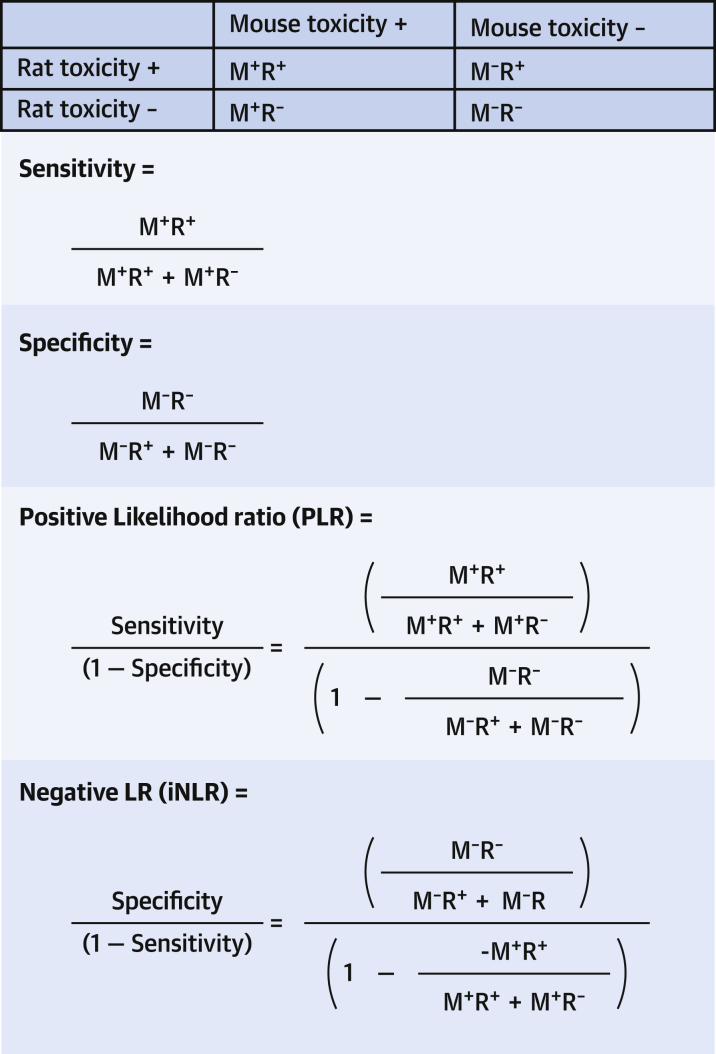
“The negative likelihood ratio (NLR) indicates how much the probability that a condition exists decreases compared with its pre-test probability, given a negative test result.”
§ Limitations of Animal Studies for Predicting Toxicity in Clinical Trials > Reproducibility and Interspecies Reliability of Animal Tests > PPV, NPV, and LR
“For an NLR of <1.0, for any subject with a negative test, the probability that they do not have the condition also decreases compared with the pre-test probability.”
Rated minor: it would not touch a result — a value no result rests on, a p-value that stays on the same side of the significance level, or a conflict that is clerical, resolved elsewhere in the paper, or outside its own findings.
In the paper
§ Limitations of Animal Studies for Predicting Toxicity in Clinical Trials > Reproducibility and Interspecies Reliability of Animal Tests > PPV, NPV, and LR
“The change in post-test probability from pre-test probability is calculated by multiplying the pre-test probability (prevalence) by the PLR or NLR.”
§ Limitations of Animal Studies for Predicting Toxicity in Clinical Trials > Reproducibility and Interspecies Reliability of Animal Tests > PPV, NPV, and LR
“it requires knowing the sensitivity and specificity of a test and pre-test probabilities, conversion of probabilities to odds and back again”
Cited works that were retracted
Works this paper cites that were later retracted, from the retraction notices publishers deposit. Major when the notice came out before this paper was published.
A note, not an issue: for example, a cited work that was retracted only after this paper was published, which its authors could not have known.
In the paper
“The most common toxicity types associated with drug withdrawals in the United States and Europe are hepatic (21%), cardiovascular (16%), hematological (11%), neurological (9%), and carcinogenicity (8%) (Figure 2) (20).”
Cited work 10.1093/nar/gkv1192 · retraction date not known · this paper published 2019-11
Citations
Cites
1 retracted
WITHDRAWN—a resource for withdrawn and discontinued drugs
Siramshetty, V. B., Nickel, J., Omieczynski, C., Gohlke, B.-O., Drwal, M. N., & Preissner, R. (2016) · Nucleic Acids Research · doi:10.1093/nar/gkv1192 · Cited by 286 · cited 2×
“The most common toxicity types associated with drug withdrawals in the United States and Europe are hepatic (21%), cardiovascular (16%), hematological (11%), neurological (9%), and carcinogenicity (8%) (Figure 2) (20).”
BackgroundRetractedHeart Disease and Stroke Statistics—2020 Update: A Report From the American Heart Association
Virani, S. S., Alonso, A., Benjamin, E. J., Bittencourt, M. S., Callaway, C. W., Carson, A. P., Chamberlain, A. M., Chang, A. R., Cheng, S., Delling, F. N., et al. (2020) · Circulation · doi:10.1161/cir.0000000000000757 · Cited by 9,175
Drug repositioning: identifying and developing new uses for existing drugs
Ashburn, T. T., & Thor, K. B. (2004) · Nature Reviews Drug Discovery · doi:10.1038/nrd1468 · Cited by 3,237
Cytokine Storm in a Phase 1 Trial of the Anti-CD28 Monoclonal Antibody TGN1412
Suntharalingam, G., Perry, M. R., Ward, S., Brett, S. J., Castello-Cortes, A., Brunner, M. D., & Panoskaltsis, N. (2006) · New England Journal of Medicine · doi:10.1056/nejmoa063842 · Cited by 2,164
Diagnostic tests 4: likelihood ratios
Deeks, J. J., & Altman, D. G. (2004) · BMJ · doi:10.1136/bmj.329.7458.168 · Cited by 1,600
Can Animal Models of Disease Reliably Inform Human Studies?
van der Worp, H. B., Howells, D. W., Sena, E. S., Porritt, M. J., Rewell, S., O'Collins, V., & Macleod, M. R. (2010) · PLoS Medicine · doi:10.1371/journal.pmed.1000245 · Cited by 1,354
Timing of new black box warnings and withdrawals for prescription medications
Lasser, K. E. (2002) · JAMA · doi:10.1001/jama.287.17.2215 · Cited by 1,005
A Human Disease Model of Drug Toxicity–Induced Pulmonary Edema in a Lung-on-a-Chip Microdevice
Huh, D., Leslie, D. C., Matthews, B. D., Fraser, J. P., Jurek, S., Hamilton, G. A., Thorneloe, K. S., McAlexander, M. A., & Ingber, D. E. (2012) · Science Translational Medicine · doi:10.1126/scitranslmed.3004249 · Cited by 993
McGee, S. (2002) · Journal of General Internal Medicine · doi:10.1046/j.1525-1497.2002.10750.x · Cited by 894 · cited 1×
“, a Fagan’s nomogram) or log calculator to determine how much a test is likely to improve (or decrease) the chances of detecting the condition (53).”
BackgroundLarge-scale prediction and testing of drug activity on side-effect targets
Lounkine, E., Keiser, M. J., Whitebread, S., Mikhailov, D., Hamon, J., Jenkins, J. L., Lavan, P., Weber, E., Doak, A. K., Côté, S., et al. (2012) · Nature · doi:10.1038/nature11159 · Cited by 892
Research works printed but not linked: 2
- Schardein, 1976, 5, 49
- Sankar, 2005, The delicate toxicity balance in drug discovery, Scientist, 19, 32
Cited by
Sorted by citations
Organ-on-a-Chip: A New Paradigm for Drug Development
Ma, C., Peng, Y., Li, H., & Chen, W. (2020) · Trends in Pharmacological Sciences · doi:10.1016/j.tips.2020.11.009 · Cited by 612
“Because of variable responses and unexpected toxicity in humans, approximately 40% of the newly developed drugs fail clinical trials even after accomplishing preclinical evaluation with animal models [5].”
BackgroundThe Importance of Animal Models in Biomedical Research: Current Insights and Applications
Domínguez-Oliva, A., Hernández-Ávalos, I., Martı́nez-Burnes, J., Olmos-Hernández, A. S., Verduzco-Mendoza, A., & Mota‐Rojas, D. (2023) · Animals · doi:10.3390/ani13071223 · Cited by 322
Organoids: The current status and biomedical applications
Yang, S., Hu, H., Kung, H., Zou, R.-Q., Dai, Y.-S., Hu, Y.-F., Wang, T., Lv, T., Yu, J., & Li, F. (2023) · MedComm · doi:10.1002/mco2.274 · Cited by 300
A framework for establishing scientific confidence in new approach methodologies
van der Zalm, A. J., Barroso, J., Browne, P., Casey, W., Gordon, J., Henry, T. R., Kleinstreuer, N., Lowit, A., Perron, M. M., & Clippinger, A. J. (2022) · Archives of Toxicology · doi:10.1007/s00204-022-03365-4 · Cited by 296
The evolving role of investigative toxicology in the pharmaceutical industry
Pognan, F., Beilmann, M., Boonen, H. C. M., Czich, A., Dear, G. J., Hewitt, P. G., Mow, T. J., Oinonen, T., Roth, A. B., Steger‐Hartmann, T., et al. (2023) · Nature Reviews Drug Discovery · doi:10.1038/s41573-022-00633-x · Cited by 280
Metadata
- Authors
- Van Norman, G. A.
- Venue
- JACC: Basic to Translational Science
- Publisher
- Elsevier BV
- Published
- 2019-11
- Volume
- 4
- Issue
- 7
- Pages
- 845-854
- ISSN
- 2452-302X (ISSN-L)
- PMC
- PMC6978558
- OpenAlex
- W2990376563
- Semantic Scholar
- a2a9d2d371770e1ed07ef2f37ee2de2649caa0c0
- Cited by
- 732
- References
- 118
- Citations by year
- 2026: 128 · 2025: 149 · 2024: 159 · 2023: 110 · 2022: 104 · 2021: 59 · 2020: 21
- FWCI
- 68.93
- Type
- journal article
- Language
- en
- Open access
- gold
- doi.org
- Licence
- Locations
- JACC Basic to Translational Science (publishedVersion, cc-by-nc-nd)
- PubMed Central (publishedVersion, cc-by-nc-nd)
- PubMed (publishedVersion)
- DOAJ (DOAJ: Directory of Open Access Journals) (submittedVersion, cc-by-sa)
- Topics
- Health Sciences › Veterinary › Small Animals › Animal testing and alternatives
- Life Sciences › Immunology and Microbiology › Immunology › Immunotoxicology and immune responses
- Health Sciences › Veterinary › Small Animals › Veterinary Pharmacology and Anesthesia
- Keywords
- animal experimentation, animal models, drug safety, translational research, alternatives to animal testing, clinical trials, drug development, drug approval delays
About these checks
Registry, retraction, Cites and statistics results are computed, not judged, with one exception: a printed reference that no index lists is read once by a model before it counts as a citation error. Claims are extracted by a model and kept only when their quote appears verbatim in the text; each cited source is then checked, with a model’s help, for whether it says what the claim relies on. Those verdicts can be wrong — read the claim’s quote and the cited source before relying on one.
A language model drew the claims from the paper on 2026-10-07, under version 3 of the claim definition (model deepseek-v4.1-flash, prompt extract-v3).
A second model labelled each claim on 2026-10-07 (model jev-1.13-20260917, definition revision gold-guideline-v0.2).
Cited sources are checked with a language model’s help (gpt-6-sol).
Statistics and arithmetic are recomputed, not judged.
Confidence bands are shown only for fields calibrated on our annotated test set. None is calibrated yet, so no band is shown.
What counts as a claim ›How we measure confidence ›How we check this ›
Are you an author, or do you see a problem with this page? Request a review
