

The DOI matches its Crossref record; 73 of the 80 references it cites were found in a registry or an index.
Are there interactional differences between telephone and face-to-face psychological therapy? A systematic review of comparative studies
Open accessAbstract
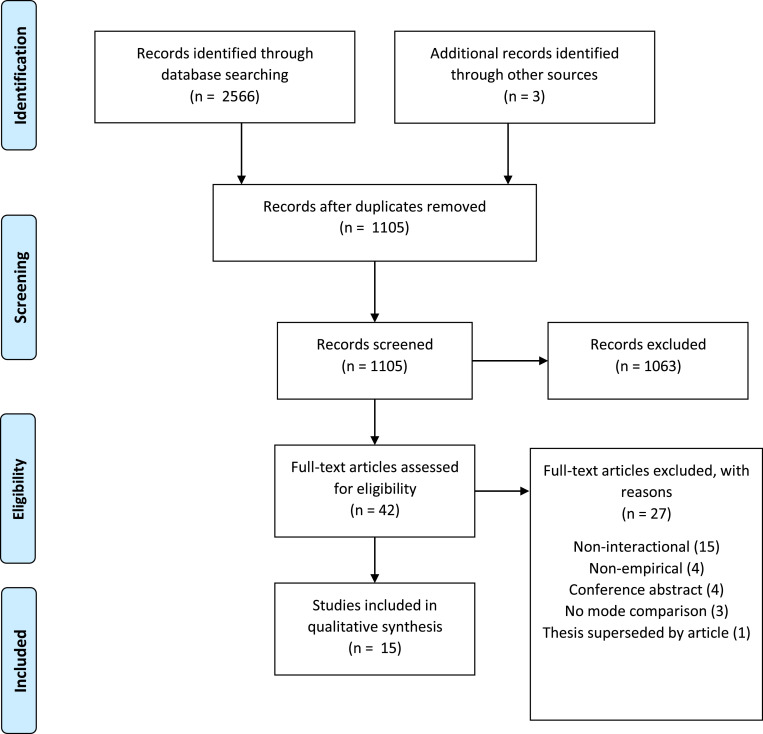
BACKGROUND: Despite comparable clinical outcomes, therapists and patients express reservations about the delivery of psychological therapy by telephone. These concerns centre around the quality of the therapeutic relationship and the ability to exercise professional skill and judgement in the absence of visual cues. However, the empirical evidence base for such perceptions has not been clearly established. METHODS: We conducted a systematic review to establish what is known empirically about interactional differences between psychotherapeutic encounters conducted face-to-face vs. by telephone. RESULTS: The review identified 15 studies that used situated, comparative approaches to exploring interactional aspects of telephone and face-to-face psychological therapy. These studies revealed evidence of little difference between modes in terms of therapeutic alliance, disclosure, empathy, attentiveness or participation. However, telephone therapy sessions were significantly shorter than those conducted face-to-face. LIMITATIONS: We identified only a small number of heterogeneous studies, many of which used non-randomised, opportunity samples and did not use validated measures to assess the constructs under investigation. Disparate therapeutic modalities were used across studies and samples included both clinically diagnosed and non-clinical populations. CONCLUSIONS: Available evidence suggests a lack of support for the viewpoint that the telephone has a detrimental effect on interactional aspects of psychological therapy. The challenge for clinical practice is to translate this evidence into a change in practitioner and patient attitudes and behaviours. In order to do so, it is important to understand and address the breadth of factors that underpin ongoing ambivalence towards the telephone mode, which pose a barrier to wider implementation.
Overview
The claims and statistics of this paper haven’t been checked yet.
Run the check — free, no account needed. It reads the open-access text and checks the sources it cites.
Integrity signals
Registry
Cites
Statistics
Figures
Verification
Claims the paper makes
The claims and statistics of this paper haven’t been checked yet.
Run the check — free, no account needed. It reads the open-access text and checks the sources it cites.
Claims other papers make about this one
Each is checked against this paper’s own text: does it say what the citing paper says it does?
The cited source says what the claim attributes to it.
In the citing paper
“Despite sporicidal skepticism, the good therapeutic relationship reported in our and earlier studies (Bee et al., 2010; Haller et al., 2019) is in line with studies reporting no difference in therapeutic relationship in telephone- or face-to-face therapy (Irvine et al., 2020; Stiles-Shields et al., 2014).”
Self-check
Percentages, sums and reported differences re-computed from the paper’s own numbers.
The self-check needs the paper’s full text.
Citations
Cites
PRISMA-P Group, Moher, D., Shamseer, L., Clarke, M., Ghersi, D., Liberati, A., Petticrew, M., Shekelle, P., & Stewart, L. A. (2015) · Systematic Reviews · doi:10.1186/2046-4053-4-1 · Cited by 26,223 · cited 2×
“The paper followed the PRISMA guidelines for reporting of systematic reviews and metaanalyses (Moher et al., 2015).”
MethodThe American Psychological Association
Langfeld, H. S. (1919) · Science · doi:10.1126/science.49.1254.51 · Cited by 7,453
Development and validation of the working alliance inventory
Horvath, A. O., & Greenberg, L. S. (1989) · Journal of Counseling Psychology · doi:10.1037//0022-0167.36.2.223 · Cited by 3,520 · cited 2×
“, 2014) considered patient and/or therapist ratings of therapeutic alliance across telephone and face-to-face therapy sessions, using versions of the Working Alliance Inventory (WAI; Horvath and Greenberg, 1989).”
MethodThe Effectiveness of Telemental Health: A 2013 Review
Hilty, D. M., Ferrer, D. C., Parish, M. B., Johnston, B., Callahan, E. J., & Yellowlees, P. M. (2013) · Telemedicine and e-Health · doi:10.1089/tmj.2013.0075 · Cited by 1,048 · cited 1×
“These various modes, sometimes referred to collectively as „telemental health‟ or „telepsychology‟ (e.g. American Psychological Association, 2013; Hilty et al., 2013; Langarizadeh at al., 2016), include telephone, videoconference, email, text message and web-based interventions, alongside the traditional face-to-face…”
BackgroundReducing Patients’ Unmet Concerns in Primary Care: the Difference One Word Can Make
Heritage, J., Robinson, J. D., Elliott, M. N., Beckett, M. K., & Wilkes, M. S. (2007) · Journal of General Internal Medicine · doi:10.1007/s11606-007-0279-0 · Cited by 436
Depression in adults: recognition and management
(2017) · Clinical pharmacist · doi:10.1211/cp.2017.20202439 · Cited by 396
Robinson, J. D. (2003) · Health Communication · doi:10.1207/s15327027hc1501_2 · Cited by 393 · cited 1×
“The method of Conversation Analysis (CA) offers a proven method for adding understanding to the interactional processes of clinical encounters (Drew et al., 2001; Heritage and Maynard, 2006; Heritage and Robinson, 2006; Perakyla et al., 2008; Robinson, 2003; Robinson and Heritage, 2006).”
MethodThe Social Impact of the Telephone
Tarr, J. A., & Pool, I. D. S. (1978) · Journal of American History · doi:10.2307/1901515 · Cited by 381
Conversation Analysis and Psychotherapy
Peräkylä, A., Antaki, C., Vehviläinen, S., & Leudar, I. (2008) · Cambridge University Press eBooks · doi:10.1017/cbo9780511490002 · Cited by 376 · cited 1×
“The method of Conversation Analysis (CA) offers a proven method for adding understanding to the interactional processes of clinical encounters (Drew et al., 2001; Heritage and Maynard, 2006; Heritage and Robinson, 2006; Perakyla et al., 2008; Robinson, 2003; Robinson and Heritage, 2006).”
MethodDrew, P., Chatwin, J., & Collins, S. L. (2001) · Health Expectations · doi:10.1046/j.1369-6513.2001.00125.x · Cited by 367 · cited 1×
“The method of Conversation Analysis (CA) offers a proven method for adding understanding to the interactional processes of clinical encounters (Drew et al., 2001; Heritage and Maynard, 2006; Heritage and Robinson, 2006; Perakyla et al., 2008; Robinson, 2003; Robinson and Heritage, 2006).”
Method
Research works printed but not linked: 7
- Antonioni, D.T., 1973. A field study comparison of counselor empathy, concreteness and client self-exploration in face-to-face and telephone counseling during first and second interviews(Doctoral Thesis). University of Wisconsin, USA.
- Brown, L. J., 1985. Antecedents of compliance in employee assistance programs: telephone vs. face-to-face communications(Doctoral Thesis). University of Windsor, Ontario, Canada.
- Daniel, L.S., 1973. A study of the influence of introversion-extraversion and neuroticism on telephone counseling vs. face to face counselling(Doctoral Thesis). University of Texas, Austin, USA.
- 2014, Psychological therapies: Annual report on the use of IAPT Services 2013/14, Experimental statistics.
- Spiro, 1992, Telephone Therapy: Enhancement of the Psychotherapeutic Process, Psychoth. Private Pract., 94, 31
- Spizman, P., 2001. Is Counseling by Telephone Effective?(Doctoral Thesis). University of Pennsylvania, Indiana. USA.
- Webb, C., 2014. A qualitative study of the therapeutic alliance during telephone cognitive behavioural therapy: Clinicians’ perspectives(Doctoral Thesis). University of East Anglia, UK.
Cited by
Sorted by citations
Rauschenberg, C., Schick, A., Hirjak, D., Seidler, A., Paetzold, I., Apfelbacher, C., Riedel-Heller, S. G., & Reininghaus, U. (2021) · Journal of Medical Internet Research · doi:10.2196/23365 · Cited by 205
“…that use videoconference tools or the telephone has also been well documented in depressive [80-83], anxiety [80,83-85], and psychotic disorders [86], with comparable effects for online group and individual therapy sessions [87,88], compared with conventional (offline) therapy sessions.”
BackgroundResearch priorities for the COVID‐19 pandemic and beyond: A call to action for psychological science
O'Connor, D. B., Aggleton, J. P., Chakrabarti, B., Cooper, C. L., Creswell, C., Dunsmuir, S., Fiske, S. T., Gathercole, S., Gough, B., Ireland, J. L., et al. (2020) · British Journal of Psychology · doi:10.1111/bjop.12468 · Cited by 210
“Psychological therapies and behaviour change interventions can already be delivered remotely and evidence suggests that remote delivery does not necessarily mean inferior delivery (e.g., Irvine et al. , 2020).”
BackgroundPsychological Intervention and COVID-19: What We Know So Far and What We Can Do
Inchausti, F., MacBeth, A. M., Hasson‐Ohayon, I., & Dimaggio, G. (2020) · Journal of Contemporary Psychotherapy · doi:10.1007/s10879-020-09460-w · Cited by 170
Alkureishi, M. A., Choo, Z.-Y., Rahman, A., Ho, K., Benning-Shorb, J., Lenti, G., Velázquez Sánchez, I., Zhu, M., Shah, S. D., & Lee, W. W. (2021) · JMIR Human Factors · doi:10.2196/33364 · Cited by 143
“In studies with seniors and in mental health settings, audio-only phone visits were as effective as video in resolving urgent and nonemergent needs [90,91].”
BackgroundRosen, C. S., Morland, L. A., Glassman, L. H., Marx, B. P., Weaver, K. R., Smith, C. A., Pollack, S. J., & Schnurr, P. P. (2020) · American Psychologist · doi:10.1037/amp0000751 · Cited by 119
“A recent review suggests that therapeutic alliance and process factors in telephone therapy tend to be similar to in-person psychotherapy (Irvine et al., 2020).”
Background
Metadata
- Authors
- Irvine, A., Drew, P., Bower, P., Brooks, H., Gellatly, J., Armitage, C. J., Barkham, M., McMillan, D., & Bee, P.
- Affiliations
- University of York (GB)
- Manchester Academic Health Science Centre (GB)
- University of Liverpool (GB)
- University of Manchester (GB)
- University of Sheffield (GB)
- Corresponding author
- Irvine, Annie
- ORCID
- Venue
- Journal of Affective Disorders
- Publisher
- Elsevier BV
- Published
- 2020-03
- Volume
- 265
- Pages
- 120-131
- ISSN
- 0165-0327 (ISSN-L)
- PMC
- PMC7049904
- OpenAlex
- W2998977303
- Cited by
- 196
- References
- 80
- Citations by year
- 2026: 13 · 2025: 13 · 2024: 17 · 2023: 41 · 2022: 35 · 2021: 52 · 2020: 25
- FWCI
- 6.41
- Type
- journal article
- Language
- en
- Open access
- hybrid
- doi.org
- Licence
- Locations
- Journal of Affective Disorders (publishedVersion, cc-by-nc-nd)
- Europe PMC (PubMed Central) (publishedVersion, cc-by-nc-nd)
- PubMed Central (publishedVersion, cc-by-nc-nd)
- PubMed (publishedVersion)
- White Rose Research Online (University of Leeds, The University of Sheffield, University of York) (acceptedVersion)
- Research Explorer (The University of Manchester) (submittedVersion, cc-by-nc-nd)
- Funders
- National Institute for Health Research (RP-PG-1016-20010)
- Department of Health and Social Care
- Manchester Biomedical Research Centre
- NIHR Greater Manchester Patient Safety Translational Research Centre
- Topics
- Health Sciences › Medicine › Public Health, Environmental and Occupational Health › Telemedicine and Telehealth Implementation
- Social Sciences › Psychology › Clinical Psychology › Psychotherapy Techniques and Applications
- Social Sciences › Psychology › Applied Psychology › Digital Mental Health Interventions
- Keywords
- face-to-face psychotherapy, therapeutic relationship, empathy, patient participation, disclosure, session duration, therapist attitudes, patient attitudes
- MeSH terms
- Empathy, Humans, Telephone, Exercise
About these checks
Registry, retraction, Cites and statistics results are computed, not judged, with one exception: a printed reference that no index lists is read once by a model before it counts as a citation error. Claims are extracted by a model and kept only when their quote appears verbatim in the text; each cited source is then checked, with a model’s help, for whether it says what the claim relies on. Those verdicts can be wrong — read the claim’s quote and the cited source before relying on one.
Statistics and arithmetic are recomputed, not judged.
Confidence bands are shown only for fields calibrated on our annotated test set. None is calibrated yet, so no band is shown.
What counts as a claim ›How we measure confidence ›How we check this ›
Are you an author, or do you see a problem with this page? Request a review
