

The DOI matches its Crossref record; 73 of the 80 references it cites were found in a registry or an index.
Are there interactional differences between telephone and face-to-face psychological therapy? A systematic review of comparative studies
Open accessAbstract
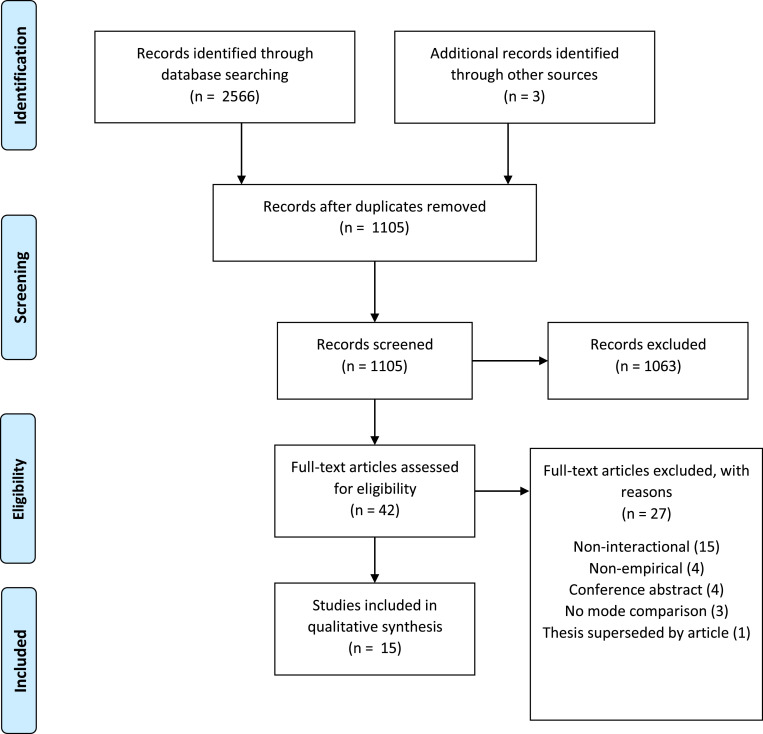
BACKGROUND: Despite comparable clinical outcomes, therapists and patients express reservations about the delivery of psychological therapy by telephone. These concerns centre around the quality of the therapeutic relationship and the ability to exercise professional skill and judgement in the absence of visual cues. However, the empirical evidence base for such perceptions has not been clearly established. METHODS: We conducted a systematic review to establish what is known empirically about interactional differences between psychotherapeutic encounters conducted face-to-face vs. by telephone. RESULTS: The review identified 15 studies that used situated, comparative approaches to exploring interactional aspects of telephone and face-to-face psychological therapy. These studies revealed evidence of little difference between modes in terms of therapeutic alliance, disclosure, empathy, attentiveness or participation. However, telephone therapy sessions were significantly shorter than those conducted face-to-face. LIMITATIONS: We identified only a small number of heterogeneous studies, many of which used non-randomised, opportunity samples and did not use validated measures to assess the constructs under investigation. Disparate therapeutic modalities were used across studies and samples included both clinically diagnosed and non-clinical populations. CONCLUSIONS: Available evidence suggests a lack of support for the viewpoint that the telephone has a detrimental effect on interactional aspects of psychological therapy. The challenge for clinical practice is to translate this evidence into a change in practitioner and patient attitudes and behaviours. In order to do so, it is important to understand and address the breadth of factors that underpin ongoing ambivalence towards the telephone mode, which pose a barrier to wider implementation.
Overview
The claims and statistics of this paper haven’t been checked yet.
Run the check — free, no account needed. It reads the open-access text and checks the sources it cites.
Integrity signals
Registry
Cites
Statistics
Figures
Verification
Claims the paper makes
The claims and statistics of this paper haven’t been checked yet.
Run the check — free, no account needed. It reads the open-access text and checks the sources it cites.
Claims other papers make about this one
Each is checked against this paper’s own text: does it say what the citing paper says it does?
The cited source says what the claim attributes to it.
In the citing paper
“Despite sporicidal skepticism, the good therapeutic relationship reported in our and earlier studies (Bee et al., 2010; Haller et al., 2019) is in line with studies reporting no difference in therapeutic relationship in telephone- or face-to-face therapy (Irvine et al., 2020; Stiles-Shields et al., 2014).”
Self-check
Percentages, sums and reported differences re-computed from the paper’s own numbers.
The self-check needs the paper’s full text.
Citations
Cites
PRISMA-P Group, Moher, D., Shamseer, L., Clarke, M., Ghersi, D., Liberati, A., Petticrew, M., Shekelle, P., & Stewart, L. A. (2015) · Systematic Reviews · doi:10.1186/2046-4053-4-1 · Cited by 26,223 · cited 2×
“The paper followed the PRISMA guidelines for reporting of systematic reviews and metaanalyses (Moher et al., 2015).”
MethodThe American Psychological Association
Langfeld, H. S. (1919) · Science · doi:10.1126/science.49.1254.51 · Cited by 7,453
Development and validation of the working alliance inventory
Horvath, A. O., & Greenberg, L. S. (1989) · Journal of Counseling Psychology · doi:10.1037//0022-0167.36.2.223 · Cited by 3,520 · cited 2×
“, 2014) considered patient and/or therapist ratings of therapeutic alliance across telephone and face-to-face therapy sessions, using versions of the Working Alliance Inventory (WAI; Horvath and Greenberg, 1989).”
MethodThe Effectiveness of Telemental Health: A 2013 Review
Hilty, D. M., Ferrer, D. C., Parish, M. B., Johnston, B., Callahan, E. J., & Yellowlees, P. M. (2013) · Telemedicine and e-Health · doi:10.1089/tmj.2013.0075 · Cited by 1,048 · cited 1×
“These various modes, sometimes referred to collectively as „telemental health‟ or „telepsychology‟ (e.g. American Psychological Association, 2013; Hilty et al., 2013; Langarizadeh at al., 2016), include telephone, videoconference, email, text message and web-based interventions, alongside the traditional face-to-face…”
BackgroundReducing Patients’ Unmet Concerns in Primary Care: the Difference One Word Can Make
Heritage, J., Robinson, J. D., Elliott, M. N., Beckett, M. K., & Wilkes, M. S. (2007) · Journal of General Internal Medicine · doi:10.1007/s11606-007-0279-0 · Cited by 436
Depression in adults: recognition and management
(2017) · Clinical pharmacist · doi:10.1211/cp.2017.20202439 · Cited by 396
Robinson, J. D. (2003) · Health Communication · doi:10.1207/s15327027hc1501_2 · Cited by 393 · cited 1×
“The method of Conversation Analysis (CA) offers a proven method for adding understanding to the interactional processes of clinical encounters (Drew et al., 2001; Heritage and Maynard, 2006; Heritage and Robinson, 2006; Perakyla et al., 2008; Robinson, 2003; Robinson and Heritage, 2006).”
MethodThe Social Impact of the Telephone
Tarr, J. A., & Pool, I. D. S. (1978) · Journal of American History · doi:10.2307/1901515 · Cited by 381
Conversation Analysis and Psychotherapy
Peräkylä, A., Antaki, C., Vehviläinen, S., & Leudar, I. (2008) · Cambridge University Press eBooks · doi:10.1017/cbo9780511490002 · Cited by 376 · cited 1×
“The method of Conversation Analysis (CA) offers a proven method for adding understanding to the interactional processes of clinical encounters (Drew et al., 2001; Heritage and Maynard, 2006; Heritage and Robinson, 2006; Perakyla et al., 2008; Robinson, 2003; Robinson and Heritage, 2006).”
MethodDrew, P., Chatwin, J., & Collins, S. L. (2001) · Health Expectations · doi:10.1046/j.1369-6513.2001.00125.x · Cited by 367 · cited 1×
“The method of Conversation Analysis (CA) offers a proven method for adding understanding to the interactional processes of clinical encounters (Drew et al., 2001; Heritage and Maynard, 2006; Heritage and Robinson, 2006; Perakyla et al., 2008; Robinson, 2003; Robinson and Heritage, 2006).”
MethodTherapeutic alliance rupture as a therapy event for empirical investigation.
Safran, J. D., Crocker, P., McMain, S., & Murray, P. D. (1990) · Psychotherapy · doi:10.1037/0033-3204.27.2.154 · Cited by 333 · cited 1×
“It could illuminate what alliance formation - and potentially the processes of alliance rupture and repair (Safran et al., 1990) - „look like‟ in practice, and where there might be scope to intervene in and influence this process through practitioner training.”
BackgroundMohr, D. C., Ho, J., Duffecy, J., Reifler, D., Sokol, L., Burns, M. N., Jin, L., & Siddique, J. (2012) · JAMA · doi:10.1001/jama.2012.5588 · Cited by 330 · cited 1×
“…Disorder, and that similar clinical outcomes can be achieved via the telephone as are obtained in face-to-face intervention (Castro et al., 2020; Coughtrey and Pistrang, 2016; Furukawa et al., 2012; Hammond et al., 2012; Leach and Christensen, 2006; Mohr et al., 2008, 2012; Turner et al., 2014).”
BackgroundTelemental Health Care, an Effective Alternative to Conventional Mental Care: a Systematic Review
Langarizadeh, M., Tabatabaei, M., Tavakol, K., Naghipour, M., & Moghbeli, F. (2017) · Acta Informatica Medica · doi:10.5455/aim.2017.25.240-246 · Cited by 314
The Structure of Patients' Presenting Concerns: Physicians' Opening Questions
Heritage, J., & Robinson, J. D. (2006) · Health Communication · doi:10.1207/s15327027hc1902_1 · Cited by 274 · cited 1×
“The method of Conversation Analysis (CA) offers a proven method for adding understanding to the interactional processes of clinical encounters (Drew et al., 2001; Heritage and Maynard, 2006; Heritage and Robinson, 2006; Perakyla et al., 2008; Robinson, 2003; Robinson and Heritage, 2006).”
MethodMohr, D. C., Likosky, W., Bertagnolli, A., Goodkin, D. E., Wende, J. V. D., Dwyer, P., & Dick, L. P. (2000) · Journal of Consulting and Clinical Psychology · doi:10.1037//0022-006x.68.2.356 · Cited by 240
Mohr, D. C., Likosky, W., Bertagnolli, A., Goodkin, D. E., Van Der Wende, J., Dwyer, P., & Dick, L. P. (2000) · Journal of Consulting and Clinical Psychology · doi:10.1037/0022-006x.68.2.356 · Cited by 240
Mohr, D. C., Vella, L., Hart, S., Heckman, T., & Simon, G. (2008) · Clinical Psychology: Science and Practice · doi:10.1111/j.1468-2850.2008.00134.x · Cited by 227
Psychotherapy using distance technology: A comparison of face-to-face, video, and audio treatment.
Day, S. X., & Schneider, P. L. (2002) · Journal of Counseling Psychology · doi:10.1037/0022-0167.49.4.499 · Cited by 214 · cited 1×
“Participation: Two studies (Day and Schneider, 2002; Spizman, 2001) considered patients‟ degree of participation in the therapy session.”
BackgroundPhysicians’ opening questions and patients’ satisfaction
Robinson, J. D., & Heritage, J. C. (2006) · Patient Education and Counseling · doi:10.1016/j.pec.2005.11.009 · Cited by 209
Reinforcement of affect responses of schizophrenics during the clinical interview.
Salzinger, K., & Pisoni, S. (1958) · Journal of Abnormal & Social Psychology · doi:10.1037/h0040304 · Cited by 165
Lovell, K., Cox, D., Haddock, G., Jones, C., Raines, D., Garvey, R., Roberts, C., & Hadley, S. (2006) · BMJ · doi:10.1136/bmj.38940.355602.80 · Cited by 162 · cited 1×
“Some commentators frame the shorter duration of telephone therapy as an economic and resource efficiency for services (e.g. Hammond et al., 2012; Lovell et al., 2006; Stephenson et al., 2003), and suggest that this time saving should be embraced and if possible enhanced (Hammond et al.”
BackgroundFann, J. R., Bombardier, C. H., Vannoy, S., Dyer, J., Ludman, E., Dikmen, S., Marshall, K., Barber, J., & Temkin, N. (2015) · Journal of Neurotrauma · doi:10.1089/neu.2014.3423 · Cited by 147
Jones, D., Drew, P., Elsey, C., Blackburn, D. J., Wakefield, S., Harkness, K., & Reuber, M. (2015) · Aging & Mental Health · doi:10.1080/13607863.2015.1021753 · Cited by 146
Concept mapping the client's perspective on counseling alliance formation.
Bedi, R. P. (2006) · Journal of Counseling Psychology · doi:10.1037/0022-0167.53.1.26 · Cited by 139 · cited 2×
“…of therapeutic alliance reveal that, whilst eye contact is considered amongst the most important individual factors, non-verbal gestures and body language as a whole are rated as significantly less important than therapist validation of the patient‟s experience (Bedi, 2006; Bedi and Duff, 2014).”
BackgroundEffectiveness of telephone counseling: A field-based investigation.
Reese, R. J., Conoley, C. W., & Brossart, D. F. (2002) · Journal of Counseling Psychology · doi:10.1037/0022-0167.49.2.233 · Cited by 116 · cited 2×
“Alliance: Five studies (Fann et al., 2015; Himmelhoch et al., 2013; Mulligan et al., 2014; Reese et al., 2002; Stiles-Shields et al., 2014) considered patient and/or therapist ratings of therapeutic alliance across telephone and face-to-face therapy sessions, using versions of the Working Alliance Inventory (WAI; Horv…”
MethodEveritt, H. A., Landau, S., O'Reilly, G., Sibelli, A., Hughes, S., Windgassen, S., Holland, R., Little, P., McCrone, P., Bishop, F. L., et al. (2019) · The Lancet Gastroenterology & Hepatology · doi:10.1016/s2468-1253(19)30243-2 · Cited by 116
Turner, C. M., Mataix-Cols, D., Lovell, K., Krebs, G., Lang, K., Byford, S., & Heyman, I. (2014) · Journal of the American Academy of Child & Adolescent Psychiatry · doi:10.1016/j.jaac.2014.09.012 · Cited by 111 · cited 1×
“Evidence from both trial and service settings suggests that telephone-delivered psychological therapy leads to symptom improvement for subthreshold depression, mild to moderate depression and anxiety, and Obsessive Compulsive Disorder, and that similar clinical outcomes can be achieved via the telephone as are obtaine…”
BackgroundA systematic review of telephone-based interventions for mental disorders
Leach, L. S., & Christensen, H. (2006) · Journal of Telemedicine and Telecare · doi:10.1258/135763306776738558 · Cited by 94 · cited 2×
“Evidence from both trial and service settings suggests that telephone-delivered psychological therapy leads to symptom improvement for subthreshold depression, mild to moderate depression and anxiety, and Obsessive Compulsive Disorder, and that similar clinical outcomes can be achieved via the telephone as are obtaine…”
BackgroundPsychotherapy by telephone: Risks and benefits for psychologists and consumers.
Haas, L. J., Benedict, J. G., & Kobos, J. C. (1996) · Professional Psychology Research and Practice · doi:10.1037/0735-7028.27.2.154 · Cited by 91 · cited 2×
“At the same time, it is noted that the absence of visual co-presence can be helpful to some patients, through offering greater anonymity, reducing anxieties that may be aroused by visiting a clinic setting, and eliminating any material indications of (differential) social status (Anthony and Goss, 2003; Bakalar, 2013;…”
BackgroundClinical issues in analyses over the telephone and the internet
Scharff, J. S. (2012) · The International Journal of Psychoanalysis · doi:10.1111/j.1745-8315.2011.00548.x · Cited by 89 · cited 1×
“, 2015; Mohr et al, 2008), Dialectal Behaviour Therapy (Ben-Porath, 2015; Koons, 2011; Oliveira and Rizvi, 2018) and psychoanalysis (Bakalar, 2013; Leffert, 2003; Scharff, 2012).”
Telephone-Based Cognitive–Behavioral Therapy for Depression in Parkinson Disease
Dobkin, R. D., Menza, M., Allen, L. A., Tiu, J., Friedman, J., Bienfait, K. L., Gara, M. A., & Mark, M. H. (2011) · Journal of Geriatric Psychiatry and Neurology · doi:10.1177/0891988711422529 · Cited by 88
Furukawa, T. A., Horikoshi, M., Kawakami, N., Kadota, M., Sasaki, M., Sekiya, Y., Hosogoshi, H., Kashimura, M., Asano, K., Terashima, H., et al. (2012) · PLoS ONE · doi:10.1371/journal.pone.0035330 · Cited by 88 · cited 1×
“Evidence from both trial and service settings suggests that telephone-delivered psychological therapy leads to symptom improvement for subthreshold depression, mild to moderate depression and anxiety, and Obsessive Compulsive Disorder, and that similar clinical outcomes can be achieved via the telephone as are obtaine…”
BackgroundCoughtrey, A. E., & Pistrang, N. (2016) · Journal of Telemedicine and Telecare · doi:10.1177/1357633x16686547 · Cited by 83 · cited 1×
“Evidence from both trial and service settings suggests that telephone-delivered psychological therapy leads to symptom improvement for subthreshold depression, mild to moderate depression and anxiety, and Obsessive Compulsive Disorder, and that similar clinical outcomes can be achieved via the telephone as are obtaine…”
BackgroundHammond, G. C., Croudace, T. J., Radhakrishnan, M., Lafortune, L., Watson, A., McMillan-Shields, F., & Jones, P. B. (2012) · PLoS ONE · doi:10.1371/journal.pone.0042916 · Cited by 79 · cited 5×
“We were able to conduct a meta-analysis of data on duration from four studies (Bassilios et al., 2014; Brown, 1985; Fann et al., 2015; Hammond et al., 2012).”
BackgroundMethodInfluentialCastro, A., Gili, M., Ricci-Cabello, I., Roca, M., Gilbody, S., Perez-Ara, M. Á., Seguí, A., & McMillan, D. (2020) · Journal of Affective Disorders · doi:10.1016/j.jad.2019.09.023 · Cited by 78 · cited 1×
“Evidence from both trial and service settings suggests that telephone-delivered psychological therapy leads to symptom improvement for subthreshold depression, mild to moderate depression and anxiety, and Obsessive Compulsive Disorder, and that similar clinical outcomes can be achieved via the telephone as are obtaine…”
BackgroundSelf-citationDeveloping a U.K. protocol for collaborative care: a qualitative study
Richards, D. A., Lankshear, A. J., Fletcher, J., Rogers, A. E., Barkham, M., Bower, P., Gask, L. L., Gilbody, S. M., & Lovell, K. (2006) · General Hospital Psychiatry · doi:10.1016/j.genhosppsych.2006.03.005 · Cited by 72 · cited 2×
“These reservations centre around the quality of therapeutic relationship that can be established over the telephone, and the ability to exercise professional skill and judgement in their interactions with patients in the absence of visual cues (e.g. Bee et al., 2016; Gellatly et al., 2017; Jones et al., 2013; Richards…”
BackgroundTherapeutic alliance in face-to-face and telephone-administered cognitive behavioral therapy.
Stiles-Shields, C., Kwasny, M. J., Cai, X., & Mohr, D. C. (2014) · Journal of Consulting and Clinical Psychology · doi:10.1037/a0035554 · Cited by 69 · cited 2×
“Alliance: Five studies (Fann et al., 2015; Himmelhoch et al., 2013; Mulligan et al., 2014; Reese et al., 2002; Stiles-Shields et al., 2014) considered patient and/or therapist ratings of therapeutic alliance across telephone and face-to-face therapy sessions, using versions of the Working Alliance Inventory (WAI; Horv…”
MethodTelephone counselling in Australia: Applications and considerations for use
Coman, G. J., Burrows, G. D., & Evans, B. J. (2001) · British Journal of Guidance and Counselling · doi:10.1080/03069880124904 · Cited by 68 · cited 2×
“The telephone has a long history in counselling and crisis intervention (Coman et al., 2001; Lester, 1977; Lester et al., 2012) and is utilised in specific treatment modalities such as Cognitive Behavioural Therapy (Haregu et al.”
BackgroundMethodHimelhoch, S. S., Medoff, D. R., Maxfield, J., Dihmes, S. E., Dixon, L. B., Robinson, C., Potts, W., & Mohr, D. C. (2013) · AIDS and Behavior · doi:10.1007/s10461-013-0465-5 · Cited by 67
Rosenfield, M. (1997) · SAGE Publications Ltd eBooks · doi:10.4135/9781446222058 · Cited by 58
Telephone-delivered cognitive behavioural therapy: a systematic review and meta-analysis
Müller, I., & Yardley, L. (2011) · Journal of Telemedicine and Telecare · doi:10.1258/jtt.2010.100709 · Cited by 57
Heritage, J. C., Elliott, M. N., Stivers, T., Richardson, A., & Mangione-Smith, R. M. (2010) · Patient Education and Counseling · doi:10.1016/j.pec.2009.12.005 · Cited by 48
Technology in Counselling and Psychotherapy: A Practitioner's Guide
Anthony, K., & Goss, S. (2003) · Medical Entomology and Zoology · Cited by 46
Analysis and Psychotherapy by Telephone: Twenty Years of Clinical Experience
Leffert, M. (2003) · Journal of the American Psychoanalytic Association · doi:10.1177/00030651030510011301 · Cited by 45 · cited 1×
“, 2015; Mohr et al, 2008), Dialectal Behaviour Therapy (Ben-Porath, 2015; Koons, 2011; Oliveira and Rizvi, 2018) and psychoanalysis (Bakalar, 2013; Leffert, 2003; Scharff, 2012).”
Affective Self-Disclosure in Telephone Versus Face To Face Interviews
Janofsky, A. I. (1971) · Journal of Humanistic Psychology · doi:10.1177/002216787101100110 · Cited by 42
Psychoanalysis online: mental health, teletherapy, and training
Anthony, K. (2014) · British Journal of Guidance and Counselling · doi:10.1080/03069885.2015.975090 · Cited by 41
Lingley‐Pottie, P., & McGrath, P. J. (2007) · Advances in Nursing Science · doi:10.1097/01.ans.0000300184.94595.25 · Cited by 39
Telephone therapy: A review and case report.
Grumet, G. W. (1979) · American Journal of Orthopsychiatry · doi:10.1111/j.1939-0025.1979.tb02643.x · Cited by 39 · cited 1×
“At the same time, it is noted that the absence of visual co-presence can be helpful to some patients, through offering greater anonymity, reducing anxieties that may be aroused by visiting a clinic setting, and eliminating any material indications of (differential) social status (Anthony and Goss, 2003; Bakalar, 2013;…”
BackgroundBee, P., Lovell, K., Airnes, Z., & Pruszynska, A. (2016) · BMC Psychiatry · doi:10.1186/s12888-016-0761-5 · Cited by 38 · cited 2×
“We know that more nuanced forms of intervention are required to effect change in practitioner attitudes and behaviours, and that barriers to change lie not only at the individual or interpersonal level, but also at the systems level (Bee et al., 2016).”
BackgroundTurner, J., Brown, J. C., & Carpenter, D. T. (2018) · Journal of Psychiatric and Mental Health Nursing · doi:10.1111/jpm.12440 · Cited by 37
The Telephone in Outpatient Psychotherapy
Miller, W. B. (1973) · American Journal of Psychotherapy · doi:10.1176/appi.psychotherapy.1973.27.1.15 · Cited by 31 · cited 1×
“5 communication and interaction between patient and therapist, with consequences for understanding, empathy and alliance (e.g. Bennett, 2004; Miller, 1973).”
BackgroundEkberg, S., Barnes, R., Kessler, D. S., Mirza, S., Montgomery, A. A., Malpass, A., & Shaw, A. R. G. (2014) · Behavioural and Cognitive Psychotherapy · doi:10.1017/s1352465814000241 · Cited by 31 · cited 1×
“CA is being widely applied to uncover the interactional/communicative practices used by medical professionals and patients/clients, and to identify those practices that are more effective than others (Ekberg et al., 2015; Heritage et al., 2007; Heritage et al., 2010; Jones et al., 2015).”
Mulligan, J., Haddock, G., Hartley, S., Davies, J., Sharp, T., KELLY, J. A., Neil, S. T., Taylor, C. D. J., Welford, M., Price, J., et al. (2014) · Psychology and Psychotherapy Theory Research and Practice · doi:10.1111/papt.12018 · Cited by 30 · cited 2×
“Alliance: Five studies (Fann et al., 2015; Himmelhoch et al., 2013; Mulligan et al., 2014; Reese et al., 2002; Stiles-Shields et al., 2014) considered patient and/or therapist ratings of therapeutic alliance across telephone and face-to-face therapy sessions, using versions of the Working Alliance Inventory (WAI; Horv…”
MethodGellatly, J. L., Pedley, R., Molloy, C., Butler, J. A., Lovell, K., & Bee, P. (2017) · BMC Psychiatry · doi:10.1186/s12888-017-1238-x · Cited by 24 · cited 1×
“These reservations centre around the quality of therapeutic relationship that can be established over the telephone, and the ability to exercise professional skill and judgement in their interactions with patients in the absence of visual cues (e.g. Bee et al., 2016; Gellatly et al., 2017; Jones et al., 2013; Richards…”
Background(2016) · Human Rights Documents online · doi:10.1163/2210-7975_hrd-1763-0129 · Cited by 24
Christogiorgos, S., Vassilopoulou, V., Florou, A., Xydou, V., Douvou, M., Vgenopoulou, S., & Tsiantis, J. (2010) · British Journal of Guidance and Counselling · doi:10.1080/03069885.2010.482394 · Cited by 23 · cited 2×
“Likewise, over the telephone, silence from the patient may leave the therapist unsure of the „meaning‟ of that silence, or less able to judge when it might be appropriate to employ a „skilful silence‟ (Christogiorgos et al., 2010).”
BackgroundKoons, C. R. (2010) · Cognitive and Behavioral Practice · doi:10.1016/j.cbpra.2009.10.008 · Cited by 22 · cited 1×
“…et al., 2012) and is utilised in specific treatment modalities such as Cognitive Behavioural Therapy (Haregu et al., 2015; Mohr et al, 2008), Dialectal Behaviour Therapy (Ben-Porath, 2015; Koons, 2011; Oliveira and Rizvi, 2018) and psychoanalysis (Bakalar, 2013; Leffert, 2003; Scharff, 2012).”
MethodOrienting Clients to Telephone Coaching in Dialectical Behavior Therapy
Ben‐Porath, D. D. (2014) · Cognitive and Behavioral Practice · doi:10.1016/j.cbpra.2014.02.004 · Cited by 20 · cited 2×
“…et al., 2012) and is utilised in specific treatment modalities such as Cognitive Behavioural Therapy (Haregu et al., 2015; Mohr et al, 2008), Dialectal Behaviour Therapy (Ben-Porath, 2015; Koons, 2011; Oliveira and Rizvi, 2018) and psychoanalysis (Bakalar, 2013; Leffert, 2003; Scharff, 2012).”
MethodBedi, R. P., & Duff, C. T. (2013) · Counselling Psychology Quarterly · doi:10.1080/09515070.2013.857295 · Cited by 18
Phone coaching in Dialectical Behavior Therapy: frequency and relationship to client variables
Oliveira, P. N., & Rizvi, S. L. (2018) · Cognitive Behaviour Therapy · doi:10.1080/16506073.2018.1437469 · Cited by 18 · cited 1×
“…et al., 2012) and is utilised in specific treatment modalities such as Cognitive Behavioural Therapy (Haregu et al., 2015; Mohr et al, 2008), Dialectal Behaviour Therapy (Ben-Porath, 2015; Koons, 2011; Oliveira and Rizvi, 2018) and psychoanalysis (Bakalar, 2013; Leffert, 2003; Scharff, 2012).”
MethodLove in the Age of the Internet: Attachment in the Digital Era
Cundy, L. (2014) · Cited by 18
Stephenson, D., Bingaman, D., Plaza, C., Selvik, R., Sudgen, B., & Ross, C. (2004) · Employee Assistance Quarterly · doi:10.1300/j022v19n02_02 · Cited by 15 · cited 4×
“These seven studies consistently found that telephone sessions were shorter than those delivered face-to-face, with three (Fann et al., 2015; Hammond et al., 2012; Stephenson et al., 2003) reporting statistically significant differences between modes.”
BackgroundInfluentialRobson, C., Drew, P., & Reuber, M. (2013) · Epilepsy & Behavior · doi:10.1016/j.yebeh.2013.03.008 · Cited by 15
Viewing Telephone Therapy Through the Lens of Attachment Theory and Infant Research
Bennett, S. (2004) · Clinical Social Work Journal · doi:10.1023/b:csow.0000035106.05138.f3 · Cited by 14 · cited 1×
“At the same time, it is noted that the absence of visual co-presence can be helpful to some patients, through offering greater anonymity, reducing anxieties that may be aroused by visiting a clinic setting, and eliminating any material indications of (differential) social status (Anthony and Goss, 2003; Bakalar, 2013;…”
BackgroundIs empathy ear‐to‐ear or face‐to‐face?
Dilley, J. S., LEE, J. L., & VERRILL, E. L. (1971) · The Personnel and Guidance Journal · doi:10.1002/j.2164-4918.1971.tb03708.x · Cited by 13 · cited 1×
“Empathy: Two studies (Antonioni, 1973; Dilley et al., 1971) used the Carkhuff scale for Assessment of Interpersonal Functioning (Carkhuff, 1969) to explore counsellor empathy in the context of a university counselling service.”
MethodJones, E. A., Bale, H. L., & Morera, T. (2013) · The Cognitive Behaviour Therapist · doi:10.1017/s1754470x13000226 · Cited by 12
Observations on silence in telephone delivered cognitive behavioural therapy (T-CBT)
Chatwin, J., Bee, P., Macfarlane, G. J., & Lovell, K. (2014) · Journal of Applied Linguistics and Professional Practice · doi:10.1558/japl.27652 · Cited by 12
Evaluation of an Australian primary care telephone cognitive behavioural therapy pilot
Bassilios, B., Pirkis, J., King, K., Fletcher, J. R., Blashki, G. A., & Burgess, P. M. (2012) · Australian Journal of Primary Health · doi:10.1071/py12111 · Cited by 11 · cited 2×
“Duration: Seven studies reported on the length of therapy sessions (Bassilios et al., 2014; Brown, 1985; Daniel, 1973; Fann et al., 2015; Hammond et al., 2012; Hinrichsen and Zwibelman, 1981; Stephenson et al., 2003).”
BackgroundMethodHaregu, T., Chimeddamba, O., & Islam, M. R. (2015) · SM Journal of Depression Research and Treatment · doi:10.36876/smjdrt.1006 · Cited by 8 · cited 4×
“Telephone-based Cognitive Behavioural Therapy (CBT) is also used to address a range of physical and co-morbid health conditions (e.g. Dobkin et al., 2011; Everitt et al., 2019; Mohr et al., 2000; Muller and Yardley, 2011”
MethodInfluentialThe unique contributions of telephone therapy.
Williams, T., & Douds, J. (2002) · Cited by 7
Using Counselling Skills on the Telephone and in Computer-mediated Communication
Sanders, P. (2007) · Medical Entomology and Zoology · Cited by 3
Transition from in-person psychotherapy to telephone psychoanalysis
Bakalar, N. L. (2018) · Routledge eBooks · doi:10.4324/9780429478833-10 · Cited by 3
Differences Between Telephone and In-Person Peer Counseling.
Hinrichsen, J. J., & Zwibelman, B. B. (1981) · Journal of College Student Personnel · Cited by 1
Research works printed but not linked: 7
- Antonioni, D.T., 1973. A field study comparison of counselor empathy, concreteness and client self-exploration in face-to-face and telephone counseling during first and second interviews(Doctoral Thesis). University of Wisconsin, USA.
- Brown, L. J., 1985. Antecedents of compliance in employee assistance programs: telephone vs. face-to-face communications(Doctoral Thesis). University of Windsor, Ontario, Canada.
- Daniel, L.S., 1973. A study of the influence of introversion-extraversion and neuroticism on telephone counseling vs. face to face counselling(Doctoral Thesis). University of Texas, Austin, USA.
- 2014, Psychological therapies: Annual report on the use of IAPT Services 2013/14, Experimental statistics.
- Spiro, 1992, Telephone Therapy: Enhancement of the Psychotherapeutic Process, Psychoth. Private Pract., 94, 31
- Spizman, P., 2001. Is Counseling by Telephone Effective?(Doctoral Thesis). University of Pennsylvania, Indiana. USA.
- Webb, C., 2014. A qualitative study of the therapeutic alliance during telephone cognitive behavioural therapy: Clinicians’ perspectives(Doctoral Thesis). University of East Anglia, UK.
Cited by
Sorted by citations
Rauschenberg, C., Schick, A., Hirjak, D., Seidler, A., Paetzold, I., Apfelbacher, C., Riedel-Heller, S. G., & Reininghaus, U. (2021) · Journal of Medical Internet Research · doi:10.2196/23365 · Cited by 205
“…that use videoconference tools or the telephone has also been well documented in depressive [80-83], anxiety [80,83-85], and psychotic disorders [86], with comparable effects for online group and individual therapy sessions [87,88], compared with conventional (offline) therapy sessions.”
BackgroundResearch priorities for the COVID‐19 pandemic and beyond: A call to action for psychological science
O'Connor, D. B., Aggleton, J. P., Chakrabarti, B., Cooper, C. L., Creswell, C., Dunsmuir, S., Fiske, S. T., Gathercole, S., Gough, B., Ireland, J. L., et al. (2020) · British Journal of Psychology · doi:10.1111/bjop.12468 · Cited by 210
“Psychological therapies and behaviour change interventions can already be delivered remotely and evidence suggests that remote delivery does not necessarily mean inferior delivery (e.g., Irvine et al. , 2020).”
BackgroundPsychological Intervention and COVID-19: What We Know So Far and What We Can Do
Inchausti, F., MacBeth, A. M., Hasson‐Ohayon, I., & Dimaggio, G. (2020) · Journal of Contemporary Psychotherapy · doi:10.1007/s10879-020-09460-w · Cited by 170
Alkureishi, M. A., Choo, Z.-Y., Rahman, A., Ho, K., Benning-Shorb, J., Lenti, G., Velázquez Sánchez, I., Zhu, M., Shah, S. D., & Lee, W. W. (2021) · JMIR Human Factors · doi:10.2196/33364 · Cited by 143
“In studies with seniors and in mental health settings, audio-only phone visits were as effective as video in resolving urgent and nonemergent needs [90,91].”
BackgroundRosen, C. S., Morland, L. A., Glassman, L. H., Marx, B. P., Weaver, K. R., Smith, C. A., Pollack, S. J., & Schnurr, P. P. (2020) · American Psychologist · doi:10.1037/amp0000751 · Cited by 119
“A recent review suggests that therapeutic alliance and process factors in telephone therapy tend to be similar to in-person psychotherapy (Irvine et al., 2020).”
Background
Metadata
- Authors
- Irvine, A., Drew, P., Bower, P., Brooks, H., Gellatly, J., Armitage, C. J., Barkham, M., McMillan, D., & Bee, P.
- Affiliations
- University of York (GB)
- Manchester Academic Health Science Centre (GB)
- University of Liverpool (GB)
- University of Manchester (GB)
- University of Sheffield (GB)
- Corresponding author
- Irvine, Annie
- ORCID
- Venue
- Journal of Affective Disorders
- Publisher
- Elsevier BV
- Published
- 2020-03
- Volume
- 265
- Pages
- 120-131
- ISSN
- 0165-0327 (ISSN-L)
- PMC
- PMC7049904
- OpenAlex
- W2998977303
- Cited by
- 196
- References
- 80
- Citations by year
- 2026: 13 · 2025: 13 · 2024: 17 · 2023: 41 · 2022: 35 · 2021: 52 · 2020: 25
- FWCI
- 6.41
- Type
- journal article
- Language
- en
- Open access
- hybrid
- doi.org
- Licence
- Locations
- Journal of Affective Disorders (publishedVersion, cc-by-nc-nd)
- Europe PMC (PubMed Central) (publishedVersion, cc-by-nc-nd)
- PubMed Central (publishedVersion, cc-by-nc-nd)
- PubMed (publishedVersion)
- White Rose Research Online (University of Leeds, The University of Sheffield, University of York) (acceptedVersion)
- Research Explorer (The University of Manchester) (submittedVersion, cc-by-nc-nd)
- Funders
- National Institute for Health Research (RP-PG-1016-20010)
- Department of Health and Social Care
- Manchester Biomedical Research Centre
- NIHR Greater Manchester Patient Safety Translational Research Centre
- Topics
- Health Sciences › Medicine › Public Health, Environmental and Occupational Health › Telemedicine and Telehealth Implementation
- Social Sciences › Psychology › Clinical Psychology › Psychotherapy Techniques and Applications
- Social Sciences › Psychology › Applied Psychology › Digital Mental Health Interventions
- Keywords
- face-to-face psychotherapy, therapeutic relationship, empathy, patient participation, disclosure, session duration, therapist attitudes, patient attitudes
- MeSH terms
- Empathy, Humans, Telephone, Exercise
About these checks
Registry, retraction, Cites and statistics results are computed, not judged, with one exception: a printed reference that no index lists is read once by a model before it counts as a citation error. Claims are extracted by a model and kept only when their quote appears verbatim in the text; each cited source is then checked, with a model’s help, for whether it says what the claim relies on. Those verdicts can be wrong — read the claim’s quote and the cited source before relying on one.
Statistics and arithmetic are recomputed, not judged.
Confidence bands are shown only for fields calibrated on our annotated test set. None is calibrated yet, so no band is shown.
What counts as a claim ›How we measure confidence ›How we check this ›
Are you an author, or do you see a problem with this page? Request a review
