Cited by 202

The DOI matches its Crossref record.

Prevalence of Food Sensitization and Food Allergy in Children Across Europe

Lyons, Sarah A., Clausen, Michael, Knulst, André C., Ballmer-Weber, Barbara K., Fernandez-Rivas, Montserrat, Barreales, Laura, Bieli, Christian, Dubakiene, Ruta, Fernandez-Perez, Cristina, Jedrzejczak-Czechowicz, Monika, Kowalski, Marek L., Kralimarkova, Tanya, Kummeling, Ischa, Mustakov, Tihomir B., Papadopoulos, Nikolaos G., Popov, Todor A., Xepapadaki, Paraskevi, Welsing, Paco M.J., Potts, James, Mills, E.N. Clare, van Ree, Ronald, Burney, Peter G.J., Le, Thuy-My·2020·The Journal of Allergy and Clinical Immunology: In Practice

Overview

The claims and statistics of this paper haven’t been checked yet.

Run the check — free, no account needed. It reads the open-access text and checks the sources it cites.

A few free checks a day · papers already verified open instantly · results are public

Integrity signals

Registry

Crossref · 10.1016/j.jaip.2020.04.020

Cites

Statistics

Figures

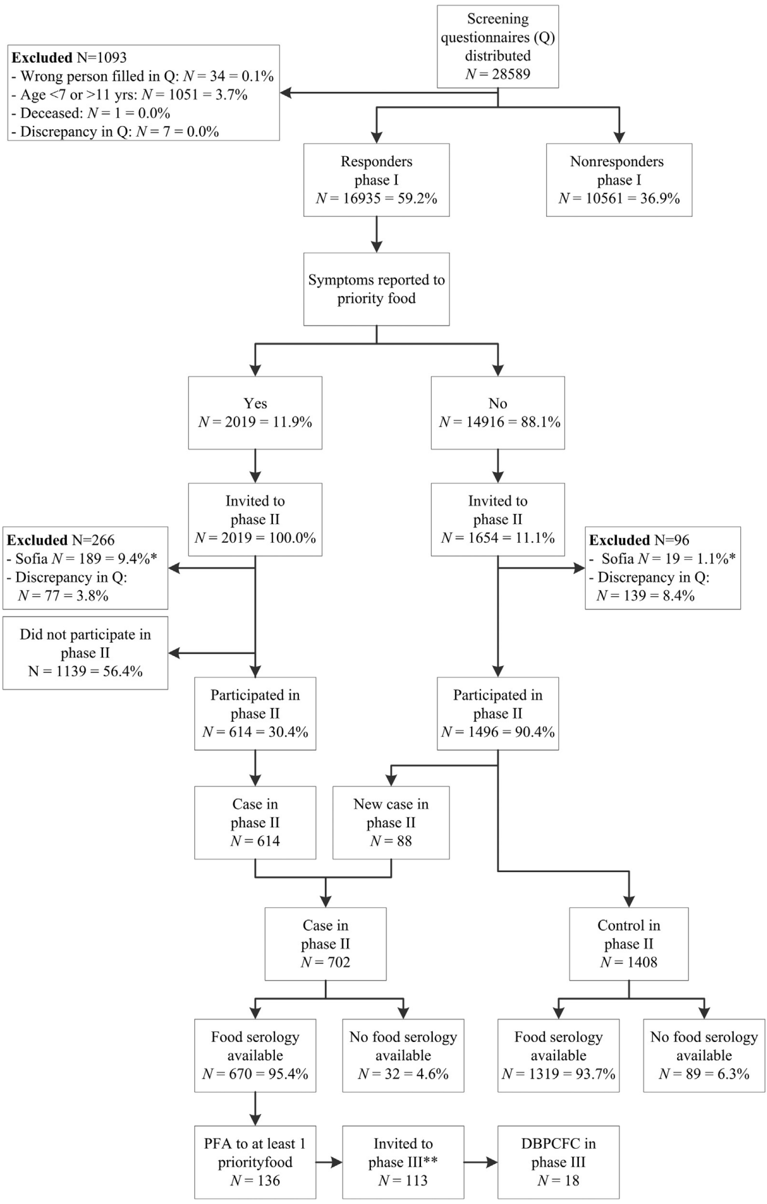
FIGURE 1 Flowchart. Case: subject self-reporting symptoms to at least 1 priority food; Control: subject not reporting symptoms to any priority food; New case: subjects who reported symptoms to priority foods in phase II, but symptoms to only nonpriority foods in phase I, most likely due to the maximum of 3 foods that could be reported in phase I (see ' Food Allergy Screening Questionnaire for Children ' in this article ' s Online Repository). *Sofia was excluded from calculation of probable FA prevalence because of lack of cases participating in phase I. **Probable FA to cow ' s milk, hen ' s egg, fish, shrimp, peanut, hazelnut, apple, peach, or celery . PFA , Probable food allergy .
FIGURE 1 Flowchart. Case: subject self-reporting symptoms to at least 1 priority food; Control: subject not reporting symptoms to any priority food; New case: subjects who reported symptoms to priority foods in phase II, but symptoms to only nonpriority foods in phase I, most likely due to the maximum of 3 foods that could be reported in phase I (see ' Food Allergy Screening Questionnaire for Children ' in this article ' s Online Repository). *Sofia was excluded from calculation of probable FA prevalence because of lack of cases participating in phase I. **Probable FA to cow ' s milk, hen ' s egg, fish, shrimp, peanut, hazelnut, apple, peach, or celery . PFA , Probable food allergy .CC-BY-NC-ND · From the PDF
Image 2
CC-BY-NC-ND · From the PDF
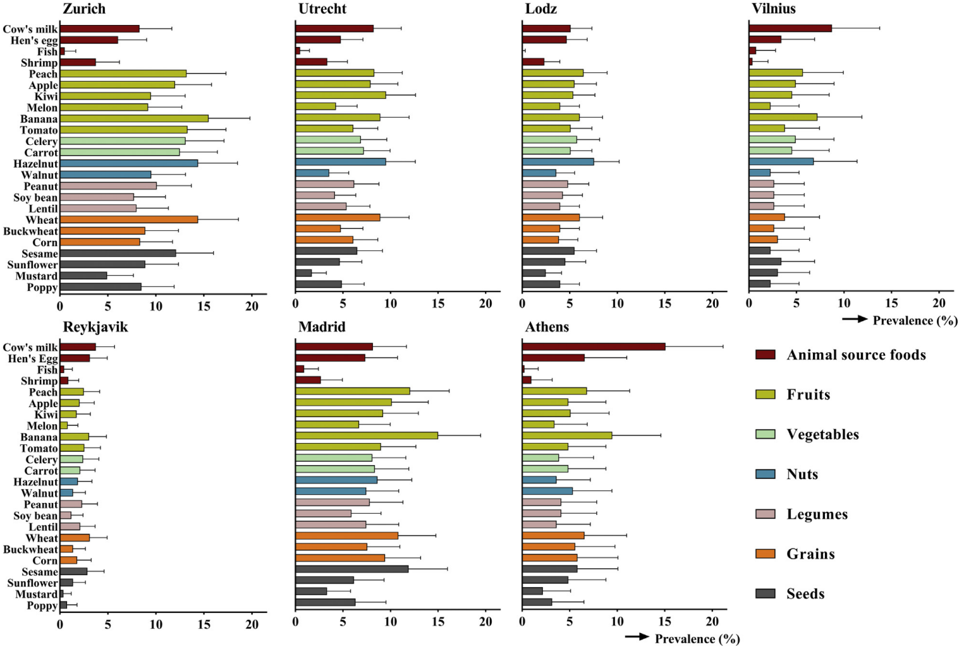
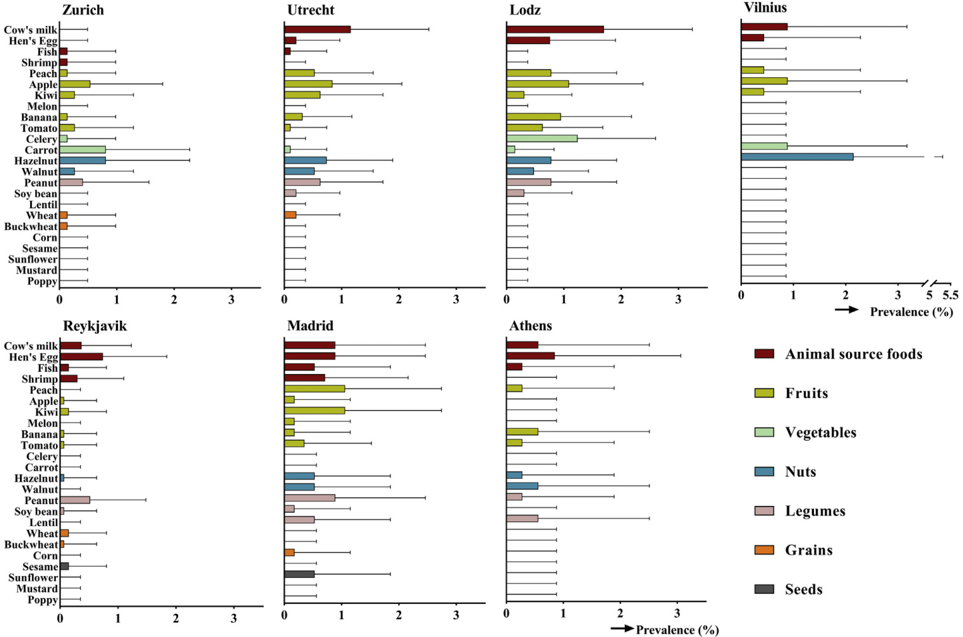
FIGURE 3 FS across Europe. This figure displays the prevalence of FS for each priority food in each center, and the upper limit of the 95% CIs. For numeric prevalence estimates of FS, view T able E1 in this article's Online Repository at www.jaci-inpractice.org. Foods are sorted according to food group. The birch-endemic centers are displayed in the top row.
FIGURE 3 FS across Europe. This figure displays the prevalence of FS for each priority food in each center, and the upper limit of the 95% CIs. For numeric prevalence estimates of FS, view T able E1 in this article's Online Repository at www.jaci-inpractice.org. Foods are sorted according to food group. The birch-endemic centers are displayed in the top row.CC-BY-NC-ND · From the PDF
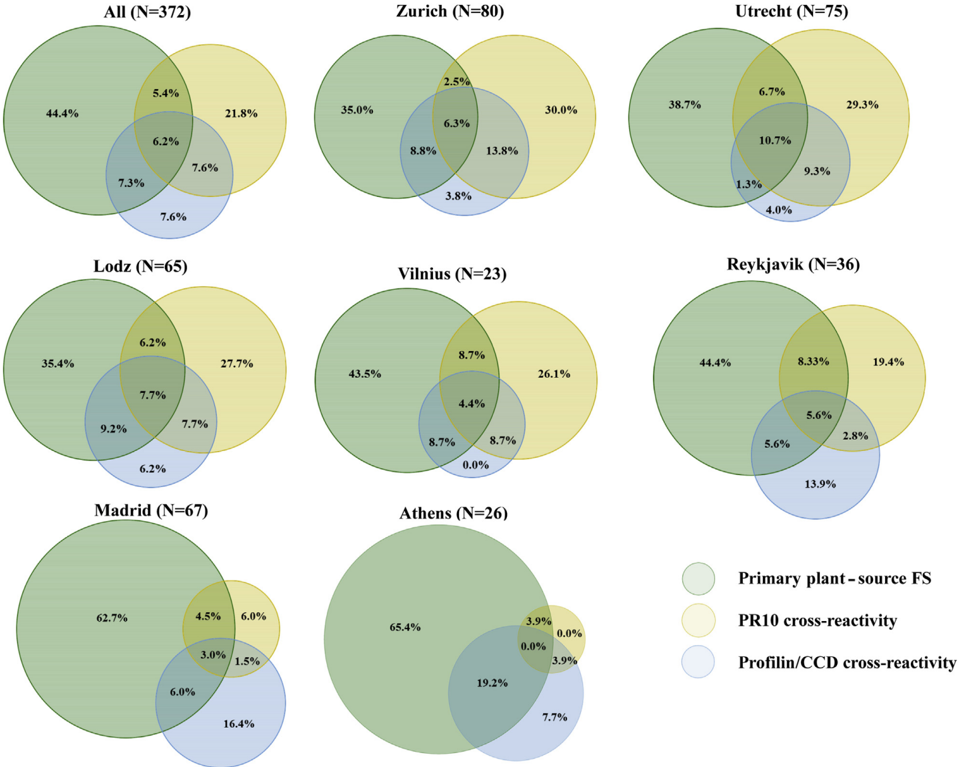
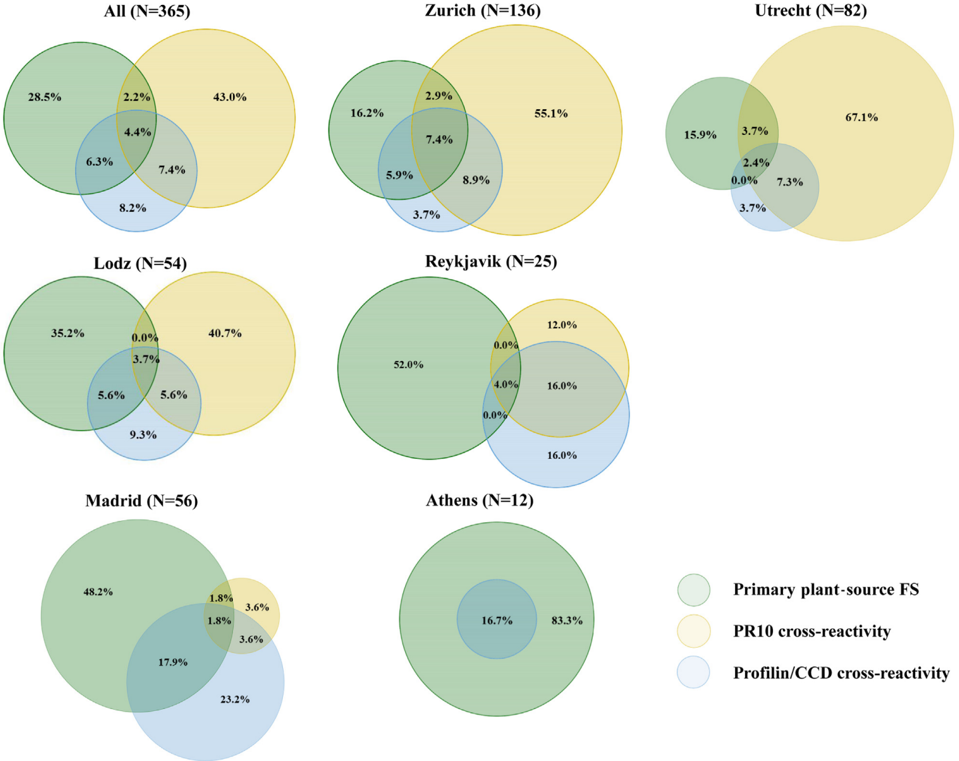
FIGURE 4 Plant-source FS: primary sensitization and cross-reactivity in children. For classification of primary sensitization, PR-10, CCD, and profilin cross-reactivity , view Figure E1. Only subjects with sensitization to plant-source foods are included in this figure.
FIGURE 4 Plant-source FS: primary sensitization and cross-reactivity in children. For classification of primary sensitization, PR-10, CCD, and profilin cross-reactivity , view Figure E1. Only subjects with sensitization to plant-source foods are included in this figure.CC-BY-NC-ND · From the PDF
FIGURE 5 Probable FA across Europe. This figure displays the prevalence of probable FA for each priority food in each center, and the upper limit of the 95%CIs. For numeric prevalence estimates of probable FA, view T able E3 in this article ' s Online Repository at www.jaciinpractice.org. Foods are sorted according to food group. The birch endemic centers are displayed in the top row.
FIGURE 5 Probable FA across Europe. This figure displays the prevalence of probable FA for each priority food in each center, and the upper limit of the 95%CIs. For numeric prevalence estimates of probable FA, view T able E3 in this article ' s Online Repository at www.jaciinpractice.org. Foods are sorted according to food group. The birch endemic centers are displayed in the top row.CC-BY-NC-ND · From the PDF
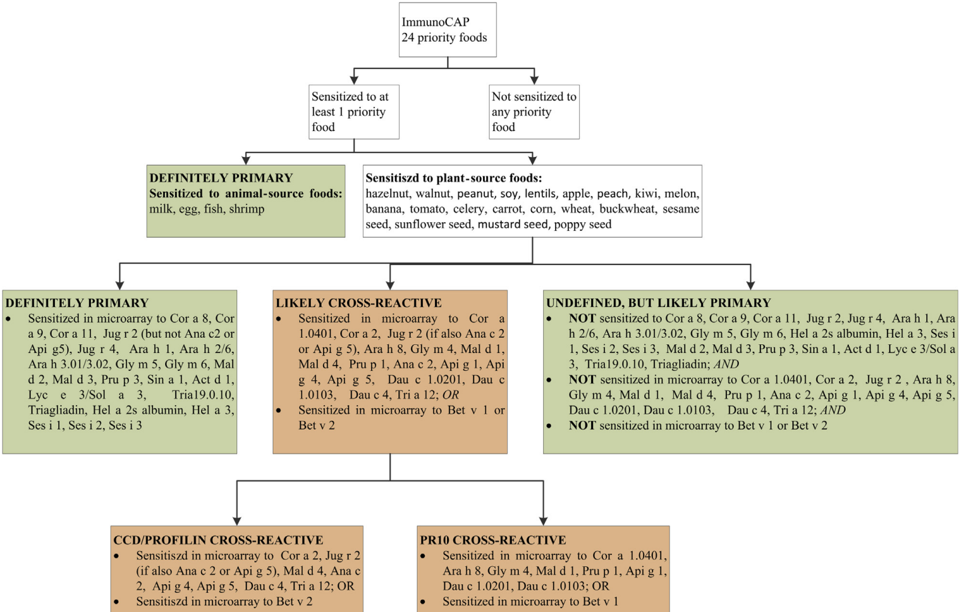
FIGURE E1. Classification of FS into primary sensitization and cross-reactive sensitization. Subjects were classified into 1 or more of the boxes depending on their sensitization patterns (ie, subjects could have both primary and cross-reactive sensitization). This is a simplified classification, designed for exploratory purposes, and subjects with cross-reactive sensitization through food rather than pollen, or with cross-reactive sensitization to tropomyosins (eg, shrimp through house-dust mite), have been classified as primary sensitization. However, aforementioned cross-reactivity patterns are much less common than pollen-related cross-reactivity , and are expected to have only limited influence on the prevalence estimates of primary FS. Green: Primary sensitization ( ¼ definite, or undefined but likely primary sensitization). Orange: cross-reactive sensitization.
FIGURE E1. Classification of FS into primary sensitization and cross-reactive sensitization. Subjects were classified into 1 or more of the boxes depending on their sensitization patterns (ie, subjects could have both primary and cross-reactive sensitization). This is a simplified classification, designed for exploratory purposes, and subjects with cross-reactive sensitization through food rather than pollen, or with cross-reactive sensitization to tropomyosins (eg, shrimp through house-dust mite), have been classified as primary sensitization. However, aforementioned cross-reactivity patterns are much less common than pollen-related cross-reactivity , and are expected to have only limited influence on the prevalence estimates of primary FS. Green: Primary sensitization ( ¼ definite, or undefined but likely primary sensitization). Orange: cross-reactive sensitization.CC-BY-NC-ND · From the PDF
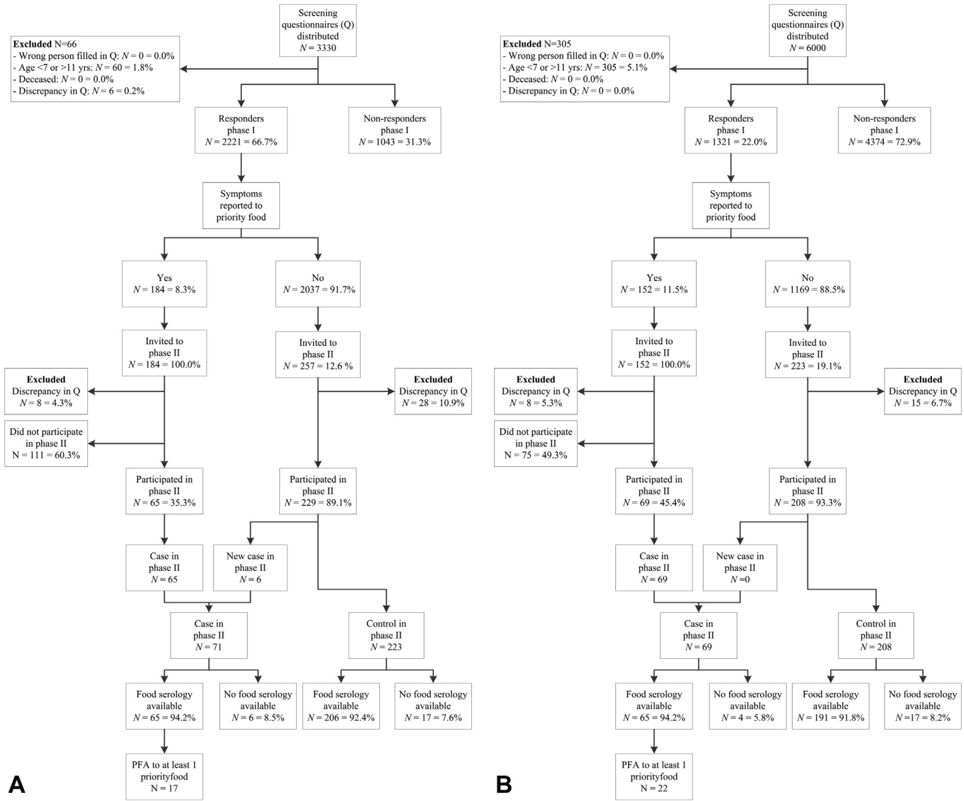
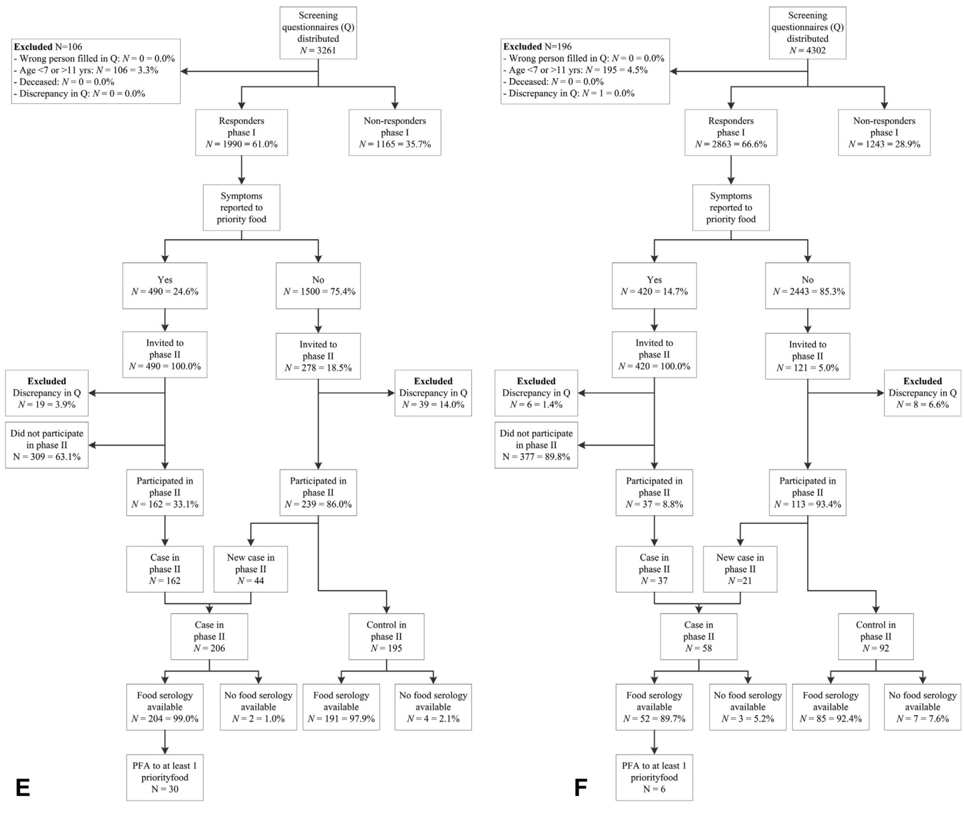
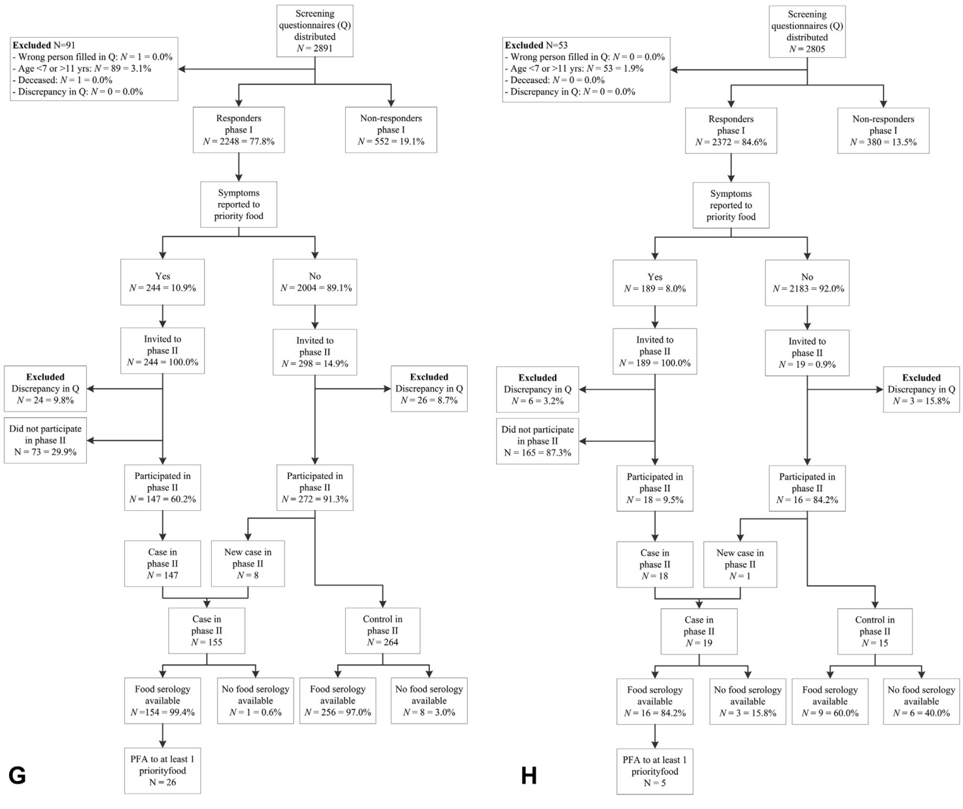
FIGURE E2. Flowcharts for (A) Zurich, ( B ) Madrid, ( C ) Athens, ( D ) Utrecht, ( E ) Lodz, ( F ) Vilnius, ( G ) Reykjavik, and ( H ) Sofia. Case: subject self-reporting symptoms to at least 1 priority food; Control: subject not reporting symptoms to any priority food; New case: subjects who reported symptoms to priority foods in phase II, but symptoms only to nonpriority foods in phase I, most likely due to the maximum of 3 foods that could be reported in phase I (see ' Food Allergy Screening Questionnaire for Children ' in this article ' s Online Repository at www.jaci-inpractice.org.). PFA , Probable food allergy.
FIGURE E2. Flowcharts for (A) Zurich, ( B ) Madrid, ( C ) Athens, ( D ) Utrecht, ( E ) Lodz, ( F ) Vilnius, ( G ) Reykjavik, and ( H ) Sofia. Case: subject self-reporting symptoms to at least 1 priority food; Control: subject not reporting symptoms to any priority food; New case: subjects who reported symptoms to priority foods in phase II, but symptoms only to nonpriority foods in phase I, most likely due to the maximum of 3 foods that could be reported in phase I (see ' Food Allergy Screening Questionnaire for Children ' in this article ' s Online Repository at www.jaci-inpractice.org.). PFA , Probable food allergy.CC-BY-NC-ND · From the PDF
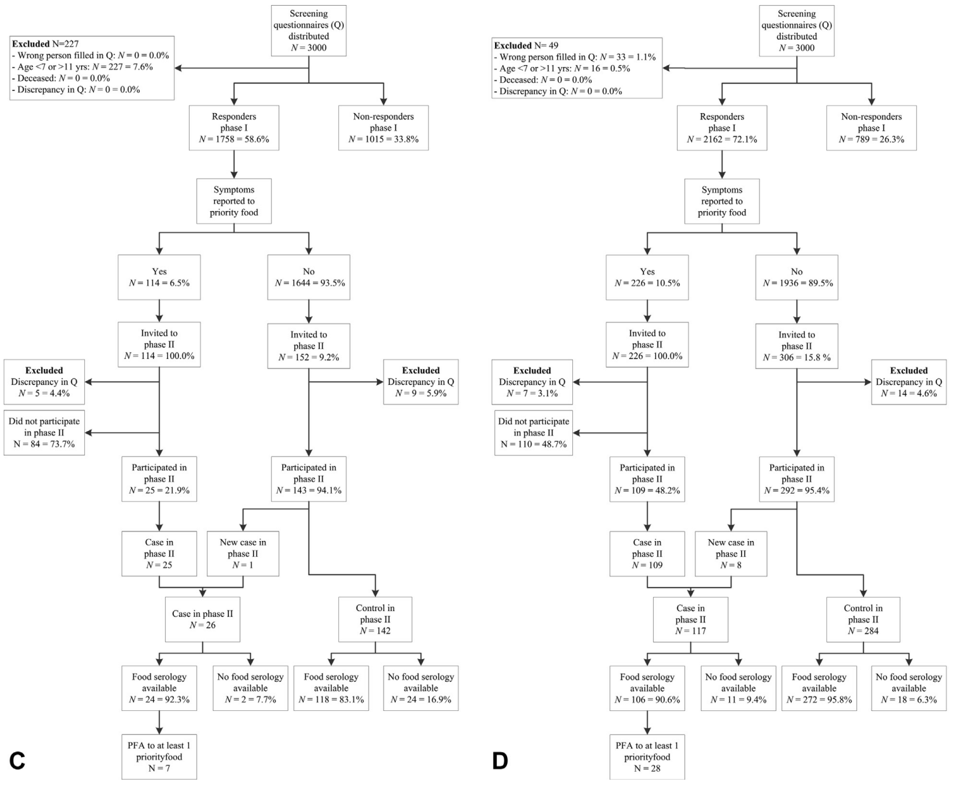
FIGURE E2. ( CONTINUED ).
FIGURE E2. ( CONTINUED ).CC-BY-NC-ND · From the PDF
FIGURE E2. ( CONTINUED ).
FIGURE E2. ( CONTINUED ).CC-BY-NC-ND · From the PDF
FIGURE E2. ( CONTINUED ).
FIGURE E2. ( CONTINUED ).CC-BY-NC-ND · From the PDF
FIGURE E3. Plant FS: primary sensitization and cross-reactivity in adults. For classification of primary sensitization, PR-10, CCD, and profilin cross-reactivity , view Figure E1.
FIGURE E3. Plant FS: primary sensitization and cross-reactivity in adults. For classification of primary sensitization, PR-10, CCD, and profilin cross-reactivity , view Figure E1.CC-BY-NC-ND · From the PDF

Verification

Claims the paper makes

The claims and statistics of this paper haven’t been checked yet.

Run the check — free, no account needed. It reads the open-access text and checks the sources it cites.

A few free checks a day · papers already verified open instantly · results are public

Claims other papers make about this one

Each is checked against this paper’s own text: does it say what the citing paper says it does?

Self-check

Percentages, sums and reported differences re-computed from the paper’s own numbers.

The self-check needs the paper’s full text.

Citations

Cites

No references could be resolved yet.

Research works printed but not linked: 22

  1. Nwaru, 2014, The epidemiology of food allergy in Europe: a systematic review and meta-analysis, Allergy, 69, 62, 10.1111/all.12305 · DOI
  2. Muraro, 2014, EAACI food allergy and anaphylaxis guidelines: diagnosis and management of food allergy, Allergy, 69, 1008, 10.1111/all.12429 · DOI · Paper page
  3. Roehr, 2004, Food allergy and non-allergic food hypersensitivity in children and adolescents, Clin Exp Allergy, 34, 1534, 10.1111/j.1365-2222.2004.02080.x · DOI
  4. Burney, 2014, The prevalence and distribution of food sensitization in European adults, Allergy, 69, 365, 10.1111/all.12341 · DOI
  5. Lyons, 2019, Food allergy in adults: substantial variation in prevalence and causative foods across Europe, J Allergy Clin Immunol Pract, 7, 1920, 10.1016/j.jaip.2019.02.044 · DOI · Paper page
  6. Kummeling, 2009, The EuroPrevall surveys on the prevalence of food allergies in children and adults: background and study methodology, Allergy, 64, 1493, 10.1111/j.1398-9995.2009.02046.x · DOI
  7. Fernandez-Rivas, 2015, The EuroPrevall outpatient clinic study on food allergy: background and methodology, Allergy, 70, 576, 10.1111/all.12585 · DOI
  8. Amlot, 1987, Oral allergy syndrome (OAS): symptoms of IgE-mediated hypersensitivity to foods, Clin Allergy, 17, 33, 10.1111/j.1365-2222.1987.tb02317.x · DOI
  9. Turner, 2016, Can we identify patients at risk of life-threatening allergic reactions to food?, Allergy, 71, 1241, 10.1111/all.12924 · DOI
  10. Steinke, 2007, Perceived food allergy in children in 10 European nations: a randomised telephone survey, Int Arch Allergy Immunol, 143, 290, 10.1159/000100575 · DOI
  11. Maintz, 2007, Histamine and histamine intolerance, Am J Clin Nutr, 85, 1185, 10.1093/ajcn/85.5.1185 · DOI
  12. Werfel, 2015, Position paper of the EAACI: food allergy due to immunological cross-reactions with common inhalant allergens, Allergy, 70, 1079, 10.1111/all.12666 · DOI · Paper page
  13. Hofmann, 2008, Pollen food syndrome: update on the allergens, Curr Allergy Asthma Rep, 8, 413, 10.1007/s11882-008-0080-0 · DOI
  14. Wensing, 2002, IgE to Bet v 1 and profilin: cross-reactivity patterns and clinical relevance, J Allergy Clin Immunol, 110, 435, 10.1067/mai.2002.126380 · DOI
  15. Hauser, 2010, Panallergens and their impact on the allergic patient, Allergy Asthma Clin Immunol, 6, 1, 10.1186/1710-1492-6-1 · DOI · Paper page
  16. McKenna, 2016, How relevant is panallergen sensitization in the development of allergies?, Pediatr Allergy Immunol, 27, 560, 10.1111/pai.12589 · DOI
  17. Allen, 2012, The epidemiology of IgE-mediated food allergy and anaphylaxis, Immunol Allergy Clin North Am, 32, 35, 10.1016/j.iac.2011.11.008 · DOI
  18. Ronmark, 2009, Major increase in allergic sensitization in schoolchildren from 1996 to 2006 in northern Sweden, J Allergy Clin Immunol, 124, 357, 10.1016/j.jaci.2009.05.011 · DOI
  19. Koet, 2018, Increase in atopic sensitization rate among Dutch children with symptoms of allergic disease between 1994 and 2014, Pediatr Allergy Immunol, 29, 78, 10.1111/pai.12825 · DOI
  20. Venkataraman, 2018, Prevalence and longitudinal trends of food allergy during childhood and adolescence: results of the Isle of Wight Birth Cohort study, Clin Exp Allergy, 48, 394, 10.1111/cea.13088 · DOI
  21. Santos, 2011, Profilins: mimickers of allergy or relevant allergens?, Int Arch Allergy Immunol, 155, 191, 10.1159/000321178 · DOI
  22. Rodriguez Del Rio, 2018, Profilin, a change in the paradigm, J Investig Allergol Clin Immunol, 28, 1, 10.18176/jiaci.0193 · DOI

Cited by

Sorted by citations

Metadata

Authors
Lyons, S. A., Clausen, M., Knulst, A. C., Ballmer-Weber, B. K., Fernandez-Rivas, M., Barreales, L., Bieli, C., Dubakiene, R., Fernandez-Perez, C., Jedrzejczak-Czechowicz, M., Kowalski, M. L., Kralimarkova, T., Kummeling, I., Mustakov, T. B., Papadopoulos, N. G., Popov, T. A., Xepapadaki, P., Welsing, P. M. J., Potts, J., Mills, E. N. C., van Ree, R., Burney, P. G. J., & Le, T.-M.
Venue
The Journal of Allergy and Clinical Immunology: In Practice
Publisher
Elsevier BV
Published
2020-09
Volume
8
Issue
8
Pages
2736-2746.e9
ISSN
2213-2198
Cited by
202
References
0
Language
en
Funders
  • Meso Scale Diagnostics
  • Boehringer Ingelheim
  • Novartis Pharma
  • AstraZeneca
  • European Commission (FP6-FOOD-CT-2005-514000)
  • Sanofi
  • Novartis

About these checks

Registry, retraction, Cites and statistics results are computed, not judged, with one exception: a printed reference that no index lists is read once by a model before it counts as a citation error. Claims are extracted by a model and kept only when their quote appears verbatim in the text; each cited source is then checked, with a model’s help, for whether it says what the claim relies on. Those verdicts can be wrong — read the claim’s quote and the cited source before relying on one.

Statistics and arithmetic are recomputed, not judged.

Confidence bands are shown only for fields calibrated on our annotated test set. None is calibrated yet, so no band is shown.

What counts as a claim ›How we measure confidence ›How we check this ›

Are you an author, or do you see a problem with this page? Request a review